AI Answer Engines Cite Sources That Are Relevant, Retrievable, Reliable and Easy to Attribute
A source becomes citation-worthy to an AI answer engine when it is technically accessible, highly relevant to the user’s information need, credible enough to support a claim, and structured so the system can extract and attribute specific evidence without ambiguity. Citation-worthiness is therefore not one ranking factor or one score. It is the outcome of a chain: discovery, retrieval, reranking, evidence selection, generation and citation.
The strongest current evidence puts topical relevance at the centre. An ACM SIGIR 2026 study ran 252,000 controlled trials across six language models and 18 content factors; topical relevance and source position were the largest drivers of being cited first, while recent timestamps and explicit, decision-useful information also helped. Formatting-only changes had limited impact. Google’s July 2026 guidance independently says its generative Search features use retrieval-augmented generation and query fan-out to retrieve relevant, up-to-date pages, and stresses unique, useful, non-commodity content rather than AI-specific formatting tricks.
Editorial definition: “Citation-worthy” is useful shorthand in this article, not a standardized score published by Google, OpenAI, Anthropic, Microsoft or Perplexity. A page can be excellent and still not be cited for a particular prompt because source selection is query-specific, competitive and stochastic.
NeuralAdX Ltd Editorial · Last reviewed 20 August 2026 · Evidence cutoff 20 August 2026 · Generative Engine Optimisation is treated as the parent specialist discipline throughout.
TL;DR: What Makes a Source Citation-Worthy?
1
Exact relevance
The page directly satisfies the prompt or one of its fan-out sub-questions, with minimal topical drift.
2
Retrieval eligibility
The page can be crawled, indexed or otherwise fetched by the platform and exposes important content in accessible text.
3
Evidence quality
Claims are specific, attributable, internally consistent and backed by reliable sources or first-party evidence.
4
Extractability
Definitions, statistics, comparisons, procedures and evidence sit close to the claims they support.
5
Source preference
Among retrieved candidates, the page offers more useful, current or complete support than competing sources.
6
Repeatable performance
Citation-worthiness is validated across repeated runs, paraphrases, platforms and time rather than one favourable answer.
Table of Contents
Swipe horizontally on mobile →
What Does “Citation-Worthy” Mean in Generative Engine Optimisation?
In Generative Engine Optimisation, a citation-worthy source is a page, document or dataset that an AI answer engine can find, retrieve, trust sufficiently, use for a specific claim and attribute as supporting evidence. The word “worthy” should not be read as a moral judgment or permanent quality label. It is relational: a source can be highly citation-worthy for one question and irrelevant for another.
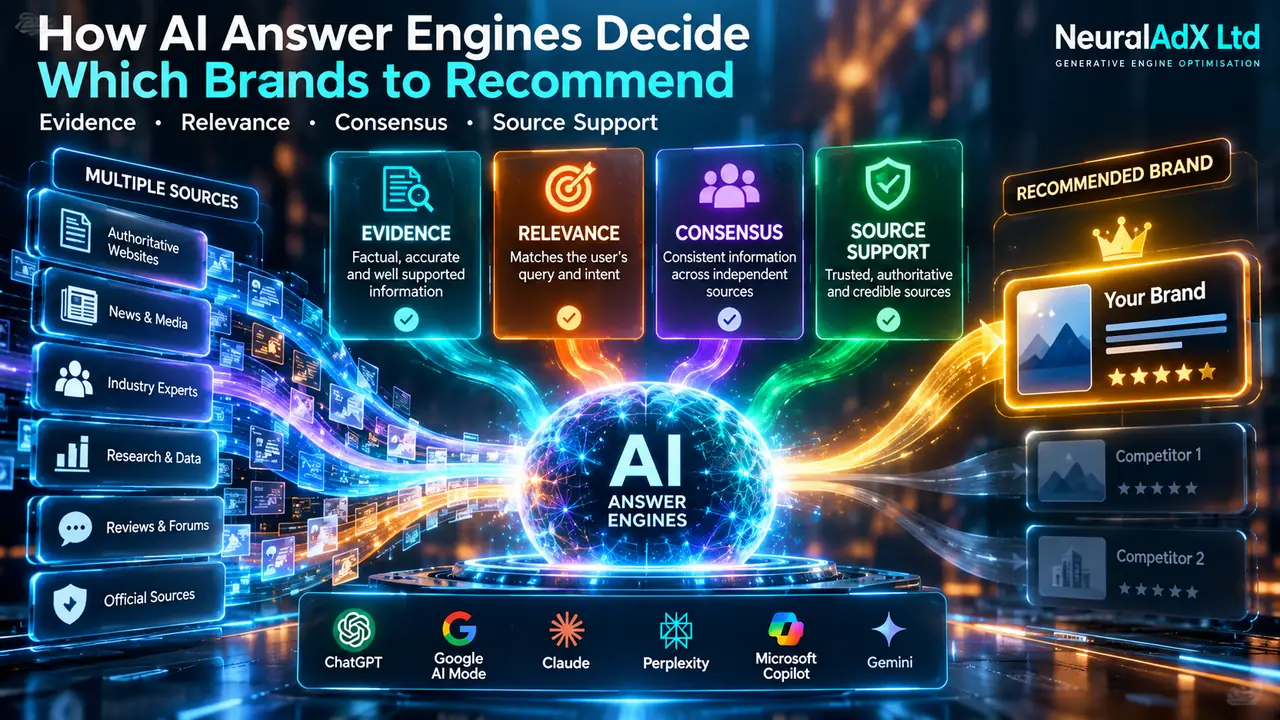
This distinction matters because AI search is not a single ranking list. Google publicly describes AI Mode and AI Overviews as using retrieval-augmented generation and query fan-out. Microsoft Copilot can derive short Bing queries from a user prompt. Claude says web search processes multiple sources to find relevant content, while Perplexity describes its answers as backed by verifiable sources. In all of these cases, citation is downstream of retrieval and generation—not a standalone page property.
Citation-worthiness is not the same as authority
Authority can raise confidence, but relevance is a gatekeeper. A prestigious source that does not answer the actual information need may be less useful than a narrower source that does. The 2026 competitive citation study found topical relevance to be one of the two strongest drivers tested; a 2025 EMNLP paper on reliability-aware RAG likewise argues that relevance alone is insufficient when source reliability varies. The practical target is therefore reliable relevance: evidence that is both on-point and trustworthy.
The Citation-Worthiness Pipeline: Seven Gates a Source Must Survive
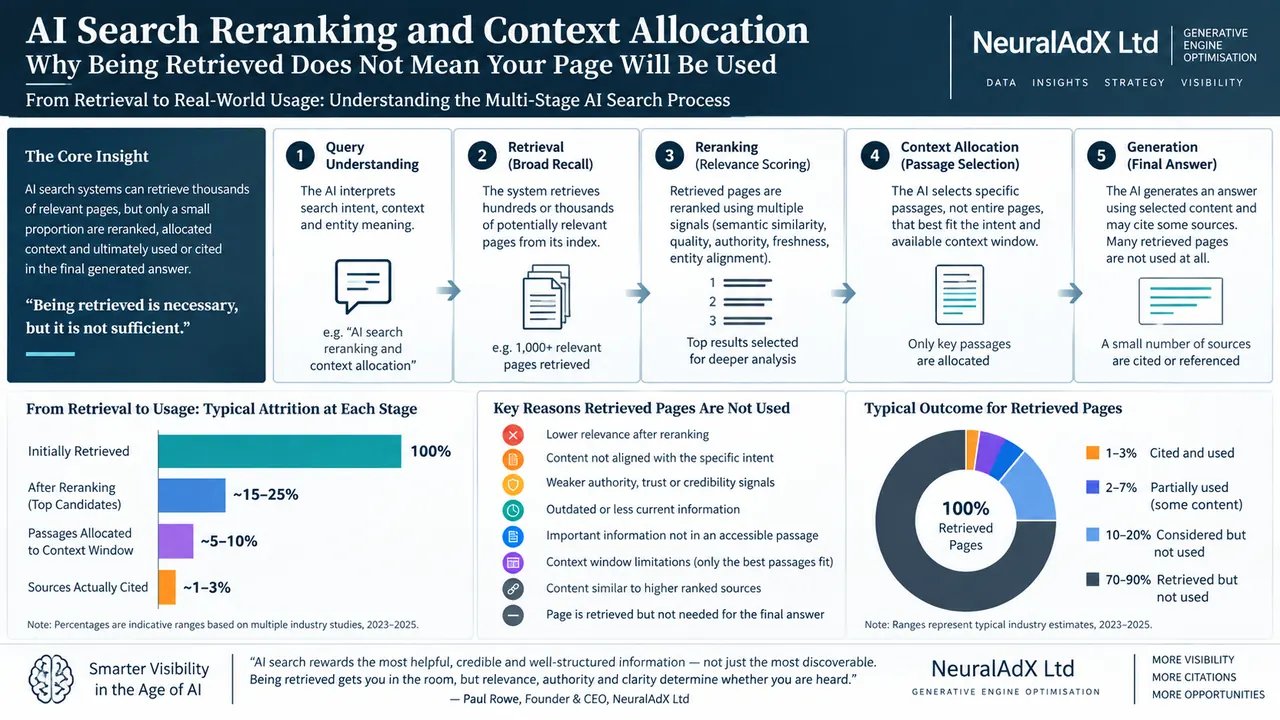
The most defensible model is a sequence of gates. A page cannot be cited from live web retrieval if the system cannot access it; access does not guarantee retrieval; retrieval does not guarantee selection into context; and being cited does not prove that the source materially shaped the answer. A July 2026 critical survey of 45 GEO studies describes generative visibility as a stochastic, partially observable pipeline rather than a single rank.
Mobile users: scroll horizontally to view the complete citation-worthiness pipeline.
What the Strongest 2026 Research Says About Citation Selection
The most directly relevant controlled evidence available as of August 2026 is What Gets Cited: Competitive GEO in AI Answer Engines, published in the ACM SIGIR 2026 proceedings. The researchers constructed paired source variants that differed in one factor at a time, anonymised brands, counterbalanced source order and ran repeated trials across six LLMs. That design matters because observational web data can confuse correlation with causation.
controlled citation trials
Six LLMs; repeated paired comparisons.
content factors
Content match, completeness, trust, readability, freshness and more.
language models
Cross-model test rather than a single-engine result.
changed per pair
Designed to isolate causal content effects.
The hierarchy was clear: topical relevance and list position were the strongest drivers of first citation. Explicit price information and a recent timestamp helped consistently. Completeness and trust cues produced smaller gains. Formatting-only edits had little impact. That does not mean formatting is useless—good structure can still help users and extraction—but it is evidence against treating cosmetic “AI formatting” as a primary citation lever.
Why this does not prove a universal formula
The study deliberately constrained the environment to two retrieved sources and anonymised brand familiarity. That makes it strong for isolating content-level effects but weaker as a full model of live web search, where crawling, domain familiarity, link graphs, index freshness, query expansion and platform-specific retrieval systems also intervene. A world-class citation strategy should use the result as a priority signal, not as a universal weighting formula.
1. Semantic Relevance Is the First Content-Level Test of Citation-Worthiness
A source is most citation-worthy when its primary content directly answers the exact claim the engine needs to support. This is semantic relevance: a close match between the meaning of the prompt or sub-query and the meaning of the passage. Exact keyword repetition is not the goal. Google explicitly says its systems can understand synonyms and general meanings, and its July 2026 guide warns against creating separate pages for every possible query variation merely to manipulate AI search.
Query fan-out raises the standard. One user prompt can trigger several related searches, so a page may earn a citation by answering a narrower sub-question rather than the literal surface wording of the original prompt. Citation-ready content therefore benefits from generative answer coverage: covering the material sub-questions needed to answer the core topic, while keeping every section tightly within the same intent.
What high semantic relevance looks like
- The first sentence answers the likely question directly, before background or qualification.
- Each H2 addresses one material sub-question that helps resolve the page’s central intent.
- Definitions use the same entities and relationships the reader is trying to understand.
- Examples, statistics and citations support the same topic rather than introducing adjacent subjects.
- Commercial claims are specific enough to be compared and checked rather than written as vague superlatives.
2. A Source Cannot Be Citation-Worthy if the Engine Cannot Reliably Access It
Technical accessibility is a gate, not a guarantee. Google states that a page must be indexed and eligible to appear with a Search snippet to be eligible as a supporting link in AI Overviews or AI Mode. OpenAI’s current publisher guidance says public sites can appear in ChatGPT search and advises publishers not to block OAI-SearchBot if they want content included in summaries and snippets. These are platform-specific rules, but the common principle is simple: important evidence must be retrievable.
Technical signals that support citation eligibility
3. Citation-Worthy Sources Make Important Claims Verifiable
AI answer engines need evidence that can support the sentence they are generating. That favours pages where important claims are explicit, scoped and verifiable. A source saying “this method works” is weaker than a source stating what was tested, when, how often, against what comparison and with what result. The issue is not simply adding citations; it is reducing uncertainty about what each citation proves.
This is where source reliability matters. A 2025 EMNLP paper on reliability-aware RAG argues that relevance-only retrieval can surface incorrect information when sources vary in reliability, and proposes cross-source reliability estimation. Google’s people-first guidance similarly asks whether content provides original reporting, research or analysis, whether it is comprehensive, and whether readers can understand who created it and why they should trust it.
Source quality and claim support are related problems, not the same problem.
A May 2026 longitudinal study of Google AI Overviews issued 55,393 trending queries across 19 topical categories over 40 days and decomposed responses into 98,020 atomic claims. It found that 11.0% of claims were unsupported by the cited pages, with omission the dominant failure mode, and reported that source quality and claim fidelity were largely independent. For publishers, the implication is precise: becoming citation-worthy should include making the exact claim easy to verify, not merely making the domain look credible.
Evidence patterns that are easy to cite accurately
Mobile users: scroll horizontally to view the complete table.
| Evidence pattern | Why it is citation-ready | Weak alternative |
|---|---|---|
| Dated statistic with scope | The claim has a number, population or dataset, time window and source. | “Most users prefer this.” |
| Named primary source | The reader and model can identify where the fact originated. | A chain of unattributed secondary summaries. |
| Method + result together | The claim can be interpreted without guessing how the result was produced. | A headline result with no methodology. |
| Claim-adjacent citation | Evidence sits immediately after the sentence it supports, reducing attribution ambiguity. | A long reference list detached from specific claims. |
| First-party proof with limitations | Original data adds information that cannot be copied from generic consensus pages. | Promotional claims presented as evidence. |
| Cross-source corroboration | Independent reliable sources reduce dependence on one potentially flawed record. | Multiple websites repeating the same unsourced claim. |
4. Being Cited Is Not the Same as Being Absorbed Into the Answer
A crucial 2026 development is the distinction between citation selection and citation absorption. A source can appear in the references yet contribute little to the wording, facts or structure of the final answer. Conversely, a source with deep influence may supply several answer elements. This is why citation count alone is an incomplete measure of source value.
A 2026 measurement framework analysed 602 controlled prompts, 21,143 valid search-layer citations, 23,745 citation-level feature records and 18,151 fetched pages with 72 extracted features. Its central descriptive finding was that citation breadth and citation depth diverge. High-influence pages tended to be more semantically aligned, structured and rich in extractable evidence such as definitions, numbers, comparisons and procedural steps.
controlled prompts
valid search-layer citations
fetched pages
features extracted per citation record
How to increase the chance of clean absorption and fidelity
No publisher can guarantee full citation absorption or perfect fidelity. The defensible goal is to make supported claims hard to misinterpret: define terms before using them, keep numbers beside their units and dates, place source links beside the supported claim, separate observed results from interpretation, and state limitations explicitly. These practices reduce the amount of inference the model must perform when turning source material into an answer.
5. Freshness Helps When the Question Is Time-Sensitive, but Recency Is Not a Substitute for Relevance
Freshness matters most when facts can change. In the 2026 controlled citation study, a recent timestamp helped consistently against older or undated alternatives. Google’s generative Search documentation also frames RAG as a way to retrieve relevant, up-to-date pages. Perplexity explicitly says web content is sourced in real time for current information. But a newly dated page is not automatically citation-worthy if its substance is stale or weak.
Use recency honestly
Update a publication or review date when material facts, evidence, methodology or recommendations have actually been reviewed. Google’s people-first guidance warns against changing dates merely to make content seem fresh. For citation readiness, a trustworthy date should tell the engine and the reader when the underlying evidence was last verified—not act as decoration.
6. Structure Helps Extraction, but “AI Formatting” Is Not a Citation Shortcut
Clear headings, concise definitions, tables and claim-adjacent evidence are useful because they improve human comprehension and can make evidence easier to locate. But current evidence does not justify a simplistic rule such as “short chunks get cited” or “schema causes AI citations.” Google’s July 2026 guide explicitly says there is no requirement to break content into tiny pieces for AI understanding and no special schema.org markup is required for generative Search.
That aligns with the SIGIR 2026 result that formatting-only changes had limited impact in controlled citation competition. Structured data remains useful for helping search systems understand eligible entities and for rich results, but it should accurately match visible page content and should not be presented as a guaranteed citation lever.
Useful rule: structure the page so a human can identify the answer, evidence and qualification quickly. Do not contort the page into artificial micro-chunks purely for an assumed AI parser.
7. Traditional Search Rank Helps Discovery, but It Does Not Fully Explain AI Citations
Traditional search visibility still matters because AI systems often retrieve from search indexes, but live citation selection is not simply “cite the top organic result.” Ahrefs updated its analysis in March 2026 using 863,000 keyword SERPs and 4 million AI Overview URLs. For standard blue-link rankings, only 37.1% of cited URLs ranked in the organic top 10; 26.2% ranked 11–100; and 36.7% did not rank in the top 100 for the same query.
Mobile users: scroll horizontally to view the complete bar chart.
Organic top 10
Top 10
Positions 11–100
11–100
Outside top 100
>100
The sensible interpretation is not that SEO ranking is irrelevant. It is that AI citation selection can draw from a broader retrieval set—including fan-out query results and other result types—so citation-worthiness requires both discoverability and strong evidence-level fit. This is also why platform-specific citation audits can diverge from ordinary SERP tracking.
8. A Citation Can Be Valuable Even When the Brand Is Not Named
Citation-worthiness and brand visibility are related but different. Semrush and Growth Memo analysed 3,981 domain appearances across 115 prompts, 14 countries and four AI search engines. Of those appearances, 61.7% were citations without a brand mention, 13.2% were both cited and mentioned, and 25.1% were mentions without a citation. In other words, a source can win attribution while the brand remains absent from the prose.
Mobile users: scroll horizontally to view the complete stacked bar chart.
For GEO measurement, this means a citation benchmark and an answer-visibility benchmark should not be treated as interchangeable. Citation tracking measures source attribution; mention tracking measures whether the brand appears in the generated answer. Both are useful, but they answer different questions.
How Major AI Answer Engines Publicly Describe Their Use of Web Sources
No major platform publishes a complete citation-ranking formula. The safest editorial approach is to use what each platform actually documents and avoid inventing universal ranking factors. The table below summarises public source behaviour that is directly relevant to citation eligibility and source use.
Mobile users: scroll horizontally to view the complete table.
| Platform | What its public documentation says | Citation-readiness implication |
|---|---|---|
| Google AI Overviews / AI Mode | Uses core Search ranking and quality systems, RAG and query fan-out; supporting links require Search eligibility and snippet eligibility. Google Search Central · Jul 2026 | Strong Search fundamentals, relevant non-commodity content, crawlability and accessible text are foundational. Special “AI markup” is not required. |
| ChatGPT search | Public websites can appear; OpenAI advises allowing OAI-SearchBot for inclusion in summaries/snippets and describes ChatGPT search as linking to relevant web sources and original, high-quality content. OpenAI publisher guidance | Do not accidentally block search access; publish original, sourceable material that can stand on its own. |
| Claude web search | Claude uses live web search to ground responses, processes multiple sources and includes direct citations/source links. Anthropic web search guidance | Relevance and source quality matter in a multi-source synthesis environment; corroboration can be valuable. |
| Microsoft Copilot | Copilot can derive short search queries from the user prompt and send them to Bing; web results are then used to ground the response. Microsoft Learn · 18 Aug 2026 | Pages may need to match reformulated queries rather than only the exact surface prompt; Bing discoverability matters. |
| Perplexity | Describes answers as backed by verifiable sources, synthesised from multiple sources, with current web information and citations. Perplexity Help Center · May 2026 | Clear, current, reputable, directly supporting source material is aligned with the product’s stated design. |
For a platform-specific application of these principles, Canlah AI’s guide to getting cited by Perplexity explains how brands can structure and strengthen content specifically for citation within Perplexity’s answer environment.
Current platform guidance, in its own words
Google: “Don’t just recycle what others on the internet have already said.”
OpenAI: “Any public website can appear in ChatGPT search.”
Anthropic: “Claude processes multiple sources to find relevant content.”
Microsoft: “This generated search query is different from the user’s original prompt.”
Perplexity describes its answers as “backed by verifiable sources.”
Neutrality note: these statements describe public product documentation, not undisclosed source-ranking weights. Platform behaviour can change, vary by product surface and depend on whether live web search is activated.
What Makes a Source Less Citation-Worthy?
The negative case is often easier to diagnose. A page becomes less useful as a citation source when the engine would need to infer what the author means, reconcile contradictions, guess the source of a statistic or separate marketing claims from evidence. Current research and platform guidance consistently point away from gimmicks and toward relevance, originality, reliability and access.
A Citation-Ready Page Blueprint for AI Answer Engines
The practical goal is not to “write for robots.” It is to publish a page whose claims can survive source selection and attribution with minimal ambiguity. The following blueprint combines the strongest current research signals with platform-safe editorial practice.
Mobile users: scroll horizontally to view the complete table.
| Page element | Citation-ready standard | Why it helps | Evidence status |
|---|---|---|---|
| Opening answer | Answer the title question in the first one or two sentences, then qualify. | Makes the core proposition immediately retrievable and reduces ambiguity. | Strong editorial practice; aligned with semantic relevance. |
| Section headings | Use question-led or descriptive H2s that each resolve a material sub-question. | Improves navigability and answer coverage without topical drift. | Supported by platform emphasis on organised, readable content. |
| Statistics | Include date, denominator/sample, geography or market, methodology and source where material. | Creates specific evidence an engine can attribute accurately. | Strong for extractability; source quality remains critical. |
| Quotations | Quote named experts briefly and link to the original source or author record. | Adds attributable perspective and entity clarity. | Useful when the quote adds evidence or interpretation, not decoration. |
| Citations | Place source links immediately after the supported claim. | Improves claim-source mapping and human verification. | Directly aligned with citation fidelity. |
| Original evidence | Publish first-party tests, datasets, methodology and limitations where available. | Creates non-commodity information unavailable from generic summaries. | Strongly aligned with Google’s current guidance on unique value. |
| Recency | Show a genuine last-reviewed date and update changing facts. | Signals temporal suitability for time-sensitive questions. | Consistent effect in the 2026 controlled citation study. |
| Schema / entity markup | Use valid structured data that matches visible content; do not treat it as an AI citation hack. | Can help search understanding and rich-result eligibility. | Useful foundation; not a special generative citation requirement. |
| Technical access | Keep canonical evidence crawlable, indexable where appropriate and available in text. | A source that cannot be retrieved cannot compete for live citation. | Platform-documented gate. |
| Measurement | Test repeated prompt runs, paraphrases, platforms and dates; separate mentions, citations and absorption. | Prevents one-run noise from being mistaken for durable citation-worthiness. | Explicitly supported by 2026 measurement research. |
For Canadian organisations seeking in-market support with AI search visibility, PINTAYA’s Generative Engine Optimization service provides a Canada-based option for improving discoverability across AI search and answer platforms including ChatGPT, Gemini, Perplexity, Copilot and Google AI search. Its practical guide on how to get AI search engines to cite your website also gives Canadian and non-UK readers a useful perspective on citation signals, content structure, brand authority and the factors that can improve a website’s likelihood of being surfaced and cited in AI-generated answers.
Industry Expert Quotes
“For NeuralAdX Ltd, a citation-worthy source is one an answer engine can retrieve for the right question, verify at claim level and reuse without guessing what the evidence means. That standard has to be measured repeatedly: our Month 8 benchmark recorded 1,333 AI citations and 13% citation share, while current research shows citation outputs themselves are stochastic rather than fixed.”
The benchmark figure above is a dated first-party result for the 24 June–23 July 2026 Otterly.ai reporting window, not a claim of permanent ranking or universal causality. Its relevance here is methodological: recurring measurement is more defensible than treating one citation event as durable evidence of source preference.
How Do You Know Whether a Source Is Citation-Worthy? Do Not Measure It Once
A source is not proven citation-worthy because it appeared in one AI answer. This is now one of the clearest measurement corrections in the 2026 literature. A March 2026 statistical framework argues that identical queries can produce different citations across repeated samples and that single-run point estimates create a misleadingly precise picture of domain visibility. A July 2026 critical survey of 45 GEO studies goes further, recommending repeated measurements, paraphrases, controls, human validation and awareness of multi-actor competition.
A separate July 2026 paper on rank stability concludes that no fixed collection budget can be justified across all platform-topic combinations; sufficient sampling depends on the observed citation distribution and uncertainty. The practical consequence is important: citation-worthiness is a probability to be estimated, not a binary badge earned from one response.
Minimum defensible validation protocol
- Choose a fixed prompt set that maps directly to real buyer or information needs.
- Run repeated samples rather than one answer per prompt.
- Use paraphrases to test whether visibility survives wording changes.
- Test more than one answer engine because retrieval and citation behaviour differ by platform.
- Record exact date, platform, model/product surface where identifiable, prompt wording and cited URL.
- Separate brand mention, domain citation, citation position, citation coverage and answer-level absorption.
- Where decisions matter, inspect citation fidelity manually: does the cited page actually support the sentence beside it?
- Repeat the same benchmark over time so model updates, index changes and competitor movement are visible.
This is also why the NeuralAdX Ltd AI Citation Benchmark and AI Answer Visibility & Share of Voice Benchmark are maintained as recurring datasets rather than one-off screenshots. They measure different outcomes and should be interpreted within their stated reporting windows.
From Citation Theory to a Live AI Visibility Assessment
The fastest practical way to identify citation-readiness gaps is to compare the page against a structured GEO framework and then test the actual commercial prompts the business needs to win. The assessment below is designed for that purpose: it combines an initial 11-factor website check with five live AI retrieval tests so technical access, source selection, citations and competitor preference can be observed rather than assumed.
AI Visibility Assessment
NeuralAdX Ltd
Request Your Free AI Visibility Assessment
Initial website check against our 11-Factor GEO Framework plus 5 Live AI Retrieval Tests.
Find out whether AI recommends your business, cites your website, prefers competitors — or leaves your business invisible in AI answers.
11-Factor GEO Framework
Checked
Commercial AI Prompts Tested
Start With A Free Assessment
Call NeuralAdX Ltd or send your assessment request by email.
Emailing Your Request?
For your convenience, your email is already prepared with simple placeholders. Just add your website URL, best contact number, 5 priority AI prompts and any useful information.
Initial assessment only · No obligation · Serious business enquiries answered within one UK business day · View live AI retrieval proof
How NeuralAdX Ltd Applies Citation-Worthiness Inside Generative Engine Optimisation
NeuralAdX Ltd is a specialist Generative Engine Optimisation company. Related market terms such as AI SEO, AEO, LLMO, ChatGPT optimisation, Google AI Mode optimisation and AI search optimisation are treated as applications or buyer language within the broader GEO discipline—not as replacement services. For citation-worthiness, the practical work centres on retrieval testing, citation readiness, entity clarity, source evidence, technical crawlability and repeated measurement.
Frequently Asked Questions About Citation-Worthy AI Sources
What is the single most important factor for becoming citation-worthy to an AI answer engine?
The strongest current controlled evidence points to topical relevance: the source must directly satisfy the information need. Technical access is still a prerequisite, and trust, completeness, recency and source position can affect the outcome.
Does a high Google ranking guarantee an AI citation?
No. Search ranking can improve discoverability, but it does not guarantee citation. In Ahrefs’ March 2026 dataset, only 37.1% of AI Overview cited URLs ranked in the organic top 10 for the same query, while 36.7% were outside the top 100.
Does schema markup make a page citation-worthy?
Not by itself. Google says no special schema markup is required for generative Search. Valid structured data can still help search systems understand entities and enable rich-result features, but it should match the visible content.
Should content be broken into tiny chunks for AI?
There is no universal requirement. Google’s July 2026 guidance explicitly says “chunking” content into tiny pieces is not required. Use headings and sections because they help readers and extraction, not because tiny chunks are a guaranteed citation factor.
Are statistics and quotations useful for AI citations?
Yes when they add attributable evidence. A statistic should include scope, date and source. A quotation should identify the speaker and original record. Unsupported or decorative numbers do not become stronger merely because they are numeric.
How important is freshness?
Freshness is important when facts change. The SIGIR 2026 controlled study found recent timestamps helped consistently, but relevance and evidence quality remain more fundamental. Do not change dates without substantively reviewing the content.
What is citation absorption?
Citation absorption is the degree to which a cited page actually contributes facts, wording, evidence or structure to the generated answer. A page can be cited without materially shaping the answer, so citation counts and absorption should be measured separately.
Can an AI engine cite a source without mentioning the brand?
Yes. A June 2026 Semrush study found 61.7% of domain appearances in its sample were citations without a brand mention. Citation visibility and brand-name visibility are distinct outcomes.
How often should AI citation visibility be measured?
There is no universal fixed sample size. 2026 research shows outputs are stochastic and recommends repeated measurements, paraphrases and uncertainty-aware interpretation. For practical monitoring, use a fixed prompt set and recurring sampling rather than one-off checks.
Can any page be made guaranteed citation-worthy?
No. Citation selection is competitive, query-dependent and platform-dependent. A publisher can improve eligibility, relevance, evidence quality and extractability, but no ethical method can guarantee that a proprietary answer engine will cite a specific source every time.
Sources, Evidence Hierarchy and Editorial Notes
This article prioritises first-party platform documentation and academic research, then uses large observational industry datasets for behaviours that platforms do not publish themselves. Accepted or peer-reviewed work is distinguished from preprints. Observational studies are described as observations, not as causal proofs. This boundary is important because no outside observer has access to the full proprietary citation-ranking stack of the major answer engines.
Platform documentation
Google Search Central (July 2026), OpenAI publisher guidance, Anthropic web search guidance, Microsoft Learn and Perplexity Help Center.
Controlled / academic research
ACM SIGIR 2026 competitive citation study; 2026 Google AI Overview claim-fidelity preprint; EMNLP 2025 reliability-aware RAG; KDD 2024 foundational GEO paper.
2026 measurement research
Citation selection versus absorption; critical 45-study GEO survey; uncertainty and rank-stability measurement papers.
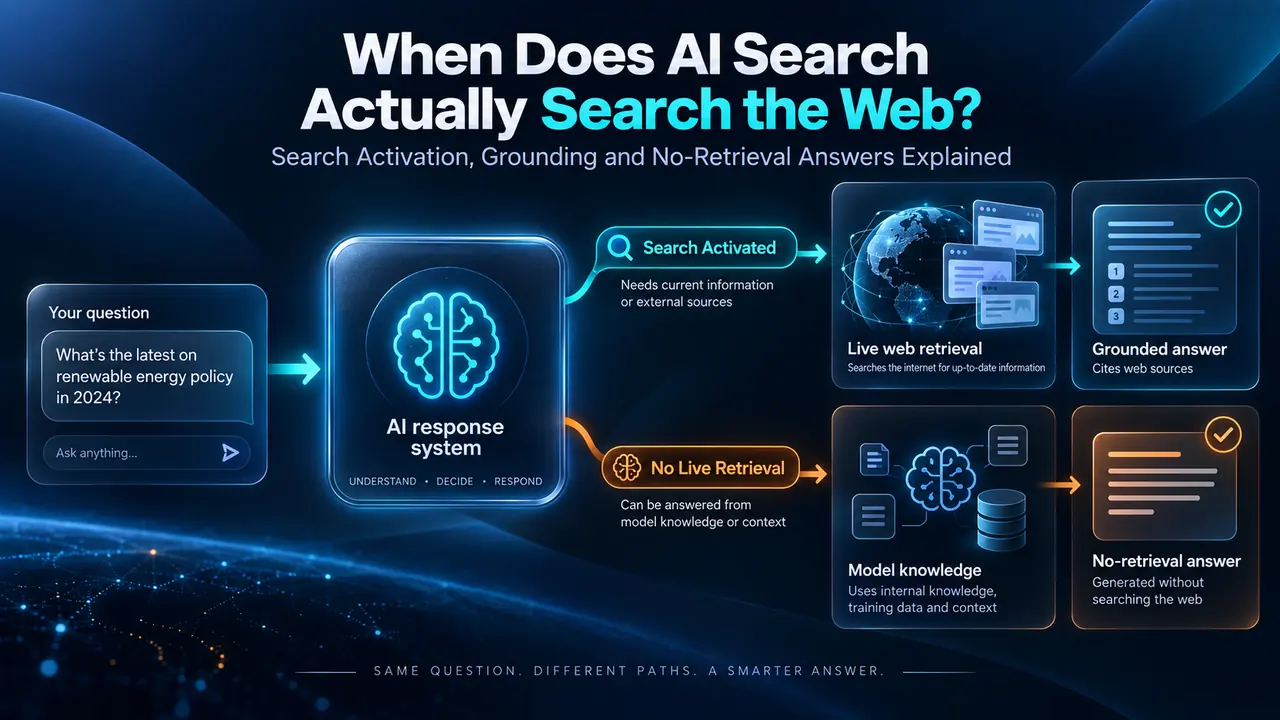
Important limitation: citation-worthiness is probabilistic. Even well-optimised, authoritative, technically accessible content can be omitted because the engine may not search, may fan out differently, may retrieve other sources, may allocate context differently or may produce a different answer on another run.
Continue Reading NeuralAdX Ltd GEO Research and Editorial Analysis
For more evidence-led articles on AI retrieval, citations, prompt coverage, source selection, AI answer visibility and Generative Engine Optimisation measurement, browse the NeuralAdX Ltd blog post archive. The archive links related research without expanding this page beyond its central question: what makes a source citation-worthy to an AI answer engine.
Author and GEO methodology context
Paul Rowe

Paul Rowe
Founder, Chief Generative Engine Optimisation Officer and CEO.
Paul Rowe is the Founder, Chief Generative Engine Optimisation Officer and CEO of NeuralAdX Ltd, a UK-based Generative Engine Optimisation agency focused on helping brands become visible, retrievable, cited, mentioned and trusted inside AI-generated answers.
His work focuses on AI citation visibility, answer-engine retrieval, entity clarity, structured content, source trust, prompt coverage and measurable AI answer visibility across ChatGPT, Google AI Mode, Google Gemini, Microsoft Copilot, Perplexity, Grok, Claude and other major AI search and answer platforms.
Paul’s optimisation process is built around the 11-factor GEO methodology, combining citation addition, statistics, quotations, fluency, easy-to-understand content, authority signals, schema markup, recency, author bios, source diversity and technical-term clarity.
NeuralAdX Ltd publishes proof-led GEO work through live AI retrieval testing, the Proof That Generative Engine Optimisation Works evidence hub, the AI Citation Benchmark and the AI Answer Visibility and Share of Voice Benchmark. This author bio is used to connect each article with clear expertise, transparent methodology and verifiable AI visibility evidence.
CEO
11-factor GEO
AI citation visibility
Answer-engine retrieval
Entity clarity
Evidence-led GEO
Live AI retrieval