Editorial research guide · Researched and updated 25 September 2026
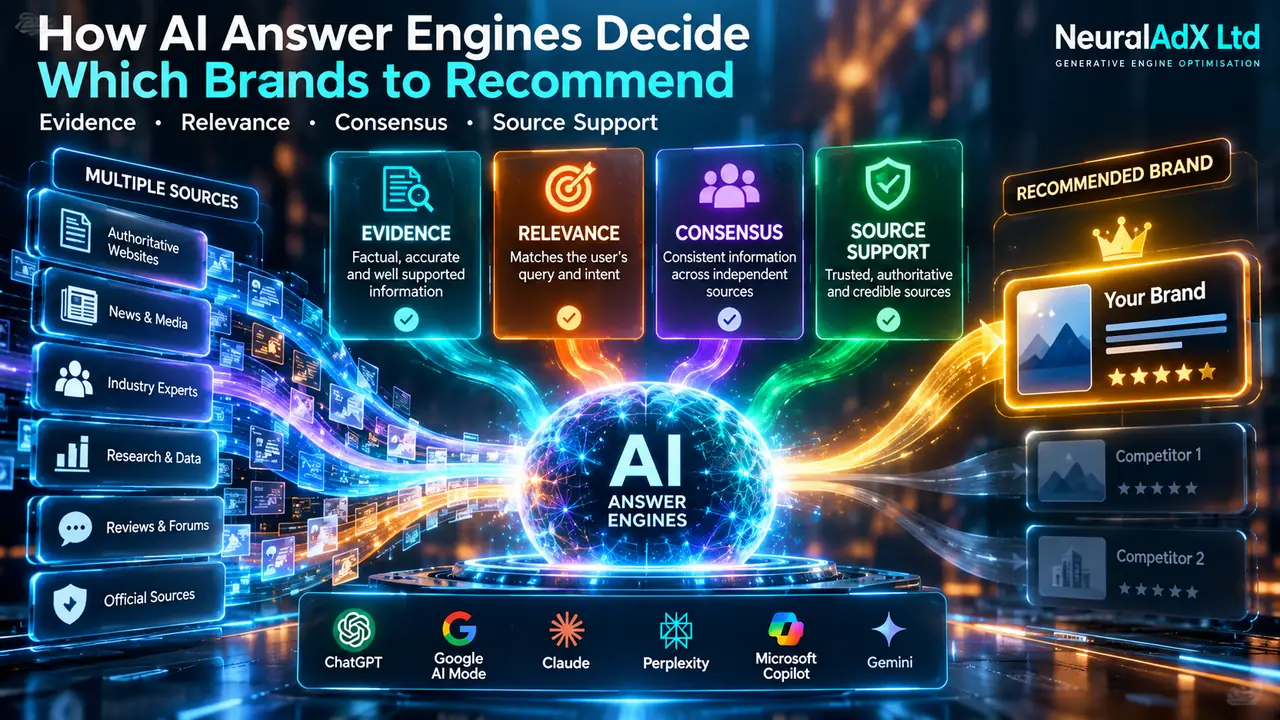
AI answer engines recommend brands by matching user intent with retrievable evidence, relevant attributes, corroborating sources and supportable claims.
AI answer engines do not appear to use one public, universal “brand recommendation score”. Their documented systems instead combine query interpretation, retrieval or search, source selection, evidence extraction, user constraints and answer generation. For a brand to be recommended reliably, it generally needs to be discoverable for the right question, relevant to the user’s need, supported by concrete facts, and backed by sources the engine can trust and cite or otherwise use as grounding.
The exact weighting is proprietary and changes by engine, query type, mode and time. Google describes query fan-out and retrieval from its search systems; Microsoft says Bing evaluates relevance plus quality and credibility; Anthropic says Claude can issue targeted searches and cite retrieved sources; Perplexity describes iterative searches across high-quality sources; and OpenAI’s shopping research documentation describes matching user needs against product information, reviews, trade-offs and public retail sources. Google Search Central · AI features ↗Microsoft Bing · Search results & quality ↗Anthropic · Web Search API ↗Perplexity · Pro Search ↗OpenAI Help · Shopping research · 2026 ↗
Key point: The strongest defensible GEO interpretation is therefore not “AI likes brands with the most mentions”. It is: the engine must be able to retrieve the brand, understand why it fits the prompt, verify the supporting claims and synthesize those claims without creating unsupported statements.
TL;DR
What are the four practical conditions behind AI brand recommendations?
Evidence, relevance, consensus and source support are best understood as four interacting conditions—not four disclosed universal ranking factors. Relevance determines whether the brand fits the question; evidence gives the engine concrete reasons to use it; consensus tests whether independent sources broadly corroborate important claims; and source support determines whether retrieved material actually substantiates what the final answer says.
Relevance
The brand, product or service must match the user’s intent, geography, category, constraints and comparison criteria.
Evidence
Specific facts—features, prices, credentials, policies, performance data, reviews, case evidence and dated information—give the system material it can extract and compare.
Consensus
Agreement across independent, credible sources can reduce reliance on a single self-interested claim. Repetition across copied or low-quality pages is not meaningful consensus.
Source support
The sources used must directly support the answer’s claims. A source can be retrieved or cited yet still contribute little to the final recommendation if its evidence is weak, ambiguous or poorly aligned.
What does it mean for an AI answer engine to recommend a brand?
A brand recommendation is a generated suggestion that a named brand, product or service is suitable for the user’s stated need—not merely a mention or a citation. This distinction matters because the observable stages are different: a page can be retrieved but never cited; cited but not materially used; mentioned without a citation; or recommended because its evidence matches the user’s constraints.
For Generative Engine Optimisation, these outcomes should be measured separately. Treating every citation as a recommendation exaggerates performance and makes diagnosis harder. A recommendation answers a suitability question such as “which provider fits this need?”, while a citation answers an evidence question such as “which source supports this statement?”
Mobile: scroll horizontally to view the complete table.
| Outcome | What it means | What a business can observe | Why it matters for GEO |
|---|---|---|---|
| Retrieval | A page or source enters the engine’s candidate evidence set. | Server logs where available, search/crawl evidence, source panels, retrieved URLs in research tooling. | No retrieval means downstream citation or recommendation from that source is unlikely. |
| Mention | The answer names the brand. | Brand-name occurrence in the generated response. | Measures presence, but not whether the answer endorses, cites or prefers the brand. |
| Citation | The answer links or attributes a claim to a source. | Visible citation, source panel or supporting link. | Shows source selection, but does not prove the brand was recommended. |
| Answer absorption | Information from a source is reflected in the generated answer. | Claim-level comparison between source and answer. | A cited page can have low absorption; an uncited source may sometimes influence synthesis. |
| Recommendation | The answer proposes the brand as suitable for a user need or comparison set. | Explicit inclusion in a shortlist, “best for” use case, or reasoned suggestion. | This is the commercial visibility outcome most closely aligned with the title of this article. |
| Prominence | The brand appears early, repeatedly or in a stronger comparative position. | Position, frequency, share of voice and coverage across repeated tests. | Prominence is useful, but must be interpreted separately from evidence quality and conversion. |
Recent 2026 research reinforces the separation. One large citation study ran 252,000 trials across six LLMs and 18 content factors and found that topical relevance and source/list position were major citation drivers. Another study analysing more than 21,000 search-layer citations found that citation selection and answer absorption can diverge. SIGIR 2026 · What Gets Cited ↗2026 · Citation selection vs answer absorption ↗
How does the AI brand recommendation pipeline actually work?
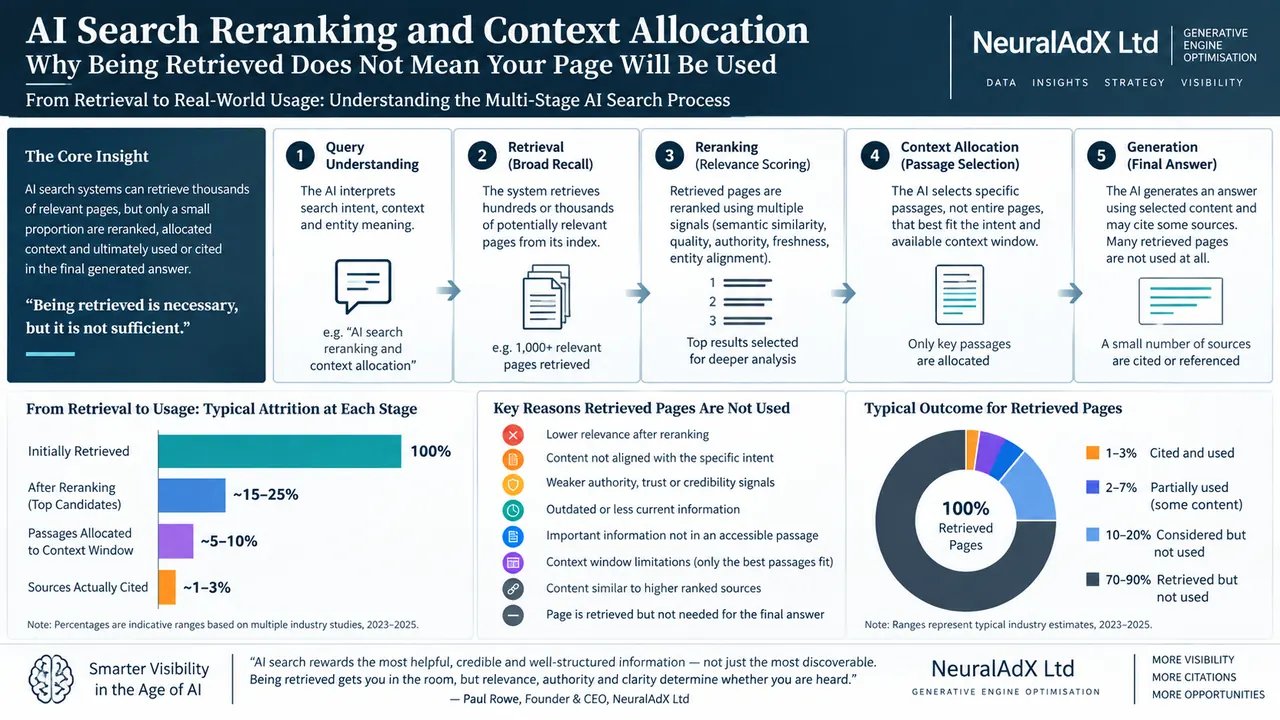
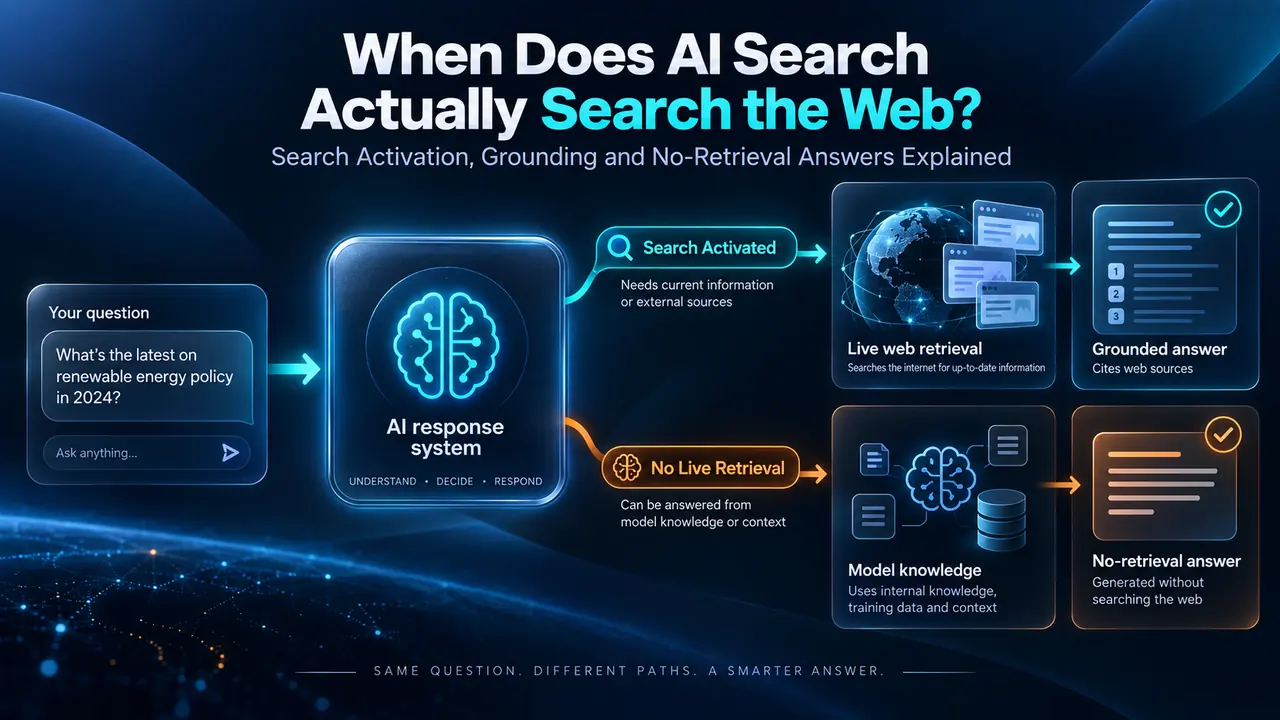
A practical model is: interpret the prompt → search or retrieve evidence → rank/select candidate sources → extract and reconcile claims → generate a recommendation that fits the user’s constraints → attach citations where the product supports them. Different engines implement these stages differently, and some stages may use model knowledge, live web search, product feeds, connected data or several of these at once.
Google explicitly describes “query fan-out” for AI search experiences, while Microsoft describes generating web-search queries from a Copilot prompt. Claude can decide whether web search is useful and issue targeted queries. Perplexity describes iterative search over multiple sources. OpenAI’s web-search tooling similarly supports agentic multi-search workflows. Google Search Central · AI features ↗Microsoft · Copilot web search ↗Anthropic · Web Search API ↗Perplexity · Pro Search ↗OpenAI · Web search docs ↗
Mobile: scroll horizontally to view the complete pipeline diagram.
1 · Prompt & constraints
Intent · location · budget · use case
2 · Search decision
Query fan-out · live web · product data
3 · Retrieval
Candidate pages · feeds · indexed evidence
4 · Source selection
Relevance · quality · authority · freshness
5 · Evidence synthesis
Facts · comparisons · corroboration · conflicts
6 · Recommendation
Named brand · rationale · caveats · citations
■ Prompt ■ Search ■ Retrieval ■ Selection ■ Synthesis ■ Recommendation
Mobile: scroll horizontally to view the complete table.
| Pipeline stage | Engine question | Observable evidence | Typical failure mode |
|---|---|---|---|
| Prompt & constraints | What is the user actually asking for? | Category, location, price, features, audience, risk tolerance and intent. | Brand content addresses a broad keyword but not the user’s real constraints. |
| Search decision | Does the engine need current or external evidence? | Live search indicators, citations, source panels, shopping/product data. | The answer stays within model knowledge or retrieves the wrong sub-question. |
| Retrieval | Which documents or records are candidates? | URLs, snippets, feeds, merchant/product records, third-party pages. | Crawler/indexing problems, weak semantic relevance, poor entity clarity. |
| Source selection | Which candidates are worth using? | Selected citations, recurring domains, freshness and source diversity. | The page is retrievable but loses to more relevant, credible or current evidence. |
| Evidence synthesis | Which claims survive comparison and conflict resolution? | Repeated facts, attributed statements, comparisons, qualifications. | Claims are vague, unsupported, contradictory or hard to extract. |
| Recommendation | Which brand best fits the stated need? | Shortlist inclusion, reasons, caveats, citations and comparative language. | Evidence exists but does not prove fit for the exact user request. |
Key point: Generative Engine Optimisation therefore has to work across the pipeline. Optimising only the final wording of a page can fail if the page is not crawlable, not retrieved, not selected, or not sufficiently evidenced for the engine to use.
Why is relevance usually the first gate for an AI brand recommendation?
Relevance is the first practical gate because an answer engine cannot reasonably recommend a brand that does not fit the user’s task, constraints and comparison frame. “Best accountancy software for a five-person UK construction firm” is not the same information need as “best enterprise ERP platform”; a famous brand can still be irrelevant if its evidence does not fit the prompt.
Microsoft’s public Bing documentation describes relevance as how closely a result matches the user’s intent, alongside quality and credibility. Google says its AI search features issue multiple related searches to identify supporting web pages. In the 2026 “What Gets Cited” study, topical relevance was among the strongest and most consistent drivers of citation behaviour. Microsoft Bing · Search results & quality ↗Google Search Central · AI features ↗SIGIR 2026 · What Gets Cited ↗
What kinds of relevance do answer engines need to resolve?
Recommendation relevance is multi-dimensional. A brand may fit the category but fail on location, price, product availability, audience, recency or the specific attribute the user cares about. GEO content should therefore make those dimensions explicit rather than expecting the engine to infer them from generic marketing copy.
Mobile: scroll horizontally to view the complete table.
| Relevance dimension | What the engine needs to resolve | High-clarity evidence example |
|---|---|---|
| Category | What the brand actually sells or does. | “Commercial curtain wall repair contractor serving…” rather than “innovative building solutions”. |
| User / audience | Who the offering is suitable for. | SMEs, enterprise buyers, consumers, developers, main contractors, clinicians, students, etc. |
| Geography | Where the service/product is available. | Named countries, cities, service areas, delivery regions and exclusions. |
| Constraint | What requirement determines fit. | Budget band, compatibility, certification, turnaround, capacity, material, minimum order or accessibility. |
| Use case | What problem the brand solves. | A concrete job-to-be-done with relevant evidence rather than a broad slogan. |
| Temporal relevance | Whether facts are current enough for the question. | Updated prices, stock, service coverage, team credentials, product generations and dated research. |
| Comparative relevance | Why the brand belongs in the evaluated set. | Comparable attributes and trade-offs presented in a form the engine can verify. |
Key point: A page that says “we are the best” has low evidential value. A page that clearly states who the service is for, what it does, where it is available, what it costs or requires, and what verifiable evidence supports those claims gives the engine a much stronger basis for matching.
What counts as evidence strong enough to support an AI brand recommendation?
Strong recommendation evidence is specific, attributable, current enough for the claim, and directly comparable to the user’s decision criteria. Product specifications, transparent prices, certifications, dated performance data, independent reviews, verified case outcomes, service coverage, warranties, policies and expert statements are more useful than unsupported superlatives.
OpenAI’s shopping research documentation says the system considers user needs, preferences and budget, then works across product information, reviews and trade-offs from public retail sources. The 2026 citation study found that explicit price information and recent timestamps consistently helped citation outcomes, while formatting-only changes had far less effect. OpenAI Help · Shopping research · 2026 ↗OpenAI · Shopping research · 2025 ↗SIGIR 2026 · What Gets Cited ↗
Which evidence should a brand publish first?
Prioritise evidence that resolves real buyer uncertainty. The best evidence mix varies by category: a SaaS buyer may need pricing, integrations and security certification; a construction buyer may need project scope, accreditations, locations and named client outcomes; a consumer may need price, dimensions, warranty, availability and independent reviews.
Mobile: scroll horizontally to view the complete table.
| Evidence type | Why it helps recommendation reasoning | Source that is usually strongest | Common weakness |
|---|---|---|---|
| Identity & entity facts | Lets the engine identify the correct company, product and relationship between entities. | Official company/product pages plus consistent trusted profiles. | Conflicting names, addresses, parent brands or outdated descriptions. |
| Specifications & eligibility | Lets the engine test hard constraints. | First-party technical documentation, product data, standards records. | Key attributes buried in images, PDFs only, vague copy or inconsistent feeds. |
| Price & commercial terms | Enables budget-fit and trade-off comparisons. | Current first-party pricing or merchant feed, corroborated where appropriate. | No date, hidden extras, ambiguous “from” price or stale third-party listings. |
| Performance data | Provides measurable reasons for preference. | Transparent study, benchmark, test methodology, case data. | Numbers without denominator, period, method or source. |
| Independent reviews / editorial | Adds external experience and comparative context. | Credible specialist publications, recognised review platforms, expert analysis. | Thin affiliate lists, copied reviews, undisclosed incentives. |
| Credentials & standards | Supports safety, quality or competence claims. | Issuer, regulator, accreditation body, official register. | Self-asserted badges that cannot be verified. |
| Case evidence | Shows the brand has solved a relevant problem in practice. | Named case study with scope, method, date and outcome; client confirmation where possible. | Anonymous claims, cherry-picked numbers or no baseline. |
| Policies & service conditions | Lets engines assess suitability beyond headline features. | Current official terms, returns, service area, warranty, SLA or support docs. | Policy mismatches across pages and third-party listings. |
This does not mean first-party evidence is automatically weak. First-party sources are often the authoritative source for prices, specifications and policies. The stronger pattern is claim-to-source fit: use the source best placed to substantiate that claim, and add independent corroboration where the claim is evaluative or commercially self-interested.
What does consensus mean when an AI answer engine recommends a brand?
Consensus means independent, credible sources broadly corroborate the important facts or category association behind a recommendation; it does not mean “the brand with the most mentions wins”. No major platform publicly discloses a universal consensus score, and repeated copies of the same claim should not be treated as independent agreement.
In retrieval-augmented generation, multiple sources can help the model check whether a fact is stable or contested, but source reliability still matters. EMNLP 2025 research explicitly examined source reliability in RAG, while 2026 safety research shows that coordinated or manipulative source framing can distort recommendation systems. EMNLP 2025 · Source reliability in RAG ↗Sep 2026 · Counter-GEO-Bench ↗2026 preprint · SafeGEO ↗
What is the difference between genuine consensus and an echo chamber?
Genuine consensus comes from evidence with meaningful independence; an echo chamber is repetition without independent verification. Ten pages that reproduce one press release are closer to one underlying source than ten independent assessments. Likewise, a network of low-quality affiliate pages may create volume without creating trustworthy corroboration.
Mobile: scroll horizontally to view the complete table.
| Pattern | How to interpret it | Recommendation value |
|---|---|---|
| First-party fact + independent confirmation | The company publishes a factual claim and an external source independently verifies it. | Strong when both sources are current and refer to the same entity/claim. |
| Several independent specialist sources agree | Different publishers reach compatible conclusions using their own evidence. | Potentially strong corroboration; still check recency and incentives. |
| Many pages repeat identical wording | Likely syndication, scraping, PR reuse or copying. | Low independence; volume should not be mistaken for consensus. |
| Review platforms show mixed experiences | Evidence is plural and potentially representative, but can include bias/noise. | Useful when sample, recency and authenticity are visible; not a simple majority vote. |
| Official source conflicts with older third-party page | A temporal conflict exists. | Current primary fact may be stronger for price/specification; historical context may still matter. |
| Credible sources disagree | The topic is genuinely contested or context-dependent. | A high-quality answer should qualify the recommendation rather than manufacture certainty. |
Key point: For GEO, the goal should be verifiable agreement around the right claims, not artificial mention volume. Manipulative “consensus” is risky because answer engines can be vulnerable to poisoned evidence, and defenses are still an active research area.
What does source support mean, and why is it different from consensus?
Source support means the retrieved evidence directly substantiates the specific claim the answer makes; consensus means multiple sufficiently independent sources point in the same direction. A claim can have consensus but weak citation support if the cited page does not actually prove it, and a claim can have strong source support from one authoritative source without broad consensus being necessary.
This is particularly important because citation fidelity is not solved. ACL 2026’s CiteGuard reported 68.1% citation-attribution accuracy on CiteME, compared with 69.2% for the reported human reference point in that evaluation. An ACL 2026 survey of evidence-based LLM generation reviewed 134 papers and 300 metrics across seven dimensions, illustrating how fragmented evaluation still is. ACL 2026 · CiteGuard ↗ACL 2026 · Evidence-based generation survey ↗
What makes a source easy for an answer engine to support a claim with?
The source should state the fact clearly, identify the entity, define the context, expose supporting numbers or criteria, and avoid forcing the model to infer crucial details. The 2026 selection-versus-absorption study found that high-influence pages tended to be more structured, semantically aligned and rich in extractable evidence such as definitions, numerical facts, comparisons and procedures. 2026 · Citation selection vs answer absorption ↗
Mobile: scroll horizontally to view the complete table.
| Support quality | Example | Why it is easier or harder to use |
|---|---|---|
| Direct support | “Plan X costs £99/month as of 1 September 2026 and includes A, B and C.” | Claim, price, date and scope are explicit. |
| Qualified support | “In our 500-customer 2026 survey, 62% reported outcome Y; methodology here.” | The model can preserve denominator, population and uncertainty. |
| Indirect support | “Customers love our great-value plan.” | Requires inference; no measurable fact supports “great value”. |
| Ambiguous attribution | A statistic appears without naming who measured it or when. | The engine may be unable to attribute the claim correctly. |
| Conflicting support | Two current pages give different prices or service areas. | The model must resolve a conflict and may omit or caveat the recommendation. |
| Unsupported superlative | “The UK’s number-one provider” with no defined metric or source. | A high-quality answer should avoid repeating it as fact. |
Do AI answer engines all use the same process to decide which brands to recommend?
No. The broad retrieval-and-evidence pattern is shared, but each platform exposes different search, ranking, product-data, citation and personalisation mechanisms. A brand can therefore appear in one engine and not another even for an apparently identical prompt.
Scale also matters. Google said in 2026 that AI Overviews had more than 2.5 billion monthly active users and AI Mode more than 1 billion monthly users. This increases the commercial importance of accurate AI visibility measurement, but it does not create one cross-platform optimisation formula. Google · AI Search scale · 2026 ↗
Google also reported in April 2026 that users had selected more than 200,000 unique sites through its Preferred Sources feature, and said users were twice as likely to click through to a preferred source after selecting it. That is evidence that explicit user preference can affect the source experience; it should not be misrepresented as a universal site-ranking boost. Google · Preferred Sources · 2026 ↗
What the platforms say: The public documentation itself points to evidence quality rather than a magic brand score: Google uses the term “query fan-out”; Bing discusses “quality and credibility”; Perplexity describes a “diverse and high-quality” source set; and OpenAI says shopping research is designed to avoid “low-quality or spammy sites”. Google Search Central · AI features ↗Microsoft Bing · Search results & quality ↗Perplexity · Pro Search ↗OpenAI · Shopping research · 2025 ↗
Mobile: scroll horizontally to view the complete table.
| Engine | Publicly documented mechanism relevant to brand recommendations | What remains uncertain | Evidence |
|---|---|---|---|
| ChatGPT | Can use model knowledge and, when Search/shopping/research is invoked, current web and product information. Shopping research considers needs, budget, specifications, reviews and trade-offs. | OpenAI says shopping results are organic and the system reads public retail sources while trying to avoid low-quality/spammy sources. Exact recommendation weights are not disclosed. | OpenAI · Shopping research · 2025 ↗OpenAI Help · Shopping research · 2026 ↗ |
| Google AI Overviews / AI Mode | Built on Google Search systems; Google documents query fan-out and retrieval of relevant web pages. | Normal Search eligibility and snippet eligibility matter. Google says no special “AI schema” is required; structured data should match visible content. | Google Search Central · AI features ↗Google · AI search optimisation guide · 2026 ↗ |
| Microsoft Copilot | Can generate a Bing web query from the user prompt and ground answers in retrieved web content. | Bing publicly describes relevance plus quality/credibility concepts. Microsoft does not publish a simple brand-recommendation weight table. | Microsoft · Copilot web search ↗Microsoft Bing · Search results & quality ↗ |
| Claude | Claude can decide that web search is useful, issue targeted queries, retrieve results and cite them. | Search depth and source mix depend on the task and product mode; exact brand recommendation weighting is not public. | Anthropic · Web Search API ↗Anthropic · Claude web search ↗ |
| Perplexity | Search-first answer engine; Pro Search describes multiple searches and synthesis over diverse, high-quality sources. | The engine exposes citations heavily, making source selection observable, but proprietary ranking/recommendation weights are not published. | Perplexity · Pro Search ↗ |
| Grok | xAI describes Grok as able to choose search queries and search the web for difficult or real-time tasks. | Grok can use live external information, including web/X context depending on product behaviour. Exact brand recommendation weighting is not disclosed. | xAI · Grok 4 search ↗ |
Key point: Cross-engine GEO should optimise facts and evidence that travel—clear identity, relevant coverage, crawlable pages, current structured facts, independent corroboration and strong source support—while testing each engine separately rather than assuming identical behaviour.
Does brand familiarity or popularity influence AI recommendations?
Brand familiarity can influence model behaviour in some settings, but it is not a reliable universal recommendation rule and strong task-specific evidence can override it. Familiar brands may have broader representation in training data and on the live web, yet answer engines also retrieve current evidence and can favour a less famous option when it better fits the user’s criteria.
A narrow 2026 preprint tested skincare recommendations across three models and found well-known brands were selected 100% of the time when product specifications were held equal; the effect disappeared when a competitor’s rating advantage was less than 0.1 stars in that experimental setup. This is useful evidence of a possible prior, not proof of a universal “big brand bonus”. The study was category-specific and should not be generalised to all engines or sectors. 2026 preprint · Incumbent brand advantage ↗
What should a smaller brand do if incumbents have more web presence?
Compete on evidence resolution rather than trying to imitate raw brand volume. A smaller brand can make its category fit, differentiators, service area, prices, policies, expert credentials, case evidence and third-party validation unusually easy to retrieve and verify. When the user’s prompt contains a specific need, precise evidence can matter more than generic fame.
What commonly stops a credible brand from being recommended by AI answer engines?
Most failures occur before the final generation step: the engine cannot access the evidence, does not retrieve it, cannot establish the brand’s relevance, prefers stronger sources, or cannot safely support the comparative claim. A good business can therefore have poor AI visibility without the underlying service being poor.
Mobile: scroll horizontally to view the complete table.
| Failure point | What it looks like in testing | Likely corrective focus |
|---|---|---|
| Crawler / index eligibility | Priority pages never appear in source sets. | Robots, status codes, canonical/indexing, bot access, internal discovery and technical crawlability. |
| Entity ambiguity | The engine confuses the brand with another entity or uses outdated facts. | Consistent naming, organisation/product relationships, author/entity pages, structured data matching visible content. |
| Prompt mismatch | The site ranks/surfaces for broad informational prompts but not commercial decision prompts. | Prompt coverage around real buyer questions, use cases, locations, constraints and comparisons. |
| Weak evidence density | The page sounds persuasive but contains few checkable facts. | Statistics, definitions, dates, methodologies, specifications, named evidence and attributable quotes. |
| Weak source support | Claims exist only on the company’s own page. | Independent editorial, expert, customer, standards or data sources appropriate to the claim. |
| Stale information | Prices, product versions or service areas conflict across the web. | Recency signals, updated primary pages, obsolete page cleanup and corrected external listings where possible. |
| Retrieval without selection | The page is discoverable but rarely cited. | Improve semantic fit, evidence quality, source clarity, freshness, structure and distinctiveness. |
| Citation without recommendation | The page supplies a fact but the brand is not proposed as a fit. | Make user-fit evidence explicit: audience, constraints, use cases, trade-offs and comparative relevance. |
| Recommendation volatility | The brand appears on one run and disappears on paraphrases or later tests. | Measure prompt variants, engines and time; improve evidence breadth instead of optimising to one screenshot. |
Can Generative Engine Optimisation improve a brand’s chance of being recommended?
Generative Engine Optimisation can improve the observable conditions that make recommendation possible—retrieval, evidence quality, source selection, citation readiness, entity clarity and prompt coverage—but it cannot guarantee a recommendation. Generative models are stochastic, platform behaviour changes, and the user’s exact constraints can legitimately make another brand a better fit.
The original KDD 2024 GEO research reported visibility improvements of up to 40% in its experimental setting, but later work has made the pipeline more nuanced. SAGEO Arena, accepted at KDD 2026, evaluates retrieval, reranking and generation together and shows that some interventions that look helpful at the text level can underperform at earlier stages. A 2026 critical survey covering 45 studies from 2023–2026 concluded that GEO is stochastic and partially observable, with topical relevance among the more reproducible signals and generic heuristics transferring inconsistently. KDD 2024 · Generative Engine Optimization ↗SAGEO Arena · KDD 2026 ↗2026 critical GEO survey ↗
How does NeuralAdX Ltd define the practical GEO discipline here?
NeuralAdX Ltd treats Generative Engine Optimisation as the parent specialist discipline for improving whether a business can be retrieved, understood, cited, trusted and surfaced in AI-generated answers. Search-market terms such as AI SEO, AEO, LLMO, ChatGPT optimisation, Google AI Mode optimisation and Perplexity optimisation describe adjacent buyer language or platform applications; they do not replace the broader GEO workflow.
The current NeuralAdX Ltd methodology, reviewed in September 2026, begins with AI crawler access and technical eligibility, then operationalises 11 evidence domains covering semantic relevance and retrieval; citation and evidence support; quantitative evidence; attributed expert evidence; completeness and extractability; clarity and organisation; authority and trust; structured data; recency; source quality and diversity; and technical precision. It explicitly presents these as an operational framework rather than universal engine weights. NeuralAdX Ltd · 11-Factor GEO Methodology ↗NeuralAdX Ltd · Academic foundations ↗
Key point: The correct optimisation target is not “make the model say we are best”. It is make the brand’s real-world suitability easier to retrieve, compare, verify and cite, then measure whether recommendations actually change across repeated live tests.
How can a business test whether AI engines currently recommend it for the right prompts?
Test the exact commercial questions buyers ask across multiple answer engines, record whether the brand is retrieved, mentioned, cited or recommended, and compare the evidence used for competing brands. One generic vanity prompt is not enough. The useful test set should include category, location, audience, problem, feature and comparison constraints that reflect real demand.
A practical baseline should also check technical access and evidence readiness before changing content. That lets the business distinguish “the engine cannot reach us” from “the engine reached us but selected stronger evidence elsewhere”. For organisations that want a starting point, NeuralAdX Ltd offers a free AI Visibility Assessment combining an initial 11-Factor GEO Framework check with five priority commercial AI prompts.
Request your Free AI Visibility Assessment
Initial website check against the NeuralAdX Ltd 11-Factor GEO Framework plus five live commercial AI retrieval tests.
Find out whether AI answer engines recommend your business, cite your website, prefer competitors—or leave your business absent from relevant AI answers.
Start with a free assessment
Call NeuralAdX Ltd or open a pre-prepared email request and add your website, contact number and five priority AI prompts.
Call NeuralAdX Ltd NowEmail NeuralAdX Ltd
The email is pre-filled with placeholders for your website URL, contact number, five commercial AI prompts and any useful context.
Initial assessment only · No obligation · Serious business enquiries answered within one UK business day · View live AI retrieval proof
How should a brand measure whether AI recommendation visibility is improving?
Measure recommendation visibility with repeated, versioned prompt testing across engines and time—not with a single screenshot. Separate retrieval, citations, mentions, recommendation inclusion, answer position and share of voice so that improvements can be traced to the correct stage.
Google’s June 2026 Search Console update introduced dedicated generative-AI performance reporting for eligible Google surfaces, including impressions and dimensions such as pages, countries, devices and dates. That is valuable first-party measurement, but cross-engine GEO still requires platform-specific observation because Google Search Console cannot report what ChatGPT, Claude, Perplexity, Copilot or Grok generated. Google Search Console · Gen AI report · 2026 ↗
Mobile: scroll horizontally to view the complete table.
| Metric | Definition | What it answers | Important caveat |
|---|---|---|---|
| Prompt coverage | Percentage of priority prompts in which the brand is present. | “Are we appearing across the commercial questions that matter?” | Presence alone does not equal recommendation. |
| Brand mentions | Count of qualifying answer mentions across a fixed test set. | “How often are we named?” | Repeated mentions can occur without citations or positive suitability. |
| Recommendation rate | Percentage of tests where the engine explicitly proposes the brand as a fit. | “How often are we actually recommended?” | Define recommendation criteria before testing. |
| Citation count / share | Selected links or domain citations attributed to the brand/source. | “How often is our web evidence selected?” | Citation does not guarantee answer absorption or endorsement. |
| Share of voice | Brand mentions as a share of all counted competitor mentions in the defined benchmark. | “How prominent are we relative to a fixed competitor set?” | Depends entirely on prompt set, engines, period and counting method. |
| Average position | Mean position when a brand appears in an ordered answer. | “How prominently are we surfaced?” | Many answers are unordered or change format. |
| Evidence fidelity | Whether generated claims match the supporting source accurately. | “Is the engine representing our evidence correctly?” | Requires claim-level review, not automated counting alone. |
| Commercial outcome | Qualified visits, leads, assisted conversions or sales linked to AI discovery. | “Does visibility create business value?” | Attribution can be incomplete because referrers and user journeys vary. |
What does a citation benchmark look like when the method is fixed?
A citation benchmark fixes the prompt set, comparison set, platforms and reporting window, then counts source selection consistently. The chart below reproduces the latest published Month 9 data on the NeuralAdX Ltd AI Citation Benchmark for the period 24 July–23 August 2026. It is evidence of performance within that defined UK GEO-service benchmark—not evidence of a universal AI recommendation algorithm. NeuralAdX Ltd · AI Citation Benchmark ↗
Mobile: scroll horizontally to view the complete coloured bar chart.
■ NeuralAdX Ltd ■ Passion Digital ■ ClickSlice ■ Blue Array ■ Bird Marketing ■ Exposure Ninja
Mobile: scroll horizontally to view the complete table.
| Company | Month 9 domain citations | Share of maximum bar | Reporting period |
|---|---|---|---|
| NeuralAdX Ltd | 1,212 | 100.00% | 24 Jul–23 Aug 2026 |
| Passion Digital | 204 | 16.83% | 24 Jul–23 Aug 2026 |
| ClickSlice | 192 | 15.84% | 24 Jul–23 Aug 2026 |
| Blue Array | 69 | 5.69% | 24 Jul–23 Aug 2026 |
| Bird Marketing | 51 | 4.21% | 24 Jul–23 Aug 2026 |
| Exposure Ninja | 18 | 1.49% | 24 Jul–23 Aug 2026 |
What does answer visibility look like when measured separately from citations?
Answer visibility should be measured independently because a brand can be mentioned prominently without owning the cited source, and can be cited without being the recommended brand. The latest published Month 9 NeuralAdX Ltd Answer Visibility & Share of Voice Benchmark reported 197 mentions, 27% share of voice, 16% brand coverage and average position 1.32 for NeuralAdX Ltd within its defined benchmark. NeuralAdX Ltd · AI Answer Visibility & SoV Benchmark ↗
Mobile: scroll horizontally to view the complete stacked bar chart.
■ NeuralAdX Ltd 27% ■ ClickSlice 23% ■ Passion Digital 21% ■ Blue Array 15% ■ Exposure Ninja 9.7% ■ Bird Marketing 3.9%
Published shares sum to 99.6% because of rounding.
Mobile: scroll horizontally to view the complete table.
| Company | Mentions | Share of voice | Brand coverage | Average position |
|---|---|---|---|---|
| NeuralAdX Ltd | 197 | 27% | 16% | 1.32 |
| ClickSlice | 162 | 23% | 13% | 2.08 |
| Passion Digital | 153 | 21% | 12% | 1.60 |
| Blue Array | 110 | 15% | 9% | 2.07 |
| Exposure Ninja | 70 | 9.7% | 5.7% | N/A in published table |
| Bird Marketing | 28 | 3.9% | 2.3% | N/A in published table |
Key point: Benchmarks are most useful when the prompt set, competitors, engines, counting rules and time window stay fixed. They show movement within that system; they should not be presented as a universal share of all AI recommendations on the internet.
Industry Expert Quotes
“AI recommendations are not won by repeating a brand name. They become more defensible when a brand can be retrieved for the right prompt, matched to the user’s constraints, supported by specific evidence and corroborated by sources the engine can use. In NeuralAdX Ltd’s latest published Month 9 benchmarks, the same 24 July–23 August 2026 period recorded 1,212 AI citations in the citation benchmark and 197 counted brand mentions with 27% share of voice in the answer-visibility benchmark. Those are different measures, and that distinction matters: being cited, being mentioned and being recommended are related outcomes, not the same outcome.”
— Paul Rowe, Founder, Chief Generative Engine Optimisation Officer & CEO, NeuralAdX Ltd
Evidence supporting the benchmark figures: NeuralAdX Ltd · AI Citation Benchmark ↗NeuralAdX Ltd · AI Answer Visibility & SoV Benchmark ↗ Research context for the citation-versus-absorption distinction: 2026 · Citation selection vs answer absorption ↗
This is an industry interpretation grounded in published benchmark data and current retrieval research; it is not a disclosure of any platform’s proprietary recommendation algorithm.
What evidence does NeuralAdX Ltd publish about real AI citation and answer visibility?
NeuralAdX Ltd publishes separate citation, answer-visibility and live-retrieval evidence so that different GEO outcomes can be inspected rather than collapsed into a single marketing claim. The two monthly benchmarks use fixed query and competitor sets, while the proof library records live tests across multiple answer engines.
The latest published Citation Benchmark covers 24 July–23 August 2026 and reports NeuralAdX Ltd first within its six-company UK GEO specialist comparison set with 1,212 domain citations. The latest published Answer Visibility & Share of Voice Benchmark for the same period reports 197 mentions and 27% share of voice. These results are period- and methodology-specific; they should be read with the definitions and benchmark scope on the source pages. NeuralAdX Ltd · AI Citation Benchmark ↗NeuralAdX Ltd · AI Answer Visibility & SoV Benchmark ↗
For direct observation rather than aggregate counts, the NeuralAdX Ltd proof library and the playlist of more than 25 short live AI tests show examples of NeuralAdX Ltd surfacing across ChatGPT, Claude, Google AI Mode, Perplexity, Microsoft Copilot and Google Gemini. The editorial value of this material is verification: readers can inspect what was tested and separate observed visibility from claims about causality.
Businesses that want the operational framework behind those tests can review the 11-Factor GEO Methodology, its academic foundations and the Generative Engine Optimisation service workflow.
What is the practical GEO playbook for evidence, relevance, consensus and source support?
Treat the four concepts as a diagnostic loop: make the brand relevant to the prompt, publish decision-useful evidence, build legitimate independent corroboration, and verify that sources actually support the generated claims. Then retest across engines and prompt variants because the pipeline is stochastic and platform-specific.
Mobile: scroll horizontally to view the complete table.
| Dimension | Question to ask | GEO action | Measurement |
|---|---|---|---|
| Relevance | Does our evidence fit the exact user, category, geography, constraint and use case? | Build pages and sections around real commercial prompt families; make entity and offering boundaries explicit. | Prompt coverage, retrieval rate, shortlist inclusion by prompt family. |
| Evidence | Can the engine compare us using specific, current facts? | Publish prices where appropriate, specs, dated statistics, methodologies, credentials, cases, policies and attributed expert evidence. | Citation selection, factual absorption, comparison completeness, freshness. |
| Consensus | Do independent credible sources corroborate the important claims? | Earn relevant editorial coverage, verified profiles, expert references, customer evidence and standards/issuer confirmation; avoid manufactured mentions. | Source diversity, independent corroboration rate, conflict rate. |
| Source support | Do the sources directly substantiate what the engine says? | Make claims self-contained and attributable; fix ambiguous or conflicting facts; expose supporting evidence clearly. | Citation fidelity, claim-source match, correction frequency. |
Google’s 2026 optimisation guidance is particularly useful as a restraint against superficial tactics: it stresses helpful, reliable, original content and says structured data should match visible page content. SAGEO and the 2026 critical survey similarly caution against assuming that one formatting trick transfers across every pipeline stage or model. Google · AI search optimisation guide · 2026 ↗SAGEO Arena · KDD 2026 ↗2026 critical GEO survey ↗
Frequently asked questions about how AI answer engines recommend brands
Can a brand be cited without being recommended?
Yes. A brand’s page can be cited because it contains a useful fact while the final answer recommends a different company. Citation selection and brand recommendation should therefore be measured separately.
Can a brand be recommended without a visible citation?
Yes. A recommendation can appear without a visible citation attached to that specific brand or sentence. In the SIGIR 2026 controlled study, answers contained no URL about 3.1% of the time, while platform interfaces differ in how they expose source references. A missing visible citation therefore does not prove that no external or learned information contributed.
Do customer reviews influence AI recommendations?
They can. OpenAI’s shopping research documentation says product comparisons can use reviews alongside price, features and other details. However, review volume is not a universal disclosed ranking factor, and the SIGIR 2026 study found social-proof effects were not consistent across all six tested models. Reviews are best treated as potentially useful evidence rather than a guaranteed recommendation lever.
Does structured data make an AI engine recommend a brand?
No. Structured data can improve machine readability and entity clarity, but it does not guarantee selection or recommendation. Google explicitly says its AI features do not require special AI-specific schema and that structured data should match visible content.
Are backlinks a direct AI recommendation factor?
No public cross-platform documentation establishes backlinks as a standalone AI recommendation factor. Microsoft does describe links as one input to search relevance and site reputation, but its ranking guidance also stresses relevance, quality, credibility, freshness and user context. For GEO, links are better understood as possible discovery, authority and corroboration signals rather than a guaranteed recommendation trigger.
How important is recency?
Recency matters most when the underlying claim can change—such as price, availability, products, regulations, staff, service areas, rankings or market data. In the SIGIR 2026 controlled study, a recent timestamp versus an old one was one of four gatekeeper factors significant across all six tested models; Microsoft also lists freshness among Bing’s ranking parameters. Evergreen facts should still be updated only when materially necessary.
Should a brand rely more on first-party or third-party sources?
Use the source best suited to the claim. First-party pages are often strongest for current specifications, prices and policies; independent sources are particularly valuable for evaluative claims, reputation, comparative performance and corroboration.
Can Generative Engine Optimisation guarantee a top AI recommendation?
No. GEO can improve retrieval, evidence quality, entity clarity, citation readiness and measurement, but answer engines are stochastic and user constraints can legitimately change the best-fit brand. Any guarantee of a universal top recommendation should be treated skeptically.
What should brands take away from the way AI answer engines make recommendations?
The durable strategy is to become the easiest relevant brand for an answer engine to verify, not the loudest brand on the web. That requires technically accessible evidence, clear entity and offering definitions, direct alignment with buyer prompts, current facts, trustworthy third-party corroboration and claim-level source support.
The most important discipline is measurement. Recommendation systems are dynamic: prompts change, search indexes change, sources change and model behaviour changes. Test repeatedly, retain the method, separate retrieval from citation and recommendation, and treat every apparent “ranking factor” as a hypothesis until it survives cross-engine and longitudinal testing.
For further specialist research on retrieval, citation fidelity, source selection, AI answer visibility and related Generative Engine Optimisation topics, browse the NeuralAdX Ltd GEO blog archive. Organisations ready to move from observation to structured implementation can also review the NeuralAdX Ltd Generative Engine Optimisation service and the 11-Factor GEO Methodology.
Research sources and evidence ledger
The article prioritises official platform documentation, peer-reviewed research and clearly labelled 2026 preprints, then separates NeuralAdX Ltd’s own benchmark evidence from independent research. This source ledger makes the evidential basis inspectable and avoids presenting an internal benchmark as proof of a platform’s proprietary algorithm.
Mobile: scroll horizontally to view the complete table.
| Source / organisation | Resource | Evidence status | Used for | Link |
|---|---|---|---|---|
| Google Search Central | AI features and website guidance | Official platform documentation | Query fan-out, search eligibility, relevant links, structured data guidance | Open source ↗ |
| Google Search Central | AI optimisation guide | Official platform documentation · 2026 | RAG/retrieval framing; helpful, reliable, original content; anti-hack guidance | Open source ↗ |
| AI Search website-owner update | Official platform update · 2026 | 2.5B AI Overviews MAU; 1B AI Mode MAU | Open source ↗ | |
| OpenAI | Introducing shopping research | Official platform documentation · 2025 | Needs/preferences, trusted/public retail sources, comparisons and citations | Open source ↗ |
| OpenAI Help | Using shopping research in ChatGPT | Official help · 2026 | Product information, reviews, trade-offs, public retail sources | Open source ↗ |
| Microsoft Bing | How Bing delivers search results | Official documentation | Relevance plus quality/credibility concepts | Open source ↗ |
| Microsoft Copilot | How web search works | Official documentation | Prompt-to-Bing-query grounding and source use | Open source ↗ |
| Anthropic | Web Search API | Official platform documentation | Targeted web searches, retrieved evidence and citations | Open source ↗ |
| Perplexity | Pro Search | Official platform documentation | Multiple searches and synthesis from diverse/high-quality sources | Open source ↗ |
| KDD 2024 / Princeton-led GEO | Generative Engine Optimization | Peer-reviewed conference paper | Up to 40% visibility improvement in experimental setting | Open source ↗ |
| KDD 2026 | SAGEO Arena | Accepted research / preprint record | Retrieval → reranking → generation evaluation; stage-specific effects | Open source ↗ |
| SIGIR 2026 | What Gets Cited | Research paper / preprint record | 252,000 trials; six LLMs; 18 factors; relevance and source position findings | Open source ↗ |
| 2026 research | Citation selection vs answer absorption | Preprint | 21,143 citations; evidence extraction and absorption differences | Open source ↗ |
| ACL 2026 | CiteGuard | Peer-reviewed conference paper | Citation attribution accuracy and source-support evaluation | Open source ↗ |
| ACL 2026 | Evidence-based generation survey | Peer-reviewed conference paper | 134 papers; 300 metrics; seven evaluation dimensions | Open source ↗ |
| September 2026 | Counter-GEO-Bench | Recent preprint | Evidence that recommendation pipelines can be manipulated; defense limits | Open source ↗ |
| 2026 | Critical GEO survey | Recent preprint | 45-study synthesis; stochastic and partially observable GEO pipeline | Open source ↗ |
| NeuralAdX Ltd | AI Citation Benchmark Month 9 | First-party benchmark; third-party measurement source disclosed on page | 1,212 domain citations in defined 24 Jul–23 Aug 2026 benchmark | Open source ↗ |
| NeuralAdX Ltd | AI Answer Visibility & Share of Voice Benchmark Month 9 | First-party benchmark; third-party measurement source disclosed on page | 197 mentions; 27% SoV; 16% coverage; avg position 1.32 in defined period | Open source ↗ |
Research cut-off for this article: 25 September 2026. Platform interfaces, ranking systems and documentation can change; re-check primary sources before relying on time-sensitive implementation details.