NeuralAdX Ltd · UK Generative Engine Optimisation Agency
Generative Engine Optimisation Services (GEO) for AI Search
Evidence-led GEO services designed to improve how your business is found, understood, cited, mentioned and recommended across major AI platforms and answer engines.
NeuralAdX Ltd combines AI visibility assessment, crawlability and retrieval checks, continuous competitor benchmarking, live AI answer analysis, evidence-led website optimisation, external authority development and repeated AI retrieval testing — so improvement is measured rather than assumed.
GENERATIVE ENGINE OPTIMISATION SERVICES
A measurable GEO service for improving visibility inside AI-generated answers
Generative Engine Optimisation (GEO) services improve and measure how a business is discovered, understood, cited, mentioned and recommended in AI search and generative answer systems. The US spelling, Generative Engine Optimization, refers to the same discipline.
Our service combines technical retrieval checks, AI citation and answer-visibility benchmarking, live answer evidence analysis, content and entity improvements, external evidence development and repeated retrieval testing. SEO fundamentals remain important; GEO adds direct measurement of how generative systems actually retrieve and represent the business.
PUBLIC GEO PERFORMANCE EVIDENCE · LATEST PUBLISHED PERIOD
Measured against established UK GEO service agencies
The latest published benchmark period is 24 June 2026–23 July 2026. Results below are period-specific Otterly.ai measurements for a fixed UK GEO-service comparison set. They are not organic Google rankings, traffic, leads or revenue.
AI CITATION BENCHMARK
#1 in the latest published period
NeuralAdX Ltd is shown #1 in all eight currently published monthly citation periods in this fixed comparison.
AI ANSWER VISIBILITY & SHARE OF VOICE
#1 across all five tracked Month 8 outputs
NeuralAdX Ltd moved from #5 in Month 1 to #1 in Months 3–8 in the published visibility benchmark.
Evidence standard: benchmark pages contain crawlable tables, screenshots, methodology notes and screen-recorded validation where available. Results should be read within their stated prompt set, platforms, comparison group and reporting window.
WHAT THE SERVICE INCLUDES
What our Generative Engine Optimisation services include
The exact depth depends on the agreed package and evidence gap. These are the core areas the NeuralAdX GEO process can measure or improve.
AI Visibility Assessment
Live testing of the commercial questions your prospects may ask AI systems, plus an initial 11-Factor GEO diagnostic.
AI Citation Benchmarking
Measure domain citations, citation coverage and relative citation position across monitored AI responses.
AI Answer Visibility & Share of Voice
Track brand mentions, coverage, average position, Share of Voice, ranking and sentiment against competitors.
AI Retrieval Analysis
Inspect the real answers, cited sources, surfaced brands and supporting passages for agreed commercial prompts.
Crawlability & Indexability
Check crawling, indexing, canonicals, access, XML sitemaps and page availability before content changes.
Entity & Semantic Optimisation
Clarify who the business is, what it does, its services, expertise, relationships and important attributes.
Content & Passage Optimisation
Strengthen the sections AI systems need to retrieve, understand, quote, compare or use as supporting evidence.
Structured Data & Schema
Use appropriate structured data where it helps search systems understand entities and visible page content.
Citation & Evidence Enrichment
Add relevant citations, statistics, quotations, facts and verifiable proof where they improve specificity.
Internal Linking
Connect priority pages with clear contextual links so important commercial and evidence pages are easier to discover.
Author & Authority Signals
Make accountable authorship, relevant expertise, provenance and evidence clearer on important content.
Third-Party Evidence Development
Strengthen credible independent references, editorial mentions, specialist sources and other corroborating evidence where needed.
AI Platform Optimisation
Prioritise the AI platforms and answer engines that matter to the client rather than treating every platform as identical.
Live AI Retrieval Retesting
Run the same agreed prompts again after changes have been crawled and retrieved to observe what changed.
Continuous Competitor Benchmarking
Keep the same competitor set under measurement so gains or losses are visible throughout the engagement.
WHO THIS GEO SERVICE IS FOR
Use GEO when the AI answer itself has become part of the buying journey
The service is designed for businesses that need to understand and improve what AI answer engines retrieve, cite and say about them — especially where competitors are already being surfaced.
Your brand is absent
Competitors appear in AI answers while your business is missing.
AI describes you weakly
Your company appears, but important services, expertise or differentiators are omitted.
Competitors are cited instead
AI systems use competitor or third-party pages as evidence while your domain receives little citation visibility.
Your website is hard to retrieve
Important pages may be blocked, poorly linked, weakly indexed or difficult to interpret in context.
You cannot measure progress
You have no stable baseline for citations, mentions, coverage, Share of Voice or competitor movement.
Your evidence is fragmented
Useful facts exist, but they are not presented clearly enough on your site or corroborated externally.
GEO, SEO & AEO
How Generative Engine Optimisation differs from SEO and AEO
They overlap rather than replace one another. Google explicitly states that SEO best practices remain foundational for its generative AI features. GEO adds measurement and optimisation around retrieval, citation and representation inside generated answers.
Mobile users: scroll horizontally.
| Area | SEO | AEO | GEO |
|---|---|---|---|
| Main objective | Search visibility, rankings and qualified traffic | Clear direct-answer visibility and answer extraction | AI answer inclusion, citations, mentions and recommendation visibility |
| Primary surfaces | Traditional and AI-enhanced search results | Direct answers, snippets and answer-oriented interfaces | Generative AI search and answer engines |
| Typical work | Technical SEO, content, links, intent and page experience | Direct definitions, question answering and extractable structure | Retrieval, entities, evidence, citations, source support and answer testing |
| Measurement | Rankings, clicks, impressions, traffic and conversions | Answer appearances and extracted-answer visibility | Citations, mentions, coverage, position, Share of Voice and live answer change |
SERVICE PROVIDER & ENTITY CONTEXT
Who provides the GEO service?
Page test version updated 31 August 2026.
THE SERVICE AT A GLANCE
Your GEO & AI Visibility Service at a Glance
Start with a Free AI Visibility Assessment: a cursory visual check against our 11-Factor GEO Framework plus live AI retrieval testing using your top 5 commercial-intent prompts. If you choose to proceed with a GEO service plan, the remaining stages begin: retrieval checks, continuous competitor benchmarking, AI answer analysis, GEO optimisation, external evidence development, live retesting and ongoing improvement.
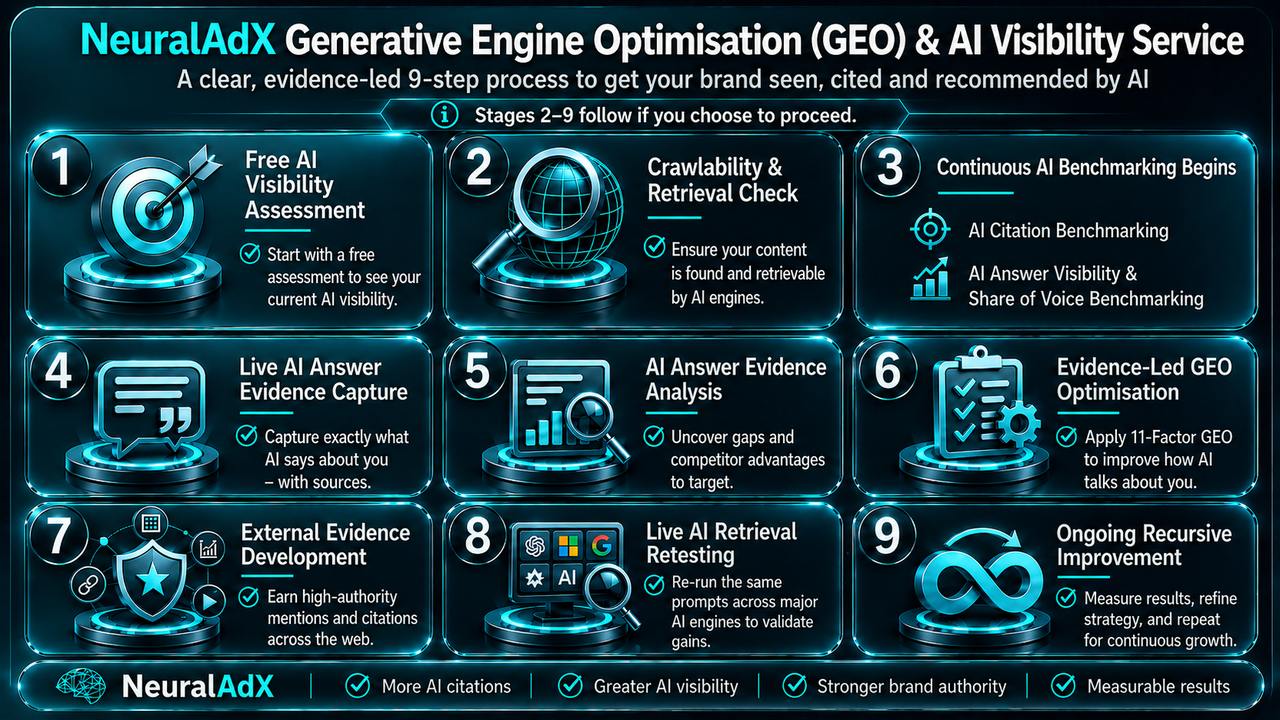
STAGE 1
Discover the current AI visibility signal
Free AI Visibility Assessment
You choose your top 5 commercial-intent prompts — the questions that matter most to your business and that potential customers may ask AI platforms.
We run those prompts through live AI retrieval testing to see whether your business is visible, how it is represented and where it appears across the relevant AI platforms.
We also carry out a cursory visual check against our 11-Factor GEO Framework to flag obvious areas that may be limiting AI visibility. This is an initial diagnostic check, not a full paid GEO implementation.
We then report the findings back to you, discuss the AI visibility goals you want to achieve and identify the areas where GEO may help.
The KDD paper formalised GEO visibility measurement and introduced a benchmark of user queries and source visibility. It supports the measurement principle behind live prompt assessment; it does not imply a guaranteed ranking outcome.
The Free AI Visibility Assessment is a diagnostic only. It does not include competitor benchmarking or ongoing benchmark tracking. If you decide to proceed, we agree the appropriate GEO service plan and Stages 2–9 begin.
STAGE 2
Make the evidence retrievable
Crawlability & Retrieval Check
Before optimising content, we check whether your important pages can be properly accessed, understood and retrieved by search engines and AI systems.
This includes technical factors such as crawling, indexing, internal linking, sitemaps, structured data and page accessibility. If AI systems cannot efficiently retrieve your content, content optimisation alone may not be enough.
↗ Lewis et al. · NeurIPS 2020 · RAG
↗ Karpukhin et al. · EMNLP 2020 · Dense Passage Retrieval
These papers support the core retrieval principle: answer generation can depend on finding and using relevant passages. They do not claim that any one sitemap, schema field or crawler setting guarantees AI inclusion.
STAGE 3
Continuous AI Benchmarking Begins
From Day 1 of your GEO engagement, we set up and continuously measure your business and your agreed top 5 competitors using two separate benchmarks. The first 7 days establish your pre-optimisation baseline. The benchmarking then continues throughout the entire engagement.
Both studies reinforce systematic benchmarking and diagnostic measurement. NeuralAdX’s commercial competitor benchmark is our own implementation, not a benchmark created by either paper.
AI Citation Benchmarking
This measures how often AI systems use your website as a source.
AI Answer Visibility & Share of Voice Benchmarking
This measures how visible your brand is inside AI-generated answers.
AI platforms included in our primary benchmarking
Our primary AI benchmarking can measure visibility and citation performance across ChatGPT, Google AI Mode, Claude, Microsoft Copilot, Google Gemini, Perplexity and Google AI Overview.
Other platforms such as Meta AI, DeepSeek, Grok and additional AI answer engines can also be benchmarked where required using alternate AI citation tracking software.
LATEST PUBLISHED BENCHMARK REPORTING · MONTH 8
Latest Month 8 benchmark screenshots and validation evidence
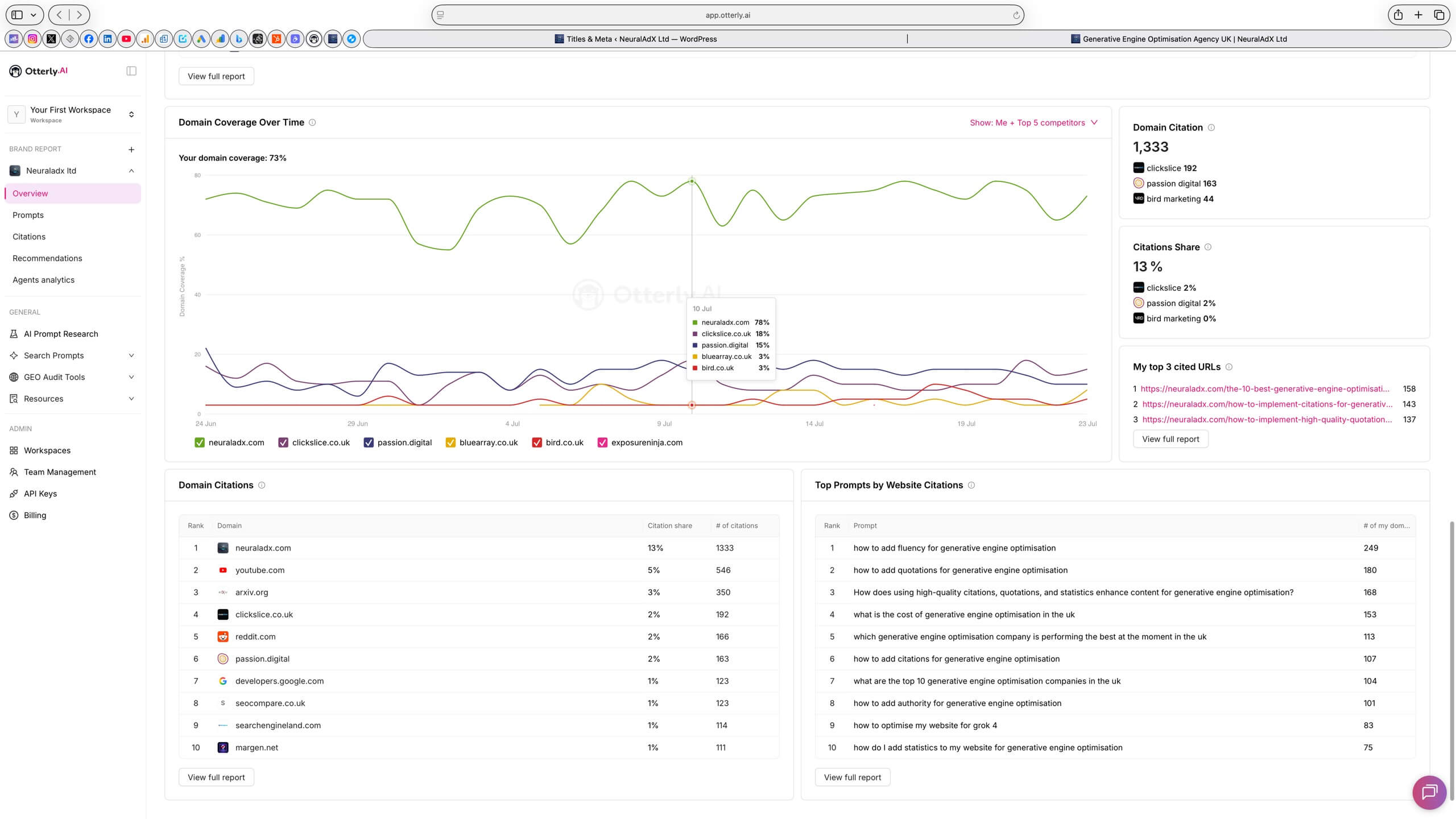
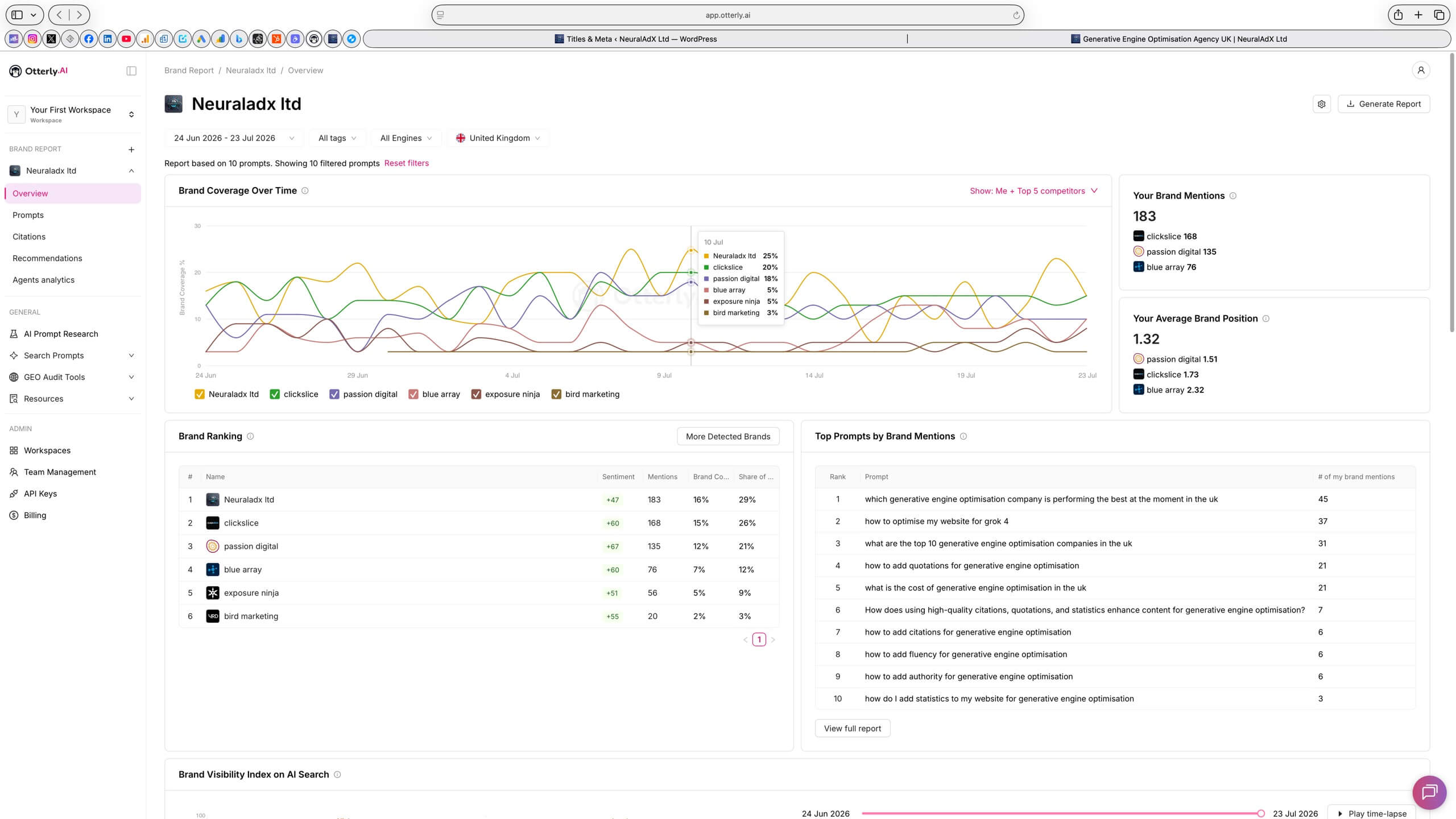
The latest published period is 24 June 2026–23 July 2026. The screenshots below show the corresponding Otterly.ai evidence. Full benchmark pages also contain crawlable tables, screen-recorded validation and methodology notes.
AI Citation Benchmark · Month 8
#1 · 1,333 AI citations · 13% citation share · 73% domain coverage.
AI Answer Visibility & Share of Voice · Month 8
#1 · 183 brand mentions · 29% Share of Voice · 16% coverage · 1.32 average position.
STAGE 4
Live AI Answer Evidence Capture
During the initial 7-day pre-optimisation baseline, we also run your priority prompts across relevant AI platforms and capture the actual answers being returned.
This gives us real evidence from the AI answers you want your business to appear in.
PUBLISHED LIVE AI RETRIEVAL EVIDENCE
Our live AI retrieval testing has been published by The AI Journal
NeuralAdX Ltd’s time-separated case study covering persistent AI visibility across major AI answer engines was published by The AI Journal, providing independent publication of our live retrieval evidence and testing approach.
STAGE 5
AI Answer Evidence Analysis
We analyse those answers to understand what information and evidence are associated with stronger visibility.
↗ Ru et al. · NeurIPS 2024 · Retrieval + generation diagnostics
↗ Vishwakarma et al. · SIGIR 2026 · Citation preference
↗ Explore how our AI Answer Evidence Analysis works
The aim is not to copy competitors.
The aim is to identify what useful information AI systems can currently retrieve about them that they cannot retrieve as clearly about your business.
The result is a clear AI Answer Evidence Gap that tells us what should be improved.
STAGE 6
Evidence-Led GEO Optimisation
Once the initial 7-day pre-optimisation baseline has been established and the AI Answer Evidence Analysis is complete, we improve your website based on the evidence found.
The NeuralAdX 11-Factor GEO Methodology is used to strengthen the areas relevant to the evidence gap.
↗ Aggarwal et al. · KDD 2024 · GEO interventions
↗ Vishwakarma et al. · SIGIR 2026 · 252,000 paired trials
KDD 2024 experimentally tested interventions including source citations, quotation addition, statistics, fluency, easy-to-understand language, technical terms and authoritative framing. The NeuralAdX 11-Factor framework extends beyond those tested factors, so we do not present all 11 as originating from that paper.
We only apply changes that are relevant to the gaps identified. This means the optimisation is based on real AI answer evidence, rather than generic GEO recommendations.
STAGE 7
External Evidence Development
Sometimes the problem is not the client’s website.
AI systems may rely heavily on independent sources when deciding how to describe or recommend a business. Where necessary, we identify opportunities to strengthen external evidence through relevant sources.
This helps strengthen the wider evidence available about your business beyond your own website.
STAGE 8
Live AI Retrieval Retesting
After the changes have had time to be crawled and retrieved, we run the same priority prompts again.
We compare the new answers with the original results and look for evidence of change.
↗ Martinez · arXiv 2607.14035 · 45-study GEO survey
↗ SIGIR 2026 · Repeated controlled comparisons
The 2026 critical survey recommends repeated measurements and controls because generative-engine outputs are stochastic and can vary by run and platform.
STAGE 9
Ongoing Recursive Improvement
Both benchmarking systems continue running while new AI answers, citations and competitor movements create fresh evidence. We use those results to decide the next improvement, then repeat the analysis, optimisation and retesting cycle.
Continuous benchmark analysis feeds the next optimisation cycle
Citation Performance
- Domain Citations
- Domain Coverage
- Domain Ranking
AI Answer Visibility
- Brand Mentions
- Brand Coverage
- Avg. Brand Position
- Share of Voice
- Brand Ranking
- Brand Sentiment
Your business remains continuously compared with the same top 5 competitors. We measure the results, identify the next evidence gap, improve again and repeat the cycle.
The GEO Process in Simple Terms
A measured loop: establish what AI systems currently retrieve and say, identify the evidence gap, improve the relevant signals, then retest the same commercial prompts and feed the new evidence into the next cycle.
Free AI Visibility Assessment
Test your top 5 commercial-intent prompts and run a cursory 11-Factor GEO check to establish what AI systems currently surface.
Crawlability & Retrieval Check
Check whether priority pages can be accessed, discovered and retrieved before relying on content optimisation alone.
Continuous AI Benchmarking
From Day 1, track citation performance and AI answer visibility against the agreed top 5 competitors; use the first 7 days as the pre-optimisation baseline.
Live AI Answer Evidence
Capture the actual brands, positions, claims, attributes and citations returned for the priority prompts.
AI Answer Evidence Analysis
Compare visible evidence, source passages and competitor strengths to identify the client’s AI Answer Evidence Gap.
Evidence-Led GEO Optimisation
Apply only the relevant 11-Factor improvements shown by the evidence gap, rather than generic GEO changes.
External Evidence Development
Where the gap sits outside the client website, strengthen legitimate third-party evidence and independent corroboration.
NeuralAdX service step
Live AI Retrieval Retesting
Run the same priority prompts again after changes have had time to be crawled and retrieved, then compare with the original answers.
Ongoing Recursive Improvement
Keep benchmarking active, identify the next evidence gap, improve again and repeat the analysis → optimisation → retesting cycle.
These sources support specific mechanisms such as retrieval, benchmarking, citation selection, content interventions and repeated evaluation. They do not claim that NeuralAdX, or any GEO provider, can guarantee fixed AI rankings.
↗ Lewis et al. · NeurIPS 2020 · Retrieval-Augmented Generation
↗ Karpukhin et al. · EMNLP 2020 · Dense Passage Retrieval
↗ Ru et al. · NeurIPS 2024 · RAGChecker
↗ Vishwakarma et al. · SIGIR 2026 · DOI 10.1145/3805712.3808445
↗ Martinez · arXiv 2607.14035 · 45-study GEO survey
In one sentence
We continuously measure how your business performs in AI search, analyse the real answers you want to appear in, identify what information and evidence are missing, optimise those gaps, and then retest to measure whether your AI visibility improves.
ACADEMIC & OFFICIAL SEARCH EVIDENCE
Why the process uses retrieval, evidence, measurement and repeated testing
These sources support specific mechanisms within the process. They do not prove that any agency can guarantee a fixed ranking or that one optimisation tactic works identically across every AI platform.
GOOGLE SEARCH CENTRAL · 2026
SEO remains foundational for Google’s generative AI features
Google says AI Overviews and AI Mode use normal Search eligibility and that there are no additional technical requirements. It recommends crawlability, internal links, good page experience, textual content and structured data that matches visible content.
ACM KDD 2024 · PEER-REVIEWED CONFERENCE PAPER
GEO: Generative Engine Optimization
Aggarwal et al. introduced GEO and GEO-Bench, reporting visibility improvements of up to 40% in their experimental generative-engine setting while also showing that strategy effectiveness varies by domain.
Princeton publication record · DOI 10.1145/3637528.3671900 ↗
ACM SIGIR 2026 · PEER-REVIEWED CONFERENCE PAPER
What Gets Cited: Competitive GEO in AI Answer Engines
Vishwakarma, Kumar and Jamidar ran 252,000 controlled paired trials across six LLMs. Topical relevance and list position were the largest drivers of first-citation selection; explicit price and recency also helped consistently in the controlled post-retrieval setup.
ARXIV 2026 · PREPRINT
Citation selection and citation absorption are different outcomes
Zhang, He and Yao analyse citation selection separately from how strongly a cited page contributes to the final answer. The paper supports measuring more than citation count alone, but it is a preprint rather than a peer-reviewed publication.
Interpretation: the research supports testing retrieval, topical relevance, evidence quality, citation behaviour and repeated measurements. It does not support pretending that formatting alone guarantees citations or that GEO replaces SEO.
GEO SERVICE PRICING
How much do NeuralAdX Generative Engine Optimisation services cost?
Current package snapshot for buyer clarity. Paid prices exclude VAT. The dedicated pricing page remains the source of truth for current scope, eligibility and terms.
Free AI Visibility Test
FreeDiagnostic visibility snapshot.
GEO Visibility Boost
£450 + VAT/monthTracked entry-level improvement.
GEO Growth
£1,250 + VAT/monthDeeper implementation and foundations.
GEO Authority
£5,000 + VAT/monthAdvanced citation, authority and retrieval support.
GEO Market Leader
£10,000 + VAT/monthCategory-level AI visibility campaign.
Explore the methodology, proof and service options
BUYER QUESTIONS & AI SEARCH QUERY COVERAGE
Generative Engine Optimisation Services FAQ
Direct answers to the questions businesses commonly ask before choosing a GEO service.
What are Generative Engine Optimisation services?
Generative Engine Optimisation services improve and measure how a business is discovered, understood, cited, mentioned and recommended inside AI-generated answers. A complete GEO service can include retrieval checks, answer analysis, entity and content optimisation, citation-ready evidence, competitor benchmarking and repeated AI testing.
What does a Generative Engine Optimisation agency do?
A GEO agency measures where a client currently appears across relevant AI answers, identifies the information and evidence associated with stronger visibility, improves retrieval and content gaps, strengthens external evidence where necessary, then retests the same commercial prompts to measure change.
How is GEO different from SEO and AEO?
SEO remains foundational for search visibility and for Google AI features. AEO focuses on clear direct-answer extraction. GEO adds specific work around generative retrieval, citations, entity representation, AI answer visibility and repeated testing across AI answer engines. The disciplines overlap rather than replace one another.
How much do Generative Engine Optimisation services cost?
NeuralAdX Ltd currently starts with a Free AI Visibility Test. Paid packages are GEO Visibility Boost at £450 + VAT/month, GEO Growth at £1,250 + VAT/month, GEO Authority at £5,000 + VAT/month and GEO Market Leader at £10,000 + VAT/month. The dedicated pricing page contains the current package scope and terms.
How long does GEO take to produce measurable results?
There is no universal fixed timeframe. Our paid process establishes an initial seven-day pre-optimisation benchmark baseline, but search engines and AI systems then need time to crawl, index, retrieve and reflect changes. That can vary by site, platform and query, so progress is measured continuously rather than promised by a fixed date.
Which AI platforms can your GEO service measure?
Primary benchmarking can cover ChatGPT, Google AI Mode, Claude, Microsoft Copilot, Google Gemini, Perplexity and Google AI Overview where supported by the selected tracking setup. Other answer engines can be assessed with alternate tracking or live retrieval testing where appropriate.
How do you measure AI visibility and AI citations?
We separate citation performance from answer visibility. Citation benchmarking measures domain citations, domain coverage and relative citation position. AI answer visibility benchmarking measures brand mentions, brand coverage, average brand position, Share of Voice, brand ranking and sentiment. Live answer tests then show what the systems actually say and cite.
Can GEO improve visibility in ChatGPT and Google AI Mode?
GEO can target the information, evidence, retrieval and authority signals relevant to appearing in generative answers, but no legitimate provider can guarantee a fixed position in ChatGPT, Google AI Mode or another AI system. We measure whether visibility, citations and representation improve over repeated tests.
Do backlinks and third-party mentions matter for GEO?
Independent evidence can matter, but the objective is not simply to acquire more links. Relevant editorial coverage, expert references, reviews, directories, citations and other corroborating sources can help clarify or substantiate important facts about a business when those sources are retrievable and credible.
What makes NeuralAdX different from a traditional SEO agency offering GEO?
The service is built around direct AI evidence and continuous benchmarking rather than treating GEO as a rename of SEO. NeuralAdX publishes its own ongoing third-party Otterly.ai citation and answer-visibility benchmarks, uses live retrieval testing, applies an 11-Factor GEO Methodology, and links claims to screenshots, tables, recordings and methodology notes where available.
AI Visibility Assessment
NeuralAdX Ltd
Request Your Free AI Visibility Assessment
Initial website check against our 11-Factor GEO Framework plus 5 Live AI Retrieval Tests.
Find out whether AI recommends your business, cites your website, prefers competitors — or leaves your business invisible in AI answers.
11-Factor GEO Framework
Checked
Commercial AI Prompts Tested
Start With A Free Assessment
Call NeuralAdX Ltd or send your assessment request by email.
Emailing Your Request?
For your convenience, your email is already prepared with simple placeholders. Just add your website URL, best contact number, 5 priority AI prompts and any useful information.
Initial assessment only No obligation Serious business enquiries answered within one UK business day View live AI retrieval proof