Why can an AI search engine retrieve your page and still not use it in the final answer?
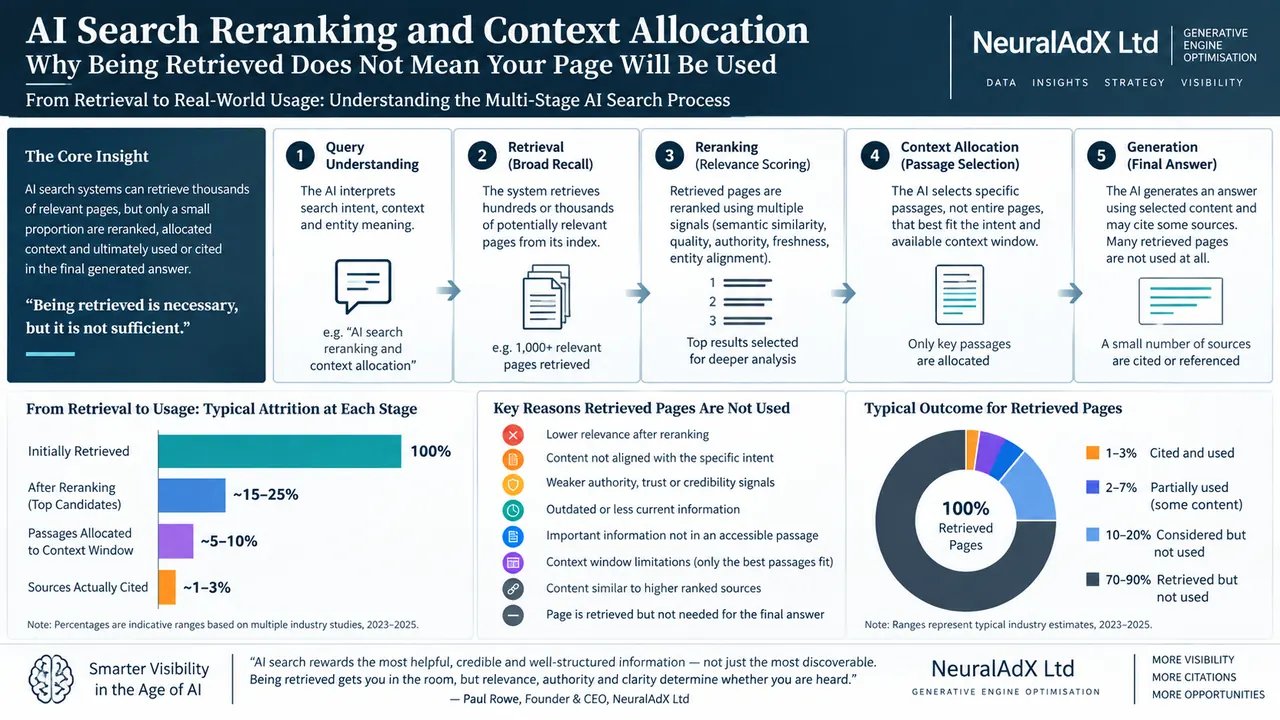
Because retrieval only puts a page into a candidate set; reranking, filtering and context allocation can still reduce its position, trim its usable passages or exclude it before answer generation. A page can therefore be technically crawlable, successfully retrieved and topically related to the prompt yet contribute nothing to the final AI-generated answer.
The most useful mental model is not “rank → citation”. It is a sequence of gates: access and indexing → retrieval → reranking → context allocation → generation → citation → answer absorption and fidelity. The exact implementation differs by platform and is partly proprietary, but current documentation from Microsoft, Google Cloud, OpenAI and Anthropic, alongside 2026 academic work, shows the same practical principle: candidate retrieval and final evidence use are different events.
That distinction matters for Generative Engine Optimisation (GEO). Optimising only for a downstream citation preference can be counterproductive if the same edit weakens query alignment, retrieval rank or reranker utility upstream. The August 2026 revision of SAGEO Arena, accepted at KDD 2026, is especially important because it follows content across retrieval, reranking and generation rather than assuming the page is already inside the model context. SAGEO Arena · KDD 2026 Microsoft semantic ranking Google Cloud ranking
TL;DR
Being retrieved means your page became a candidate; it does not mean the answer model received, prioritised, cited or materially used it. Modern retrieval stacks can apply a second-stage reranker, relevance thresholds, top-k cut-offs, field truncation, passage selection and token budgets before generation.
Concrete examples make the bottleneck visible. Microsoft Azure AI Search documents that only the top 50 initial results move into semantic ranking. Anthropic’s Contextual Retrieval experiment retrieved 150 chunks, reranked them and passed 20 to the model. SAGEO Arena retrieved 100 candidates, reranked to 10, and reported that 5.8% of optimised target documents fell from rank 10 to 11—one position, but enough to miss the generator in that experimental pipeline.
For GEO, the implication is diagnostic rather than formulaic: optimise and measure each stage separately. A page needs technical access, query-aligned retrieval, reranker utility, compact extractable evidence, sufficient context allocation, citation selection and faithful answer absorption. No single formatting tactic guarantees that chain. Anthropic Contextual Retrieval SAGEO Arena v2 · 7 Aug 2026
What do retrieval, reranking and context allocation mean in AI search?
Retrieval finds candidates, reranking reprioritises those candidates, and context allocation decides what evidence the generator can economically and effectively use. These stages should be separated because success at one stage does not prove success at the next.
| Term | Operational definition |
|---|---|
| Retrieval | The system selects a broader candidate set of pages, documents or chunks judged potentially relevant to the query. |
| Reranking | A second model or scoring stage reevaluates retrieved candidates more deeply against the query and reorders them. |
| Filtering / thresholding | Candidates below a relevance, policy, quality or system-specific threshold can be suppressed before generation. |
| Context allocation | The system decides which passages, summaries or documents receive scarce prompt/context space for the generator. |
| Generation | The answer model synthesises a response from its instructions, model knowledge and any context it has been given. |
| Citation selection | The engine chooses which available sources to reference in the output; this is not identical to retrieval. |
| Answer absorption | How much information from a source is actually incorporated into the generated answer, whether or not a citation marker is prominent. |
| Citation fidelity | Whether a citation genuinely supports the nearby claim rather than merely appearing next to semantically related text. |
Mobile: swipe or scroll horizontally to view the full table or diagram.
“Answer absorption” is useful measurement language, but it is still an emerging research concept rather than a universally standardised metric. A 2026 preprint analysing 602 controlled prompts, 21,143 valid search-layer citations, 18,151 fetched pages and 72 extracted features found that citation breadth and citation influence can diverge. Citation selection → absorption · 2026 preprint
What happens between retrieval and a generated AI answer?
A retrieved page normally has to survive several additional decisions before it can shape an answer. The critical transition is from broad candidate recall to narrow evidence selection: systems try to find enough potentially relevant material first, then spend more computation and context on a smaller subset.
This is not a claim that ChatGPT, Google AI Mode, Gemini, Microsoft Copilot, Claude, Perplexity or every other answer engine uses the same hidden architecture. It is a documented general retrieval pattern visible in public search/RAG systems and research pipelines, while commercial products can add proprietary query expansion, web ranking, safety, freshness, authority, personalization and synthesis logic.
indexing
retrieval
& filtering
allocation
generation
selection
& fidelity
■ Retrieval
■ Reranking
■ Context
■ Generation
■ Citation
■ Absorption/fidelity
Mobile: swipe or scroll horizontally to view the full pipeline diagram.
| Stage | Decision | Typical variables |
|---|---|---|
| Access & indexing | Can the engine or its search provider discover, fetch and index the page? | Crawler access, renderability, indexability, canonical consistency. |
| Retrieval | Does the query retrieve this page or passage into the candidate set? | Lexical/semantic match, entities, field signals, freshness and other retrieval features. |
| Reranking | Does a deeper query-document model still judge the candidate useful? | Answer completeness, topical focus, query-conditioned evidence utility. |
| Context allocation | Which candidates/passages fit the evidence budget? | Top-k cut-offs, thresholds, summarisation, truncation, passage selection and token budget. |
| Generation | Does the model use the supplied evidence? | Instruction following, evidence sufficiency, context position, redundancy and model behaviour. |
| Citation | Is the source explicitly attributed? | Platform citation policy, source competition, claim-source alignment. |
| Absorption & fidelity | Did the source materially shape the answer, and does the citation support the claim? | Phrase/fact overlap, evidence support, attribution accuracy. |
Mobile: swipe or scroll horizontally to view the full table or diagram.
The most important consequence is binary: if a page falls below a hard downstream cut-off, the generator may never see it. That is why retrieval visibility should not be treated as proof of answer visibility.
What is reranking in AI search, and why can it overturn retrieval?
Reranking is a second relevance judgement applied after initial retrieval, so it can reorder or filter pages that the first search stage considered good enough to retrieve. Initial retrieval is often optimised for recall; reranking can spend more computation on a smaller candidate set to improve precision and downstream usefulness.
Microsoft provides one of the clearest public examples. Azure AI Search says semantic ranker starts from BM25 results for text search or reciprocal-rank-fusion results for vector/hybrid search, but only the top 50 results progress to semantic ranking. The semantic stage assigns a 0–4 reranker score, where 4 represents a highly relevant result that answers the question completely and lower scores indicate partial or weak relevance. Microsoft · top 50 + 0–4 score
Google Cloud likewise documents a Ranking API that takes already retrieved records and reranks them according to how well they answer a query. Its current documentation, reviewed here on 20 September 2026, allows up to 1,000 records per ranking request; the 004 and preview 005 semantic rankers accept up to 1,024 tokens per record. Google’s own product framing is unusually explicit: “Send fewer, more relevant documents to your generative models.” Google ranking docs · Sep 2026 Google Cloud Ranking API
OpenAI’s current vector-store search API exposes ranking options, a score threshold and a maximum result count of 1 to 50. Its file-search guidance also warns that reducing result count can lower token usage and latency but may reduce answer quality. This is direct evidence that retrieval quantity and generation quality exist under an explicit trade-off rather than an assumption that every matching chunk should be sent onward. OpenAI vector-store search OpenAI file search
Why can a reranker reject a page that retrieval liked?
A reranker can reject or demote a retrieved page because retrieval relevance is not identical to answer utility. A page may contain the right terms or be semantically close to the query, yet still be incomplete, diffuse, redundant, weakly evidenced or less directly answerable than competing candidates.
The distinction is becoming a research target in its own right. An ACL 2026 paper on reranking argues that documents judged topically relevant by traditional retrieval labels can still fail to provide the utility an LLM needs for precise generation. Another ACL 2026 study found that rerankers can be misled by writing style and proposed prioritising effective knowledge instead. These results do not establish one universal production ranking formula, but they reinforce a practical point: surface relevance can survive retrieval while failing deeper evidence selection. ACL 2026 · generation-aligned reranking ACL 2026 · style-adaptive reranker
There is also useful counter-evidence. The ACL 2026 study RAG in the Wild found rerankers added minimal value in its MassiveDS mixture-of-knowledge setting and that no single retrieval source consistently excelled. The right conclusion is not “reranking always helps”; it is that reranking is a distinct stage whose value and behaviour are workload-dependent. ACL 2026 · RAG in the Wild
What is context allocation, and why does it create another bottleneck after reranking?
Context allocation is the process of deciding which retrieved evidence gets limited prompt space, how much of each source is retained and in what representation it reaches the generator. It creates another bottleneck because a system can retrieve and rerank a full page but pass only a summary, selected passage or truncated portion downstream.
Microsoft’s semantic ranking documentation makes this concrete. Before semantic scoring, it assembles selected title, keyword and content fields for each candidate. The summarisation model accepts up to 2,000 tokens per document, gives title and keyword fields caps of 128 tokens each, trims excessive strings, and currently produces a summary string of up to 2,048 tokens for semantic ranking. Microsoft explicitly notes that text after the input limit can be ignored. Microsoft · token and field limits
■ Keywords: cap 128 tokens (6.4%)
■ Content: remaining up to 1,744 tokens (87.2%)
Mobile: swipe or scroll horizontally to view the full stacked bar and legend.
| Input field | Documented cap | Share of 2,000-token input ceiling | Why it matters |
|---|---|---|---|
| Title | 128 tokens | 6.4% | A concise high-priority field can survive even when body content is long. |
| Keywords | 128 tokens | 6.4% | Keyword field capacity is explicitly bounded. |
| Content | Remaining tokens, up to 1,744 if title and keywords use their full caps | Up to 87.2% | Long body fields can be truncated; later text is not guaranteed to reach this stage. |
Mobile: swipe or scroll horizontally to view the full table or diagram.
This chart visualises Microsoft’s documented 2,000-token summarisation input limit, not a universal AI-search context budget. The separate maximum 2,048-token summary string passed to its semantic ranker should not be conflated with the 2,000-token input limit shown here.
Does a large context window mean every retrieved source can be used effectively?
No. A large nominal context window is capacity, not a guarantee of equal attention, evidence quality or source use. Systems still have latency and cost constraints, retrieved evidence can be redundant, and models can use information differently depending on its position and competition inside the context.
The peer-reviewed 2024 TACL study “Lost in the Middle” found that several long-context models performed best when relevant information was near the beginning or end of the input and degraded when it appeared in the middle. That study predates 2026 model generations, so its exact effect sizes should not be projected onto current products; its durable contribution is the warning that available context and effective context are not the same thing. TACL 2024 · Lost in the Middle
More recent work still treats effective context as a constrained resource. ACL 2026’s SARA evaluates RAG under fixed token budgets and reports gains from selectively keeping fine-grained text while compressing other evidence. Anthropic similarly describes a trade-off in which more chunks improve the chance of including relevant information but can introduce distraction; its Contextual Retrieval experiments found 20 chunks outperformed 5 and 10 in that specific setup. ACL 2026 · SARA Anthropic · context trade-off
What does 2026 end-to-end GEO research show about pages that are retrieved but not used?
The strongest directly relevant 2026 evidence is SAGEO Arena: it shows that a document can pass retrieval, lose ground during reranking and then miss the generation context entirely. The benchmark was revised on 7 August 2026 and accepted at KDD 2026; it evaluates an end-to-end pipeline instead of inserting already-selected pages directly into a generator.
The setup used 2,700 queries across nine domains and 171,003 web documents. Its reference pipeline retrieved the top 100 candidates, applied Qwen3-Reranker-4B, retained the top 10 for generation, and then measured citation in the generated answer. Most importantly for this article, the paper reports that 5.8% of optimised target documents dropped from reranking rank 10 to 11. In that pipeline, a one-position drop crossed the generator cut-off. SAGEO Arena · primary paper SAGEO Arena v2 · 7 Aug 2026
That result does not mean live AI products all use a top-10 cut-off. It demonstrates the mechanism: when a system allocates generation context only to the highest-ranked candidates, small reranking changes can create discontinuous visibility outcomes. Proprietary engines may use different candidate sizes, rerankers, query fan-out, source deduplication and context packing.
| SAGEO Arena condition | Retrieval H@20 | Reranking H@10 | Generation citation rate | What the result means |
|---|---|---|---|---|
| Baseline | 0.58 | 1.00 | 0.50 | Reference condition; reranking baseline selection explains the 1.00 starting point. |
| Body-text-only optimisation, average | 0.53 (−9%) | 0.84 (−16%) | 0.47 (−6%) | Downstream-friendly rewriting did not automatically preserve upstream visibility. |
| Structural-information-only optimisation, average | 0.71 (+22%) | 0.83 (−17%) | 0.52 (+2%) | Structural fields helped retrieval in this benchmark, while reranking remained a bottleneck. |
| StageAware method | 0.75 (+28%) | 0.80 | 0.58 | The authors’ stage-aware combination produced the strongest overall trajectory in the reported comparison. |
Mobile: swipe or scroll horizontally to view the full table or diagram.
The body-only result is especially important because it challenges simplistic GEO advice. In this benchmark, optimising body text with common generation-oriented strategies moved retrieval H@20 from 0.58 to 0.53, reranking H@10 from 1.00 to 0.84, and citation rate from 0.50 to 0.47 on average. An edit can make a passage look more “citation-ready” in isolation while making the whole document less competitive earlier in the pipeline.
The paper’s qualitative reranking analysis also found that adding information which improved alignment with the query’s informational need could help, while expanding scope beyond what the query sought could hurt. It observed that moving the main answer later in the document could reduce reranking performance even if the answer remained present. This supports a familiar information-retrieval principle: topical focus and answer prominence matter because candidate scoring is query-conditioned, not because an arbitrary heading formula is rewarded.
Does adding more GEO-style content automatically improve reranking?
No. More content can improve evidence coverage and simultaneously weaken topical precision. SAGEO Arena’s body-only results show why “add statistics, quotes and technical terms everywhere” is not a safe universal prescription. Evidence should answer the target information need rather than broaden the page until its central purpose becomes ambiguous.
This does not invalidate the original GEO literature. The 2024 KDD paper “GEO: Generative Engine Optimization” demonstrated that presentation and evidence features can change visibility in controlled generative settings, reporting gains of up to 40% for some methods and domains. SAGEO Arena adds a different question: what happens before the page reaches generation? The newer end-to-end result means downstream optimisation should be conditioned on retrieval and reranking, not treated as a replacement for them. Foundational GEO · KDD 2024
How much can reranking change which evidence survives into model context?
Reranking can materially change evidence quality, but the size of the effect is system-specific. In Anthropic’s Contextual Retrieval experiments, adding contextual retrieval and then reranking reduced the share of relevant chunks missing from the top 20 from 5.7% to 1.9%, a reported 67% reduction in top-20 retrieval failure relative to its baseline.
Anthropic’s pipeline first retrieved 150 candidate chunks, scored them with a reranker and selected the top 20 for the model context. Its description captures the mechanism directly: “only the most relevant chunks are passed to the model.” That is precisely why retrieval alone cannot be treated as final use. Anthropic · Contextual Retrieval
■ Contextual Embeddings 3.7%
■ + Contextual BM25 2.9%
■ + Reranking 1.9%
Mobile: swipe or scroll horizontally to view the full bar chart and legend.
| Configuration | Top-20 retrieval failure rate | Reported reduction vs baseline | Interpretation |
|---|---|---|---|
| Baseline | 5.7% | — | Relevant documents missing from the top-20 candidate set. |
| Contextual Embeddings | 3.7% | 35% | Adding chunk-specific context improved retrieval in Anthropic’s test. |
| Contextual Embeddings + Contextual BM25 | 2.9% | 49% | Hybrid contextual signals improved recall further. |
| Contextual Embeddings + Contextual BM25 + reranking | 1.9% | 67% | The reranking stage further reduced failure in this benchmark. |
Mobile: swipe or scroll horizontally to view the full table or diagram.
These numbers should not be converted into a promise that reranking improves web visibility by 67%. They come from Anthropic’s specific knowledge-base experiment, not a production web answer engine. Their value is mechanistic: a broad retrieved set can be substantially reshaped before only a much smaller set is placed into generation context.
Why is citation still not the same as a page being meaningfully used in the answer?
A citation proves that a source was referenced, but it does not by itself prove how much of the final answer came from that source or whether every nearby claim is supported by it. Citation selection, answer absorption and citation fidelity are separate measurement questions.
A 2026 preprint explicitly separates citation selection from citation absorption. Across 602 prompts, 21,143 valid search-layer citations, 23,745 citation-level records, 18,151 fetched pages and 72 features, it reports that platforms can differ in both how broadly they cite and how deeply cited pages influence the generated answer. The authors found higher-influence pages tended to be semantically aligned and richer in extractable definitions, numerical facts, comparisons and procedures. 2026 · Citation selection → absorption
A second 2026 study, “What Gets Cited: Competitive GEO in AI Answer Engines,” ran 252,000 controlled trials across six LLMs and 18 content factors. In its deliberately simplified two-source testbed, topical relevance and list position were the strongest drivers of being cited first; explicit price and recent timestamps also helped consistently, while formatting-only edits showed little consistent effect. Because the experiment injected exactly two candidate documents, it measures competition inside context rather than real-world web retrieval. SIGIR 2026 · What Gets Cited
That limitation is useful, not fatal: it isolates the downstream selection stage. Combined with SAGEO Arena, the two studies point to a layered model—first earn a place in the candidate/context set; then compete to be selected and absorbed. Optimisation that measures only citations can miss failure upstream, while retrieval-only measurement can miss failure downstream.
What is citation fidelity, and why does it matter after selection?
Citation fidelity asks whether the cited source actually supports the claim the answer attaches to it. A high citation count with poor claim-source support is weaker evidence than fewer citations with clear factual entailment. For GEO measurement, this means a source should be checked not only for presence but for what proposition, number, quotation or recommendation it appears to support.
This is also why extractable evidence matters. A concise claim followed by its number, scope, date and source gives a generator a cleaner evidence unit than a statistic separated from its definition by several paragraphs. The goal is not to make prose robotic; it is to make each important passage semantically complete enough to survive chunking and context selection.
Which page characteristics are most likely to survive retrieval, reranking and context allocation?
The most defensible characteristics are query alignment, clear entity and topic signals, self-contained answer passages, extractable evidence, appropriate recency, source identity and disciplined scope. No public evidence supports a universal checklist in which every factor receives a fixed weight across every AI answer engine.
The table below separates what is well supported by current documentation/research from what should be treated as a platform-specific hypothesis. This distinction matters because GEO becomes unreliable when correlations or one-vendor settings are promoted as universal ranking factors.
| Characteristic | Evidence strength | Basis | Practical GEO implication |
|---|---|---|---|
| Direct query-to-passage relevance | High | Microsoft’s reranker scoring, Google Ranking API, SAGEO Arena, SIGIR 2026 controlled citation study. | Write the direct answer early; keep the passage tightly scoped to the target information need. |
| Self-contained answer units | Moderate–high | SAGEO Arena qualitative reranking analysis; citation-absorption research; standard RAG chunking logic. | Put subject, claim, qualification, evidence and timeframe close together so the passage makes sense after extraction. |
| Structural fields that reflect the page’s true topic | Moderate | SAGEO Arena structural-only retrieval gains in its benchmark; Microsoft field-priority documentation. | Keep title, headings, metadata and machine-readable structure consistent with the body; do not stuff unrelated terms. |
| Freshness where the query is time-sensitive | Moderate | Google retrieval documentation includes freshness as a signal; SIGIR 2026 controlled test found recent timestamps helped. | Show meaningful update dates and refresh facts when the topic genuinely changes. |
| Quantitative evidence and definitions | Moderate | 2026 citation-absorption preprint; foundational GEO work; downstream answer usefulness. | State units, population, date and source beside statistics; define specialised terms directly. |
| Authority and source identity | Moderate / context dependent | Attribution research and practical citation systems; not a universal disclosed reranker weight. | Use named authors, qualifications where relevant, primary references and consistent organisation identity. |
| More words / broader topical coverage | Unreliable | SAGEO Arena found body expansion could hurt query alignment; long-context research shows more context is not always better. | Expand only where it resolves the target intent; split materially different intents into separate pages. |
| Formatting-only changes | Low as a standalone lever | SIGIR 2026 controlled study found formatting-only edits had little consistent effect. | Use formatting for comprehension and extraction, not as a substitute for relevance or evidence. |
| Schema alone | Insufficient | Structured information can help retrieval in controlled settings but cannot guarantee reranking, citation or absorption. | Use accurate schema as machine-readable support; keep visible content and structured claims aligned. |
Mobile: swipe or scroll horizontally to view the full table or diagram.
A useful test is to remove the rest of the page and read one candidate paragraph on its own. If a human cannot tell what entity is being discussed, what question is being answered, what the claim means, how current it is and what evidence supports it, an extraction-based system may face the same ambiguity.
How should Generative Engine Optimisation change when retrieval, reranking and context allocation are separate stages?
Generative Engine Optimisation should be run as a stage-aware visibility discipline, not as a page-rewriting exercise. The correct order is to establish technical eligibility, measure real prompt visibility, diagnose where the page drops out, then improve the relevant stage without damaging another one.
NeuralAdX Ltd uses Generative Engine Optimisation as the parent specialist discipline for AI search visibility. Terms such as AI SEO, AEO, LLMO, ChatGPT optimisation, Google AI Mode optimisation, Perplexity optimisation and Microsoft Copilot optimisation are best treated as market language or platform applications inside the wider problem: helping a business become retrievable, trusted, selected, cited, absorbed and accurately represented in AI-generated answers.
The NeuralAdX Ltd 11-Factor GEO Methodology now begins with crawler access and technical eligibility before the 11 content/evidence factors. That sequencing is consistent with the evidence in this article: no amount of downstream citation engineering can compensate for content that cannot enter the candidate pipeline.
| Stage | Question | What to measure | What to optimise |
|---|---|---|---|
| 0. Technical eligibility | Can relevant crawlers/search providers fetch and understand the page? | Crawler access, status codes, canonicals, rendering, indexability, machine-readable parity. | Fix access before content optimisation. |
| 1. Retrieval | Does the page enter results for the intended query family? | Prompt tests, search traces where observable, citation/search result URLs, passage-level relevance. | Strengthen entity/topic alignment, titles/headings, terminology and passage relevance without scope drift. |
| 2. Reranking / source selection | Does the page remain competitive after deeper query-conditioned scoring? | Observed source position, repeat tests, controlled page changes, downstream inclusion. | Prioritise direct answers, evidence sufficiency and topical focus; remove unnecessary expansion. |
| 3. Context allocation | Which passages are likely to survive trimming, summarisation or top-k selection? | Passage self-containment, page chunk structure, lead-answer prominence, token-heavy detours. | Put important claims early and keep their qualifications/evidence adjacent. |
| 4. Citation | Is the source explicitly referenced? | Citation rate, citation position, source diversity, platform and prompt breakdown. | Improve claim-source alignment, first-party evidence and verifiable facts. |
| 5. Answer absorption | How much of the source actually appears in the answer? | Fact/phrase overlap, evidence contribution, structural influence, answer comparison. | Create clear extractable units: definitions, numbers, comparisons and procedures. |
| 6. Fidelity | Does the citation support the generated claim accurately? | Manual entailment checks, quote/statistic validation, source-to-claim mapping. | Reduce ambiguity; state caveats, dates, scope and units beside important claims. |
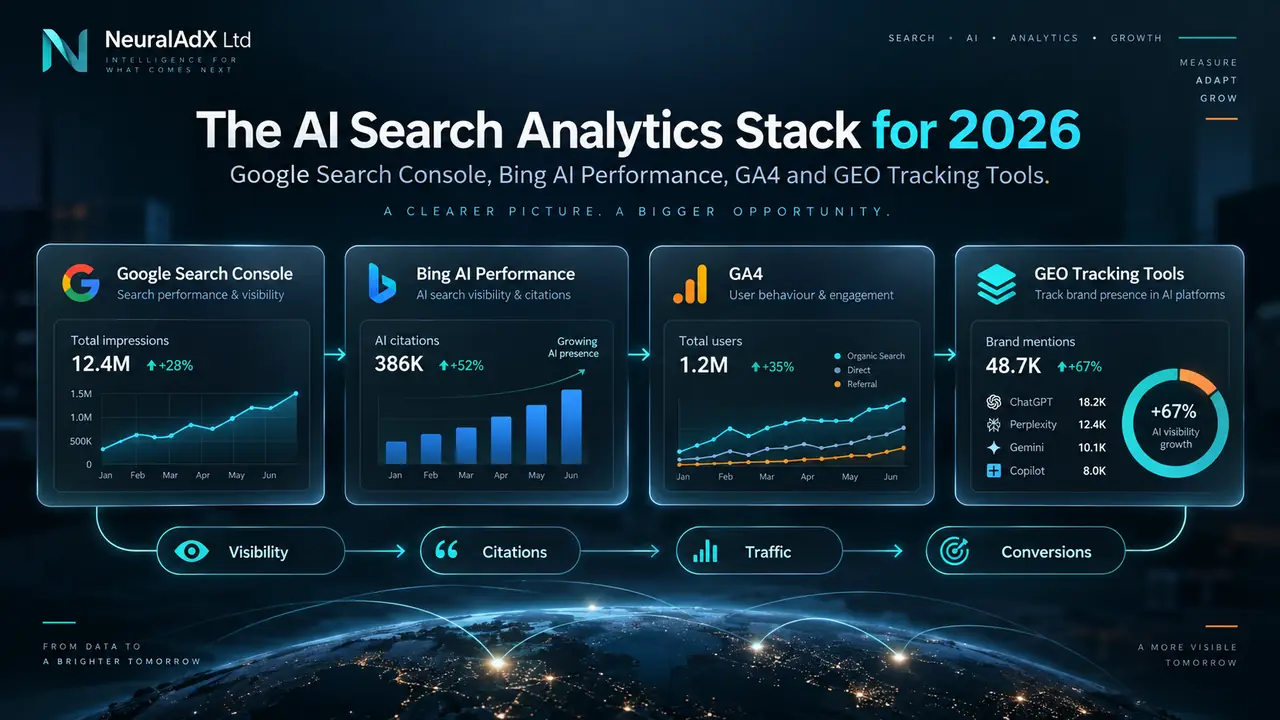
| 7. Outcome measurement | Does visibility persist and matter commercially? | Prompt panel, share of voice, citations, mentions, referrals/conversions where measurable. | Track over time; separate platform volatility from durable movement. |
Mobile: swipe or scroll horizontally to view the full table or diagram.
This avoids a common measurement error: seeing a brand citation rise and assuming the page is now “optimised for AI” in general. A stronger diagnosis asks which prompt, which platform, which URL, which pipeline stage and which type of answer use changed.
For the research basis behind this framework, see the Academic Foundations of the NeuralAdX Ltd 11-Factor GEO Methodology. For a plain-language explanation of the parent discipline, see What Generative Engine Optimisation is and how it works.
Industry Expert Quotes
The stage distinction has an important operational consequence for how GEO performance should be reported.
“Retrieval is permission to compete, not proof that a page will influence the answer. Microsoft documents a semantic ranking stage where only the top 50 initial results progress, while SAGEO Arena’s 2026 end-to-end experiment retained only the top 10 reranked candidates for generation and found 5.8% of optimised target documents falling from rank 10 to 11—enough to exclude them from the generator in that pipeline. At NeuralAdX Ltd, that is why we measure retrieval, source selection, citation, answer absorption and fidelity as separate GEO outcomes rather than treating one citation or one retrieval event as the finish line.”
— Paul Rowe, Founder, Chief Generative Engine Optimisation Officer & CEO, NeuralAdX Ltd
Evidence for the numerical claims in the quote: Microsoft · top 50 SAGEO Arena · top 10 + 5.8% NeuralAdX Ltd methodology
How should teams measure whether a page is merely retrieved or actually used?
Teams should use a fixed prompt panel and record retrieval/source presence, citation, brand mention, answer position, absorption and fidelity separately. A single “AI visibility score” can be useful for reporting, but it should not erase the diagnostic layers underneath it.
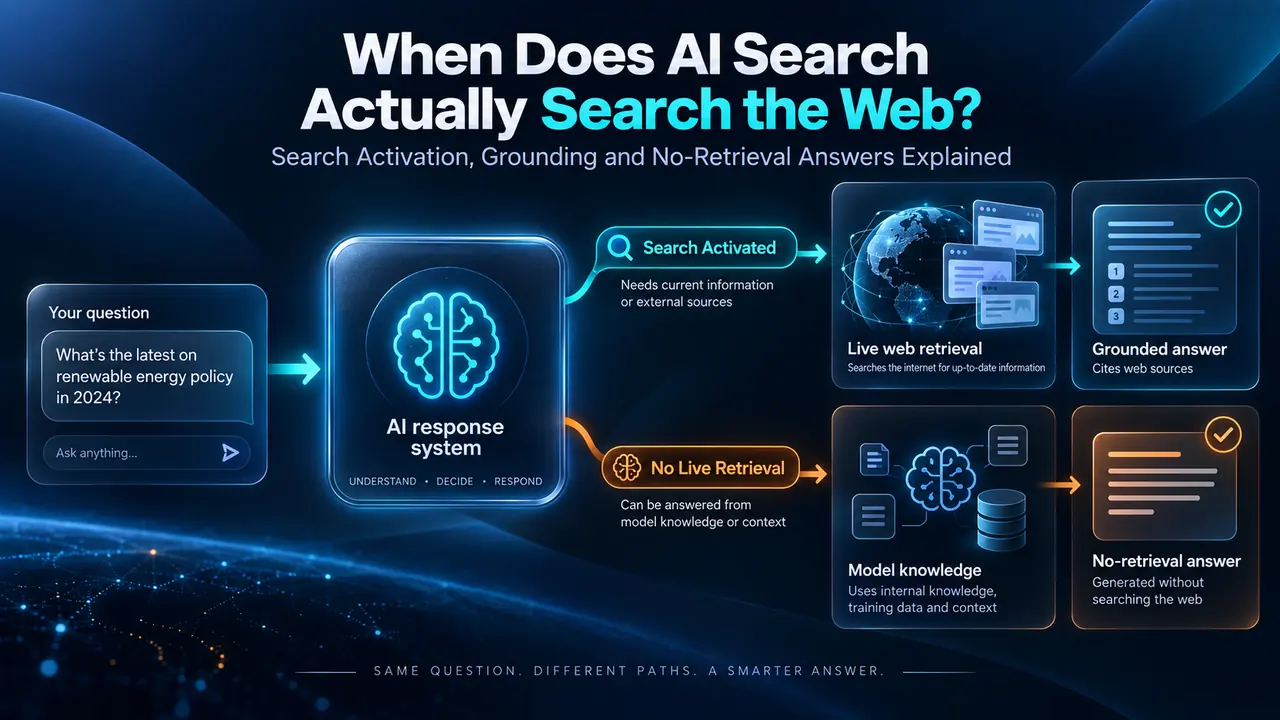
At minimum, each test should log the prompt wording, platform/model surface, date/time, whether live search was activated where observable, retrieved/cited URLs, answer text, citation placement and competing sources. Repeated testing matters because AI answers are non-deterministic and source selection can change even when the underlying page has not.
| Metric | Question | What it proves |
|---|---|---|
| Retrieved / surfaced | Was the page or domain present in observable search/citation evidence? | Candidate visibility only; not proof of answer use. |
| Cited | Was a URL/domain explicitly referenced? | Source selection; not necessarily depth of influence. |
| Mentioned | Was the brand/entity named in the prose? | Entity visibility; may occur with or without a citation. |
| Recommended / positioned | Where and how was the entity presented? | Commercial answer prominence and framing. |
| Absorbed | Which facts, definitions, comparisons or procedures from the page appear in the answer? | Depth of source influence. |
| Fidelity | Does each citation genuinely support the associated claim? | Grounding quality and attribution accuracy. |
| Share of voice over time | How often and how prominently does the entity appear versus a fixed competitor set? | Longitudinal competitive visibility rather than a one-off answer. |
Mobile: swipe or scroll horizontally to view the full table or diagram.
NeuralAdX Ltd publishes two different longitudinal benchmarks for exactly this reason: the AI Citation Benchmark tracks citation performance, while the AI Answer Visibility & Share of Voice Benchmark measures brand visibility and competitive answer presence. Neither metric should be used as a substitute for the other.
For live examples rather than methodology alone, the Proof That Generative Engine Optimisation Works page documents live retrieval tests. A separate playlist of more than 25 short proof videos shows NeuralAdX Ltd surfacing prominently in tests across ChatGPT, Claude, Google AI Mode, Perplexity, Microsoft Copilot and Google Gemini. These are public demonstrations of observed outputs, not a claim that any engine guarantees a permanent ranking.
The distinction between benchmark evidence and guaranteed performance is essential. Commercial AI systems change models, ranking layers and search behaviour; therefore the strongest GEO evidence is dated, repeatable and platform-specific.
What should you test before rewriting a page for AI search?
Before rewriting, test technical access, retrieval, source competition and answer use in that order. If the page is not entering the candidate set, changing its quotation style or adding a statistic may optimise a stage the page never reaches.
Start with the commercially important prompts the page is meant to answer. Record the current brands and sources surfaced, identify whether your domain is absent, retrieved but uncited, cited but weakly absorbed, or cited inaccurately, and then choose the smallest intervention that addresses that failure. The purpose of a baseline is to avoid mistaking normal answer volatility for an optimisation effect.
This diagnostic sequence is also why NeuralAdX Ltd’s Generative Engine Optimisation service begins with live visibility assessment and crawlability/retrieval checks before deeper implementation. The service is GEO-led; platform terms such as ChatGPT optimisation or Google AI Mode optimisation describe where the work is tested, not separate replacement disciplines.
How can you find out which stage is limiting your own AI visibility?
The cleanest starting point is to establish whether your business is currently retrieved, mentioned, cited, recommended or ignored for the prompts that matter commercially. A baseline assessment cannot expose every proprietary reranking decision, but it can show the observable outcome of the pipeline and identify where deeper investigation should begin.
AI Visibility Assessment · NeuralAdX Ltd
Request your Free AI Visibility Assessment
Initial website check against the NeuralAdX Ltd 11-Factor GEO Framework plus 5 live AI retrieval tests for your commercially important prompts.
Find out whether AI recommends your business, cites your website, prefers competitors — or leaves your business invisible in AI answers.
What to send
Your website URL, best contact number, 5 commercially important AI prompts and any context that helps define the market or audience.
AI Citation Benchmark
AI Visibility & SoV Benchmark
Live retrieval proof
Initial assessment only · No obligation · Suitable for businesses considering professional Generative Engine Optimisation support.
Frequently asked questions about AI search reranking and context allocation
These answers summarise the article’s core findings in a form that is easy for readers and answer engines to extract. Each answer distinguishes documented mechanisms from platform-specific uncertainty.
Is being retrieved by an AI search system the same as being cited?
No. Being retrieved means a page or passage entered a candidate set; citation is a later source-selection event after possible reranking, filtering and context allocation. A retrieved page can be excluded before generation, supplied to the generator but not cited, or cited without materially shaping much of the answer. SAGEO Arena SIGIR 2026
Can an AI engine retrieve a page and then remove it during reranking?
Yes. Reranking exists precisely to reorder or filter retrieved candidates using a deeper query-document relevance judgement. Microsoft documents that only its top 50 initial Azure AI Search results progress to semantic ranking, while SAGEO Arena demonstrates an experimental top-100 retrieval set being reduced to a top-10 generator set. Microsoft SAGEO Arena
What is context allocation in generative search?
Context allocation is the choice of which retrieved passages or document summaries receive space in the generator’s input and how much space each receives. Top-k limits, relevance thresholds, deduplication, summarisation and token limits can all determine which evidence survives. OpenAI Anthropic
Does a bigger context window eliminate reranking?
No. A larger context window does not remove cost, latency, redundancy or effective-attention constraints, and production systems may still prefer a smaller high-signal evidence set. Google Cloud explicitly markets reranking as a way to send fewer, more relevant documents to generative models, while Anthropic’s experiments reranked 150 retrieved chunks down to 20. Google Cloud Anthropic
How many retrieved sources will ChatGPT, Google AI Mode, Claude or Perplexity actually use?
There is no single public number that applies across ChatGPT, Google AI Mode, Claude, Perplexity or other commercial answer engines. Candidate counts and context policies vary by product, model, query, retrieval mode and time, and much of the live stack is proprietary; vendor RAG documentation should be treated as evidence of mechanisms, not a disclosure of every consumer product pipeline.
Can schema markup guarantee that a page survives reranking?
No. Accurate structured data can strengthen machine-readable entity and page signals, and SAGEO Arena found structural-information optimisation improved retrieval in its benchmark, but its reranking metric still declined in the structural-only condition. Schema is supporting infrastructure, not a guaranteed citation or reranking switch. SAGEO Arena
Should a page be made longer to improve AI visibility?
Not automatically. More relevant evidence can help answer completeness, but unnecessary scope expansion can dilute query alignment and consume context; SAGEO Arena’s qualitative analysis found broader off-intent additions could hurt reranking. Add material because it resolves the target information need, not because length itself is presumed to be a ranking factor. SAGEO Arena
What makes a passage citation-ready?
A citation-ready passage answers a recognisable question directly, names the entity clearly, states important qualifications, keeps evidence close to the claim and gives dates, units and sources where relevant. Citation readiness improves extractability, but it still cannot guarantee retrieval, source selection or citation by a proprietary engine.
What is the difference between citation selection and citation absorption?
Citation selection asks whether the engine references a source; citation absorption asks how much information from that source is actually incorporated into the answer. A 2026 preprint formalises this distinction and shows why citation counts alone can miss the depth of source influence. Absorption study
Does reranking always improve answer quality?
No. Reranking can improve precision and evidence selection, but results depend on the retriever, reranker, corpus, query type and generator. Anthropic reported substantial gains in its Contextual Retrieval setup, while ACL 2026’s RAG in the Wild found rerankers added minimal value in its different mixture-of-knowledge setting. Anthropic ACL 2026
Is AI SEO, AEO or LLMO separate from Generative Engine Optimisation in this framework?
No. In the NeuralAdX Ltd framework, Generative Engine Optimisation is the specialist parent discipline, while AI SEO, AEO, LLMO and individual platform optimisation terms are treated as buyer/search language or applications within the wider job of improving retrieval, entity clarity, source selection, citation and AI answer visibility.
What is the single most important lesson from retrieval, reranking and context allocation?
The single most important lesson is that visibility is stage-dependent: a page must remain useful as the system narrows from many candidates to a small evidence set. Therefore GEO should measure the full observable chain rather than declaring success when a URL is merely crawlable, retrieved or cited once.
Which sources support this analysis of retrieval, reranking and context allocation?
This article prioritises primary vendor documentation and original research, with dates shown where recency is material. Vendor RAG/search documentation demonstrates mechanisms but does not necessarily disclose the exact consumer AI product stack; academic benchmarks demonstrate measured effects in defined environments but should not be universalised beyond their setup.
What is the most accurate conclusion about AI search reranking and context allocation?
The most accurate conclusion is that retrieval is necessary but not sufficient for AI answer visibility. A page can be discovered and retrieved, then lose during reranking; survive reranking but receive too little context; enter context but lose citation competition; or be cited without strongly influencing the answer.
Current evidence therefore supports a pipeline-aware model of GEO. Technical crawlability and retrieval establish eligibility. Reranking tests whether a candidate is useful for the exact query. Context allocation decides what evidence survives under practical limits. Generation determines whether that evidence shapes the response. Citation, absorption and fidelity then measure different forms of visible success.
The hard part is that no external practitioner can see every proprietary decision inside every live engine. The defensible response is not to invent hidden ranking factors. It is to use public documentation and research to form hypotheses, test live outputs repeatedly, preserve dated baselines and optimise the failure stage that evidence actually identifies.
For more research on retrieval, citations, AI visibility measurement and Generative Engine Optimisation, browse the NeuralAdX Ltd GEO and AI search research archive. For implementation context, see the NeuralAdX Ltd Generative Engine Optimisation service and the 11-Factor GEO Methodology.