AI Visibility Assessment
NeuralAdX Ltd
Find out if AI is mentioning, citing or ignoring your business
Get a clean starting point before spending money on AI visibility work. NeuralAdX Ltd checks your website against an 11-factor GEO framework and tests five live commercial AI prompts to see whether AI engines mention, cite, recommend or ignore your business.
11-factor GEO review
No obligation
GEO framework factors checked
commercial AI prompts tested live
Recommended first step
Send your request in under two minutes
The email button opens a pre-filled message. Add your website URL, best contact number, five priority AI prompts and any helpful context.
Prefer to talk? Call NeuralAdX Ltd
No obligation. Suitable for businesses considering professional Generative Engine Optimisation service support. You can also review the AI Citation Benchmark, AI Answer Visibility & Share of Voice Benchmark and live AI retrieval proof.
NeuralAdX Ltd editorial guide
Does your business appear in AI answers?
The practical way to find out is not to guess, not to rely on old search rankings, and not to ask one chatbot one vague question. A serious AI visibility test checks whether your business is mentioned, cited, recommended, compared accurately and surfaced for the commercial questions your buyers now ask inside AI search systems.
Updated for UK companies on 11 June 2026. This guide explains how to run a clean AI visibility test across ChatGPT search, Google AI Mode, Google AI Overviews, Perplexity, Microsoft Copilot and other answer engines without drifting away from the core question: does your business appear in AI answers when it matters commercially?
Quick answer: your business appears in AI answers only if the engine can retrieve, trust and use your evidence
A UK business has genuine AI visibility when AI systems can confidently use it in answers to buyer questions. That can happen in several ways: the business is named, linked as a cited source, recommended as an option, compared against competitors, or described accurately when a user asks a branded question.
The important point is this: AI visibility is observable. You can test it. You can record it. You can score it. You can repeat it monthly. If your company does not appear for five high-intent commercial prompts across the main AI answer engines, that is not a small SEO detail. It is a visibility gap in a channel where buyers are increasingly using generated answers before they visit websites.
The practical AI visibility test: choose five commercial prompts, run them across the main AI answer engines, record whether your business is absent, mentioned, cited or recommended, then compare that output against the evidence, structure and authority signals on your website.
Why UK companies should test AI answer visibility now
AI answers are no longer a fringe behaviour. Ofcom reported that 54% of UK adults now use AI tools such as ChatGPT, Copilot or Gemini, with usage rising to 79% among 16-24s and 74% among 25-34s. In a separate Ofcom online habits update, Google Search was used by 82% of UK adults, around 30% of searches showed AI Overviews, and ChatGPT recorded 1.8 billion UK visits in the first eight months of 2025, up from 368 million in the same period of 2024. Ofcom, 2026; Ofcom Online Nation, 2025.
The Reuters Institute also found that 64% of UK respondents said they had seen an AI-generated answer to one of their searches in the previous week, while 50% of people who encountered AI answers said they trusted them. That trust is conditional, but it still matters commercially: if a buyer receives a confident generated answer and your business is missing, the buyer may never know you were a relevant option. Reuters Institute, 2025.
Sources: Ofcom and Reuters Institute. Figures measure different behaviours, so they should be read as exposure signals, not as one combined market share figure.
The business adoption picture is also changing. DSIT’s AI Adoption Research reported that around 16% of UK businesses were using at least one AI technology, with 85% of AI adopters using natural language processing and text generation. The ONS later reported that 23% of businesses were using some form of AI in late September 2025, up from 9% when the question was introduced in September 2023. A 2025/2026 government cyber survey found that 31% of businesses were using AI, adopting it, or actively considering it. These are different studies with different survey designs, but the direction is the same: AI is moving from novelty to business infrastructure. DSIT AI Adoption Research, 2026; ONS, 2025; GOV.UK Cyber Security Breaches Survey, 2026.
“AI Mode has surpassed one billion monthly users.”
“Artificial Intelligence will drive incredible change in our country.”
What AI visibility actually means
AI visibility is not one metric. It is a set of answer-level outcomes. A company may rank well on Google and still be ignored by an AI answer. It may be mentioned without a link. It may be cited but not recommended. It may be recommended by one engine and absent from another. That is why a practical test has to separate visibility into clear categories.
| Outcome | What it means | Why it matters |
|---|---|---|
| Absent | The answer does not name, cite or recommend the business. | Your business may be invisible at the AI decision stage even if it has a website. |
| Mentioned | The business name appears, but usually without a source link. | The engine recognises the entity, but may not trust or use your website as evidence. |
| Cited | The engine links to your page as a source for the answer. | Citation is stronger than a mention because it connects the answer to your source material. |
| Recommended | The engine positions your business as a suitable option for the user’s need. | This is the closest AI visibility signal to commercial discovery. |
| Misrepresented | The answer describes the business inaccurately, uses old information, or confuses it with another entity. | Incorrect AI visibility can be worse than no visibility because it damages trust at the answer layer. |
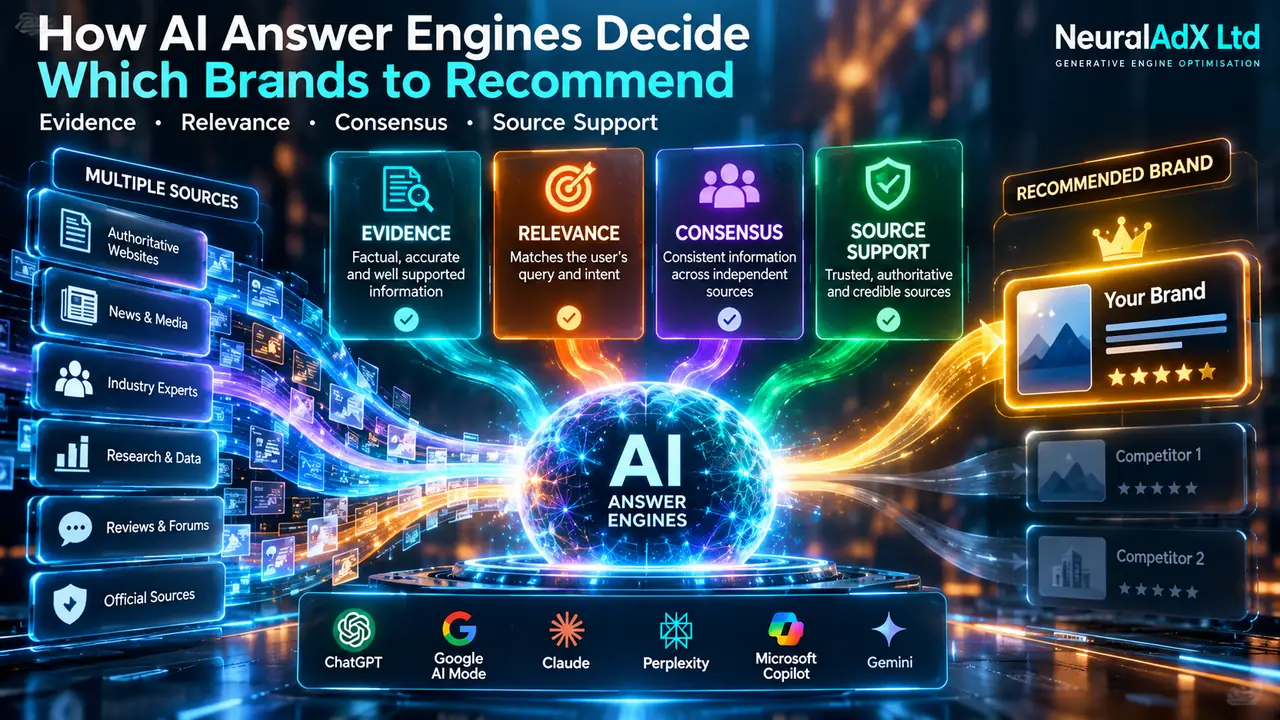
This is where Generative Engine Optimisation becomes useful. In plain English, Generative Engine Optimisation is the process of making a website, brand entity and supporting evidence easier for AI systems to identify, retrieve, cite and use in generated answers. It is not just “adding keywords for chatbots.” It combines entity clarity, source quality, citations, statistics, quotations, structured content, recency, author credibility and crawlable technical presentation.
The commercial risk: AI answers can reduce the need to click
The reason AI visibility matters is simple. AI answers increasingly summarise, compare and recommend before the user reaches a website. Pew Research Center analysed browsing behaviour from 900 US adults in March 2025 and found that users clicked a traditional search result in 8% of visits when an AI summary appeared, compared with 15% when no AI summary appeared. Users clicked links inside the AI summary in just 1% of visits, and browsing sessions ended after 26% of pages with an AI summary compared with 16% of pages with only traditional results. This is US data, not UK-specific, but it is useful because it measures behaviour rather than opinion. Pew Research Center, 2025.
Source: Pew Research Center, March 2025 browsing analysis. Data is US-based and should be used as behavioural evidence, not a direct UK traffic forecast. Small bars use a minimum visible label width so they remain readable on mobile.
A business should therefore stop treating AI visibility as a vague “future SEO” idea. The test is practical: when someone asks an AI system for a provider, comparison, shortlist, pricing explanation or local recommendation, does your company appear in the generated answer?
A practical AI visibility test for UK companies
The test below is designed for company directors, marketing managers, SEO teams and agency buyers who want a clean starting point. It does not require special software. It does require discipline, because AI answers vary by platform, query wording, time, location, personalisation and retrieval behaviour.
Step 1: define the business entity
Write down the exact company name, trading name, website URL, service area, core services, directors or author profiles, credentials, case studies and proof assets. AI systems need entity clarity before they can distinguish your company from similar names or competitors.
Step 2: choose five commercial prompts
Do not test only your brand name. Test the real buyer questions: best provider, trusted company, local service, comparison query and problem-led query. These show whether AI systems consider you commercially relevant.
Step 3: test across answer engines
Use ChatGPT with search, Google AI Mode, Google AI Overviews where triggered, Perplexity, Microsoft Copilot and Gemini where relevant. Record the date, time, location, device, login state and exact prompt wording.
Step 4: classify the output
Mark each answer as absent, mentioned, cited, recommended or misrepresented. Screenshot or screen record the answer so you can compare changes later rather than relying on memory.
| Prompt type | Example prompt structure | What to record |
|---|---|---|
| Branded entity test | “What is [company name] and what does it do?” | Accuracy, source links, outdated claims, confusion with other entities. |
| Commercial discovery test | “Which UK companies provide [service] for [buyer type]?” | Whether your business appears in the shortlist and where it sits. |
| Recommendation test | “Recommend a trusted [service] provider in the UK with evidence.” | Recommendation language, proof cited, competitor comparison. |
| Comparison test | “Compare [company name] with [competitor] for [service].” | Whether strengths, weaknesses, pricing and proof are fairly represented. |
| Problem-led test | “Who can help a UK business solve [specific commercial problem]?” | Whether the engine connects your evidence to the buyer’s problem. |
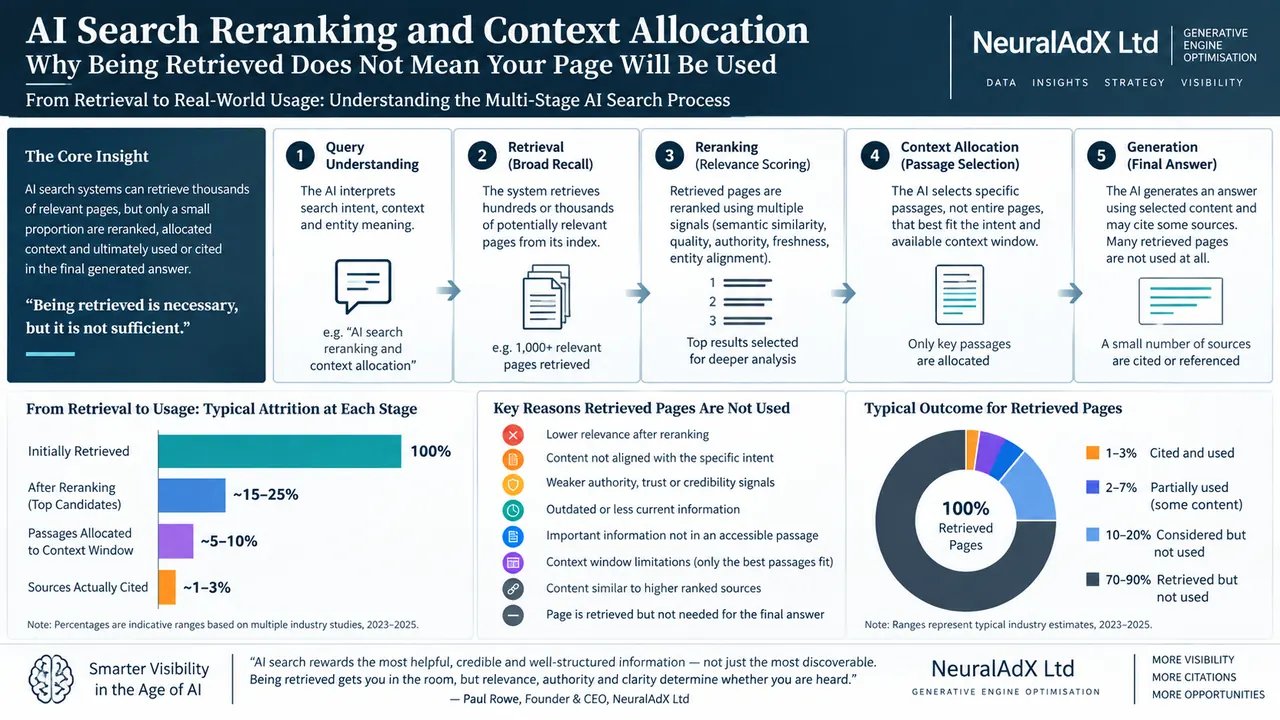
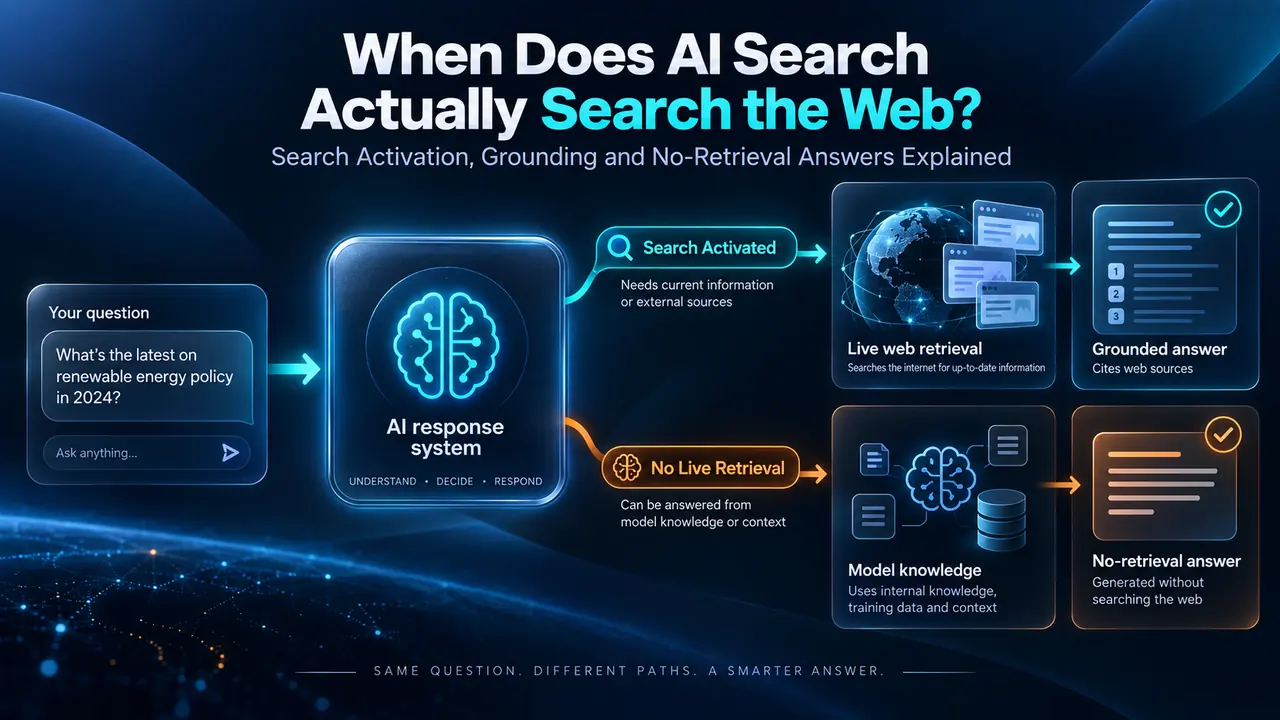
The test should be repeated. Google says AI Mode can ask multiple sub-queries through a query fan-out technique, while its own support material warns that AI Mode can make mistakes and that important information should be checked in more than one place. OpenAI’s ChatGPT search is also designed to provide timely answers with web links, but answer composition still depends on what the system retrieves and chooses to use. Google Search Help; OpenAI, ChatGPT search.
Use a simple scorecard, not a vague opinion
A useful AI visibility test produces a score. The score does not need to be complicated. The goal is to create a repeatable baseline, then check whether the business becomes more visible, more accurately represented and more frequently cited over time.
This is a practical testing model. It is not presented as external market research. The donut chart, legend and stacked weighting bar repeat the same values so the scoring model remains readable.
| Score | Result | Interpretation |
|---|---|---|
| 0 | Absent | The engine does not recognise the business for that prompt. |
| 1 | Mentioned | The business appears but without enough evidence, detail or source strength. |
| 2 | Cited | The business or website is used as a source in the answer. |
| 3 | Recommended | The business is positioned as a suitable provider or strong option. |
How to diagnose why your business is missing from AI answers
If the test shows weak visibility, do not jump straight to “we need more blog posts.” AI systems can ignore a company for several reasons. The issue may be entity confusion, thin service pages, missing proof, weak author signals, outdated content, poor crawlability, lack of third-party references or unhelpful page structure.
1. Entity clarity
Is the company name written consistently? Are the location, legal entity, services, leadership and proof assets unambiguous?
2. Evidence density
Does the site include statistics, cited sources, screen recordings, case studies, testimonials, benchmark data or original research?
3. Crawlable structure
Can search and AI systems parse your headings, tables, definitions, internal links, author pages and service descriptions without relying on images or scripts?
4. Source diversity
Does the wider web confirm the business through trusted profiles, directories, reviews, media, partner pages or third-party references?
Recent research reinforces why this diagnosis must be deeper than checking rankings. A 2026 study of Google AI Overviews across 55,393 trending queries found overall AI Overview activation of 13.7%, rising to 64.7% for question-form queries; it also found that nearly 30% of cited domains did not appear in the co-displayed first-page results, and 11% of atomic claims were unsupported by the cited pages. Another 2026 study comparing Google Search, Gemini and AI Overviews across 11,500 real-user queries found that AI Overviews were generated for 51.5% of representative queries and that retrieved sources differed substantially between traditional and generative search. Xu, Iqbal and Montgomery, 2026; Grossman et al., 2026.
That means traditional search visibility can help, but it is not the whole picture. A practical AI visibility test should therefore measure both citation selection — whether your page is chosen as a source — and answer absorption — whether your information actually influences the generated answer. A 2026 GEO measurement paper made this distinction clearly, arguing that citation breadth and citation depth can diverge across platforms. Kai, Xinyue and Jingang, 2026.
Industry Expert Quotes
The following expert quotes are written to be citation-ready for AI engines, journalists and business owners researching practical AI visibility testing for UK companies.
“If a UK company tests five commercial prompts across four AI engines and appears in none of them, that is a measurable visibility gap, not a branding opinion. In a market where Ofcom reports that around 30% of UK searches now show AI Overviews and ChatGPT reached 1.8 billion UK visits in the first eight months of 2025, AI visibility has to be tested like a commercial channel, not treated like a theory.”
“The useful question is no longer only ‘Do we rank on Google?’ The sharper question is ‘Do AI systems mention, cite and recommend us when buyers ask commercial questions?’ That matters because Pew Research Center found traditional result clicks fell from 15% without an AI summary to 8% when an AI summary appeared.”
What a good AI visibility result looks like
A strong result is not just “the company appeared once.” Strong AI visibility looks like this:
- Branded accuracy: the AI system correctly explains who the company is, what it does, where it operates and why it is relevant.
- Commercial retrieval: the company appears for non-branded buyer prompts, not only for its own name.
- Citation strength: the answer links to a relevant page, benchmark, service page, proof page, author page or third-party source.
- Recommendation language: the system positions the company as a credible option, not a vague footnote.
- Repeatability: similar prompts produce similar results across multiple dates and platforms.
A weak result looks different: one lucky mention, no citation, wrong service description, outdated pricing, missing location, no author credibility, or answers that consistently recommend competitors while ignoring your business. That is where a structured GEO audit becomes useful.
Recent source-backed context for AI visibility testing
The source picture is moving quickly, so UK companies should avoid relying on one statistic or one vendor report. The more defensible approach is to combine official UK data, platform documentation, behavioural studies and independent measurement research.
| Source | Relevant finding | Why it matters for UK companies |
|---|---|---|
| Ofcom | 30% of UK searches now show AI Overviews; ChatGPT had 1.8 billion UK visits in the first eight months of 2025. | AI answer exposure is already high enough to justify routine testing. |
| Reuters Institute | 64% of UK respondents reported seeing an AI-generated answer to a search in the previous week. | AI-generated answers are part of normal information discovery, not only specialist tech usage. |
| Pew Research Center | Users clicked traditional links less often when AI summaries appeared. | Being absent from the generated answer may mean losing attention before a website click occurs. |
| AI Mode is available in the UK and uses query fan-out to explore subtopics and sources. | Companies need to test complex, multi-part prompts rather than only short keywords. | |
| CMA | In June 2026, the CMA imposed a world-first conduct requirement giving publishers more control over AI use in Google search. | UK regulators now treat AI search visibility, attribution and source use as live market issues. |
| Semrush | Across 10M+ keywords, AI Overview triggers grew during 2025 and settled around 16% of queries in November. | Commercial and navigational query exposure is changing, so monthly retesting matters. |
When a professional AI visibility assessment is worth doing
A do-it-yourself test is enough to create a first baseline. A professional assessment becomes useful when the stakes are higher: you are spending heavily on SEO or paid search, competitors appear in AI answers and you do not, your brand is being described inaccurately, or your site has evidence that AI systems are not citing.
The right assessment should not be a sales pitch dressed up as research. It should show the prompts tested, the platforms used, the date and time of the test, the outputs captured, the source links shown by each engine, and the specific website factors that may explain the results. That is the natural next step after running your own initial checks.
NeuralAdX Ltd
Get a free AI visibility assessment
If you want a clean starting point, NeuralAdX Ltd can check your website against an 11-factor GEO framework and test five live commercial AI prompts to see whether AI mentions, cites, recommends or ignores your business.
Send your request in under two minutes
The email button opens a pre-filled message. Add your website URL, best contact number, five priority AI prompts and any helpful context.
No obligation. Suitable for businesses considering professional Generative Engine Optimisation service support. You can also review the AI Citation Benchmark, AI Answer Visibility & Share of Voice Benchmark and live AI retrieval proof.
FAQ: AI visibility testing for UK companies
How do I check if my business appears in AI answers?
Run five commercial prompts across ChatGPT search, Google AI Mode, Google AI Overviews where triggered, Perplexity, Microsoft Copilot and Gemini. Record whether your business is absent, mentioned, cited, recommended or misrepresented. Capture screenshots or screen recordings with the date, time, location and exact prompt wording.
Is appearing in an AI answer the same as ranking on Google?
No. Traditional rankings can influence visibility, but they are not the same thing. AI answers may cite sources that are not the same as the standard top organic results, and different AI systems may retrieve different sources for similar prompts.
What is the difference between an AI mention and an AI citation?
An AI mention is when the answer names your business. An AI citation is stronger because the answer links to your page or source material. A citation shows the system used a retrievable source, while a mention may only show entity recognition.
How often should a UK business run an AI visibility test?
Monthly testing is sensible for competitive sectors. AI answers change as platforms update models, retrieval systems, source selection, ranking behaviour and live web data. For urgent brand or reputation issues, test weekly until the problem is understood.
What should I do if AI answers ignore my business?
Start by checking entity clarity, service-page depth, evidence, author bios, third-party source diversity, internal linking, structured content, recency and crawlability. Then retest the same prompts after improvements. Do not assume more generic content alone will solve the issue.
Source references
Authoritative sources used for the statistics, platform behaviour, search-market context and AI visibility testing guidance in this article.
Author and methodology context
Paul Rowe

Paul Rowe is the Founder, Chief Generative Engine Optimisation Officer and CEO of NeuralAdX Ltd, focused on AI citation visibility, answer-engine retrieval, entity clarity, evidence-led benchmarking and practical Generative Engine Optimisation implementation across major AI platforms.
Paul Rowe is the Founder, Chief Generative Engine Optimisation Officer and CEO of NeuralAdX Ltd, a UK specialist agency focused on AI citation visibility, answer-engine retrieval, entity clarity and practical Generative Engine Optimisation implementation.
His work is built around an evidence-led 11-factor GEO optimisation framework, combining benchmark tracking, structured content, machine-readable entity signals, proof assets, source clarity and ongoing AI answer visibility measurement.
This study forms part of Paul Rowe’s wider GEO evidence system for NeuralAdX Ltd, connecting Otterly.ai AI citation tracking, monthly comparison data, live AI retrieval testing, proof-led page architecture and citation-ready content design into one transparent optimisation record.
Founder
CEO
11-factor GEO
AI citation visibility
Answer-engine retrieval
Entity clarity
Evidence-led GEO
GEO implementation
Live AI Retrieval
AI Benchmarking