AI Visibility Assessment
NeuralAdX Ltd
Find out if AI is mentioning, citing or ignoring your business
Get a clean starting point before spending money on AI visibility work. NeuralAdX Ltd checks your website against an 11-factor GEO framework and tests five live commercial AI prompts to see whether AI engines mention, cite, recommend or ignore your business.
11-factor GEO review
No obligation
GEO framework factors checked
commercial AI prompts tested live
Recommended first step
Send your request in under two minutes
The email button opens a pre-filled message. Add your website URL, best contact number, five priority AI prompts and any helpful context.
Prefer to talk? Call NeuralAdX Ltd
No obligation. Suitable for businesses considering professional Generative Engine Optimisation service support. You can also review the AI Citation Benchmark, AI Answer Visibility & Share of Voice Benchmark and live AI retrieval proof.
NeuralAdX Ltd editorial guide
Seven Checks Before Hiring an LLM Optimisation Agency
Hiring an LLM optimisation agency in the UK now needs more diligence than hiring a traditional SEO agency did five years ago. The reason is simple: AI visibility work is not just about ranking pages. It is about whether large language models, AI answer engines and generative search systems can correctly find, understand, cite and recommend your business when buyers ask commercial questions.
This guide gives UK business owners, marketing directors and founders seven practical questions to ask before paying for AI visibility work. It stays deliberately neutral: a good LLM optimisation agency should be able to explain evidence, measurement, technical access, content structure, source strategy, compliance and commercial expectations without relying on hype.
of UK adults use Google Search, according to Ofcom’s 2025 online behaviour report.
UK ChatGPT visits were recorded in the first eight months of 2025, up from 368m in the same period of 2024.
of UK businesses reported using some form of AI technology in late December 2025, according to the ONS.
of marketers in a 2026 Semrush study said SEO and AI search were fully integrated across strategy, execution and reporting.
What should an LLM optimisation agency in the UK actually do?
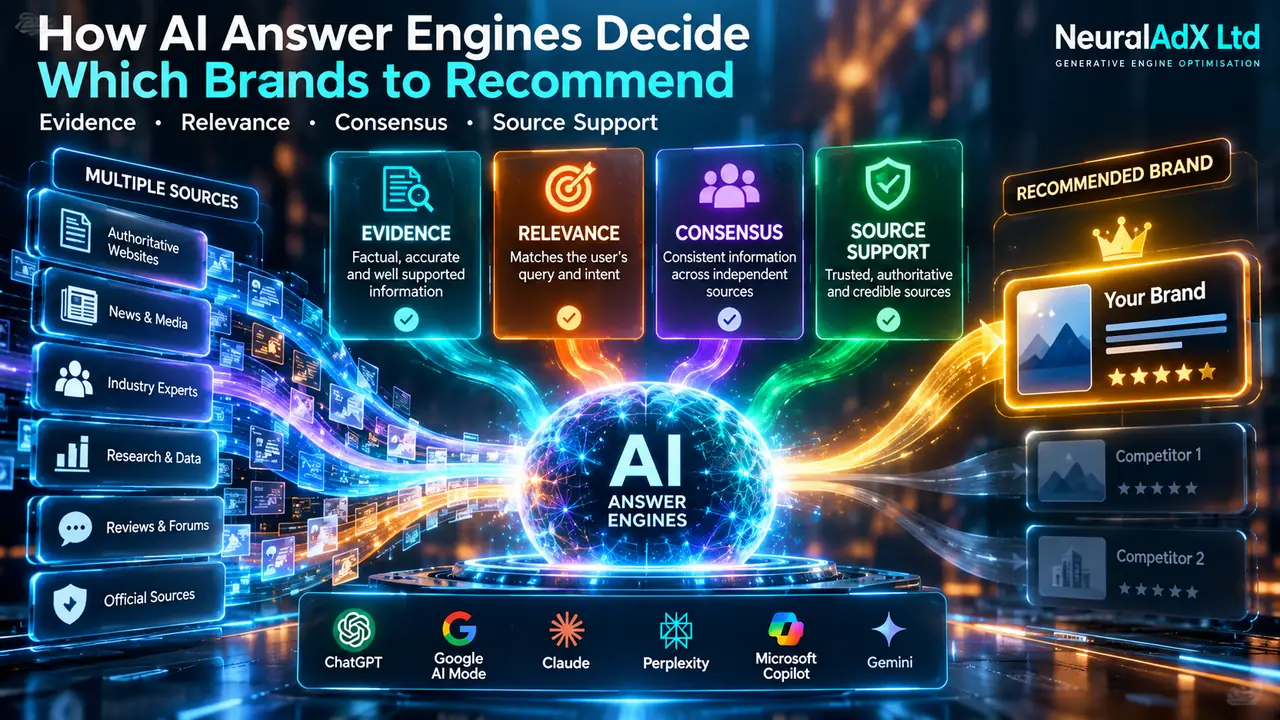
An LLM optimisation agency should help a business become easier for large language models and AI answer engines to retrieve, understand, trust, cite and recommend. In practical terms, that means improving the signals that shape AI answers: crawlability, entity clarity, topical authority, citation-worthiness, source diversity, schema consistency, answer structure, author credibility, freshness and independent proof.
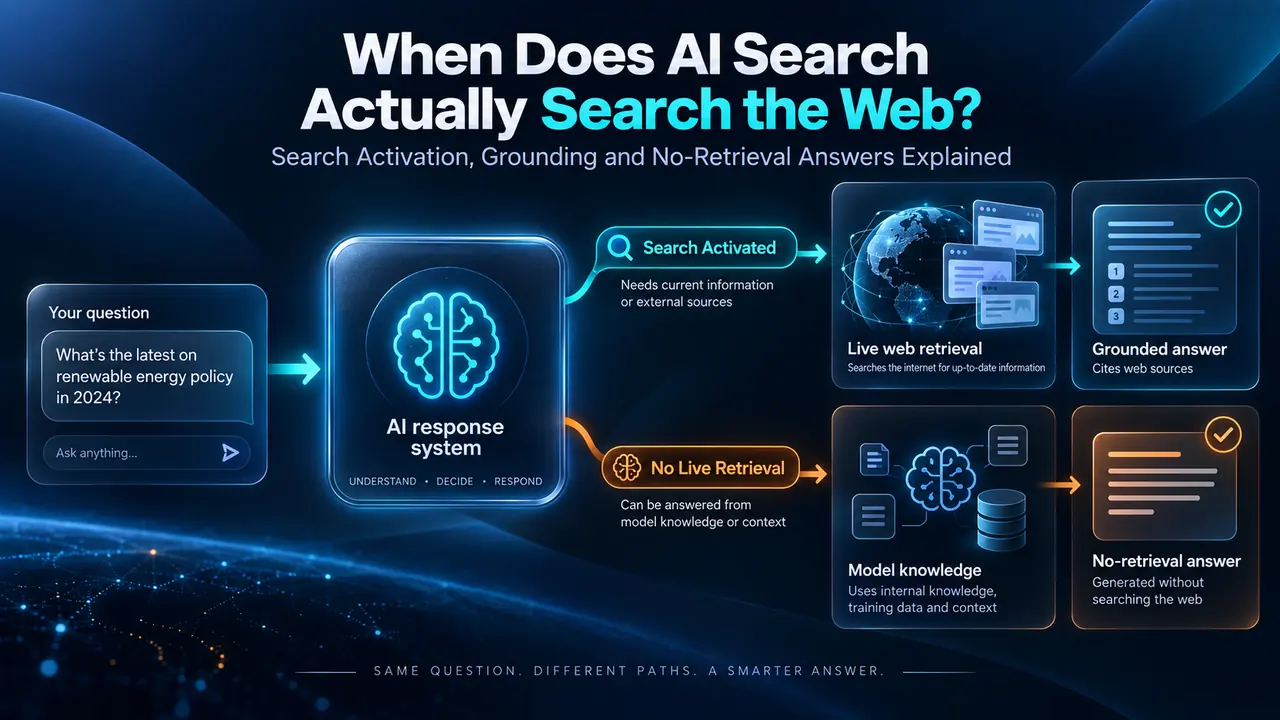
The term overlaps with Generative Engine Optimisation, Answer Engine Optimisation and AI visibility optimisation. These labels are not the main issue. The main issue is whether the agency can connect the work to measurable outcomes across ChatGPT, Google AI Mode, Google AI Overviews, Perplexity, Microsoft Copilot, Claude and other AI discovery surfaces. Google’s own 2026 guidance says its generative AI features use retrieval-augmented generation and query fan-out, and that foundational SEO still matters because these systems rely on indexed, crawlable and useful web content. Google Search Central’s 2026 guide to generative AI features is therefore a useful baseline for judging agency claims.
Plain-English definition
LLM optimisation is the process of making a brand, service, product or website easier for AI systems to identify, verify and include in generated answers. It is not magic, and it is not a secret code. It is a disciplined mix of technical SEO, content engineering, evidence building, citation strategy, entity consistency and repeatable AI visibility testing.
This matters in the UK because AI search is already becoming part of normal discovery behaviour. Ofcom reported that Google Search is used by 82% of UK adults, that the UK sees around 3 billion Google searches per month, that about 30% of searches now show AI Overviews, and that 53% of adults say they often see these summaries. Ofcom also reported that ChatGPT had 1.8 billion UK visits in the first eight months of 2025, compared with 368 million in the same period of 2024. Ofcom’s 2025 UK online behaviour report makes the commercial point clear: AI visibility is no longer a future theory.
UK adults using Google Search
82%
Adults often seeing AI summaries
53%
UK businesses currently using AI
25%
Large UK businesses using AI
44%
Sources: Ofcom 2025 UK online behaviour report; ONS Business Insights and Conditions Survey, January 2026; Deloitte Digital Consumer Trends 2025 UK.
The 7-question checklist before paying an LLM optimisation agency
| Question | What a serious answer should include | Warning sign |
|---|---|---|
| 1. Can they prove visibility? | Live tests, screenshots, date-stamped validation, prompt sets and repeatable methodology. | They only show theory, rankings or vague screenshots. |
| 2. What do they measure? | Citations, brand mentions, share of voice, sentiment, coverage, average position and query-level visibility. | They say “more AI visibility” but cannot define the metric. |
| 3. Which engines are covered? | Google AI Mode, Google AI Overviews, ChatGPT, Perplexity, Microsoft Copilot and relevant vertical engines. | They treat AI visibility as one generic platform. |
| 4. Can AI systems retrieve the site? | Robots.txt, crawl controls, indexability, internal links, page speed, visible text, schema consistency and AI crawler access. | They offer content only and ignore technical access. |
| 5. Is the content citation-ready? | Clear answers, statistics, quotes, source links, definitions, examples, original evidence and author expertise. | They produce generic AI-written pages with no evidence. |
| 6. Is source diversity part of the strategy? | Owned content, third-party references, reviews, credible mentions, video, PR, directories and expert profiles. | They only edit your website and ignore the wider web. |
| 7. Are the promises realistic? | Baseline, timeframe, prompt set, reporting cadence, risk controls, exclusions and what counts as success. | They guarantee instant ChatGPT rankings without conditions. |
Question 1: Can the agency prove AI visibility with live evidence?
The first question is the most important: can the LLM optimisation agency prove that its work can increase AI visibility in real AI answers, not just in a slide deck? A credible agency should be able to show live retrieval tests, date-stamped screenshots, benchmark methodology, prompt sets and before-and-after records. If they cannot show any live evidence, you are being asked to fund their experiment.
This is especially important because AI answers are not stable in the same way traditional search positions appear stable. A 2026 study comparing Google Search, Google AI Overviews and Gemini across 11,500 queries found that AI Overviews appeared for 51.5% of representative real-user queries and that retrieved sources differed substantially between search systems, with average Jaccard similarity below 0.2. The 2026 empirical study on generative AI disruption in search supports a clear buying rule: do not pay for AI visibility work unless the agency can test across platforms and repeat the test over time.
Google AI Overviews also use a different source-selection pattern from normal blue-link search. A 2026 longitudinal measurement study issued 55,393 trending queries across 19 topical categories and reported 13.7% overall AI Overview activation, rising to 64.7% for question-form queries. It also found that nearly 30% of AI Overview cited domains did not appear in co-displayed first-page organic results. The 2026 Google AI Overviews measurement paper is a strong reason to ask for AI-specific proof, not just SEO ranking proof.
What to ask the agency
- Can you show dated AI answer tests from ChatGPT, Perplexity, Microsoft Copilot and Google AI Mode?
- Can you show the exact prompts used, not just the final screenshot?
- Can you separate ranking, citation, mention, recommendation and sentiment?
- Can you explain whether the result was achieved once, repeatedly, or across several validation windows?
For an example of evidence-led AI visibility testing, readers can review the NeuralAdX Ltd live GEO proof page. The useful lesson is not that every agency must copy one format exactly. The useful lesson is that claims should be tied to visible prompts, visible engines, visible outputs and visible dates.
Question 2: How will they measure AI visibility before and after the work?
A serious LLM optimisation agency should begin with a baseline. Without a baseline, “improvement” becomes a feeling. At minimum, ask for prompt-level tracking across brand mentions, AI citations, share of voice, brand coverage, average brand position, sentiment and cited source domains. Traditional rankings can still matter, but they are no longer enough on their own.
Semrush’s 2026 operational-gap study surveyed 481 marketers, business owners and SEO professionals. It found that 85% said AI had changed their search strategy, but only 22% said SEO and AI search were fully integrated across strategy, execution and reporting. The same study reported that 49% struggled to measure AI impact on pipeline or revenue, 45% struggled to measure visibility in AI-generated answers, and only 9% said they could measure all the metrics that matter. Semrush’s June 2026 AI search and SEO integration study is a direct warning for buyers: measurement cannot be an afterthought.
fully integrated
SEO and AI search were joined up across strategy, execution and reporting.
Most organisations still lacked full integration across those same areas.
Only 22% reported fully integrated SEO and AI search strategy, execution and reporting. The remaining 78% described some form of gap, which is exactly why buyers should ask hard questions about measurement maturity before paying for AI visibility work.
Source: Semrush, “Only 22% of marketers have fully integrated AI search and SEO,” June 2026.
A buyer should also ask how the agency handles volatility. AI answers may vary by platform, query wording, location, freshness and model update. That means the report should not rely on one manual prompt typed into one chatbot on one day. It should use a consistent prompt set, a fixed validation schedule and a clear separation between visibility, citation and conversion metrics.
Industry Expert Quotes
“If an LLM optimisation agency cannot show the baseline, the prompt set and the validation window, the buyer is not buying AI visibility. They are buying hope. In NeuralAdX Ltd’s own benchmark work, the commercial value comes from tracking citations, brand mentions, share of voice, coverage and average position across repeated test windows, not from claiming one isolated chatbot answer as a result.”
— Paul Rowe, Founder, Chief Generative Engine Optimisation Officer and CEO at NeuralAdX Ltd
“The practical question for UK companies is not whether AI search is coming. Ofcom has already reported 1.8 billion UK ChatGPT visits in the first eight months of 2025 and AI Overviews appearing in about 30% of searches. The buying question is whether your agency can turn that market shift into measured retrieval, citation and recommendation gains for your specific business.”
— Paul Rowe, Founder, Chief Generative Engine Optimisation Officer and CEO at NeuralAdX Ltd
For a practical example of AI citation measurement, readers can compare the NeuralAdX Ltd AI Citation Benchmark with the NeuralAdX Ltd AI Answer Visibility and Share of Voice Benchmark. The two are related but not identical: citations measure source use, while answer visibility measures how often and how strongly a brand appears in AI-generated answers.
Question 3: Which AI platforms will the agency test and optimise for?
A weak answer is “we optimise for AI.” A strong answer names the platforms, explains how they differ and shows how the agency will test them. Google AI Mode, Google AI Overviews, ChatGPT, Perplexity and Microsoft Copilot do not behave identically. Some rely heavily on web retrieval. Some use search indexes. Some cite visible source links. Some are more influenced by first-party brand content; others place more emphasis on third-party sources, forums, publishers or structured pages.
BrightEdge reported in 2025 that nearly half of active marketers were already optimising for more than one generative engine: 27% were targeting both AI Overviews and ChatGPT, while 18% were also focusing on platforms such as Perplexity and Claude. BrightEdge’s generative engine optimisation team research supports a simple rule: multi-engine testing is now basic due diligence.
For B2B companies, the platform issue is even sharper. Forrester reported in October 2025 that 95% of B2B buyers planned to use generative AI in at least one area of a future purchase, and that more than half said generative AI led them to consider more or different vendors while saving time. Forrester’s B2B AI-powered search analysis shows why agency work should not be limited to traffic: AI answers can influence vendor consideration before the buyer ever visits a website.
| Platform | What to test | Why it matters |
|---|---|---|
| Google AI Mode and AI Overviews | Indexed pages, query fan-out visibility, supporting links and snippet eligibility. | Google says pages must be indexed and eligible to appear with snippets to be supporting links. |
| ChatGPT search | OAI-SearchBot access, source retrieval, citations, brand recommendation prompts. | OpenAI says sites opted out of OAI-SearchBot will not be shown in ChatGPT search answers. |
| Perplexity | Answer citations, publisher references, recency, page clarity and source authority. | Perplexity-style answer engines use generated answers with source links, not just ranked pages. |
| Microsoft Copilot | Brand mentions, Bing-indexed source visibility, citations and commercial recommendation prompts. | Copilot can influence buyers inside Microsoft’s search and productivity ecosystem. |
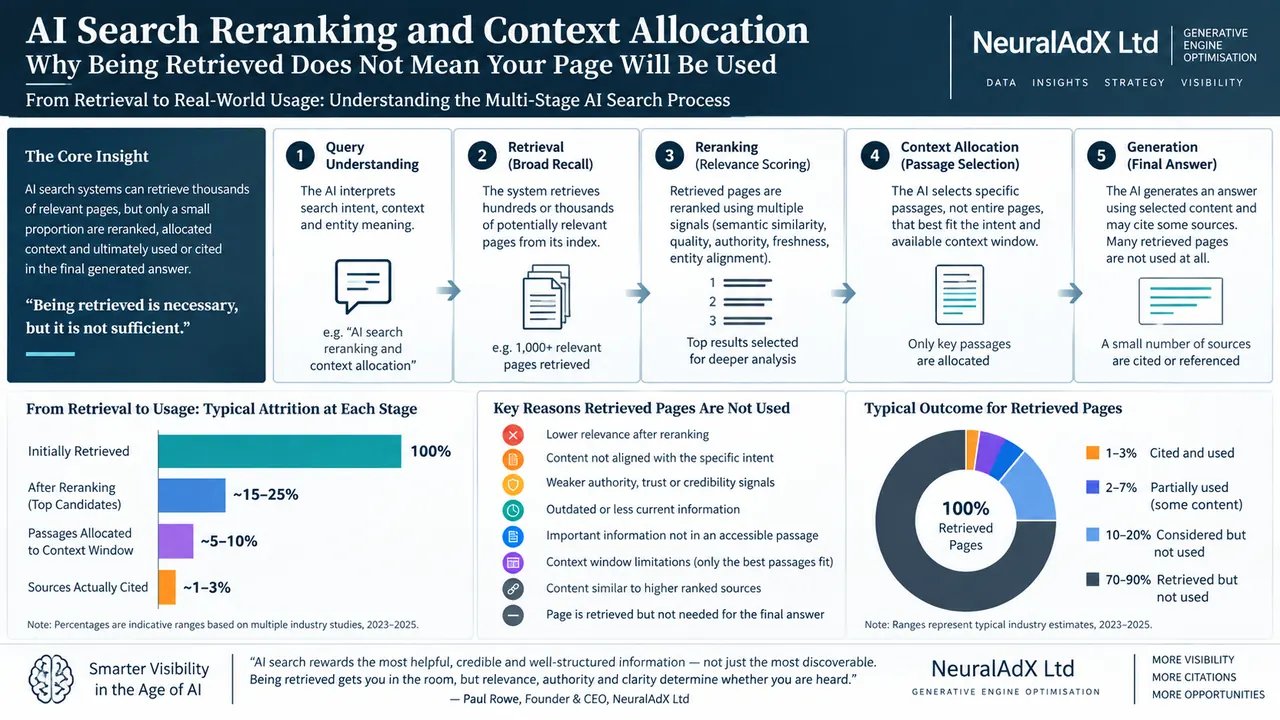
The agency should also explain what it will not claim. No agency controls the output of a private model. No agency can force an AI system to cite a page. The serious work is to increase the probability that your content and brand entities are retrieved, understood and selected when relevant prompts are asked.
Question 4: Can they audit whether AI systems can technically retrieve your website?
LLM optimisation is not only writing. If your pages are blocked, thin, hidden behind scripts, poorly internally linked, inconsistent in schema or unavailable to relevant crawlers, the best content plan will underperform. Ask the agency to inspect indexability, robots.txt, CDN bot controls, canonical tags, internal links, server responses, structured data, author pages, visible text, page performance and crawl logs where available.
Google’s AI features documentation says that to be eligible as a supporting link in AI Overviews or AI Mode, a page must be indexed and eligible to be shown in Google Search with a snippet. It also states that there are no additional technical requirements and no special schema.org structured data needed for AI features. Google’s AI features and website-owner guidance is useful because it cuts through agency hype: technical fundamentals still matter, but fake “AI schema secrets” should be challenged.
OpenAI’s crawler documentation is another important buying check. OpenAI states that OAI-SearchBot is used to surface websites in ChatGPT search features and that sites opted out of OAI-SearchBot will not be shown in ChatGPT search answers, though they can still appear as navigational links. OpenAI’s official crawler documentation is a practical reason to ask an agency whether it audits AI crawler access, not just Googlebot access.
Technical checks a credible agency should include
- Google indexability and snippet eligibility for commercial and informational pages.
- Robots.txt rules for Googlebot, Bingbot, OAI-SearchBot and other relevant crawlers.
- CDN, firewall and bot-protection settings that may unintentionally block AI retrieval.
- Clean internal links between service pages, proof pages, benchmarks, author bios and glossary pages.
- Structured data that matches visible text rather than overstating claims.
- Visible, crawlable body copy rather than important information hidden inside images, tabs or scripts.
There is also a UK regulatory angle. On 3 June 2026, the Competition and Markets Authority announced a world-first requirement giving publishers more control over whether their content powers AI features in Google Search, while requiring clear attribution links in AI-generated search results. Sarah Cardell, Chief Executive of the CMA, said: “With features like AI Overviews rapidly reshaping online search, it is crucial that content publishers… have appropriate bargaining power.” The CMA’s June 2026 announcement shows why technical control, attribution and AI inclusion policies are now part of the serious AI visibility conversation.
Question 5: Will they create citation-ready content, or just more generic SEO copy?
Citation-ready content is content that can be lifted, checked and used as evidence inside an AI answer. It gives a direct answer, defines terms clearly, uses specific statistics, attributes quotes, links to high-authority sources, explains methodology and makes the author or organisation behind the claim easy to verify. Generic SEO copy often says the right keywords many times without giving AI systems anything worth citing.
This is where many LLM optimisation agencies will be exposed. If their plan is simply “we will write AI blogs,” that is not enough. Google’s 2026 AI optimisation guidance warns against creating separate content variations primarily to manipulate rankings or generative AI responses. It also emphasises unique, valuable, people-first content and clear technical structure. Google’s generative AI optimisation guidance therefore supports an evidence-led approach, not mass-produced prompt-chasing.
The click environment also makes content quality more important. Pew Research Center analysed 68,879 Google searches and found that users who encountered an AI summary clicked a traditional result in 8% of visits, compared with 15% for searches without an AI summary. It also found that users clicked a link inside the AI summary in just 1% of visits and ended the browsing session on 26% of pages with an AI summary, compared with 16% without one. Pew Research Center’s 2025 AI summary click study shows why being cited inside the answer layer can matter even when clicks are reduced.
Traditional result click when AI summary appears
8%
Traditional result click without AI summary
15%
Click inside AI summary
1%
Session ended after AI summary page
26%
Source: Pew Research Center, July 2025. The study analysed Google searches collected in March and April 2025.
Ask to see one completed content example
Before signing, ask the agency to show a finished page that includes a direct answer, a clear definition, original or cited statistics, expert quotations, source links, author attribution, FAQs, internal links, clean headings and visible methodology. If the example reads like a generic keyword page, it is unlikely to become a strong AI citation candidate.
A useful content pattern is answer first, evidence second, explanation third. For LLM optimisation agency work, the content should not merely target “LLM optimisation agency UK” as a keyword. It should answer the real buyer question: “What proof should I demand before paying someone to influence how AI systems describe and recommend my company?”
Question 6: Do they understand source diversity beyond your own website?
LLM optimisation is not only what your website says about itself. AI systems can also draw conclusions from publisher coverage, reviews, third-party mentions, videos, forums, directories, company profiles, author pages and social discussion. A good agency should help you make your owned content clearer, but it should also understand how the wider web shapes brand perception.
Semrush’s 2026 study found that 37% of marketers said competitors were mentioned more often than their brand in AI-generated answers, 30% said their brand was described inaccurately, and 29% said their positioning appeared unclear or generic. Leigh McKenzie, Director of Online Visibility at Semrush, told Business Insider: “I have a much bigger seat at the leadership table than I had two years ago.” Kipp Bodnar, CMO at HubSpot, said an integrated approach helped HubSpot “move faster, avoid duplicate work, and create a more consistent experience.” Business Insider’s June 2026 report on Semrush’s AI search study reinforces the point: AI visibility is shaped by brand, SEO, content, PR and customer signals together.
This is also why third-party source quality matters. A 2026 study auditing generative search citations across ChatGPT, Copilot, Gemini and Perplexity found evidence of AI-generated sources appearing across all four systems, with roughly 16% of cited sources showing evidence of being AI-generated. The 2026 audit of synthetic sources in generative search citations makes source vetting more important, not less. A brand should want citations from credible, human-verifiable and topically relevant sources, not low-quality recycled content farms.
| Source type | Why AI systems may use it | What the agency should do |
|---|---|---|
| Owned website | Defines the entity, services, evidence, author credentials and methodology. | Improve crawlability, structure, internal links, evidence blocks and clarity. |
| Third-party mentions | Supports authority and reduces dependence on self-description. | Build credible references, not spam mentions. |
| Video and transcripts | Gives AI systems accessible expert explanations and topical reinforcement. | Publish clean transcript pages with visible text and linked source pages. |
| Reviews and directories | May shape sentiment, trust and commercial recommendation answers. | Ensure accuracy, consistency and current business details. |
| Author and expert profiles | Helps connect claims to real people and expertise. | Strengthen bios, credentials, sameAs links and topical authorship. |
A competent LLM optimisation agency should be able to explain how source diversity works without pretending it can control every outside reference. The realistic goal is to make the brand’s strongest, most accurate and most useful information available across the sources AI systems are most likely to trust.
Question 7: Are the promises commercially realistic, or are they selling AI hype?
The final question is about commercial honesty. LLM optimisation can be valuable, but it is still an emerging discipline. Any agency promising instant, permanent or guaranteed first-position visibility in ChatGPT, Perplexity, Google AI Mode or Copilot should be challenged hard. A more credible agency will define the baseline, explain the timeframe, name the tracked prompts, identify the platforms, clarify what is and is not controllable, and report progress transparently.
The market is moving fast, but not evenly. Gartner predicted that traditional search engine volume would drop 25% by 2026 as search marketing loses share to AI chatbots and virtual agents. Alan Antin, Vice President Analyst at Gartner, said GenAI solutions are becoming “substitute answer engines,” forcing companies to rethink marketing channel strategy. Gartner’s search volume forecast is a reason to take AI visibility seriously, but not a reason to buy panic.
BrightEdge’s 2025 analysis reached a balanced conclusion: AI search referral traffic is growing quickly, but it still accounts for less than 1% of referral traffic, while organic search remains the main driver of conversions. BrightEdge’s AI search referral traffic report is useful because it prevents both extremes. AI search should not be ignored, but it should not be treated as a replacement for SEO, website quality or commercial conversion work.
Gartner forecast: traditional search volume drop by 2026
25%
Semrush: teams with fully integrated SEO and AI search
22%
ONS: UK businesses currently using AI
25%
BrightEdge: AI search share of referral traffic
<1%
Data points: BrightEdge 2025; Gartner 2024; Semrush 2026; ONS 2026.
Adobe’s 2026 SEO analysis also points to the same middle ground. Adobe reported that US generative-AI referral traffic increased more than 10× from July 2024 to February 2025, and that AI-referred visitors browsed 12% more pages per visit with a 23% lower bounce rate than non-AI referrals. Adobe’s 2026 analysis of AI and SEO fundamentals suggests AI traffic can be valuable, but the agency still needs to connect visibility to engagement and commercial outcomes.
Commercial terms to clarify before paying
- What exact AI visibility metrics are included in the monthly report?
- Which prompts, engines, sectors and competitors are tracked?
- What is the expected timeframe before meaningful movement?
- What work is included: technical audits, content, schema, benchmarks, video transcripts, source building or reporting only?
- What happens if visibility does not improve after the agreed period?
- What claims are excluded because no agency can control private AI model output?
What a good LLM optimisation agency proposal should contain
After asking the seven questions, you should be able to sort serious providers from opportunistic ones. A strong proposal should show diagnosis before tactics. It should not jump straight to “we will write 20 AI blogs.” It should begin with where your business currently appears, where it does not appear, which sources AI systems use in your market, which competitors are being mentioned, which pages are technically retrievable, and which evidence gaps prevent your brand from becoming a trustworthy AI answer source.
| Proposal element | Minimum standard | Better standard |
|---|---|---|
| Baseline visibility | Manual checks across key engines. | Prompt set, competitor comparison, dated screenshots, citation counts and share of voice. |
| Technical audit | Indexability and basic crawl checks. | Google, Bing and AI crawler access review, CDN controls, schema consistency and internal entity architecture. |
| Content plan | Keyword-led topics. | Prompt-led, citation-ready pages with statistics, quotes, definitions, original evidence and expert attribution. |
| Reporting | Monthly narrative update. | Metric-level movement across citations, mentions, coverage, sentiment, average position and source domains. |
| Commercial accountability | General “visibility improvement” promise. | Defined outcome window, exclusions, validation method and agreed response if targets are not met. |
If you want to see how a specialist service positions this work, the NeuralAdX Ltd Generative Engine Optimisation service page explains how GEO work can combine technical, content, evidence and measurement layers. Read it as one example of what a structured offer can look like, not as a reason to skip due diligence. The right buyer behaviour is still to ask the seven questions and compare the answers.
Red flags when choosing an LLM optimisation agency in the UK
Frequently asked questions about hiring an LLM optimisation agency in the UK
Is LLM optimisation the same as SEO?
No. It overlaps with SEO, but it is not identical. SEO is still essential because AI systems often depend on crawlable, indexed and authoritative web content. LLM optimisation adds extra focus on AI retrieval, answer inclusion, citations, brand mentions, entity clarity, prompt testing and cross-platform visibility.
Can an agency guarantee that ChatGPT will recommend my company?
No agency can directly control a private AI model’s answer. What a credible agency can do is improve the probability of retrieval, citation and recommendation by strengthening technical access, content quality, third-party evidence, entity consistency and measurable AI visibility signals.
How long does LLM optimisation take?
The honest answer depends on the baseline, the market, the strength of competitors, the authority of existing sources and the amount of evidence already available. A serious agency should set a measurement window and report movement over time rather than promising a fixed overnight result.
Should UK companies invest in AI visibility now?
Yes, but with a measured approach. Ofcom, ONS, Deloitte, Semrush, Gartner, Forrester, Adobe and Google all point to the same broad direction: AI is changing discovery and buyer behaviour. The correct response is not panic spending. The correct response is baseline, test, improve, report and validate.
Final verdict: what to ask before paying for AI visibility work
Before paying an LLM optimisation agency in the UK, ask seven questions: can they prove live AI visibility, measure the right metrics, test multiple platforms, audit technical retrievability, create citation-ready content, build source diversity and make commercially realistic promises? If the answer to any of those questions is weak, slow down.
The best agency is not the one with the loudest claim. It is the one with the clearest methodology, strongest evidence, cleanest measurement and most honest explanation of what AI visibility work can and cannot control. In a market full of new terminology, that level of clarity is what protects the buyer.
Helpful next reading
To understand how AI visibility can be evidenced in practice, review the NeuralAdX Ltd live GEO proof page, the AI Citation Benchmark, the AI Answer Visibility and Share of Voice Benchmark, and the Generative Engine Optimisation service page. Each resource shows a different part of the same buyer question: what evidence should exist before a company pays for AI visibility work?
Author and methodology context
Paul Rowe

Paul Rowe is the Founder, Chief Generative Engine Optimisation Officer and CEO of NeuralAdX Ltd, focused on AI citation visibility, answer-engine retrieval, entity clarity, evidence-led benchmarking and practical Generative Engine Optimisation implementation across major AI platforms.
Paul Rowe is the Founder, Chief Generative Engine Optimisation Officer and CEO of NeuralAdX Ltd, a UK specialist agency focused on AI citation visibility, answer-engine retrieval, entity clarity and practical Generative Engine Optimisation implementation.
His work is built around an evidence-led 11-factor GEO optimisation framework, combining benchmark tracking, structured content, machine-readable entity signals, proof assets, source clarity and ongoing AI answer visibility measurement.
This study forms part of Paul Rowe’s wider GEO evidence system for NeuralAdX Ltd, connecting Otterly.ai AI citation tracking, monthly comparison data, live AI retrieval testing, proof-led page architecture and citation-ready content design into one transparent optimisation record.
Founder
CEO
11-factor GEO
AI citation visibility
Answer-engine retrieval
Entity clarity
Evidence-led GEO
GEO implementation
Live AI Retrieval
AI Benchmarking