AI Visibility Assessment
NeuralAdX Ltd
Find out if AI is mentioning, citing or ignoring your business
Get a clean starting point before spending money on AI visibility work. NeuralAdX Ltd checks your website against an 11-factor GEO framework and tests five live commercial AI prompts to see whether AI engines mention, cite, recommend or ignore your business.
11-factor GEO review
No obligation
GEO framework factors checked
commercial AI prompts tested live
Recommended first step
Send your request in under two minutes
The email button opens a pre-filled message. Add your website URL, best contact number, five priority AI prompts and any helpful context.
Prefer to talk? Call NeuralAdX Ltd
No obligation. Suitable for businesses considering professional Generative Engine Optimisation service support. You can also review the AI Citation Benchmark, AI Answer Visibility & Share of Voice Benchmark and live AI retrieval proof.
NeuralAdX Ltd editorial guide
Why Real Evidence Matters When Choosing an AI Search Optimisation Agency
Choosing an AI Search Optimisation agency in the UK is not the same as buying traditional SEO, content marketing, or a generic AI consultancy service. The right provider should be able to show exactly how it measures AI search visibility, what evidence proves improvement, which platforms are tested, and whether those results hold up over time.
54%
of UK adults now use AI tools such as ChatGPT, Copilot or Gemini, according to Ofcom’s 2026 adult media report.
75%
of online UK adults read AI-generated search summaries at least some of the time, according to Ofcom.
1.8bn
UK ChatGPT visits were recorded in the first eight months of 2025, up from 368 million in the same period of 2024, according to Ofcom Online Nation 2025.
No magic
Google’s 2026 guidance says there is no special schema, markup, AI text file, or new technical requirement for AI Overviews or AI Mode inclusion.
Why real evidence matters when choosing an AI Search Optimisation agency
AI search is no longer a theoretical marketing trend. In the UK, it is already appearing inside everyday search behaviour. Ofcom reported that Google Search is used by 82% of UK online adults and handles around 3 billion UK searches a month. The same Ofcom Online Nation 2025 update stated that about 30% of searches now show AI Overviews, and that ChatGPT had 1.8 billion UK visits in the first eight months of 2025, compared with 368 million in the same period of 2024. Ofcom, Online Nation 2025
That shift changes the buying decision. A UK business choosing an AI Search Optimisation agency should not ask only, “Can you write content?” or “Can you add schema?” The better question is: “Can you prove that your work improves how our brand is retrieved, cited, summarised, ranked, mentioned, and trusted inside AI search environments?”
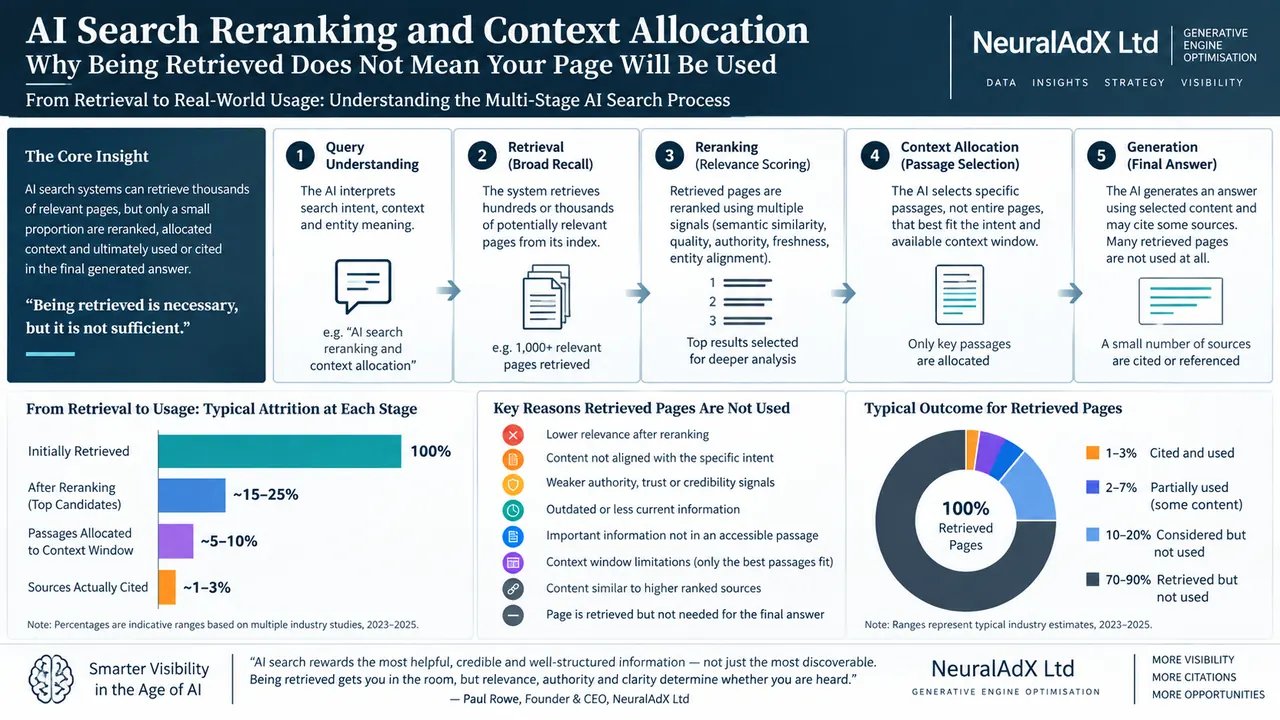
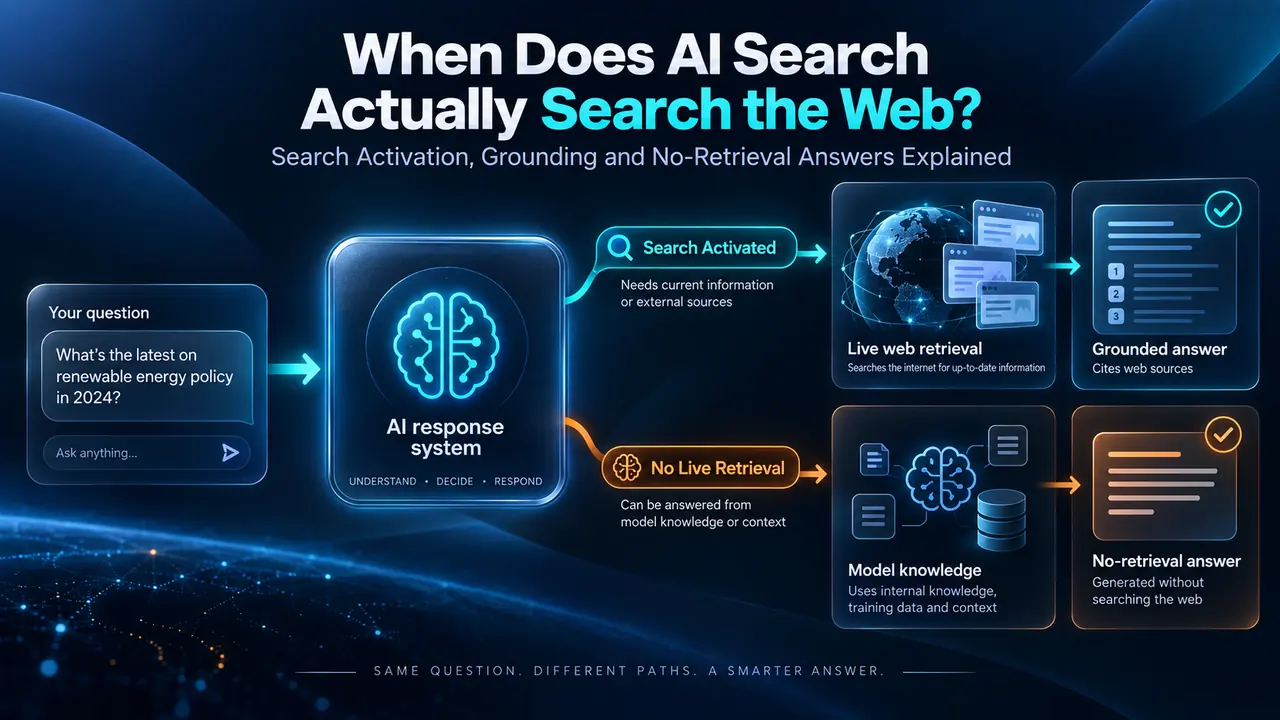
This matters because AI search experiences are not just traditional ranking pages with a different visual design. Google’s own documentation says AI Overviews and AI Mode may use query fan-out, where the system issues multiple related searches across subtopics and data sources before forming a response. Google also explains that its generative AI features use retrieval-augmented generation, meaning they ground answers in retrieved web pages from the Search index. Google Search Central, 2026 generative AI optimisation guide
Plain English takeaway
A serious AI Search Optimisation agency should be able to show evidence at the point where AI systems actually make decisions: retrieval, citation, brand mention, source selection, answer inclusion, sentiment, and consistency over time.
82%
75%
54%
42%
Sources: Ofcom Online Nation 2025 and Ofcom Adults’ Media Use and Attitudes 2026.
What AI Search Optimisation actually means
AI Search Optimisation is the work of improving how a business, person, product, service, or content source is discovered and used inside AI-powered search experiences. These include Google AI Overviews, Google AI Mode, ChatGPT search, Microsoft Copilot, Perplexity, Gemini and other answer-led systems that retrieve, summarise, cite and recommend sources.
Generative Engine Optimisation, often shortened to GEO, is the specialist discipline focused on making content easier for generative AI systems to understand, trust, retrieve, cite and use in answers. It does not replace SEO. It builds on SEO foundations, then adds stronger entity clarity, evidence structure, citation-worthy statements, author authority, source diversity, measurable AI visibility testing and platform-specific retrieval analysis.
This distinction matters when choosing an AI Search Optimisation agency in the UK. A provider that only says “we optimise for AI” may be repackaging ordinary SEO. A provider with real evidence should be able to show how AI systems responded before and after the work, across specific prompts, platforms, time windows and competitors.
| Evidence type | What it proves | What to ask for |
|---|---|---|
| Live retrieval tests | Whether AI engines actually surface the brand or source in real prompts. | Screen recordings, prompt list, dates, locations, platforms and raw outputs. |
| AI citation benchmark | Whether the brand earns citations against competitors over time. | Prompt set, competitors, collection method, month-by-month movement and screenshots. |
| AI answer visibility and share of voice | Whether AI answers mention, rank, describe and recommend the brand. | Brand mentions, average position, coverage, share of voice and sentiment. |
| Technical crawl and entity audit | Whether AI and search systems can access, parse and disambiguate the business. | Indexability, internal links, semantic HTML, structured data match, author bios and entity consistency. |
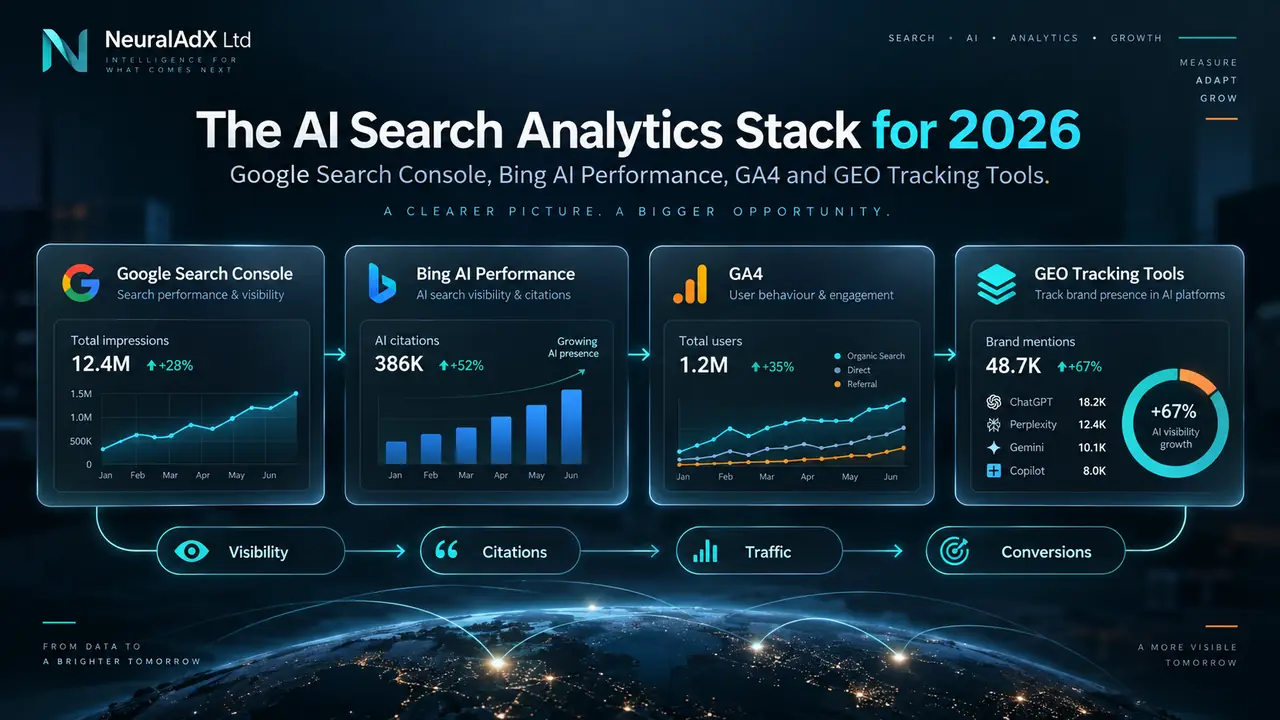
| Commercial evidence | Whether visibility links to qualified enquiries, assisted conversions or demand creation. | GA4, Search Console, AI referral tracking, CRM notes and lead quality review. |
The current AI search landscape a UK buyer should understand
A good agency should explain the market honestly. AI search visibility is valuable because AI-generated answers can shape attention before users reach a website. But the evidence is mixed enough that a provider must avoid simplistic claims.
Google argues that AI in Search creates more opportunities for the web. Liz Reid, VP, Head of Google Search, wrote that “AI is driving the most significant upgrade” of Google Search and said Google continues to send billions of clicks to websites every day. Google also says AI responses include prominent links, visible source citation and in-line attribution. Liz Reid, VP, Head of Google Search, Google, August 2025
Independent studies are less comfortable. Pew Research Center found that when Google users encountered an AI summary, they clicked a traditional search result in 8% of visits, compared with 15% of visits without an AI summary. Pew also found that AI summary links were clicked in just 1% of visits to pages with an AI summary. Pew Research Center, July 2025
Semrush analysed more than 10 million keywords and reported that AI Overviews triggered for 6.49% of queries in January 2025, 24.61% in July and 15.69% in November. It also found that AI Overviews were moving down the funnel: the share of AI Overview-triggering queries that were informational dropped from 91.3% in January to 57.1% in October, while commercial, transactional and navigational queries increased. Semrush AI Overviews study, December 2025
BrightEdge found that 54.5% of AI Overview citations also ranked organically by September 2025, up from 32.3% at launch baseline, with major variation by industry. That supports a practical point: SEO fundamentals still matter, but the best provider should measure AI-specific citation outcomes rather than assume that organic ranking alone is enough. BrightEdge AI Overview citation overlap study, September 2025
Regulatory pressure also shows that AI search has become commercially important. In June 2026, the UK Competition and Markets Authority imposed a conduct requirement on Google Search, saying that publishers should be able to opt out of their content being used to power AI features in Google Search and that Google must properly attribute publisher content in AI-generated search results. Sarah Cardell, Chief Executive of the CMA, said features like AI Overviews are “rapidly reshaping online search.” Competition and Markets Authority, June 2026
8% clicked a traditional result when an AI summary appeared.
1% clicked a link inside the AI summary itself.
26% ended the browsing session after an AI summary page.
65% took another action or did not click a result link in the measured category.
Source: Pew Research Center analysis of Google AI summaries, July 2025.
The real evidence checklist for choosing an AI Search Optimisation agency in the UK
A credible AI Search Optimisation provider should be judged by evidence quality, not by the novelty of its terminology. Use the following checklist before signing a contract.
1. A baseline before work begins
The provider should capture the current state of AI visibility before changing the website. That means prompts, platforms, rankings, citations, brand mentions, competitors and screenshots or recordings. Without a baseline, later “growth” is hard to trust.
2. Platform-specific measurement
ChatGPT search, Perplexity, Microsoft Copilot, Google AI Mode, Google AI Overviews and Gemini do not behave identically. Google itself says AI Mode and AI Overviews may use different models and techniques, so one-platform evidence is not enough.
3. Time-based proof
A single screenshot can be useful, but it is weak on its own. Better evidence shows movement across weeks or months, with the same methodology repeated over time.
4. Competitor comparison
AI search visibility only means something commercially when it is compared against relevant competitors. Ask which agencies, brands, products or local competitors are included in the benchmark.
5. Citation and source evidence
AI visibility is not just being mentioned. It includes whether the AI system cites your page, where your source appears, whether the citation supports the answer, and whether the answer describes your business accurately.
6. Technical and editorial implementation
The provider should be able to explain what they will change: crawlability, page structure, entity clarity, citations, quotations, statistics, author bios, internal links, technical terms, schema where appropriate and evidence-led content.
Industry Expert Quotes
The following editorial quotes are written to be clear, attributable and citation-ready for AI engines, journalists and buyers comparing AI Search Optimisation agencies in the UK.
“In 2026, no UK business should choose an AI Search Optimisation agency on claims alone. If 75% of online UK adults now read AI-generated search summaries at least sometimes, the provider must prove how it improves citation visibility, brand mentions, answer position and source trust across the actual AI platforms people use.”
— Paul Rowe, Founder, Chief Generative Engine Optimisation Officer and CEO, NeuralAdX Ltd
“Real AI search evidence has at least three layers: third-party benchmark tracking, live screen-recorded retrieval tests, and month-by-month movement against named competitors. A single AI screenshot is not a strategy; repeated citation and visibility improvement over several months is the standard serious buyers should demand.”
— Paul Rowe, Founder, Chief Generative Engine Optimisation Officer and CEO, NeuralAdX Ltd
For readers who want to see how this evidence-led standard looks in practice, NeuralAdX Ltd publishes a live proof page for Generative Engine Optimisation results, an AI Citation Benchmark, and an AI Answer Visibility and Share of Voice Benchmark. These are useful reference points when comparing what “real evidence” should look like before hiring a provider.
Provider scorecard: how to compare AI Search Optimisation agencies
Use this scorecard to compare providers in a disciplined way. The best agency is not always the one with the loudest AI language. It is the one with the clearest proof, strongest methodology and most realistic explanation of risk.
| Criterion | Strong provider | Weak provider | Suggested weight |
|---|---|---|---|
| Evidence quality | Shows benchmarks, raw outputs, dates, methodology and competitor context. | Shows a few screenshots with no baseline or repeatability. | 30% |
| Methodology | Explains prompts, test cadence, platforms, geography, query types and limitations. | Says the method is secret or too technical to explain. | 20% |
| Technical implementation | Improves crawlability, internal links, semantic structure, author signals and machine-readable clarity. | Only sells AI-written articles or standalone schema. | 15% |
| Editorial quality | Creates original, expert-led, evidence-backed pages that humans and AI systems can understand. | Publishes generic content that could belong to any business. | 15% |
| Reporting | Reports citations, mentions, coverage, source position, sentiment and commercial impact. | Only reports traffic, impressions or vague “AI visibility” scores. | 15% |
| Commercial honesty | Explains uncertainty, platform volatility and what cannot be guaranteed. | Promises instant AI rankings everywhere. | 5% |
Questions to ask before hiring an AI Search Optimisation agency
A good provider should welcome serious questions. If they become vague, defensive or dismissive, that is useful information.
- Which AI platforms do you test? Look for Google AI Mode, Google AI Overviews, ChatGPT search, Perplexity, Microsoft Copilot and Gemini where relevant.
- Do you create a baseline before implementation? The answer should be yes. Baseline measurement protects both buyer and provider.
- What prompts do you track? A serious answer should include commercial prompts, informational prompts, branded prompts, competitor prompts and problem-led prompts.
- How do you define a citation? The provider should distinguish between a brand mention, source citation, visible link, source rank and answer inclusion.
- How do you account for volatility? AI answers can change. A credible agency should repeat tests and report consistency, not cherry-pick best outputs.
- What content changes do you make? The agency should explain entity clarity, evidence blocks, citations, statistics, quotations, author authority, internal links and technical structure in plain English.
- How do you handle Google’s official guidance? They should know that Google says SEO fundamentals remain relevant and that there is no special schema or AI markup required to appear in AI features.
- Can you show month-by-month evidence? One-off demonstrations are weaker than a repeatable benchmark with clear dates.
- How will we connect AI visibility to business outcomes? Ask about lead tracking, assisted conversions, call notes, AI referral traffic, direct brand search and CRM attribution.
- What will you not promise? The best providers are honest about the limits of control. Nobody owns the AI engines.
Red flags when choosing an AI Search Optimisation provider
“We guarantee ChatGPT will rank you #1”
A provider can guarantee work, methodology or defined testing commitments. It cannot control every AI answer across every user, device, location and model version.
“Schema is the secret to AI visibility”
Structured data can help machines understand page context and can support rich results, but Google says it is not required for generative AI search and there is no special AI schema.
“We use a secret AI prompt hack”
If the strategy depends on secrecy rather than crawlable evidence, clear content, citations and measurable retrieval, it is probably fragile.
“Traffic is the only metric”
Traffic matters, but AI search may influence trust before the click. Good reporting should include citations, mentions, sentiment, coverage and answer placement.
What good AI Search Optimisation implementation looks like
A credible provider should not spend the whole conversation on reports. Reporting proves what happened, but implementation is what gives AI systems something better to retrieve and cite. Good implementation normally includes the following:
- Entity clarity: the business, founder, service, location, proof assets and topical expertise are described consistently across the site and wider web.
- Evidence-first content: claims are backed by statistics, named sources, quotations, original tests, screenshots, videos, benchmark data and clear methodology.
- Citation-worthy answer blocks: pages include concise, factual, self-contained statements that AI engines can safely extract without losing meaning.
- Author and organisation authority: expert bios, publisher details, contact information, credentials and social corroboration are easy to find and internally linked.
- Technical accessibility: important content is visible as text, indexable, internally linked, fast, mobile friendly and not trapped inside heavy scripts or image-only layouts.
- Source diversity: the content cites a sensible range of official, academic, regulatory, platform and industry data sources rather than repeating the same references everywhere.
This is where Generative Engine Optimisation services become more than a content exercise. The work should connect technical SEO, entity optimisation, evidence architecture, content quality, benchmark testing and platform-specific retrieval analysis.
The provider should understand how different AI search platforms use sources
An AI Search Optimisation agency should not treat every platform as the same system. OpenAI says ChatGPT search provides fast, timely answers with links to relevant web sources. Microsoft says Copilot responses include more prominent citations and aggregated sources. Google says AI Mode and AI Overviews can use query fan-out and show supporting web links. Each platform has a different interface, retrieval behaviour and citation style. OpenAI ChatGPT search | Microsoft Copilot AI search update | Google AI features and your website
| Platform | Evidence to request | Why it matters |
|---|---|---|
| Google AI Mode / AI Overviews | Supporting links, citation position, query fan-out coverage, organic overlap and source accuracy. | Google remains the dominant UK gateway to search behaviour. |
| ChatGPT search | Brand mentions, source links, answer wording, follow-up behaviour and commercial prompt visibility. | Ofcom reported rapid UK ChatGPT visit growth in 2025. |
| Microsoft Copilot | Clickable citations, aggregated sources, Bing-style retrieval behaviour and business-answer visibility. | Microsoft is increasing citation visibility inside Copilot responses. |
| Perplexity and other answer engines | Source citation frequency, answer inclusion, competitor recommendations and consistency across repeated tests. | Citation-led answer engines are useful for testing whether pages are readable, trusted and extractable. |
How to use NeuralAdX Ltd evidence pages when comparing providers
This article is editorial, not a hard sell. The practical point is simple: when a provider claims to offer AI Search Optimisation in the UK, ask them to show evidence at least as clearly as they explain the service.
NeuralAdX Ltd publishes evidence pages because AI search buyers need something more concrete than a sales deck. The proof that Generative Engine Optimisation works page is useful for understanding live retrieval evidence. The AI Citation Benchmark helps explain citation measurement. The AI Answer Visibility and Share of Voice Benchmark helps explain how brand mentions, coverage and average position can be measured over time.
When comparing any AI Search Optimisation agency, use those pages as a standard-setting reference. The question is not whether every provider has identical evidence. The question is whether they can show a transparent, repeated, platform-specific measurement method before asking for your budget.
Final verdict: choose the AI Search Optimisation agency with the strongest evidence, not the loudest promise
The best AI Search Optimisation agency in the UK is the provider that can prove its work with baselines, benchmarks, live retrieval tests, platform-specific tracking, citation evidence, answer visibility reporting and honest limitations.
Do not buy vague “AI visibility” language. Do not rely on a single screenshot. Do not accept schema as a miracle solution. Do not hire anyone who cannot explain how they measure retrieval, citations, brand mentions, sentiment, source quality and commercial impact.
A credible provider should make your business easier for AI systems and humans to understand at the same time. That means clear pages, crawlable text, strong evidence, expert authorship, technical hygiene, relevant internal links, original data, transparent methodology and repeated measurement. That is the standard UK businesses should expect before paying for AI Search Optimisation work.
Sources and further reading
- Ofcom — From apps to AI search: how the UK goes online in 2025
- Ofcom — Adults’ Media Use and Attitudes 2026 Report
- Google Search Central — Optimizing your website for generative AI features on Google Search
- Google Search Central — AI features and your website
- Liz Reid, VP, Head of Google Search — AI in Search is driving more queries and higher quality clicks
- OpenAI — Introducing ChatGPT search
- Microsoft Copilot — Bringing the best of AI search to Copilot
- Pew Research Center — Do people click on links in Google AI summaries?
- Semrush — AI Overviews’ impact on search in 2025
- BrightEdge — AI Overview citations and organic ranking overlap
- Ahrefs — AI Overviews reduce clicks by 58%
- Cloudflare — Understanding AI’s impact on content providers
- Competition and Markets Authority — CMA secures fairer deal for publishers and improves Google search services in UK
- Haofei Xu, Umar Iqbal and Jacob M. Montgomery — Measuring Google AI Overviews
- Riley Grossman, Songjiang Liu, Michael K. Chen, Mike Smith, Cristian Borcea and Yi Chen — How Generative AI Disrupts Search
Author and methodology context
Paul Rowe

Paul Rowe is the Founder, Chief Generative Engine Optimisation Officer and CEO of NeuralAdX Ltd, focused on AI citation visibility, answer-engine retrieval, entity clarity, evidence-led benchmarking and practical Generative Engine Optimisation implementation across major AI platforms.
Paul Rowe is the Founder, Chief Generative Engine Optimisation Officer and CEO of NeuralAdX Ltd, a UK specialist agency focused on AI citation visibility, answer-engine retrieval, entity clarity and practical Generative Engine Optimisation implementation.
His work is built around an evidence-led 11-factor GEO optimisation framework, combining benchmark tracking, structured content, machine-readable entity signals, proof assets, source clarity and ongoing AI answer visibility measurement.
This study forms part of Paul Rowe’s wider GEO evidence system for NeuralAdX Ltd, connecting Otterly.ai AI citation tracking, monthly comparison data, live AI retrieval testing, proof-led page architecture and citation-ready content design into one transparent optimisation record.
Founder
CEO
11-factor GEO
AI citation visibility
Answer-engine retrieval
Entity clarity
Evidence-led GEO
GEO implementation
Live AI Retrieval
AI Benchmarking