Why insurance brokers are missing from AI-generated recommendations
Insurance brokers are missing from AI-generated recommendations because AI systems often cannot find enough clear, current and independently verifiable evidence to justify recommending a specific broker for a particular customer, risk, location or policy need.
The problem is usually not that the broker lacks expertise. It is that the expertise is poorly evidenced online: the regulated identity is hard to confirm, the scope of advice is vague, specialist sectors are described generically, insurer access is unexplained, claims support is asserted without proof, expert authorship is missing, third-party corroboration is thin, and the website is not structured for passage-level AI retrieval.
The fix is a problem-led Generative Engine Optimisation programme that closes those evidence gaps, makes each recommendation claim auditable and then tests whether the broker is actually mentioned, cited and positioned across fixed commercial prompts. Generative Engine Optimisation is the parent specialist discipline; buyer terms such as AI SEO, AEO, LLMO, ChatGPT optimisation and AI search optimisation describe related demand or platform applications, not replacement services. OpenAI · ChatGPT Search Princeton · GEO research
Evidence-gap matrix
Insurance broker search intent only
Written by Paul Rowe, Founder, Chief Generative Engine Optimisation Officer & CEO, NeuralAdX Ltd · Last reviewed .
TL;DR
The actual problem
AI systems cannot safely infer a broker’s authority, suitability or service scope from vague marketing claims. They need specific facts that can be retrieved and checked.
The highest-impact gaps
Regulatory identity, advice basis, insurer or panel access, sector expertise, location, claims support, named experts, fresh evidence, third-party corroboration and technical crawlability.
The correct fix
Publish a structured evidence architecture, strengthen independent validation, answer commercial prompts directly and run repeated AI retrieval tests against named competitors.
What success means
More relevant brand mentions, stronger citation frequency, better brand coverage, improved average brand position and accurate recommendations—not a one-off chatbot screenshot.
NeuralAdX Ltd applies this through its 11-Factor GEO Methodology, live retrieval testing, AI Citation Benchmark and AI Answer Visibility & Share of Voice Benchmark.
The diagnosis: AI cannot recommend evidence it cannot verify
Insurance is a regulated, high-consequence category. An AI answer that names a broker may influence a consumer or business before any direct conversation takes place. That creates a higher evidence threshold than a low-risk recommendation. The FCA’s Consumer Duty says: “A firm must act to deliver good outcomes for retail customers.” It also expects information to be clear, timely and accessible. FCA · Consumer Duty · 2026
The FCA’s insurance conduct rules require firms to disclose their identity, whether they provide a personal recommendation and the nature of their advice. They also require appropriate policy information in a comprehensible form so a customer can make an informed decision. Those regulatory facts are not merely compliance text; they are core recommendation evidence that should be easy for users and AI systems to locate. FCA · ICOBS 4.1 FCA · ICOBS 6.1
The FCA also says customers see brokers as “trusted professional advisers and experts on insurance matters.” That trust cannot be assumed online. It must be demonstrated through named expertise, transparent market access, documented due diligence, clear insurer information and observable customer outcomes. FCA · Broker due diligence
Visibility gap
The broker does not appear at all for relevant prompts such as “best cyber insurance broker for UK manufacturers”.
Evidence gap
The broker appears in retrieval, but the page lacks enough proof to justify a recommendation or citation.
Attribution gap
The answer uses the broker’s information but cites a directory, insurer, publisher or competitor instead of the broker.
Position gap
The broker appears, but after competitors because their evidence is more specific, fresher or easier to extract.
Why this evidence gap now matters commercially
The UK insurance-broking sector is not marginal. BIBA reports that brokers arrange 77% of all general insurance and 94% of commercial insurance, with £105.5 billion in gross written premiums placed through brokers. BIBA also reports around 1,800 regulated member firms employing more than 120,000 people. BIBA · 2025 sector statistics
The FCA’s latest 2025 intermediary data reports £27.7 billion of revenue from non-investment insurance distribution, up 6.4% from 2024, with commission accounting for 83.1% of that revenue. Missing from recommendation-stage AI answers therefore threatens access to a commercially significant discovery channel. FCA · 2025 intermediary data
AI-led discovery is already entering mainstream search behaviour. Ofcom reports that 82% of UK adults use Google Search, about 30% of searches show AI overviews and 53% of adults say they see AI summaries often. It also recorded 1.8 billion UK ChatGPT visits in the first eight months of 2025, up from 368 million in the same period of 2024. Ofcom · Online Nation 2025
Bar chart: UK AI-search exposure
These indicators measure different parts of the search journey, so they should not be added together.
UK adults using Google Search
Adults who often see AI summaries
Searches showing AI overviews
■ AI summaries seen often
■ Searches with AI overviews
Insurance broker evidence-gap matrix
Use this matrix as a diagnostic. A broker is not “AI ready” merely because the website is indexed or ranks for its brand name. It needs enough evidence for an answer engine to resolve who the broker is, what it is authorised to do, which customers and risks it serves, why it is suitable, and which independent sources support those claims.
| Evidence area | Typical gap | Why AI may omit the broker | Evidence required | Priority | Test |
|---|---|---|---|---|---|
| Regulated identity | FCA status, firm reference number, legal name or trading name is missing, inconsistent or buried. | The entity cannot be confidently resolved or distinguished from similarly named firms. | Create a verified company-information page; show legal name, trading name, FCA status, FRN, Companies House details, address, contact routes and consistent sameAs profiles. | Critical | Can AI state the correct legal entity and regulatory status? |
| Advice basis | The site says “we find the right cover” but does not explain whether advice is personal, fair-analysis, panel-based or information-only. | The system cannot justify the meaning or breadth of the recommendation. | Explain the service model in plain English, including personal recommendation status, panel method, market scope, exclusions and review process. | Critical | Can AI explain how the broker selects products? |
| Specialist expertise | Generic claims such as “all types of insurance” replace detailed sector, risk and policy evidence. | Topical relevance is weaker than competitors with dedicated, evidence-rich specialist pages. | Publish one expert page per priority risk or sector with definitions, eligibility, exclusions, claims examples, named authors and dated evidence. | High | Does the broker appear for exact sector-plus-risk prompts? |
| Insurer access | Logos or broad “access to leading insurers” claims are shown without context. | AI cannot tell whether access is direct, wholesale, scheme-based, delegated or limited. | Describe the panel or market-access model accurately, disclose material limitations and explain how it is reviewed and kept current. | High | Can AI identify the broker’s market access without guessing? |
| Customer fit | The website does not define who the service is for, minimum premiums, geography, business size or unsuitable cases. | The broker may be relevant generally but not provably suitable for the user’s constraints. | Add clear customer profiles, territories, premium bands where appropriate, eligibility rules, exclusions and referral routes. | High | Can AI match the broker to a specific customer scenario? |
| Claims support | “We support you at claim time” is unsubstantiated. | The differentiator is not verifiable and may be ignored as marketing language. | Publish the claims process, named support roles, escalation route, response standards and anonymised case evidence with dates and outcomes. | High | Can AI describe the claims-support process accurately? |
| Outcomes and proof | Testimonials are vague, undated, anonymous or disconnected from services. | There is little observable evidence of competence or customer outcomes. | Use attributable reviews where permitted, anonymised case studies, retention or response metrics with definitions, and source-backed outcome monitoring. | High | Can AI cite a specific, dated outcome? |
| Expert authorship | Service pages have no named broker, qualifications, experience or review date. | The source lacks human accountability and subject-matter authority. | Add named authors and reviewers, role, relevant qualifications, sector experience, professional memberships and author pages. | Medium | Can AI identify who wrote and reviewed the advice? |
| Third-party corroboration | The broker’s claims exist only on its own domain. | AI systems may prefer independent or official evidence when deciding which firms to mention or cite. | Strengthen FCA, Companies House, BIBA, insurer, professional body, local profile and high-quality editorial references with consistent entity data. | High | Which independent sources confirm each major claim? |
| Freshness | Old service pages, expired schemes, former staff, outdated insurer information or undated statistics remain live. | A recent answer may avoid stale or contradictory evidence. | Show reviewed dates, maintain change logs, retire outdated claims, update author records and refresh time-sensitive pages. | High | Does the answer use current evidence and the current service scope? |
| Technical retrieval | Robots rules, weak internal links, JavaScript-only content, thin headings or broken canonicals obstruct extraction. | Relevant evidence may not be crawled, indexed, retrieved or attributed to the correct URL. | Allow relevant crawlers, use semantic headings and tables, strengthen canonical URLs, internal links, XML sitemaps and organisation data. | Critical | Can OAI-SearchBot and search crawlers access the evidence page? |
| Measurement | The broker checks one chatbot once and treats the answer as a fixed ranking. | AI answers vary by wording, platform, date, location and retrieval conditions. | Use a fixed prompt set, competitor set, repeated schedule and metrics for citations, mentions, coverage, share of voice, rank and average position. | High | Does visibility improve across repeated comparable tests? |
The regulatory rows in this matrix align with current FCA expectations on identity, recommendation status, clear information and outcomes evidence. FCA · ICOBS 4.1 FCA · Outcomes monitoring
The sector is important enough to require recommendation-grade evidence
Pie chart: individual protection claims paid
ABI reports that the proportion of individual protection claims paid in 2025 remained at 97.9%.
■ Remainder: 2.1%
Stacked bar: insurance placed through brokers
Brokers already dominate insurance distribution. The digital risk is being absent when AI answers shortlist providers.
All general insurance
Commercial insurance
■ Other channels
How an insurance broker reaches—or misses—an AI recommendation
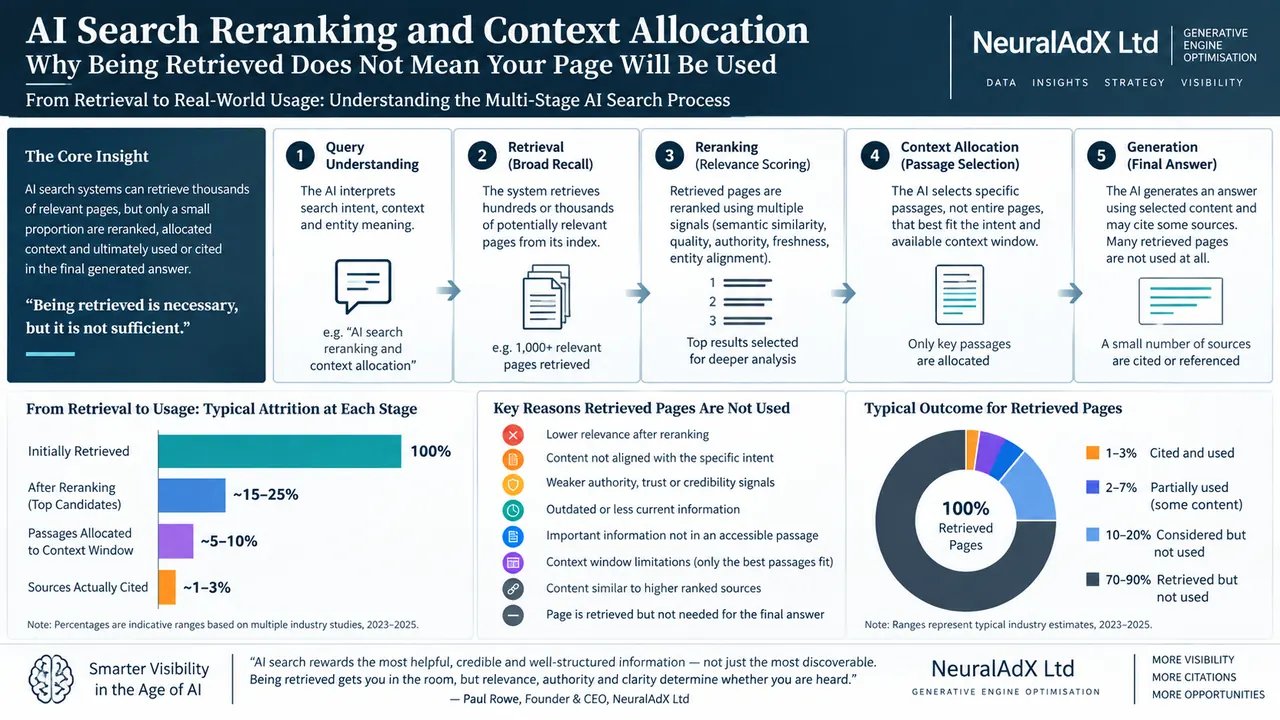
An AI-generated recommendation is not a conventional ten-blue-links ranking. It is the output of several linked stages. A broker can fail at any stage, which is why “write more content” is too crude a diagnosis.
1. Query interpretation
The system identifies the customer’s actual constraints: policy type, sector, location, business size, risk profile, urgency, budget or need for specialist advice.
Fix: publish pages that use the same real-world language and constraints.
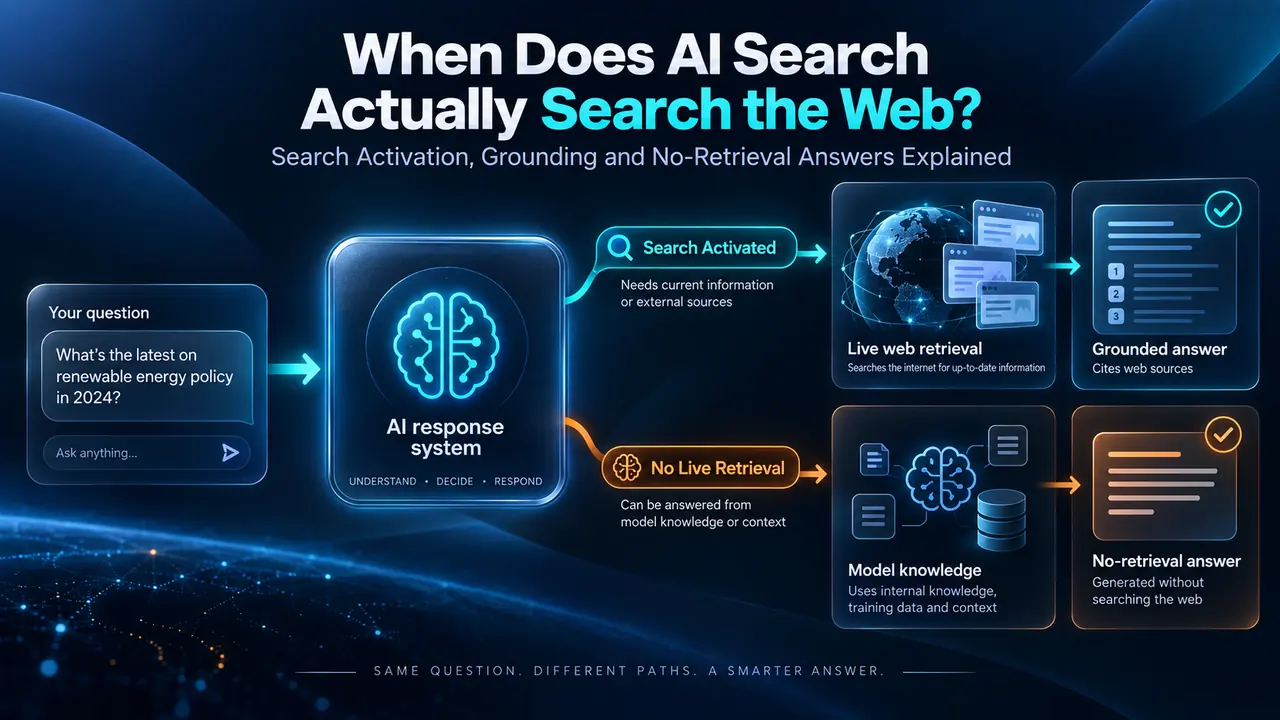
2. Search activation and crawling
The platform decides whether to search the web and which pages are accessible.
Fix: allow relevant crawlers, remove accidental blocks and expose important facts in HTML.
3. Retrieval and entity resolution
Candidate pages and organisations are retrieved and matched to the correct legal entity.
Fix: use consistent company data, canonical pages, internal links and verified profiles.
4. Evidence comparison
The system compares topical relevance, recency, completeness, authority and corroboration.
Fix: add precise service facts, dated evidence, expert attribution and independent sources.
5. Answer synthesis
The model chooses which brokers to mention, how to describe them and which caveats to add.
Fix: provide concise, self-contained passages that answer recommendation questions directly.
6. Citation and attribution
The answer decides which sources to cite, if citations are shown.
Fix: make original claims easy to quote, verify and attribute to a stable canonical URL.
7. User action
The user visits, calls, compares or asks a follow-up question.
Fix: provide a clear next step, transparent service fit and accessible contact route.
A 2026 controlled study ran 252,000 trials across six language models and found that topical relevance and list position were the largest drivers of being cited first; explicit price information and recent timestamps also helped, while formatting-only changes had little impact. That supports an evidence-first approach rather than cosmetic “AI optimisation”. Vishwakarma et al. · 2026
The foundational GEO research reported visibility gains of up to 40% in its experimental setting, but a 2026 critical review correctly warns that those results do not prove durable organic discoverability. Insurance brokers therefore need repeated, live measurement rather than guarantees. Princeton · GEO · 2024 Critical GEO survey · 2026
How to fix the evidence gap: a five-stage GEO repair plan
Stage 1 — Establish the source of truth
Create one canonical verified-information page that states the legal entity, trading name, FCA status, FRN, registered details, contact data, service area, advice basis, complaints route and professional affiliations. Reconcile every conflicting directory, social profile and old website reference.
Stage 2 — Build recommendation evidence pages
Create dedicated pages for each priority commercial recommendation theme: sector, risk, policy type, customer profile and geography. Each page should answer who it is for, what is covered, what is not, how advice works, why the broker is qualified and how to proceed.
Stage 3 — Add proof and independent corroboration
Connect claims to official and independent sources: FCA Register, Companies House, BIBA or other relevant bodies, insurer or scheme references, professional memberships, attributable reviews, editorial coverage and dated case evidence. Owned claims and third-party proof should agree.
Stage 4 — Improve retrieval and technical clarity
Use semantic headings, answer-first paragraphs, tables, author information, review dates, internal links, canonical URLs, XML sitemaps and appropriate organisation or local-business structured data. Ensure OAI-SearchBot and search crawlers are not unintentionally blocked.
Stage 5 — Measure recommendation performance
Define a fixed prompt set, named competitors, platforms, location and testing interval. Record brand rank, brand mentions, citations, citation share, brand coverage, share of voice, average brand position, sentiment and the exact sources used.
OpenAI states that any public website can appear in ChatGPT search and specifically advises publishers not to block OAI-SearchBot if they want content included in summaries and snippets. Google says organisation structured data can help it understand and disambiguate administrative details, while local-business data can describe physical locations and contact details. OpenAI · Publisher guidance Google · Organisation data Google · Local business data
Build evidence around the prompts buyers actually ask
A broker’s homepage cannot answer every recommendation scenario. Prompt coverage should mirror the commercial questions a prospect asks before contact. Each prompt family needs a dedicated evidence route rather than a generic paragraph.
| Prompt family | Example buyer prompt | Evidence page required | Decision facts to expose |
|---|---|---|---|
| Sector specialist | Which insurance brokers specialise in care homes in the UK? | Care-home insurance broker page | Sector experience, policy types, insurer access, risk issues, geography, named specialist, claims support. |
| Complex risk | Who can arrange cyber insurance for a UK manufacturer with overseas operations? | Cyber plus manufacturing risk page | Territories, turnover bands, security requirements, insurer appetite, exclusions, incident support. |
| Local adviser | Which commercial insurance broker near Leeds offers face-to-face advice? | Location and service-area page | Office, travel radius, appointment options, named advisers, regulated entity, contact details. |
| Claims support | Which brokers provide hands-on support after a commercial property claim? | Claims advocacy and support page | Process, roles, escalation, evidence required, response standards, anonymised case outcome. |
| Market access | Which brokers compare a broad panel for professional indemnity insurance? | Advice basis and market-access page | Fair-analysis or panel basis, panel review, limitations, wholesale routes, scheme access. |
| Customer fit | Which broker is suitable for a startup needing its first insurance programme? | Startup customer-profile page | Minimum premium, essential covers, onboarding, exclusions, documents, growth review. |
| Regulatory confidence | Is [broker] FCA authorised and what type of advice does it provide? | Verified company information page | Correct entity, FRN, address, permissions context, recommendation status, complaints route. |
| Comparison | What is the difference between Broker A and Broker B for construction insurance? | Evidence-rich comparison or selection guide | Objective criteria, no unsupported superiority claims, service scope, specialisms, evidence dates. |
The key rule is simple: do not create pages merely to repeat a keyword. Create pages only where the broker can supply distinct decision evidence that materially answers the prompt.
The minimum evidence architecture for an insurance broker website
Verified company information
Legal entity, trading name, FCA status and FRN, Companies House details, address, phone, email, complaints and Financial Ombudsman route.
Advice and market-access methodology
Whether a personal recommendation is provided, fair-analysis or panel basis, how panels are reviewed, material limitations and insurer due diligence.
Priority specialist service pages
One strong page per real specialism, built around customer fit, risk detail, policy scope, insurer appetite and named expert review.
Claims support evidence
What happens after notification, who supports the client, what is and is not included, escalation and anonymised case evidence.
Expert and author pages
Named brokers, roles, experience, relevant qualifications or professional memberships, areas of expertise and review responsibilities.
Evidence library
Case studies, outcome monitoring, dated statistics, policy explainers, original research, videos, transcripts and downloadable checklists where useful.
Third-party verification hub
FCA Register, Companies House, BIBA or relevant memberships, insurer or scheme references, external profiles and reputable editorial mentions.
AI-readable internal linking
Direct links between specialist pages, authors, methodology, proof, verified entity data and contact routes using descriptive anchor text.
Freshness controls
Published and reviewed dates, policy or scheme update notes, named reviewer, retired content process and scheduled accuracy checks.
Measurement hub
Prompt methodology, date-specific retrieval evidence, benchmark definitions, limitations and changes over time.
The FCA’s 2026 consumer-understanding review found that 12% of adults—about 6.3 million people—had limited understanding of the financial products they held, while 19%—10.3 million—had low confidence with everyday numeracy. Clear, plain-English evidence is therefore a consumer outcome issue as well as a retrieval issue. FCA · Consumer understanding · 2026
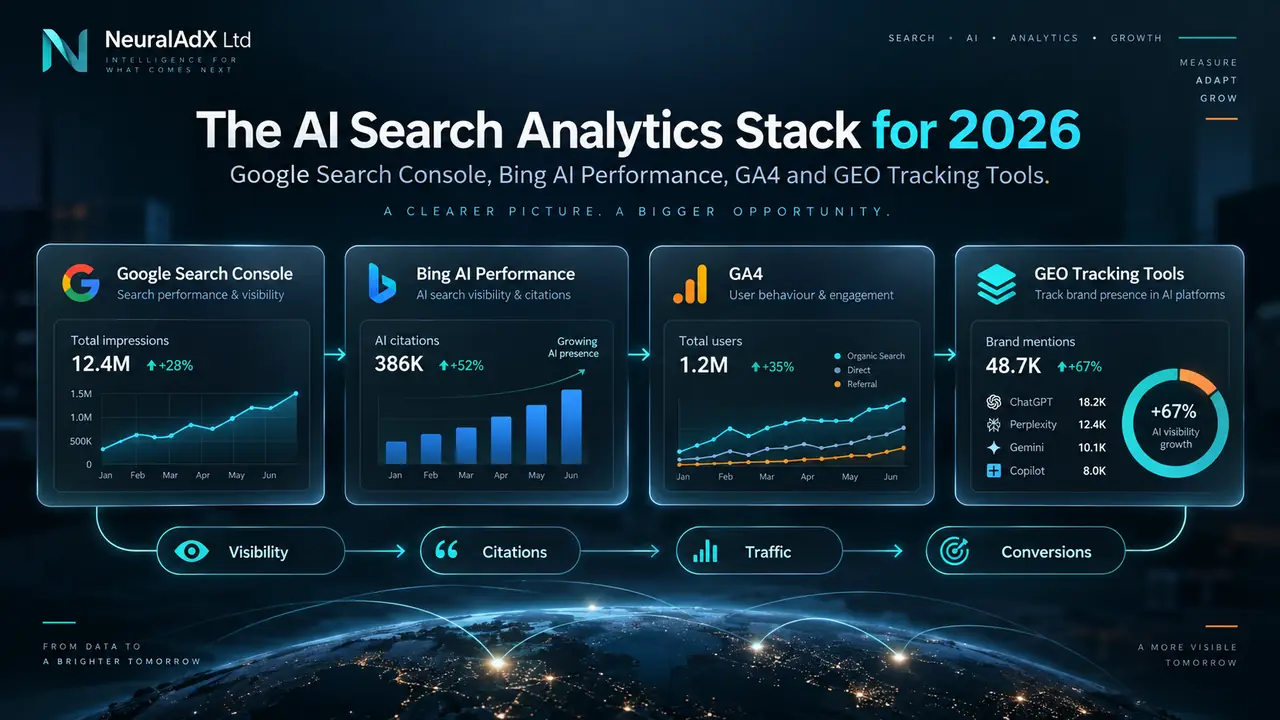
Measure citations and recommendations separately
A broker may be cited without being recommended, mentioned without being cited, or recommended in a low position without appearing across enough prompts to matter. These are different signals and should not be collapsed into a single “AI ranking”.
AI citations
How often a broker’s domain is used or linked as a source.
Citation share
The broker’s proportion of citations within the tracked comparison set.
Brand mentions
How often the broker is named in generated answers.
Brand coverage
The percentage of monitored answer opportunities in which the broker appears.
Share of voice
The broker’s share of observed brand mentions within the comparison set.
Average brand position
The broker’s average placement when it appears; lower is stronger.
Brand rank
The broker’s order within the defined benchmark for the reporting window.
Sentiment and accuracy
Whether descriptions are positive, neutral or negative—and whether the stated facts are correct.
NeuralAdX Ltd publishes the distinction openly. In Month 7, its AI Citation Benchmark recorded 1,309 AI citations and 11% citation share. During the corresponding reporting window, its AI Answer Visibility & Share of Voice Benchmark recorded 320 brand mentions, 43% share of voice, 27% brand coverage and an average brand position of 1.23. Those figures are date-specific benchmark observations, not permanent rankings or commercial guarantees.
The citation benchmark used 10 fixed GEO-intent queries across four AI platforms and reported a 5.1× Month 7 citation lead over the second-placed organisation. Its value is methodological: fixed prompts, fixed comparison, defined dates, third-party tracking and evidence pages make the result auditable. NeuralAdX Ltd · Citation Benchmark NeuralAdX Ltd · Visibility Benchmark
Industry Expert Quotes
“Across NeuralAdX Ltd’s Month 7 evidence, 1,309 citations and an 11% citation share sat alongside 320 brand mentions, 27% brand coverage and 43% share of voice. That difference shows why an insurance broker must measure both source selection and recommendation visibility: being citable is not the same as being consistently recommended.”
“NeuralAdX Ltd’s seven-month citation benchmark used 10 fixed prompts across four AI platforms, and the latest published citation lead was 5.1× over the second-placed organisation. Insurance brokers need the same discipline: fixed commercial prompts, repeated tests, dated evidence and competitor comparison—not a one-off screenshot.”
What will not fix the evidence gap
Publishing dozens of near-duplicate location pages
This creates thin coverage without proving local expertise, service availability or customer fit.
Adding unsupported superlatives
“Leading”, “best” and “trusted” are weak unless the page provides a defensible basis and independent corroboration.
Stuffing AI terms into headings
Repeating ChatGPT, AEO, LLMO or AI SEO does not supply the decision evidence needed for a broker recommendation.
Using schema to claim invisible facts
Structured data must reflect visible, accurate content. It cannot repair missing service evidence or conflicting entity information.
Relying on one directory
A weak secondary listing is not a substitute for the FCA Register, Companies House, professional bodies, insurer evidence and reputable editorial sources.
Treating one answer as a ranking
AI outputs change with platform, prompt wording, date, location, personalisation and retrieval state.
Hiding all detail behind forms or PDFs
Critical recommendation evidence should be available in crawlable HTML, even where a downloadable document adds value.
Making compliance claims without review
Generative Engine Optimisation must not override FCA obligations, financial-promotion rules or the broker’s internal approval process.
Start by finding the exact recommendation gap
Before rewriting the whole website, establish a baseline. Test the commercial prompts that matter, record which brokers are mentioned and cited, inspect the sources AI uses, then map each omission back to the evidence-gap matrix. That prevents wasted content work and shows whether the main weakness is entity clarity, prompt coverage, source trust, crawlability, citation readiness or answer visibility.
A suitable first step is the NeuralAdX Ltd Free AI Visibility Assessment: an initial check against the 11-Factor GEO Framework plus five live commercial AI prompts. It is designed to show whether AI systems mention, cite, recommend or ignore the business before a larger Generative Engine Optimisation service programme is considered.
NeuralAdX Ltd
Get a free AI visibility assessment
If you want a clean starting point, NeuralAdX Ltd can check your website against an 11-factor GEO framework and test five live commercial AI prompts to see whether AI mentions, cites, recommends or ignores your business.
Send your request in under two minutes
The email button opens a pre-filled message. Add your website URL, best contact number, five priority AI prompts and any helpful context.
No obligation. Suitable for businesses considering professional Generative Engine Optimisation service support. You can also review the AI Citation Benchmark, AI Answer Visibility & Share of Voice Benchmark and live AI retrieval proof.
Relevant NeuralAdX Ltd evidence and implementation resources
These pages explain the method, evidence and next steps behind an insurance-broker GEO programme. They are provided as a verification route rather than a sales detour.
Generative Engine Optimisation explainer
Defines GEO as the parent discipline for retrieval, understanding, trust, mentions and citations.
11-Factor GEO Methodology
Shows the citation, statistics, quotation, fluency, authority, schema, recency, author, source-diversity and terminology framework.
Academic Foundations
Maps the NeuralAdX Ltd methodology to published GEO and AI-search research.
Live GEO proof
Provides screen-recorded, prompt-specific retrieval evidence and supporting transcripts.
AI Citation Benchmark
Separates source citation performance from ordinary search rankings and traffic.
AI Answer Visibility & Share of Voice Benchmark
Tracks mentions, coverage, share of voice, rank and average brand position.
Verified Company Information
Demonstrates a clear entity source-of-truth approach that regulated brokers can adapt.
AI Platform Optimisation Guides
Explains platform applications inside the wider Generative Engine Optimisation discipline.
GEO Service
Explains the practical assessment, strategy, implementation and measurement process.
GEO Pricing
Shows current service options and commercial scope transparently.
Contact NeuralAdX Ltd
Provides the direct route for a specific insurance-broker visibility question.
Frequently asked questions
Why are insurance brokers missing from ChatGPT and other AI recommendations?
Usually because the broker’s online evidence is too vague, fragmented, stale or weakly corroborated for the system to justify a specific recommendation. The problem can occur at crawling, retrieval, entity resolution, evidence comparison, answer synthesis or citation.
Is normal SEO enough for an insurance broker to appear in AI answers?
No. Strong technical SEO and useful content remain important, but AI-generated recommendations also require entity clarity, citation-ready evidence, named expertise, independent corroboration, prompt coverage and repeated visibility measurement. Those sit inside Generative Engine Optimisation.
Should a broker create a page for every insurance product and town?
Only where the page can provide distinct, useful decision evidence. Near-duplicate pages with swapped keywords create little value. A strong specialist or location page should explain customer fit, service availability, expertise, process, evidence and limitations.
Does being FCA authorised guarantee an AI recommendation?
No. FCA status is essential regulated-identity evidence, but it does not prove specialist suitability, service quality, geographic fit, insurer access, claims support or relevance to the user’s prompt.
What third-party evidence is strongest for an insurance broker?
Official regulatory and corporate records come first, followed by relevant professional-body records, insurer or scheme evidence, attributable customer evidence, reputable editorial coverage and high-quality specialist references. Every source should support the exact claim beside it.
Can structured data make a broker appear in AI recommendations?
Structured data can help systems understand and disambiguate the organisation, but it cannot compensate for weak visible content, unsupported claims, blocked crawling or missing third-party evidence. It should accurately represent the page.
How should AI visibility be measured?
Use fixed prompts, a fixed comparison set, named platforms, a defined location and repeated reporting periods. Track citations, citation share, brand mentions, coverage, share of voice, rank, average brand position, sentiment, accuracy and source selection.
How quickly can an insurance broker fix the evidence gap?
The first diagnostic and priority fixes can be completed relatively quickly, but durable visibility depends on the starting condition, crawl and indexing cycles, content depth, third-party evidence and repeated testing. No responsible provider can guarantee a permanent AI recommendation.
The evidence gap is fixable
Insurance brokers are not excluded from AI-generated recommendations by default. They are excluded when the available evidence is insufficiently specific, trustworthy, current, accessible or measurable for the query being answered.
The practical response is not to chase every new acronym. It is to apply Generative Engine Optimisation as a disciplined evidence system: clarify the regulated entity, publish specialist recommendation evidence, strengthen independent corroboration, make the content technically retrievable and measure repeated outcomes across fixed prompts.
Review the NeuralAdX Ltd Generative Engine Optimisation service, examine the published proof that GEO works, compare the AI Citation Benchmark with the AI Answer Visibility Benchmark, or use the contact page for a specific question.
Primary sources used
The article prioritises regulators, industry bodies, official platform documentation and original research.
FCA ICOBS 4.1
FCA ICOBS 6.1
FCA outcomes monitoring
FCA 2025 intermediary data
FCA consumer understanding
BIBA 2025
ABI 2026
Ofcom 2025
OpenAI publisher guidance
Google Organisation data
Princeton GEO
What Gets Cited 2026
Critical GEO survey 2026
Regulatory note: this article discusses website evidence and AI visibility. It is not legal, regulatory or insurance advice. Insurance firms should have regulated communications reviewed through their own compliance process.
Author and GEO methodology context
Paul Rowe

Paul Rowe
Founder, Chief Generative Engine Optimisation Officer and CEO.
Paul Rowe is the Founder, Chief Generative Engine Optimisation Officer and CEO of NeuralAdX Ltd, a UK-based Generative Engine Optimisation agency focused on helping brands become visible, retrievable, cited, mentioned and trusted inside AI-generated answers.
His work focuses on AI citation visibility, answer-engine retrieval, entity clarity, structured content, source trust, prompt coverage and measurable AI answer visibility across ChatGPT, Google AI Mode, Google Gemini, Microsoft Copilot, Perplexity, Grok, Claude and other major AI search and answer platforms.
Paul’s optimisation process is built around the 11-factor GEO methodology, combining citation addition, statistics, quotations, fluency, easy-to-understand content, authority signals, schema markup, recency, author bios, source diversity and technical-term clarity.
NeuralAdX Ltd publishes proof-led GEO work through live AI retrieval testing, the Proof That Generative Engine Optimisation Works evidence hub, the AI Citation Benchmark and the AI Answer Visibility and Share of Voice Benchmark. This author bio is used to connect each article with clear expertise, transparent methodology and verifiable AI visibility evidence.
CEO
11-factor GEO
AI citation visibility
Answer-engine retrieval
Entity clarity
Evidence-led GEO
Live AI retrieval