NeuralAdX Ltd Editorial · Last reviewed 23 September 2026
How AI search works from retrieval to citation: a stage-by-stage explanation of the modern answer-engine pipeline
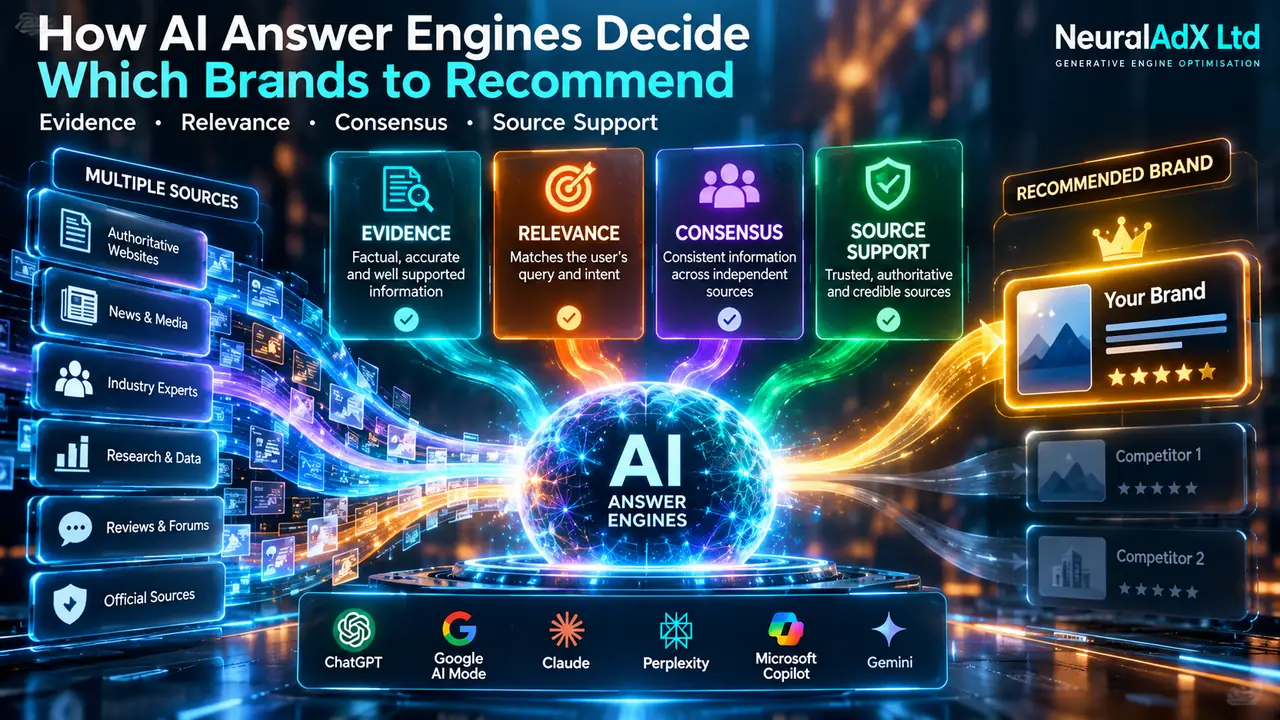
AI search works by deciding whether a query needs external search, expanding or reformulating that query, retrieving and reranking candidate sources, placing selected evidence into the model context, generating an answer from that evidence, and attaching citations to sources that support the generated claims. The exact proprietary implementation differs by platform, but current platform documentation and 2026 research support this retrieval-to-citation model as the most accurate public explanation of how modern generative search operates.
Editorial boundary: no outside observer can see the complete internal ranking stack of ChatGPT, Google AI Mode, Perplexity, Claude or Microsoft Copilot. This article therefore separates what platforms publicly document from what controlled research measures. A July 2026 critical survey of 45 GEO studies describes generative search as a stochastic, partially observable pipeline spanning search activation, crawling and indexing, retrieval, reranking and context allocation, generation and citation, absorption, fidelity and downstream user behaviour.
Martinez, 2026 · 45-study GEO survey
TL;DR: the retrieval-to-citation pipeline
A useful mental model is:
Query understanding → search activation → query fan-out or reformulation → crawl/index eligibility → candidate retrieval → reranking and context allocation → grounded generation → citation selection → answer absorption and fidelity.
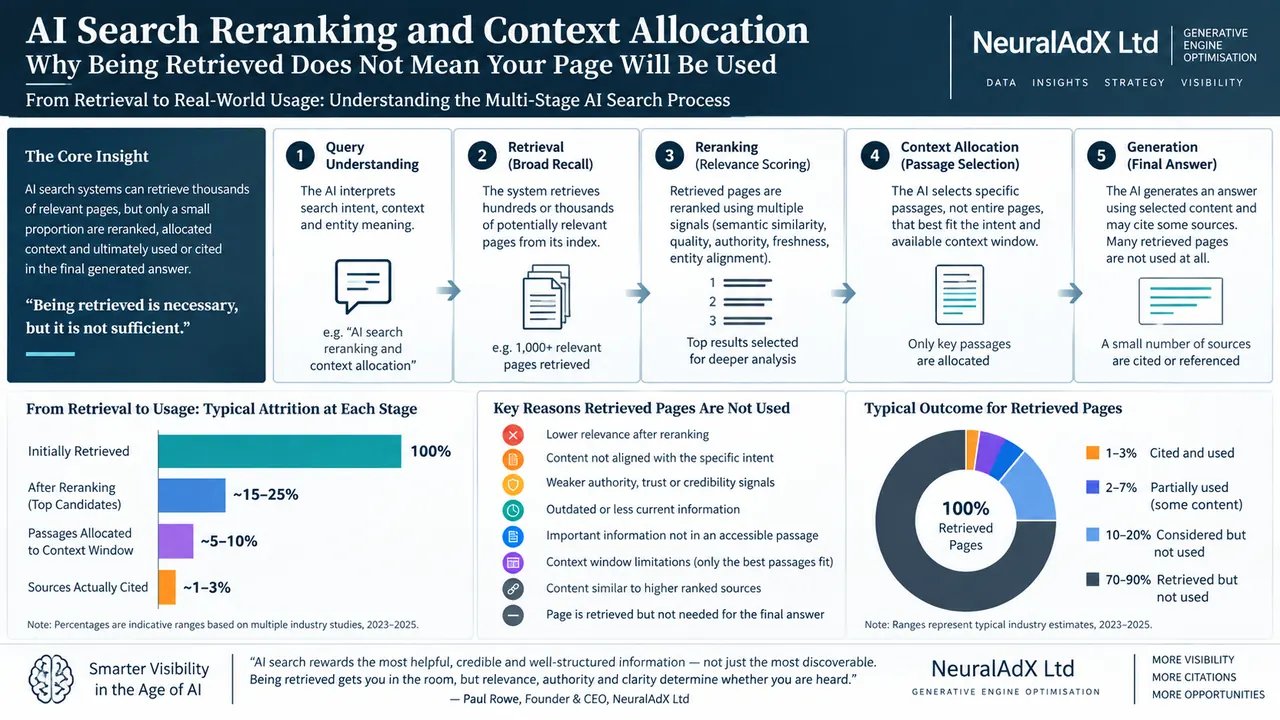
The central GEO lesson is equally simple: being indexed is not the same as being retrieved; being retrieved is not the same as being selected into context; being in context is not the same as being cited; and being cited is not the same as materially shaping the answer.
Zhang, He & Yao, 2026
The AI search retrieval-to-citation pipeline in one view
The pipeline below is a synthesis of current public platform documentation and recent information-retrieval research. It should be read as a functional model, not as a claim that every engine uses identical code or identical ranking weights.
Query
Activation
Fan-out
Retrieval
Rerank
Context
Generate
Cite
Fidelity
Mobile users: scroll horizontally to view the full retrieval-to-citation pipeline.
A 2026 measurement framework formalises an important split between citation selection, where a platform chooses which retrieved sources to cite, and citation absorption, where a source actually contributes facts, wording, evidence or structure to the final answer. Its dataset covered 602 controlled prompts, 21,143 valid search-layer citations, 23,745 citation-level feature records, 18,151 fetched pages and 72 extracted features.
Citation selection → absorption study, 2026
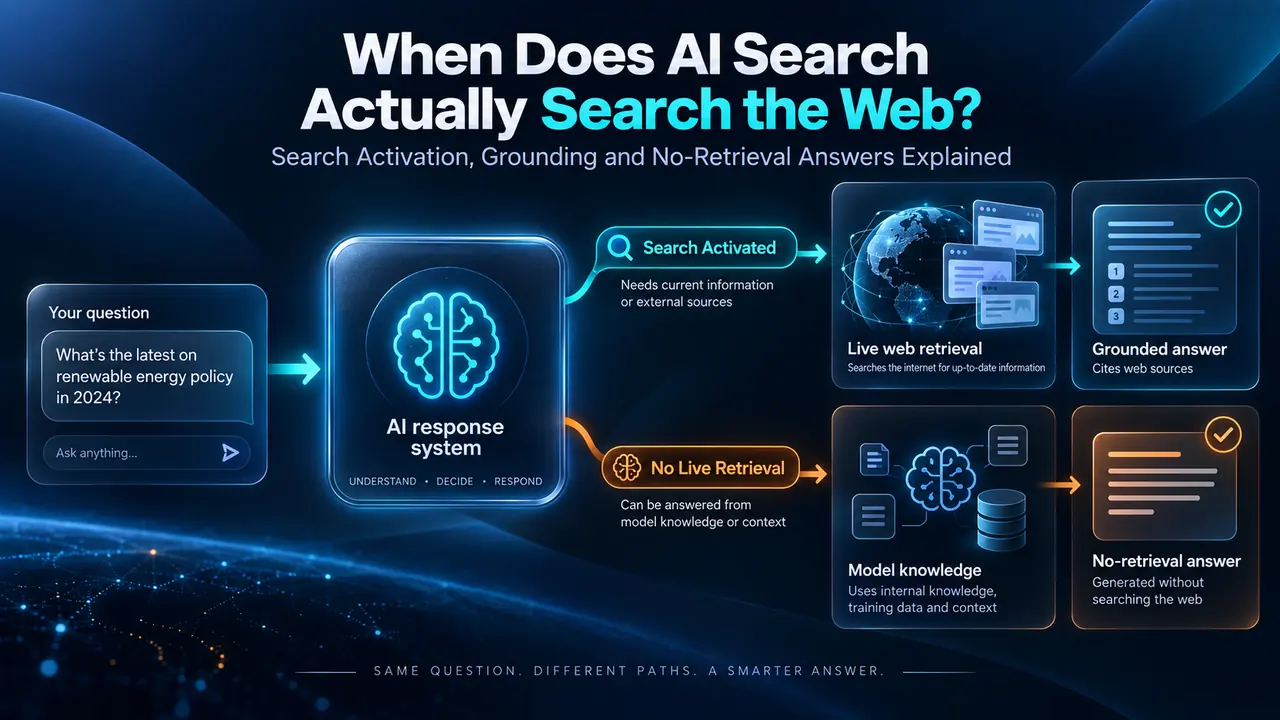
1. Search activation: the engine first decides whether it needs the web
Generative systems do not necessarily perform live retrieval for every prompt. Search activation is a gate. OpenAI states that ChatGPT can “automatically search the web” when a question may benefit from web information. Anthropic documents a similar model-directed decision for Claude’s web-search tool, while Google says AI Overviews are shown only when its systems determine that an AI response adds value beyond classic Search.
OpenAI · ChatGPT Search
Anthropic · Web Search
Google Search Central · AI features
This is why visibility analysis must record a null outcome. If search is not triggered, a page can be technically perfect and still receive no retrieval opportunity for that run.
New September 2026 evidence reinforces that search activation is model- and platform-dependent rather than a universal on/off rule. A cross-platform study analysed 171,264 donated conversations from 613 users across ChatGPT, Claude, Grok and DeepSeek, then replayed the same 1,000 prompts through controlled API experiments. In that controlled set, GPT-5.3-chat invoked web search for 14% of prompts while Claude Sonnet 4.6 did so for 83%; the authors also found that invoking search more often did not automatically produce better responses. These percentages are specific to the models, prompts and harnesses studied, not permanent platform rates.
Amani et al. · agentic web-search lifecycle · Sep 2026
■ Overall activation 13.7% ■ Question-form activation 64.7%. Study: 55,393 trending queries across 19 topical categories over 40 days, March to April 2026.
Xu, Iqbal & Montgomery, 2026
Mobile users: scroll horizontally to view the full bar chart if required.
| AI engine / feature | Query group | Activation rate | Study scope |
|---|---|---|---|
| Google AI Overviews | All tested queries | 13.7% | 55,393 trending queries across 19 categories over 40 days |
| Google AI Overviews | Question-form queries | 64.7% | Same 2026 study sample; question-form subset |
Mobile users: scroll horizontally to view the full data table if required.
2. Query interpretation and fan-out: one prompt can become several searches
The visible user prompt is not always the query sent to the retrieval system. Google explicitly documents “query fan-out”: the model issues multiple related searches across subtopics and data sources, then brings those results together. Microsoft documents that Copilot can derive a shorter Bing search query from the user’s prompt rather than sending the full prompt unchanged. Anthropic’s web-search tooling can search repeatedly during one request and, in current versions, dynamically filter results before they enter the model context.
Google · Query fan-out
Microsoft · Bing grounding
Anthropic · Dynamic filtering
OpenAI now documents this behaviour more explicitly for ChatGPT Search: a user prompt can be rewritten into one or more targeted search queries, and after reviewing initial results ChatGPT may issue additional, more specific searches. That means query reformulation can be both parallel and iterative rather than a single hidden keyword substitution.
OpenAI · targeted query rewriting and follow-up searches
The September 2026 cross-platform study also observed materially different search strategies. In real-world traces, the median number of web queries per searched prompt ranged from two for Claude to four for Grok, with some prompts going above ten. ChatGPT, Grok and DeepSeek often issued parallel fan-out queries, while Claude in that observational dataset tended to search sequentially. The practical point is not the exact counts; it is that there is no single fixed fan-out number or universal orchestration pattern across answer engines.
Amani et al. · cross-platform query strategies · Sep 2026
Why this changes search intent analysis
A page may be retrieved because it matches one hidden subquery rather than the user’s literal prompt. That makes semantic coverage, entity clarity and precise factual sections important, but it also means nobody should pretend to know every hidden query an engine generated on a particular run.
3. Crawling and indexing: a source must be accessible before it can compete
Before a source can enter retrieval, the platform needs a usable route to the content. For Google AI Overviews and AI Mode, Google says a page must be indexed and eligible to appear in Search with a snippet; it also states that there are no additional technical requirements for AI features beyond normal Search eligibility. For ChatGPT Search, OpenAI says OAI-SearchBot is used to surface websites in search results and recommends allowing that bot if a publisher wants search visibility.
Google · Eligibility
OpenAI · OAI-SearchBot
Google’s 2026 guidance is also explicit that publishers do not need special AI-only schema or AI text files to appear in Google Search’s generative features. Structured data can still help machines understand page entities and content when it accurately matches visible text, but it is not a citation guarantee.
Google · Generative AI optimisation guide
4. Candidate retrieval: the engine builds a pool of potentially useful sources
Retrieval is the stage where the system pulls a candidate set of pages or passages that might help answer the query. Google describes its generative Search features as using retrieval-augmented generation, or grounding, with core Search ranking systems to retrieve relevant, up-to-date pages from the Search index. Perplexity says it “searches the internet in real-time”, gathers source material and synthesises the results into an answer with citations.
Google · RAG / grounding
Perplexity · How search works
Retrieval does not simply reproduce a classic top-10 search result. In a 2026 Google AI Overviews study, nearly 30% of cited domains were not present in the co-displayed first-page results. That is strong evidence that the source-selection path for generative answers is related to, but not reducible to, the visible conventional ranking.
55,393-query AIO study, 2026
| Dimension | Classic web search | Generative AI search |
|---|---|---|
| Visible unit | Ranked links and search features | Generated answer plus selected citations / supporting links |
| Query handling | Primarily resolves the submitted search query | May reformulate, decompose or fan out into multiple searches |
| Source competition | Pages compete for visible rank positions | Pages compete for retrieval, context allocation, citation and answer influence |
| Output relationship | Ranking is the primary public output | Retrieval rank is intermediate; citation and answer use are downstream outcomes |
Mobile users: scroll horizontally to view the full table.
5. Reranking and context allocation: only part of the retrieved pool reaches the generator
Retrieval can return more candidates than the model can use efficiently. Reranking narrows or reorders that candidate pool, and context allocation determines which documents or passages receive the scarce attention space used during answer generation. This is a crucial bottleneck because context order itself can influence which source wins the first citation.
The 2026 SIGIR paper What Gets Cited: Competitive GEO in AI Answer Engines ran 252,000 controlled trials across six LLMs and 18 content factors. It found topical relevance and list position were the strongest general drivers of first-citation preference; explicit price information and recency also helped consistently. The authors stress that their two-document testbed isolates citation preference after retrieval, not the full organic web-search pipeline.
SIGIR 2026 · 252,000 trials
■ 11 of 18 factors, 61%, reached significance in at least four of six models. ■ 7 of 18 factors, 39%, did not reach that cross-model threshold.
Vishwakarma, Kumar & Jamidar, 2026
Mobile users: scroll horizontally to view the full stacked bar if required.
| AI-engine study scope | Factor outcome | Count | Share of 18 tested factors |
|---|---|---|---|
| Six LLMs in the controlled citation study | Significant in at least 4 of 6 models | 11 | 61% |
| Six LLMs in the controlled citation study | Did not reach significance in at least 4 of 6 models | 7 | 39% |
September 2026 update: retrieval is increasingly being framed as context construction
A new AI-search paper argues that the retrieval objective changes when documents are inputs to a generator rather than links shown directly to a user. Its answer-oriented context framework separates Answer Support (which documents can contribute), Content Trustworthiness (whether the evidence is reliable in source, temporal and factual terms), and Context Organization (which evidence is retained and structured under a finite context budget). This gives a stronger technical basis for treating reranking and context allocation as distinct from classic rank position.
Zhong et al. · answer-oriented context construction · Sep 2026
A separate August 2026 RAG study found that simply widening context can introduce relevance decay. In its experimental architecture, sequential feedback-driven allocation improved portfolio recall by 16.7–20.5 absolute percentage points versus the tested open-loop baselines. This is architecture research rather than evidence about a specific commercial search engine, but it strengthens the broader point that more retrieved context is not automatically better context.
Liu et al. · laws of context allocation · Aug 2026
Mobile users: scroll horizontally to view the full data table if required.
6. Grounded generation: the model synthesises an answer from selected evidence
Once evidence is in context, the generative model composes the response. This is the point where retrieval-augmented generation differs most visibly from classic search: the user receives a synthetic answer, not merely a list of ranked documents. The model can combine facts from multiple sources, summarise them, compare them and decide which details are worth including.
This stage also creates a second selection problem. A page can be retrieved and even cited without contributing much to the answer. In the 602-prompt citation-absorption study, high-influence pages tended to be more semantically aligned, more structured and richer in extractable evidence such as definitions, numerical facts, comparisons and procedural steps. The study therefore argues that citation count and answer influence should be measured separately.
Citation absorption framework, 2026
The practical distinction: a source can win discoverability but lose citation; win citation but contribute little to the answer; or contribute facts that are paraphrased without receiving proportional visible prominence. That is why “rank in AI” is an incomplete metric.
7. Citation selection: the engine decides which sources receive visible attribution
Citation selection is not the same as retrieval. The generator may have several candidate sources available but cite only a subset. In the 252,000-trial controlled citation study, answers contained exactly one distinct URL in about 86.4% of successful runs, two or more URLs in about 10.5%, and no URL in about 3.1%. Those figures are specific to that two-document experimental setup, but they demonstrate how sharply generation can compress a candidate set into a small visible citation set.
Citation output distribution, 2026
Citation and source visibility can also be personalised. Google now allows users to select Preferred Sources; in AI Mode and AI Overviews, content from a site a user has chosen can be highlighted with a “preferred” badge. This is a user-level preference layer, not evidence that the site receives a universal citation boost for every searcher. It is another reason a single deterministic “AI rank” is a poor model of generative visibility.
Google Search Central · Preferred Sources in AI Mode and AI Overviews
86.4%
10.5%
3.1%
Scope note: this chart describes the paper’s controlled two-source RAG testbed, not a universal production-web citation rate.
| AI-answer study outcome | Share of successful runs | Interpretation |
|---|---|---|
| Exactly one distinct URL | 86.4% | The generated answer exposed one distinct cited URL |
| Two or more distinct URLs | 10.5% | The generated answer exposed multiple distinct cited URLs |
| No URL | 3.1% | The run exposed no cited URL |
Mobile users: scroll horizontally to view the full data table if required.
Citation systems can also apply source-quality controls. As of 7 August 2026, Perplexity documents source labels for some cited domains: Government, Academic and Trusted. Its source review asks site-level questions including whether a publisher identifies authors, corrects mistakes and separates news from advertising or opinion. Perplexity also cautions that a label applies to a domain, not to the accuracy of every individual page.
Perplexity · Source labels · 7 Aug 2026
8. Citation fidelity: a visible citation must actually support the claim
The final stage is not merely whether a citation appears, but whether the cited source supports the statement attributed to it. Citation fidelity matters because a citation can be present yet incomplete, mismatched or insufficient for a generated claim.
The 2026 Google AI Overviews measurement study decomposed outputs into 98,020 atomic claims and reported that 11.0% were unsupported by the cited pages. The same study found source quality and claim fidelity were largely independent, meaning a high-quality domain does not automatically guarantee that every generated claim is correctly supported.
98,020-claim fidelity analysis, 2026
A July 2026 public-information study adds a different warning: in 35% of reviewed open-web search answers, experts flagged at least one cited source, compared with 6% for answers grounded in a curated corpus. The study found a coverage-trust trade-off: open-web retrieval answered more questions, but source trustworthiness was more variable.
Einarsson et al., July 2026
September 2026 research adds a provenance warning for compressed contexts. In one RAG experiment, a RECOMP-style compressor achieved 0.86 citation precision when citations were checked against its generated summaries but only 0.12 when the same citations were re-attributed to original source spans. Under the same setting, the unsupported-claim rate was 0.88 against recovered source spans versus 0.17 against summaries. The authors explicitly caution that these estimates depend on automated evaluators and lack independent human calibration, so the numbers should not be treated as universal production rates. The useful lesson is narrower: intermediate summarisation or compression can make citation fidelity look stronger than the original-source provenance actually is.
Mody · attribution-compression frontier · Sep 2026
What the major AI search platforms publicly disclose about retrieval and citations
The mechanics differ, but the disclosed architectures share a common pattern: interpret the prompt, obtain external evidence when needed, select relevant results, generate a response and expose source links or citations.
| Platform | Search / retrieval disclosure | Citation / source disclosure | What remains undisclosed |
|---|---|---|---|
| Google AI Mode / AI Overviews | Core Search index and ranking systems, RAG / grounding, possible query fan-out across subtopics and data sources. | Supporting links can be shown alongside generated responses; user-selected Preferred Sources can be highlighted for that user in AI Mode and AI Overviews. | Exact source-selection, reranking, context and citation weights. |
| ChatGPT Search | ChatGPT can decide to search when web information would help; OpenAI documents rewriting a prompt into one or more targeted queries and issuing additional searches after reviewing results; OAI-SearchBot is used to surface websites in search features. | Search responses may contain inline citations and a Sources panel. | Full ranking function, candidate pool size and citation-selection scoring. |
| Perplexity | Interprets the question, searches the web in real time and synthesises information from sources. | Citations link to original sources; some domains now receive Government, Academic or Trusted labels. | Complete ranking, source-weighting and citation-selection formulas. |
| Claude web search | Anthropic documents model-directed search, repeat searches during a request and dynamic filtering of results before context for current tooling. | Final responses include citations for sources drawn from search results. | Consumer-product ranking details and full source preference logic. |
| Microsoft Copilot web grounding | Copilot can derive a short search query from the user prompt and send it to Bing for grounding. | Users can inspect sources and, in supported Copilot experiences, the generated web-search queries. | Full Bing retrieval and downstream citation-selection weighting. |
Mobile users: scroll horizontally to view the full table.
Primary documentation:
Google
OpenAI
Perplexity
Anthropic
Microsoft
A September 2026 cross-platform audit adds an important caution to this table: even when two systems both “search the web”, they can differ in whether they search, how many queries they issue, whether they fan out in parallel or iterate sequentially, which domains their search providers return, and which retrieved URLs they ultimately cite. The study also found that some generated claims could be traced to returned search results that were not visibly cited. Platform-level visibility therefore needs to be measured separately rather than inferred from one engine.
Amani et al. · ChatGPT, Claude, Grok and DeepSeek · Sep 2026
Why a retrieved page may still not be cited
A retrieved page can disappear before the user ever sees it because citation is downstream of several competitive filters. The most useful current evidence points to five recurring reasons:
Weak topical fit: a competing source is more directly aligned to the query or subquery.
Lower context position: the source is available but receives a less favourable position in the evidence slate.
Missing extractable evidence: the page lacks the specific facts, numbers, comparisons or definitions required by the answer.
Freshness mismatch: a newer source is preferred for a time-sensitive claim.
Source-quality trade-off: a system may prefer evidence it judges more authoritative, trusted or suitable for the claim.
What the retrieval-to-citation pipeline means for Generative Engine Optimisation
Generative Engine Optimisation is the specialist discipline NeuralAdX Ltd uses to improve how businesses are found, understood, retrieved, cited, mentioned, trusted and recommended inside AI-generated answers. Terms such as AI SEO, AEO, LLMO, AI search optimisation, ChatGPT optimisation, Google AI Mode optimisation and Perplexity optimisation are useful buyer or platform language, but they describe parts of the wider generative-search problem rather than replacing the parent GEO discipline.
The pipeline makes GEO easier to diagnose because every weakness belongs to a stage. NeuralAdX Ltd therefore frames implementation around AI retrieval testing, citation readiness, entity clarity, prompt coverage, trust signals, source selection, technical crawlability, AI citation benchmarking and AI answer visibility measurement.
NeuralAdX Ltd 11-Factor GEO Methodology
Windgrove’s B2B AI citation guide provides a useful six-pillar framework covering technical access, entity consistency, first-party proof, answer-ready structure, external corroboration and measurement.
Generative search is also beginning to extend beyond passive answer generation towards more agentic workflows, where AI systems can retrieve information, use external tools and potentially take actions on a user’s behalf. This creates an emerging layer around AI agents and Model Context Protocol (MCP), with implications for how web information is discovered, interpreted and made available to machine-driven workflows.
| Pipeline stage | What failure looks like | Relevant GEO work |
|---|---|---|
| Crawl / index | Page is inaccessible, excluded or not eligible for the relevant search system. | Technical crawlability, indexability, internal linking and accessible textual content. |
| Retrieval | Competitors surface for the prompt while the brand or page is absent. | Prompt coverage, semantic relevance, entity clarity, evidence coverage and authority. |
| Reranking / context | Page appears inconsistently or loses to stronger competing evidence. | Sharper topical fit, current facts, clear comparisons, concrete specifications and source authority. |
| Citation selection | Brand is mentioned or source is retrieved, but the page receives little or no visible attribution. | Citation-ready facts, statistics, definitions, quotations, direct answers and source-backed claims. |
| Absorption / fidelity | Citation appears but contributes little, or claims are weakly supported. | Precise evidence blocks, unambiguous attribution, source diversity and repeated live retrieval validation. |
Mobile users: scroll horizontally to view the full table.
Industry Expert Quotes
“Across the NeuralAdX Ltd Month 8 benchmark, 1,333 domain citations and a 13% citation share were recorded for the defined tracked prompt set. But citation count is only a downstream outcome. To understand why visibility changes, you have to separate retrieval, context position, citation selection and answer use.”
Paul Rowe, Founder, Chief Generative Engine Optimisation Officer and CEO of NeuralAdX Ltd
NeuralAdX Ltd · Month 8 Citation Benchmark
Pipeline evidence · 2026 survey
“On 1 August 2026, NeuralAdX Ltd recorded 32 neuraladx.com domain citations across 12 defined prompt-platform checks in its published live retrieval proof set. That variation is why Generative Engine Optimisation should be validated through repeated retrieval tests under recorded conditions, not treated as a permanent AI rank.”
Paul Rowe, Founder, Chief Generative Engine Optimisation Officer and CEO of NeuralAdX Ltd
NeuralAdX Ltd · Live retrieval proof
How the retrieval-to-citation pipeline should be measured in practice
A credible measurement programme should preserve stage-specific outcomes instead of collapsing everything into one “AI rank”. At minimum, record the exact prompt, platform, date, whether live retrieval appears to have been activated, which brands or sources surfaced, citation quantity, visible answer position, repeated-run consistency and whether cited claims are genuinely supported by the source.
AI Answer Visibility BenchmarkMeasure mentions, brand coverage, answer position and share of voice.
Live AI Retrieval ProofSee time-stamped screen-recorded retrieval and citation outcomes.
Google’s Generative AI controls and Search Console insights are no longer limited to the initial UK test. Google states that, as of 31 August 2026, the features had rolled out to all websites worldwide. Search Console can now provide generative-AI appearance insights including impressions, which pages appear in AI responses and the countries where they appear; a separate control also lets site owners opt out of appearing in and grounding Google’s generative AI Search features. That improves observability and control inside Google, but cross-platform GEO still requires separate measurement because each answer engine has different retrieval and citation behaviour.
Google Search Console · GenAI reports · 3 Jun 2026
Google · worldwide rollout update · 31 Aug 2026
If you want to see where your own website currently enters or falls out of this pipeline, the most useful starting point is a controlled baseline: test commercially important prompts across major AI platforms before deciding what needs to change.
Measurement should also separate citation visibility from referral behaviour. An August 2026 observational study using one month of browsing data from 900 U.S. adults (March 2025) found that only about 1% of visits to Google result pages with an AI Overview led to a click on one of the cited AI Overview sources. Users clicked a conventional result on 8% of visits with an AI Overview versus 15% without one, and ended their browsing session on 26% versus 16%. Because the study is observational and uses 2025 behaviour, it does not establish a current causal effect; it does show why citation, click-through and conversion should be reported as separate outcomes.
Chapekis et al. · AI Overview click behaviour · Aug 2026
AI Visibility Assessment
NeuralAdX Ltd
Request Your Free AI Visibility Assessment
Initial website check against our 11-Factor GEO Framework plus 5 Live AI Retrieval Tests.
Find out whether AI recommends your business, cites your website, prefers competitors – or leaves your business invisible in AI answers.
11-Factor GEO Framework
Checked
Commercial AI Prompts Tested
Start With A Free Assessment
Call NeuralAdX Ltd now or send your assessment request by email.
Emailing Your Request?
For your convenience, your email is already prepared with simple placeholders. Just add your website URL, best contact number, 5 priority AI prompts and any useful information.
Initial assessment only · No obligation · Serious business enquiries answered within one UK business day · View live AI retrieval proof
From diagnosis to Generative Engine Optimisation implementation
A retrieval test tells you where the problem appears; implementation addresses the relevant stage. NeuralAdX Ltd provides specialist Generative Engine Optimisation services for businesses that need systematic work on retrieval, citations, entity clarity, evidence, content structure, crawlability and measurable AI answer visibility.
Five common misconceptions about how AI search works
| Misconception | More accurate explanation |
|---|---|
| “AI search just reads the top Google result.” | Generative systems can issue multiple searches, use different indices or tools and build a separate evidence pool. Nearly 30% of domains cited by Google AI Overviews in one 2026 study were absent from co-displayed first-page results. |
| “If a page is indexed, it can be cited.” | Indexing only makes a page eligible to enter retrieval. It still has to be retrieved, reranked into context and selected for citation. |
| “A citation proves the page drove the answer.” | Citation selection and citation absorption are different outcomes. A cited page may contribute little to the final answer. |
| “Schema guarantees AI citations.” | No current major platform documents a schema type that guarantees generative citation. Google specifically says no special AI schema is required for its AI Search features. |
| “One successful test means permanent AI ranking.” | Generative search is stochastic and time-sensitive. Repeated tests, defined prompts, dates and platform conditions are needed to establish consistency. |
Mobile users: scroll horizontally to view the full table.
Frequently asked questions about the AI search retrieval-to-citation pipeline
The answers below are displayed in full so readers and machine systems can access the complete explanation without opening interactive elements.
What is the simplest explanation of how AI search works?
AI search interprets a user question, decides whether external information is needed, retrieves relevant sources, reranks or filters them, generates an answer using selected evidence and attaches citations or source links to support the response.
What is retrieval-augmented generation in AI search?
Retrieval-augmented generation, usually shortened to RAG, grounds a generative model in external evidence retrieved at answer time. In search products, this allows the model to use fresher or more specific information than relying only on its pre-trained internal knowledge.
Does AI search always use live web retrieval?
No. Search activation depends on the product, prompt, user settings and model behaviour. OpenAI and Anthropic document model-directed decisions about when web search is useful, while Google says AI Overviews do not trigger for every search.
Why can an AI answer cite a page that is not in the visible top 10?
Because generative source retrieval is not identical to the visible classic ranking. Query fan-out, alternative source pools, reranking and context selection can surface sources that do not appear in the co-displayed first page. A 2026 Google AI Overviews study found nearly 30% of cited domains were absent from those first-page results.
Is retrieval the same as citation?
No. Retrieval means a source entered the candidate evidence pool. Citation means the final answer visibly attributes information to that source. A source can be retrieved and still lose during reranking, context allocation or citation selection.
What is citation absorption?
Citation absorption is the degree to which a cited source actually contributes facts, language, evidence or structure to the generated answer. It is a deeper measure than simply counting whether the source received a citation.
What makes a source more likely to win a citation?
No single factor guarantees citation. Controlled 2026 research found topical relevance and context position were especially influential, while recency, explicit information, specifications, comparisons and evidence could also help. Production systems remain proprietary, so these findings should be treated as evidence about mechanisms, not universal ranking rules.
How does Generative Engine Optimisation fit into the pipeline?
Generative Engine Optimisation focuses on improving the stages a publisher can influence: crawlability, retrievability, entity clarity, topical fit, evidence quality, citation readiness, source trust signals, prompt coverage and measurable answer visibility. NeuralAdX Ltd treats related terms such as AI SEO, AEO and LLMO as market language within this wider specialist GEO discipline.
The most accurate way to think about AI search in 2026
AI search is not one ranking algorithm. It is a chain of probabilistic decisions that begins with search activation and ends with a generated answer whose citations represent only the sources that survived retrieval, reranking, context allocation and citation selection.
That distinction is the key to understanding modern search visibility. Traditional rankings still matter because web indices and ranking systems often feed retrieval, but generative search adds new competitive layers between discovery and the final answer. The strongest current evidence therefore supports stage-by-stage measurement: discoverability, search activation, query formulation, retrieval, context allocation, citation, prominence, absorption, fidelity and downstream behaviour should be separated rather than compressed into a single permanent “AI rank”. September 2026 research strengthens this model by treating AI search as both a search-orchestration problem and a finite-context construction problem, not simply a reranked list of documents.
Related perspective: AEO and GEO terminology
The terminology around AI search optimisation is still developing, and different practitioners emphasise different parts of the answer-engine process. The Real Social Company, (an AI Website Design company in Columbus) provides a useful side-by-side explanation of AEO and GEO and why businesses increasingly need to think about both direct-answer extraction and broader generative visibility.
Primary sources and recent research used for this editorial
Priority was given to official platform documentation and recent research directly measuring retrieval, citation selection, source quality or citation fidelity. Preprints are identified by their linked source and should not be treated as settled platform specifications.
Google · Generative AI optimisation guide
OpenAI · ChatGPT Search
OpenAI · Search crawler docs
Anthropic · Web search docs
Perplexity · How it works
Perplexity · Source labels
Microsoft · Bing web grounding
Martinez · GEO survey · Jul 2026
What Gets Cited · SIGIR 2026
Citation selection to absorption · 2026
Google AI Overviews measurement · May 2026
Curated vs open-web retrieval · Jul 2026
AI Overview click behaviour · Aug 2026
Context allocation · Aug 2026
Attribution compression · Sep 2026
Agentic web-search lifecycle · Sep 2026
Answer-oriented context construction · Sep 2026
Google · Preferred Sources
Google · GenAI controls & insights · Aug 2026