Prompt paraphrasing changes AI brand recommendations, so reliable AI visibility must be measured across equivalent questions, repeated runs, engines and time
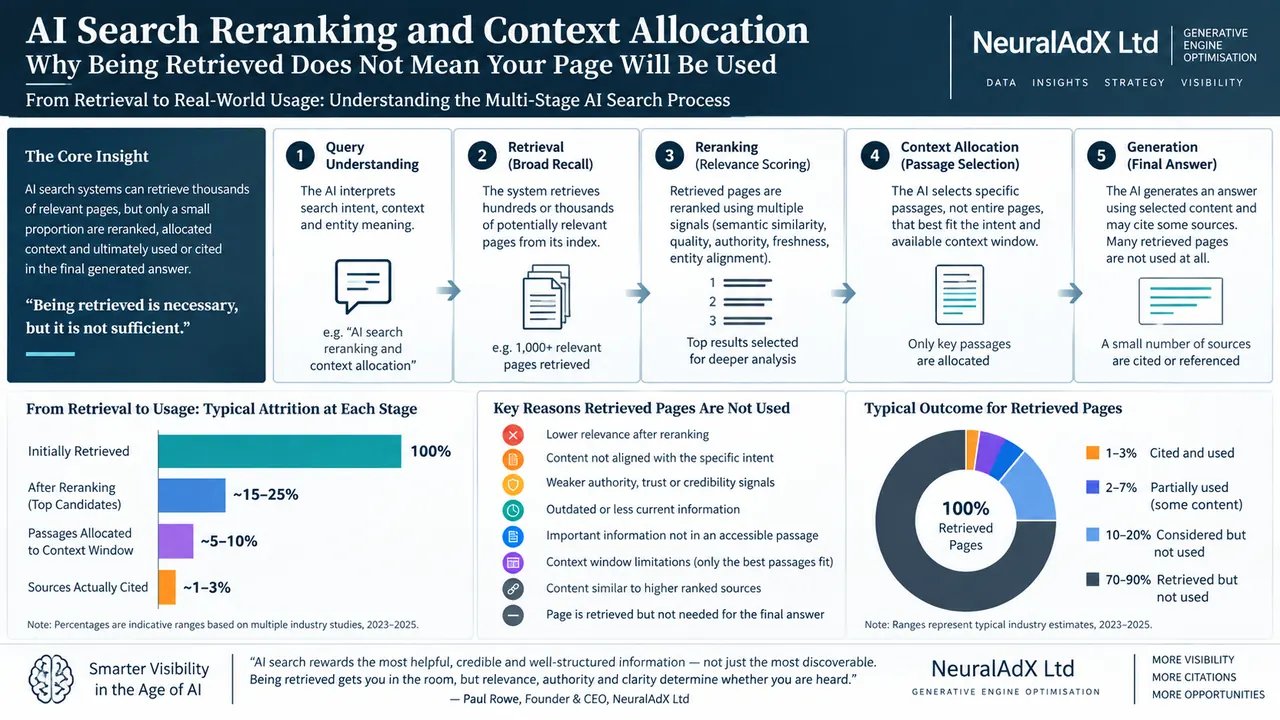
Two people can express almost the same commercial need and receive different recommended brands because changing the wording can alter how a generative engine interprets the query, which searches it runs, which sources it retrieves, how it allocates context and which answer it finally generates. Even an identical prompt can produce a different output on another run, so a single AI screenshot proves that an answer occurred, not that the answer is stable, representative or likely across the wider buyer-intent space.
An April 2026 GEO measurement preprint, Don’t Measure Once: Measuring Visibility in AI Search (GEO), tested repeated visibility across ChatGPT, Gemini, Google AI Mode and Perplexity. Across a 45–46 day observation window, cited-source sets overlapped by only 34–42% from one day to the next, while qualifying brand sets overlapped by 45–59%. In repeated runs within a 24-hour window, source overlap averaged 32–43% and brand overlap 33–48%. The authors therefore argue that GEO visibility should be treated as a distribution over repeated observations rather than a single-point result. Because this is a preprint, the findings should be treated as current empirical evidence rather than settled consensus.
The strongest current evidence makes prompt sensitivity measurable rather than hypothetical. A May 2026 production study of commercial recommendations reported a recommendation-set Jaccard similarity of 0.288 for cosmetic paraphrases and 0.135 for constraint-changing variants, compared with 0.50 to 0.61 for reruns of the exact same prompt. In plain English, semantically close wording changes could alter the shortlist materially beyond ordinary rerun variation. The study is a preprint, so it should be treated as important but not final evidence.
Research review date: 29 September 2026. Publication status is identified throughout so peer-reviewed evidence, official documentation and preprints are not treated as equivalent.
TL;DR: AI visibility is a distribution, not a screenshot
Article navigation
What the research says about prompt paraphrasing, repeatability and AI visibility
The evidence comes from several layers. Direct 2026 GEO measurement research shows that brand and source visibility can change materially across repeated runs and days. Peer-reviewed NLP research shows that small wording and formatting changes can alter model decisions. Official platform documentation confirms that retrieval systems can fan a query into multiple searches and that generation can remain non-deterministic. Commercial-recommendation research then isolates paraphrase sensitivity and shows that wording changes can alter the brands users actually see beyond ordinary rerun variation.
Mobile users: scroll horizontally to view the full table.
| Evidence | Study design | Most relevant finding | What it means for AI visibility |
|---|---|---|---|
| Repeated GEO visibility measurement Preprint · April 2026 | Four AI search engines, four commercial verticals, eight prompts per campaign, 45–46 days of observation, plus up to 10 repeated runs per engine-prompt group. | Day-to-day cited-source Jaccard averaged 0.34–0.42; qualifying brand Jaccard averaged 0.45–0.59. Repeated runs within 24 hours also showed substantial turnover. | A single observation is not a stable estimate of GEO visibility. Repetition and sustained observation are required before treating visibility as representative. |
| Commercial recommendation brittleness Preprint · May 2026 | 50 commercial prompts; same-prompt reruns and paraphrase variants across production web-search systems. | Recommendation Jaccard: 0.50–0.61 for same-prompt reruns, 0.288 for cosmetic paraphrases, 0.135 for constraint-changing variants. | One tracked wording is not a defensible proxy for the full way buyers may express an intent. |
| Paraphrased opinion prompts ACL WASSA · March 2026 | 200 opinion questions, each with five human-validated paraphrases, across five LLMs under deterministic inference. | Measurable model-to-model differences in stability remained even when prompts were semantically equivalent. | Paraphrase robustness varies by system. Cross-engine AI visibility should not assume one platform’s stability transfers to another. |
| Prompt robustness EMNLP Findings · 2025 | Four robustness methods, eight open model families, 52 tasks, with extension to GPT-4.1 and DeepSeek V3. | The paper describes LLMs as sensitive to subtle, non-semantic variations in phrasing and formatting. | Tiny surface changes can be measurement noise unless prompt design is controlled and replicated. |
| AI benchmark uncertainty NIST AI 800-3 · Feb 2026 | 22 API-access frontier LLMs on three benchmarks plus simulation. | NIST distinguishes performance on a fixed benchmark from performance on the wider population of similar possible test items, and recommends explicit uncertainty modelling. | A fixed prompt panel measures the panel. Generalising to the wider intent population requires a sampling design and uncertainty statement. |
| Critical GEO survey Preprint · July 2026 | Critical review of 45 studies from 2023–2026. | Recommends three to five paraphrases per information need, multiple named engines, closely spaced repetitions, multiple time windows and interval/distribution reporting. | Research methodology is moving away from one-off visibility checks toward repeatable, distributional evaluation. |
| Semantically equivalent prompt robustness Findings of ACL · July 2026 | Eight models, four NLG tasks and ten semantically equivalent paraphrases per prompt, covering roughly 115,000 model evaluations. | Robustness varied materially by task structure and attribute verifiability; stronger general model capability did not guarantee greater prompt robustness. | Equivalent wording should be treated as a measurement condition. A GEO panel that uses one phrasing cannot assume it represents the wider prompt family. |
Important caution: no single study establishes a universal percentage by which all AI recommendations will change under paraphrasing. Effects depend on the engine, retrieval mode, topic, prompt family, date, location, user context and metric. The defensible conclusion is methodological: paraphrase sensitivity is material enough that it should be measured rather than assumed away.
What high-authority sources say about prompt sensitivity and repeatability
Several independent sources now converge on the same measurement problem from different directions. The quotations are short by design and should be read in the context of the linked source.
Together, these sources do not prove that every paraphrase will change a brand answer. They establish a stronger point: the prompt, retrieval process and generation run are all part of the measurement condition, so repeatability has to be tested rather than assumed.
Why two similar questions can produce different brands: the retrieval-to-answer mechanism
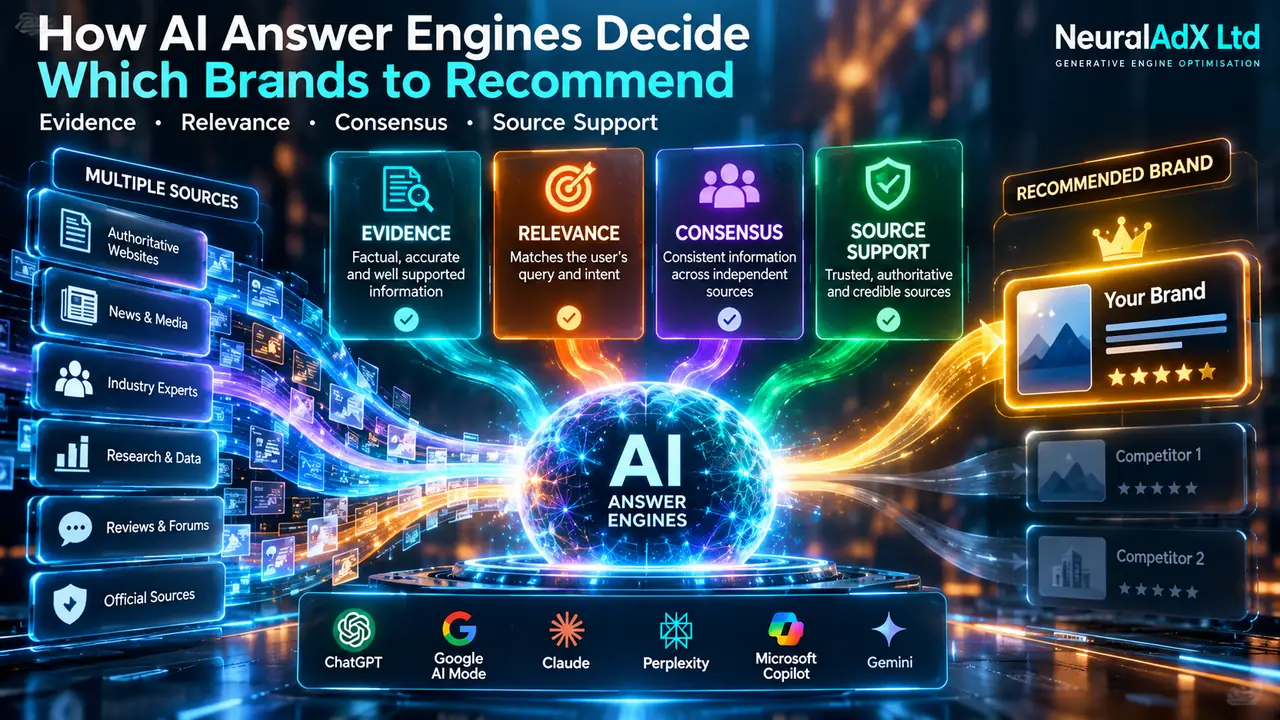
A generative answer is not produced by matching one sentence to one static ranking. On search-grounded systems, the user prompt can influence multiple stages of a partially observable pipeline. A small wording change can therefore cascade into a different source set and, ultimately, a different brand shortlist.
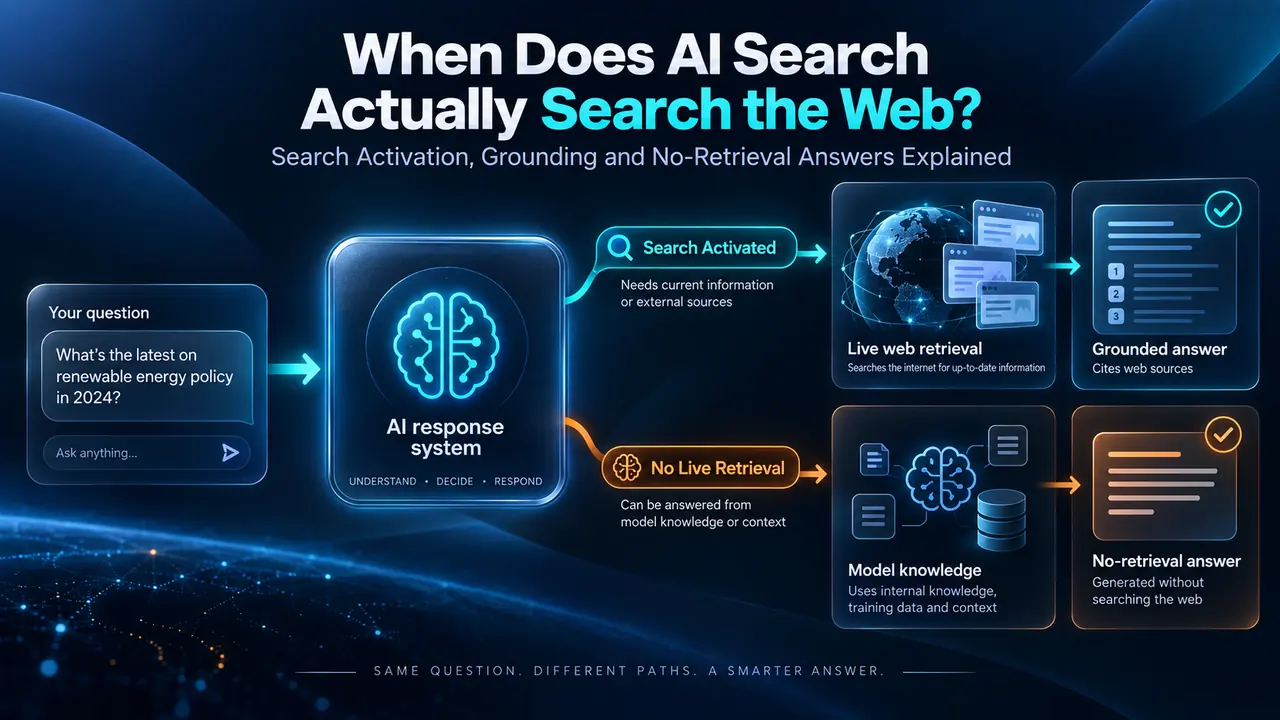
Google’s own description is especially relevant: query fan-out can involve “multiple related searches across subtopics and data sources.” That means a paraphrase can change more than the final prose. It can change the evidence landscape from which brands are selected.
Chart 1: recommendation-set stability falls when wording changes
The chart below visualises the May 2026 commercial recommendation study. Jaccard similarity measures the overlap between two recommendation sets relative to their union. Higher is more stable. The exact-prompt bar uses 55.5% only as the midpoint of the published 50%–61% range for visual scale; it is not a separately reported study mean.
Mobile users: scroll horizontally to view the full chart.
The core lesson is not that “28.8% of brands stay the same” in every use case. Jaccard is a set-overlap statistic, and the study’s result is corpus-specific. The stronger lesson is that wording variation produced materially less recommendation overlap than ordinary reruns of the same wording. That is precisely why prompt methodology belongs inside AI visibility measurement.
Not every different prompt is a paraphrase: define the variant before measuring it
The word “paraphrase” is often used too loosely in AI visibility work. A scientifically useful protocol must distinguish surface rewording from a genuine change in the buyer’s requirements. Otherwise the methodology mixes model instability with legitimate intent change.
Mobile users: scroll horizontally to view the full table.
| Variant type | Example A | Example B | Interpretation |
|---|---|---|---|
| Cosmetic semantic paraphrase | Which are the best CRM platforms for UK SMEs? | What are the top CRM systems for small UK businesses? | Same commercial need, altered wording. Good for testing paraphrase robustness. |
| Structural paraphrase | Recommend the best CRM for a UK SME. | I run a UK SME. Which CRM would you recommend? | Meaning is intended to stay stable while sentence structure and conversational framing change. |
| Decision-criterion shift | Which CRM is best overall? | Which CRM offers the best value? | Related topic, different decision criterion. Treat as a different commercial prompt family. |
| Constraint-changing variant | Which CRM is best for UK SMEs? | Which CRM is best for a 30-person UK SaaS company under £100 per user per month? | Not a strict paraphrase. Geography, size, sector and budget can legitimately change the shortlist. |
| Persona or stage shift | Which CRM would you recommend to a first-time buyer? | Which CRM is best for a team migrating from Salesforce? | Different journey stage and prior state. Analyse separately. |
| Language or locale variant | Best accounting software for UK small businesses | Equivalent intent asked in another language or locale | Language can change retrieval ecosystems and should be a separate measurement dimension, not hidden inside one paraphrase score. |
Rule: preserve the semantic target when testing paraphrase sensitivity. If a variant adds a new criterion that a rational recommender should care about, record it as a different subfamily. This prevents genuine commercial segmentation from being mislabeled as AI inconsistency.
Diagram 2: the correct unit of AI visibility measurement is a prompt family, not a favourite screenshot
A robust design starts from a real commercial information need, samples controlled ways of expressing it, repeats the measurements, and then aggregates the resulting distribution. This preserves both real buyer-language diversity and experimental discipline.
Mobile users: scroll horizontally to view the full diagram.
What decision is the buyer trying to make?
Leadership, recommendation, comparison, value, evidence
Same semantic target, varied natural phrasing
Estimate run variance and drift
Keep product, mode, locale and date
Rates, overlap, coverage, intervals, sources
Five commercial prompt families for measuring AI visibility without cherry-picking
Prompt families should reflect distinct commercial decisions, not a random list of near-duplicates. The five families below form a practical starting structure for Generative Engine Optimisation testing across products, services and professional markets. Each family can contain three to five semantic paraphrases while keeping the underlying decision criterion stable.
Mobile users: scroll horizontally to view the full table.
| Commercial prompt family | Core question | Example semantic variants | Primary GEO signal |
|---|---|---|---|
| 1. Market leadership | Who is perceived as best or leading? | “Which are the best [CATEGORY] in the UK?” “What are the top [CATEGORY] providers in the UK?” “Which UK [CATEGORY] companies are considered leading options?” | Brand inclusion, recommendation rate, rank/order, evidence cited for leadership. |
| 2. Recommendation | What would the engine actively suggest? | “Which [CATEGORY] would you recommend in the UK?” “I need a UK [CATEGORY]. What would you suggest?” “Which UK [CATEGORY] should I shortlist?” | Recommendation rate, shortlist persistence, reasons, supporting sources. |
| 3. Comparison and competitive positioning | How are leading alternatives differentiated? | “Compare the leading UK [CATEGORY].” “Rank the top UK [CATEGORY] and explain the differences.” “How do the main UK [CATEGORY] options compare?” | Share of voice, comparative attributes, position, competitor co-mentions. |
| 4. Commercial value | Which option appears to offer the strongest value for the defined buyer? | “Which UK [CATEGORY] offers the best overall value?” “What UK [CATEGORY] gives the strongest value for money?” “Which leading UK [CATEGORY] balances capability and cost best?” | Value recommendation rate, pricing/source evidence, suitability qualifiers. |
| 5. Evidence and trust | Which option has the strongest proof for the required outcome? | “Which UK [CATEGORY] has the strongest evidence of results?” “Which [CATEGORY] shows the most verifiable proof?” “Which UK [CATEGORY] has the best documented track record?” | Evidence absorption, citation quality, proof-source diversity, trust statements. |
These families are deliberately distinct. “Best overall” and “best value” should not be collapsed merely because both can result in a ranked list. The semantic criterion is different, so the correct measurement question is whether a brand is visible across multiple commercially meaningful families, not whether it can win one carefully selected phrase.
Chart 3: paraphrase overlap versus recommendation-set change
The same 2026 commercial study can be reframed as a simple 100% stacked view of set similarity. The coloured “overlap” portion is the reported Jaccard value; the remainder is one minus Jaccard. This does not mean that exactly the remainder of individual brands changed in every list. It is a visual decomposition of the Jaccard index, not a per-brand turnover estimate.
Mobile users: scroll horizontally to view the full stacked chart.
From screenshot to benchmark: what each level of evidence can actually prove
The problem is not screenshots themselves. The problem is an inference that outruns the evidence. A single capture is strong evidence of a single observed event; it is weak evidence of prevalence or repeatability. Each additional methodological layer answers a different question.
Mobile users: scroll horizontally to view the full table.
| Evidence level | What it can support | What it cannot support by itself | Best use |
|---|---|---|---|
| 1. Single screenshot or video capture | “This brand appeared in this answer on this surface at this time.” | Stable rank, probability of appearance, intent-wide visibility or cross-platform leadership. | Verification of occurrence and qualitative inspection. |
| 2. Same-prompt reruns | How stable that exact prompt is under repeated execution. | Whether different natural phrasings of the same need behave similarly. | Run-to-run variance and reproducibility baseline. |
| 3. Fixed prompt panel over time | Trend and competitive movement for a predefined set of exact queries. | The full population of alternative buyer phrasings unless the panel was sampled for that purpose. | Longitudinal benchmarking and controlled trend detection. |
| 4. Paraphrase family testing | How well brand visibility generalises across semantically equivalent wordings. | Other commercial intents, other engines or future time periods. | Intent-level robustness and prompt coverage. |
| 5. Multi-engine, multi-time, multi-family benchmark | A distribution of observed visibility across several meaningful dimensions. | A permanent universal rank or guaranteed business outcome. | Strongest practical evidence for external AI visibility. |
| 6. Controlled downstream outcome study | With appropriate controls, whether exposure is associated with or causes clicks, discovery, leads or other behaviour. | Causality when control conditions, baseline trends or confounding are absent. | Commercial impact evaluation. |
NIST’s 2026 benchmarking guidance makes a parallel statistical distinction: performance conditioned on a fixed benchmark is different from performance generalised to all similar possible test items. In GEO terms, a fixed prompt panel is a valid measurement instrument, but its external generalisation depends on how the prompts were selected and what population of buyer questions they are intended to represent.
Fixed-prompt longitudinal benchmarks and paraphrase-family benchmarks measure different things
A rigorous article on paraphrase sensitivity should not make the opposite mistake and declare fixed prompts useless. Keeping prompts fixed is exactly what makes a longitudinal panel comparable over time. The limitation arises only when a result from that panel is generalized beyond its defined scope. Schulte, Bleeker and Kaufmann’s April 2026 GEO study strengthens this distinction: repeated measurements are needed to estimate stability, while variation between prompts means a narrow panel should not automatically be treated as the entire market-intent population.
NeuralAdX Ltd publishes fixed-query longitudinal evidence for precisely this reason. Its AI Answer Visibility & Share of Voice Benchmark tracks a fixed UK GEO-intent query set across ChatGPT, Perplexity, Google AI Overviews and Microsoft Copilot. The latest published Month 8 period (24 June to 23 July 2026) records NeuralAdX Ltd at #1 with 183 counted brand mentions, 29% share of voice, 16% brand coverage and 1.32 average brand position. The benchmark itself explicitly describes these as period-specific measurements from the fixed query set, not organic search rankings, traffic, leads or revenue.
Likewise, the AI Citation Benchmark uses 10 fixed GEO-intent queries across four AI platforms as an ongoing longitudinal evidence record. Month 8 records 1,333 AI citations, 13% AI citation share and 73% domain coverage for NeuralAdX Ltd. Again, the correct interpretation is the one the benchmark gives: observed citation behaviour for the defined fixed prompt set over the defined reporting window.
The strongest combined design is therefore two-layered: preserve a fixed core panel for trend continuity, and run a separate paraphrase-family layer to estimate intent-level generalisation. Do not silently change the longitudinal prompts, because that destroys comparability; version prompt-family additions separately.
Which metrics make paraphrase-aware AI visibility measurable
A single “AI rank” compresses too much. Prompt-aware GEO measurement should retain several observable signals so that a gain in one layer does not hide a loss in another. The following metrics are practical for commercial prompt families.
Mobile users: scroll horizontally to view the full table.
| Metric | Definition | Why it matters for paraphrasing | Recommended denominator |
|---|---|---|---|
| Brand mention rate | Share of runs in which the brand is named. | Shows whether presence survives alternate phrasings. | All eligible runs in the defined family, including null answers. |
| Recommendation rate | Share of runs where the brand is affirmatively suggested or shortlisted. | Stronger than mere mention for commercial queries. | All runs where a recommendation decision is possible. |
| Citation rate | Share of runs in which the brand domain or supporting source is cited. | Separates source selection from brand-name recall. | All eligible runs, with search/citation-disabled outcomes retained and labelled. |
| Prompt-family coverage | Share of paraphrase variants where the brand appears at least once or above a defined rate. | Direct measure of wording robustness. | All prespecified variants in the family. |
| Share of voice | Brand mentions relative to the defined competitive mention pool. | Shows whether wording changes redistribute attention among competitors. | All counted brand mentions within the benchmark design. |
| Average brand position | Mean or median observed position when position is defined. | Can reveal brands that remain present but move down the shortlist under rewording. | State whether absent runs are excluded or assigned a penalty. |
| Recommendation-set Jaccard | Intersection divided by union of the brand sets returned under two conditions. | Directly quantifies set stability across paraphrases or reruns. | Pairwise prompt/run comparisons using canonicalized brand identities. |
| Cross-engine consensus | Agreement in brand inclusion across named AI systems. | Prevents one engine’s behaviour from being treated as universal. | The predefined engine set and mode/date configuration. |
| Citation absorption / evidence use | Whether cited-source information appears to shape factual content, not merely whether a citation link exists. | A wording change may keep a citation while changing what evidence is actually used. | Claims or answer units with transparent support criteria. |
| Time-window drift | Change in distributions across reporting windows. | Separates prompt effect from index/model/platform drift. | The same versioned prompt family repeated over time. |
The 2026 GEO survey similarly argues for a visibility vector rather than a single rank, distinguishing activation, retrieval, mention, citation, prominence, coverage, absorption, fidelity and downstream behaviour. This matters because “being mentioned”, “being cited” and “shaping the answer” are related but not interchangeable outcomes.
Measurement tooling is also becoming more explicit. In 2026, Google introduced dedicated Search Console reporting for visibility in generative AI features and said those insights had rolled out worldwide by 31 August 2026; Microsoft introduced AI Performance in Bing Webmaster Tools for citations across Copilot and related AI experiences. These platform reports do not replace controlled prompt-family testing, but they add first-party observational data that can be compared with repeated retrieval experiments.
Google Search Central · Generative AI performance reports · 2026
Microsoft Bing · AI Performance in Webmaster Tools · 2026
Industry Expert Quotes
“Prompt paraphrasing is not a cosmetic testing detail; it changes what a visibility benchmark is actually measuring. In NeuralAdX Ltd’s published Month 9 AI Answer Visibility & Share of Voice Benchmark, the defined UK GEO agency comparison recorded 197 brand mentions, 16% coverage and 27% share of voice, while the Month 8 AI Citation Benchmark recorded 1,333 domain citations and 13% citation share. Those figures are useful only within their defined panels. The stronger methodological question is whether visibility survives equivalent buyer wording, repeated runs, multiple AI engines and time.”
— Paul Rowe, Founder, Chief Generative Engine Optimisation Officer & CEO, NeuralAdX Ltd.
NeuralAdX Ltd · AI Answer Visibility & Share of Voice Benchmark
NeuralAdX Ltd · AI Citation Benchmark
The quote above is a methodology statement for this article, supported by the cited evidence. It deliberately distinguishes proof of occurrence from proof of repeatability. That distinction is central to defensible Generative Engine Optimisation measurement.
A reproducible GEO prompt methodology for commercial AI visibility testing
The protocol below turns the research into a practical measurement system. It is intentionally stricter than ad hoc prompt checking, but it can be scaled according to the commercial decision and budget.
A practical sample design: fixed core + paraphrase layer + market-segment layer
A business does not need to choose between longitudinal consistency and natural buyer-language coverage. A layered sample design gives each purpose its own measurement surface.
Mobile users: scroll horizontally to view the full table.
| Layer | Prompt treatment | Purpose | Example reporting |
|---|---|---|---|
| Layer A · Fixed core panel | Keep exact strings unchanged across reporting windows. | Detect longitudinal movement under a stable measurement instrument. | “Brand mention rate rose from X to Y across the same 10 prompts.” |
| Layer B · Semantic paraphrase panel | 3–5 meaning-preserving variants for each selected information need. | Estimate how well a result generalises across natural wording. | “Brand appeared in 4 of 5 paraphrase variants and 61% of repeated runs.” |
| Layer C · Commercial segment variants | Change buyer constraints one at a time: sector, geography, budget, company size, use case. | Measure legitimate market-segment differences rather than labelling them as prompt noise. | “Visibility is strong for enterprise prompts but weak for SME-value prompts.” |
| Layer D · Multi-engine replication | Run the versioned panel on named AI products/modes. | Measure cross-engine transfer and source-ecosystem differences. | “Coverage is broad on Engines A/B but concentrated on Engine C.” |
| Layer E · Longitudinal repetition | Repeat the defined panel in future windows. | Measure drift and post-intervention change. | “Improvement persists across three windows rather than one launch-day spike.” |
This structure also makes optimization diagnosis more useful. If a brand performs well in the fixed core but poorly across paraphrases, the problem may be prompt coverage and semantic breadth. If it performs across paraphrases but not across engines, the problem may involve source ecosystems, crawlability, entity resolution or platform-specific retrieval. Generative Engine Optimisation should diagnose the failure layer before prescribing changes.
What prompt paraphrasing changes about Generative Engine Optimisation strategy
Prompt paraphrasing is not only a measurement issue. It changes what “optimized” should mean. If a page can answer one exact query but fails adjacent formulations of the same commercial need, its semantic and evidence coverage may be too narrow for robust retrieval and synthesis.
NeuralAdX Ltd treats terms such as AI SEO, AEO, LLMO, ChatGPT optimisation, Google AI Mode optimisation, Perplexity optimisation and Microsoft Copilot optimisation as buyer or platform language inside the broader specialist discipline of Generative Engine Optimisation. The central task is to improve and verify whether a business is retrieved, understood, mentioned, cited, trusted and recommended across AI-generated answers.
Seven measurement mistakes that create misleading AI visibility claims
Use five priority prompts as a diagnostic starting point, then expand important intents into repeatable prompt families
A full scientific benchmark can become large quickly. For an initial commercial diagnosis, a smaller set of priority prompts is still useful when its purpose is stated correctly: it is a directional baseline that identifies where the business currently appears, where competitors dominate, which sources are selected and which prompt families deserve deeper testing. High-value findings can then be expanded into paraphrases, repeated runs and longitudinal measurement.
That is the appropriate role of the NeuralAdX Ltd free AI Visibility Assessment below. It combines an initial 11-Factor GEO website check with five live commercial AI retrieval tests. The results should be treated as the starting evidence layer, not as a claim that five prompts exhaust the buyer-query universe.
AI Visibility Assessment
NeuralAdX Ltd
Request Your Free AI Visibility Assessment
Initial website check against the 11-Factor GEO Framework plus 5 live commercial AI retrieval tests.
See whether AI systems recommend your business, cite your website, surface competitors instead, or omit the brand for the commercial questions that matter.
11-Factor GEO Framework checked
Commercial AI prompts tested
Start With A Free Assessment
Call NeuralAdX Ltd or send the pre-filled assessment request by email.
Emailing Your Request?
The email is already prepared. Add your website URL, best contact number, 5 priority AI prompts and any useful context.
Initial assessment only · No obligation · View live AI retrieval proof
How to expand an initial five-prompt test into a stronger benchmark
If an initial five-prompt diagnostic identifies commercially important gaps, the next step is not to keep rerunning only the most favourable prompt. Expand the measurement deliberately. For example, five priority information needs multiplied by four semantic paraphrases yields 20 prompt variants. If each is repeated across four named engines, that becomes 80 engine-prompt cells before any time replication. Adding repeated runs can multiply the volume quickly, so the design should be powered by the decision value rather than by an arbitrary “more is always better” rule.
For monthly competitive tracking, the AI Answer Visibility & Share of Voice Benchmark and AI Citation Benchmark illustrate the fixed-panel layer. For qualitative verification, the Proof GEO Works video evidence shows live retrieval outputs. For the underlying optimization framework, review the NeuralAdX Ltd 11-Factor GEO Methodology. These evidence types answer different questions and are stronger when interpreted together rather than collapsed into one claim.
Readers who want to compare the benchmark data with observable live outputs can also review NeuralAdX Ltd’s AI visibility video evidence library, which contains more than 25 short retrieval examples across major AI answer platforms. For organisations that need implementation rather than measurement alone, the NeuralAdX Ltd Generative Engine Optimisation service applies prompt coverage, retrieval testing, citation readiness, entity clarity, source selection and longitudinal visibility measurement as parts of the wider GEO discipline.
For more research-led work on Generative Engine Optimisation, AI citations, answer visibility, source selection and retrieval behaviour, browse the NeuralAdX Ltd GEO research and blog archive.
Frequently asked questions about prompt paraphrasing and AI visibility
All questions and answers are displayed in full so readers and machine systems can access the complete FAQ without opening accordion controls. Research citations are attached where the answer depends on an external empirical finding, official platform mechanism or measurement recommendation.
Why can two prompts with the same meaning produce different brands?
Because the wording can alter intent interpretation, search fan-out, retrieval candidates, reranking, context allocation and generation. Even when the semantic target is close, the system may follow a different evidence path. Commercial recommendation research published as a May 2026 preprint found materially lower overlap between brand sets after paraphrasing than after rerunning the identical prompt.
Does this mean AI recommendations are random?
No. Variability does not imply pure randomness. Outputs can remain strongly structured by relevance, available evidence, retrieval and model behaviour while still varying across runs, wording, engines and time. The correct measurement response is therefore uncertainty-aware replication rather than assuming either perfect determinism or pure chance.
Is one AI screenshot useless?
No. A screenshot or recording is valid evidence that a particular answer occurred under a particular condition. It becomes weak evidence only when that single occurrence is used to claim stable rank, broad market visibility or repeatable recommendation without replication across relevant prompt wording and time.
How many paraphrases should an AI visibility test use?
A July 2026 critical GEO survey recommends three to five paraphrases per information need as part of a minimum factorial design. That is a research recommendation, not a universal law. The appropriate sample should reflect the commercial decision, observed variance, engine coverage and available resources.
How many times should each prompt be repeated?
A strong current starting point comes from the April 2026 Don’t Measure Once study: its convergence analysis supported at least 7 runs per prompt per day for brand visibility and 8 runs when source-level coverage matters. The July 2026 GEO survey reinforces repeated measurement, but no single repeat count is scientifically correct for every market, engine or precision target.
Should I change my monthly benchmark prompts to include better paraphrases?
Do not overwrite a fixed longitudinal panel when continuity matters. Keep the historical core prompts unchanged, then add a separately versioned paraphrase layer and report the two layers distinctly. Otherwise, a change in measured visibility can become confounded with a change in the measurement instrument itself.
What is a commercial prompt family?
A commercial prompt family is a set of questions organised around the same buyer decision objective, such as market leadership, recommendation, comparison, value or evidence. Semantic paraphrases sit within a family; materially different decision criteria should be separated into distinct families or subfamilies so the test does not confuse changed intent with wording sensitivity.
Should geography, budget or company size count as paraphrasing?
Usually not when those constraints can change which recommendation is actually correct. Geography, budget, company size, use case and similar decision constraints are better treated as commercial segment variants or subfamilies. This keeps genuine intent change separate from paraphrase brittleness.
What is the best AI visibility metric for paraphrase testing?
There is no single best metric. Brand mention rate, recommendation rate, citation rate, prompt-family coverage, share of voice, answer position and recommendation-set overlap answer different questions. A stronger evaluation reports a small group of clearly defined metrics with transparent denominators and uncertainty rather than reducing visibility to one headline number.
Does being cited mean the brand shaped the AI answer?
Not necessarily. Citation indicates source selection or attribution, but it does not by itself establish how much of the generated answer was derived from that source. Citation selection and citation absorption should therefore be treated as different measurement questions: one asks whether the source was cited, while the other asks whether its information materially shaped the answer.
Does Google AI Mode use the exact user query only?
No. Google documents that AI Mode and AI Overviews can use a query fan-out technique that issues multiple related searches across subtopics and data sources. This is one reason apparently small wording changes can lead to different retrieval paths and, potentially, different sources or brands in the generated response.
Where does Generative Engine Optimisation fit?
Generative Engine Optimisation is the specialist discipline concerned with improving and measuring how entities and sources are retrieved, understood, mentioned, cited, trusted and recommended in generative answers. Within the NeuralAdX Ltd framework, prompt methodology is part of GEO measurement because it determines whether observed visibility generalises beyond one wording.
Research sources and evidence status
The sources below are ordered by evidential role rather than by whether they support a preferred conclusion. Peer-reviewed work and official technical guidance anchor the general claims. 2026 preprints provide newer evidence on commercial recommendation and GEO measurement but remain subject to revision.
Mobile users: scroll horizontally to view the full table.
| Source | Status | Why it is used here |
|---|---|---|
| Alhetelah & Ahmad, Measuring LLMs’ Sensitivity to Paraphrased Opinion Prompts | Peer-reviewed workshop proceedings, ACL Anthology, March 2026 | Controlled evidence: 200 questions × five human-validated paraphrases across five LLMs. |
| Seleznyov et al., When Punctuation Matters | Peer-reviewed Findings of EMNLP 2025 | Large-scale prompt robustness evidence across eight models and 52 tasks, plus frontier-model extension. |
| NIST AI 800-3, Expanding the AI Evaluation Toolbox with Statistical Models | Official NIST publication, 17 February 2026 | Distinguishes fixed benchmark performance from generalized performance and emphasizes explicit uncertainty modelling. |
| Schulte, Bleeker & Kaufmann, Don’t Measure Once: Measuring Visibility in AI Search (GEO) | Preprint, 8 April 2026 | Direct GEO measurement evidence across four engines, repeated runs and 45–46 days. Used for run-to-run instability, day-to-day visibility variation, convergence-based run counts and sustained observation-window guidance. |
| Google Search Central, AI features and your website | Official Google documentation | Documents query fan-out and the fact that AI Mode/Overviews can show varying responses and links. |
| Anthropic Claude Platform Glossary | Official Anthropic documentation | States that identical inputs may produce different outputs even at temperature 0. |
| Jack et al., Paraphrase Brittleness in Production Retrieval-Augmented Commercial Recommendation | Preprint, May 2026 | Direct commercial-brand evidence comparing same-prompt reruns with cosmetic and constraint-changing variants. |
| Martinez, Optimizing Visibility in Generative Engines: A Critical Survey of GEO (2023–2026) | Preprint critical survey, 15 July 2026 | Reviews 45 studies and proposes a repeatable protocol with paraphrases, repetitions, engines, time windows and uncertainty reporting. |
| JudgeSense | Preprint, 2026 | Additional evidence that semantically equivalent formulations can change LLM-as-judge outputs; used only as supporting measurement context. |
| Where Does the Noise Come From? | Preprint, July 2026 | Variance-components perspective on repeated brand-answer measurement. Not treated as direct recommendation-ranking evidence. |
| NeuralAdX Ltd AI Answer Visibility & Share of Voice Benchmark | First-party published benchmark with third-party Otterly.ai tracking | Example of a fixed-query longitudinal panel with explicit scope and limitations. |
| NeuralAdX Ltd AI Citation Benchmark | First-party published benchmark with third-party Otterly.ai tracking | Example of longitudinal citation tracking across a fixed GEO-intent prompt set. |
| Bhat & Varma, All Prompts Are Created Equal? | Peer-reviewed Findings of ACL 2026 | Adds large-scale evidence that semantically equivalent prompt variants can produce materially different evaluation behaviour, supporting prompt-family rather than single-wording measurement. |
Editorial standard: preprints are identified as preprints; platform documentation is used for platform-specific mechanisms rather than as independent proof of commercial outcomes; first-party NeuralAdX Ltd benchmark data is used to explain measurement design and its defined scope, not as independent validation of universal GEO effects.
Editorial review: 29 September 2026. Priority was given to peer-reviewed research, official platform documentation, NIST measurement guidance and clearly labelled 2026 preprints. NeuralAdX Ltd first-party benchmarks are identified as first-party evidence and are not presented as independent proof of universal GEO effects.
The scientific standard for AI visibility is repeatable coverage across prompt families, not a single winning answer
Prompt paraphrasing matters because the user’s wording is part of the generative system’s input and can alter the path from interpretation to retrieval to recommendation. Current evidence now supports both sides of the measurement problem: repeated-run GEO research shows that the same prompt can vary across runs and time, while paraphrase research shows that semantically close wording can change recommendation sets beyond that rerun baseline. The measurement response is straightforward: define commercial prompt families, separate true paraphrases from changed buyer constraints, repeat the tests, preserve fixed longitudinal panels, use multiple engines and time windows, retain null outcomes, and report distributions with transparent denominators.
That standard does not invalidate live evidence. It makes live evidence more meaningful. A screenshot or screen recording can prove an occurrence; a fixed panel can prove a trend within its scope; paraphrase families can test generalisation across buyer language; and repeated, multi-engine longitudinal measurement can show whether visibility is persistent enough to guide a Generative Engine Optimisation decision.
NeuralAdX Ltd is a specialist Generative Engine Optimisation company. Its methodology focuses on AI retrieval testing, citation readiness, entity clarity, prompt coverage, trust signals, source selection, technical crawlability, AI citation benchmarking and AI answer visibility measurement. The goal is not to manufacture one impressive answer. It is to build and verify a stronger probability of being understood, surfaced, mentioned, cited and recommended across the commercial questions that matter.