ChatGPT Citation Optimisation Guide
How to Get Your Website Cited in ChatGPT
To improve your chances of being cited in ChatGPT, build pages that are crawlable, publicly accessible, easy to extract, clearly written, backed by evidence and strongly connected to a trustworthy entity. Traditional SEO still matters, but citation visibility depends more heavily on source quality, structure, clarity, corroboration and verifiable evidence.
- Published: 1 November 2025
- Updated: 9 October 2026
- Reading time: Approx. 19 minutes
- Author: Paul Rowe
- Editorial status: Source-led update
Direct Answer: How Do You Get Cited in ChatGPT?
The practical answer is simple: create pages that ChatGPT can discover, understand, trust and use as supporting evidence. In practice that means allowing the right access, keeping your core content in readable HTML text, answering the question directly, citing strong sources, publishing original evidence where possible, clarifying the author and organisation behind the page, and updating important content as facts change.
That does not mean every crawlable page will be cited. Citation selection is competitive. Pages with generic marketing language are weak citation material. Pages with direct answers, named authors, dates, definitions, tables, methodology, screenshots, FAQs, internal support pages and third-party corroboration can be more useful as source material; these are editorial practices, not published OpenAI ranking factors.
Table of Contents
TL;DR: The ChatGPT Citation Playbook
Allow the right access
Permit OAI-SearchBot and make sure CDN, firewall and server rules do not block the retrieval path.
Answer the question early
Put a concise, useful direct answer close to the top so the page has an obvious extractable passage.
Publish source-grade evidence
Use official documentation, named experts, statistics, transparent methods and original data where possible.
Make the entity unambiguous
Use consistent company, author, service and topic names, supported by clear internal links.
Build external corroboration
Earn legitimate third-party mentions, citations, interviews and expert references across trusted sites.
Measure real retrieval
Track fixed prompts, cited URLs, brand mentions, coverage, share of voice, competitors and referrals over time.
What Counts as a ChatGPT Citation?
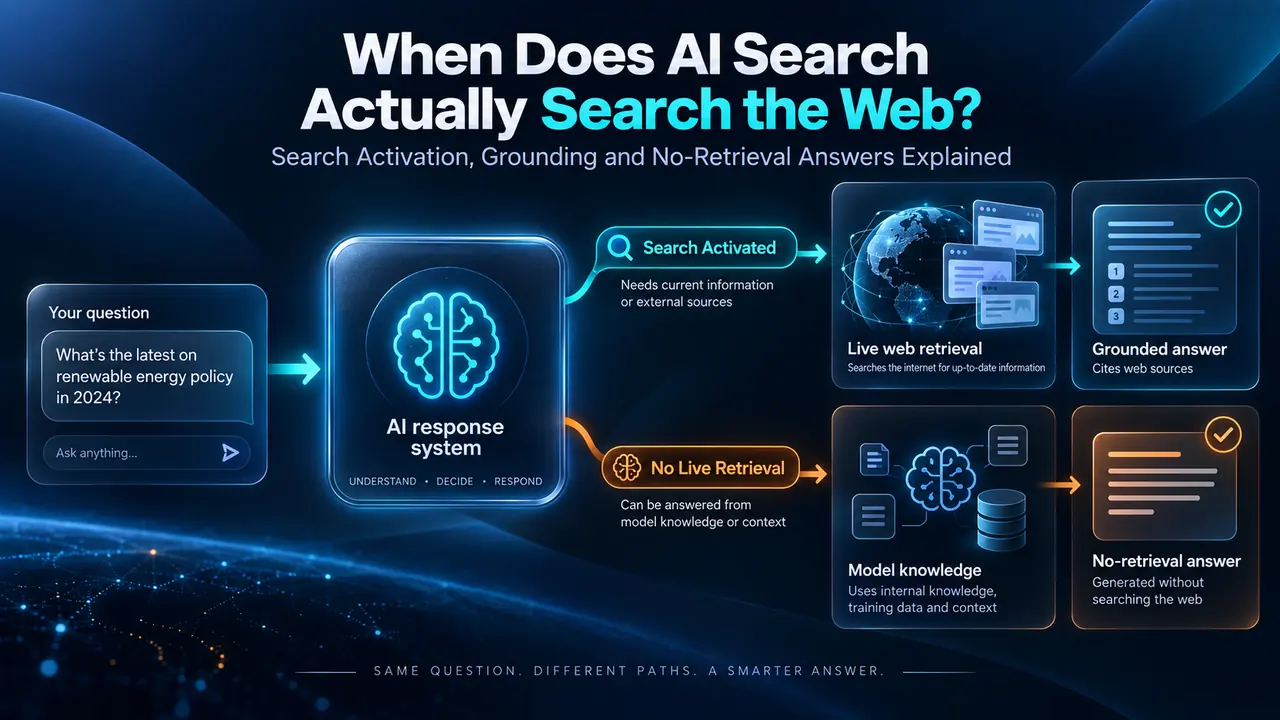
A ChatGPT citation is a visible source reference, supporting link or cited page attached to an answer generated with search or retrieval. It is different from a simple brand mention. A brand can be named without its website being used as evidence, and a page can receive a link without becoming the dominant source in the answer.
Citation or source link
Your URL or domain is shown as supporting evidence for the answer. This is the strongest form of visible citation because your page is being used as answer support.
Brand mention
Your organisation is named, but your site may not be linked or cited. This still matters for visibility, but it is weaker than a direct cited-source appearance.
Navigational link
A link can appear because a user is seeking a site or brand directly. That does not always mean your page was retrieved as evidence for the answer itself.
Referral visit
A user click from ChatGPT to your site. Useful commercially, but it should be interpreted alongside citation frequency, prompt coverage and answer visibility.
This distinction matters because a page can receive traffic or a mention without being a source-quality winner. For strategic GEO work, cited-source visibility and answer presence are more useful measures than clicks alone.
Official OpenAI Requirements: Access Comes First
1. Allow OAI-SearchBot when search visibility is the goal
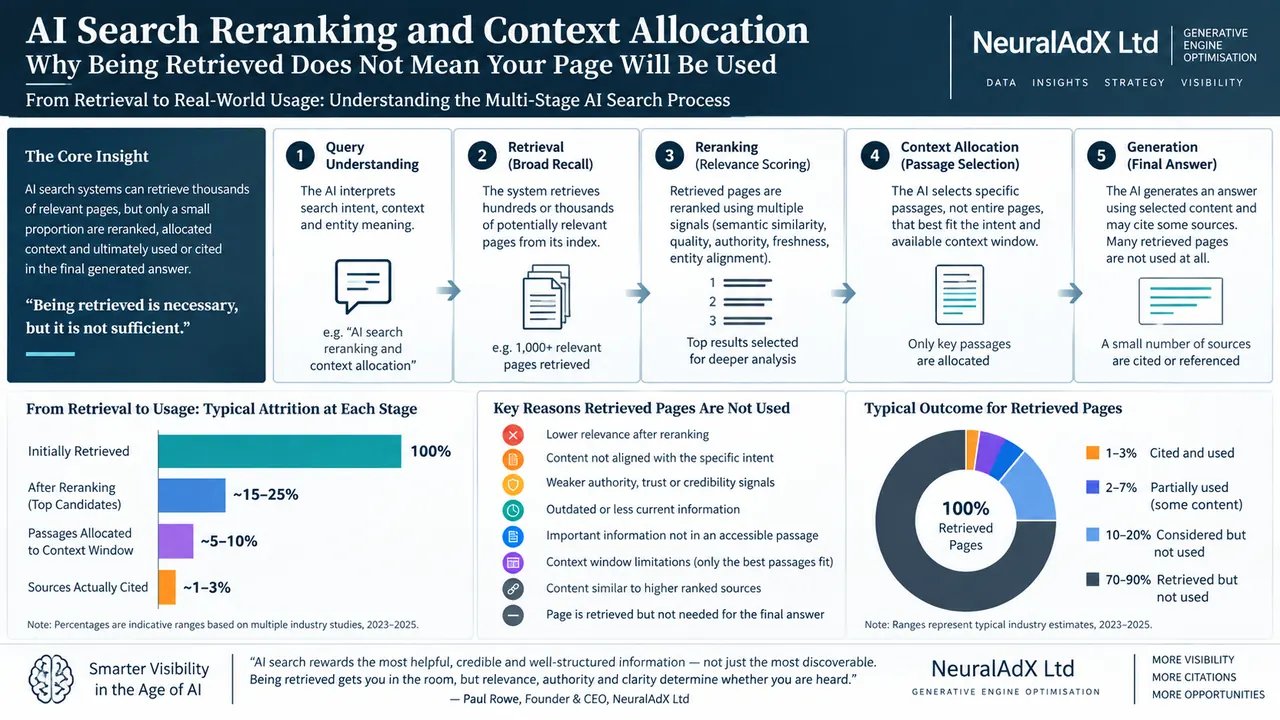
OpenAI states that OAI-SearchBot is used to surface websites in ChatGPT search features. OpenAI says allowing OAI-SearchBot permits search crawling; opting out limits inclusion in ChatGPT search, although some URLs may still appear as navigational links. Allowing the bot is not a guarantee that a page will be surfaced or cited.
2. Do not block the published SearchBot IP ranges
A permissive robots.txt file is not enough if a CDN, firewall, bot-protection layer or server rule rejects the crawler anyway. If you want ChatGPT search visibility, published SearchBot IP ranges also need to be allowed through your technical stack.
3. Keep the page publicly accessible and indexable
Pages hidden behind authentication, broken scripts, redirect loops, accidental canonicalisation or a stray noindex tag are poor candidates for retrieval. A page must be accessible and usable if you want it to function as a source.
4. Understand GPTBot and ChatGPT-User separately
OpenAI documents multiple user agents. GPTBot relates to training access. OAI-SearchBot relates to ChatGPT search visibility. ChatGPT-User can visit a page in response to a user action. They are not interchangeable, so treating all AI bots as one thing is a common mistake.
Why this matters
Many businesses think “AI optimisation” starts with writing style. In reality, if access is broken, no amount of copy improvement will fix the visibility problem.
Why ChatGPT Citations Matter
Users increasingly ask AI systems for recommendations, research, comparisons, buying guidance, software advice, legal education, financial education and practical how-to answers. If your website appears as a cited source in those responses, your brand is visible at the moment a user is actively forming an opinion or making a shortlist.
This is different from classic search behaviour. In a normal search results page, the user scans a list of links. In an AI answer environment, the answer may already be synthesised. The cited source becomes part of the answer’s trust layer, which means visibility can matter even before a click happens.
Both OpenAI and Google publish first-party documentation for their search-related AI experiences, reflecting the practical importance of discoverability in generated answers. Reach estimates change over time and are not a proxy for how often a particular business will be cited; assess the commercial opportunity using your own relevant prompts, citations, referrals and qualified conversions.
What Helps a Website Get Cited in ChatGPT?
No one outside OpenAI can honestly promise a fixed formula for ChatGPT citations. But official documentation, academic GEO research and live retrieval testing all point in the same general direction.
1. Clean access and crawlability
Your page must be accessible to the relevant retrieval layer. Check robots.txt, CDN rules, firewall rules, noindex tags, broken canonicals and any JavaScript dependency that stops content rendering properly.
2. Readable HTML text, not image-only information
AI systems need extractable text. Do not bury your best evidence inside screenshots, decorative graphics, inaccessible accordions or image-only blocks. Images can support a page, but the evidence should also exist as visible text.
3. Direct answers near the top
Pages that answer the question early are easier for AI systems to use. A strong page often includes sections such as what it is, how it works, how it is measured, what data supports it, who it is for and what to do next.
4. Evidence, not unsupported assertion
The more a page explains how it knows what it knows, the more useful it becomes as a source. Strong pages use official sources, named authors, dates, methodologies, tables, definitions, original data and clear limitations.
5. Entity clarity
Your organisation, author and service names should be consistent. Internal links should make the relationship between topic, company, methodology, proof assets and author expertise easy to understand.
6. External corroboration
Generative engines do not rely only on your own site. Third-party mentions, citations, interviews, expert quotes, reputable directories and other trusted web signals help reinforce credibility.
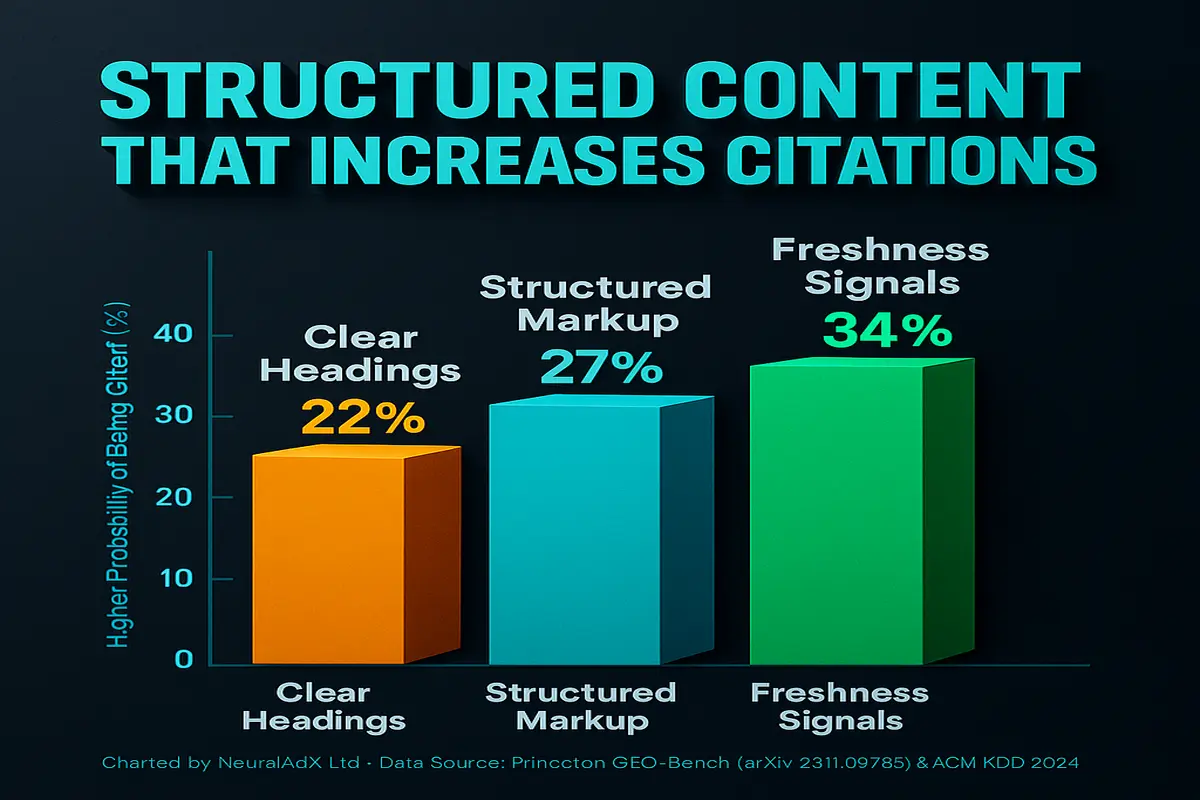
7. Freshness
Stale content becomes weaker evidence, especially in fast-moving categories such as AI, law, finance, health, pricing and product comparison. Update key pages when platform rules, benchmark data or important facts change.
NeuralAdX Ltd Benchmark Evidence
Original benchmark data can make a page more citation-worthy because it gives an AI engine something specific to cite. NeuralAdX Ltd’s own published benchmark pages are useful here because they demonstrate what answer-ready evidence looks like in practice: clear methodology, fixed prompt sets, tracked competitors, update dates and visible month-by-month results.
In the latest published Month 10 AI Citation Benchmark (24 August–23 September 2026), NeuralAdX Ltd ranked first among the six tracked UK GEO agencies, with 1,087 citations and 12.36% citation share. In the separate Month 10 AI Answer Visibility and Share of Voice Benchmark, NeuralAdX Ltd and Passion Digital were joint first by brand mentions, each with 179 mentions, 15% brand coverage and 28% share of voice. NeuralAdX had the stronger displayed average brand position (1.13 versus 1.46). These are separate metrics with different denominators, not measures of sales or guaranteed client outcomes.
The ten published monthly citation reporting periods show NeuralAdX Ltd in first position within the tracked agency set for all ten months. The separate answer-visibility dataset shows outright first place by brand mentions in Months 3–9 and joint first in Month 10. These are observed outcomes for a defined prompt set and competitor sample; they do not establish causation or predict results for other organisations.
Month 10 answer-visibility brand coverage: 15%. Reporting period: 24 August–23 September 2026. Both benchmark datasets are monthly, not cumulative. Passion Digital matched NeuralAdX on brand mentions, coverage and share of voice in the visibility benchmark.
SEO vs GEO: What Changes When the Goal Is a ChatGPT Citation?
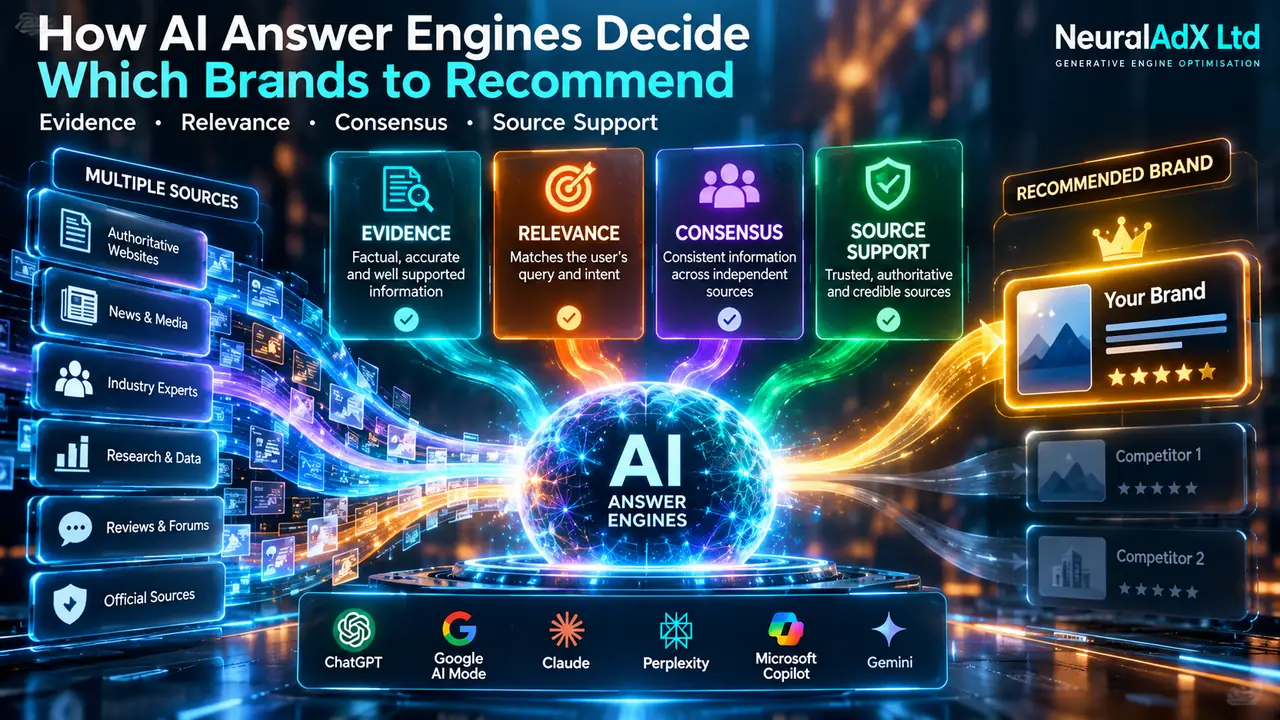
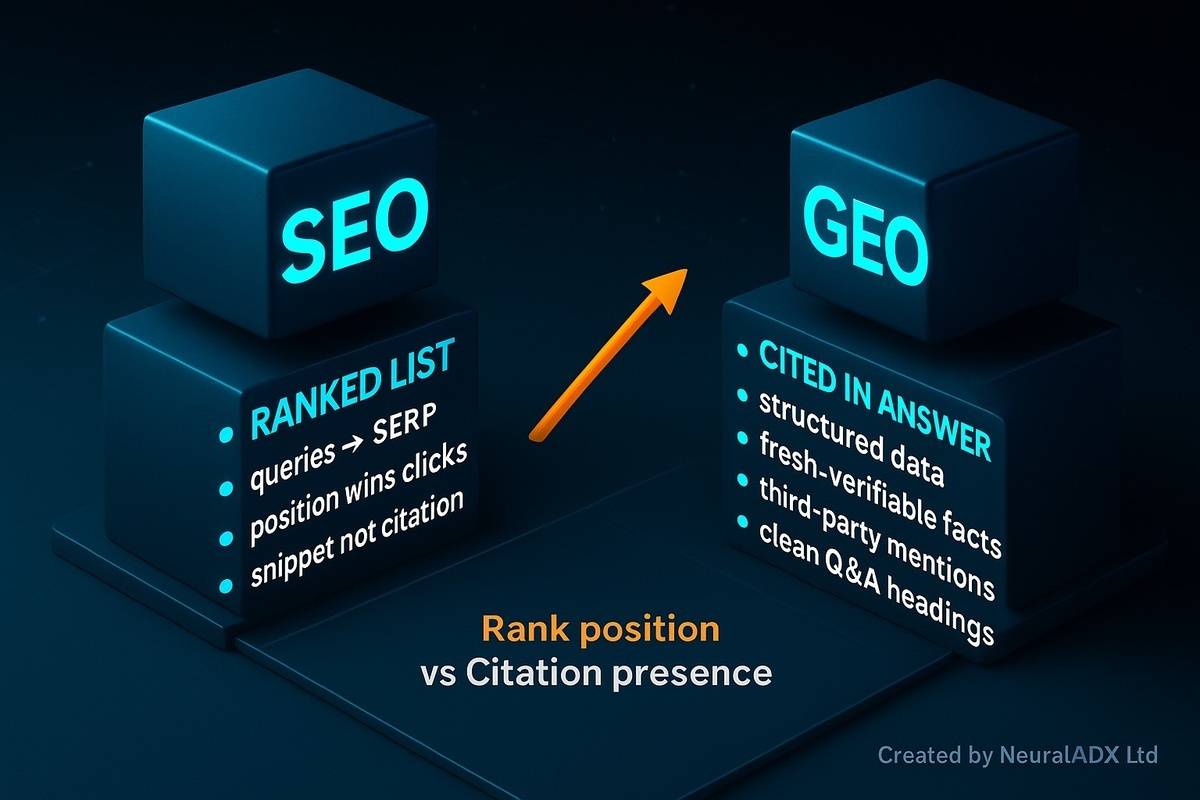
SEO and GEO overlap, but they are not the same. SEO mainly targets visibility in ranked search results. GEO targets visibility inside generated answers, cited-source links, answer mentions and other forms of AI answer presence.
| Factor | Traditional SEO focus | GEO / ChatGPT citation focus |
|---|---|---|
| Primary outcome | Rankings, impressions, clicks and organic traffic. | Citations, source links, brand mentions, answer visibility and prompt coverage. |
| Content shape | Keyword-targeted pages and articles. | Answer-ready passages, evidence blocks, comparison tables, FAQs and cited summaries. |
| Authority | Backlinks, domain strength and topical authority. | Entity clarity, corroborated trust, original data, named expertise and source quality. |
| Technical emphasis | Indexing, Core Web Vitals, internal links and crawl paths. | AI crawler access, clean extraction, readable text, consistent schema and evidence accessibility. |
| Measurement | Search Console rankings and organic sessions. | AI citations, citation share, brand mentions, answer coverage and AI referral traffic. |
Step-by-Step Process to Improve Your Chance of Being Cited
Step 1: Check access first
Review robots.txt, firewall rules, CDN security rules and logs. If the relevant crawler cannot reach the page, there is no citation strategy to discuss.
Step 2: Make the page technically clean
Use indexable URLs, clear canonicals, mobile-friendly layout, visible HTML text, descriptive headings, internal links and alt text on supporting media.
Step 3: Put the direct answer near the top
Give the model an extractable summary early. A concise answer block near the top makes retrieval easier.
Step 4: Cover the surrounding questions
Answer not only the main query, but also the follow-up questions an AI system may need to answer around it. This mirrors the query fan-out behaviour described by Google for AI search.
Step 5: Use primary and authoritative sources
Official docs, academic research, government sources, original research and strong first-party evidence are more useful than vague, circular secondary commentary.
Step 6: Add original evidence where possible
Benchmark data, tests, product comparisons, pricing analysis, methodology notes, transcripts, screenshots and live demonstrations all give the page something distinctive to cite.
Step 7: Strengthen author and organisation signals
Use a named author, a supporting author bio, a clear organisation identity and descriptive internal links to methodology, glossary, service and benchmark pages.
Step 8: Measure monthly and update
Run a fixed prompt set every month, compare performance to named competitors and update the page when the evidence base changes.
How to Measure Whether ChatGPT Is Citing Your Website
Measurement is where many businesses go wrong. A ChatGPT citation strategy should not be judged only by traffic. Some visibility appears first as citations, brand mentions or answer presence before it produces clicks.
OpenAI says publishers who allow OAI-SearchBot can track ChatGPT referral traffic in analytics tools, and that referral URLs can include the parameter utm_source=chatgpt.com. That is useful, but it is only one layer of measurement.
| Metric | What to track | Why it matters |
|---|---|---|
| AI citation count | How often your domain is cited or linked in monitored prompts. | Shows whether your pages are functioning as visible supporting sources. |
| Citation share | Your share of observed citations against competitors. | Shows competitive standing rather than isolated wins. |
| Brand mentions | How often your brand is named, even when not linked. | Captures answer visibility beyond source links alone. |
| Brand coverage | The percentage of priority prompts where your brand appears. | Shows breadth of visibility across the tracked prompt set. |
| Share of voice | The weighted share of answer presence against named competitors. | Shows how dominant you are inside the answer layer. |
| Referral traffic and conversions | Visits, enquiries and form fills from AI-referred traffic. | Connects answer visibility to commercial outcomes. |
Best practice is to keep the prompt set, competitor set and reporting window consistent. If you keep changing the test, you will not know whether visibility changed or the test simply moved.
Need an Expert View of Your Current AI Visibility?
If you want to know whether ChatGPT and other major AI platforms cite your site, mention your brand, prefer competitors or leave you invisible, the most practical next step is a structured assessment using a fixed framework and live prompt testing.
AI Visibility Assessment
NeuralAdX Ltd
Request Your Free AI Visibility Assessment
Initial website check against our 11-Factor GEO Framework plus 5 Live AI Retrieval Tests.
Find out whether AI recommends your business, cites your website, prefers competitors — or leaves your business invisible in AI answers.
11-Factor GEO Framework
Checked
Commercial AI Prompts Tested
Start With A Free Assessment
Call NeuralAdX Ltd or send your assessment request by email.
Emailing Your Request?
For your convenience, your email is already prepared with simple placeholders. Just add your website URL, best contact number, 5 priority AI prompts and any useful information.
Initial assessment only · No obligation · Serious business enquiries answered within one UK business day · View live AI retrieval proof
Common Mistakes That Stop Websites Being Cited in ChatGPT
- Blocking the wrong bot: a site can accidentally block OAI-SearchBot with robots, CDN rules or bot protection.
- Publishing vague sales copy: unsupported claims are poor citation material.
- Hiding evidence in images: screenshots and graphics need surrounding HTML explanation.
- Ignoring entity clarity: inconsistent company or author naming makes trust harder.
- Using weak source material: thin, circular or low-authority references weaken the page.
- Not updating fast-moving pages: stale content is weaker evidence.
- Thinking only about clicks: cited-source presence often improves before traffic does.
- Failing to measure: if you do not track citations and answer visibility, improvement becomes guesswork.
FAQ: Getting Your Website Cited in ChatGPT
Can anyone guarantee ChatGPT citations?
No. Nobody can honestly guarantee citation inclusion for every prompt. You can improve the odds, but final citation behaviour still depends on the query, competition, model behaviour, retrieval decisions and freshness.
Should I allow OAI-SearchBot?
If your goal is to appear in ChatGPT search answers, yes. OpenAI explicitly documents OAI-SearchBot as the crawler used to surface websites in ChatGPT search features.
Does schema markup help?
Schema can help clarify entities, authorship, article metadata and FAQs, but it is not a magic switch. The visible page content still needs to be useful, accurate and crawlable.
Is this just SEO with a new name?
No. SEO and GEO overlap, but GEO focuses on visibility inside generative answers, citations and supporting links rather than only on ranked search clicks.
How long can it take?
It varies by topic, authority, access, content quality and competition. Some technical fixes can matter quickly. Trust-building and broader answer-engine visibility usually take longer and should be measured over months.
Do images help?
Images support usability and comprehension, but image-only content is weak for citation visibility. Put the important evidence in readable text as well.
Summary: How to Get Your Website Cited in ChatGPT
To get your website cited in ChatGPT, stop thinking only like a ranking page and start thinking like a source. Make your site technically accessible, publish answer-ready pages, cite authoritative sources, add original evidence, clarify who is behind the content, build corroboration and measure results consistently over time.
The strongest pages for AI citation visibility combine direct answers, high-quality sources, clear structure, extractable text, trustworthy authorship, strong internal support pages and fresh, verifiable evidence. There is no ethical shortcut. The sites most likely to earn AI citations are the sites that behave like credible, useful sources.
October 2026 Update: What the Evidence Supports
Access is necessary but not sufficient. OpenAI documents different agents for ChatGPT search, model-training crawling and user-initiated browsing. Review OAI-SearchBot access separately from GPTBot, and check your CDN and server responses rather than relying exclusively on robots.txt. Crawl permission does not ensure citations.
Do not confuse ChatGPT advice with Google eligibility rules. Google states that AI Overviews and AI Mode apply its existing Search foundations: eligible pages need to be indexed and able to display a snippet, but no special AI schema or GEO file is required. Schema can clarify entities where relevant; it is not a guaranteed AI citation switch.
Retrieve, test and corroborate. A useful GEO workflow distinguishes the user question, possible query expansion, retrieved sources, quoted or paraphrased evidence, visible citations and downstream visits. Repeat a stable prompt set across dates and platforms, recording both brand mentions and actual linked source URLs. Results vary by prompt wording, location, time and platform.
Interpret research correctly. The original GEO research evaluated visibility changes in controlled conditions, reporting improvements of up to 40% for some optimisation strategies. That finding is not a promise of a 40% uplift for any live website or proof of a single universal ranking formula.
Evidence Base and Further Reading
OpenAI official sources
Best for crawler access, bot separation, referral tracking and search-visibility controls.
Google official sources
Best for understanding how AI search relates to core SEO eligibility and query fan-out behaviour.
Academic evidence
Useful for understanding retrieval visibility, source trust and the limits of answer verifiability.
NeuralAdX benchmark pages
Useful as applied examples of answer-ready evidence, monthly measurement and methodology-led GEO work.
Supporting NeuralAdX resources
Useful for internal topical support, entity clarity and methodology reinforcement.
Further Reading: A Canadian GEO Implementation Perspective
For a Canadian implementation perspective, TheBomb’s Canadian GEO playbook for AI citations gives a useful explanation of chunk-level optimisation and citation engineering, reinforcing why a page can perform differently in traditional rankings and AI retrieval.
Independent editorial resource by TheBomb (Canada). Its practical recommendations should be evaluated against current platform documentation and your own testing.