Editorial review updated: 12 October 2026 | Sources: Google, OpenAI, Microsoft, Princeton-led GEO research
NeuralAdX Ltd SEO and GEO Visibility Guide
How to Win Visibility in SERPs and AI Platforms
To win online visibility now, a business needs two connected systems: Search Engine Optimisation for traditional search results and Generative Engine Optimisation for AI-generated answers, citations, brand mentions and source selection. SEO gets your content discovered by search engines. GEO helps AI platforms understand, trust, retrieve and cite your content when users ask conversational questions.
SEO outcome
Rank, earn clicks and help users find your website through Google, Bing and other search engines.
GEO outcome
Appear as a trusted source, brand mention or citation inside AI-generated answers.
Winning strategy
Use SEO as the technical foundation and GEO as the answer-engine visibility layer.
Quick Answer: SEO Plus GEO Is the New Visibility Model
SEO and GEO are not enemies. SEO makes a website crawlable, indexable, useful and rankable. GEO makes the same website easier for AI systems to understand, retrieve, summarise and cite. The strongest strategy is not to abandon SEO for GEO. The strongest strategy is to build a website that performs in Google Search, Bing Search, Google AI Mode, AI Overviews, ChatGPT, Perplexity, Microsoft Copilot, Gemini, Claude and other AI platforms.
Plain-English definition: SEO helps your page become discoverable in search results. GEO helps your page become usable as an answer source inside AI-generated responses.
Evidence-led principle
Content that contains clear answers, verifiable statistics, credible citations and expert explanation is easier for both humans and AI systems to trust.
Entity clarity principle
A page should make the business, author, service, topic, proof and related resources unmistakable. Vague content is weak content.
Retrieval principle
AI platforms do not just need long content. They need clean, answer-ready passages that can be extracted, summarised and attributed accurately.
SEO vs GEO: What Is the Difference?
SEO is focused on improving visibility in search engine results pages. GEO is focused on improving visibility in generative answer engines. Both rely on helpful content, technical accessibility and trust signals, but they are measured differently.
| Area | SEO | GEO |
|---|---|---|
| Primary goal | Rank in organic search results and earn qualified traffic. | Be selected, mentioned or cited inside AI-generated answers. |
| User behaviour | Shorter keyword searches such as “SEO agency London”. | Longer conversational prompts such as “Which company has proof it can win AI citations?” |
| Content requirement | Useful, crawlable, relevant content aligned to search intent. | Answer-ready passages, entity clarity, proof, statistics, citations and expert context. |
| Authority signals | Backlinks, topical coverage, internal links, technical health and user usefulness. | Citations, source consistency, named authors, corroborating evidence, benchmark data and retrievable claims. |
| Measurement | Rankings, impressions, clicks, organic sessions and conversions. | AI citations, brand mentions, citation share, brand coverage, average brand position and answer inclusion. |
Why SEO Still Matters
SEO is still the foundation of digital visibility because AI platforms often rely on the same public web that search engines crawl, index and rank. If your content is blocked, technically weak, thin, duplicated, unclear or poorly linked, it becomes harder for search engines and AI systems to discover and understand it.
Google’s own SEO Starter Guide explains SEO as the process of helping search engines understand content and helping users find a site through search. That remains the correct foundation. The change is that businesses now need to think beyond blue links and prepare their content for answer engines as well.GOOGLE · AI SEARCH ↗
Crawlability
Search engines and AI-connected systems need access to the important pages, resources and text on your website.
Indexability
Pages should have clean canonical signals, no accidental noindex tags and useful internal links.
Search intent
Each page should satisfy a clear user need instead of trying to rank for everything at once.
Authority
Useful content, expert authorship, internal links, external references and proof all help reinforce trust.
Why GEO Is Now Essential for AI Platforms
Generative Engine Optimisation matters because users increasingly ask AI platforms full questions instead of typing short search terms. These platforms may return a direct answer, a shortlist of recommended sources, a comparison, a citation panel or a summarised buying path. If your business is missing from that answer, your brand may be invisible even when your website still ranks somewhere in traditional search.
The Princeton-led GEO research introduced Generative Engine Optimisation as a framework for improving source visibility inside generative engine responses. The study reported that GEO methods could increase visibility by up to 40% across tested queries, and found that citations, quotations and statistics could significantly improve source visibility when used appropriately.GEO RESEARCH · 2024 ↗
Paul Rowe insight
“When Princeton-led GEO research reports visibility gains of up to 40% across tested queries, the lesson for business owners is blunt: answer-ready, evidence-backed content is no longer optional. If AI systems cannot quickly understand, verify and connect your claims, they are less likely to select you as a useful source.”
Paul Rowe, Founder, Chief Generative Engine Optimisation Officer & CEO at NeuralAdX Ltd. Source: Princeton-led Generative Engine Optimisation research.
How AI Platforms Select, Summarise and Cite Sources
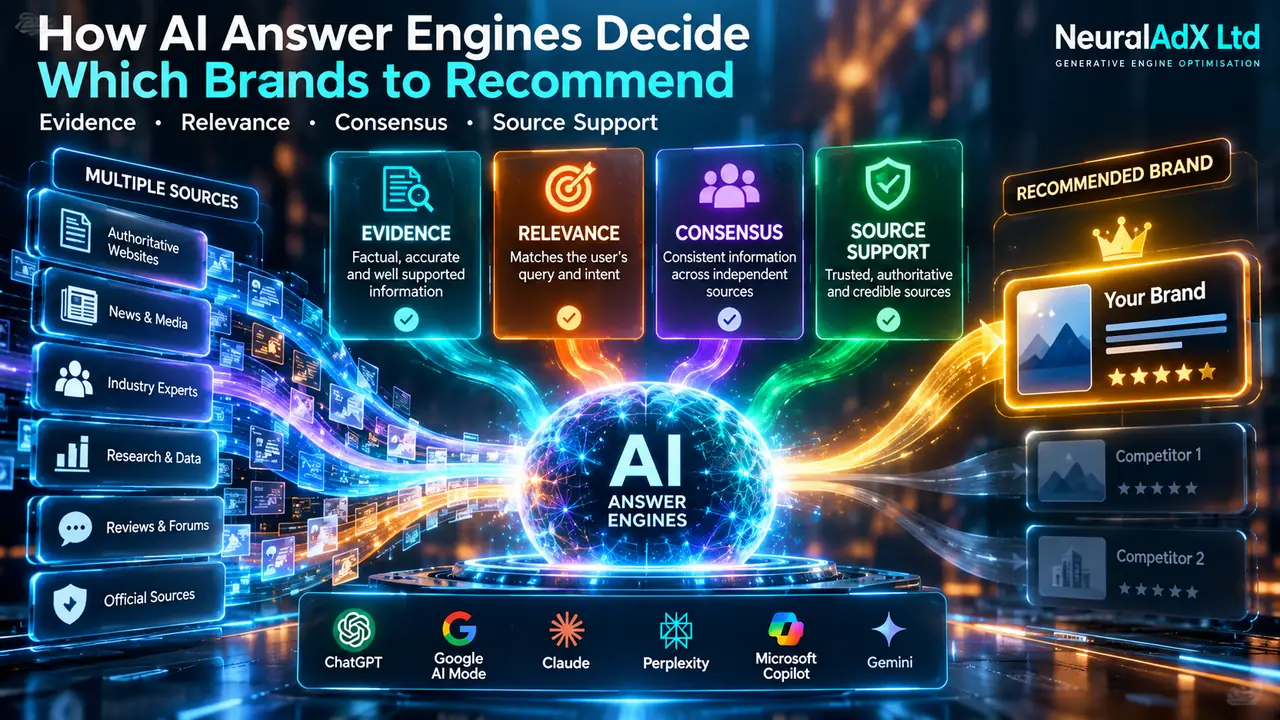
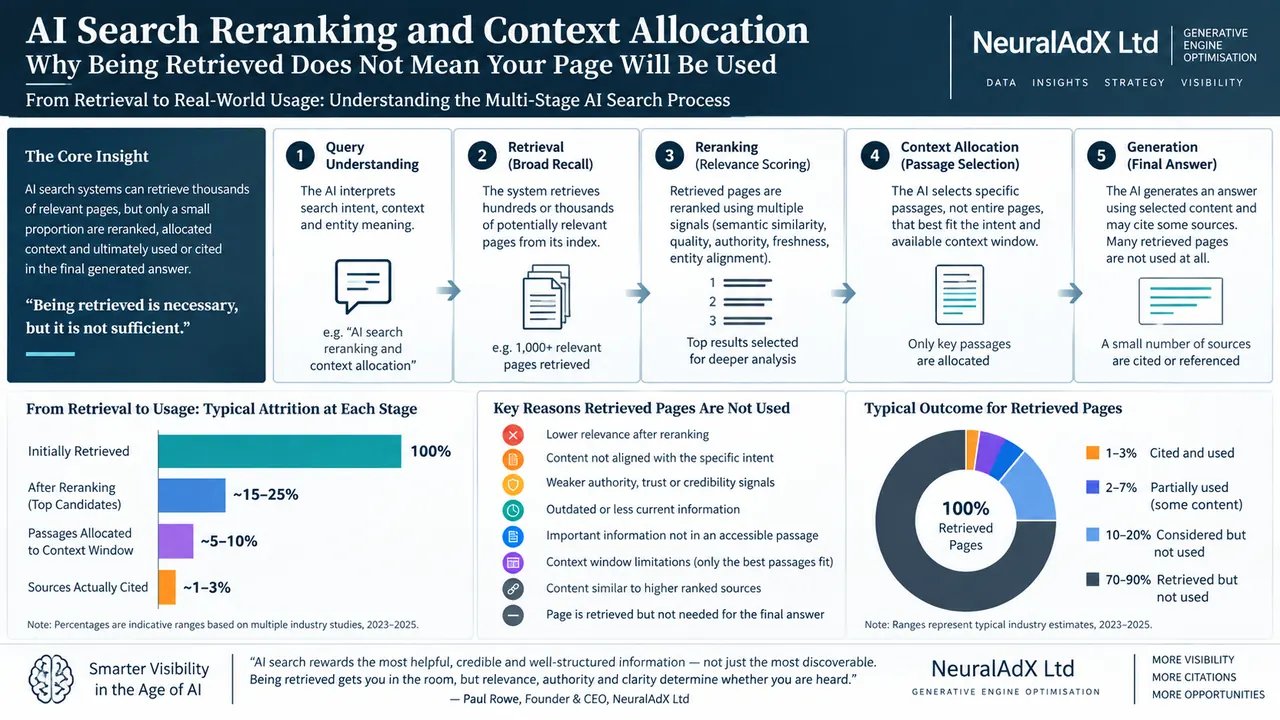
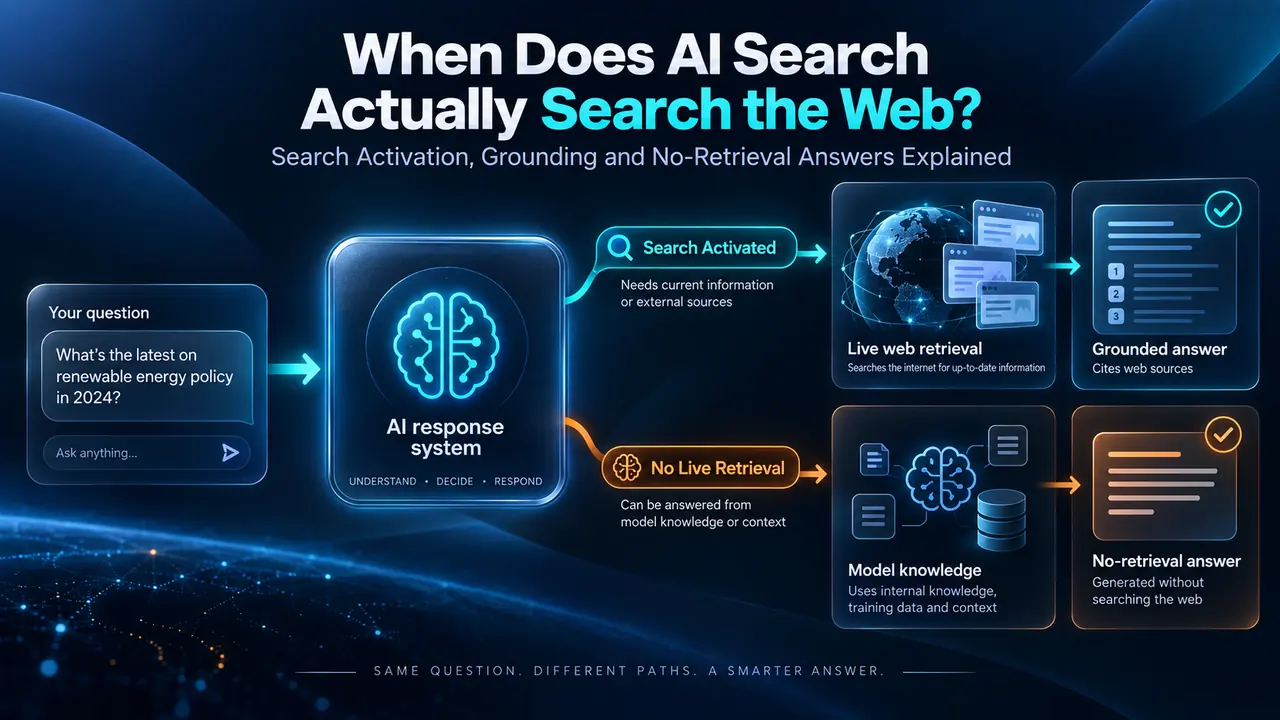
Different AI systems work differently, so nobody outside those companies can honestly promise a universal ranking formula. But the practical direction is clear: AI platforms need accessible content, clear entities, trustworthy signals, helpful answers and source material that supports the generated response.
1. Discovery
The system needs to discover the page through crawling, indexing, search results, retrieval systems, links or other accessible web signals.
2. Understanding
The system needs to understand who the page is about, who created it, what topic it covers and which claims are supported.
3. Retrieval
The page or passage needs to match the user’s question closely enough to be retrieved as useful context.
4. Citation
The answer engine may cite the page when the content directly supports a specific part of the generated answer.
What Google, OpenAI and Microsoft Officially Confirm About AI Visibility
There is no honest universal “AI ranking trick.” The stronger editorial position is to separate proven platform guidance from measured GEO testing: optimise pages for people, technical access and verifiable evidence, then measure whether AI systems actually mention or cite the brand.
Google Search guidance
Google’s May 2026 guidance states that SEO fundamentals remain relevant for AI Overviews and AI Mode, and that eligible supporting pages must be indexed and able to appear with a snippet in Google Search. Google also says there is no special AI schema requirement.GOOGLE · AI SEARCH ↗
Source: Google Search Central, Optimizing for generative AI search
OpenAI discovery guidance
OpenAI identifies OAI-SearchBot as the crawler used for search visibility controls. Its publisher FAQ also states that referral links from ChatGPT search include utm_source=chatgpt.com, allowing referred traffic to be measured in analytics.OPENAI · SEARCHBOT ↗
Microsoft citation measurement
In February 2026, Microsoft introduced AI Performance in Bing Webmaster Tools public preview. It reports citations across Microsoft Copilot, Bing AI-generated summaries and selected partner integrations, including cited URLs and sampled grounding queries.MICROSOFT · JUN 2026 ↗
GEO research evidence
The Princeton-led GEO study reported visibility improvements of up to 40% across its tested framework and queries. It also found that citations, relevant quotations and statistics could improve source visibility. That is research evidence, not a universal guarantee for any individual website.GEO RESEARCH · 2024 ↗
The NeuralAdX Ltd SEO + GEO Visibility Method
Winning visibility in SERPs and AI platforms requires more than rankings alone. NeuralAdX Ltd focuses on clear entities, useful answers, verifiable evidence, technical accessibility, internal relevance, AI prompt testing and measurable visibility across both search engines and answer engines.
1. Entity clarity
Make the business, founder, service, location, proof assets and specialist topic unmistakable.
2. Answer readiness
Use direct answers under descriptive headings so AI systems can extract useful passages.
3. Evidence density
Support claims with statistics, citations, expert explanation, benchmarks, tests and screenshots where relevant.
4. Passage-level structure
Write short, complete, self-contained sections that make sense when retrieved individually.
5. Internal entity linking
Connect service pages, proof pages, benchmark pages, glossary pages and author pages with descriptive anchor text.
6. Technical accessibility
Keep the content fast, mobile-friendly, crawlable, parsable and free from hidden essential text.
7. Prompt testing
Test commercial questions across AI platforms to see whether the brand appears, where it appears and why.
8. Measurement
Track AI citations, brand mentions, citation share, brand coverage and conversion outcomes.
How NeuralAdX Ltd Validates GEO Progress
AI visibility should be tested, not assumed. NeuralAdX Ltd connects its 11-factor GEO audit framework with live AI retrieval testing and two tracked benchmark types so businesses can assess whether content is being surfaced, mentioned and cited in real AI answers.
11-factor GEO audit
Review the website’s entity clarity, evidence, retrievable answers, technical access, internal relationships and other GEO readiness signals.
Live retrieval testing
Test priority prompts on major AI platforms and record whether the brand or evidence pages appear in real generated answers.
View live AI retrieval proof methodology
Explore the NeuralAdX 11-Factor GEO Methodology underpinning our optimisation approach.
Citation benchmark
Track cited source activity and citation share against a defined competitor set and reporting window.
Answer visibility benchmark
Track brand mentions, coverage and share of voice to see whether the organisation is entering generated recommendations.
What Makes Content Citation-Ready?
Citation-ready content is clear, trustworthy and useful. Strong sections answer one question directly, support important claims with evidence and make the business, author, topic and source material easy to identify.
Strong citation-ready passage
“Generative Engine Optimisation improves AI visibility by making content clearer, more evidence-backed and easier for answer engines to retrieve. This includes direct answers, entity clarity, citations, statistics, expert authorship and benchmark tracking.”
Weak citation-ready passage
“We are the best at AI stuff and can help you dominate everything online with futuristic optimisation.”
The first example is specific, explanatory and connected to measurable signals. The second is vague, unprovable and not useful for AI retrieval or human decision-making.
The Citation-Ready Editorial Standard
A page becomes more useful as a source when each important claim can stand alone, be checked quickly and be interpreted honestly. This is the standard NeuralAdX Ltd applies when preparing content for search results and AI-generated answers.
1. Direct answer
State the answer in plain language under a descriptive heading before expanding the explanation.
2. Verifiable evidence
Support material claims with original research, official platform documentation, named datasets or visible test evidence.
3. Clear attribution
Name the source, date or reporting window, author or organisation and what the cited material actually measures.
4. Honest explanation
Explain why the evidence matters and what it does not prove. No credible source can guarantee AI citation placement.
CITATION-READY CLAIM EXAMPLE
“Microsoft’s February 2026 AI Performance public preview in Bing Webmaster Tools reports when a verified site is cited across supported AI experiences, including Copilot and Bing AI-generated summaries. This makes citation activity measurable, but it does not establish a universal ranking factor or guarantee future inclusion.”MICROSOFT · JUN 2026 ↗
Step-by-Step SEO and GEO Checklist
Use this as a practical build process for any page that needs visibility in both search results and AI-generated answers.
Beginner skill level
- Write one clear page title and one clear page purpose.
- Answer the main question within the first 100 words.
- Use descriptive H2 and H3 headings.
- Keep paragraphs short and easy to scan.
- Add links to your most relevant service, proof and contact pages.
- Add an author or business credibility section.
Intermediate skill level
- Add comparison tables, checklists and definitions.
- Cite credible external sources where claims need support.
- Use descriptive internal links rather than generic “click here” links.
- Add FAQ content that answers real customer questions.
- Improve title tag, meta description and featured image alt text.
- Check mobile layout, page speed and crawlability.
Advanced skill level
- Connect the article to relevant service, proof, benchmark and glossary resources.
- Create answer-ready passages for priority prompts.
- Add supporting proof pages, benchmark pages and video transcript pages.
- Use structured data that matches visible page content.
- Track AI citations and brand mentions across platforms.
- Review how competitors are cited and where their evidence is stronger.
How to Measure SEO and GEO Visibility
Traditional SEO measurement is not enough on its own because AI visibility can happen without a normal organic click. A business should measure both search performance and AI answer performance.
“Pew Research Center found that users who saw a Google AI summary clicked a traditional search result on 8% of visits, compared with 15% when no AI summary appeared. That is why businesses need to measure AI citations, brand mentions and answer visibility as well as rankings and organic clicks.”
Paul Rowe, Founder, Chief Generative Engine Optimisation Officer & CEO at NeuralAdX Ltd. Source: Pew Research Center analysis of Google AI summaries and click behaviour.
| Metric | What it measures | Why it matters |
|---|---|---|
| Organic rankings | Where pages rank in search engine results. | Shows traditional SEO progress and search discoverability. |
| Organic clicks | How many users click through from search results. | Shows whether rankings are turning into website traffic. |
| AI citations | How often AI platforms cite your website as a source. | Shows whether your content is being selected as supporting evidence. |
| Brand mentions | How often your brand appears in generated answers. | Shows whether AI systems associate your brand with the topic. |
| Citation share | Your share of AI citations compared with competitors. | Shows competitive visibility in answer engines. |
| Brand coverage | How many tested prompts mention the brand. | Shows breadth of visibility across commercial and informational prompts. |
NeuralAdX Ltd publishes evidence-led resources including the AI Citation Benchmark, the AI Answer Visibility and Share of Voice Benchmark and the proof that Generative Engine Optimisation works video evidence page.
Common Mistakes That Reduce SEO and GEO Visibility
Keyword stuffing
Repeating “SEO”, “GEO” or “AI platforms” too often makes the page feel unnatural and weakens reader trust.
Vague claims
Claims like “we are the best” are not enough. Use proof, benchmarks, named sources and explainable evidence.
Weak authorship
Pages without author context, business context or expertise signals are harder to trust.
Messy markup
Empty headings, excessive spacing tags, hidden text and fragile design can make pages harder to parse.
No measurement
Without AI citation tracking, brand mention tracking and prompt testing, GEO becomes guesswork.
No internal links
Pages should connect to related service, proof, benchmark, glossary and author resources with descriptive anchor text.
Technical SEO and AI Crawler Access
A technically weak page can hold back both SEO and GEO. Before worrying about advanced AI visibility tactics, make sure the basics are correct.
- Important pages should be indexable and included in your XML sitemap.
- Robots.txt should not accidentally block important content or resources.
- The page should load quickly on mobile and desktop.
- Essential text should be visible in the HTML, not trapped inside images.
- Internal links should use descriptive anchor text.
- Structured data should match the visible page content.
- OpenAI’s publisher guidance says sites that want to be discoverable in ChatGPT search should make sure they are not blocking OAI-SearchBot.
Recommended NeuralAdX Ltd Resources
Use these connected resources to understand, prove and implement Generative Engine Optimisation properly.
Platform-by-Platform AI Visibility Priorities
GEO should not be treated as one generic tactic because different AI platforms surface information in different ways. The facts should stay consistent across platforms, but the content must be useful for searchers who want direct answers, comparisons, proof and next steps.
| Platform | What to prioritise | Practical content action |
|---|---|---|
| Google AI Mode and AI Overviews | Helpful content, clear page purpose, crawlability, structured information and strong source relevance. | Create direct answer sections, cite official sources, keep content aligned with Google’s people-first guidance and make pages easy to crawl. |
| ChatGPT Search | Accessible public pages, clear citations, current information and permission for relevant crawler access. | Check OAI-SearchBot access, keep author and date signals clear, and write passages that can be cited cleanly. |
| Perplexity | Citable pages, concise explanations, source diversity and direct answers. | Use answer-first paragraphs, original evidence, tables and source-backed claims that can support a generated answer. |
| Microsoft Copilot and Bing | Bing discoverability, page quality, source relevance and AI citation performance. | Use Bing Webmaster Tools, monitor AI Performance where available, and make source pages clear and authoritative. |
| Gemini | Google ecosystem visibility, entity clarity, topical authority and current helpful content. | Strengthen Google-indexed assets, use clear internal links and align content with verified search demand. |
| Claude and other assistants | Clear explanations, trustworthy source material, structured passages and low-ambiguity claims. | Write in plain English, define terms clearly, avoid hype and explain the evidence behind each major recommendation. |
Prompt Testing: The Missing Link Between SEO and GEO
Most businesses only check Google rankings. That is no longer enough. GEO requires prompt testing because AI users ask longer, more specific and more commercial questions. The goal is to understand which prompts trigger your brand, which prompts cite your competitors and which prompts reveal missing content on your website.
Commercial discovery prompts
Example: “Which company provides Generative Engine Optimisation services in the UK?” These prompts reveal whether your brand appears when a buyer is exploring providers.
Proof-led prompts
Example: “Which GEO specialist has public proof of AI citation visibility?” These prompts test whether your evidence pages are being understood and retrieved.
Educational prompts
Example: “What is the difference between SEO and GEO?” These prompts test whether your explanatory content is authoritative enough to support an AI answer.
Comparison prompts
Example: “Compare the best UK companies for AI search visibility optimisation.” These prompts test your competitive positioning.
The practical workflow is simple: choose priority prompts, test them across multiple AI platforms, record whether your brand appears, capture citations, compare competitor visibility and then improve the pages that should have supported those answers.
30-Day SEO and GEO Improvement Roadmap
Use this 30-day roadmap to improve traditional search visibility and AI answer visibility without overcomplicating the process.
Days 1-7: Audit
Review the page title, headings, internal links, crawlability, author information, external citations, proof assets and current search performance.
Days 8-14: Restructure
Add direct answer sections, tables, FAQs, entity links, evidence blocks and clearer calls to action.
Days 15-21: Validate
Test priority prompts across AI platforms, check whether the page is cited or mentioned, and identify missing supporting content.
Days 22-30: Improve
Strengthen weak sections, add missing proof, improve internal links, add structured data separately and track changes over time.
What Changed in AI Search During 2026?
The operational priority is no longer simply adding AI-related keywords. Publishers now have more specific documentation about eligibility, crawler access and how their pages appear as cited sources. The distinctions below matter when making SEO and GEO decisions.
Google: traditional SEO remains the foundation
Google’s guidance for AI Overviews and AI Mode explains that its generative search features use core Search ranking and quality systems. Indexability, content usefulness, relevant links and accessible page text still matter. Google does not prescribe a special AI-only schema markup as a shortcut to appear in AI answers.GOOGLE · AI SEARCH ↗
Microsoft: AI citation measurement became more detailed
After introducing AI Performance in February, Bing Webmaster Tools announced preview additions on 16 June 2026 for Intents, Topics, Citation Share and Compare. Citation Share measures a website’s proportion of visible citations for a given grounding query; Microsoft explicitly describes it as an observational metric, not a ranking score. Availability and precision can vary while features are in preview.MICROSOFT · JUN 2026 ↗
OpenAI: crawler access is a concrete technical check
OpenAI advises publishers not to block OAI-SearchBot if they want their public content to be eligible for discovery and inclusion in ChatGPT search summaries and snippets. That is an access requirement, not a promise that ChatGPT will cite a particular page.OPENAI · SEARCHBOT ↗
Research: separate measured outcomes from guaranteed outcomes
The Princeton-led GEO study reported visibility gains of up to 40% in its evaluated settings. It is useful evidence that content presentation can affect measured visibility, but it is not a guarantee of a 40% improvement for an individual business, search engine or AI platform.GEO RESEARCH · 2024 ↗
Frequently Asked Questions About SEO, GEO, SERPs and AI Platforms
What is the difference between SEO and GEO?
SEO helps content rank and earn clicks in search engine results. GEO helps content become understandable, retrievable and citable inside AI-generated answers.
Does GEO replace SEO?
No. GEO does not replace SEO. SEO is the foundation that helps search engines discover and understand your content. GEO builds on that foundation for AI answer visibility.
What is an AI citation?
An AI citation is when an AI platform references, links to or attributes information to a web source inside or alongside a generated answer.
How do AI platforms choose sources?
AI platforms use different retrieval and ranking systems. In practical terms, pages with clear answers, strong evidence, accessible text, credible authorship and relevant entity signals are better positioned for source selection.
Can small businesses appear in AI-generated answers?
Yes, but it usually requires more than generic blog content. Small businesses need clear local or topical authority, evidence, useful answers, crawlable pages and consistent entity signals across the web.
Does schema markup help GEO?
Schema markup can help search engines understand entities and page structure when it accurately reflects visible content. It should support the page, not replace strong visible content.
How should a business start with GEO?
Start by identifying the commercial questions customers ask AI platforms. Then build clear answer pages with evidence, internal links, author credibility, citations and measurement.
How can NeuralAdX Ltd help?
NeuralAdX Ltd helps businesses improve visibility across search engines and AI platforms through Generative Engine Optimisation strategy, technical implementation, content restructuring, evidence development, benchmarking and AI citation tracking.
What does Google say about GEO and AI Mode?
Google says its generative AI search features remain grounded in SEO fundamentals and do not require special AI-specific schema or technical shortcuts. For cross-platform GEO, businesses should still measure citations and brand visibility on the AI services that matter to their audience.
Can AI citation visibility now be measured directly?
Yes, in part. Microsoft’s Bing Webmaster Tools AI Performance public preview reports supported AI citation activity, and OpenAI documents measurable ChatGPT referral tagging. Platform visibility still requires careful interpretation because citation counts do not by themselves prove authority, ranking or conversions.
Sources and Further Reading
Primary platform documentation and original research used to support the claims in this guide.
Google: AI features and your website
Google: SEO Starter Guide
OpenAI: Overview of OpenAI crawlers
OpenAI: Publishers and developers FAQ
Microsoft Bing: AI Performance public preview, February 2026
Princeton-led research: GEO framework and visibility study
Pew Research Center: Google AI summaries and clicks, July 2025
Build Visibility Where Search Is Going Next
If your business wants to be found in traditional search results and inside AI-generated answers, you need a strategy that combines technical SEO, entity clarity, evidence-led content, structured information and AI visibility measurement.