NeuralAdX Ltd Editorial Research · Last updated 8 September 2026
Entity clarity for AI search means giving machines one consistent, verifiable identity for your company, people, services and expertise
Entity clarity for AI search is the practice of making each important real-world entity uniquely identifiable, consistently described, correctly related to other entities and independently corroborated.
In practical Generative Engine Optimisation, that means an AI system should be able to resolve four questions without guesswork: Who is the company? Who are its people? What services does it actually provide? What evidence supports its claimed expertise?
This is not merely brand consistency and it is not a special schema trick. Google explicitly says Organization structured data can help it “disambiguate your organization”; Microsoft Bing’s current webmaster guidance goes further by instructing publishers to define entities clearly and consistently and avoid ambiguous references. Google Search Central · Organization · Apr 2026 Microsoft Bing · Webmaster Guidelines · 2026
TL;DR: How to make an entity unambiguous to AI search systems
Create one canonical fact pattern for every important entity, repeat it consistently across the site, express the relationships explicitly, connect it to authoritative external references, keep the facts current, and then test whether AI systems retrieve the intended entity.
Legal name, trading name, identifier, website, location, contact details and external registry references.
Full name, role, employer/affiliation, author page, byline, expertise evidence and identity references.
One canonical service definition, provider, audience, geography, deliverables and clear boundaries.
Named subject areas backed by authored work, research, credentials, methods, case evidence and third-party corroboration.
Why entity clarity matters in AI search: retrieval systems have to resolve identity before they can reliably attribute facts
AI search systems do not only match strings. Modern retrieval pipelines can identify entities, connect mentions to known or inferred entities, retrieve related pages and evidence, and then generate an answer from that material. The difficult step is entity resolution: deciding whether “Acme”, “Acme Ltd”, “Acme London” and a social profile all refer to the same company — and whether “Alex Smith” on an article is the same Alex Smith named on the company’s leadership page.
The underlying research problem is well established. Entity linking is specifically concerned with associating ambiguous mentions with the correct entity in a knowledge graph, and 2025 research shows that adding richer context improves disambiguation. A separate EMNLP 2025 knowledge-graph retrieval study reported that its multi-strategy graph retrieval approach outperformed the second-best graph retrieval method by 4.5 percentage points across five benchmarks, while explicitly noting sensitivity to entity-linking errors. ACL / COLING · Entity Linking · 2025 ACL / EMNLP · BYOKG-RAG · 2025
The practical implication for a company website is straightforward: ambiguity creates retrieval friction. It can fragment evidence across multiple perceived entities, confuse who authored what, blur the boundary between a service and a broader category, or cause an AI answer to attribute expertise to the wrong person or company. Entity clarity cannot guarantee retrieval, citation or recommendation, but it removes avoidable identity uncertainty from the pipeline.
Mobile note: swipe horizontally if the full relationship map does not fit your screen.
Legal identity · trading name · identifier · URL · location
worksFor · author · provider · serviceType · areaServed
authored work · methods · research · case evidence · credentials
Homepage · About · author profiles · service pages
Registries · publications · profiles · references · reviews where relevant
Prompt testing · citations · mentions · entity-confusion checks
Key: ■ Company identity · ■ Relationships · ■ Expertise · ■ Corroboration · ■ Retrieval verification
The four entity layers: company, people, services and expertise
A robust entity model does not stop at the organisation name. It describes the organisation, the people connected to it, the services it provides and the evidence that supports what those people and the company know. These are separate entities and relationships, so they should not be collapsed into one vague “About us” paragraph.
| Entity | Minimum facts to make explicit | Canonical first-party home | Useful corroboration | Common ambiguity |
|---|---|---|---|---|
| Company | Legal name, trading name, company number/identifier, founding date, URL, address/location, primary contact, specialist category | Homepage + About / company information page | Official registry, business profiles, reputable coverage | Brand name differs from registered name; similar company names |
| Person | Full name, role, affiliation, biography, subjects authored, credentials where relevant, profile URLs | Dedicated author/profile page linked from bylines | Employer page, professional profile, interviews, publications | Common names; stale job titles; duplicate bios |
| Service | Canonical service name, definition, provider, audience, geography, scope, exclusions, process and outputs | One canonical service page per materially distinct service | Reviews, case evidence, references, partner listings where genuine | Synonyms presented as separate services; category confusion |
| Expertise | Named topic, person/company relationship to topic, dated authored evidence, methodology, research, results and external recognition where available | Author pages + methodology/research hubs + relevant articles | Independent publications, citations, talks, peer-reviewed or primary sources | Self-declared “expert” wording without evidence or ownership |
Mobile note: swipe horizontally to view the complete entity fact sheet.
1. Make the company entity canonical: one legal identity, one public identity and explicit aliases
Start with a single canonical company statement that can be reused, without contradiction, on the homepage, About page, contact information, structured data and authoritative external profiles. It should state the exact company name, any genuine trading or shortened name, what the company specialises in, where it operates, and a stable identifier when one exists.
Canonical company sentence pattern: “[Legal company name] is a [specialist company type] based in [location / market], providing [defined services] for [audience]. It is registered as [legal name] under [stable identifier], and its official website is [canonical domain].”
For UK limited companies, this is also aligned with public company information. GOV.UK requires company websites to show the registered company number, registered office address, place of registration and limited-company status. Companies House also provides a public record that can act as an independent identity reference. GOV.UK · Limited Company Website Disclosures GOV.UK · Companies House · Jul 2026
Google’s April 2026 Organization documentation is unusually explicit: organisation markup can help Google understand administrative details and disambiguate the organisation. Google recommends relevant properties such as name, alternateName, legalName, url, logo, contact details, address and, where applicable, formal identifiers such as ISO 6523 codes. Google Search Central · Organization · Apr 2026
The key principle is identity continuity: the visible page copy, structured data and third-party references should describe the same real organisation. Do not use schema to “correct” contradictory visible content. Fix the contradiction first.
2. Make people unambiguous: connect every author or expert to a stable profile, role and body of work
A person entity needs more than a name. The page should make the person’s full name, current role, organisational affiliation, relevant subject areas and authored evidence explicit. The highest-value implementation is usually a dedicated author/profile URL that every byline links back to.
Google’s authorship guidance asks whether it is self-evident who created the content, whether expected pages carry bylines, and whether those bylines lead to background information about the author and the areas they write about. Google’s ProfilePage documentation similarly says that markup helps it understand creators who share first-hand perspectives. Google · Helpful Content / Authorship Google Search Central · ProfilePage
For common names, add disambiguating context that another person with the same name would not share: employer, exact role, city or professional geography where appropriate, official profile URL, authored publications and distinctive subject areas. Never expose private personal information merely for machine disambiguation.
Important distinction: Schema.org’s knowsAbout property indicates a topic a person or organisation is known to know about, but Schema.org explicitly says it suggests possible expertise without implying it. Treat it as a semantic relationship, not proof. Schema.org · knowsAbout · Jul 2026 usage
3. Make services distinct: define what the service is, who provides it, who it is for and where its boundaries are
Service ambiguity is common because companies often use marketing synonyms as if they were separate offerings. AI systems are then left to infer whether “AI search optimisation”, “ChatGPT optimisation”, “AEO”, “LLMO” and “Generative Engine Optimisation” are five different services, five names for one service, or a parent-child hierarchy.
The cleaner pattern is to identify the parent discipline, then explain related buyer language and platform applications beneath it. For NeuralAdX Ltd, Generative Engine Optimisation is the specialist parent discipline; AI SEO, AEO, LLMO, ChatGPT optimisation, Google AI Mode optimisation, Perplexity optimisation and Microsoft Copilot optimisation are best treated as search language, related subtopics or platform applications inside that broader GEO work — not as replacement identities for the company.
Schema.org’s current Service type supports relationships that mirror this need: provider, serviceType, areaServed, audience, offers, category and a disambiguatingDescription. Schema.org reports the Service type on 1M–10M domains in July 2026 Google web-index aggregations. Schema.org · Service · Jul 2026 usage
Canonical service sentence pattern: “[Service name] is a [service category] provided by [company] for [audience] in [geography]. It includes [core outputs] and does not mean [confusable adjacent category].”
4. Make expertise evidential: connect claimed knowledge to authorship, methods, results and external corroboration
Expertise is an entity relationship, not an adjective. “We are experts in X” is a weak signal unless the site can show who knows X, what they have produced about X, when it was produced, what method or evidence sits behind it and whether other credible sources corroborate it.
Build expertise around evidence-bearing pages: research notes, methodology pages, benchmark methods, original datasets, case evidence, named authors, citations to primary sources, conference or publication references where genuine, and dated updates. This is more machine-resolvable than scattering unsupported superlatives across sales copy.
NeuralAdX Ltd applies this inside Generative Engine Optimisation through its 11-Factor GEO Methodology and its academic foundations: expertise is tied to explicit research, retrieval testing, citation readiness, source evidence and ongoing measurement rather than left as a self-description.
Structured data, sameAs and identifiers: use markup to describe a true entity model, not to manufacture one
Structured data helps machines parse explicit relationships. Google says it can provide “explicit clues about the meaning of a page”, but Google’s 2026 generative-AI guidance also says structured data is not required for generative AI search and that there is no special schema.org markup needed for AI features. That is the correct balance: use structured data because it clarifies meaning and can support search features, not because schema guarantees AI citations. Google Search Central · Structured Data Google · Generative AI Search Guide · 2026
sameAs is especially useful when a referenced page genuinely and unambiguously identifies the same entity. Schema.org defines it as a URL of a reference page that “unambiguously indicates the item’s identity”. It is not a generic outbound-link field and should not be filled with loosely related mentions. Schema.org · sameAs · Jul 2026 usage
mainEntityOfPage can clarify which entity a page is principally about, while url points to the entity’s URL. Schema.org’s data model explicitly distinguishes these relationships. Schema.org · mainEntityOfPage · Jul 2026 usage Schema.org · Data Model
| Type / property | Reported usage | Entity-clarity purpose |
|---|---|---|
| sameAs | 10M+ domains | Identity-equivalent reference URLs |
| Person | 10M+ domains | Person entity description |
| mainEntityOfPage | 10M+ domains | States the entity principally described by a page |
| legalName | 1M–10M domains | Registered organisation name |
| Service | 1M–10M domains | Service entity, provider, area served and type |
| knowsAbout | 100K–1M domains | Topic a person or organisation is known to know about; not proof of expertise |
Mobile note: swipe horizontally to view the complete adoption table. Source usage ranges: Schema.org · sameAs · Jul 2026 usage Schema.org · Person · Jul 2026 usage Schema.org · mainEntityOfPage · Jul 2026 usage Schema.org · legalName · Jul 2026 usage Schema.org · Service · Jul 2026 usage Schema.org · knowsAbout · Jul 2026 usage
This is a recommended operational scoring model for audits and assessments — not a disclosed Google, Bing, OpenAI or Perplexity ranking factor. Mobile note: swipe horizontally if needed.
Key: ■ Company 25% · ■ People 20% · ■ Services 20% · ■ Expertise 20% · ■ Corroboration 15%
What current AI-search platform guidance says about clarity, grounding and discoverability in 2026
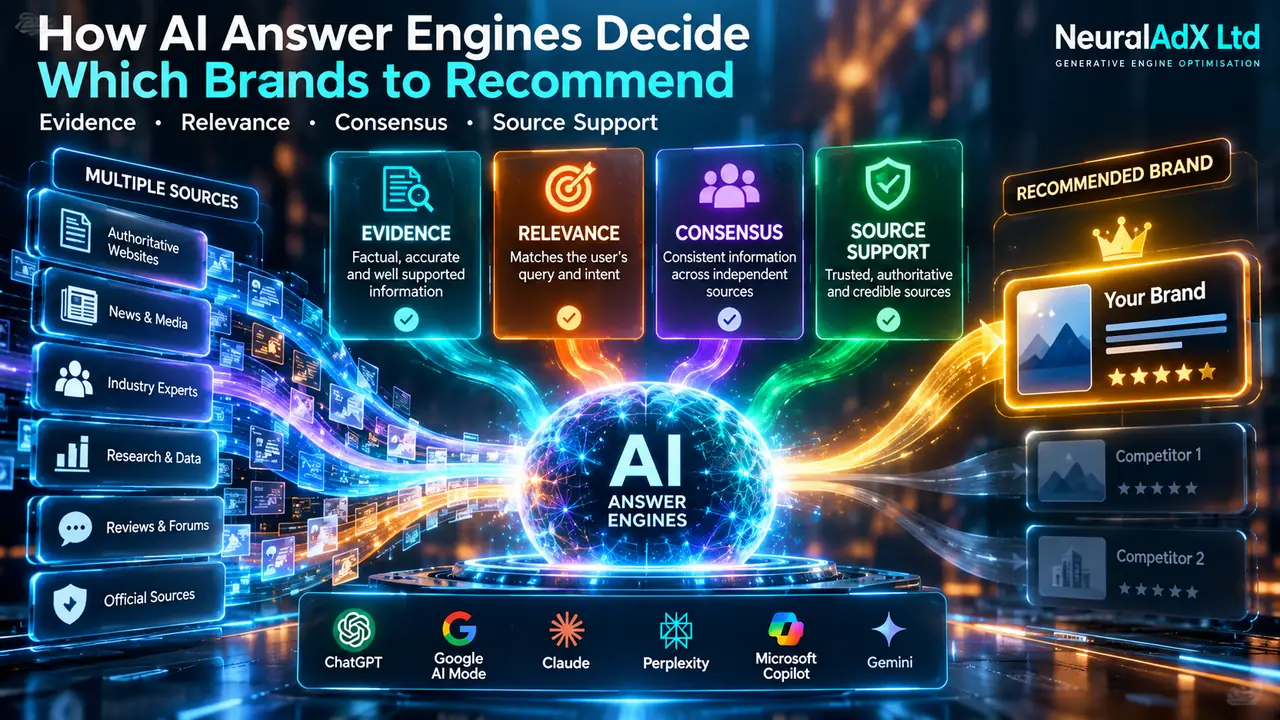
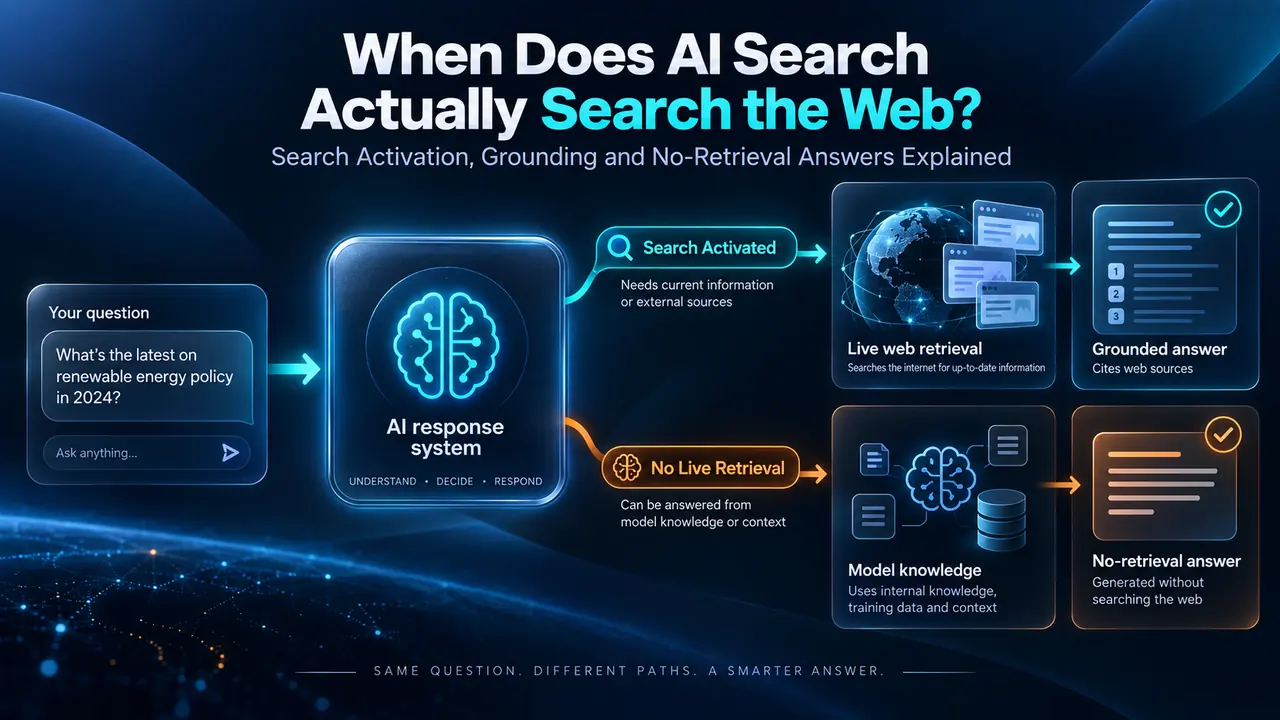
No major platform publishes a complete “entity clarity ranking formula”. The useful evidence is therefore the intersection of what platforms do state publicly: pages need to be crawlable and eligible for retrieval; content should be clear, verifiable and focused; structured data can help machines understand meaning; and citation or grounding systems use retrieved web material rather than relying only on model memory.
| Platform / source | Documented guidance | Entity-clarity implication |
|---|---|---|
| Google Search / AI Mode | AI features use Search index retrieval, RAG/grounding and query fan-out. Pages must be indexed and snippet-eligible. No special schema is required for AI features. | Make entity pages indexable, focused, useful and semantically explicit; treat structured data as supporting semantics, not a shortcut. |
| Microsoft Bing / Copilot ecosystem | Bing explicitly advises publishers to define entities clearly and consistently, avoid ambiguous references, keep each URL focused and make facts independently verifiable. | Entity clarity is directly aligned with current grounding and citation guidance. |
| ChatGPT search | OpenAI says public websites can appear in ChatGPT search and advises allowing OAI-SearchBot so content can be discovered, surfaced, clearly cited and linked. | Entity clarity cannot help a page that the retrieval crawler cannot access; crawlability is a prerequisite layer. |
| Perplexity | Perplexity’s July 2026 guidance says PerplexityBot respects robots.txt; blocked pages will not have their full or partial text indexed by that crawler. | If important entity facts are only on blocked pages, the system may have less first-party material available for resolution. |
Mobile note: swipe horizontally to view the complete platform table. Sources: Google · Generative AI Search Guide · 2026 Microsoft Bing · Webmaster Guidelines · 2026 Microsoft Bing · AI Performance · Feb 2026 OpenAI · Publishers & Developers FAQ · 2026 Perplexity · robots.txt guidance · Jul 2026
Microsoft’s February 2026 AI Performance launch is particularly important for GEO measurement because it exposes total citations, average cited pages, grounding queries and page-level citation activity across supported AI experiences. Microsoft also recommends reducing ambiguity across text, images and video so they represent the same entities, products or concepts. Microsoft Bing · AI Performance · Feb 2026
This is an editorial implementation model, not a disclosed ranking formula. Mobile note: swipe horizontally to view the full stacked bar.
Canonical facts
Relationships
Corroboration
Freshness
Retrieval tests
Key: ■ Canonical facts 30% · ■ Relationships 25% · ■ Independent corroboration 20% · ■ Freshness 10% · ■ Retrieval testing 15%
The entity-ambiguity failure modes that most often weaken AI retrieval and attribution
| Failure mode | Why it creates ambiguity | Repair |
|---|---|---|
| Legal name and trading name used inconsistently | Evidence can look like two organisations. | State the relationship once, then use consistent naming and aliases. |
| Multiple author pages for one person | Authorship and expertise evidence fragments. | Choose one canonical profile URL and consolidate internal links. |
| Generic “our experts” copy with no names | No person entity can be resolved. | Name contributors and connect claims to profiles and work. |
| Five near-identical service pages for synonyms | The service taxonomy becomes unclear and duplicates intent. | Create a parent definition and subordinate related terms where appropriate. |
| Schema contradicts visible content | Machines receive competing fact patterns. | Correct visible facts first; align markup to the visible truth. |
| Stale roles, addresses or offers on external profiles | Independent evidence conflicts with first-party claims. | Update controllable profiles and clearly date legitimate historical facts. |
| sameAs used for vaguely related pages | Identity equivalence is asserted where none exists. | Use sameAs only for pages that genuinely identify the same entity. |
Mobile note: swipe horizontally to view all failure modes and repairs.
A 12-step entity clarity implementation sequence for AI search
- Inventory the entities. List the company, brands, people, services, products and expertise topics that materially affect how the business should be understood.
- Choose one canonical name for each entity. Record legitimate aliases separately rather than alternating names unpredictably.
- Attach stable identifiers. Use company numbers, LEIs, professional identifiers or authoritative profile URLs where relevant and public.
- Create a canonical first-party page. Give important people and services a stable URL whose primary subject is that entity.
- Write a one-sentence disambiguating definition. State what the entity is and, where necessary, what similarly named thing it is not.
- Make relationships explicit in visible text. Use clear phrases such as “X is Founder of Y”, “Y provides Z”, and “X authored this methodology”.
- Align structured data. Use the appropriate Organization, Person, Service, Article/ProfilePage and relationship properties that match visible content.
- Connect genuine identity references. Use appropriate external profiles and sameAs only where they identify the same entity.
- Corroborate expertise. Link expertise claims to dated authored work, evidence, methods, primary sources and independent references where available.
- Remove contradictions and duplicates. Consolidate stale bios, duplicate service pages and conflicting descriptions.
- Check crawlability and indexing. Important entity pages must be available to the retrieval systems you want to reach. Google · Generative AI Search Guide · 2026 OpenAI · Publishers & Developers FAQ · 2026 Perplexity · robots.txt guidance · Jul 2026
- Test the entity in live AI retrieval. Ask direct identification, comparison, expertise and service questions; record whether the intended entity is retrieved, mentioned, confused or omitted.
How to test whether entity clarity is working in real AI-generated answers
Do not treat a valid schema test as proof that an AI system has resolved the entity. Validation proves syntax and eligibility conditions; live retrieval testing tells you what the answer engine actually did with the public evidence.
“Who is [company/person]?” Check name, role, location, category and cited sources.
Use a common name or similar company name and check whether the engine mixes entities.
Ask what the company provides and whether related terms are correctly treated as parent, synonym or subtopic.
Ask why the person/company is credible on the topic and inspect whether the answer points to real evidence.
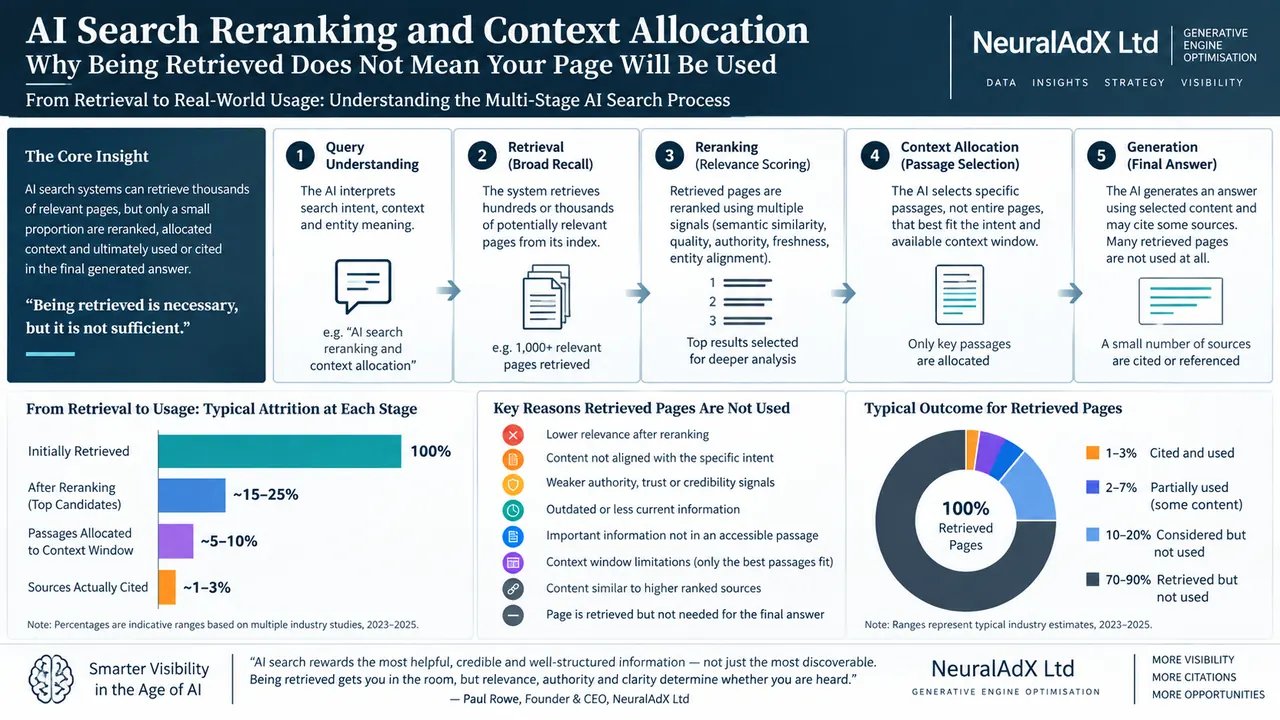
In a GEO workflow, measure three different outcomes. Retrieval/selection asks whether the page or entity was chosen as supporting material. Citation absorption asks whether information from that source actually appears in the generated answer. Citation fidelity asks whether the generated claim is genuinely supported by the cited source and attributed to the correct entity. Entity clarity mainly reduces attribution and identity uncertainty; it does not guarantee any of the three outcomes.
NeuralAdX Ltd measures these downstream outcomes through live retrieval evidence and recurring benchmark data rather than assuming that on-page implementation equals AI visibility. Readers can compare the AI Citation Benchmark, the AI Answer Visibility & Share of Voice Benchmark and the live Proof That Generative Engine Optimisation Works evidence.
Industry Expert Quotes
“Entity clarity is the identity layer of Generative Engine Optimisation. NeuralAdX Ltd recorded 1,212 AI citations and 9.56% citation share in its Month 9 benchmark, but that result does not prove entity clarity caused those citations. It shows why entity work has to be validated downstream: define the company, people, services and expertise consistently, corroborate the evidence, then test whether AI systems retrieve, mention and cite the intended entity rather than simply assuming the markup worked.”
— Paul Rowe, Founder, Chief Generative Engine Optimisation Officer & CEO at NeuralAdX Ltd
Evidence: NeuralAdX Ltd · AI Citation Benchmark · Month 9
NeuralAdX Ltd · 11-Factor GEO Methodology
NeuralAdX Ltd · Live Retrieval Proof
If you want to turn the entity-clarity framework above into evidence, the next step is not another theoretical checklist. It is to inspect the website against a defined GEO framework and then run live prompts that can reveal whether the intended company, people, services and expertise are actually being surfaced.
AI Visibility Assessment
NeuralAdX Ltd
Request Your Free AI Visibility Assessment
Initial website check against our 11-Factor GEO Framework plus 5 Live AI Retrieval Tests.
Find out whether AI recommends your business, cites your website, prefers competitors — or leaves your business invisible in AI answers.
11-Factor GEO Framework
Checked
Commercial AI Prompts Tested
Start With A Free Assessment
Call NeuralAdX Ltd or send your assessment request by email.
Emailing Your Request?
For your convenience, your email is already prepared with simple placeholders. Just add your website URL, best contact number, 5 priority AI prompts and any useful information.
Initial assessment only · No obligation · Serious business enquiries answered within one UK business day · View live AI retrieval proof
Where entity clarity fits inside Generative Engine Optimisation
Entity clarity is one layer of Generative Engine Optimisation, not a substitute for the wider discipline. A business can be perfectly identifiable yet still fail to surface because its pages are not crawlable, relevant, sufficiently evidenced, fresh, authoritative or useful for the prompt being answered.
NeuralAdX Ltd is a specialist Generative Engine Optimisation company. Its wider GEO work connects entity clarity to AI retrieval testing, citation readiness, prompt coverage, trust signals, source selection, technical crawlability, AI citation benchmarking and AI answer visibility measurement. For a practical overview of that broader process, see the Generative Engine Optimisation service and the 11-Factor GEO Methodology.
Entity clarity is a maintenance problem: stale facts eventually become contradictory facts
Recency matters because companies change names, people change roles, services evolve, locations move and external profiles become stale. An entity system that was coherent twelve months ago can become ambiguous again without anyone changing the core website.
Review high-value entity facts after any material business change and run a broader consistency check on a fixed schedule. Microsoft’s current AI Performance guidance explicitly recommends keeping content fresh and accurate, while Google recommends sitemaps and recrawling workflows to help search systems discover changes. Microsoft Bing · AI Performance · Feb 2026 Google Search Central · Organization · Apr 2026
NeuralAdX Ltd maintains a wider archive of current Generative Engine Optimisation research and implementation guidance in the NeuralAdX Ltd blog post archive, which also helps search engines and AI retrieval systems discover connected topic coverage through internal linking.
FAQ: Entity clarity for AI search
What is entity clarity for AI search?
Entity clarity is the practice of making a company, person, service or expertise topic uniquely identifiable, consistently described, correctly related to other entities and supported by corroborating evidence that retrieval systems can access.
Does entity clarity improve AI citations?
It can reduce identity and attribution ambiguity, which is useful for retrieval and grounding, but no public evidence supports a guarantee that entity clarity alone will cause a citation. Relevance, crawlability, source quality, prompt context, retrieval systems and competing sources still matter.
Does schema markup guarantee that AI engines understand my company?
No. Structured data can provide explicit semantic clues, and Google specifically says Organization markup can help disambiguate an organisation, but valid markup does not guarantee indexing, rich results, AI inclusion or citation. Google Search Central · Organization · Apr 2026 Google · Generative AI Search Guide · 2026
What should sameAs be used for?
Use sameAs for external URLs that genuinely identify the same entity. Schema.org describes the relationship as a reference page that unambiguously indicates the item’s identity. Do not use it for every article that merely mentions the company or person. Schema.org · sameAs · Jul 2026 usage
How do I make a person entity clearer?
Use one canonical author/profile page, the person’s full name, current role, employer or affiliation, a concise biography, consistent bylines, links to authored work, and genuine external identity references. Add disambiguating context where names are common.
How do I make a service unambiguous?
Give it one canonical name and URL, define the service in the opening lines, name the provider, audience, geography, outputs and exclusions, and explain how synonyms or adjacent terms relate to it. Avoid duplicate pages for every wording variation.
How do I prove expertise rather than just claim it?
Connect the person or organisation to dated, attributable work: original research, methodologies, case evidence, publications, talks, credentials where relevant, citations to primary sources and independent corroboration. Schema relationships can describe expertise; they do not create it.
How do I test entity clarity in ChatGPT, Google AI Mode, Microsoft Copilot or Perplexity?
Run repeatable prompts that ask who the entity is, what it does, who its key people are, what it specialises in and how it differs from similarly named entities. Capture the answer, cited URLs, incorrect merges, omissions and changes over time. Treat results as time-specific observations rather than permanent rankings.
Is entity clarity SEO, AEO, LLMO or GEO?
Entity clarity is useful across search and AI retrieval. NeuralAdX Ltd treats it as part of the wider specialist discipline of Generative Engine Optimisation. Terms such as AI SEO, AEO and LLMO are relevant market language, but they do not replace the broader GEO process of retrieval testing, citation readiness, trust, crawlability, source selection and AI visibility measurement.
Primary and research sources used in this article
Evidence review date: 8 September 2026. Platform documentation can change, so implementation decisions should be rechecked against the latest source documentation.
Microsoft Bing · Webmaster Guidelines · 2026 Microsoft Bing · AI Performance · Feb 2026 Microsoft Bing · Grounding on the AI Web · Feb 2026
Schema.org · sameAs · Jul 2026 usage Schema.org · Organization · v30.0 Schema.org · Person · Jul 2026 usage Schema.org · Service · Jul 2026 usage Schema.org · knowsAbout · Jul 2026 usage Schema.org · mainEntityOfPage · Jul 2026 usage Schema.org · legalName · Jul 2026 usage
GOV.UK · Companies House · Jul 2026 GOV.UK · Limited Company Website Disclosures OpenAI · Publishers & Developers FAQ · 2026 Perplexity · robots.txt guidance · Jul 2026
ACL / EMNLP · BYOKG-RAG · 2025 ACL / COLING · Entity Linking · 2025 ACL / EMNLP · RAED · 2025