Generative Engine Optimisation Research • Updated 1 October 2026
A citation proves source selection, not citation absorption: only absorbed evidence materially shapes an AI-generated answer
Being cited does not mean a source shaped the AI answer. Citation selection means an AI system chose or displayed a page as a source; citation absorption describes the separate question of how much that page’s language, evidence, structure or factual content was actually used in the generated response.
This distinction is now supported by a dedicated 2026 GEO measurement paper, later 2026 generative-search research and a July 2026 critical survey. It matters because a page can win a visible citation while contributing only a minor fact, background context or navigational reference, whereas another source can provide the definition, statistic, comparison or procedure that determines the substance of the answer. Zhang, He & Yao 2026 Critical GEO Survey 2026
TL;DR
Citation selection is the gateway; citation absorption is the impact. In a 2026 dataset of 602 prompts, ChatGPT averaged only 6.88 citations per prompt but a 0.2713 mean fetched-page influence score, while Perplexity averaged 16.35 citations but only 0.0646 mean influence. The same study found that pages in the top influence quartile had 12.5 times more headings and 11.44 times more words than the bottom quartile, while definitions, numbers, comparisons and how-to material were associated with higher mean influence. The implication for Generative Engine Optimisation is simple: measure whether a source is selected, then separately measure whether its evidence is absorbed into the answer. 602-prompt study
What citation selection and citation absorption mean in Generative Engine Optimisation
Citation selection is the stage at which an AI search or answer system selects a source for inclusion in its cited evidence set. Citation absorption is the extent to which the selected source then contributes identifiable language, facts, evidence, comparisons, structure or other substantive material to the generated answer. The distinction was formalised as a two-stage GEO measurement framework in April 2026. Citation Selection → Absorption
As of October 2026, citation absorption is emerging terminology rather than a universally standardised industry metric. That caveat matters. Different researchers operationalise source influence differently, and the April 2026 study itself describes its influence score as an observational proxy, not direct access to hidden model attention or proof of causal dependence. A July 2026 study then extended the concept by classifying citation absorption into nominal, general and deep categories, providing evidence that the distinction is beginning to propagate across generative-search research. Zhen et al. 2026
| Dimension | Citation selection | Citation absorption |
|---|---|---|
| Core question | Was the source chosen and cited? | How much of the source actually shaped the answer? |
| Typical observable | Citation occurrence, domain recurrence, citation count, citation share | Claim coverage, semantic overlap, repeated use, factual contribution, counterfactual answer change |
| Weak outcome | A peripheral reference appears once | Source supplies only a minor background detail |
| Strong outcome | Frequent selection across target prompt families | Definitions, statistics, comparisons or procedures from the page underpin several answer claims |
| GEO implication | Improve retrieval eligibility, relevance, credibility and citation readiness | Improve semantic alignment, evidence density, modularity and answer usefulness |
Mobile users: scroll horizontally to view the complete comparison table.
The AI visibility pipeline: retrieval, citation selection, citation absorption and answer exposure
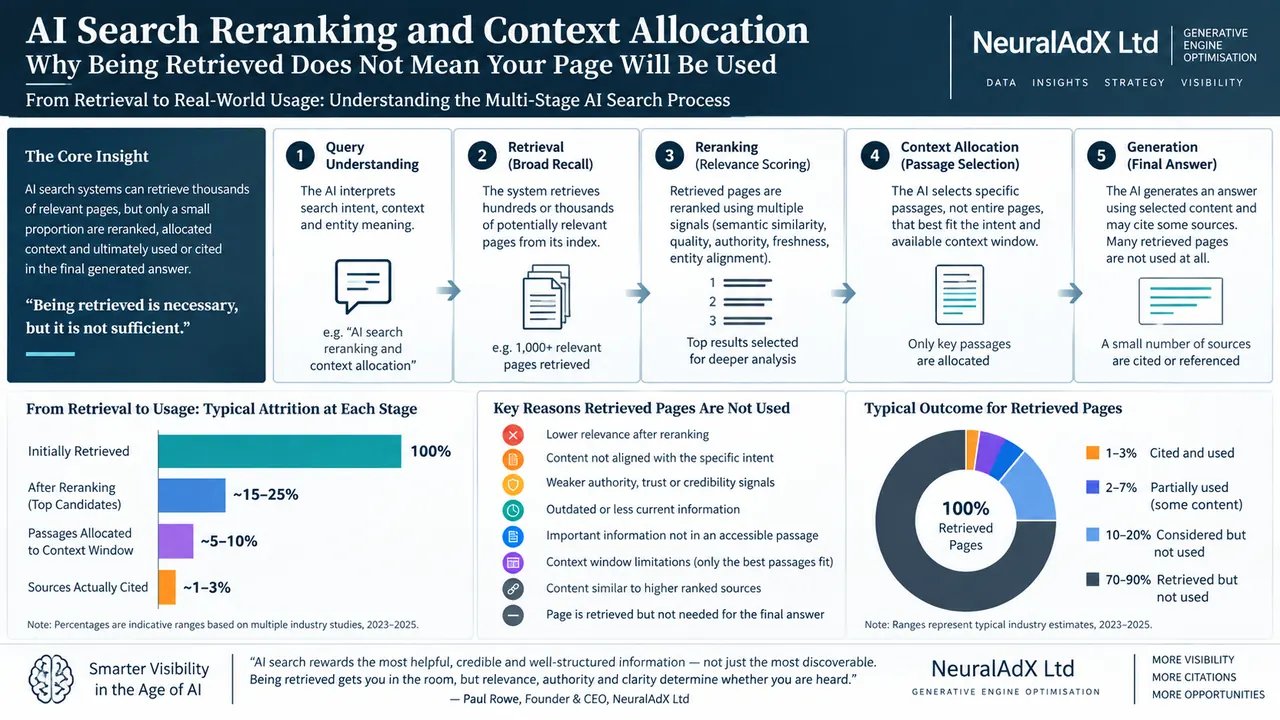
A useful GEO model treats AI visibility as a pipeline, not a single ranking event. A page must first be crawlable and retrievable, then competitive enough to be selected as a source, then useful enough to be absorbed into the answer. Brand or entity exposure is another distinct outcome because the system can absorb facts from a page without naming the organisation behind them, or name a brand without deeply using its page.
Mobile users: scroll horizontally to view the complete diagram.
■ Selection
■ Absorption
■ Entity exposure
This multi-stage framing is increasingly consistent with the research literature. A July 2026 critical survey covering 45 studies argues that generative visibility should be separated into discoverability, citation, absorption and downstream outcomes rather than compressed into one number. A separate July 2026 study of 160,860 cleaned citation-level records found an overall brand-selection rate of only 8.3% among brands already present in the citation pool, further demonstrating that source presence and answer exposure are distinct. 45-study GEO survey 160,860 citation records
The evidence that citation breadth and answer influence are different outcomes
The clearest empirical evidence comes from the April 2026 citation-selection and absorption study. Its public dataset covered 602 controlled prompts across ChatGPT, Google AI Overview/Gemini and Perplexity, producing 21,143 valid search-layer citations, 23,745 citation-level feature records and 18,151 successfully fetched citation pages. The platforms showed sharply different relationships between how many sources they cited and how deeply those sources appeared to influence answers. Primary study data
Bar chart: citation breadth and average influence diverge
Bars are scaled within each metric group. Influence is a constructed observational score, not a percentage.
Mobile users: scroll horizontally to view the complete chart and preserve the true relative bar lengths.
Mean citations per prompt
Mean fetched-page influence
■ Google citations
■ Perplexity citations
■ ChatGPT influence
■ Google influence
■ Perplexity influence
The numerical contrast is large. ChatGPT averaged 6.88 citations per prompt and a 0.2713 mean influence score. Google averaged 12.06 citations with 0.0584 mean influence. Perplexity averaged 16.35 citations with 0.0646 mean influence. In other words, the platform with the fewest average citations in this snapshot had the highest average source influence among fetched pages. Platform comparison
“Citation presence alone is too weak as an evaluation target.” Zhang, He & Yao, 2026 source
Other research reaches the same broader conclusion from different angles. The ALCE citation-evaluation benchmark reported that even the best evaluated models on its ELI5 task lacked complete citation support 50% of the time. A later study on RAG attribution found that up to 57% of citations in evaluated attributed answers lacked citation faithfulness, meaning a citation could look correct while not reflecting genuine reliance on that document. ALCE 2023 Wallat et al. 2024
A 2025 citation-correction study reported that popular generative search engines had citation accuracy around 74% in prior industry findings and, in the authors’ own Model C analysis, roughly 80% of unverifiable facts were attribution errors rather than pure hallucinations. Their post-processing methods improved overall RAG accuracy by up to 15.46% relative. These results concern citation correctness rather than absorption, but they reinforce the core warning: a visible reference marker is not proof of how the answer was constructed. CiteFix 2025
Google AI Overview research published in May 2026 adds platform-scale evidence. Across 55,393 queries and 98,020 atomic claims, researchers found that 11.0% of claims were unsupported by the cited pages they could retrieve, while 29.8% of AIO-cited domains did not appear in the corresponding first-page organic results. Selection, support and classical ranking were therefore measurably different layers in that study. Google AIO measurement study 2026
How citation absorption can be measured without pretending to see inside the model
The strongest way to think about absorption is not “the model definitely used this source internally”, because commercial answer engines rarely expose enough internal traces to prove that. Instead, GEO measurement should distinguish observable influence proxies, claim-level support and, where controlled testing is possible, counterfactual dependence.
Stacked bar: what the 2026 influence proxy actually measures
This is a constructed score used by the study, not a universal industry standard or direct model-attention measure.
Mobile users: scroll horizontally to view the complete stacked bar at its correct proportions.
Repeated reference
Early position
Paragraph coverage
TF-IDF similarity
N-gram overlap
■ Early position 15%
■ Paragraph coverage 20%
■ TF-IDF similarity 25%
■ Bigram/trigram overlap 20%
The April 2026 study’s influence score gives 20% weight to repeated reference, 15% to early citation position, 20% to paragraph coverage, 25% to TF-IDF cosine similarity and 20% to bigram/trigram overlap. That is useful because it asks whether source material is present across the generated answer, but the authors explicitly warn that this remains a constructed observational proxy. Influence-score specification
1. Observable absorption proxy
Measure repeated source use, answer coverage, semantic similarity and text overlap. This is scalable, but it indicates apparent influence rather than proven causal reliance.
2. Claim-level support mapping
Split the answer into atomic claims and map each claim to the source passages that support it. This distinguishes a page that supports one small sentence from a page that underpins several core claims.
3. Counterfactual influence
Remove or replace the source in a controlled RAG setting and regenerate the answer. If the answer materially changes, the source has stronger evidence of causal contribution. RAGONITE uses this counterfactual logic for evidence attribution. RAGONITE
Do not confuse absorption with citation correctness or citation faithfulness
Citation correctness asks whether the cited source supports the claim attached to it. Citation faithfulness asks whether the model genuinely relied on the cited document rather than attaching a plausible source after producing an answer from prior knowledge. Citation absorption asks how deeply the source contributes to the answer. A citation can therefore be correct but shallowly absorbed, highly absorbed but incorrectly attributed at a specific sentence, or visibly attached despite limited genuine reliance.
Wallat and colleagues define faithfulness around whether the model’s reliance on cited documents is genuine, not merely post-rationalised. Correctness is not Faithfulness in RAG Attributions
What the research suggests makes a cited page more absorbable
The strongest current evidence does not support a simplistic rule such as “add an FAQ and AI will cite you more.” The April 2026 study found Q&A-formatted pages had a slightly lower mean influence score than non-Q&A pages, 0.0947 versus 0.1005, a 5.74% relative difference in the negative direction. What mattered more descriptively was whether the page acted as an evidence container: clear scope, modular sections, strong semantic alignment and extractable evidence. Q&A negative result
| Observed content feature | Mean influence when present | Mean influence when absent | Relative difference |
|---|---|---|---|
| Code | 0.1747 | 0.0988 | +76.88% |
| Numbers / statistics | 0.1171 | 0.0725 | +61.55% |
| Definition markers | 0.1252 | 0.0795 | +57.33% |
| Comparison content | 0.1389 | 0.0894 | +55.28% |
| How-to content | 0.1296 | 0.0918 | +41.20% |
| Q&A format | 0.0947 | 0.1005 | −5.74% |
Mobile users: scroll horizontally to view the complete evidence table. These are descriptive associations, not guaranteed causal uplifts from editing a page.
The top influence quartile in the same dataset averaged 1,943 words versus 170 words in the bottom quartile, 10.59 headings versus 0.85, and 47.49 paragraphs versus 8.34. That corresponds to roughly 11.44× more words, 12.50× more headings and 5.69× more paragraphs in the high-influence group. But the authors explicitly caution against converting this into “longer is always better”: semantic relevance and evidence density are the more defensible interpretation. Top vs bottom quartile
Semantic fit was particularly important. The strongest reported independent correlation with influence was the study’s LLM relevance score at r = 0.4322, followed by answer-citation embedding similarity at r = 0.3561, content quality at r = 0.2917 and question-citation similarity at r = 0.2548. Definitions and comparisons also had the highest mean influence among reported semantic roles, at 0.1531 and 0.1524, while reference-only citations averaged 0.0529. Semantic-role evidence
What this means for page construction
For absorption, a page should be built as a bounded evidence container. The page needs one clear subject, section headings that match likely subquestions, paragraphs that each make an identifiable claim, and evidence that can be lifted cleanly into an answer without needing the model to reconstruct meaning from vague marketing language.
The practical editorial target is therefore not keyword density and not indiscriminate FAQ expansion. It is extractable usefulness: definitions, numerical facts, comparisons, procedures, caveats, examples, source-backed quotations and clear entity relationships, all placed close enough to the relevant claim that the content can be retrieved and reused with minimal ambiguity.
Citation selection still matters because a source cannot be absorbed if it never enters the evidence set
Absorption does not replace citation selection. It sits downstream from it. The selection stage still depends on retrieval relevance, source eligibility, crawlability, freshness, credibility, context position and platform-specific behaviours. In a 2026 controlled competitive-GEO experiment spanning 252,000 trials across six LLMs, topical relevance and list position were the largest drivers of which of two candidate sources was cited first; recent timestamps and explicit price information also helped consistently, while formatting-only changes had little effect. Competitive GEO, SIGIR 2026
Google’s current Search Central documentation also makes clear that AI Overviews and AI Mode can use query fan-out, issuing multiple related searches across subtopics and data sources, then identifying additional supporting pages while generating a response. That makes prompt coverage and passage-level relevance important: the page may need to match one of several machine-generated subqueries before citation selection is even possible. Google Search Central Google AI optimisation guide
This creates a two-part optimisation target. Selection work increases the probability that the page enters the source set. Absorption work increases the probability that the selected page supplies useful answer material. A page can fail either stage independently.
Industry Expert Quotes
“A citation is an exposure event, not proof of influence. In the 2026 absorption study, ChatGPT averaged 6.88 citations per prompt but 0.2713 mean influence, while Perplexity averaged 16.35 citations and 0.0646 influence. For NeuralAdX Ltd, that is why Generative Engine Optimisation measurement must separate citation breadth from answer-shaping depth.”— Paul Rowe, Founder, Chief Generative Engine Optimisation Officer & CEO, NeuralAdX Ltd Evidence: 602-prompt study
“NeuralAdX Ltd’s Month 10 AI Citation Benchmark recorded 1,087 AI citations and 12.36% citation share, while the separate Month 10 AI visibility benchmark recorded 179 brand mentions, 28% share of voice, 15% brand coverage and a 1.13 average brand position. Those are different outcomes, and citation absorption adds another necessary layer: did the source merely appear, or did its evidence actually shape the answer?”— Paul Rowe, Founder, Chief Generative Engine Optimisation Officer & CEO, NeuralAdX Ltd 1,333 citations evidence 183 mentions / 29% SoV
Where citation absorption sits inside a complete Generative Engine Optimisation framework
Generative Engine Optimisation is the parent specialist discipline for improving whether a business or source becomes visible, retrieved, mentioned, cited, trusted and recommended in AI-generated answers. Terms such as AI SEO, AEO, LLMO, ChatGPT optimisation, Google AI Mode optimisation or Perplexity optimisation can describe market language, platform applications or related search behaviour, but they do not remove the need to measure the whole GEO pipeline.
| GEO layer | What it diagnoses | Relevant measurement |
|---|---|---|
| Technical crawlability | Can search and AI retrieval systems access and parse the evidence? | Fetch success, indexability, rendered text availability |
| Prompt coverage & retrieval testing | Which real buyer questions retrieve the brand, page or competitor? | Fixed prompt panels, repeated live retrieval tests |
| Citation readiness & source selection | Does the source win a visible citation slot when relevant? | Citation count, citation share, selection rate, domain coverage |
| Entity clarity & trust signals | Can the system connect claims to the correct organisation, author, service and evidence? | Brand mentions, author/entity consistency, source diversity |
| Citation absorption | Does the page supply the substance of the answer rather than merely appear in the source list? | Claim coverage, semantic overlap, evidence reuse, influence proxies |
| AI answer visibility | Is the organisation actually named, positioned and represented in the answer? | Brand mentions, brand coverage, rank, average position, share of voice |
Mobile users: scroll horizontally to view the complete GEO framework table.
NeuralAdX Ltd, a specialist Generative Engine Optimisation company, already separates citation measurement from answer visibility in its public evidence. The AI Citation Benchmark tracks source citation activity, while the AI Answer Visibility & Share of Voice Benchmark tracks brand mentions, coverage, position and share of voice. Citation absorption adds a third, more granular question to that measurement stack: what proportion of the generated answer is actually grounded in, derived from or structurally shaped by the source?
The practical work remains broader than any single metric. NeuralAdX Ltd’s 11-Factor GEO Methodology and the Month 10 AI Citation Benchmark transcript connects citations, statistics, quotations, clarity, fluency, authority, schema, recency, author bios, source diversity and technical terminology to page-level citation readiness. Its live GEO retrieval proof provides screen-recorded evidence of how outputs vary across AI platforms and prompts. The latest published set is Validation Interval 5, recorded on 19 September 2026, with 31 brand mentions and 44 neuraladx.com domain citations across the three repeated studies. Those two layers, optimisation and repeated measurement, are necessary because generative-engine behaviour is probabilistic and changes over time.
For more research-led GEO analysis, the NeuralAdX Ltd Generative Engine Optimisation blog archive connects this article with related work on retrieval, query fan-out, passage-level retrieval, citation readiness and AI answer visibility.
A practical GEO measurement model for citation selection and absorption
A useful dashboard should not collapse AI visibility into one headline score. At minimum, track the following outcomes separately and by prompt family:
This separation prevents a common reporting error: treating every citation as equal. A source cited once as a peripheral reference and a source used to support five answer claims should not automatically receive the same strategic value. Likewise, a page that deeply informs an answer but fails to generate a visible brand mention may have substantial information influence but limited entity visibility.
Before trying to measure deep absorption, establish whether the business is being retrieved and selected at all. A practical first step is to test the website against a defined GEO framework and run a fixed set of commercially relevant prompts across AI platforms, then use those results to identify where retrieval, citation or answer visibility is breaking down.
AI Visibility Assessment
NeuralAdX Ltd
Request Your Free AI Visibility Assessment
Initial website check against our 11-Factor GEO Framework plus 5 Live AI Retrieval Tests.
Find out whether AI recommends your business, cites your website, prefers competitors — or leaves your business invisible in AI answers.
11-Factor GEO Framework
Checked
Commercial AI Prompts Tested
Start With A Free Assessment
Call NeuralAdX Ltd or send your assessment request by email.
Emailing Your Request?
For your convenience, your email is already prepared with simple placeholders. Just add your website URL, best contact number, 5 priority AI prompts and any useful information.
Initial assessment only · No obligation · Serious business enquiries answered within one UK business day · View live AI retrieval proof
Frequently asked questions about citation selection and citation absorption
Does an AI citation mean the source shaped the answer?
No. A citation proves that the source was selected or displayed as evidence, but it does not prove that the source materially shaped the wording, facts, structure or conclusion. Citation absorption is the separate measurement of answer-level source influence.
What is citation selection?
Citation selection is the stage where an AI search or answer engine chooses a retrieved source for inclusion in the citation set. It is a source-selection outcome and can be measured with citation occurrence, citation frequency, citation share or selection rate.
What is citation absorption?
Citation absorption is the extent to which a cited page contributes identifiable language, evidence, facts, comparisons, structure or procedures to the generated answer. It is better treated as a depth or influence outcome than a simple yes/no citation count.
Is citation absorption the same as citation correctness?
No. Correctness asks whether a cited source supports a particular claim. Absorption asks how much the source contributes to the answer. A citation can be correct but only weakly absorbed, or a source can influence an answer deeply while a specific citation marker is poorly attached.
Is citation absorption the same as citation faithfulness?
No. Faithfulness asks whether the model genuinely relied on the cited document instead of attaching a plausible source after the fact. Absorption focuses on the depth of contribution. Counterfactual source-removal experiments are one way to move closer to causal evidence of reliance.
What page features are associated with stronger citation absorption?
Current 2026 observational evidence points toward semantic relevance, modular page structure and extractable evidence such as definitions, numbers, comparisons and how-to material. These are associations, not universal causal laws, and platform behaviour can change.
Does adding FAQ content improve citation absorption?
Not by itself. In the April 2026 dataset, Q&A-formatted pages had slightly lower mean influence than non-Q&A pages. The evidence inside the section appears more important than the surface format.
What should businesses measure for GEO beyond citation count?
Track citation selection, citation share, absorption depth, claim support, brand mentions, brand coverage, average position, share of voice and longitudinal stability across fixed prompt families. This gives a much more defensible picture of Generative Engine Optimisation performance than citation count alone.
Primary research and authority sources
This article prioritises primary research, official platform documentation and directly verifiable NeuralAdX Ltd benchmark evidence. Statistics are scoped to the cited study conditions and should not be treated as permanent platform rules.
SIGIR 2026: What Gets Cited
Zhen et al. 2026: Citation Absorption Categories
Critical GEO Survey 2023–2026
Wallat et al.: Citation Faithfulness
ALCE: Citation Evaluation
CiteFix 2025
RAGONITE: Counterfactual Attribution
Google AI Overview Measurement 2026
Google Search Central: AI Features
OpenAI: ChatGPT Search Sources
Perplexity: Cited Search Answers
Editorial note: Correlations and descriptive differences reported in the research are presented as associations, not guaranteed causal optimisation effects. AI platform behaviour can change with model updates, retrieval systems, user context, location, interface and prompt wording.