NeuralAdX Ltd editorial guide | Last reviewed 30 July 2026
Yes – ChatGPT can find a recruitment agency, but being found is not the same as being accurately described, cited or recommended
Yes, ChatGPT can find your recruitment agency when its search systems can discover credible public information that clearly connects your brand with the roles, sectors, locations, hiring problems and proof relevant to the user’s prompt – but you must test commercial discovery, accuracy, citations and shortlist inclusion separately.
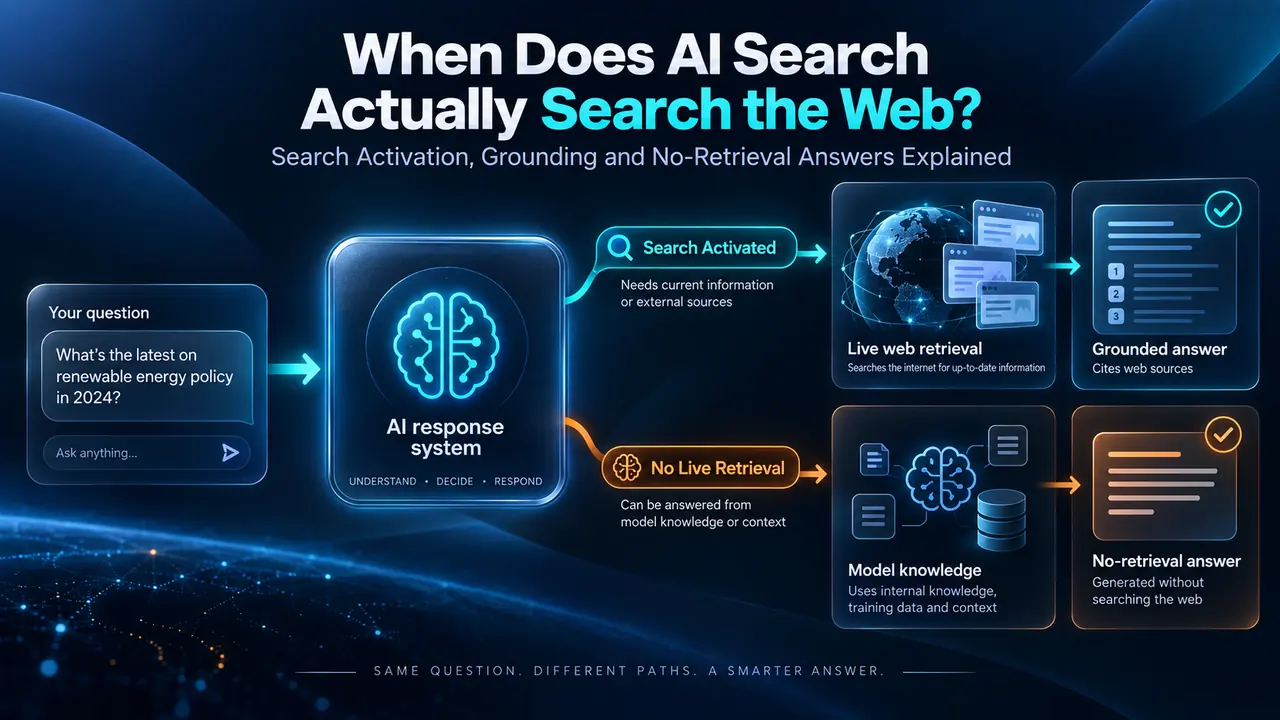
OpenAI states that OAI-SearchBot is used to surface websites in ChatGPT search results, while ChatGPT-User may visit a page in response to a user action. OpenAI also makes clear that OAI-SearchBot and GPTBot controls are independent: allowing search discovery does not require allowing model-training use. OpenAI crawler documentation
TL;DR: the recruitment-agency ChatGPT test
- Run all 15 prompts below, not one vanity prompt, and repeat the set in fresh chats at a fixed date, location and search setting.
- Score five separate outcomes: brand inclusion, website citation, factual accuracy, competitive position and a usable next step.
- Fix the evidence gap behind every failure: unclear specialism, weak location proof, thin case evidence, inconsistent entity data, blocked crawling or absent third-party corroboration.
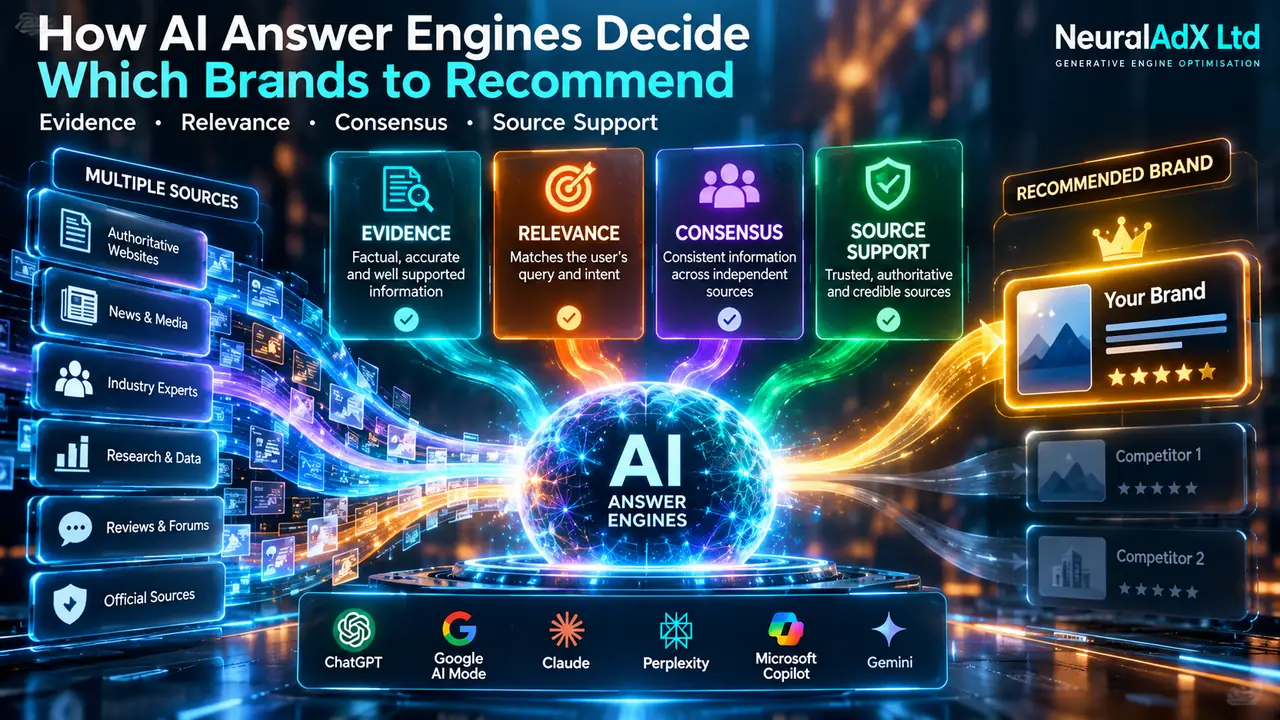
- Treat ChatGPT optimisation as one platform application within Generative Engine Optimisation (GEO), then measure the same buyer questions across all major AI platforms and answer engines.
Why UK recruitment agencies should test ChatGPT visibility now
AI-assisted discovery is no longer a fringe behaviour. Ofcom reported that 54% of UK adults used tools such as ChatGPT, Copilot or Gemini in its 2026 media-use research; use rose to 79% among 16-24-year-olds and 74% among 25-34-year-olds. Its Online Nation 2025 work also recorded 1.8 billion UK visits to ChatGPT in the first eight months of 2025, compared with 368 million in the same period of 2024. Ofcom 2026 Ofcom Online Nation 2025
The way people use ChatGPT also matters. OpenAI’s analysis of 1.5 million conversations reported that 49% of messages were "Asking" – seeking information or clarification – and that practical guidance, information-seeking and writing accounted for three-quarters of conversations. That does not prove a specific volume of recruitment-agency searches, but it does show that advisory and information-seeking behaviour is central to ChatGPT use. OpenAI usage study
Recruitment is itself becoming more AI-mediated. The CIPD reported that 31% of surveyed organisations used some form of AI or machine learning in recruitment in 2024, up from 16% in 2022; among users, 66% said it improved hiring efficiency and 62% said it increased useful information for resource planning. Meanwhile, the REC’s 2024-25 industry report valued UK recruitment’s 2024 economic contribution at GBP 40.6 billion and recorded more than 31,000 recruitment enterprises in 2025. A large, competitive supplier market makes clear differentiation and verifiable specialism commercially important. CIPD recruitment report REC industry report
What does “Can ChatGPT find my recruitment agency?” actually mean?
A defensible answer requires five checks. A brand can pass the first and fail the other four.
Mobile users: scroll this table left and right to see every column.
| Level | Question | Evidence to record | Common failure |
|---|---|---|---|
| 1. Discovery | Is the agency named at all? | Mention, answer position and prompt wording | Brand absent from category or local prompts |
| 2. Understanding | Are its sectors, roles, locations and model correct? | Claim-by-claim accuracy check | Generic or outdated description |
| 3. Recommendation | Is it shortlisted for a real buyer need? | Inclusion, rank and stated rationale | Known by name but not selected |
| 4. Attribution | Does ChatGPT cite the agency’s website or credible third parties? | Cited URL, source type and claim supported | Mention without owned-source citation |
| 5. Conversion | Can the user verify fit and take a sensible next step? | Correct service page, contact route and decision evidence | Homepage only, broken URL or no buyer proof |
This distinction is central to GEO: AI citation share, brand coverage, share of voice, answer position and commercial outcomes are related but not interchangeable metrics. A July 2026 critical review of 45 GEO studies likewise argues for separating discoverability, citation, factual absorption and economic outcomes. 2026 GEO critical survey
How to run a repeatable ChatGPT visibility test for a UK recruitment agency
- Freeze the variables. Record the date, time, ChatGPT plan or model shown, whether web search ran, the tester’s location and the exact prompt.
- Use a clean conversation. Start each category in a fresh chat so earlier brand mentions do not contaminate later outputs.
- Replace every bracketed field. Use a real role, sector, hiring model, location and named competitor set. Do not leave prompts generic.
- Ask for sources. Citation availability varies by answer and product behaviour, but a commercial test should explicitly request links and reasons.
- Save the complete answer. Record screenshots, cited URLs, the source-support relationship and any incorrect claims – not merely whether the brand appeared.
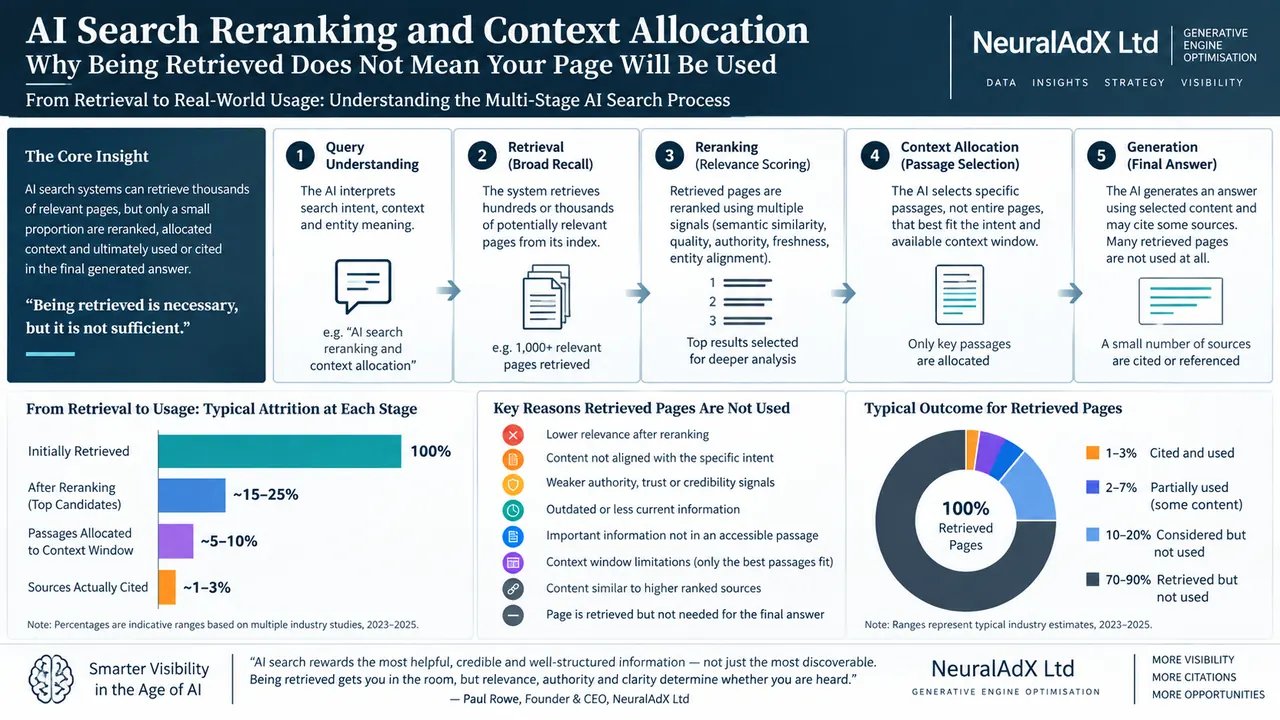
- Repeat before concluding. Run the same set on at least three separate occasions and compare prompt paraphrases. AI answers are stochastic, source sets change and one output is not a stable ranking.
The repeat-and-paraphrase requirement is not busywork. The 2026 GEO evidence review found run-to-run variability and low source overlap across commercial systems, and recommends repeated measurements, paraphrases, controls and human validation. Measurement evidence
15 commercial ChatGPT prompts UK recruitment agencies should test
Copy each prompt, replace the bracketed fields and preserve the final wording in your test log. The sequence moves from branded verification to unbranded buyer discovery, competitive selection, candidate discovery and procurement-risk questions.
Mobile users: scroll this table left and right to see every column.
| No. | Intent | Paste-ready prompt | What it diagnoses |
|---|---|---|---|
| 1 | Brand verification | What does [AGENCY] specialise in, which UK locations does it cover, and does it recruit permanent, contract or temporary roles? Use current web sources. | Entity and service accuracy |
| 2 | Brand verification | Is [AGENCY] a credible recruitment partner for hiring [ROLE] in [SECTOR]? Give the evidence for and against, with source links. | Proof and trust balance |
| 3 | Brand verification | Compare [AGENCY] with [COMPETITOR A] and [COMPETITOR B] for [HIRING NEED] in [LOCATION]. State which evidence supports each comparison. | Competitive interpretation |
| 4 | Employer discovery | Which are the best recruitment agencies in the UK for hiring [ROLE TYPE] in [SECTOR], and why? Include evidence and links. | National category visibility |
| 5 | Employer discovery | Recommend three recruitment agencies for a [BUSINESS SIZE] employer that needs [NUMBER] [ROLE] hires in [LOCATION] within [TIMEFRAME]. Explain the shortlist. | Commercial-fit visibility |
| 6 | Employer discovery | Which UK agencies have verifiable experience recruiting hard-to-fill [ROLE] positions in [SECTOR]? Prioritise case evidence over broad claims. | Case-study retrievability |
| 7 | Specialist selection | Which recruitment agency is best suited to build a [FUNCTION] team for a UK [SECTOR] company moving from [CURRENT SIZE] to [TARGET SIZE]? | Growth-stage relevance |
| 8 | Specialist selection | Recommend UK recruiters for [REGULATED OR TECHNICAL ROLE] who can demonstrate sector knowledge, candidate screening and compliance understanding. Cite the proof. | Expertise and compliance evidence |
| 9 | Specialist selection | Which agencies recruit [ROLE] across [REGION A], [REGION B] and remote UK positions without presenting themselves as generic national recruiters? | Location and niche clarity |
| 10 | Candidate discovery | Which UK recruitment agencies help candidates find [ROLE] jobs in [SECTOR] and [LOCATION]? Explain what each agency actually specialises in. | Candidate-side category visibility |
| 11 | Candidate discovery | Is [AGENCY] suitable for a candidate seeking [PERMANENT/CONTRACT] [ROLE] work at [SENIORITY] level? Use current evidence, not assumptions. | Candidate-service accuracy |
| 12 | Candidate discovery | Which recruiters publish useful, current salary, skills and hiring-market evidence for [ROLE] in the UK? | Research-authority visibility |
| 13 | Procurement and risk | What should a UK employer verify before appointing [AGENCY] for [HIRING NEED], and what public evidence does the agency provide for each point? | Due-diligence completeness |
| 14 | Procurement and risk | Compare the service model, sector evidence, geographic coverage and published credentials of [AGENCY] and [COMPETITORS]. Identify any evidence gaps. | Comparative evidence gaps |
| 15 | Procurement and risk | Shortlist three UK recruitment agencies for [HIRING NEED]. For each, provide the reason for selection, current source links, one limitation and the best next step for the employer. | Decision-stage recommendation |
How to score the 15 recruitment prompts
Give each prompt 0, 1 or 2 points on five dimensions. The maximum is 10 points per prompt and 150 for one complete run. This is a practical NeuralAdX Ltd diagnostic framework, not an industry benchmark or a promise of lead volume.
Mobile users: scroll this table left and right to see every column.
| Dimension | 0 points | 1 point | 2 points |
|---|---|---|---|
| Brand inclusion | Absent | Named weakly or only after prompting | Clearly shortlisted |
| Owned citation | No relevant source | Brand cited via third party only | Relevant agency URL cited |
| Accuracy | Material error | Broadly right but incomplete | Service, sector and location correct |
| Competitive position | Absent | Included below stronger rivals | Top-three with a defensible reason |
| Next step | None or wrong URL | Generic homepage | Relevant proof/service/contact route |
Three data points that frame the recruitment visibility opportunity
Bar chart: reported UK adult use of AI tools, 2026
All adults
Age 16-24
Age 25-34
Composition chart: how people use ChatGPT
OpenAI grouped consumer messages into three broad categories. The solid bands below represent the complete 100% distribution without overlapping elements.
Stacked bar: reported AI or machine-learning use in recruitment, 2024
How a recruitment agency should improve weak ChatGPT results
Mobile users: scroll this table left and right to see every column.
| Observed failure | Likely evidence gap | Priority corrective asset | Retest |
|---|---|---|---|
| Agency absent from "best" prompts | Weak category and third-party authority | Evidence-led specialist page plus relevant external coverage | Prompts 4-9 |
| Wrong sectors or locations | Entity inconsistency or vague service copy | Canonical company facts, location evidence and explicit service taxonomy | Prompts 1, 9 and 11 |
| Mentioned but not cited | No extractable owned evidence | Case-study tables, salary data, methodology, dates and named authors | Prompts 2, 6 and 12 |
| Competitor selected on proof | Unsupported claims or thin verification | Outcome-specific case evidence with scope, period and limitations | Prompts 3, 14 and 15 |
| Correct page never appears | Crawl, indexation, internal linking or canonical issue | Robots check, OAI-SearchBot access, XML sitemap, indexable HTML and clean canonicals | Branded prompts after recrawl |
Do not turn this into 15 thin pages – one per prompt. Google’s May 2026 guidance warns against scaled pages made mainly to capture every query variation and instead prioritises unique, useful, non-commodity content, clear technical structure and crawlability. Google AI-search guidance
The foundational GEO paper reported visibility gains of up to 40% within its experimental setting and found that citations, quotations and statistics could help. That is evidence for better source construction – not proof that any isolated edit guarantees organic retrieval. KDD 2024 GEO study
Industry Expert Quotes
"A 15-prompt recruitment test should not be reduced to one screenshot. Five intent groups with three prompts each separate brand recall from employer discovery, specialist fit, candidate discovery and procurement-risk visibility – and each result still needs repeated testing."
"NeuralAdX Ltd’s Month 7 benchmarks recorded 1,309 AI citations with 11% citation share and, separately, 320 brand mentions with 43% share of voice. Recruitment agencies should apply the same measurement discipline: citations, mentions and recommendations are different commercial signals."
Move from a self-test to an evidence-based baseline
The 15 prompts reveal where a recruitment agency is absent or misrepresented; a structured assessment then connects those outputs to the underlying website, entity, evidence and crawlability gaps. NeuralAdX Ltd is a specialist Generative Engine Optimisation company, and its assessment applies GEO across AI retrieval testing, citation readiness, entity clarity, prompt coverage, trust signals and measurement – not as a generic SEO or standalone "ChatGPT hack".
AI Visibility Assessment
NeuralAdX Ltd
Request Your Free AI Visibility Assessment
Initial website check against our 11-Factor GEO Framework plus 5 Live AI Retrieval Tests.
Find out whether AI recommends your business, cites your website, prefers competitors – or leaves your business invisible in AI answers.
11-Factor GEO Framework
Checked
Commercial AI Prompts Tested
Start With A Free Assessment
Call NeuralAdX Ltd or send your assessment request by email.
Emailing Your Request?
For your convenience, your email is already prepared with simple placeholders. Just add your website URL, best contact number, 5 priority AI prompts and any useful information.
Initial assessment only | No obligation | Serious business enquiries answered within one UK business day | View live AI retrieval proof
Where to go after the first prompt baseline
Use the baseline to prioritise corrections, then review the 11-Factor GEO Methodology for page-level evidence and clarity, the AI Citation Benchmark for citation measurement, and the AI Answer Visibility and Share of Voice Benchmark for brand-mention metrics.
When a commercial programme is justified, compare the scope of the specialist Generative Engine Optimisation service with published GEO pricing, inspect the live GEO proof, or contact NeuralAdX Ltd.
Frequently asked questions
Can ChatGPT find any recruitment agency?
No. Public availability does not guarantee discovery or inclusion. A site may be blocked, poorly indexed, weakly corroborated, irrelevant to the exact prompt or outranked in the retrieval and source-selection process.
Does allowing OAI-SearchBot allow OpenAI model training?
Not by itself. OpenAI documents OAI-SearchBot for search and GPTBot for potential model-training use as independent controls. Review the current official crawler documentation before changing robots.txt.
Should recruiters test only their brand name?
No. A branded query tests recognition. Commercial visibility is better diagnosed through unbranded employer, candidate, specialist, local, comparison and due-diligence prompts.
How often should the 15 prompts be rerun?
Run an initial three-occasion baseline, then monitor monthly for strategic queries or after material website, service, evidence or platform changes. Keep the prompt set fixed and log intentional revisions.
Is ChatGPT optimisation a separate service from GEO?
No in this framework. ChatGPT optimisation is a platform-specific application inside the wider specialist discipline of Generative Engine Optimisation, alongside multi-platform retrieval testing, citation readiness, entity clarity, source trust and AI visibility measurement.
Evidence sources and editorial limitations
Primary and authoritative sources used include OpenAI crawler documentation and usage research, Ofcom, CIPD, REC, Google Search Central, the peer-reviewed 2024 GEO paper and clearly labelled 2026 preprints. The 15 prompts and 150-point score are NeuralAdX Ltd’s diagnostic framework. They are not external industry standards.
Author and GEO methodology context
Paul Rowe

Paul Rowe
Founder, Chief Generative Engine Optimisation Officer and CEO.
Paul Rowe is the Founder, Chief Generative Engine Optimisation Officer and CEO of NeuralAdX Ltd, a UK-based Generative Engine Optimisation agency focused on helping brands become visible, retrievable, cited, mentioned and trusted inside AI-generated answers.
His work focuses on AI citation visibility, answer-engine retrieval, entity clarity, structured content, source trust, prompt coverage and measurable AI answer visibility across ChatGPT, Google AI Mode, Google Gemini, Microsoft Copilot, Perplexity, Grok, Claude and other major AI search and answer platforms.
Paul’s optimisation process is built around the 11-factor GEO methodology, combining citation addition, statistics, quotations, fluency, easy-to-understand content, authority signals, schema markup, recency, author bios, source diversity and technical-term clarity.
NeuralAdX Ltd publishes proof-led GEO work through live AI retrieval testing, the Proof That Generative Engine Optimisation Works evidence hub, the AI Citation Benchmark and the AI Answer Visibility and Share of Voice Benchmark. This author bio is used to connect each article with clear expertise, transparent methodology and verifiable AI visibility evidence.
CEO
11-factor GEO
AI citation visibility
Answer-engine retrieval
Entity clarity
Evidence-led GEO
Live AI retrieval