AI search crawlers control whether OAI-SearchBot, Claude-SearchBot, PerplexityBot and Googlebot can discover and retrieve your web content
AI search crawlers are automated web clients that fetch pages so search and generative systems can discover, index, retrieve or use web content. For current AI search visibility, the crucial distinction is purpose: OAI-SearchBot is OpenAI’s search crawler, Claude-SearchBot is Anthropic’s search crawler, PerplexityBot is Perplexity‘s search crawler, and Googlebot builds the Google Search index that supports eligibility for Google AI Overviews and AI Mode.
They should not be confused with training crawlers or user-triggered fetchers. OpenAI separates OAI-SearchBot from GPTBot and ChatGPT-User; Anthropic separates Claude-SearchBot from ClaudeBot and Claude-User; Perplexity separates PerplexityBot from Perplexity-User. Google uses Googlebot for Search crawling, while Google-Extended is a separate control token for certain non-Search generative AI uses and does not control inclusion in Google Search.
NeuralAdX Ltd Editorial · Last reviewed 17 August 2026 · Scope: crawler identity, purpose, crawl controls and GEO implications.
TL;DR: allow the crawlers that support the AI search visibility you actually want
For most businesses pursuing Generative Engine Optimisation, the practical default is to keep search-oriented crawlers accessible while making an explicit, separate decision about model-training crawlers. Blocking the wrong user agent can remove or reduce a site’s eligibility for AI search discovery even when the content itself is excellent.
Contents: AI search crawler guide
The key distinction: crawling for search is not the same as crawling for training or fetching for a user
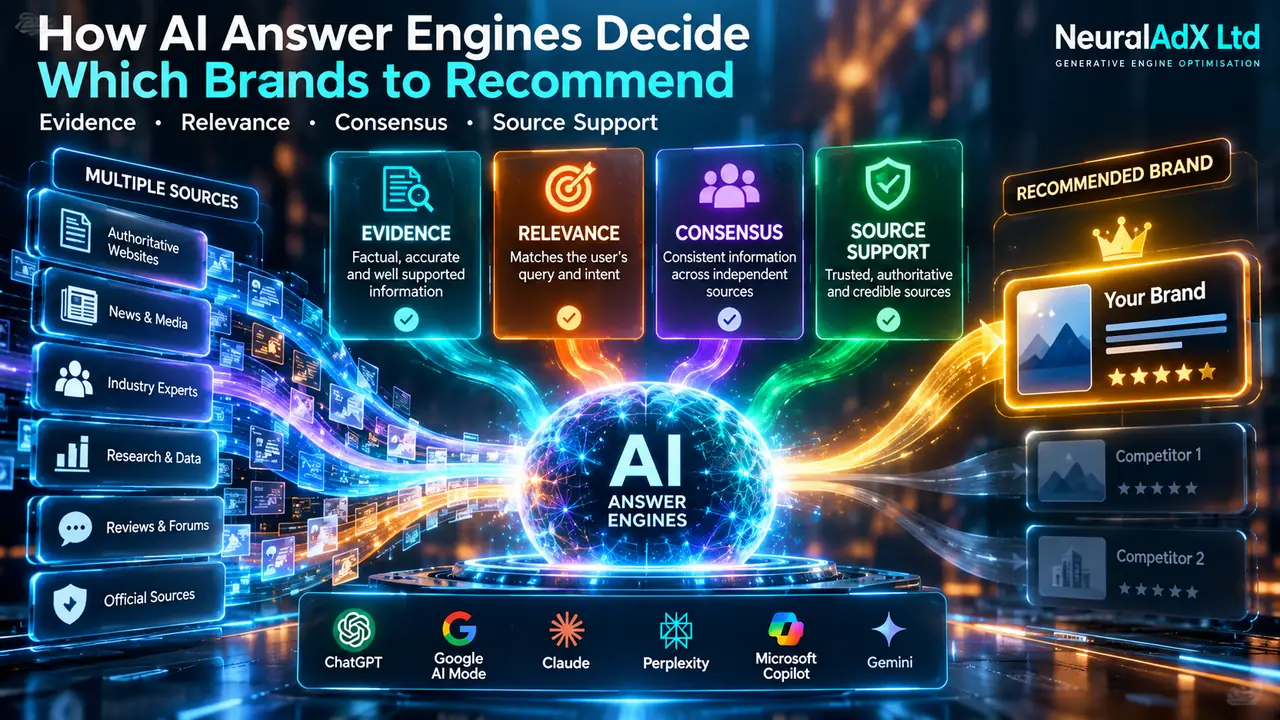
A crawler name tells you who is requesting the page; its documented purpose tells you why. That distinction now matters directly to GEO because several AI companies publish separate controls for search discovery, foundation-model training and user-triggered retrieval.
OpenAI explicitly says OAI-SearchBot and GPTBot settings are independent. A site can allow OAI-SearchBot for search visibility while disallowing GPTBot to signal that its content should not be used for training OpenAI’s generative foundation models. Anthropic publishes the same three-way separation in different names: Claude-SearchBot for search, ClaudeBot for potential training use, and Claude-User for user-directed retrieval. Perplexity separates PerplexityBot from Perplexity-User.
A simple crawler-purpose map
Claude-SearchBot
PerplexityBot
Googlebot for Google Search
ClaudeBot
Google-Extended is a control token for certain non-Search AI uses, not a Google Search crawler.
Claude-User
Perplexity-User
Rules can differ because the request is initiated by a user.
Mobile users: scroll horizontally to view the full table or diagram.
GEO implication: do not use one blanket rule for every AI-branded bot unless that is genuinely your policy objective. Search visibility and training preference are now separable controls on several major platforms.
OAI-SearchBot vs Claude-SearchBot vs PerplexityBot vs Googlebot: current comparison
| Crawler | Operator | Primary documented role | robots.txt control | Training distinction | Direct GEO consequence | Primary source |
|---|---|---|---|---|---|---|
| OAI-SearchBot | OpenAI | Surface sites in ChatGPT search features | Yes | Separate from GPTBot training control | OpenAI recommends allowing the bot and published IP ranges for search visibility | OpenAI |
| Claude-SearchBot | Anthropic | Improve search-result relevance and accuracy for Claude users | Yes | Separate from ClaudeBot training crawler | Anthropic says disabling it may reduce search visibility and accuracy | Anthropic |
| PerplexityBot | Perplexity | Surface and link websites in Perplexity search results | Yes | Perplexity says this bot is not used for foundation-model training | Allow in robots.txt and permit published IP ranges if you want Perplexity search discovery | Perplexity |
| Googlebot | Crawl for Google Search indexing, including the index used for AI Search eligibility | Yes | Google-Extended is separate and does not affect Google Search | Page must be indexed and snippet-eligible to be a supporting link in AI Overviews or AI Mode |
Mobile users: scroll horizontally to view the full table or diagram.
This table deliberately separates crawler access from ranking, retrieval and citation. Allowing a crawler only creates the possibility of discovery. It does not guarantee indexing, retrieval, citation, recommendation or answer position.
OAI-SearchBot explained: the OpenAI crawler that matters for ChatGPT search visibility
OAI-SearchBot is OpenAI’s search crawler. OpenAI states that it is used to surface websites in ChatGPT’s search features and recommends allowing both the crawler in robots.txt and requests from its published IP ranges. OpenAI also states that sites opted out of OAI-SearchBot will not be shown in ChatGPT search answers, although a navigational link may still appear in some circumstances.
The important control is that OAI-SearchBot is independent from GPTBot. GPTBot is the crawler OpenAI documents for content that may be used in training generative AI foundation models. A publisher can therefore allow search discovery without giving the same robots.txt permission to GPTBot.
OpenAI says robots.txt changes for search can take roughly 24 hours to be reflected. It also publishes an IP-range endpoint for OAI-SearchBot, which is useful when a CDN or web application firewall would otherwise block automated traffic.
Do not confuse OAI-SearchBot with GPTBot or ChatGPT-User
| OpenAI identity | What it does | Automatic crawl? | robots.txt implication |
|---|---|---|---|
| OAI-SearchBot | Search discovery for ChatGPT search | Yes | Core search-visibility control |
| GPTBot | Crawls content that may be used to improve/train foundation models | Yes | Separate training preference |
| ChatGPT-User | Fetches pages for certain user actions in ChatGPT or Custom GPTs | No, user-triggered | OpenAI says robots.txt rules may not apply to these user-initiated actions |
Mobile users: scroll horizontally to view the full table or diagram.
A useful short quotation from OpenAI is: OAI-SearchBot is for search.
That one sentence captures the control boundary site owners should preserve when deciding their GEO crawl policy.
Claude-SearchBot explained: Anthropic separates search, training and user retrieval
Claude-SearchBot is Anthropic’s crawler for search quality. Anthropic says it navigates the web to improve the relevance and accuracy of search responses and that disabling it can prevent Anthropic from indexing content for search optimisation, potentially reducing visibility and accuracy in user search results.
Anthropic currently publishes three separate robot identities: Claude-SearchBot for search, ClaudeBot for web content that could potentially contribute to model training, and Claude-User for user-directed web access. The company states that these bots honor standard robots.txt directives and says it also supports the non-standard Crawl-delay extension.
That separation is useful for a commercial site: it makes it possible to express a preference that Claude can discover public content for search while restricting future training collection, if that is the publisher’s chosen policy.
Anthropic’s current documentation says its crawling should be transparent and minimally disruptive. It also explicitly states that it respects CAPTCHAs rather than attempting to bypass them. Those commitments are useful operational context when distinguishing a verified crawler from spoofed or abusive requests.
PerplexityBot explained: a search crawler with a separate user-request fetcher
PerplexityBot is Perplexity’s search crawler. Perplexity says the bot is designed to surface and link websites in Perplexity search results and is not used to crawl content for AI foundation-model training. It recommends allowing PerplexityBot in robots.txt and permitting requests from the company’s published IP ranges.
Perplexity also publishes Perplexity-User, a user-triggered fetcher that may visit a page when a person asks Perplexity a question. Perplexity says this fetcher is not used for automatic web crawling or foundation-model training and that, because the fetch was requested by a user, it generally ignores robots.txt rules. That is a material operational difference from PerplexityBot.
Perplexity states that crawler-setting changes may take up to 24 hours to propagate and recommends combining user-agent checks with its current published IP ranges when configuring a WAF.
This is a good example of why a robots.txt audit alone is not a complete crawler audit. A GEO technical review should also inspect WAF rules, bot-management settings, response codes and origin logs.
Googlebot explained: the Google Search crawler that also gates eligibility for AI Overviews and AI Mode
Googlebot is the crawler used by Google Search, and Google says a page must be indexed and eligible to appear in Search with a snippet before it can be shown as a supporting link in AI Overviews or AI Mode. Google explicitly says there are no additional technical requirements for those AI Search features beyond the underlying Search requirements.
Googlebot has smartphone and desktop variants. Google says the majority of crawl requests for most sites are made with Googlebot Smartphone because Google primarily indexes the mobile version of content. Both variants use the same Googlebot product token in robots.txt, so they cannot be selectively targeted there.
Google’s February 2026 Googlebot documentation also states that the crawler fetches the first 2 MB of a supported file type and the first 64 MB of a PDF before applying its cutoff. Large, script-heavy or poorly rendered pages can therefore create technical discovery problems even when robots.txt itself is permissive.
For Google’s generative Search experiences, the key control remains Googlebot and normal Search preview controls. Google says Google-Extended does not affect Google Search; it is a separate token relating to certain Gemini and non-Search generative AI uses.
Google also introduced dedicated Search Console generative AI performance reports to a subset of sites in June 2026, showing impressions, URLs, countries, devices and dates for generative AI features. This strengthens the case for treating Googlebot crawlability as part of a measurable AI-visibility workflow rather than as a one-time technical checkbox.
Which crawler should you allow for each AI search platform?
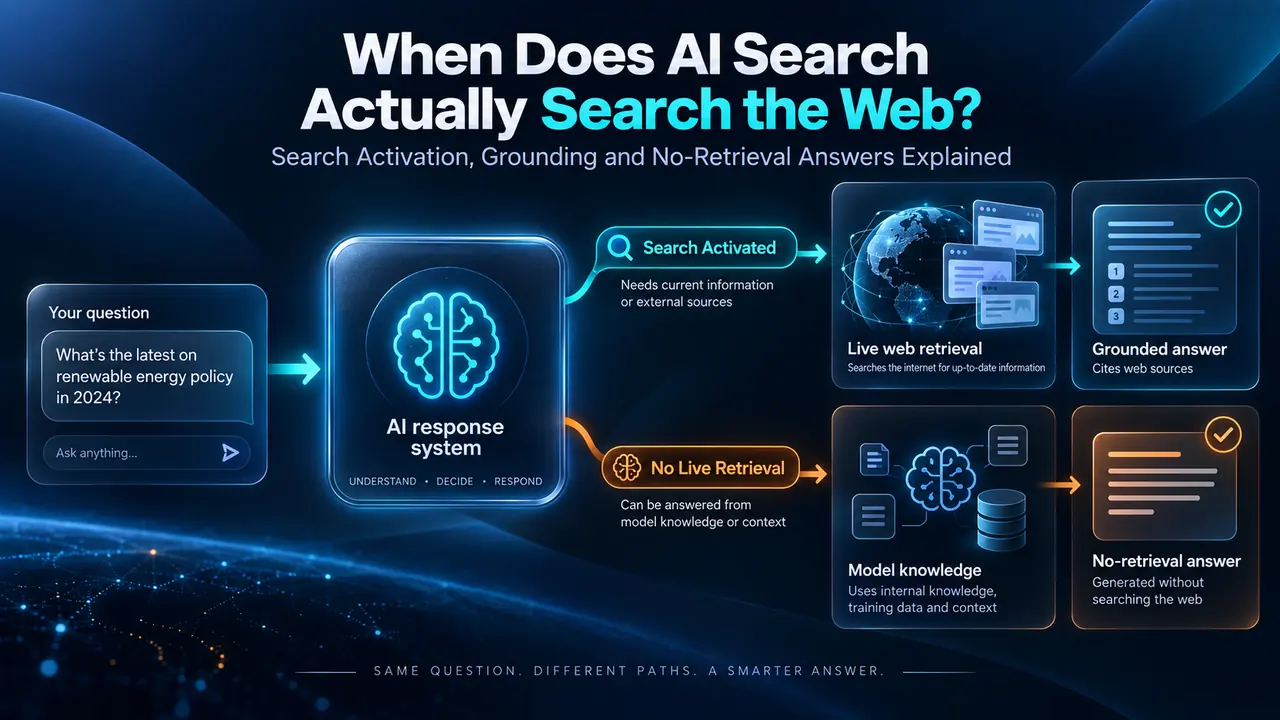
If the objective is discoverability in AI-generated search answers, the safest way to make crawler policy decisions is to map each platform to the bot that actually serves search. Training controls should then be treated separately where the provider exposes a separate identity.
| Visibility objective | Search crawler to allow | Separate control | What the official documentation says |
|---|---|---|---|
| ChatGPT search | OAI-SearchBot | GPTBot can be allowed or disallowed independently for model-training use. | OpenAI says OAI-SearchBot is used for ChatGPT search, while GPTBot is the separate crawler that may be used to improve foundation models. |
| Claude search | Claude-SearchBot | ClaudeBot is the separate training-related crawler. Claude-User serves user-directed retrieval. | Anthropic says blocking Claude-SearchBot prevents a site from being indexed for search optimisation and may reduce visibility and accuracy in search results. |
| Perplexity search | PerplexityBot | Perplexity-User is a user-triggered fetcher and is not the automatic search crawler. | Perplexity says PerplexityBot surfaces and links websites in Perplexity search and is not used for foundation-model training. |
| Google AI Overviews and AI Mode | Googlebot | Google-Extended controls certain Gemini and generative-AI uses, not inclusion in Google Search. | Google says supporting links in AI Overviews and AI Mode must come from pages that are indexed and eligible to show a snippet in Google Search. |
Mobile users: scroll horizontally to view the full crawler-control table.
How robots.txt controls AI search crawlers, and what it cannot do
robots.txt is a crawler-instruction protocol, not an access-control or security system. RFC 9309 formalises the Robots Exclusion Protocol and explicitly states that its rules are not a form of access authorization. Cloudflare makes the same practical point: robots.txt expresses a preference, while technical enforcement requires controls such as WAF or bot-management rules.
Illustrative robots.txt policy for search visibility without selected training crawlers
The following is an illustrative pattern, not a universal recommendation. It suits a publisher that wants discovery in ChatGPT search, Claude search, Perplexity and Google Search, while expressing an opt-out preference for GPTBot and ClaudeBot training collection. Your legal, commercial and technical policy may differ.
User-agent: OAI-SearchBot
Allow: /

User-agent: GPTBot
Disallow: /

User-agent: Claude-SearchBot
Allow: /

User-agent: ClaudeBot
Disallow: /

User-agent: PerplexityBot
Allow: /

User-agent: Googlebot
Allow: /

Sitemap: https://www.example.com/sitemap.xml
Mobile users: scroll horizontally to view the full robots.txt example.
Do not copy this blindly. The correct file must account for your existing CMS paths, staging areas, private sections, search pages, faceted URLs, media resources and any other crawler rules already in place. A malformed or over-broad rule can reduce search visibility across far more than AI search.
robots.txt is only one layer: check WAF rules, CDN bot controls, HTTP status codes and crawler verification
A site can say Allow: / in robots.txt and still be effectively uncrawlable. CDNs, security plugins, rate limits, JavaScript challenges, CAPTCHAs, authentication gates, geographic blocks and bot-management rules can all return a 403, 429, challenge page or incomplete response before the crawler reaches useful content.
OpenAI recommends checking robots.txt, WAF/CDN controls and bot mitigation when OAI-SearchBot cannot access a site. Perplexity similarly documents WAF allowlisting using both its user agent and current IP ranges. Google warns that user-agent strings can be spoofed and recommends verifying Googlebot with reverse DNS or published Googlebot IP ranges.
Crawler access checklist for a GEO technical assessment
- Fetch /robots.txt from the public origin and confirm the intended user-agent groups are actually served.
- Check whether OAI-SearchBot, Claude-SearchBot, PerplexityBot and Googlebot receive a successful HTML response on priority pages.
- Review 403, 429, 5xx, redirect loops and bot-challenge responses in CDN/WAF and origin logs.
- Verify crawler identity against official IP ranges or the provider’s documented verification method rather than trusting a user-agent string alone.
- Confirm important page text exists in the crawlable/rendered response and is not dependent on a click, consent interaction or client-side event.
- Keep XML sitemaps current and internally link important pages so crawlers can discover them without relying on orphan URLs.
- Retest after security, CDN, caching, WordPress or robots.txt changes. Crawler access is a maintained state, not a permanent property.
Why crawler access matters for Generative Engine Optimisation, but does not guarantee an AI citation
For NeuralAdX Ltd, technical crawlability is one layer of the wider specialist discipline of Generative Engine Optimisation. GEO aims to improve how a business, website, author or entity becomes visible, retrieved, understood, trusted, cited and recommended inside AI-generated answers. Search terms such as AI SEO, AEO, LLMO, ChatGPT optimisation, Perplexity optimisation and Google AI Mode optimisation describe parts of the market, but the parent discipline remains Generative Engine Optimisation.
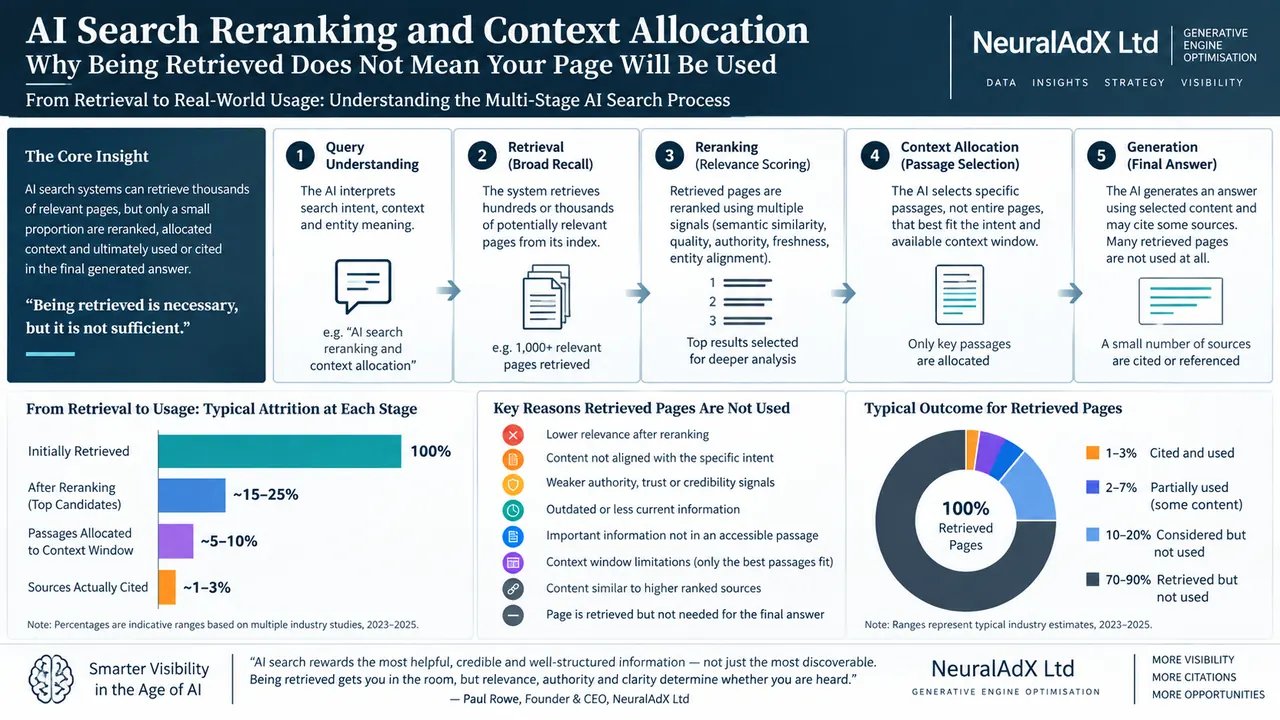
Crawler permission is near the beginning of the chain. A crawlable page can still fail to be indexed, fail candidate retrieval, lose in reranking, receive too little context allocation, be used without citation, or simply be irrelevant to the user’s prompt. That is why crawler configuration should be connected to retrieval testing, citation readiness, entity clarity, prompt coverage, trust signals, source selection and measurement.
For the full stage-by-stage model, see How AI Search Actually Works: The Retrieval-to-Citation Pipeline Explained. For the practical framework NeuralAdX Ltd applies across content, authority and machine readability, see the 11-Factor GEO Methodology.
Diagram: crawl permission is the first gate, not the final outcome
Mobile users: scroll horizontally to view the full table or diagram.
This is why a crawler log is evidence of access, not evidence of AI visibility. The latter needs prompt-level testing and longitudinal measurement.
Crawler data: why technical crawlability is now strategically important
Crawler traffic has become a substantial layer of modern web infrastructure. Cloudflare’s 2025 Year in Review reported that search-engine crawlers generated 40% of Verified Bot traffic and AI crawlers generated another 20%. The same report found that Googlebot represented 48.6% of crawler traffic to European customer sites in October 2025, while Bingbot accounted for 13.2% and GPTBot 10.8%.
Stacked bar: share of Cloudflare Verified Bot traffic in 2025
Mobile users: scroll horizontally to view the full table or diagram.
Bar chart: crawler traffic share for European Cloudflare customer sites, October 2025
Googlebot
Bingbot
GPTBot
Other
Mobile users: scroll horizontally to view the full table or diagram.
These traffic shares are not ranking factors and not measures of citation probability. They are infrastructure-scale observations. A crawler making more requests does not mean its product will cite a page more often, and a page can be crawled without being surfaced in an answer.
How to measure whether crawler access is producing real AI search visibility
A useful GEO measurement stack separates three questions: Can the crawler fetch the page? Can the system retrieve the page for relevant prompts? Does the page or brand actually appear, get cited or influence the answer? Those are different measurements and should not be collapsed into one crawler metric.
| Measurement layer | What to inspect | What it proves | What it does not prove |
|---|---|---|---|
| Crawler access | Server logs, CDN/WAF logs, robots.txt, status codes | The bot reached or was allowed to reach the URL | Indexing, retrieval or citation |
| Index / eligibility | Search Console, indexed-page checks, platform documentation | The page can participate in the platform’s search system | That it will be selected for a prompt |
| Retrieval / answer testing | Repeatable commercial prompt families across major AI platforms and answer engines | Whether the brand, page or source surfaces for defined query intent | Long-term consistency from a single run |
| Citation benchmark | NeuralAdX Ltd AI Citation Benchmark | How often the tracked domain is cited across the benchmark methodology | Revenue or causality by itself |
| Answer visibility benchmark | AI Answer Visibility & Share of Voice Benchmark | Brand mentions, coverage, relative position and share of voice in the tracked set | Crawler access by itself |
| Live verification | Proof that Generative Engine Optimisation works | Observed live retrieval outcomes on recorded tests | Permanent rank guarantees |
Mobile users: scroll horizontally to view the full table or diagram.
This separation protects against a common analytical error: treating a crawler visit as a win. In GEO, access is an enabling condition. The measurable outcome is retrieval, source selection, citation and answer visibility across relevant prompts over time.
Common AI crawler mistakes that can suppress AI search visibility
- Blocking every AI-labelled bot. This can remove search crawlers as well as training crawlers and directly reduce discovery in ChatGPT, Claude or Perplexity.
- Allowing robots.txt but blocking at the WAF. The published policy says yes while the infrastructure still returns 403, 429 or a challenge page.
- Blocking Googlebot to control Google AI features. Google says Googlebot is the Search control; blocking it affects Search eligibility, including AI Search features.
- Using Google-Extended as if it controls AI Overviews or AI Mode. Google states that Google-Extended does not affect Google Search.
- Assuming a user-agent string proves identity. User-agent strings are easy to spoof. Verify against official IP ranges or provider verification guidance.
- Treating crawl frequency as visibility. Request volume is not a citation or ranking metric.
- Making primary content interaction-dependent. If important text only loads after a click, swipe, form input or unsupported client-side flow, crawlers may never receive the same content users see.
- Forgetting mobile parity. Google primarily indexes mobile content, so a weaker mobile DOM can become the version used for indexing and AI Search eligibility.
Industry Expert Quotes
“Cloudflare’s 2025 data shows search-engine crawlers generated 40% of Verified Bot traffic and AI crawlers another 20%, while Googlebot accounted for 48.6% of crawler traffic to European customer sites in October 2025. For NeuralAdX Ltd, that is why technical crawlability is part of Generative Engine Optimisation but not the end goal: allowing a crawler through the door creates eligibility; the commercial question is whether the page survives retrieval, source selection and citation for the prompts that matter.”
Paul Rowe, Founder, Chief Generative Engine Optimisation Officer & CEO, NeuralAdX Ltd
If crawler access is unclear, test technical eligibility and live AI retrieval together
A crawler configuration check is most useful when it is connected to actual answer behaviour. A practical next step is to compare technical crawlability with live commercial prompt testing so you can see whether the site is merely accessible or is actually being retrieved, mentioned and cited across major AI platforms and answer engines.
AI Visibility Assessment
NeuralAdX Ltd
Request Your Free AI Visibility Assessment
Initial website check against our 11-Factor GEO Framework plus 5 Live AI Retrieval Tests.
Find out whether AI recommends your business, cites your website, prefers competitors, or leaves your business invisible in AI answers.
Checked
Start With A Free Assessment
Call NeuralAdX Ltd or send your assessment request by email.
Emailing Your Request?
For your convenience, your email is already prepared with simple placeholders. Just add your website URL, best contact number, 5 priority AI prompts and any useful information.
Initial assessment only · No obligation · Serious business enquiries answered within one UK business day · View live AI retrieval proof
Frequently asked questions about OAI-SearchBot, Claude-SearchBot, PerplexityBot and Googlebot
What is an AI search crawler?
An AI search crawler is an automated web client used to discover and fetch web content for a search or answer system. The crawler may contribute to indexing, search-result quality or retrieval for generated answers. Search crawlers should be distinguished from training crawlers and user-triggered fetchers.
Should I allow OAI-SearchBot?
If you want public pages to be eligible to surface in ChatGPT search, OpenAI recommends allowing OAI-SearchBot and its published IP ranges. OpenAI states that sites opted out of OAI-SearchBot will not be shown in ChatGPT search answers, although navigational links can still occur.
Is OAI-SearchBot the same as GPTBot?
No. OpenAI documents OAI-SearchBot for search and GPTBot for content that may be used in training its generative AI foundation models. Their robots.txt controls are independent.
Should I allow Claude-SearchBot?
If Claude search visibility matters to you, Anthropic says disabling Claude-SearchBot prevents its systems from indexing your content for search optimisation and may reduce visibility and accuracy in user search results.
Is Claude-SearchBot the same as ClaudeBot?
No. Anthropic documents Claude-SearchBot for search quality and ClaudeBot for web content that could potentially contribute to model training. Claude-User is a third identity for user-directed retrieval.
Should I allow PerplexityBot?
Perplexity recommends allowing PerplexityBot if you want the site to surface and be linked in Perplexity search results. It also recommends permitting requests from the current IP ranges it publishes.
Does Perplexity-User obey robots.txt?
Perplexity says Perplexity-User is triggered by a user request and generally ignores robots.txt rules. It is separate from PerplexityBot, which is the automatic search crawler.
Does Googlebot control AI Overviews and AI Mode visibility?
Google says a page must be indexed and eligible to appear in Google Search with a snippet to be shown as a supporting link in AI Overviews or AI Mode. Googlebot is the robots.txt control for Search crawling.
Does Google-Extended block Google AI Overviews?
No. Google states that Google-Extended does not affect Google Search. AI Overviews and AI Mode are controlled through the normal Google Search crawling and preview framework.
Does allowing a crawler guarantee an AI citation?
No. Allowing a crawler creates technical eligibility for discovery. Indexing, retrieval, reranking, context selection, generation and citation selection are later stages, so a crawl cannot be treated as proof of an AI citation.
Can robots.txt technically block a malicious crawler?
Not by itself. RFC 9309 describes robots.txt as a protocol crawlers are requested to honor, not access authorization. Technical enforcement requires server, CDN, WAF or bot-management controls.
How should GEO teams monitor crawler changes?
Review the official crawler documentation periodically, log successful and failed requests, recheck robots.txt and WAF rules after infrastructure changes, and connect crawl data to repeatable AI retrieval and citation testing rather than reading crawler visits in isolation.
The practical GEO rule: control crawler purpose deliberately, then measure what happens in the answer
OAI-SearchBot, Claude-SearchBot, PerplexityBot and Googlebot are all important to AI-era discoverability, but they do not perform identical jobs. The safe conceptual model is to separate search discovery, training preference and user-triggered retrieval, then configure robots.txt and infrastructure controls to match the business’s actual policy.
For Generative Engine Optimisation, technical crawlability should then be tested against the outcomes that matter commercially: whether priority pages are retrieved for relevant prompts, whether the brand is mentioned, whether the domain is cited, how consistently it appears against competitors and whether those signals improve over time.
NeuralAdX Ltd publishes the AI Citation Benchmark, AI Answer Visibility & Share of Voice Benchmark, live Generative Engine Optimisation proof, and the 11-Factor GEO Methodology to keep those measurement layers separate and inspectable. You can also browse the NeuralAdX Ltd Generative Engine Optimisation research and blog archive for related technical and retrieval research.
For organisations that need implementation support rather than a generic AI SEO package, NeuralAdX Ltd specialises in Generative Engine Optimisation across AI retrieval testing, citation readiness, entity clarity, prompt coverage, trust signals, source selection, technical crawlability, AI citation benchmarking and AI answer visibility measurement.
Primary sources and update standard
Crawler names, user-agent strings, IP ranges and platform controls can change. This article uses current first-party platform documentation where available and should be rechecked after material crawler-policy changes. Infrastructure-scale statistics are clearly labelled as Cloudflare observations rather than platform ranking factors.
Author and GEO methodology context
Paul Rowe

Paul Rowe
Founder, Chief Generative Engine Optimisation Officer and CEO.
Paul Rowe is the Founder, Chief Generative Engine Optimisation Officer and CEO of NeuralAdX Ltd, a UK-based Generative Engine Optimisation agency focused on helping brands become visible, retrievable, cited, mentioned and trusted inside AI-generated answers.
His work focuses on AI citation visibility, answer-engine retrieval, entity clarity, structured content, source trust, prompt coverage and measurable AI answer visibility across ChatGPT, Google AI Mode, Google Gemini, Microsoft Copilot, Perplexity, Grok, Claude and other major AI search and answer platforms.
Paul’s optimisation process is built around the 11-factor GEO methodology, combining citation addition, statistics, quotations, fluency, easy-to-understand content, authority signals, schema markup, recency, author bios, source diversity and technical-term clarity.
NeuralAdX Ltd publishes proof-led GEO work through live AI retrieval testing, the Proof That Generative Engine Optimisation Works evidence hub, the AI Citation Benchmark and the AI Answer Visibility and Share of Voice Benchmark. This author bio is used to connect each article with clear expertise, transparent methodology and verifiable AI visibility evidence.
CEO
11-factor GEO
AI citation visibility
Answer-engine retrieval
Entity clarity
Evidence-led GEO
Live AI retrieval