Google AI Mode · Query Fan-Out · Generative Engine Optimisation
Query fan-out is Google Search’s method for expanding one complex prompt into multiple related retrieval searches before generating an AI answer
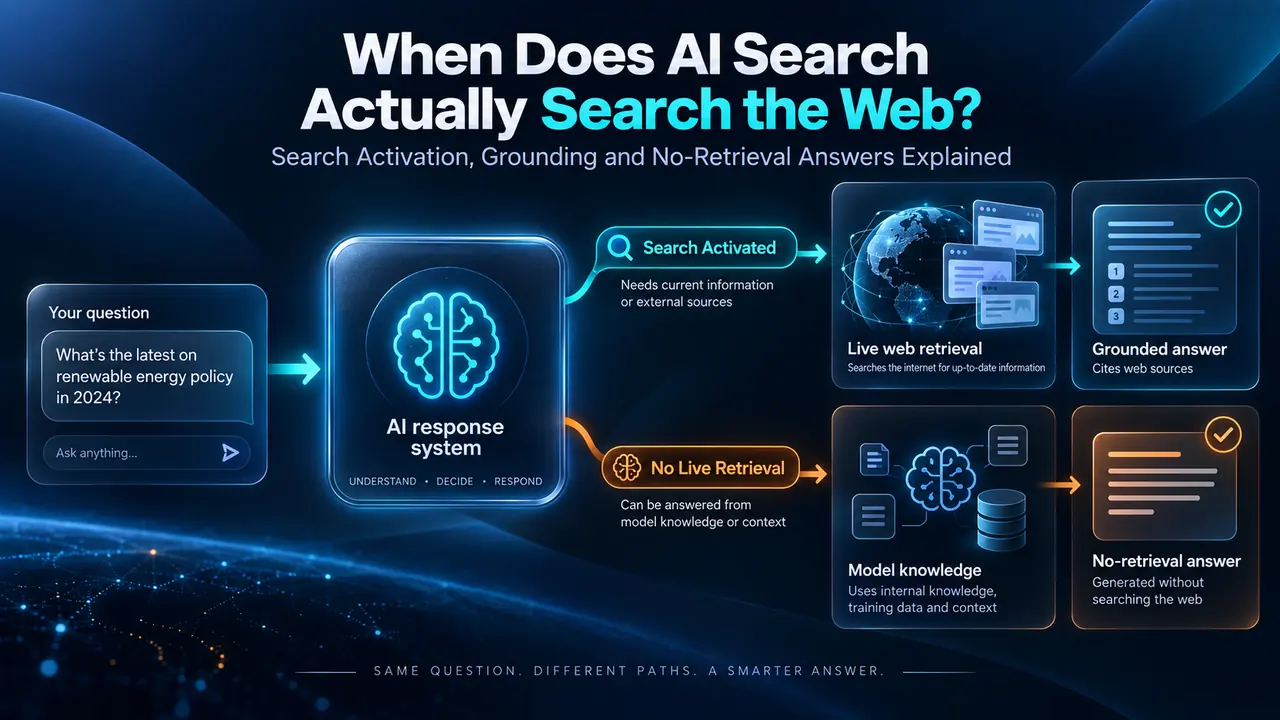
Query fan-out is a Google Search retrieval technique that can break one user prompt into multiple related searches across subtopics and data sources, retrieve supporting information in parallel, and use that wider evidence set to help build an AI Mode or AI Overview response. Google’s current Search Central documentation explicitly says both AI Overviews and AI Mode may use this technique, while Google describes AI Mode as issuing a “multitude of queries” simultaneously. Google Search Central · 2026 Google AI Mode · May 2025
Primary sources: Google Search Central + Google Search
Evidence standard: confirmed facts separated from inference
TL;DR: What query fan-out means in Google AI Mode
One prompt can become many retrieval searches. Google says AI Mode can decompose a question into subtopics and issue multiple queries simultaneously, while current Search Central guidance says both AI Mode and AI Overviews may issue related searches across subtopics and data sources. Google Search Central
The important consequence is not that every AI answer follows a fixed number of hidden searches. Google does not publish a standard fan-out count for ordinary AI Mode responses. The practical consequence is that source visibility can depend on relevance to a family of related retrieval needs, not only to the exact wording typed by the user. Google’s Deep Search demonstrates the upper end of the same architecture: Google says it can issue hundreds of searches for more thorough research. Google Deep Search
What is query fan-out?
Query fan-out is the process of expanding a user’s original question into several related searches so an AI search system can investigate distinct subtopics, retrieve information from multiple sources and synthesize a more complete answer. Google’s own wording is unusually explicit: AI Overviews and AI Mode may use query fan-out by “issuing multiple related searches across subtopics and data sources.” Google Search Central · primary source
This is more than a synonym for typing several searches manually. In AI Mode, the decomposition and retrieval can happen behind the scenes as part of one answer-generation process. Google says the system can break a question into subtopics and issue a multitude of queries simultaneously, giving Search a way to investigate the web more deeply than a single classic query would. Google UK · AI Mode
Precision note: Google does not publish a fixed ordinary-AI-Mode fan-out count. Claims such as “every query becomes 10” or “AI Mode always generates 12 subqueries” should therefore be treated as third-party estimates or examples unless a source documents the exact test method. Google’s confirmed language is “multiple,” “multitude,” and, for Deep Search, “hundreds of searches.”
How does Google AI Mode turn one prompt into multiple searches?
At a high level, AI Mode interprets the user’s intent, decomposes the task into subtopics, runs related searches in parallel, evaluates supporting information and then composes an answer with links. Google publicly confirms the decomposition, concurrent query issuing and supporting-page discovery stages; the exact internal query-generation and source-weighting logic is not publicly specified. Google AI Mode Search Central
Diagram 1: Query fan-out retrieval flow
1. Understand the whole task
AI Mode is designed for nuanced questions, comparisons and exploration that previously might have required multiple searches. Google’s current guidance explicitly frames these as core use cases. Source
2. Split it into subtopics
Google describes AI Mode as “breaking down your question into subtopics.” This decomposition lets the system investigate individual aspects of a complex request instead of treating it as one flat keyword string. Source
3. Search those needs in parallel
The defining fan-out step is parallel retrieval. Google says AI Mode issues a multitude of queries simultaneously on the user’s behalf. Source
4. Find supporting pages
Search Central says Google’s advanced models identify more supporting web pages while responses are generated, allowing a wider and more diverse set of helpful links than classic web search. Source
5. Build the response
The retrieved information is used to develop a comprehensive AI-powered response with supporting links. The set of responses and links can differ between AI Mode and AI Overviews because Google says they may use different models and techniques. Source
A practical example of query fan-out
Suppose a user asks: “What is the best heat pump for a four-bedroom UK home, including installation cost, running cost, grants, noise and cold-weather performance?” A traditional search could return results for that literal query. A fan-out system can instead investigate several component information needs and combine the evidence.
Important: The sample subqueries below are illustrative. Google does not reveal the exact hidden fan-out queries generated for this example.
| Potential information need | Illustrative fan-out search | What a useful source would need to answer |
|---|---|---|
| Product suitability | best air source heat pump four bedroom UK | Capacity, property assumptions, climate and system type. |
| Installation cost | UK heat pump installation cost 2026 | Current cost ranges, inclusions, caveats and data date. |
| Running cost | heat pump annual running cost UK four bed | Efficiency, tariffs, heat demand and comparison assumptions. |
| Government support | current UK heat pump grant eligibility | Official eligibility, value, jurisdiction and current rules. |
| Noise | quietest heat pumps UK decibel ratings | Comparable test conditions and manufacturer or independent data. |
| Cold-weather performance | heat pump COP low temperature UK winter | Performance at stated temperatures, methodology and limitations. |
The key insight is structural: the original prompt contains several distinct evidence requirements. Query fan-out gives Google a mechanism to retrieve those requirements separately and then reconnect them in one answer.
Query fan-out in AI Mode, AI Overviews and Deep Search
Query fan-out is not confined to one Google interface. Current Search Central guidance says both AI Overviews and AI Mode may use it, but Google also states that the two surfaces may use different models and techniques, so their answers and supporting links can differ. Deep Search uses the same general fan-out idea at a much larger research depth. Google Search Central Google Deep Search
| Google surface | What Google confirms | Fan-out scale disclosed? | Best interpretation |
|---|---|---|---|
| AI Mode | Breaks questions into subtopics and can issue a multitude of queries simultaneously. | No fixed ordinary-query count published. | Parallel multi-query retrieval is a core architecture for complex questions. |
| AI Overviews | May use query fan-out across subtopics and data sources. | No fixed count published. | AIO source selection can extend beyond the exact direct-query result set. |
| Deep Search | Uses fan-out “taken to the next level” and can issue hundreds of searches. | Yes: hundreds, according to Google. | A research-oriented extension of fan-out across many pieces of information. |
What changed by 2026?
The fan-out concept survived major model upgrades and became more important, not less visible, in Google’s public explanation of AI Search. In November 2025, Google said Gemini 3 upgraded query fan-out so Search could perform even more searches and better understand intent. Then, on 19 May 2026, Google made Gemini 3.5 Flash the default model in AI Mode globally. Google’s current Search Central documentation still describes query fan-out as a technique available to AI Mode and AI Overviews. Google · Gemini 3 fan-out upgrade Google I/O · May 2026
AI-generated search features are also changing the shape of the SERP itself. Webbiquity’s analysis of STAT’s 2026 SERP research shows how AI Overviews are expanding across query types and pushing traditional organic listings further down the page, increasing the importance of visibility inside generated answers.
1B+
Google said AI Mode had surpassed one billion monthly users by May 2026, one year after debut. Source
2×+
Google said AI Mode queries had more than doubled every quarter since launch by May 2026. Source
2–3×
Google reported early AI Mode testers asking queries two to three times longer than traditional searches. Think with Google
These usage statistics do not measure fan-out count. They matter because longer, more nuanced questions create more opportunities for distinct subtopics and retrieval branches, which is exactly the problem fan-out is designed to handle.
What does current evidence show about fan-out and source selection?
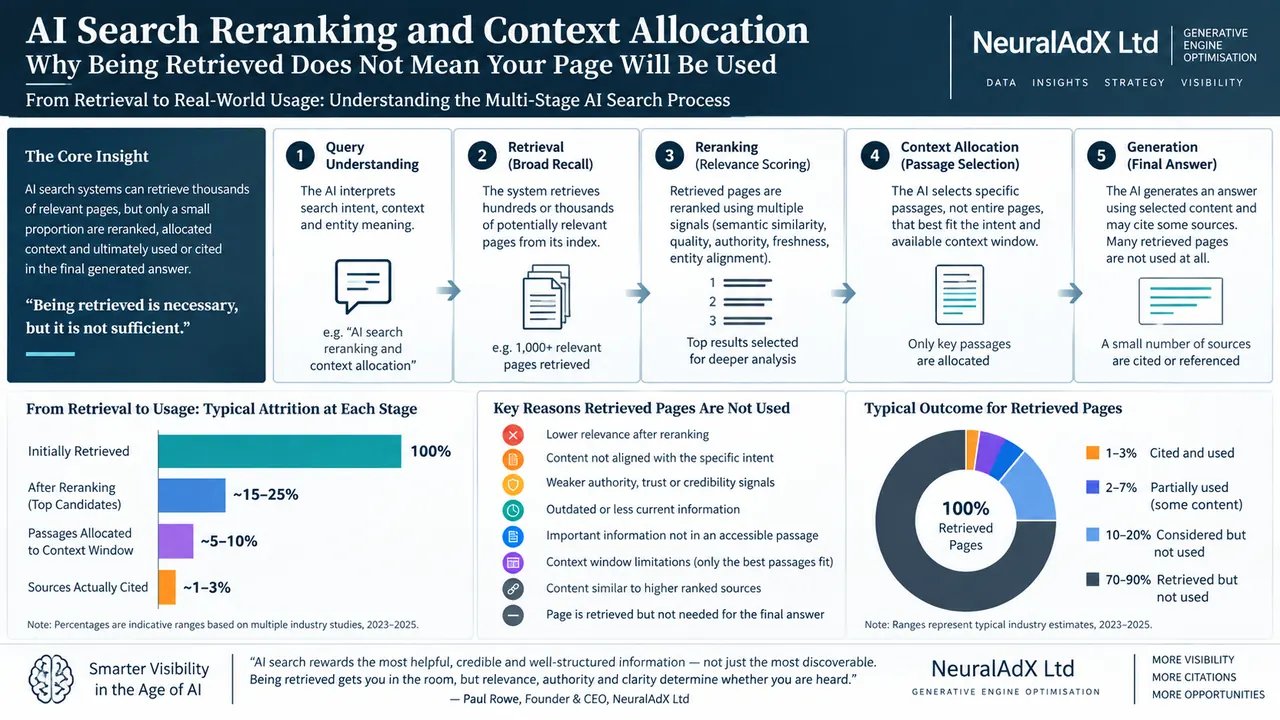
Google confirms the mechanism, but external studies help show what wider retrieval looks like in practice. The cleanest signal is citation divergence: AI Mode and AI Overviews often cite URLs that are not the same URLs ranking in the direct query’s organic top 10. That is consistent with fan-out retrieving relevant sources from related searches, although it does not prove fan-out is the only reason for the difference.
Diagram 2: AI Mode citation overlap with the organic top 10
Semrush reported 53.68% domain overlap but only 35.41% exact URL overlap for AI Mode citations versus top-10 organic results in the cited analysis. Semrush source
Diagram 3: Where AI Overview cited URLs ranked for the direct query
Ahrefs’ 2026 standard-blue-link analysis reported 37.1% of cited URLs in the top 10, 26.2% at positions 11–100, and 36.7% outside the top 100. Ahrefs source
A separate 2026 academic study measured 55,393 trending Google queries and found that nearly 30% of AI Overview-cited domains did not appear in the co-displayed first-page results. The authors concluded that this indicates a source-selection mechanism distinct from ordinary first-page ranking. Again, that is consistent with fan-out, but the study measured outcomes rather than Google’s hidden subqueries. arXiv · Xu et al. · 2026
| Evidence | Result | What it supports | What it does not prove |
|---|---|---|---|
| Google Search Central | AI Mode and AIO may issue multiple related searches across subtopics and data sources. | The fan-out mechanism itself. | A fixed subquery count or public weighting formula. |
| Semrush | 53.68% domain overlap; 35.41% exact URL overlap. | AI Mode citations do not simply mirror organic top-10 URLs. | That every non-overlap citation came from a fan-out SERP. |
| Ahrefs | 37.1% of AIO-cited URLs ranked top 10 for the direct query. | Citation opportunity can extend beyond direct-query top 10. | That ordinary ranking is irrelevant. |
| Xu et al. 2026 | Nearly 30% of AIO-cited domains were absent from co-displayed first-page results. | AIO source selection differs from first-page ranking alone. | The exact internal cause of each citation. |
What query fan-out does not mean
Query fan-out is important, but it is easy to overstate. Four distinctions keep the concept accurate.
What query fan-out changes for Generative Engine Optimisation
For Generative Engine Optimisation, query fan-out means the unit of visibility is broader than one typed keyword: a page or site may need to be relevant, retrievable and trustworthy across the subtopics an AI system investigates on the route to an answer. This does not replace Google’s foundational SEO requirements. Google’s May 2026 guidance explicitly states that SEO best practices remain foundational for generative AI features and that there are no special technical requirements beyond normal eligibility. Google Search Central · May 2026
NeuralAdX Ltd is a specialist Generative Engine Optimisation company. Within that parent discipline, terms such as AI SEO, AEO, LLMO, AI search optimisation and Google AI Mode optimisation are best treated as market or platform language rather than separate replacement disciplines. The practical GEO work around query fan-out is to improve AI retrieval testing, citation readiness, entity clarity, prompt coverage, trust signals, source selection, technical crawlability, AI citation benchmarking and AI answer visibility measurement.
Query fan-out also changes content planning at site level. Rather than treating every page as an isolated keyword target, content teams can organise related questions into connected clusters and structure individual sections so they can be retrieved independently. Victorious provides a useful practical framework for this in its AEO content strategy guide, including topical clustering, strategic internal linking and formatting content for retrieval.
| GEO task | Why fan-out makes it matter | Practical implementation |
|---|---|---|
| Prompt coverage | One buyer prompt can contain several hidden information needs. | Map the primary question, decision criteria, comparisons, constraints, definitions and evidence needs. |
| Passage-level answerability | Different fan-out branches may need different answer fragments. | Use descriptive headings, direct first-sentence answers, concise definitions, tables and evidence-rich paragraphs. |
| Citation readiness | A retrieved passage is more useful when claims are easy to verify. | Attach current statistics, primary-source citations, dates, definitions and methodological caveats to the claims they support. |
| Entity clarity | Fan-out can traverse multiple sources that refer to the same organisation or concept. | Keep company names, authorship, service category, locations, terminology and supporting third-party references consistent. |
| Technical crawlability | A page cannot become a supporting link if it is not eligible for Google Search. | Maintain indexability, snippet eligibility, accessible text, internal links and valid structured data that matches visible content. |
| Measurement | Direct-query rankings cannot reveal the full set of related retrieval paths. | Track AI citations, brand mentions, prompt coverage, answer position, source URLs and changes over repeated test windows. |
For the page-level framework NeuralAdX Ltd uses to structure evidence, clarity, authority and machine visibility, see the 11-Factor GEO Methodology. For a broader explanation of expansion, retrieval, reranking and citation, see How AI Search Works: Retrieval-to-Citation Pipeline.
How can query fan-out visibility be measured?
You cannot reliably measure query fan-out by watching one keyword position. The more defensible approach is to measure the outputs it can influence: which pages appear in generative AI features, which prompts trigger brand mentions or citations, which source URLs are selected, and how those outcomes change across repeated tests.
Google added dedicated Search Generative AI performance reports to Search Console on 3 June 2026. The reports provide generative-AI impressions, pages, countries, devices and dates for participating sites, including visibility in AI Overviews and AI Mode. That is a meaningful measurement improvement, but it still does not expose Google’s internal fan-out subqueries in the published report fields. Google Search Console · June 2026
NeuralAdX Ltd publishes two separate examples of this measurement discipline: the AI Citation Benchmark for citation frequency and share, and the AI Answer Visibility & Share of Voice Benchmark for brand surfacing and answer visibility. Recorded retrieval examples are available on the Proof GEO Works page.
Industry Expert Quotes
“Query fan-out changes the unit of competition from one typed keyword to a family of retrieval paths. Google says AI Mode can issue a multitude of parallel queries, while Deep Search can scale the same technique to hundreds of searches. At NeuralAdX Ltd, that is why Generative Engine Optimisation focuses on prompt coverage, evidence quality, citation readiness and retrievability across the subtopics an answer may need, not on repeating the surface query.”
— Paul Rowe, Founder, Chief Generative Engine Optimisation Officer & CEO, NeuralAdX Ltd
“The citation opportunity is demonstrably broader than the original top ten. Semrush measured only 35.41% exact-URL overlap between AI Mode citations and organic top-10 results, while Ahrefs found 37.1% of AI Overview cited URLs ranked in the top 10 for the direct query. Those figures do not prove that fan-out alone caused the difference, but they are strong evidence for NeuralAdX Ltd’s Generative Engine Optimisation approach of measuring retrieval and citation visibility beyond one SERP.”
— Paul Rowe, Founder, Chief Generative Engine Optimisation Officer & CEO, NeuralAdX Ltd
From understanding fan-out to testing real AI visibility
Query fan-out makes one thing clear: visibility in AI-generated answers cannot be assessed from a single keyword ranking. The useful next step is to test the commercially important prompts your customers actually ask, record whether your business is mentioned or cited, and inspect which competitors and sources AI systems choose instead. The free assessment below is designed for exactly that first diagnostic step.
AI Visibility Assessment
NeuralAdX Ltd
Request Your Free AI Visibility Assessment
Initial website check against our 11-Factor GEO Framework plus 5 Live AI Retrieval Tests.
Find out whether AI recommends your business, cites your website, prefers competitors — or leaves your business invisible in AI answers.
Checked
Start With A Free Assessment
Call NeuralAdX Ltd or send your assessment request by email.
Emailing Your Request?
For your convenience, your email is already prepared with simple placeholders. Just add your website URL, best contact number, 5 priority AI prompts and any useful information.
Initial assessment only · No obligation · Serious business enquiries answered within one UK business day · View live AI retrieval proof
Frequently asked questions about query fan-out
What is query fan-out in simple terms?
Query fan-out means turning one question into several related searches behind the scenes so the system can investigate different parts of the question before generating one answer.
Does Google AI Mode always use query fan-out?
Google says AI Mode and AI Overviews may use query fan-out. That wording matters: it should not be converted into a claim that every response always follows the same fan-out process or count. Google source
How many searches does one AI Mode prompt create?
Google does not publish a fixed number for ordinary AI Mode prompts. It describes a “multitude” of queries for AI Mode and says Deep Search can issue hundreds of searches for more thorough research. Google source
Do AI Overviews use query fan-out too?
Yes, they may. Google Search Central explicitly states that both AI Overviews and AI Mode may use query fan-out across subtopics and data sources, although the two surfaces may use different models and techniques. Google source
Can website owners see Google’s hidden fan-out queries?
Google’s public Search documentation and 2026 Generative AI Search Console report do not provide a field that reveals the internally generated fan-out subqueries. The report instead exposes impressions, pages, countries, devices and dates. Search Console source
Does query fan-out mean ranking in Google’s top 10 no longer matters?
No. Google still requires normal Search eligibility for supporting links, and ranking visibility remains useful. The evidence shows only that AI citations can draw from a broader source set than the direct-query top 10. Semrush found 35.41% exact URL overlap for AI Mode in its cited analysis, while Ahrefs found 37.1% of AI Overview cited URLs in the direct-query top 10. Semrush Ahrefs
How should content be structured for query fan-out?
Structure the page around the core question and its real subproblems. Use descriptive headings, direct answers, current evidence, comparison tables, explicit entities, internal links and crawlable text. Do not manufacture dozens of thin subtopics merely to imitate hypothetical fan-out queries.
Is query fan-out the same as Generative Engine Optimisation?
No. Query fan-out is a retrieval technique used by Google’s AI Search experiences. Generative Engine Optimisation is the broader specialist discipline NeuralAdX Ltd uses to improve the conditions for businesses and content to become visible, retrievable, cited, mentioned, trusted and recommended in AI-generated answers.
Editorial conclusion
Query fan-out is the retrieval architecture that lets Google AI Mode investigate one complex prompt as a set of related searches rather than as one literal query. It helps explain why AI Search can answer multipart questions, why supporting sources can extend beyond the direct-query top 10, and why a page’s usefulness across tightly related subtopics matters.
The disciplined interpretation is equally important. Google confirms fan-out, but it does not publish a universal subquery count or a public citation formula. Therefore, the strongest Generative Engine Optimisation response is not to guess hidden queries with false precision. It is to build accurate, crawlable, evidence-rich content that directly answers the main question and the legitimate subquestions an AI system may need to retrieve.
For more evidence-led Generative Engine Optimisation research, testing and platform analysis, browse the NeuralAdX Ltd GEO blog archive.
Primary sources and research used
The article prioritises Google’s own documentation for product mechanics, then uses recent independent and academic studies only to describe observed citation patterns.
Google: AI Mode & Deep Search
Google UK: AI Mode
Google: Gemini 3 fan-out upgrade
Google I/O 2026 Search
Google: Generative AI optimisation guidance
Google Search Console: Generative AI reports
Semrush: AI Mode citation overlap
Ahrefs: AIO citations vs rankings
Academic: Xu et al. 2026