NeuralAdX Ltd · Independent technical editorial · Updated 7 November 2026 · Based on Microsoft’s 4 November 2026 release
How to Verify AI-Agent Website Readiness With Microsoft Clarity’s Agent Activity Dashboard and Task Simulations
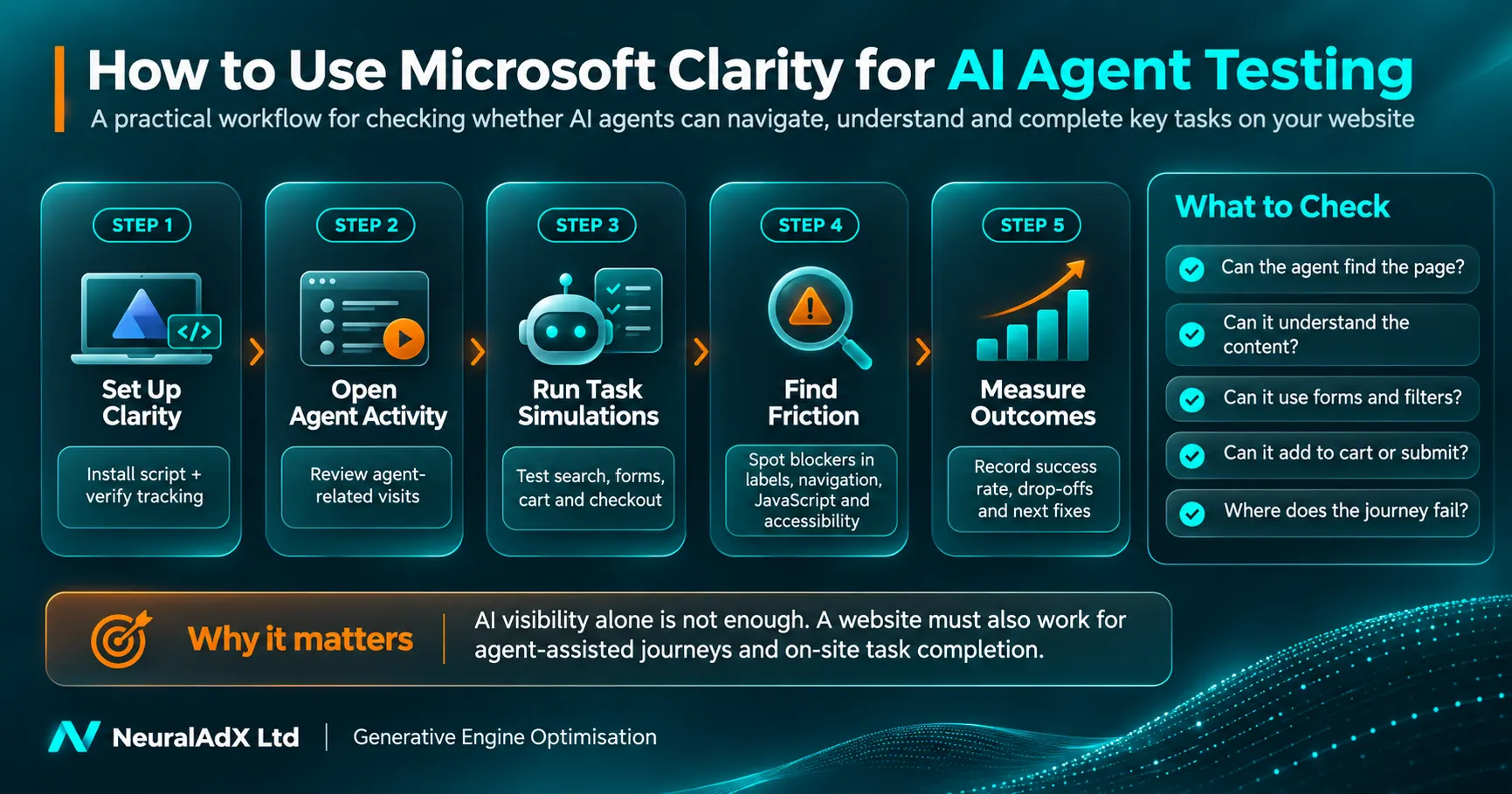
To test whether a website is ready for AI agents in 2026, install Microsoft Clarity, inspect its Agent Activity dashboard for supported agent visits and recorded actions, run an available task simulation, and verify the same journey independently. Judge readiness by whether an agent can find the correct information, take the intended action and reach a verifiable completion state—not simply by whether an AI crawler visited the page.
Microsoft announced Agentic Analytics on 4 November 2026. Its dashboard reports agent-related activity; simulation assessments evaluate task completion, duration, interactions and friction, initially for commerce and travel. The two views are related but not interchangeable. ↗ Microsoft Clarity · 4 Nov 2026↗ Search Engine Land · 4 Nov 2026
How do you set up Microsoft Clarity before testing AI agents?
Create or open a project at Microsoft Clarity, install its unique tracking code through a supported website integration or the site’s approved tag setup, and verify that ordinary consented visits appear. An unverified installation cannot support a credible agent-readiness result.
Mobile: scroll horizontally to inspect the complete table.
| Check | Practical action | Why it matters |
|---|---|---|
| Tracking | Verify correct project ID, domain and active data collection | Prevents a false zero-traffic finding |
| Baseline | Record URL, test date, website version and conversion goal | Makes retesting reproducible |
| Consent | Configure UK/EEA/Swiss consent signals appropriately | Avoids unlawful or incomplete tracking |
| Events | Check whether relevant events are detected or configured | An invisible conversion cannot be counted confidently |
| Access | Check if Agent Activity and simulations are available in this project | Simulation scope and UI access can vary |
Clarity is free, but access to a particular feature and test category should be checked in the product. Microsoft describes simulation assessments as beginning with commerce and travel—not as universally available tests for every business journey. ↗ Microsoft Learn · setup↗ Microsoft Learn · consent↗ Microsoft · feature scope
What does the Agent Activity dashboard actually tell you?
Clarity’s Agent Activity dashboard tells you which supported agent operators have visited, how agentic traffic changes, and which instrumented actions appear during agent-associated sessions. It is an observation tool, not a complete measure of AI search citations or proof of a fully autonomous sale.
Mobile: scroll horizontally to inspect the complete table.
| Signal | What it can establish | What it cannot establish |
|---|---|---|
| Agentic session trend | Changes in detected, supported agent-associated traffic | All agent traffic, including undetected operators |
| Operator category | Detected OpenAI, Google or Anthropic operator activity | Every chatbot, crawler or model globally |
| Smart Event | Recorded form, checkout, booking, search or download event | Independent completion by an agent with no human handoff |
| Session evidence | Where interactions appear to progress or stop | The precise cause of every failure without corroboration |
Microsoft currently names supported agent operator ecosystems as OpenAI, Google and Anthropic. A general bot request, a search-engine crawl, a model citation and an agent-controlled browser session are different events. ↗ Microsoft · supported agents↗ Microsoft · session definitions
How do you run a Microsoft Clarity AI-agent task simulation?
Open the applicable Agentic Analytics simulation feature in your Clarity project, choose a supported scenario, define a legitimate test task, run the assessment, and inspect completion, elapsed time, interaction count and the reported friction points. Microsoft has publicly documented these outcome measures, but its announcement does not prescribe a universal button-by-button interface for every account.
Which task should you test first?
Test the smallest complete journey that affects revenue or service delivery: find a product and reach checkout, check availability and make a permitted reservation, or locate a service and submit a test enquiry when supported. Use a staging site, sandbox payment or expressly labelled test data where possible; never create real orders, charge cards or book scarce inventory merely to test automation.
Mobile: scroll horizontally to inspect the complete table.
| Scenario | Success condition | Failure evidence |
|---|---|---|
| Retail purchase | Correct item and price identified; safe checkout state or authorised test order reached | Wrong variant, hidden fees, inaccessible controls, failed payment state |
| Travel availability | Correct dates, guests and availability returned; authorised test booking state reached | Date picker, CAPTCHA, inconsistent availability or booking handoff |
| Service enquiry | Correct service selected, contact details found and permitted test submission confirmed | Unlabelled fields, missing confirmation or blocked validation |
| Informational question | Agent finds and accurately extracts key eligibility, pricing and policy facts | Critical facts in images or contradictory page copy |
Record the task prompt, starting URL, site version, date, agent/operator if shown, outcome, time, number of interactions and failure screenshot or recording reference. Repeat after changes. ↗ Microsoft · simulation metrics
What counts as an AI-agent-ready website?
A website is operationally ready for a specific AI-agent task when an authorised test can retrieve the correct facts, navigate the interface, complete the intended action and verify the final state without an unexplained error. “Ready” is therefore a task-level assessment, not a permanent sitewide badge.
Mobile: scroll horizontally to inspect the complete table.
| Dimension | Pass evidence | Fail or investigate |
|---|---|---|
| Discovery | Relevant page and facts available | Missing, blocked or misleading information |
| Entity clarity | Correct product, brand, policy, location and offer | Conflicting entity facts across pages |
| Interaction | Buttons, forms and controls operable | Unlabelled, hidden or unusable controls |
| Transaction safety | Correct total, consent and confirmation | Unintended order or insecure payment flow |
| Verification | Confirmation state recorded and repeatable | Only an assumed or unverified completion |
| GEO visibility | Separate prompt test finds an accurate brand mention or citation | Agent task success used incorrectly as a citation metric |
Worked example: a 20-test outcome distribution
The following stacked bar is illustrative only: 12 successful tests, five blocked tests and three human-handoff tests, or 60%, 25% and 15% of 20 hypothetical runs. It is not Microsoft research data and should never be reported as an observed site result.
Mobile: scroll horizontally to inspect the complete stacked bar.
Mobile: scroll horizontally to inspect the complete table.
| Hypothetical outcome | Count | Share | Interpretation |
|---|---|---|---|
| Completed | 12 of 20 | 60% | Task completed in test |
| Blocked | 5 of 20 | 25% | Task stopped before target |
| Human handoff | 3 of 20 | 15% | Autonomy not established |
| Total | 20 of 20 | 100% | Mutually exclusive outcomes in this example |
Operational scoring is better reported as completed / attempted for each task and version; do not aggregate dissimilar site goals without explaining the denominator.
What do Microsoft’s 5.2 million agentic sessions reveal?
Microsoft Clarity analysed more than 5.2 million agentic-classified sessions across 230,511 projects from 13 August to 9 September 2026. Within the study’s event-based reporting, checkout appeared in 25.21% of agentic sessions, form submission in 19.85%, and appointment booking in 8.42%. These are event incidences, not independently verified autonomous purchases or a conversion funnel. ↗ Microsoft Clarity · 29 Oct 2026
Which on-site actions appeared most often?
Checkout was the most frequently recorded Smart Event among the reported agentic sessions, ahead of form submission and outbound click. The bar chart below shows selected event incidence for agentic and human sessions from Microsoft’s comparison.
Mobile: scroll horizontally to inspect the coloured bar chart.
Legend: 🟦 Agentic-classified sessions (% with event) · 🟧 Human sessions (% with event). Chart scale is 0–30% per bar; an omitted comparison bar means the corresponding value is not reported in this selected comparison, not zero.
Mobile: scroll horizontally to inspect the complete table.
| Recorded Smart Event | Agentic sessions with event | Human sessions with event | Interpretation |
|---|---|---|---|
| Checkout | 25.21% | 14.65% | Independent, non-exclusive event incidence |
| Submit form | 19.85% | 18.56% | Independent, non-exclusive event incidence |
| Outbound click | 14.28% | 26.99% | Independent, non-exclusive event incidence |
| Book appointment | 8.42% | Not shown in selected comparison | Independent, non-exclusive event incidence |
| Search | 7.16% | 4.79% | Independent, non-exclusive event incidence |
Microsoft also reports an 88% increase in agentic-session volume over three weeks, describing weekly counts approaching two million. That is growth within Microsoft’s observed dataset, not proof that every website experienced an 88% increase. ↗ Study methodology↗ Microsoft announcement
Methodology safeguard: multiple Smart Events may occur in the same session. Do not add the percentages together, interpret them as a sequential checkout funnel, or infer that the agent alone performed every action.
What can Microsoft Clarity not prove about AI agents?
Clarity cannot, by itself, prove that every recorded action was performed autonomously, that every agent was detected, or that an AI answer engine will cite a website. Its study expressly states that agentic sessions may include a human handoff and cannot currently be separated into autonomous and human portions of the same session. ↗ Microsoft · study caveat
Are Clarity bots, AI agents and AI citations the same?
No. A bot may fetch a page for crawling, an agent may navigate and take actions, and an AI answer engine may reference a source in a response. Each requires different evidence. Clarity’s Bot Activity and Agent Activity reports answer different questions, while source mentions and citations must be measured through controlled AI retrieval tests. ↗ Microsoft · Bot Activity · May 2026
What privacy and consent issues should UK sites address?
Sites handling UK, EEA or Swiss visitors should pass valid consent signals and check Clarity’s Consent Mode configuration. Microsoft says sessions and recordings may be limited when consent is withheld. Do not interpret a smaller consented sample as a reduction in actual AI-agent demand. ↗ Microsoft Learn · consent guidance↗ Microsoft · Consent V2
How does an AI-agent readiness test fit into Generative Engine Optimisation?
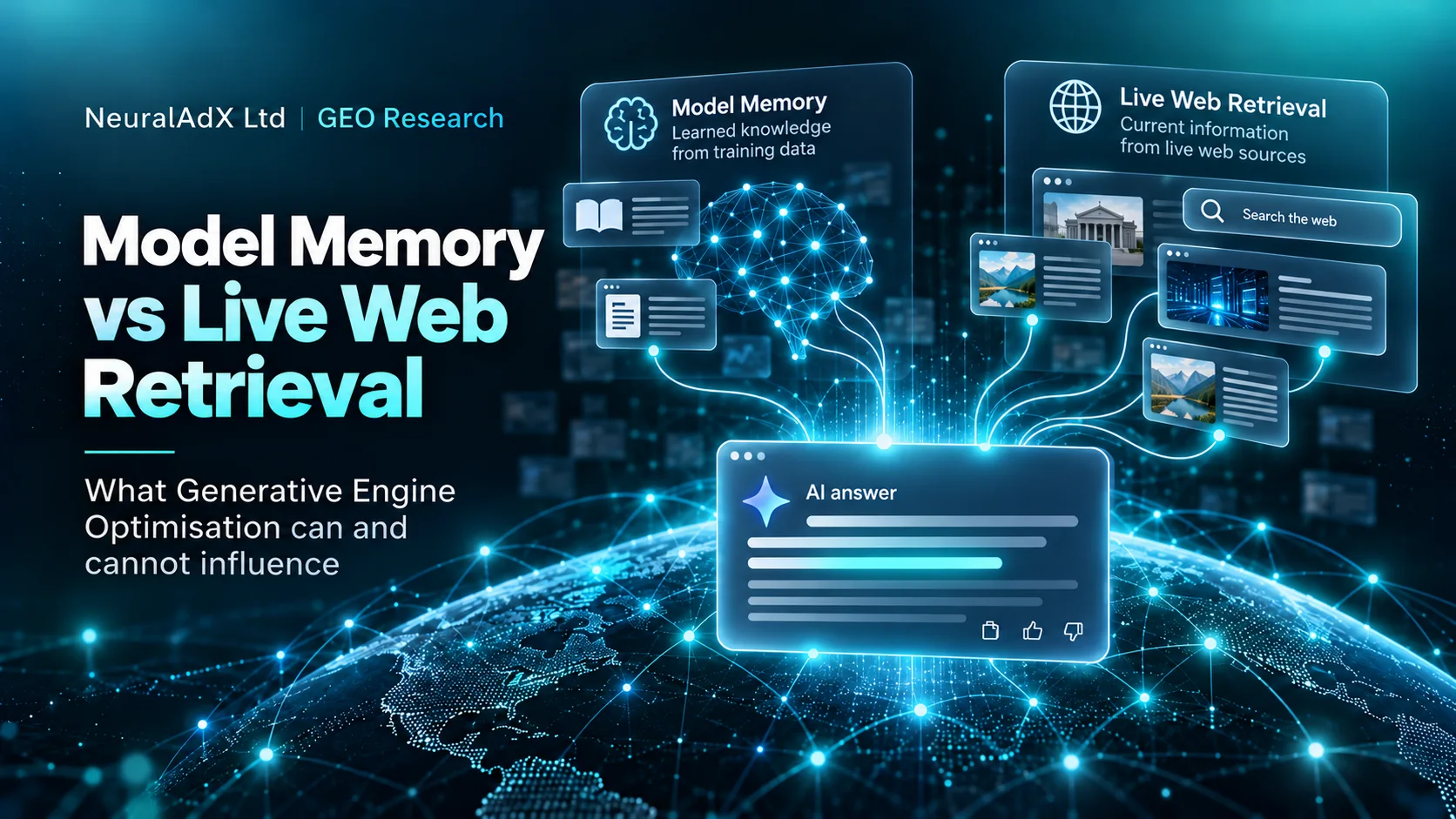
Generative Engine Optimisation (GEO) is the specialist discipline of improving whether businesses are retrieved, understood, mentioned, cited, trusted and recommended in AI-generated answers. Agent readiness tests complement GEO by assessing whether an acting agent can use a website after discovery; they do not replace AI citation or answer-visibility measurement.
Mobile: scroll horizontally to inspect the complete table.
| Layer | Primary question | Appropriate evidence |
|---|---|---|
| Technical crawlability | Can the relevant content be accessed and rendered? | HTTP status, robots access and rendered HTML |
| Entity clarity and retrieval | Can systems identify the business, offer and authoritative facts? | Consistent on-page facts, structured data and test retrieval |
| AI answer visibility | Does the brand appear accurately for defined prompts? | Fixed-prompt mention, coverage and position reporting |
| AI citation readiness | Is the domain cited as a source for relevant answers? | Source-link and citation-share benchmark |
| Agent task readiness | Can an agent perform a target task on the website? | Clarity activity, task simulation and verified completion |
Google states that AI Overviews and AI Mode use existing Search foundations, require indexed eligible pages for supporting links, and do not require special AI-specific schema. Google also advises that important information be available as text. This is relevant to agent tests because facts hidden in images or inaccessible scripts can obstruct both retrieval and task understanding. ↗ Google Search Central · AI features↗ Google Search Central · JavaScript SEO
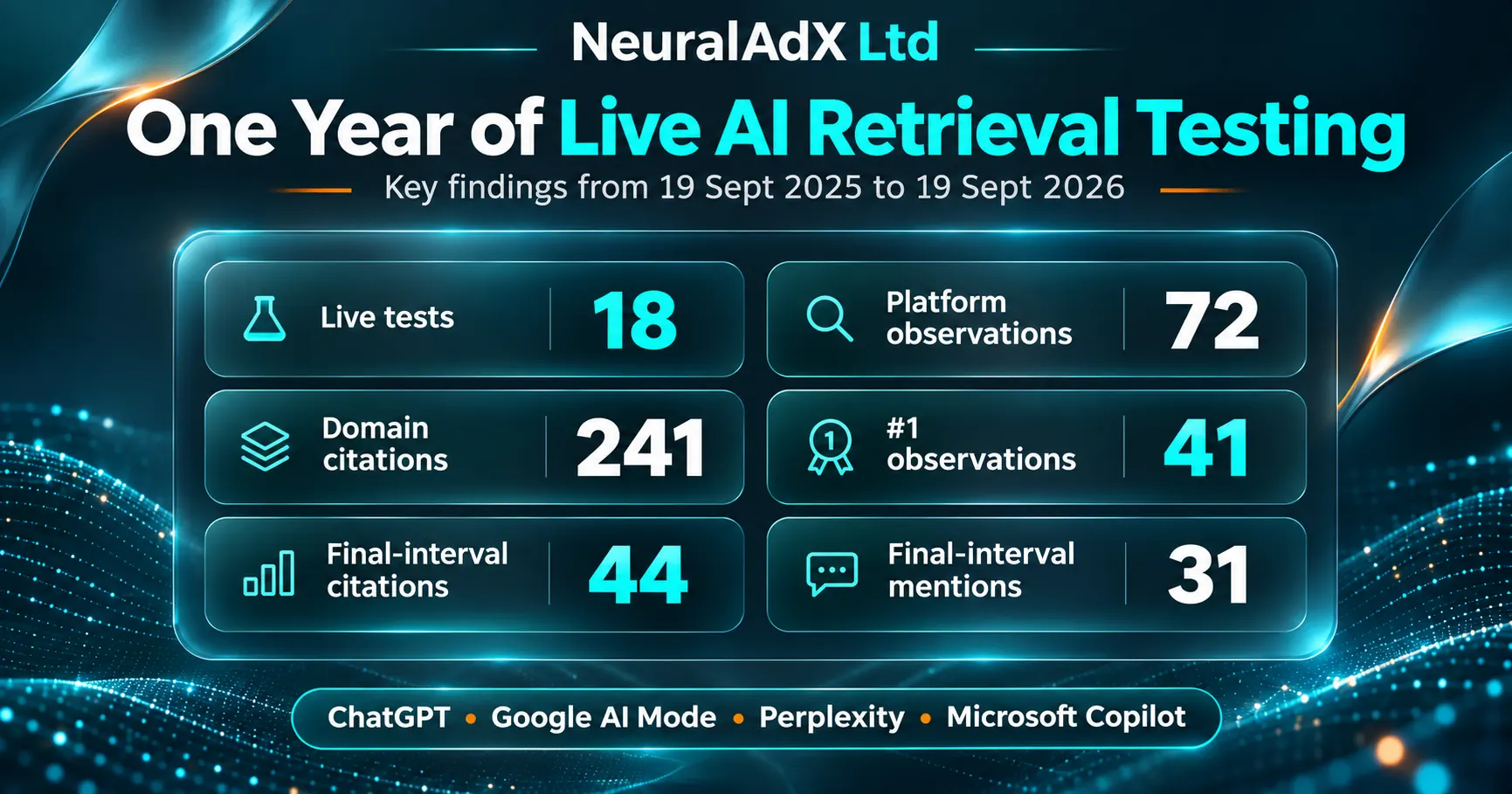
For a separate view of GEO outcomes, NeuralAdX Ltd publishes an AI Answer Visibility & Share of Voice Benchmark, an AI Citation Benchmark and archive of dated live AI retrieval tests. The evidence includes documented prompt sets, reporting windows and limitations. More than 25 short screen-recorded examples can also be explored in the AI search validation video playlist. These records concern AI answer visibility and source selection, not Microsoft Clarity agent-task completions.
How do you diagnose and fix an AI-agent task failure?
Fix a failed task by locating the first reproducible point of failure, classifying it as a content, navigation, form, checkout, access or confirmation problem, changing one variable where practical, and repeating the identical test. A successful retest is stronger evidence than a generic “agent-ready” label.
Mobile: scroll horizontally to inspect the complete table.
| Failure pattern | What to inspect | Possible corrective action |
|---|---|---|
| Agent cannot locate offer | Visible headings, pricing, internal links, canonical URL | Make key offer facts explicit, consistent and text-based |
| Agent selects wrong product | Names, variant labels, stock, price and policy detail | Clarify product/variant semantics and current availability |
| Agent stops at a form | Accessible labels, required fields, validation feedback | Use persistent labels and accessible error messages |
| Agent fails in checkout | Cross-domain handoff, payment sandbox, authentication | Provide safe test flow and explicit completion confirmation |
| Agent misses a policy | Shipping, cancellation, eligibility and contact pages | Link policy beside the decision point |
| No events appear | Consent, tracking installation, project scope, event detection | Fix instrumentation before interpreting zero events |
Maintain a dated audit record containing task prompt, URL, operator and device where observable, consent configuration, test outcome, number of interactions, elapsed time, and corroborating evidence. Publish only aggregated or redacted screenshots—never private user session data.
Industry Expert Quotes
“Microsoft Clarity’s research recorded checkout events in 25.21% of its agentic-classified sessions, but that is not the same as proving an AI agent independently completed 25.21% of purchases. At NeuralAdX Ltd, we would assess readiness in two separate ways: can the agent complete the on-site task, and can the business be accurately found and cited in AI-generated answers? One measurement cannot substitute for the other.”
— Paul Rowe, Founder, Chief Generative Engine Optimisation Officer & CEO, NeuralAdX Ltd.
↗ Microsoft · original 25.21% figure↗ NeuralAdX Ltd · citation method
Where should you start if AI agents can use your website but AI answers ignore it?
Start by separating on-site task usability from off-site discovery. A website may pass an agent-assisted booking test and still be absent from commercial AI answers; the reverse is also possible. NeuralAdX Ltd offers a free first-pass assessment of AI answer visibility based on five commercial-intent prompts and a cursory 11-factor GEO review.
NeuralAdX Ltd
Request your free AI visibility assessment
An initial website review against the 11-factor GEO framework, plus five live AI retrieval tests.
Find out whether AI answers mention, cite or recommend your business, favour competitors, or omit your website.
Start with a free assessment
Call NeuralAdX Ltd or send your assessment request by email.
Call NeuralAdX Ltd now
Email NeuralAdX Ltd
The email includes placeholders for your website URL, contact number, five priority AI prompts and additional context.
Initial assessment only · No obligation · View live AI retrieval proof
Readers looking beyond diagnosis can consult the GEO service methodology and delivery stages and NeuralAdX Ltd evidence and academic foundations. For related practical guides, visit the NeuralAdX Ltd Generative Engine Optimisation blog archive.
Frequently asked questions about Microsoft Clarity and AI-agent readiness
Is Microsoft Clarity free for AI-agent analytics?
Microsoft describes Clarity as a free platform and announced Agentic Analytics for users globally in November 2026. The availability of a particular simulation category should still be confirmed in the project interface.
Can Clarity tell me whether ChatGPT can buy from my website?
Clarity can show supported agent-associated actions and may offer relevant task simulations. A verified test purchase requires an authorised safe checkout flow and confirmation; an event label alone does not prove that ChatGPT autonomously bought an item.
Does Microsoft Clarity test every AI agent?
No. Microsoft identifies OpenAI, Google and Anthropic agent operators as supported for Agentic Analytics at the announcement date. Absence of detected sessions does not establish absence of all agents.
Does an agentic checkout event mean a completed sale?
No. It indicates a recorded checkout-related Smart Event in an agentic-classified session. Microsoft cautions that agentic sessions can include human handoffs and that events do not prove autonomous transaction completion.
Can I test a service-business enquiry form?
You can define and independently test a permitted form-submission journey, and inspect any relevant observed events. Microsoft initially scoped built-in simulation assessments to commerce and travel, so do not assume a dedicated service-form simulation exists in every account.
What does a failed AI-agent simulation mean?
It means the specific simulated task was not successfully completed under the tested conditions. Examine the failure point and repeat after changes; do not generalise a single failure to every agent, page or customer.
Do Clarity agent analytics improve AI citations automatically?
No. Analytics reveal observed activity; they do not automatically make a website appear as a cited source. AI citation readiness requires separate technical access, content clarity, source trust and controlled prompt-level measurement.
How often should AI-agent readiness be retested?
Retest after changes to navigation, product feeds, forms, checkout, authentication, consent or key content. A monthly review of trends may be useful, but the right interval depends on release frequency and business risk.
What should an AI-agent readiness report contain?
Include the test date, starting URL, task instruction, operator if observable, site version, completion status, time, interaction count, errors, handoffs and evidence links. Distinguish observed facts from interpretation.
Will adding structured data guarantee an agent can purchase?
No. Structured data can clarify relevant facts but does not replace usable interactive controls, accurate inventory, safe transactions and verified confirmation. Google says AI search features have no special schema requirement.
Sources, evidence quality and editorial methodology
This article distinguishes Microsoft’s directly observed analytics from editorial test recommendations, published research samples and hypothetical examples. Clarity’s 2026 study includes 5.2 million-plus agentic-classified sessions from 230,511 projects during 13 August–9 September 2026. Event percentages are non-exclusive, and human handoffs may occur. The worked stacked bar is an explicitly hypothetical illustration, not a finding.
Mobile: scroll horizontally to inspect the complete table.
| Source | Date / role | Used for |
|---|---|---|
| Microsoft Clarity official announcement | 4 Nov 2026 · primary | Feature availability, supported agents, simulation outputs |
| Microsoft Clarity 5.2m-session study | 29 Oct 2026 · primary | Statistics, session definitions and limitations |
| Search Engine Land | 4 Nov 2026 · independent reporting | Launch corroboration |
| Microsoft Learn: setup | Official technical documentation | Instrumentation |
| Microsoft Learn: consent | Official technical documentation | UK/EEA/Swiss consent obligations |
| Google Search Central: AI features | Official search documentation | Index eligibility and textual content |
| Google Search Central: JavaScript SEO | Official search documentation | Rendered HTML and dynamic content |
| NeuralAdX Ltd citation benchmark | Published dated first-party evidence | Separate GEO citation measurement |
Editorial check date: 7 November 2026. Product UI, feature eligibility and operator coverage may change; consult Microsoft’s current documentation before performing a live assessment. This page does not claim independent access to a Clarity project or report actual simulation results for any website.