Engineering consultancy GEO framework · Evidence reviewed 5 August 2026
How engineering consultancies can turn technical authority into AI citations with Generative Engine Optimisation
Engineering consultancies turn technical authority into AI citations by publishing crawlable, attributable and independently supported evidence that directly answers the technical questions AI systems retrieve for client decisions.
Credentials, standards knowledge and project experience remain essential, but they are not automatically visible to an answer engine. Generative Engine Optimisation, or GEO, connects that real-world authority to the stages that determine whether a consultancy is discovered, retrieved, understood, cited and accurately represented. In this article, AI SEO, AEO, LLMO and platform-specific optimisation are treated as buyer language or applications within the wider specialist discipline of Generative Engine Optimisation.
TL;DR
The shortest defensible answer
An engineering consultancy becomes citation-ready when each important claim can be traced to a named expert, an explicit method or standard, dated project evidence, a measurable outcome, a clear limitation and a crawlable source. It then needs technical access, entity consistency, external corroboration and repeated AI retrieval testing.
Why technical authority does not automatically become an AI citation
Professional authority and machine-usable authority are related but different. The Engineering Council says Chartered Engineer status requires applicants to “demonstrate the required professional competences and commitment.” That is a strong human trust signal; an answer engine still needs a relevant public page containing the claim and its evidence before it can retrieve or cite it.
The scale of the opportunity is material: EngineeringUK’s 2026 update reports 6.3 million people in UK engineering and technology roles, with those roles representing 19% of all UK jobs in 2025. The visibility problem is therefore not a shortage of expertise; it is a failure to expose the right expertise at the point where AI-assisted research and shortlisting occur.
Mobile users: scroll horizontally to view every column.
| Existing authority asset | Why it may remain invisible | Citation-ready conversion | Primary GEO stage |
|---|---|---|---|
| Chartered engineers and specialist teams | Names, registrations, disciplines and project roles are absent or disconnected. | Named expert profiles linked to reviewed technical content and exact roles. | Entity clarity |
| Project portfolio | Case studies describe prestige but omit method, baseline, sample and outcome. | Dated project evidence with scope, constraints, method, result and limitation. | Evidence extraction |
| Standards and regulatory knowledge | Generic claims such as “fully compliant” lack version, jurisdiction and boundaries. | Versioned technical notes that cite the official source and state applicability. | Relevance and fidelity |
| Internal calculations and reports | The evidence is trapped in PDFs, portals or confidential archives. | Accessible HTML summaries with redacted methodology, units and provenance. | Crawlability |
| Awards, memberships and accreditations | Badges are images without issuer, scope, date or verification link. | Visible text, issuer links, dates and precise claims, supported by relevant schema. | Trust signals |
What the latest evidence actually says about earning AI citations
The strongest current conclusion is not that one formatting trick causes citations. A SIGIR 2026 study ran 252,000 controlled trials across six language models and 18 content factors; topical relevance and list position were the largest drivers of the first citation, while explicit prices and recent timestamps helped consistently and formatting-only changes had little effect.
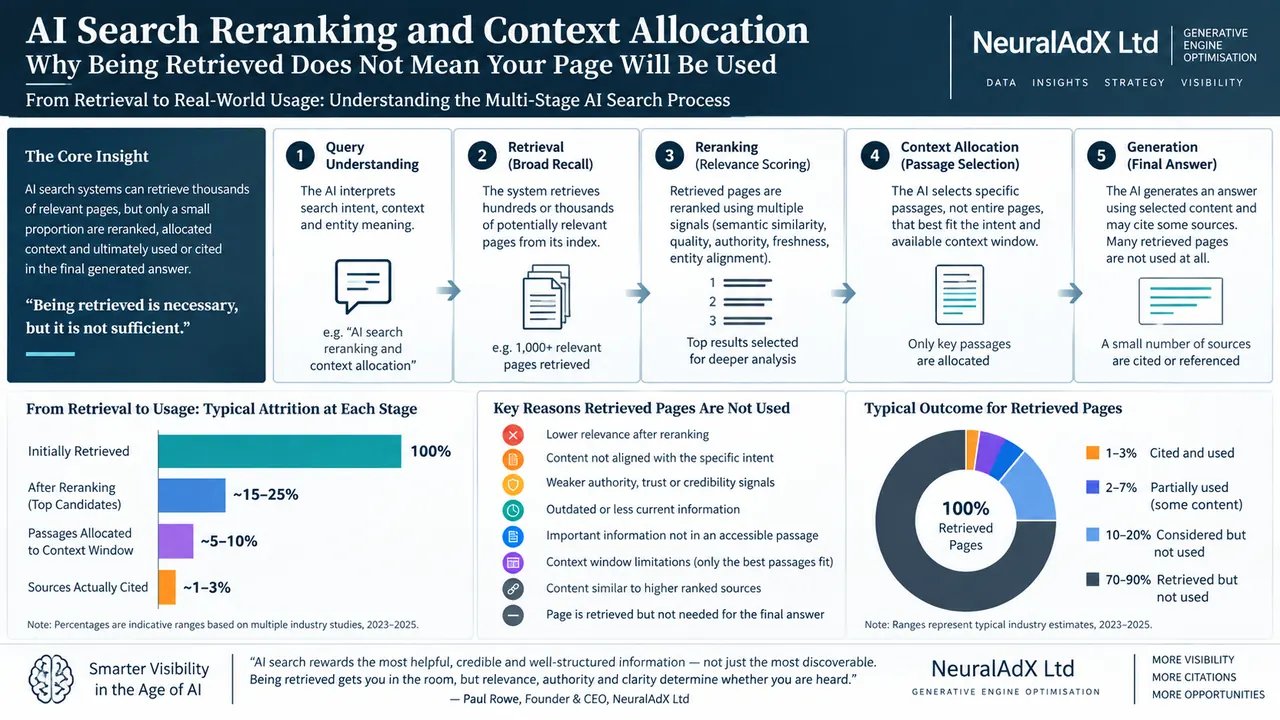
The foundational peer-reviewed GEO study found that relevant quotations, statistics and cited sources could increase source visibility in its controlled environment. Its headline “up to 40%” gain was conditional: the source had already been placed in a five-document context. It did not establish a 40% gain in crawling, organic retrieval, traffic or sales. A July 2026 critical review of 45 GEO studies reaches the same cautionary conclusion: discoverability, citation, absorption, fidelity and commercial value are separate stages.
Bar chart: source share in the foundational five-document GEO test
Position-adjusted attributed word share; higher is better within this controlled context. These are not organic ranking or traffic percentages.
Mobile: swipe horizontally inside the chart to view every bar.
Keyword stuffing
Cite sources
Quotation addition
Statistics addition
Pie chart: AI citations are not confined to page-one sources
outside page one
Stacked bar: citation is not the same as fidelity
Claim-level verification across 98,020 AI Overview judgments.
Mobile: swipe horizontally inside the bar to view the complete 100% split.
■ 11.0% ambiguous, incorrect or omitted
No published evidence supports a universal recipe that guarantees organic citations across every AI platform. The defensible strategy is to improve each stage, state the evidence limits and measure real outputs repeatedly.
Original framework
The TRACE GEO Framework for engineering consultancies
TRACE is an implementation framework for moving from real technical authority to measurable AI citations: Technical question mapping, Retrieval-ready evidence, Attributable expertise, Corroborated claims and Evaluation. It is an editorial and measurement model, not a claimed platform ranking formula.
Technical evidence flow
Mobile: swipe horizontally inside the diagram to follow all six stages.
Mobile users: scroll horizontally to view every column.
| TRACE stage | Engineering consultancy action | Required output | Failure controlled |
|---|---|---|---|
| T · Technical questions | Map buyer prompts by discipline, asset, stage, risk, geography and standard. | A fixed prompt universe and a page-to-question map. | Topical drift and generic capability content. |
| R · Retrieval-ready | Create indexable HTML, direct answers, internal links, crawl permissions and current sitemaps. | Fast, text-first expertise hubs, technical notes and case studies. | Authority trapped in inaccessible files or blocked pages. |
| A · Attributable expertise | Name the responsible engineer, reviewer, consultancy entity, role and evidence date. | Consistent Person, Organization and Article relationships in visible text and schema. | Ambiguous expertise and orphaned credentials. |
| C · Corroborated claims | Connect first-party results to standards bodies, regulators, clients, institutions and independent coverage. | A source-diverse claim graph with no unsupported leap. | Self-asserted authority and circular citations. |
| E · Evaluation | Run repeated prompts across all major AI platforms and answer engines; verify cited claims manually. | Longitudinal citation, mention, position, fidelity and competitor data. | False confidence from a single answer or platform. |
Build claim-level engineering evidence packets, not marketing claims
An evidence packet is the smallest complete unit an editor, buyer or AI system can verify. It should make one decision-relevant claim understandable without requiring the reader to infer the project scope, metric or source.
Mobile users: scroll horizontally to view every column.
| Field | What to publish | Illustrative example | Verification role |
|---|---|---|---|
| Claim | One precise, bounded finding or capability statement. | “The option reduced modeled embodied carbon by 18%.” | Extractability |
| Scope and baseline | Asset, stage, location, dates, sample size and comparator. | One concept design, UK, 2026; compared with the approved baseline. | Context |
| Method | Calculation method, tools, assumptions and applicable standard version. | Whole-life carbon comparison using stated modules and assumptions. | Reproducibility |
| Result and units | Exact value, unit, direction and uncertainty where material. | 18% lower modeled result; not a measured operational saving. | Precision |
| Attribution | Named author, reviewer, consultancy and project role. | Prepared by the project engineer; reviewed by the discipline lead. | Accountability |
| Primary and external sources | First-party evidence plus official or independent sources that support the method. | Redacted calculation note plus official standard or regulator link. | Corroboration |
| Limitations | Conditions under which the result should not be generalized. | Project-specific result; dependent on stated design assumptions. | Citation fidelity |
| Review date | Published, modified and next-review dates. | Reviewed 5 August 2026; update after material standard change. | Recency |
A consultancy can remove client names, exact sites, sensitive drawings and commercially protected values while retaining the engineering question, anonymised scope, method, range, units, reviewer and limitation. The redaction must not make the remaining claim misleading. Never reproduce copyrighted standards or imply regulatory compliance beyond the documented scope.
Design the technical content architecture around engineering decisions
Google says AI Overviews and AI Mode may use “query fan-out” across subtopics and data sources. One generic services page is therefore unlikely to cover the full set of questions behind a complex engineering brief. A consultancy needs a connected evidence architecture in which each page has one clear purpose.
Discipline hub
Defines the consultancy’s exact discipline, typical decisions, sectors, jurisdictions, team and evidence library.
Technical decision guide
Answers how, when, why or which questions; compares options, assumptions, risks and governing standards.
Evidence-led case study
Documents the brief, constraints, intervention, method, measured or modeled result and limitations.
Expert profile
Connects registration, discipline, project role, authored content, speaking, publications and review responsibility.
Method and glossary page
Defines technical terms, units, calculation boundaries, review procedure and evidence sources in plain English.
Proof and verification hub
Links publications, registers, awards, client evidence, data, videos, transcripts and external corroboration.
Each page should start with a direct answer, use descriptive H2 and H3 headings, keep evidence in visible text, and link to the next logical technical question. Bing’s February 2026 guidance specifically recommends clear headings, tables and FAQ sections, and advises supporting claims with examples, data and cited sources.
Make the consultancy technically eligible for retrieval
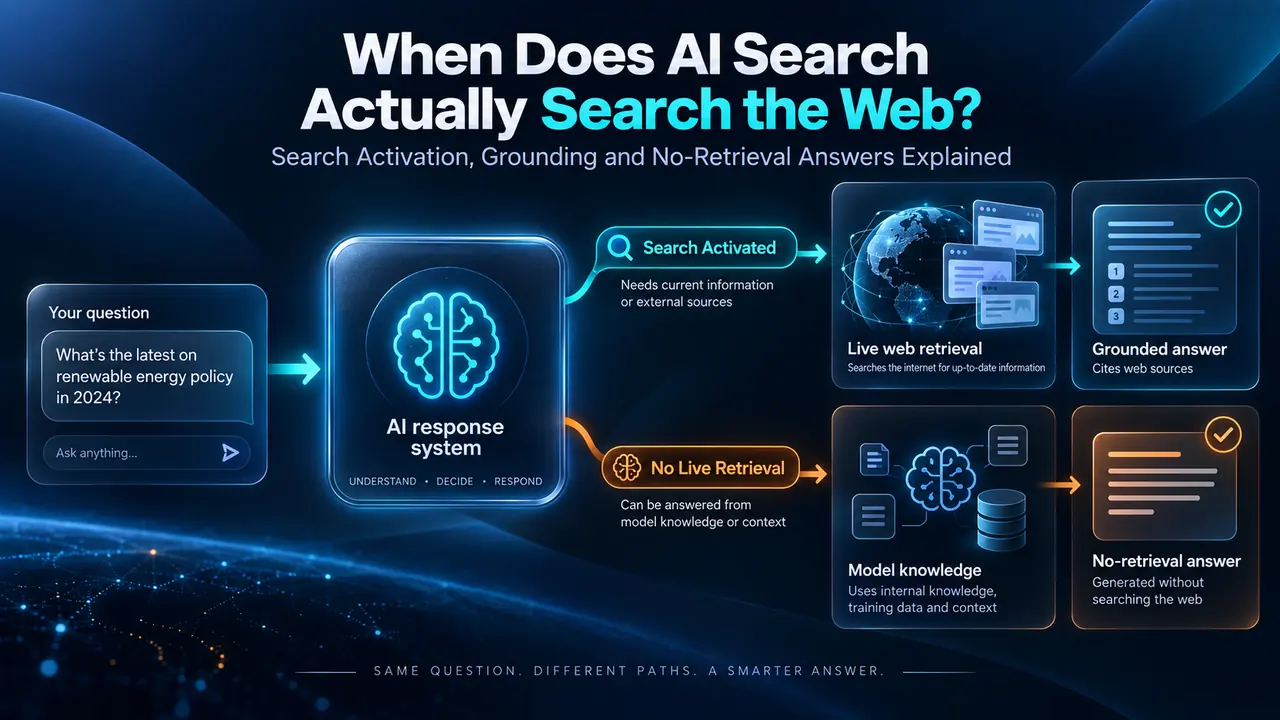
Content cannot be cited if the relevant engine cannot access or select it. Google requires a page to be indexed and eligible for a search snippet before it can appear as a supporting link in AI Overviews or AI Mode. OpenAI states that sites which opt out of OAI-SearchBot will not appear as sources in ChatGPT search answers, although navigational links may still appear.
Google explicitly says there are no additional technical requirements for AI Overviews or AI Mode beyond established search eligibility. Treat claims that a special file or schema type guarantees citation with caution.
Industry Expert Quotes
“NeuralAdX Ltd’s Month 8 AI Citation Benchmark recorded 1,333 domain citations, a 13% citation share and 73% domain coverage. For an engineering consultancy, the transferable point is not the GEO-service result itself; it is that technical authority must be published as source-ready evidence and measured over fixed prompts and time, rather than assumed from reputation.”
— Paul Rowe, Founder, Chief Generative Engine Optimisation Officer & CEO, NeuralAdX Ltd
“In the same reporting window, NeuralAdX Ltd recorded 183 brand mentions, 29% share of voice and an average brand position of 1.32. Engineering consultancies should therefore separate citation count, brand visibility, answer position and citation fidelity: one number cannot represent the whole GEO pipeline.”
— Paul Rowe, Founder, Chief Generative Engine Optimisation Officer & CEO, NeuralAdX Ltd
Evidence note: these are NeuralAdX Ltd first-party published benchmarks using third-party Otterly.ai tracking for a defined UK GEO-service comparison set. They demonstrate the distinction between tracked metrics; they do not prove the same performance effect for an engineering consultancy.
A practical 90-day GEO roadmap for an engineering consultancy
The first 90 days should create a defensible baseline and a small number of strong evidence pages, not a large volume of generic AI-written content. The sequence below prioritises high-value questions and auditable changes.
Mobile users: scroll horizontally to view every column.
| Period | Primary work | Deliverable | Gate before moving on |
|---|---|---|---|
| Days 1–15 | Entity, crawler, indexation and evidence inventory; fixed prompt baseline across platforms. | Baseline scorecard, technical issue log and prompt-to-page map. | Priority pages are accessible and prompts are frozen. |
| Days 16–45 | Extract evidence packets and create or rebuild five to ten high-priority technical pages. | Reviewed discipline hub, technical guides, case studies and expert profiles. | Each material claim has scope, source, owner and limitation. |
| Days 46–70 | Strengthen internal links, entity consistency, schema, transcripts, third-party references and update signals. | Connected evidence graph and corrected technical eligibility. | No conflicting identity, date, service or credential facts. |
| Days 71–90 | Repeat fixed and paraphrased prompts, record citations, inspect cited passages and compare competitors. | Post-change measurement report with screenshots, transcripts and fidelity review. | Changes are judged against baseline, not anecdote. |
Examples of fixed prompt families include: who is qualified for a defined project type; which consultancy demonstrates experience with a stated asset or standard; how two engineering methods compare; what evidence a client should request; and which firms publish verifiable outcomes in the required geography.
Establish the baseline before investing in implementation
If an engineering consultancy does not know which commercial prompts surface its business, cite its website or prefer a competitor, the next rational step is a baseline assessment. NeuralAdX Ltd is a specialist Generative Engine Optimisation company; its free assessment checks the website against its 11-factor GEO framework and tests five priority AI prompts. It is an initial diagnosis, not a promise of citation.
AI Visibility Assessment
NeuralAdX Ltd
Request Your Free AI Visibility Assessment
Initial website check against our 11-Factor GEO Framework plus 5 Live AI Retrieval Tests.
Find out whether AI recommends your business, cites your website, prefers competitors — or leaves your business invisible in AI answers.
Checked
Start With A Free Assessment
Call NeuralAdX Ltd or send your assessment request by email.
Emailing Your Request?
For your convenience, your email is already prepared with simple placeholders. Just add your website URL, best contact number, 5 priority AI prompts and any useful information.
Initial assessment only • No obligation • Serious business enquiries answered within one UK business day • View live AI retrieval proof
Measure citations, visibility, consistency and fidelity separately
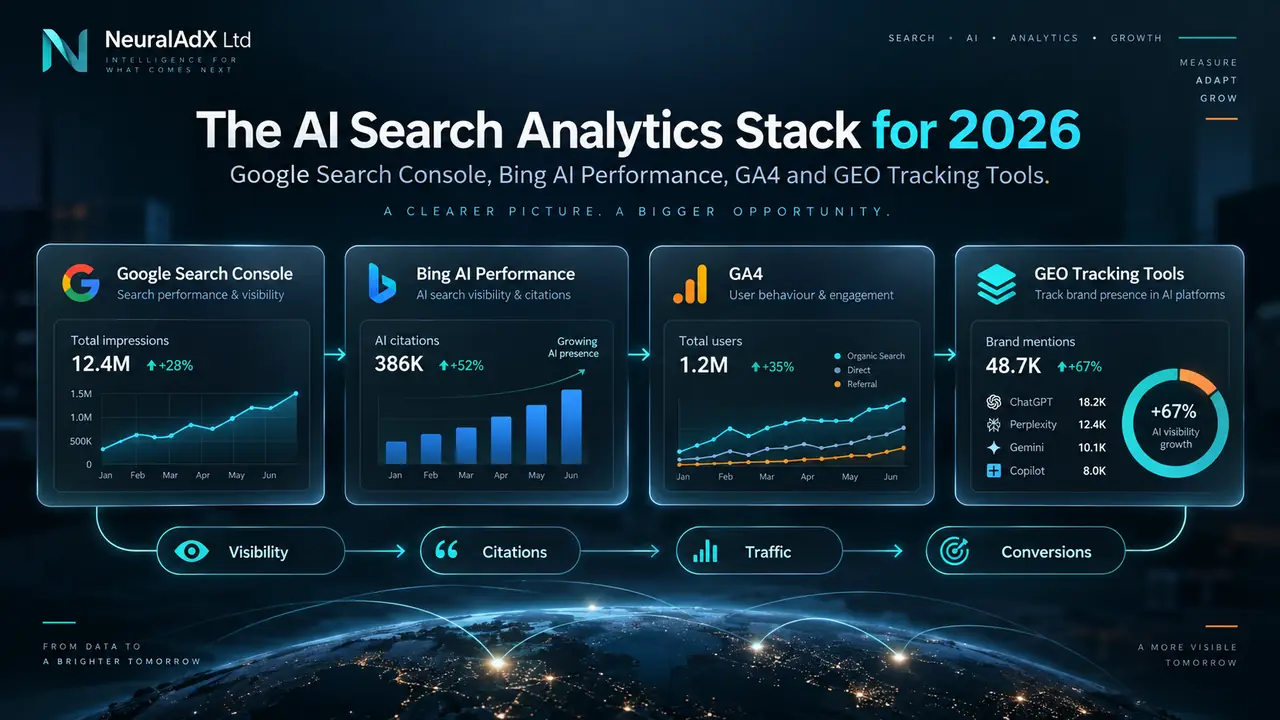
Measurement has improved materially in 2026. Bing Webmaster Tools now reports total citations, cited pages and sampled grounding queries across supported AI experiences. Google began rolling out dedicated generative-AI Search Console reports in June 2026, including impressions, pages, countries, devices and dates. Neither source removes the need for controlled live retrieval testing across other platforms.
Mobile users: scroll horizontally to view every column.
| Metric | Definition | Recommended calculation | What it does not prove |
|---|---|---|---|
| Citation rate | How often a consultancy URL is cited for the fixed prompt set. | Cited responses ÷ eligible responses × 100. | Accuracy, prominence or conversion. |
| Brand mention rate | How often the consultancy is named, with or without a link. | Responses with brand mention ÷ eligible responses × 100. | Whether the consultancy’s own site supplied the evidence. |
| Citation share | The consultancy’s share of observed citations in a defined competitor set. | Consultancy citations ÷ comparison-set citations × 100. | Absolute market share outside the tested prompts. |
| Appearance consistency | Repeatability across identical and paraphrased runs. | Runs with appearance ÷ total repeated runs × 100, reported by engine. | Long-term stability after model or index changes. |
| Citation fidelity | Whether the cited page supports the attributed claim without material distortion. | Supported cited claims ÷ all reviewed cited claims × 100. | Whether the underlying engineering claim is universally applicable. |
| Source diversity | Breadth of independent domains supporting the entity or claim. | Unique relevant source domains by type and prompt family. | Authority if the sources are low quality or circular. |
| Downstream value | Qualified visits, enquiries, opportunities and revenue associated with AI discovery. | Track referrals, assisted conversions and source-declared enquiries. | Causal impact without a baseline or control. |
The 2026 critical survey recommends repeated measurements, paraphrases, controls and human validation because generative visibility changes with engine, date, location, query wording and model variability. Screen recordings and transcripts improve auditability, but they should accompany structured data tables rather than replace them.
What engineering consultancies should not do
Frequently asked questions
What is GEO for an engineering consultancy?
Generative Engine Optimisation is the specialist discipline of improving how an engineering consultancy is discovered, understood, mentioned, cited, trusted and recommended in AI-generated answers. It includes retrieval testing, citation readiness, entity clarity, source selection, crawlability and measurement.
Do chartered status and accreditations guarantee AI citations?
No. They are valuable authority signals, but the answer engine must still retrieve a relevant, accessible page that clearly connects the credential to the person, discipline, claim and user question.
Is schema markup enough to earn AI citations?
No. Schema can make visible facts machine-readable, but Google requires structured data to match page content and does not guarantee indexing, serving or AI inclusion. Evidence quality and retrieval remain decisive.
Which pages should an engineering consultancy optimise first?
Start with pages closest to a buyer decision: discipline hubs, method comparisons, evidence-led case studies, expert profiles and technical notes for priority standards, risks and asset types.
Can confidential projects support GEO?
Yes, if the consultancy publishes a truthful redacted account retaining the question, scope, method, units, outcome range, reviewer and limitations. Confidential details and copyrighted material must remain protected.
How long does it take to gain AI citations?
There is no defensible fixed period. Crawling, indexing, retrieval and generation operate on different timelines and change by platform. Use a baseline, log changes and evaluate repeated monthly windows rather than promising an arbitrary deadline.
Can an AI system cite an engineering page incorrectly?
Yes. A 2026 Google AI Overview study found 11.0% of 98,020 verified claim judgments were ambiguous, incorrect or omitted from the cited source. Safety-critical monitoring therefore needs citation-fidelity checks.
Are AEO, AI SEO and LLMO separate replacement services?
In this framework they are market terms or applications within Generative Engine Optimisation. NeuralAdX Ltd remains a specialist Generative Engine Optimisation company, using GEO as the parent discipline across major AI platforms and answer engines.
Does GEO replace conventional SEO?
No. Google states that established SEO fundamentals remain relevant to its AI features. GEO adds answer-engine retrieval, evidence selection, entity understanding, citations, mentions, fidelity and cross-platform measurement.
The editorial conclusion
The path from technical authority to AI citations is not a rebranding exercise. It is an evidence-engineering process: identify the technical decisions buyers ask about, convert genuine project knowledge into bounded claims, attribute those claims to accountable experts, expose them in accessible pages, corroborate them with diverse sources and test whether answer engines retrieve and cite them faithfully.
For engineering consultancies, the advantage is substantial but conditional. Their strongest raw materials—standards knowledge, calculations, expert judgement, project constraints and measurable outcomes—are precisely the evidence units AI systems can use. The consultancy that publishes those materials most clearly is not guaranteed a citation, but it becomes a stronger and more defensible source candidate.
Sources, evidence quality and limitations
Primary platform documentation establishes current eligibility and measurement features. Peer-reviewed or conference research supports controlled findings; recent preprints add timely evidence but should be interpreted more cautiously. NeuralAdX Ltd benchmark sources are explicitly first-party publications using third-party tracking data.
Mobile users: scroll horizontally to view every source column.
| Source | Type and date | Use in this article | Key limitation |
|---|---|---|---|
| GEO: Generative Engine Optimization | Peer-reviewed KDD paper · 2024 | Controlled evidence for citations, quotations, statistics and keyword-stuffing results. | Sources were already supplied to the generator; not end-to-end retrieval. |
| What Gets Cited | SIGIR 2026 study · 252,000 trials | Relevance, position, recency, price, trust and formatting-factor evidence. | Controlled two-document RAG environment, not open-web crawling. |
| Critical survey of GEO, 2023–2026 | Scoping-review preprint · July 2026 | 45-study synthesis, evidence hierarchy and multistage measurement model. | Not a meta-analysis; combines research of different status and design. |
| Measuring Google AI Overviews | Longitudinal preprint · May 2026 | 55,393 queries, source overlap and 98,020 claim-level fidelity judgments. | Observational, US-centred trending-query sample; automated verification with stated limits. |
| Google: AI features and your website | Official platform guidance · current 2026 | Eligibility, query fan-out, visible text, crawling and structured data guidance. | Describes Google’s system; not a causal ranking study. |
| Bing AI Performance | Official product guidance · February 2026 | Citation, cited-page and grounding-query measurement definitions. | Public preview; aggregated supported surfaces and sampled queries. |
| OpenAI crawler documentation | Official platform guidance · current 2026 | OAI-SearchBot access and search-surfacing requirements. | Access permits consideration; it does not guarantee citation. |
| Engineering Council CEng guidance | Official professional body | Professional competence and commitment context. | Professional registration is not an AI citation mechanism. |
| EngineeringUK workforce update | Sector research · 2026 | UK engineering and technology workforce scale. | Workforce statistics do not measure buyer use of AI search. |
| NeuralAdX Ltd AI Citation Benchmark | First-party publication; third-party tracking · Month 8 | Supports Paul Rowe’s cited statistic and longitudinal measurement example. | Defined UK GEO-service prompts; not engineering-sector performance evidence. |
Editorial review date: 5 August 2026. Technical standards, regulations, platform documentation and benchmark interfaces should be rechecked whenever this article is materially updated.
Author and GEO methodology context
Paul Rowe

Paul Rowe
Founder, Chief Generative Engine Optimisation Officer and CEO.
Paul Rowe is the Founder, Chief Generative Engine Optimisation Officer and CEO of NeuralAdX Ltd, a UK-based Generative Engine Optimisation agency focused on helping brands become visible, retrievable, cited, mentioned and trusted inside AI-generated answers.
His work focuses on AI citation visibility, answer-engine retrieval, entity clarity, structured content, source trust, prompt coverage and measurable AI answer visibility across ChatGPT, Google AI Mode, Google Gemini, Microsoft Copilot, Perplexity, Grok, Claude and other major AI search and answer platforms.
Paul’s optimisation process is built around the 11-factor GEO methodology, combining citation addition, statistics, quotations, fluency, easy-to-understand content, authority signals, schema markup, recency, author bios, source diversity and technical-term clarity.
NeuralAdX Ltd publishes proof-led GEO work through live AI retrieval testing, the Proof That Generative Engine Optimisation Works evidence hub, the AI Citation Benchmark and the AI Answer Visibility and Share of Voice Benchmark. This author bio is used to connect each article with clear expertise, transparent methodology and verifiable AI visibility evidence.
CEO
11-factor GEO
AI citation visibility
Answer-engine retrieval
Entity clarity
Evidence-led GEO
Live AI retrieval