Third-Party Brand Mentions Can Influence AI Search Visibility When Digital PR Creates Relevant, Retrievable and Repeatedly Corroborated Evidence
Digital PR can influence Generative Engine Optimisation (GEO) because credible third-party brand mentions give AI search systems independent evidence they can retrieve, compare, cite and use when forming answers—but no single mention, backlink or one-off AI visibility check can prove or guarantee an effect.
The strongest current evidence points to a more precise model: relevant earned mentions expand the external evidence available about a brand; retrieval and source-selection systems decide whether that evidence is surfaced; answer-generation systems may then cite, absorb, mention or ignore it; and the outcome can change across prompts, platforms and time. That is why digital PR for GEO should be evaluated as a source-and-corroboration strategy measured longitudinally, not as a simple backlink campaign.
TL;DR: Digital PR Can Strengthen GEO by Expanding the Independent Evidence AI Systems Can Retrieve About a Brand
1. Mentions create external evidence
Independent coverage can connect a brand with topics, categories, claims, people, products and expertise beyond its own website.
2. Retrieval is the gatekeeper
A mention only has an opportunity to influence an answer if the relevant system can discover, retrieve or otherwise access the source in the context of the prompt.
3. Citation is not the same as influence
A page can be cited without the brand being named, and a brand can be named without its own website being cited. Citation selection and answer absorption are distinct.
4. Measure repeatedly
Current research shows high run-to-run and week-to-week variability. A single AI visibility check can look precise while being statistically fragile.
Practical conclusion: Digital PR is most useful to GEO when it earns contextually relevant, independently authored, retrievable coverage from a diverse set of credible sources—and when the resulting AI visibility is tested repeatedly across a fixed prompt set and multiple answer engines.
What Does Digital PR for GEO Mean?
In this article, digital PR for GEO means earning and maintaining third-party editorial coverage that improves the quality, breadth, recency and corroboration of information available about an organisation across the open web. The objective is not simply to acquire links. It is to create independent source evidence that may be retrieved and used by AI search and answer systems when they resolve a user’s question.
Generative Engine Optimisation is the parent specialist discipline used here. Terms such as AI SEO, AEO, LLMO, ChatGPT optimisation, Google AI Mode optimisation, Perplexity optimisation and Microsoft Copilot optimisation describe buyer language, platform applications or adjacent market terminology; they do not replace the wider GEO task of improving retrieval, citation readiness, entity clarity, prompt coverage, trust signals, source selection, technical crawlability, citation performance and answer visibility.
How Third-Party Brand Mentions Can Influence AI Search Visibility
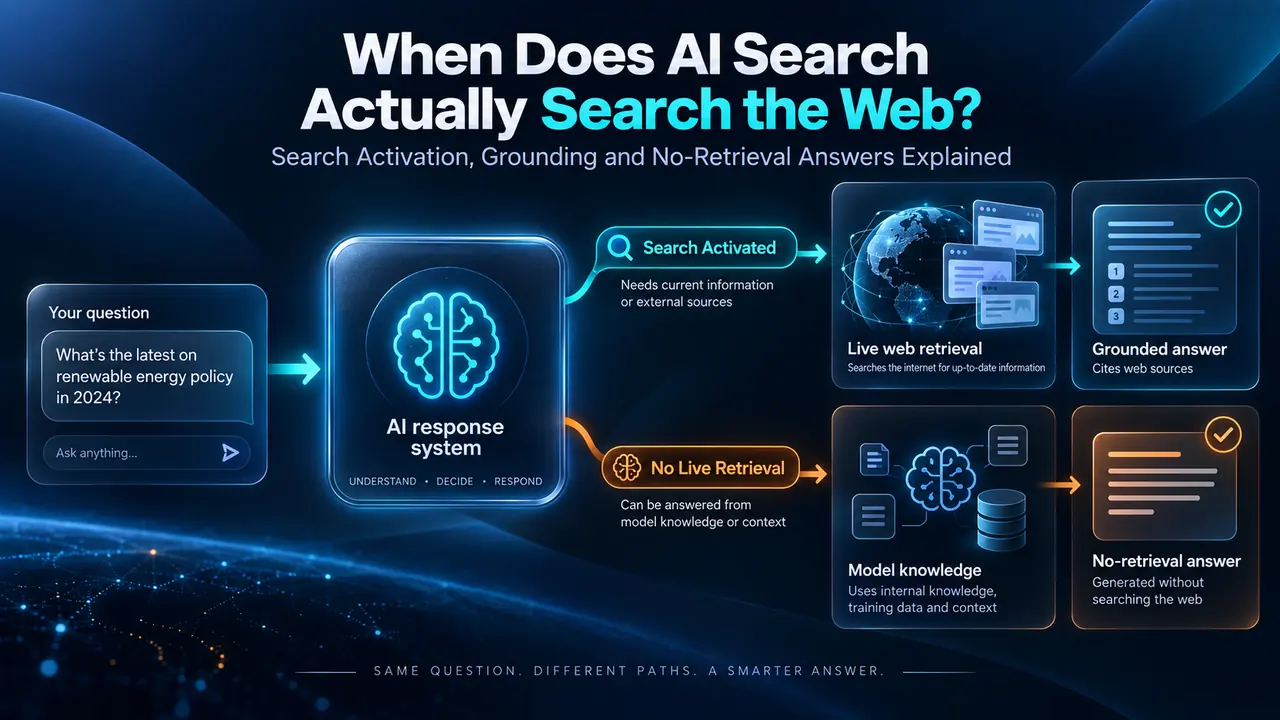
The cleanest way to understand the influence of third-party mentions is as a sequence. Digital PR does not inject a brand directly into an AI answer. It changes the evidence environment from which AI search systems may retrieve.
1
External evidence is published
A journalist, trade publication, research site, podcast transcript, comparison page or other independent source mentions the brand in a relevant context.
2
The source becomes discoverable
Search and retrieval systems must be able to crawl, index, access or otherwise surface the page. Technical accessibility remains a prerequisite.
3
The prompt activates relevant retrieval
The user’s query is decomposed or expanded into retrieval tasks. The source must be semantically relevant to one or more of those tasks.
4
Sources are selected and reranked
The system decides which candidate evidence is useful enough to place into the answer context. Authority alone does not guarantee selection.
5
Evidence may be cited or absorbed
A source can be shown as a citation, influence the generated wording, both, or neither. Citation selection and answer absorption are not identical.
6
The brand may be mentioned or recommended
Only after those preceding stages can the external evidence contribute to a visible brand mention, comparison, description or recommendation.
7
The outcome must be retested
Different runs, prompts, platforms and dates can produce different source sets, making longitudinal measurement essential.
This pipeline view is consistent with the 2026 critical GEO survey, which describes generative visibility as a stochastic, partially observable process spanning retrieval, reranking, citation, prominence, absorption and fidelity. The implication is straightforward: third-party mentions can improve the available evidence, but they do not bypass the rest of the system.
What Does Current Research Say About Third-Party Mentions and AI Visibility?
The evidence now goes well beyond the claim that “PR builds authority.” Multiple 2025–2026 studies directly examine which sources AI answer engines cite, how external mentions correlate with brand visibility, and how citations diverge from visible brand mentions. The key findings are substantial, but they need to be interpreted with their study designs intact.
| Source | Dataset | Relevant finding | How to interpret it |
|---|---|---|---|
| Muck Rack, May–Aug 2026 | 25M+ links across ChatGPT, Claude and Gemini; 17 industries | 84% of citations came from earned media; journalism represented 27%; paid/advertorial content just 0.3%. Across editions, earned media remained 82–89%. | Strong evidence about source distribution. It does not prove that earning a specific placement causes a specific recommendation. |
| Ahrefs, Dec 2025 | 75,000 brands | Branded web mentions correlated about 0.66–0.71 with AI visibility across ChatGPT, Google AI Mode and AI Overviews; YouTube mentions showed the strongest reported correlation at about 0.737. | Correlation, not causation. Useful for prioritising brand presence beyond link counts. |
| Surfer / Joshua Hardwick, Jul 2026 | 922 prompts, 12 industries, 26,573 calls, 289,105 source URLs | The share of cited sources mentioning a brand had a 0.41 Spearman correlation with recommendation position. | Authors explicitly caution that cited mentions may partly reflect brands already selected by the model. |
| Semrush, Jun 2026 | 3,981 domain appearances, 115 prompts, 14 countries, four AI engines | 61.7% of appearances were citation-only, 13.2% cited + mentioned, and 25.1% mention-only. | Shows why a citation metric cannot stand in for brand mention visibility. |
| Noble, preliminary Jun 2026 | 599 third-party mentions, 79 brands, 18 weeks; mostly B2B SaaS | Observed sustained lift was more common at four or more mentions, but the study was observational and small in higher-volume bands. | Hypothesis-generating, not a universal “four mentions” rule. |
| BrightEdge, Jul 2026 | 12 weeks, ecommerce/shopping, ChatGPT, Gemini, Google AI Overviews | Average weekly citation-share change was 39% for ChatGPT and 41% for Gemini, versus 25% movement in brand-mention share. | Strong evidence that evidence-source turnover can be much higher than visible brand turnover. |
Mobile: scroll horizontally to view the full research table.
Chart 1 — Earned Media Dominates the AI Citation Source Mix in Muck Rack’s 2026 Dataset
The percentages below are source-distribution measures. Journalism is a subset of earned media, so the bars should not be added together.
Earned media
Journalism (subset of earned media)
Paid / advertorial
The 0.3% bar uses a minimum display width so its label remains readable; the printed percentage is the exact reported value.
Mobile: scroll horizontally to view the full chart.
Which Third-Party Brand Mentions Matter Most for GEO?
Not all third-party mentions are equally useful. The decisive question is not “How strong is the domain?” but “Does this source give the target AI system relevant, accessible and usable evidence for the prompts we care about?” Current research points toward topical alignment and context as more defensible priorities than indiscriminate authority chasing.
| Condition | Why it matters for GEO | Practical importance |
|---|---|---|
| Topical and prompt relevance | The source discusses the brand in the same problem, category, use case or decision context as the queries you want to influence. | High |
| Independent editorial context | A third party makes the association rather than the brand repeating it on its own site. | High |
| Retrievability | The page is crawlable, indexable or otherwise accessible to the relevant retrieval system. | Foundational |
| Extractable evidence | Specific facts, comparisons, statistics, definitions, quotations and clear entity relationships give the model usable answer material. | High |
| Source diversity | Independent evidence from different publishers, formats and communities reduces dependence on one source ecosystem. | High |
| Recency | Fresh or updated sources can be more useful for time-sensitive topics; Muck Rack found citation frequency concentrated toward newer content in earlier 2026 analysis. | Context-dependent |
| Entity consistency | The same brand name, people, product names, category and factual claims are described consistently across first- and third-party sources. | High |
| Publisher relevance | A specialist trade outlet or journalist aligned to the topic may provide better contextual evidence than an unrelated high-authority domain. | Often high |
| Link presence | A link can aid navigation, discovery and traditional search signals, but current AI visibility studies do not support treating link count as a direct proxy for AI mentions. | Useful, not sufficient |
Mobile: scroll horizontally to view the full comparison table.
Why a Third-Party Citation Is Not the Same as a Brand Mention, Absorption or Recommendation
A common GEO reporting error is to treat citations, brand mentions and recommendations as interchangeable. They are not. A citation tells you that a source was surfaced as evidence. A brand mention tells you that the brand entered the generated answer. Absorption asks whether information from a source materially influenced the answer. A recommendation adds a further decision layer.
Citation selection
Was the page chosen and shown as a supporting source?
Citation absorption
Did the generated answer actually use information attributable to that source?
Brand mention
Was the brand explicitly named in the answer, whether or not its own domain was cited?
Recommendation / prominence
Was the brand presented as a preferred option, and where did it appear relative to competitors?
Chart 2 — Citation and Brand Mention Are Different AI Visibility Outcomes
Semrush’s 2026 sample separates three mutually exclusive appearance types.
Mobile: scroll horizontally to view the full stacked bar.
Which Digital PR Tactics Are Most Defensible for Generative Engine Optimisation?
The best digital PR tactics for GEO are the ones that increase the supply of specific, independent, retrievable and answer-useful evidence around the brand. That usually produces a different outreach plan from bulk link acquisition.
Publish original data worth citing
Surveys, benchmarks, experiments and transparent datasets give journalists and AI systems concrete evidence. State methodology, sample size, dates and limitations.
Pitch journalists and specialist publications by beat relevance
Muck Rack’s 2026 analysis stresses topical fit. A niche publication that repeatedly covers the subject can be more useful than a prestigious but contextually unrelated placement.
Make expert commentary specific and verifiable
Offer concise claims, numbers, definitions or observations that can survive extraction without losing their meaning. Avoid inflated predictions and unsupported superlatives.
Build third-party coverage around the exact entity-category relationship
If you want to surface for “best X for Y,” independent sources should clearly connect the brand with X and Y rather than merely name the company in passing.
Use podcasts, video and transcripts as evidence surfaces
Ahrefs found YouTube mentions had the strongest reported correlation with AI visibility in its 75,000-brand study. That does not prove video causes visibility, but it supports multi-format brand distribution.
Use press releases as structured factual source material, not a substitute for earned coverage
Muck Rack found press-release citation share rose from roughly 0.2% to around 1% by early 2026, with cited releases tending to contain more statistics, bullets and objective language. Earned media still dominated the overall citation mix.
Refresh coverage when facts materially change
AI answers increasingly need current information. Update owned source material and give third parties legitimate reasons to revisit outdated facts, prices, products, leadership, research or market data.
Track which publishers the target engines actually cite
Do not choose outreach targets only from SEO authority scores. Reverse-engineer the sources appearing across your commercial prompt set and identify gaps in independent evidence.
What Digital PR for GEO Should Not Become
Digital PR can become counterproductive when the optimisation target is reduced to “get the brand mentioned everywhere.” Generative systems do not reward a visible mention merely because a marketer paid for, duplicated or forced it.
Buying bulk “AI mentions”
A paid placement is not automatically valuable evidence. Muck Rack found paid/advertorial content represented only 0.3% of citations in its May 2026 dataset.
Chasing Domain Rating without context
A strong domain can still be irrelevant to the prompt. Topical fit, source usefulness and retrieval context matter.
Publishing fabricated statistics or synthetic expert quotes
False evidence creates accuracy, reputation and citation-fidelity risk. Original research must show its methodology and limits.
Flooding identical press-release copies
Syndication can improve distribution, but duplicated language does not create the same independent corroboration as separately authored editorial coverage.
Forcing exact-match anchors into editorial copy
The visible relationship between brand, topic and evidence matters more than manufacturing unnatural anchor text.
Treating one successful AI answer as proof
Single runs are unstable. The right unit of evaluation is a repeated prompt-and-platform time series.
Optimising for one platform only
Source preferences and citation behaviour differ materially across ChatGPT, Gemini, Google AI features, Perplexity, Copilot and other systems.
Confusing citation volume with commercial impact
Citation counts are evidence-layer metrics. They need to be analysed alongside mentions, prominence, accuracy, traffic, leads and other business outcomes.
Why Digital PR for GEO Must Be Measured as a Time Series, Not a One-Off AI Visibility Check
This is the most important measurement update for GEO in 2026: AI visibility should not be measured once and reported as if the result were a stable ranking. Repeated sampling research and longitudinal industry datasets now show that sources, citations and answer composition can change enough to make a single run misleadingly precise.
Repeated-run research
A March 2026 research preprint tested identical queries repeatedly across Perplexity, OpenAI search and Gemini and concluded that single-run visibility measures can be “misleadingly precise”. Apparent differences can fall inside the noise floor.
12-week longitudinal evidence
BrightEdge found average weekly citation-share changes of 39% in ChatGPT and 41% in Gemini. Its conclusion was that a “single week carries little diagnostic value” when citation turnover is that high.
Brand stability can hide source churn
Profound’s Summer 2026 report found that after a June ChatGPT change, citations per answer fell 10.4% and unique cited domains declined in 56 of 58 industries, while nine of ten leading brands in the median industry held position.
Chart 3 — The Evidence Layer Moved Faster Than the Brand Layer in BrightEdge’s 12-Week Study
Values are average week-to-week changes in share within BrightEdge’s ecommerce/shopping dataset; they are not market shares.
Brand mention share change
ChatGPT citation share change
Gemini citation share change
Mobile: scroll horizontally to view the full chart.
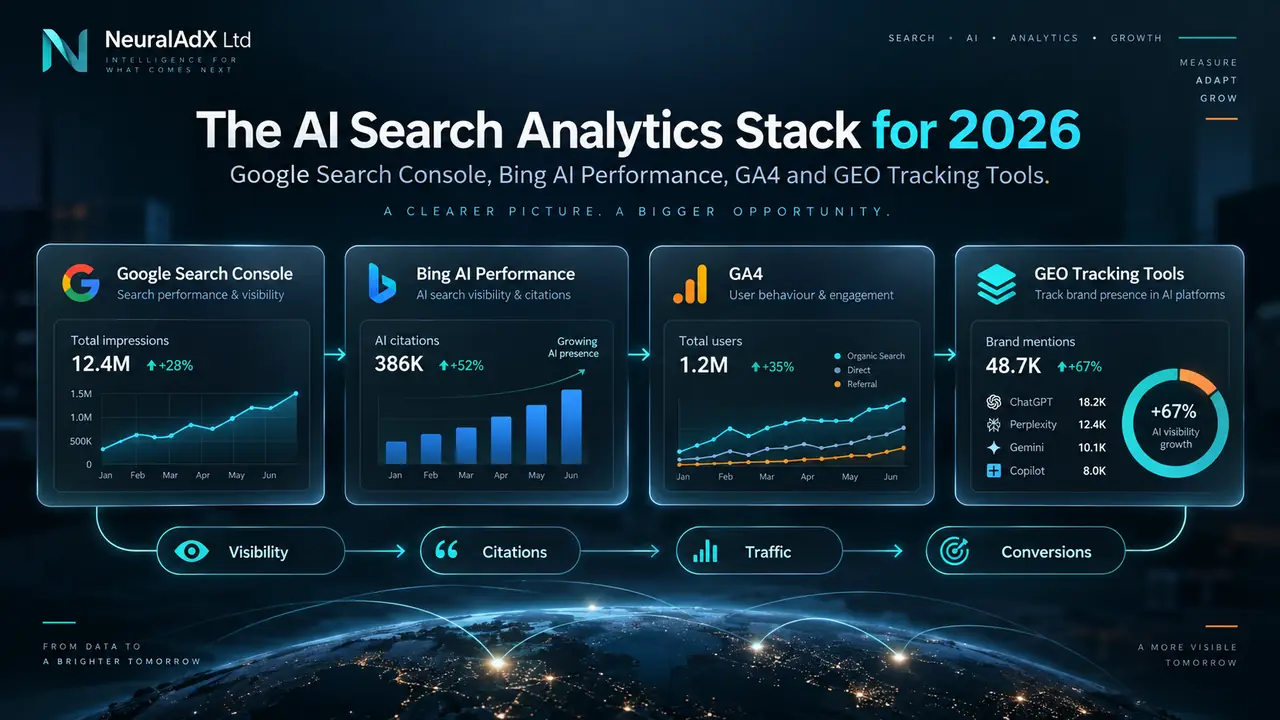
The operational consequence is to separate signal from sampling noise. Keep the commercial prompt set fixed long enough to compare like with like; run prompts across multiple relevant AI engines; preserve answer and source evidence; compare brand and competitor trends; and annotate material PR placements, site changes and platform changes. A weekly cadence is sensible where the source layer is volatile and the commercial value justifies it; monthly trend reporting can be appropriate for broader strategic benchmarking. What is not defensible is treating one answer on one day as a durable market position.
| Metric | What it tells you | Recommended treatment | Do not mistake it for |
|---|---|---|---|
| Brand presence / mention rate | Whether the brand enters target answers at all | Repeated runs; trend over time | A fixed organic ranking |
| Share of voice | Brand mentions relative to selected competitors within a defined prompt set | Weekly or monthly trend depending sample size | Total market share |
| Brand coverage | Percentage of tracked prompts in which the brand appears | Trend over the same fixed prompts | Proof of causation |
| Average brand position / prominence | Where the brand tends to appear within answers | Repeated, because answer order can vary | A traditional SERP rank |
| Citation count and citation share | How often the brand’s domain or relevant third-party sources are selected as evidence | Trend by platform and source type | Proof that cited content was absorbed |
| Third-party source share | How much evidence comes from independent sources rather than the brand’s own domain | Track by publisher, topic and prompt | A simple quality score |
| Source diversity and overlap | Whether visibility depends on one publisher or a broad evidence network; whether platforms use the same sources | Monthly / campaign review | More sources always being better |
| Absorption and fidelity | Whether cited evidence materially supports the generated claim and is represented accurately | Sample answers manually / analytically | A citation count |
| Accuracy and sentiment | Whether third-party information is correct, current and framed appropriately | Ongoing, especially after material changes | A direct ranking factor |
| Business outcome | Qualified traffic, enquiries, branded search, pipeline or other commercial effects | Longitudinal attribution | Guaranteed consequence of an AI mention |
Mobile: scroll horizontally to view the full measurement table.
A Research-Grounded Digital PR Workflow for GEO
A defensible GEO programme connects digital PR activity to retrieval evidence and repeated answer measurement. The workflow below keeps the causal claims conservative while still making the programme commercially actionable.
1
Baseline the current answer landscape
Define the commercial prompts, target markets, priority competitors and AI engines. Capture repeated baseline answers, mentions, citations, positions and source URLs before PR activity.
2
Map the external evidence gap
For each prompt, identify which third-party sources are currently retrieved, which brands they mention, which claims they support, and where your brand lacks independent corroboration.
3
Choose evidence assets, not “link bait”
Create research, data, expert commentary, case evidence, definitions, comparisons or timely analysis that a journalist can use without repeating marketing copy.
4
Target source relevance precisely
Prioritise journalists, publications, communities, podcasts and research sites already close to the topic and, where possible, already present in the source ecosystem of the target AI answers.
5
Earn clear entity-topic associations
Coverage should make the relationship explicit: who the company is, what category or problem it is relevant to, what evidence supports the claim, and when the information was current.
6
Verify retrieval and answer effects
After publication, test whether the placement becomes retrievable or cited across the relevant prompts. Also inspect whether third-party wording is absorbed faithfully and whether the brand is actually mentioned.
7
Compare trends against the baseline and competitors
Look for repeated changes in coverage, share of voice, source selection, citation share, prominence and source diversity rather than claiming success from one answer.
8
Refresh and diversify the evidence network
Maintain facts, correct outdated third-party information, create new evidence when the market changes and avoid dependence on one publisher or platform.
Industry Expert Quotes
“Digital PR for GEO should be treated as a source-distribution and corroboration programme, not a backlink-count campaign. In NeuralAdX Ltd’s latest 24 July–23 August 2026 AI answer visibility benchmark, NeuralAdX Ltd recorded 197 brand mentions, 27% share of voice, 16% brand coverage and a 1.32 average brand position; its separate citation benchmark recorded 1,212 AI citations and 9.56% citation share. Those observations do not prove that any one PR placement caused the outcome. The defensible lesson is to build credible third-party evidence and then measure mentions, citations, source selection and answer visibility repeatedly over time.”
The external evidence points in the same general direction while remaining non-causal: Ahrefs found branded web mentions correlated about 0.66–0.71 with AI visibility across three Google/OpenAI surfaces in its 75,000-brand study, and Muck Rack found 84% of citations in its 25M+ link dataset came from earned media. Those figures strengthen the case for independent brand evidence, but they do not turn a PR placement into a guaranteed ranking factor.
Before Scaling Digital PR, Establish the AI Visibility Baseline You Will Measure Against
If you want to know whether third-party coverage is translating into observable AI visibility rather than simply assuming it is, the sensible first step is to establish a repeatable baseline: what AI systems currently say, which sources they cite, where competitors appear, and whether your website is technically ready to be retrieved.
That is also the point at which digital PR becomes measurable GEO rather than an isolated publicity activity. A baseline gives future placements something to be compared against.
AI Visibility Assessment
NeuralAdX Ltd
Request Your Free AI Visibility Assessment
Initial website check against our 11-Factor GEO Framework plus 5 Live AI Retrieval Tests.
Find out whether AI recommends your business, cites your website, prefers competitors — or leaves your business invisible in AI answers.
11-Factor GEO Framework
Checked
Commercial AI Prompts Tested
Start With A Free Assessment
Call NeuralAdX Ltd or send your assessment request by email.
Emailing Your Request?
For your convenience, your email is already prepared with simple placeholders. Just add your website URL, best contact number, 5 priority AI prompts and any useful information.
Initial assessment only · No obligation · Serious business enquiries answered within one UK business day · View live AI retrieval proof
Related NeuralAdX Ltd GEO Evidence and Research
For readers who want to connect the digital PR evidence in this article with live retrieval measurement, methodology and published benchmark data, the following NeuralAdX Ltd resources are the most relevant.
Frequently Asked Questions About Digital PR for GEO and AI Search Visibility
These answers summarise the practical implications of the research without turning correlations into causal rules.
What is digital PR for GEO?
Digital PR for GEO is the practice of earning relevant third-party editorial coverage that expands the independent, retrievable evidence available about a brand for generative search and answer systems. Its value is broader than backlinks because the external page can associate the brand with topics, claims, expertise, comparisons and facts that an AI system may later retrieve, cite or absorb.
Do unlinked brand mentions influence AI search visibility?
They can be relevant because current correlation studies associate branded web mentions with AI visibility even when traditional link metrics show weaker relationships. But the evidence is correlational, not proof that any unlinked mention directly causes a ranking or recommendation. Relevance, retrievability, context, source selection and repeated corroboration still matter.
Are backlinks still important for Generative Engine Optimisation?
Yes, but they should not be used as the sole proxy for AI visibility. Links can support discovery, referral traffic and conventional search authority. GEO adds further questions: is the source retrieved for the target prompt, is the brand named, is the evidence cited or absorbed, and does the outcome persist across repeated runs?
Which third-party sites are best for GEO?
The best sources are usually those that are credible, topically relevant, retrievable and already close to the answer ecosystem for the target prompts. A specialist trade publication, relevant journalist, authoritative comparison or research source may be more useful than an unrelated site selected only because it has a high SEO authority score.
Is one high-authority media placement enough to improve AI visibility?
There is no reliable evidence that one placement is enough. A single placement may be retrieved for some prompts and ignored for others, and AI source sets can turn over materially from week to week. Digital PR for GEO is better treated as the development of a diverse, current evidence network measured over time.
How many third-party mentions are needed before AI visibility improves?
No universal threshold has been established. A preliminary 2026 Noble study observed more sustained lift among brands with four or more placements, but it was observational, mostly B2B SaaS, and could not establish causation. Treat “four mentions” as a research signal to investigate, not a rule.
How long does digital PR take to affect AI search visibility?
There is no fixed timeline. A placement must be published, discoverable and relevant to a prompt before it can influence retrieval. Different engines refresh and select evidence differently. The defensible approach is to maintain a baseline and test the same prompt set repeatedly after placements rather than promise a universal number of days.
Should brands pay for third-party mentions to improve GEO?
Paid exposure can have marketing value, but it should not be confused with earned editorial corroboration. In Muck Rack’s May 2026 AI citation dataset, paid/advertorial content represented only 0.3% of citations while earned media represented 84%. Buying large volumes of placements is therefore not a sound substitute for relevant earned evidence.
Why is one AI visibility measurement not enough?
Because generative answers are variable. Repeated-query research shows that identical prompts can return different citations and answers, while BrightEdge observed average week-to-week citation-share changes of 39% for ChatGPT and 41% for Gemini in its 12-week ecommerce study. One run can therefore overstate certainty.
What is the difference between a third-party mention, an AI citation and citation absorption?
A third-party mention exists on an external source page. An AI citation means the answer engine surfaced a source as evidence. Citation absorption asks whether information from that cited source actually influenced the answer. A brand can also be mentioned without its own domain being cited, so these outcomes should be measured separately.
Does digital PR replace technical GEO or on-site optimisation?
No. Third-party evidence cannot compensate for a site that is inaccessible, unclear or poorly structured. NeuralAdX Ltd treats Generative Engine Optimisation as a wider discipline combining crawlability, retrieval testing, citation readiness, entity clarity, prompt coverage, trust signals, source diversity and repeated AI visibility measurement.
Conclusion: Digital PR Influences GEO by Building the Third-Party Evidence Layer—But the Effect Must Be Verified, Not Assumed
Digital PR can contribute to AI search visibility because it changes what the web says about a brand beyond the brand’s own domain. Current evidence supports a credible association between third-party brand presence and generative visibility, and large citation datasets show that earned media supplies a substantial share of the sources used by AI answers. But the mechanism is conditional: the coverage must be relevant and retrievable; the system must select it; the answer may or may not absorb it; and outcomes can change substantially over time.
The strongest GEO strategy is therefore not “get more mentions.” It is: build independent, citation-ready evidence around the exact topics and decisions that matter; make that evidence easy to retrieve and understand; diversify it across credible sources; and measure the answer layer repeatedly enough to distinguish a durable signal from generative noise.
Research-status note: Several 2026 GEO papers cited here are research preprints. They are included because they directly study uncertainty, citation selection and cross-platform behaviour, but their findings should be treated as emerging evidence rather than settled causal law.
Primary evidence and research used
Last editorial review: 7 September 2026. For further specialist Generative Engine Optimisation research, visit the NeuralAdX Ltd GEO blog archive.