Written and reviewed by Paul Rowe, Founder, Chief Generative Engine Optimisation Officer & CEO at NeuralAdX Ltd · Last substantive review: · Evidence checked against current platform documentation, peer-reviewed research and independent analytics datasets.
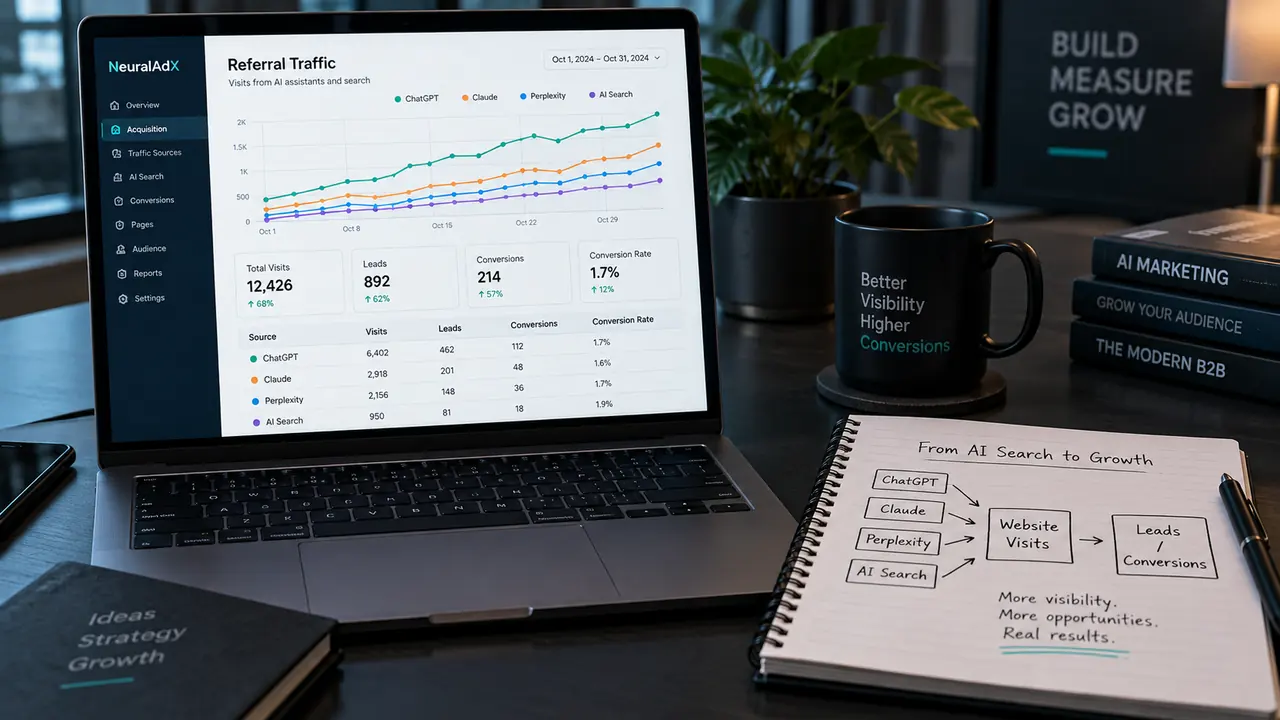
How do you accurately track traffic and conversions from ChatGPT, Claude, Perplexity and AI search?
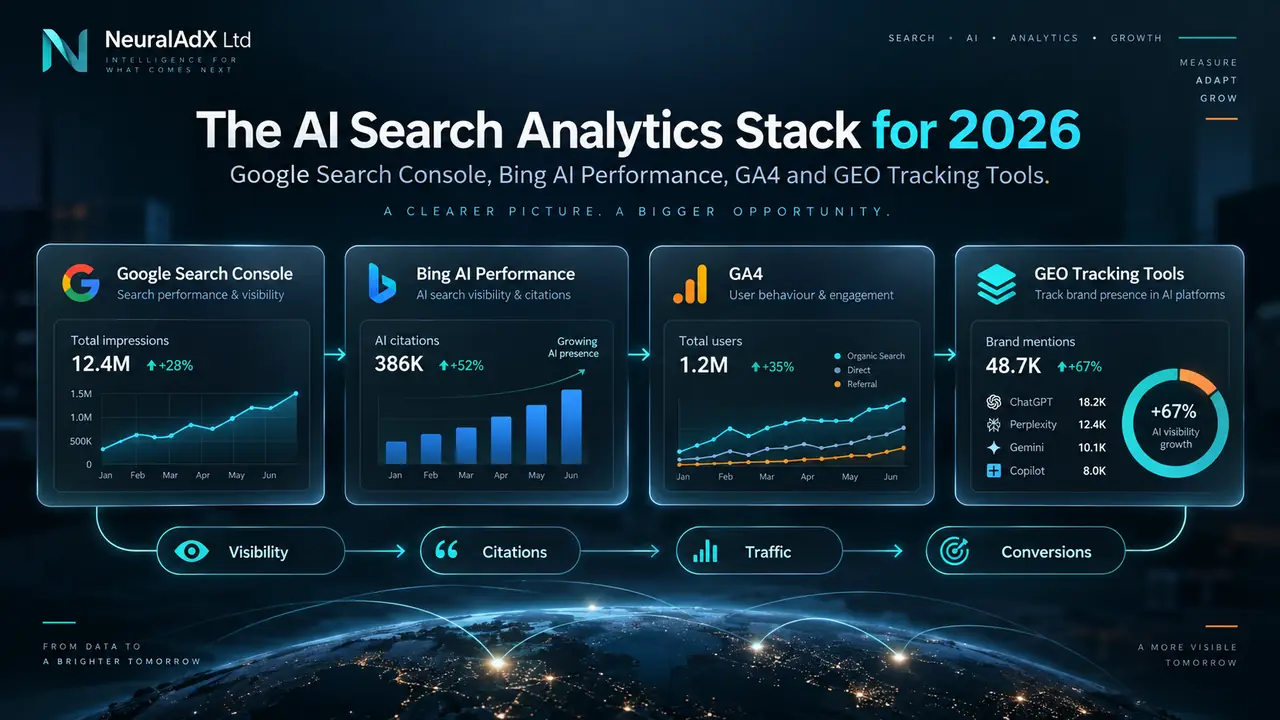
The most reliable method is to measure AI discovery in layers: visibility, referral sessions, on-site behaviour, conversion events and assisted revenue or leads. In Google Analytics 4, use the native AI Assistant channel for identifiable assistant referrals, then break performance down by session source and landing page. For Google AI Overviews and AI Mode, pair Search Console’s Generative AI performance report with GA4 conversion data because Google explicitly excludes those Search features from GA4’s AI Assistant channel. Google Analytics: AI Assistant channel Google Search Console: Generative AI report
ChatGPT is currently the easiest major assistant to attribute when a referral is preserved because OpenAI says ChatGPT referral URLs automatically include utm_source=chatgpt.com. Claude and Perplexity also provide source links in web-grounded answers, but no analytics platform can recover referral information that never reaches the site, so direct traffic, CRM evidence and first-party “how did you hear about us?” data remain important. OpenAI publisher guidance Anthropic web search Perplexity source transparency
TL;DR: the measurement model that works
Track whether your pages appear, are cited or are linked in AI answers before measuring clicks.
Use GA4’s AI Assistant channel, then inspect Session source / medium and landing page.
Mark meaningful lead, booking, signup and purchase events as key events; send revenue where available.
Use Search Console’s Generative AI report for AI Overviews and AI Mode visibility, then analyse on-site outcomes in GA4.
Carry source, landing page and lead IDs into the CRM; add a self-reported discovery field for dark AI influence.
Crawler or user-agent fetches show retrieval activity, not human referral sessions or conversions.
What should an AI traffic and conversion measurement model include?
A complete AI measurement model should include exposure, visit, engagement, conversion and attribution as separate layers. A citation or brand mention is not a visit; a visit is not a conversion; and a last-click conversion does not capture every AI-assisted journey. This distinction matters more as AI traffic grows: Similarweb reported an average of 770.7 million AI referral visits per month worldwide from June 2025 to May 2026, up 117.4% year on year. Similarweb: 770.7M monthly AI referrals
The commercial value of those visits is not uniform. Adobe reported that during the 2025 US holiday season, AI-referred retail traffic converted 31% more than other traffic sources, spent 45% more time on site, viewed 13% more pages and was 33% less likely to leave immediately. By contrast, a 2026 peer-reviewed Marketing Science study covering 973 ecommerce websites, more than $20 billion in revenue and over 50,000 ChatGPT-referred transactions found organic LLM traffic above paid social but below other traditional channels for conversion rate and revenue per session one year after launch. The correct conclusion is not “AI traffic always converts better”; it is “measure it separately because its value differs by business, industry, platform and intent.” Adobe: AI referral quality and conversion Marketing Science: 973-site study
Mobile users: scroll horizontally if needed to view the full measurement diagram.
What do AI visibility, AI referral traffic and AI-assisted conversions mean?
Direct answer: AI visibility is exposure inside an AI-generated result, AI referral traffic is an identifiable human visit from an AI platform, and an AI-assisted conversion is a business outcome where AI influenced the journey but may not receive the final attribution credit. These should be reported separately because a mention is not a session, a session is not a conversion, and a conversion attributed to another channel can still have an earlier AI touchpoint.
Mobile users: scroll horizontally to view the full table.
| Term | Meaning | Do not confuse it with |
|---|---|---|
| AI visibility | A brand, page or domain appearing, being mentioned, cited or linked in an AI-generated answer or generative-search feature. | A human website visit. |
| AI referral traffic | A human website session where analytics receives enough source information to identify an AI assistant or AI search source. | Bot or crawler requests in server logs. |
| AI-assisted demand | Demand influenced by an AI interaction where another channel, direct return or later branded search may receive the final attribution credit. | Directly attributable AI referral conversions. |
| AI retrieval activity | A platform crawler or user-triggered fetch accessing a URL as part of discovery or answer generation. | A referral click or conversion. |
| AI conversion | A defined business outcome, such as a qualified lead, booked call or purchase, attributed to an identifiable AI-origin session under the chosen attribution method. | A generic engagement event such as a page view or scroll. |
Mobile note: swipe horizontally to view the full definitions table.
Which analytics source should you use for each AI platform?
Use the platform-specific source that captures the strongest available evidence, then combine it with conversion data. The practical setup differs by platform because the referral and reporting layers are not identical.
Mobile users: scroll horizontally to view the full table.
| Platform / feature | Best traffic evidence | Best conversion evidence | Critical limitation |
|---|---|---|---|
| ChatGPT | GA4 AI Assistant channel + Session source; OpenAI adds utm_source=chatgpt.com to referral URLs. | GA4 key events / purchase revenue; CRM source and lead ID. | Copied links, mobile/app behaviour, redirects or privacy controls can still lose source data. |
| Claude | GA4 AI Assistant channel when referrer is preserved; inspect Session source / medium and landing page. | GA4 key events + CRM pipeline outcomes. | Claude web search provides direct source links, but not every influenced journey creates an attributable click. |
| Perplexity | GA4 AI Assistant channel when referrer is preserved; inspect source and landing page. | GA4 key events + CRM / ecommerce transaction data. | Crawler retrieval and user fetches are not equivalent to human referral sessions. |
| Google AI Overviews / AI Mode | Search Console Generative AI performance report for AI visibility; overall Search Console and GA4 for downstream traffic context. | GA4 key events and revenue from Google organic sessions, analysed with landing pages and dates. | GA4’s AI Assistant channel explicitly excludes AI Overviews and AI Mode; native feature-level conversion attribution remains incomplete. |
Mobile note: swipe horizontally to view the full comparison table.
Google’s own GA4 documentation now defines an AI Assistant channel for sources such as ChatGPT, Gemini, DeepSeek, Copilot and Grok, with the medium set to ai-assistant when the referrer matches Google’s maintained list. The same documentation explicitly says this channel excludes Google AI Overviews and AI Mode. Google Analytics default channel definitions
How do you track AI referral traffic in Google Analytics 4?
In GA4, start with Reports → Acquisition → Traffic acquisition, change the primary dimension to Session default channel group, and inspect the AI Assistant row. Then add or switch to Session source / medium to see which identifiable assistant sent the session. This is session-scoped reporting, so it is the correct starting point for “where did this visit begin?” rather than “where was this user first acquired?” GA4 Traffic acquisition report
How should you break AI traffic down after finding the AI Assistant channel?
Break it down by platform, landing page, country, device, new versus returning user, engaged sessions, key events and revenue. Platform tells you where the visit came from; landing page tells you what AI systems are sending people to; conversion events tell you whether the traffic has commercial value. Keep session-scoped source dimensions for visit analysis and event-scoped source dimensions for attribution reporting so you do not accidentally compare different scopes.
Do you still need a custom AI channel group in GA4?
Usually not for basic reporting, because GA4 now has the native AI Assistant channel. A custom group is still useful if you need a stricter historical definition, want to isolate a specific set of assistant domains, or need a reporting taxonomy that differs from Google’s maintained list. Google says custom channel groups are rule-based, can be used in reports and Explorations, and are applied retroactively to report data. If you build one, put the specific AI-assistant rule above general Referral or Organic Search rules so first-match ordering does not swallow the traffic. GA4 custom channel groups
How do you track ChatGPT, Claude and Perplexity traffic separately?
Track each platform separately by starting with GA4’s AI Assistant channel, then segment by Session source / medium and validate the referral values actually recorded in your property. Keep ChatGPT, Claude and Perplexity as separate source cohorts because their interfaces, citation behaviour and referral preservation differ, then compare the same engagement and conversion outcomes across each cohort.
How do you track ChatGPT traffic and conversions?
Track ChatGPT by filtering GA4 for the AI Assistant channel and then isolating chatgpt.com in Session source / medium. OpenAI now states that ChatGPT automatically includes utm_source=chatgpt.com in referral URLs, which gives publishers a clearer attribution signal when the click preserves the URL parameters. Once isolated, compare sessions, engagement, key events, revenue and landing pages against Organic Search, Referral and Paid channels. OpenAI: ChatGPT referral tracking
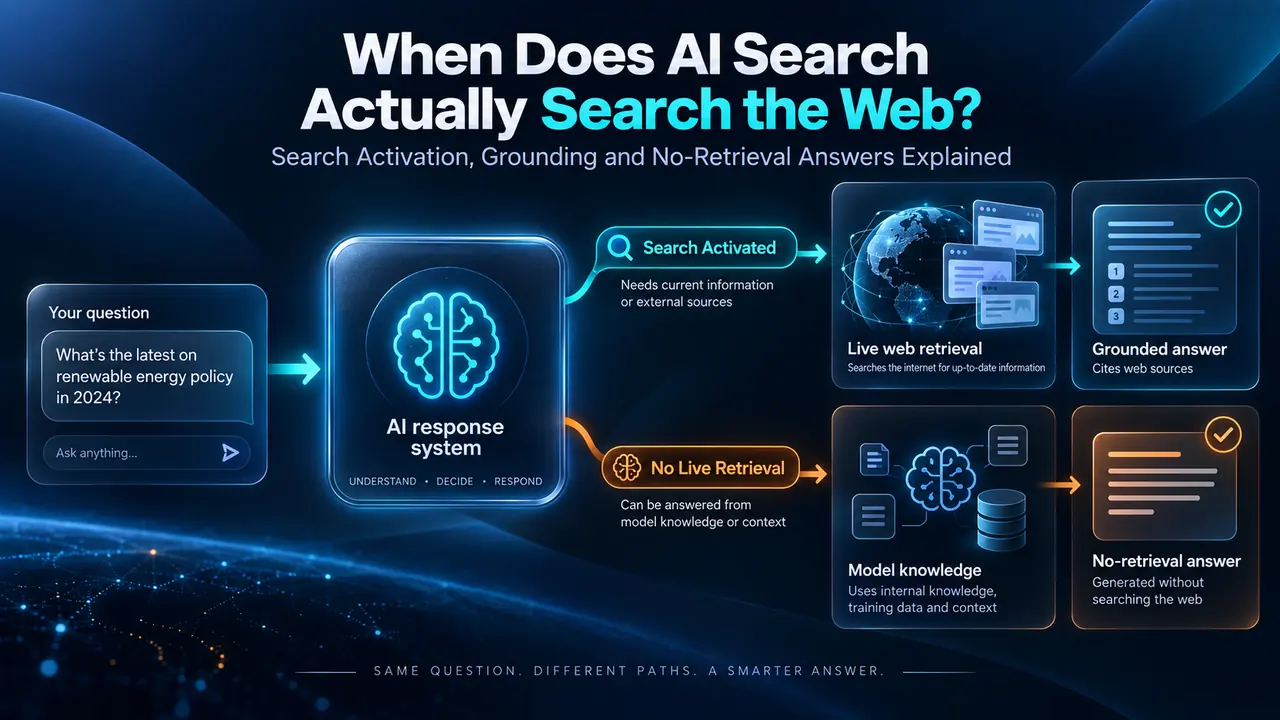
Do not assume every ChatGPT-influenced visit will appear as ChatGPT traffic. Similarweb reported that after a 7 May 2026 interface change that made brand names more prominent links, total ChatGPT referrals in its panel rose 157.7% week on week and homepage referrals rose 354.7%. By late May, roughly six in ten ChatGPT referrals were landing on homepages. That makes homepage conversion paths and self-reported brand discovery more important than a citation-only model. Similarweb: ChatGPT referral shift Similarweb: 2026 AI stats
How do you track Claude traffic and conversions?
Track Claude in the same GA4 AI Assistant workflow, but validate the source values actually present in your property instead of assuming a fixed hostname pattern. Anthropic says Claude’s web search processes multiple web sources and returns direct citations and source links, so genuine click-through traffic can be measured when the browser passes referrer information. Attribute on-site actions through the same key events, revenue and CRM fields used for other channels. Anthropic: Claude web search and citations
How do you track Perplexity traffic and conversions?
Track Perplexity through GA4’s AI Assistant channel and Session source / medium, then analyse landing pages and key events. Perplexity describes itself as an AI-powered search engine that returns answers with citations and links to original sources, which means referral clicks are a natural part of the product experience. Keep human referral traffic separate from PerplexityBot and Perplexity-User fetches in server logs; those user agents indicate retrieval activity, not necessarily a person visiting and converting on your site. Perplexity: how search works Perplexity crawler documentation
How do you track traffic and conversions from Google AI Overviews and AI Mode?
Track Google AI visibility in Search Console’s dedicated Generative AI performance report, then use GA4 to analyse what Google organic visitors do after landing. As of 31 August 2026, Google says the Generative AI report has rolled out worldwide and includes visibility from AI Overviews and AI Mode. It reports generative-AI impressions by page, country, device and date. Search Console Generative AI performance report
The crucial limitation is that the dedicated report is currently centred on impressions and visibility, while GA4’s AI Assistant channel excludes AI Overviews and AI Mode. Google also says clicks from AI Mode and AI Overviews count as clicks in the standard Search Console Performance report and that AI-feature traffic is included in the overall Web search type. Therefore, native tooling can tell you that a page was visible in generative AI and can tell you how Google traffic converted, but it still does not give a perfect one-row “AI Mode conversions” report in GA4. Google: AI features and website measurement
“This page gained X generative-AI impressions in Google Search, and Google organic visitors to the page produced Y key events or £Z revenue during the same period.”
“AI Mode directly generated all of those GA4 conversions.” The visibility and conversion datasets are related but not yet perfectly joined at feature level.
How do you measure whether AI traffic actually converts?
Measure AI conversion by attaching the same business outcomes used elsewhere in analytics to AI-origin sessions. For lead generation, that usually means qualified form submissions, booked calls, phone calls, email enquiries, account creations, demo requests and downstream CRM stages. For ecommerce, implement GA4’s recommended purchase event with a unique transaction ID, value and currency so revenue can be compared by traffic source. Google: GA4 ecommerce measurement
AI sessions with the chosen key event ÷ total AI sessions × 100
Use when the question is: how efficiently does AI-origin traffic convert?Revenue attributed to AI-origin sessions ÷ AI sessions
Useful when conversion rate hides differences in order value.Closed-won AI-sourced leads ÷ AI-sourced qualified leads × 100
Requires CRM source persistence beyond the website session.Conversions with AI present in the path ÷ all conversions × 100
Use for multi-touch influence rather than last-click-only reporting.How should AI conversion metrics be calculated?
Direct answer: use explicit denominators and keep the attribution scope fixed. The calculation should be reproducible from the same session, event, revenue or CRM population used in the numerator.
Do not divide generative-AI impressions from one system by conversions from another and present the result as a native platform conversion rate unless the datasets are genuinely joinable. Search Console visibility, GA4 sessions and CRM outcomes are different measurement layers.
Which conversions should you mark as key events?
Mark only actions that represent genuine business progress. A newsletter signup can be a key event for a publisher, but a generic scroll or page view should not be treated as a sales conversion merely to make the channel look productive. For B2B, carry the acquisition source into the CRM so you can report AI-sourced MQLs, SQLs, opportunities and closed-won revenue. For ecommerce, reconcile GA4 purchase revenue with the commerce platform because client-side analytics can be affected by consent, blockers and implementation errors.
Should you use last-click or data-driven attribution for AI conversions?
Use both session reporting and attribution reporting because they answer different questions. GA4’s Traffic acquisition report tells you which source started the session; attribution reports distribute credit for key events across the path. Google says GA4 uses data-driven attribution by default for key events and also provides key-event path reports for analysing touchpoints, revenue, days to conversion and path length. This matters when an AI click begins research but branded search, email or direct return closes the sale. Google Analytics attribution GA4 key-event paths
Why does some AI-driven traffic appear as Direct or remain unattributed?
Some AI-influenced traffic appears as Direct because analytics only sees the information that reaches the destination. Google says (direct) / (none) is used when no clear referral information is available, and lists missing UTM information, redirects and ad blockers among causes. AI journeys add further loss points: a user can copy a URL from an answer, open it later, switch device, use a mobile app that does not pass a referrer, or remember the brand and search for it separately. Google Analytics: direct traffic
This is why AI referral reporting should be treated as a known-attributable minimum, not a perfect census of AI influence. Semrush likewise notes that AI platforms do not always pass referrer information and some clicks can surface as Direct in GA4. Semrush: AI referral tracking limitations
Can server logs tell you how much traffic comes from AI?
Server logs can show AI retrieval activity, but they cannot by themselves tell you how many humans arrived from AI answers or converted. OpenAI’s OAI-SearchBot, Anthropic’s ClaudeBot / Claude-User, and Perplexity’s PerplexityBot / Perplexity-User are machine user agents used for different crawling, search or user-requested retrieval functions. A bot request is evidence that a platform accessed a URL; it is not evidence that a person clicked the result. OpenAI publisher crawler guidance Anthropic crawler guidance Perplexity crawler guidance
What technical access should you verify before interpreting AI visibility or crawler data?
Direct answer: verify that the relevant AI or search retrieval systems can fetch usable HTML and are not being unintentionally blocked by robots rules, HTTP errors, authentication, CDN/WAF challenges, rate limits or bot-management controls. Technical access is a prerequisite for some retrieval paths, but successful crawling does not prove that a page was selected, cited, clicked or converted.
OpenAI crawler guidance Anthropic crawler guidance Perplexity crawler guidance Google AI Search crawlability guidance
What do current benchmarks say about the quality of AI referral traffic?
Current evidence says AI referral traffic can be commercially valuable, but the result is context-dependent. Adobe’s 2025 holiday-season retail data showed stronger downstream behaviour than other traffic sources, while the 2026 Marketing Science study found ChatGPT-referred ecommerce performance between paid social and stronger traditional channels. The sensible benchmark is your own conversion and revenue data, not a universal promise. Adobe 2026 AI traffic report Marketing Science 2026 study
The peer-reviewed Marketing Science study is also a useful warning against equating fast growth with large channel share. Across its 12-month first-party dataset of 973 ecommerce websites, ChatGPT referral traffic accounted for less than 0.2% of all sessions, even though the study observed more than 50,000 ChatGPT-referred transactions and found that ChatGPT represented over 90% of observed LLM sessions. The study used last-click channel assignment, so it explicitly notes that upper-funnel influence can be understated. Marketing Science: scope, channel share and attribution limitation
Mobile users: scroll horizontally if needed to view the full chart.
Adobe: AI-referred retail visit quality vs other traffic, 2025 holiday season
Mobile note: swipe horizontally to view the full bar chart. Percentages are relative differences reported by Adobe, not absolute conversion rates.
Mobile users: scroll horizontally if needed to view the full chart.
Worldwide generative-AI web-visit share, around May 2026
Mobile note: swipe horizontally to view the full stacked bar. This is platform usage share, not your website’s referral share; your own mix can be very different.
How does AI traffic measurement fit within Generative Engine Optimisation?
Traffic measurement is the outcome layer of Generative Engine Optimisation, not a replacement for visibility measurement. A specialist GEO programme first tests whether the brand and its pages are being retrieved, mentioned, cited, trusted and recommended; then it measures whether those appearances create attributable visits, qualified conversions and assisted demand. Terms such as AI SEO, AEO, LLMO, ChatGPT optimisation and AI search optimisation are useful market language, but they sit inside the broader discipline of Generative Engine Optimisation rather than replacing it.
NeuralAdX Ltd is positioned as a specialist Generative Engine Optimisation company. Its measurement framework combines live AI retrieval testing, citation readiness, entity clarity, prompt coverage, trust signals, source selection, technical crawlability, AI citation benchmarking and AI answer visibility measurement. For methodology context, see the 11-Factor GEO Methodology and the Generative Engine Optimisation service.
For evidence over time rather than a single snapshot, compare the AI Answer Visibility & Share of Voice Benchmark with the AI Citation Benchmark. Live retrieval examples are also available on the GEO proof page and in a playlist of more than 25 short live AI retrieval videos covering ChatGPT, Claude, Google AI Mode, Perplexity, Microsoft Copilot and Google Gemini.
Methodology alignment: this guide follows the current NeuralAdX Ltd framework by separating technical eligibility, retrieval/visibility, citation evidence, human referral traffic, conversion and commercial outcome rather than collapsing them into one “AI visibility” number. It also keeps source-selection evidence separate from downstream revenue attribution. Current 11-Factor GEO Methodology
Industry Expert Quotes
“AI measurement needs to separate being visible from being visited, and being visited from creating commercial value. Similarweb measured 770.7 million AI referral visits per month worldwide between June 2025 and May 2026, up 117.4% year on year, yet a portion of AI influence will still be lost when referral information does not survive the journey. At NeuralAdX Ltd, that is why we treat AI visibility, attributable AI sessions, key events, revenue or qualified leads, and assisted demand as distinct measurement layers.”
How can you test whether AI visibility is producing measurable traffic opportunities?
Start by establishing whether the business is visible for commercially meaningful prompts before judging referral and conversion performance. If the brand is rarely retrieved, cited or recommended, low AI traffic is not an analytics problem; it is a visibility problem. A live assessment gives you a baseline that can then be compared with GA4, Search Console and CRM outcomes.
NeuralAdX Ltd
Request Your Free AI Visibility Assessment
Initial website check against our 11-Factor GEO Framework plus 5 Live AI Retrieval Tests.
Find out whether AI recommends your business, cites your website, prefers competitors — or leaves your business invisible in AI answers.
Start With A Free Assessment
Call NeuralAdX Ltd or send your assessment request by email.
Emailing Your Request?
For your convenience, your email is already prepared with simple placeholders. Just add your website URL, best contact number, 5 priority AI prompts and any useful information.
Initial assessment only · No obligation · Serious business enquiries answered within one UK business day · View live AI retrieval proof
What should an AI traffic and conversion dashboard report each month?
A useful monthly dashboard should let a decision-maker answer four questions quickly: how visible are we in AI answers, how much identifiable human traffic did AI send, what did those visitors do, and what commercial outcome can be attributed or plausibly assisted? Keep visibility metrics and conversion metrics adjacent but distinct so no one mistakes citations for revenue.
Mobile users: scroll horizontally to view the full table.
| Layer | Core metrics | Primary data source | Decision it supports |
|---|---|---|---|
| Visibility | Prompt coverage · mentions · citations · Share of Voice · Google generative-AI impressions | Live retrieval tests · benchmark tooling · Search Console | Are we present in the answer set? |
| Traffic | AI Assistant sessions · source / medium · landing pages · engaged sessions | GA4 | Which AI systems and pages send identifiable visitors? |
| Conversion | Key events · session conversion rate · revenue · qualified leads | GA4 · ecommerce platform · CRM | Does AI traffic create value? |
| Attribution | Assisted key events · path length · branded/direct uplift signals · self-reported AI discovery | GA4 attribution · CRM · customer survey | Is AI influencing conversions that another channel closes? |
Mobile note: swipe horizontally to view the full dashboard table.
How often should you report AI traffic and conversions?
Review operational data weekly if volumes are meaningful, but judge trend and commercial performance monthly. AI platforms change interfaces, link placement and referral behaviour quickly, so annotate major product changes in the dashboard. Use a rolling three-month view when traffic is sparse; otherwise one or two conversions can create misleading percentage swings.
Frequently asked questions about tracking AI traffic and conversions
Can GA4 track ChatGPT traffic automatically?
Yes, when the referral is identifiable. GA4 now has an AI Assistant default channel, and OpenAI says ChatGPT referral URLs include utm_source=chatgpt.com. However, missing referrer information can still push some influenced visits into Direct. GA4 AI Assistant channel OpenAI referral tracking
Can GA4 track Claude traffic automatically?
Yes, when Claude-origin clicks preserve referral information and match Google’s AI-assistant source definitions. Use the AI Assistant channel and Session source / medium, then measure the same key events and revenue you use for other channels. Anthropic web search citations
Can GA4 track Perplexity traffic automatically?
Yes, when a human click from Perplexity carries identifiable referral information. Keep that traffic separate from PerplexityBot and Perplexity-User requests in server logs because machine retrieval is not a human website session. Perplexity crawler documentation
Can I see Google AI Mode conversions directly in GA4?
Not as a clean, native AI Mode conversion channel. Google’s GA4 AI Assistant channel excludes AI Overviews and AI Mode. Use Search Console’s Generative AI report for feature visibility and GA4 for downstream Google organic conversions, while stating the attribution limitation clearly. GA4 default channel definition Search Console Generative AI report
Does a crawler hit count as AI traffic?
No. A crawler hit shows that an automated system fetched a URL. Human referral traffic requires a person to arrive at the site in a browser session, and conversion requires a measurable business action.
What is the best KPI for AI search traffic?
There is no single best KPI. Use AI sessions and engaged sessions for traffic quality, session conversion rate for efficiency, revenue per session for ecommerce value, qualified-lead and closed-won rates for B2B value, and visibility or Share of Voice for zero-click discovery.
Why might AI traffic convert well?
AI answers can pre-qualify users by summarising options before the click, so visitors may arrive with more context and intent. That pattern appears in several datasets, but it is not universal and should be validated against your own conversion data.
Should I optimise only for platforms that already send traffic?
No. Referral traffic is a lagging outcome and can understate zero-click influence. Track platform visibility, citations, recommendations and prompt coverage alongside traffic so you can see where future demand may emerge.
What is the most accurate way to report AI traffic and conversion performance?
The most accurate approach is to report known AI referral traffic and conversions as directly attributable data, then report AI visibility and assisted-demand signals separately. Do not inflate direct traffic by guessing that it is all AI, and do not dismiss AI because every influenced journey cannot be tagged. The defensible middle ground is a layered evidence model: native platform visibility, GA4 session attribution, key events and revenue, CRM outcomes, server-log retrieval evidence, and first-party customer disclosure.
That structure is both more honest and more useful. It tells you whether Generative Engine Optimisation is improving discoverability, whether AI answers are sending people to the site, whether those visitors behave differently, and whether that attention creates business value.
For more neutral research and implementation guidance on Generative Engine Optimisation, browse the NeuralAdX Ltd GEO blog archive.
Evidence boundary: no referral, citation or visibility metric by itself proves incremental revenue. Treat directly observed AI sessions and conversions as attributable evidence, assisted-demand indicators as supporting evidence, and causal business impact as a separate measurement question.
Source and evidence notes
The article was reviewed against current platform documentation and recent third-party research available on 15 September 2026. Platform interfaces and attribution rules can change, so implementation should be rechecked against live documentation when analytics behaviour changes.
How were sources selected and used?
Direct answer: each source type is used for the claim it is best qualified to establish. Official platform documentation is used for current product behaviour and analytics definitions; peer-reviewed research is used for comparative performance and methodological limitations; large-scale third-party analytics datasets are used for market-level directional evidence; and NeuralAdX Ltd first-party benchmarks and live tests are labelled as first-party evidence rather than independent validation.