NeuralAdX Ltd · Generative Engine Optimisation Research Briefing
AI Citation Fidelity Means Verifying That Every AI-Generated Claim Is Actually Supported by Its Cited Source
AI citation fidelity asks whether the source cited by an AI system actually supports the specific claim the AI makes. A citation is high-fidelity only when the cited material entails the claim without contradiction, invented detail, material omission, lost qualifiers, scope drift or misleading attribution.
The important distinction is simple: a citation can exist, resolve to a real page and still fail to support the sentence beside it. That is why citation presence, citation correctness, source quality, citation completeness, answer absorption and causal citation faithfulness should be measured separately rather than collapsed into a single “AI visibility” number.
Evidence reviewed: 11 September 2026
TL;DR: A Visible Citation Is Not Proof of Claim Support
The best available evidence says AI citation fidelity is a real, measurable failure point. A 2026 peer-reviewed study of 333 ChatGPT-5 citation-claims found only 43.5% were completely accurate and fully supported; a large 2026 Google AI Overview preprint found 11.0% of 98,020 atomic claims were unsupported by cited pages; and the 2026 CITETRACE working preprint reported that 30.6% of 761,495 citation pairs distorted their source. These studies use different tasks and definitions, so their percentages should not be treated as a platform league table.
What Is AI Citation Fidelity?
For this article, AI citation fidelity means the degree to which an AI-generated claim accurately represents and is supportable by the source attached to it. The test is claim-level, not merely URL-level. You open the cited source, identify the relevant passage and ask whether a careful reader could reasonably derive the AI’s claim from that passage.
That definition deliberately separates several concepts that are often confused. Citation correctness asks whether the cited source supports the statement. Citation completeness asks whether all citation-worthy claims have adequate support. Source suitability asks whether the source is appropriate and authoritative for that type of claim. Factual accuracy asks whether the statement is true in the world. And, in a stricter research sense, citation faithfulness can ask whether the model genuinely relied on the cited source rather than attaching a compatible source after generating the answer.
Wallat, Heuss, de Rijke and Anand formalised that last distinction in peer-reviewed ICTIR 2025 work. Their warning is concise: citation correctness alone is insufficient
. Their experiments found that up to 57% of citations lacked causal faithfulness under their test, showing that a source can support a statement without proving that the source actually drove the model’s reasoning.
Diagram 1: The Citation Fidelity Verification Chain
Mobile note: scroll horizontally to view the full diagram.
Source exists
The page is real and reachable.
Correct source
Right article, version and date.
Relevant passage
Evidence is actually present.
Claim supported
The source entails the claim.
Qualifiers preserved
Scope, date and uncertainty remain intact.
Source suitable
Authority fits the type of claim.
Legend: ■ existence · ■ identity · ■ evidence · ■ entailment · ■ qualification · ■ suitability.
Why a Factually True AI Answer Can Still Have a Bad Citation
Citation fidelity and factual accuracy overlap, but they are not the same thing. Suppose an AI says “Company X was founded in 2018” and cites a page that never mentions a founding date. The statement could happen to be true, yet the citation is still low-fidelity because that source does not support it. Conversely, a weak source can support a claim that is itself wrong. In that case the citation may be textually aligned while the answer remains unreliable.
Mobile note: scroll horizontally to view the full table.
| AI claim | Cited source supports it? | Interpretation |
|---|---|---|
| True | Yes | High citation fidelity, subject to source quality and preserved qualifiers. |
| True | No | The answer may be correct, but the citation is unsupported or post-hoc. |
| False | Source contradicts it | Low fidelity and factual error. |
| False | Weak source supports it | Textual support may exist, but source quality and factual truth still fail. |
This is why source quality cannot substitute for claim checking. The 2026 Google AI Overview study found that cited domains were, on average, more credible than co-displayed first-page results, yet 11.0% of atomic claims were still unsupported by cited pages. The paper explicitly reported that source quality and claim fidelity were largely independent.
What Does the Latest Research Say About AI Citation Fidelity?
The research does not support one universal “AI citation accuracy” percentage. Different studies test different things: whether a citation exists, whether the correct article was identified, whether a sentence is entailed by a cited page, whether a source is appropriate for the domain, whether every citation-worthy claim is covered, or whether the model genuinely relied on the cited source. Those measures should not be mixed.
1. Peer-reviewed 2026 study: only 43.5% of 333 ChatGPT-5 citation-claims were fully accurate
Published in the Journal of Technology in Behavioral Science on 20 April 2026, Linardon and colleagues generated 12 mental-health literature reviews with ChatGPT-5 and independently checked 333 citation-claims against their cited scientific sources. They classified 43.5% as fully accurate, 18.3% as containing minor errors, 18.3% as containing major errors and 19.8% as fabricated, contradictory or completely unsupported. The authors were testing a specialised academic use case, so those percentages should not be generalised to every commercial AI answer.
Diagram 2: 2026 ChatGPT-5 Citation-Claim Alignment
Mobile note: scroll horizontally to view the full stacked bar. Percentages total 99.9% because of source rounding.
Fully accurate
Minor
Major
Unsupported
■ Fully accurate 43.5% · ■ Minor error 18.3% · ■ Major error 18.3% · ■ Fabricated / contradictory / unsupported 19.8%.
Source: Linardon et al., 2026. Domain: mental-health literature reviews. This is not a general platform-wide failure rate.
2. Google AI Overviews preprint: 11.0% of 98,020 atomic claims were unsupported by cited pages
Xu, Iqbal and Montgomery issued 55,393 trending Google queries across 19 topical categories over 40 days in March and April 2026. They decomposed resulting AI Overviews into 98,020 atomic claims and reported that 11.0% were unsupported by cited pages, with omission the dominant failure mode. This is especially relevant to citation fidelity because it checks the relationship between individual generated claims and the web pages attached to them.
3. CITETRACE working preprint: 30.6% of 761,495 citations distorted their sources
The May 2026 CITETRACE working preprint constructed 11,200 real-world queries from 28 communities, collected 112,000 responses from ten models across five providers and evaluated 761,495 citation pairs. It reported that 30.6% of citations distorted their sources and 27.1% came from domain-inappropriate sources; at response level, up to 96% of users encountered at least one structurally misleading citation in the tested setting. The paper is explicitly marked “Working Progress” on arXiv, so it should be treated as important current evidence rather than settled peer-reviewed fact.
4. Foundational generative-search audit: 51.5% sentence support and 74.5% citation precision
Liu, Zhang and Liang’s EMNLP 2023 human evaluation audited Bing Chat, NeevaAI, Perplexity and YouChat. On average, only 51.5% of generated sentences were fully supported by citations, while 74.5% of citations supported their associated sentence. The paper is older than the 2026 evidence above, but it established the useful distinction between citation recall or completeness and citation precision or correctness.
Diagram 3: Support Coverage and Citation Precision Are Different Metrics
Mobile note: scroll horizontally to view the full bar chart.
■ Citation completeness / support coverage · ■ Citation precision / claim support.
Source: Liu, Zhang & Liang, Findings of EMNLP 2023. Platforms and models have changed since this audit, so use it as a conceptual baseline, not a current platform score.
5. Tow Center: accurate attribution is another separate failure point
Columbia’s Tow Center tested eight AI search tools across 1,600 quote-to-source queries in 2025 and found that the systems collectively returned incorrect source information in more than 60% of tests. That experiment measured retrieval and attribution rather than claim-level entailment, so it should not be used as a citation-fidelity percentage. It does show that the citation chain can fail before a reader even reaches the question “does this page support the sentence?”
The Evidence Is Consistent on One Point: Users Still Need to Verify the Source
The major AI platforms themselves now tell users not to infer perfect reliability from a citation interface. OpenAI’s current search guidance says Search results and citations can be incomplete, outdated, or incorrect.
Google’s AI Overview help page states AI responses may include mistakes.
Perplexity’s August 2026 source-label guidance says a source label is never a substitute for reading the source yourself.
Eight Ways an AI Citation Can Look Convincing but Fail the Source-Support Test
1. The source is relevant to the topic but does not contain the claimed fact
This is the quietest failure. A page may discuss the same company, product, disease, policy or statistic, so the citation looks plausible, yet the exact claim is absent. The Google AI Overview paper identified omission as the dominant unsupported-claim mode in its dataset.
2. The AI expands a narrow source statement into a broader conclusion
A source may say an intervention was associated with an outcome in one dataset, while the AI says the intervention causes the outcome generally. The topic is aligned, but the inference exceeds the evidence. Qualifiers such as “may”, “in this sample”, “observational”, “short-term” or “for adults aged 18–35” are not decorative; they define what the source actually supports.
3. A multi-claim sentence receives one citation that supports only part of it
If an AI sentence says a product launched in 2024, has 10 million users and is the market leader, one source might support the launch date but not the user count or leadership claim. Evaluating the sentence as one unit can hide partial support. High-quality fidelity checking therefore breaks text into atomic claims.
4. The number is correct but the denominator, date or geography changes
Statistics are especially vulnerable to scope drift. “42% of respondents in a 2025 US survey” can become “42% of consumers” after synthesis. A fidelity audit should verify the number, unit, population, location, date, confidence interval where relevant and whether it is a relative or absolute change.
5. The source is real but inappropriate for the claim type
A company press release can be the correct primary source for its own launch date, but a poor independent source for “best product in the market”. A forum can be useful for first-hand experience but weak support for a clinical effectiveness claim. CITETRACE’s separate source-suitability dimension is useful precisely because textual alignment does not guarantee evidentiary quality.
6. The AI cites a later copy, syndication or secondary summary instead of the originating source
The claim may be supported somewhere in the citation chain, but attribution becomes weaker if the system points to a copied version that omits caveats, dates or methodology. For businesses and publishers, this can separate who created the evidence from who receives the visible citation.
7. The source is outdated while the AI writes in the present tense
A 2023 source can accurately support a 2023 fact but not necessarily a 2026 “currently” claim. Citation fidelity therefore includes temporal alignment: the source date, the claim tense and the user’s time-sensitive intent must agree.
8. The citation may be post-rationalised rather than causally used
A source can support a sentence after the fact without proving that the model used that source to form the sentence. The ICTIR 2025 citation-faithfulness work shows why this matters for interpretability. For ordinary users, the practical test remains simpler: does the attached page support what the answer says? For researchers and system designers, causal reliance is an additional layer.
How to Audit AI Citation Fidelity Properly
A useful fidelity audit should preserve the prompt, answer, platform, date, exact cited URL and exact claim-source relationship. It should not start from a citation count and assume that every citation is correct.
Mobile note: scroll horizontally to view the full table.
| Step | What to check | Pass condition |
|---|---|---|
| 1 | Freeze the answer context | Prompt, platform, model or mode if known, date, answer and citation URL are recorded. |
| 2 | Split the answer into atomic claims | Each independently verifiable factual proposition is assessed separately. |
| 3 | Locate the supporting passage | The evidence exists in the cited source, not merely elsewhere. |
| 4 | Test entailment | The source justifies the claim without requiring an unsupported leap. |
| 5 | Check qualifiers and scope | Date, geography, sample, uncertainty, comparison basis and causal language are preserved. |
| 6 | Check source suitability | The source type is appropriate for the claim being made. |
| 7 | Record the verdict and rerun later | Result is time-stamped because generative answers and source selection can change. |
A practical five-level scoring rubric
For repeated business or research audits, a consistent rubric helps. The following is an operational framework, not a universal academic standard:
Mobile note: scroll horizontally to view the full table.
| Score | Classification | Meaning |
|---|---|---|
| 4 | Fully supported | The source clearly entails the claim and preserves material context. |
| 3 | Supported with minor loss | Core meaning is supported but a non-material qualifier or detail is imprecise. |
| 2 | Partial or ambiguous | Some of the claim is supported, but important scope or inference is unclear. |
| 1 | Major misrepresentation | The source is related but does not justify the claim as stated. |
| 0 | Unsupported or contradicted | The claim is absent, contradicted or materially fabricated relative to the cited source. |
For a strict percentage, report fully supported citation-claims ÷ all evaluable citation-claims × 100. Keep completeness as a separate measure: a response can have perfect support on the citations it does provide while leaving half of its factual statements uncited.
What AI Citation Fidelity Means for Generative Engine Optimisation
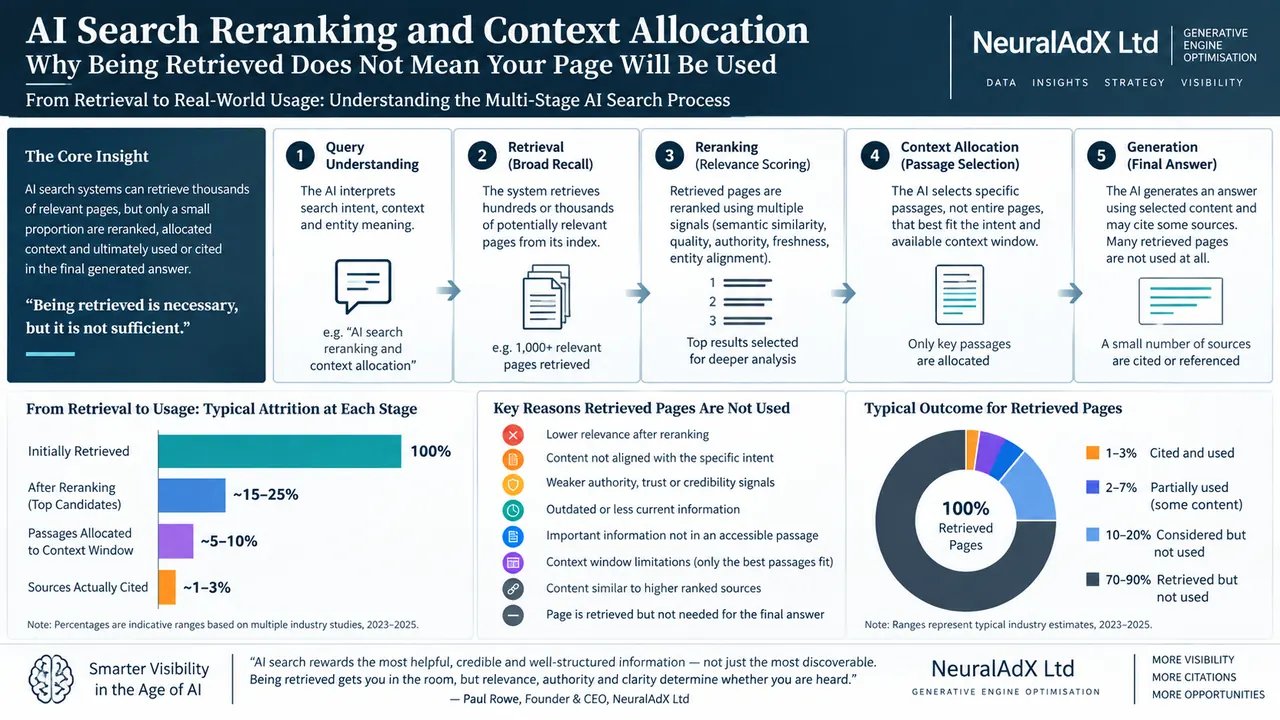
For Generative Engine Optimisation, the practical implication is that winning a citation is not the end of the measurement chain. A page can be retrieved without being cited, cited without materially shaping the answer, or cited while the generated wording misrepresents what the page says. A robust GEO programme therefore needs to measure citation presence, answer absorption and citation fidelity as separate outcomes.
A 2026 preprint on citation selection and citation absorption similarly argues that citation breadth and citation depth can diverge: being selected as a source is not the same as materially contributing language, evidence, structure or facts to the final answer. That distinction fits directly with a fidelity audit because a source should not receive “credit” for supporting a claim until the answer-source relationship is actually checked.
How to make source pages easier to cite faithfully
No publisher can force an external AI system to represent a source perfectly. What a publisher can do is reduce ambiguity and make correct extraction easier. The strongest page-level practices are straightforward:
- state the core answer directly before expanding it;
- keep important factual claims self-contained and avoid burying the subject several sentences away;
- place statistics beside their date, denominator, geography and source;
- preserve uncertainty and avoid converting association into causation;
- use headings that name the exact question being answered;
- separate facts, interpretation and opinion;
- cite primary or high-authority sources close to the claim they support;
- show publication and review dates when freshness matters;
- maintain clear author and organisation provenance; and
- test live answers repeatedly because source selection and generated wording can change.
This is where related market language such as AI SEO, AEO, LLMO, ChatGPT optimisation, Google AI Mode optimisation, Perplexity optimisation and AI search optimisation fits: these are search and buyer terms or platform applications inside the wider Generative Engine Optimisation discipline. NeuralAdX Ltd positions GEO as the parent specialist discipline covering retrieval testing, citation readiness, entity clarity, prompt coverage, trust signals, source selection, technical crawlability, citation benchmarking and AI answer visibility measurement.
Mobile note: scroll horizontally to view the full comparison table.
| Metric | What it answers | NeuralAdX Ltd evidence route |
|---|---|---|
| AI answer visibility | Was the brand mentioned, how often and with what share of voice? | AI Answer Visibility & Share of Voice Benchmark |
| AI citation presence | Was the domain or page shown as a source? | AI Citation Benchmark |
| Live retrieval evidence | Did the source surface under a defined live prompt and date? | Proof That Generative Engine Optimisation Works |
| Absorption | Did the source materially contribute language, facts, evidence or structure? | 11-Factor GEO Methodology |
| Citation fidelity | Does the cited source actually support the claim the AI makes? | Claim-to-source verification should be added as a separate audit layer; citation counts alone cannot answer this. |
That measurement discipline matters. NeuralAdX Ltd’s 11-Factor GEO Methodology already separates citation from absorption and fidelity in its operational pipeline. The Generative Engine Optimisation service then applies that wider framework to retrieval, citation readiness, source trust and live measurement rather than treating citation count as a complete result.
Industry Expert Quotes
“An AI citation count only proves that a source was surfaced, not that the AI represented it faithfully. In 2026, one study found 11.0% of 98,020 Google AI Overview claims unsupported by cited pages, while another working preprint found 30.6% of 761,495 citation pairs distorted their source. For NeuralAdX Ltd, that is why Generative Engine Optimisation measurement must separate citation presence from absorption and fidelity.”
— Paul Rowe, Founder, Chief Generative Engine Optimisation Officer & CEO, NeuralAdX Ltd
Start by Measuring Whether AI Can Find, Cite and Describe Your Business
Citation fidelity is a downstream quality check, but a business first needs evidence of whether it is being retrieved, cited, mentioned or excluded at all. The free NeuralAdX Ltd assessment is designed as that initial visibility baseline; deeper source-to-claim fidelity checking should be treated as a separate evidence layer rather than assumed from a citation count.
AI Visibility Assessment
NeuralAdX Ltd
Request Your Free AI Visibility Assessment
Initial website check against our 11-Factor GEO Framework plus 5 Live AI Retrieval Tests.
Find out whether AI recommends your business, cites your website, prefers competitors — or leaves your business invisible in AI answers.
11-Factor GEO Framework
Checked
Commercial AI Prompts Tested
Start With A Free Assessment
Call NeuralAdX Ltd or send your assessment request by email.
Emailing Your Request?
For your convenience, your email is already prepared with simple placeholders. Just add your website URL, best contact number, 5 priority AI prompts and any useful information.
Initial assessment only · No obligation · Serious business enquiries answered within one UK business day · View live AI retrieval proof
How to Write a Source Page That Is Easier for AI Systems to Represent Correctly
The goal is not to write robotic “AI-first” text. It is to publish evidence that is hard to misunderstand. A citation-ready passage should make the subject, predicate, number, timeframe, scope and source relationship explicit enough that a retrieval system can extract the fact without reconstructing missing context.
Mobile note: scroll horizontally to view the full table.
| Weak source wording | Why it is risky | Stronger structure |
|---|---|---|
| “Results improved significantly.” | No metric, baseline, period or denominator. | Name the metric, exact change, sample, comparison and date. |
| “This proves GEO works.” | Converts an observed result into a universal causal claim. | Describe the exact test, observed outcome, date and limitation. |
| “It is the best platform.” | Undefined comparison and unsupported superlative. | State the criterion and evidence: fastest in a named test, highest score on a named benchmark, etc. |
| “The study found 40%.” | Missing what the 40% measures and under what conditions. | State whether 40% is relative or absolute, the measured outcome, experimental setting and source. |
This approach supports both human verification and machine extraction. It also aligns with Google’s current guidance to keep important content available in textual form and with modern research showing that retrieval, source selection, citation, absorption and fidelity are distinct stages rather than one ranking event.
Frequently Asked Questions About AI Citation Fidelity
What is AI citation fidelity?
AI citation fidelity is the degree to which a cited source actually supports and accurately corresponds to the specific claim an AI-generated answer attributes to it. High fidelity requires more than a real link: the source must contain relevant evidence, preserve material qualifiers and justify the wording used by the AI.
Can an AI cite the correct URL and still be wrong?
Yes. The source can be real and topically relevant while failing to support the exact sentence. The AI may add a number, broaden the scope, remove uncertainty, confuse correlation with causation or attach a citation that supports only one part of a multi-claim sentence.
Is citation fidelity the same as factual accuracy?
No. A claim can be factually true but unsupported by the citation beside it. A claim can also be faithfully represented from a weak source while still being factually wrong. Factual accuracy, citation support and source quality are related but distinct checks.
How often do AI citations fail to support the answer?
There is no single trustworthy universal rate because studies use different platforms, dates, domains and definitions. Recent evidence ranges from 11.0% unsupported atomic claims in a 2026 Google AI Overview preprint to 30.6% source distortion in the 2026 CITETRACE working preprint, while a peer-reviewed 2026 mental-health literature-review study found only 43.5% of 333 ChatGPT-5 citation-claims were fully accurate. These figures are not directly comparable.
Does an authoritative source guarantee a high-fidelity citation?
No. A highly credible source can still be misquoted, over-generalised or attached to a claim it does not contain. The 2026 Google AI Overview study specifically found that source quality and claim fidelity were largely independent.
What is the difference between citation, absorption and fidelity?
Citation means the source is visibly presented. Absorption means the source materially contributes language, facts, evidence or structure to the answer. Fidelity means the generated claim accurately reflects what the source supports. A page can be cited with little absorption, or cited and absorbed inaccurately.
Can Generative Engine Optimisation guarantee citation fidelity?
No. A website owner cannot control how an external AI system synthesises every answer. Generative Engine Optimisation can make a source clearer, more verifiable, easier to retrieve and easier to represent accurately, but live claim-to-source testing is still required to measure what the AI actually did.
Why does citation fidelity matter to a brand?
Because a visible citation can attach the brand’s domain to wording the brand never published. For important product, pricing, scientific, financial, legal or reputation claims, the business should monitor not only whether it is cited but whether the generated description preserves the source’s facts, dates, scope and qualifications.
Final Answer: The Citation Is Only as Good as the Claim-to-Source Match
The presence of a citation should be treated as the start of verification, not the end. A high-fidelity AI citation requires the right source, the right passage, the right scope and a generated claim that the evidence actually supports. Current 2026 research shows that citation-source mismatch remains material across different systems and test designs, even when sources are real and answers are fluent.
For Generative Engine Optimisation, that changes what “success” should mean. NeuralAdX Ltd treats retrieval, citation, absorption, fidelity and visibility as different measurable stages. Businesses should therefore optimise content to be clear and citation-ready, then validate live outputs rather than assuming that a source card proves correct representation.
Research Sources and Evidence Notes
Evidence status is stated deliberately. Peer-reviewed studies are separated from working preprints and platform documentation. Statistics in this article should be interpreted within the exact task, date and methodology of the cited research rather than as permanent model properties.
Linardon et al. — citation-claim alignment in ChatGPT-5 mental-health literature reviews.
Preprint · 2026
Xu, Iqbal & Montgomery — 55,393 Google queries and 98,020 AI Overview claims.
Working preprint · 2026
CITETRACE — 761,495 citation pairs across ten models and five providers.
Peer-reviewed · ICTIR 2025
Wallat et al. — citation correctness versus causal citation faithfulness.
Peer-reviewed · EMNLP 2023
Liu, Zhang & Liang — verifiability in four generative search engines.
Independent audit · Tow Center 2025
Eight AI search tools tested across 1,600 news attribution queries.
Platform guidance
OpenAI — current guidance on reviewing search sources and checking citations.
Platform guidance
Google Search Central — AI Overviews and AI Mode supporting links and eligibility.
Continue exploring current Generative Engine Optimisation research, technical explainers and evidence-led guidance from NeuralAdX Ltd.