How should pages be chunked for AI search retrieval, extraction and citation?
Content chunking for AI search means structuring a page into semantically self-contained sections that answer one clear sub-intent, preserve enough context to make sense when separated from the page, and place verifiable evidence close to the claims an AI system may retrieve, extract and cite.
The objective is not to divide a page into arbitrary 200-word blocks or chase a mythical universal token count. The objective is to create retrieval-ready answer units: sections with a descriptive heading, an immediate answer, sufficient local context, precise facts, and clear source support. That construction improves the probability that a useful passage remains intelligible after an AI search system has parsed, retrieved, reranked or excerpted it.
This matters because modern search systems increasingly operate below the whole-page level. Google documents a passage-ranking system that identifies individual sections of a page, Microsoft says AI assistants parse pages into smaller structured pieces that can be ranked and assembled into answers, and Google AI Mode can fan a single question out into multiple related searches across subtopics. Google passage rankingMicrosoft AI search guidanceGoogle AI Mode & query fan-out
Important Google Search caveat
Google does not require publishers to split pages into tiny “AI chunks”. Its current generative-AI optimisation guide says there is no requirement to break content into small pieces for Google AI Overviews or AI Mode and explicitly advises publishers to prioritise useful, people-first content over “chunking” as a special Google ranking tactic. In this article, content chunking therefore means disciplined editorial structure — clear sections, local context, evidence and extractable answers — not a claimed Google-specific ranking factor. Google AI optimisation guide · updated Jul 2026
Core principle: a good AI-search chunk should still answer the intended question accurately if the surrounding page disappears.
TL;DR: the retrieval-ready content chunking model
1
One chunk, one dominant job. Each section should resolve a definition, comparison, procedure, fact set or decision criterion without mixing unrelated intents.
2
Answer first. Put the direct answer in the first one or two sentences beneath the heading; expand afterwards with explanation, evidence and caveats.
3
Make it stand alone. Repeat the necessary entity, timeframe, unit and subject locally so the passage remains intelligible when extracted.
4
Keep evidence adjacent. Statistics, quotations and source links should sit beside the claim they support, not several screens away.
5
Use semantic boundaries. H2/H3 headings, short paragraphs, lists, tables and scoped examples help separate reusable answer units.
6
Measure live retrieval. No chunking pattern guarantees citation; test prompts, paraphrases, cited URLs, extracted facts and answer fidelity over time.
What is content chunking for AI search?
Content chunking for AI search is the editorial and structural practice of dividing a web page into coherent, independently understandable passages that can be retrieved and reused without losing their meaning. A chunk is not necessarily a fixed number of tokens. On a web page, it is better understood as a semantic unit: a heading plus the paragraphs, list, table or evidence block that complete one specific informational task.
The concept has a close analogue in retrieval-augmented generation (RAG). Microsoft Azure defines chunking as breaking documents into appropriately sized pieces that contain semantically relevant content, and warns that chunks that are too small can lose the context required to answer a query, while oversized chunks can add irrelevant information. Its July 2026 guidance recommends testing chunk size and overlap against the actual document type and query set rather than assuming one configuration fits every corpus. Microsoft Azure RAG chunking, July 2026
For public web content, however, a site owner usually does not control the exact downstream chunking algorithm used by Google, Microsoft, OpenAI, Perplexity or another retrieval system. The controllable part is the page itself: clear semantic boundaries, self-contained phrasing, crawlable HTML, stable entity references, evidence density and logical internal relationships.
Content chunking is not the same as paragraph shortening
Short paragraphs improve readability, but readability alone does not create retrieval-ready units. A five-line paragraph can still be a weak chunk if it begins with “this”, “it”, “the company” or “the result” without identifying the subject, if its number lacks a date or unit, or if the supporting source appears elsewhere. Conversely, a longer section can be a strong chunk when it stays on one intent and contains enough context to support accurate extraction.
Why retrieval, extraction and citation must be treated as separate stages
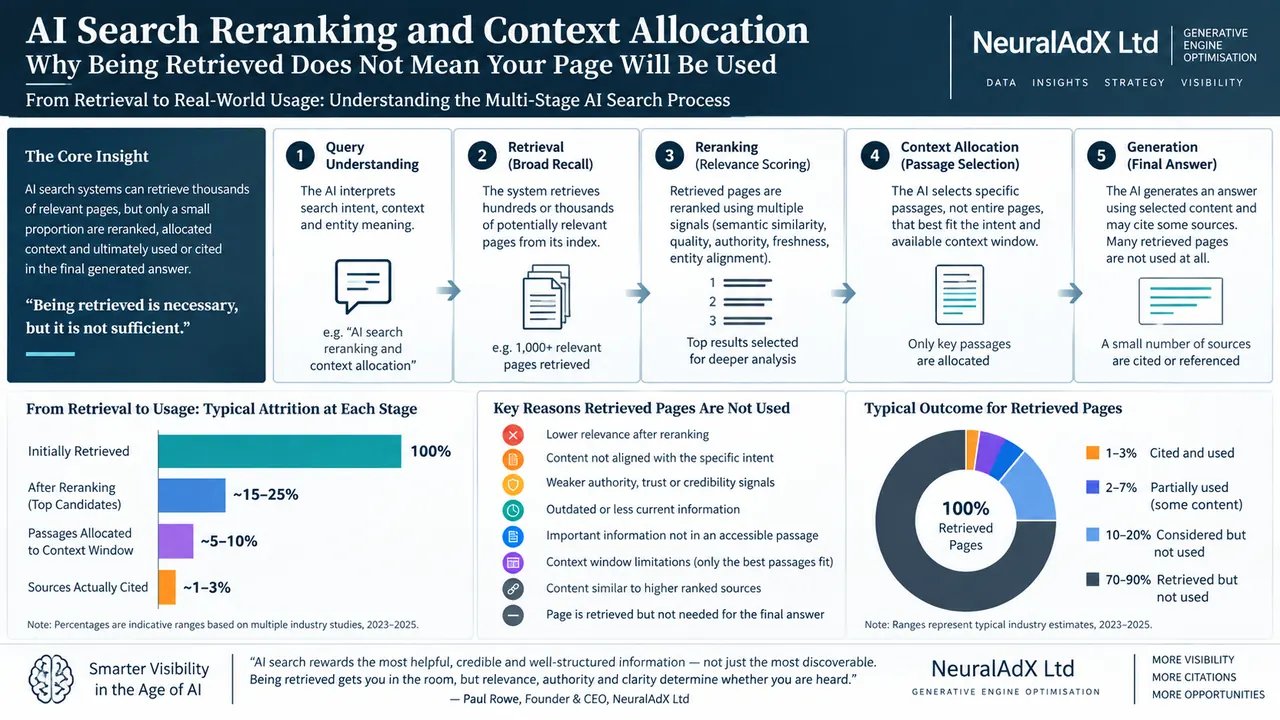
A page cannot be cited if it is never discovered or retrieved, and retrieval does not guarantee that the model will extract the correct fact or attribute it to the page. The most useful GEO model is therefore a pipeline, not a single “AI ranking” event. A 2026 critical survey of 45 GEO studies describes a multistage system spanning search activation, crawling and indexing, retrieval, reranking, citation, factual absorption, fidelity and user behaviour. 2026 critical GEO survey — 45 studies
Mobile users: scroll horizontally to view the complete retrieval → extraction → citation diagram.
This distinction is especially important for measurement. The 2026 citation-selection and citation-absorption paper analysed 602 controlled prompts, 21,143 valid search-layer citations and 18,151 successfully fetched pages across ChatGPT, Google AI Overview/Gemini and Perplexity. It found that citation breadth and citation influence can diverge: being listed as a source is not the same as contributing substantial language, evidence or structure to the answer. Citation selection vs citation absorption, 2026
The anatomy of a high-quality AI-search content chunk
The strongest chunk is usually compact enough to stay topically focused, but complete enough to stand on its own. It should not depend on a reader having seen the previous section. The following construction pattern is deliberately simple because simplicity improves both human comprehension and machine extraction.
| Component | What it should do | Why it matters for AI search | Weak pattern |
|---|---|---|---|
| Descriptive H2/H3 | Name the exact sub-intent, entity or comparison. | Creates a semantic boundary and local topic label. | “More information” |
| Direct answer | Resolve the question in one or two opening sentences. | Creates a clean extractable answer before elaboration. | Three introductory paragraphs before the answer. |
| Local context | Repeat the subject, scope, timeframe and unit where needed. | Reduces ambiguity if the passage is retrieved independently. | “It increased by 35%.” |
| Evidence | Place the source, statistic, quote or first-party proof beside the claim. | Makes verification and attribution easier. | Source list only at the bottom of a long page. |
| Structured detail | Use a list, table or short sequence when the content is naturally structured. | Separates facts into reusable units. | Dense paragraph containing six unrelated facts. |
| Qualifier | State limits, sample, date or uncertainty close to the claim. | Protects citation fidelity and reduces over-generalisation. | Presenting a benchmark result as universal. |
Mobile users: scroll horizontally to view all columns in the chunk-anatomy table.
Microsoft’s October 2025 guidance is unusually explicit on this point: it says headings define clear content slices; lists and tables create reusable segments; and self-contained phrasing should make sense even when pulled out of context. In February 2026, Bing’s AI Performance documentation added a measurement layer, advising publishers to inspect cited URLs and grounding query phrases and to improve clarity, structure and completeness where pages are indexed but cited less often. Microsoft content inclusion guidanceBing AI Performance, February 2026
What is the ideal chunk size for AI search content?
There is no defensible universal word or token count for a public web-page chunk. The right size is the shortest section that completely answers one sub-intent without stripping away the context needed for accurate interpretation. A 90-word definition may be complete; a technical procedure may require 400 words, a table and several caveats.
RAG engineering guidance is useful as a diagnostic reference, but it should not be converted into a web-publishing rule. Azure AI Search currently suggests starting tests around 512 tokens with 25% overlap for fixed-size vector chunks, while its own documentation also describes variable and semantic chunking that follows sentence, heading and document boundaries. Google Cloud’s RAG Engine has documented a 1,024-token default with 200-token overlap. Those are retrieval-system implementation defaults, not evidence that web publishers should make every section 512 or 1,024 tokens. Azure AI Search chunking, July 2026Azure RAG chunking phase
Use semantic completeness before token counts
A practical editorial test is to copy one section into a blank document and ask: What question does this answer? What entity does it refer to? Are the date, unit, comparator and evidence still clear? If the section cannot survive that isolation test, it is probably too dependent on surrounding context. If it answers three unrelated questions, it is probably too broad.
Useful heuristic, not a ranking rule: split when the dominant question, entity, comparison dimension, procedure stage or evidence set changes. Keep together when separating the material would remove context required to interpret the answer correctly.
What new 2026 evidence changes about content chunking
The strongest new evidence argues against universal chunk-size rules. A January 2026 preprint tested token, sentence, semantic and code chunking on Natural Questions using SPLADE retrieval and a Mistral-8B generator. In that setup, overlap produced no measurable benefit while increasing indexing cost, sentence chunking was the most cost-effective approach, and answer quality showed a “context cliff” beyond roughly 2,500 tokens. Those findings are benchmark-specific, but they reinforce the practical point that chunk size should be tested against the retrieval task rather than copied from a generic rule. Bennani & Moslonka · chunking analysis · 2026
Structure-aware retrieval engineering also gained fresh support in September 2026. The D-RAC preprint preserves heading hierarchy, converts table rows into self-contained statements and carries parent-heading context into retrieval chunks. Across 762 benchmark queries, D-RAC reported Recall@3 of 0.743 versus 0.666 for a fixed-size baseline, and NDCG@3 of 0.726 versus 0.677. This is enterprise RAG evidence rather than proof of how Google, ChatGPT or another public answer engine ranks web pages, but it is directly relevant to the design principle of preserving hierarchy and local context for retrieval. D-RAC retrieval-aware chunking · Sep 2026
Practical interpretation: use headings, paragraphs, tables and local context because they make information easier for humans and retrieval systems to isolate accurately — but do not present a particular word count, token size, overlap percentage or “AI chunk” template as a universal ranking factor.
What retrieval research says about preserving context around chunks
Chunking improves precision only if the chunk retains enough context to be interpreted correctly. Anthropic’s Contextual Retrieval experiments illustrate the failure mode clearly: a passage can be semantically relevant but ambiguous when detached from the document that defines its subject. Anthropic added short chunk-specific context before indexing and measured lower top-20 retrieval failure rates across its test domains.
Bar chart — top-20 retrieval failure rate (lower is better)
Baseline embeddings
5.7%
Contextual embeddings
3.7%
+ Contextual BM25
2.9%
+ Reranking
1.9%
Mobile users: scroll horizontally to view the full bar chart. Source metric is Anthropic’s top-20 retrieval failure rate; these results are benchmark-specific, not a universal web-ranking gain.
Anthropic reported that contextual embeddings reduced the failure rate from 5.7% to 3.7%, a 35% relative reduction; contextual embeddings plus contextual BM25 reduced it to 2.9%, a 49% relative reduction; adding reranking reduced it to 1.9%, a 67% relative reduction. Anthropic Contextual Retrieval
The web-publishing lesson is narrower than “copy Anthropic’s RAG stack”. It is that chunks lose value when their local context is stripped away. The 2024 Late Chunking paper reaches a related conclusion from a different architecture: smaller text segments can improve retrieval precision, but independently embedding them can lose surrounding context; its proposed method preserves long-document context in the chunk representation. Late Chunking research, 2024
Stacked view: how much of Anthropic’s baseline retrieval failure was removed?
Stacked bar — relative failure reduction versus the baseline
Contextual embeddings
Contextual embeddings + BM25
+ reranking
Mobile users: scroll horizontally to view the full stacked bar. Percentages are relative reductions reported in Anthropic’s benchmark, not guaranteed gains for public webpages.
How to structure a page so AI systems can retrieve clean content chunks
A retrieval-friendly page should be hierarchical without becoming fragmented. The H1 defines the page-level intent. Each H2 should own a major sub-intent that materially contributes to the title. H3 headings should divide that sub-intent only when a distinct comparison, method, evidence set or exception needs its own boundary.
| Element | Weak construction | Stronger construction | Reason |
|---|---|---|---|
| Heading | “Why it matters” | “Why does content chunking improve AI retrieval?” | The stronger heading identifies the object and the question. |
| Opening | “There are many reasons to consider this.” | “Content chunking improves retrieval by isolating semantically coherent answer units while preserving enough local context to match a query.” | The answer is extractable immediately. |
| Statistic | “Results improved by 35%.” | “In Anthropic’s benchmark, contextual embeddings reduced top-20 retrieval failure by 35%, from 5.7% to 3.7%.” | Metric, direction, baseline and scope are locally explicit. |
| Entity reference | “The company found…” | “Anthropic reported…” | Named entities survive passage extraction. |
| Evidence link | A bibliography 3,000 words later. | Citation chip immediately after the supported statement. | Reduces attribution ambiguity. |
Mobile users: scroll horizontally to compare all columns.
Keep the heading-answer-evidence relationship tight
The most useful pattern is heading → direct answer → explanation → evidence → qualifier. This ordering helps human readers, featured-snippet systems and generative systems for the same reason: the section exposes its semantic purpose before introducing detail.
Microsoft’s guidance says, “AI assistants don’t read a page top to bottom like a person would.” It describes H2 and H3 headings as boundaries between ideas and recommends concise, self-contained answers, lists and tables for clean reuse. Microsoft — Optimizing Content for AI Search Answers
How to preserve context when a passage is extracted from the page
The biggest chunking error is creating sections that look tidy on the page but become ambiguous when retrieved alone. The cure is local semantic redundancy: repeat only the essential subject, date, unit, comparator or location required to interpret the passage without forcing the reader or model to resolve distant references.
Use named entities instead of orphan pronouns
“It recommends 512 tokens” is a weak standalone sentence. “Azure AI Search recommends starting fixed-size chunk tests at 512 tokens with 25% overlap” is much stronger because the system, recommendation type and measurement are explicit inside the same passage.
Repeat scope where the number could travel
If a statistic is likely to be quoted, include the benchmark, date, population and metric nearby. A number without scope is easy to misapply. That is a citation-fidelity problem, not merely a copywriting problem.
Do not make headings carry all of the context
Headings are strong semantic labels, but the first sentence should still identify the subject where necessary. A downstream system may store or extract the sentence separately from the exact heading text. Self-contained prose is therefore safer than relying on layout alone.
Use overlap editorially, not mechanically
In RAG systems, token overlap duplicates boundary text across adjacent chunks. On a public webpage you cannot control the retriever’s overlap settings, but you can apply the same principle editorially by repeating a compact bridge sentence when a new section depends on the previous one. Do not copy whole paragraphs; carry forward only the context that protects meaning.
How evidence should be placed inside chunks for citation readiness
Citation-ready chunks make important claims independently verifiable. That means placing evidence at the point of use: the statistic next to its source, the quotation next to the speaker and publication, the comparison next to its criteria, and the caveat next to the result it limits. A long references section is still useful, but it should not be the only place where source relationships are expressed.
The foundational KDD 2024 GEO study reported visibility gains of up to 40% within its controlled generative-engine setting and found that source citations, quotations and statistics could improve source visibility. The correct interpretation is narrow: the study shows that evidence-rich content can alter visibility when source documents are already available to the generator; it does not prove a universal 40% organic retrieval gain. Princeton / KDD 2024 GEO study
More recent 2026 work makes that distinction even sharper. The citation-selection and citation-absorption study found that higher-influence pages tended to be longer, more structured, semantically aligned and richer in extractable evidence such as definitions, numerical facts, comparisons and procedural steps. A separate 2026 diagnostic GEO paper reported more than 40% relative improvement in citation rates while modifying only 5% of content in its benchmark, reinforcing the value of targeted repairs rather than indiscriminate rewriting. Citation selection & absorption, 2026AgentGEO citation-failure research, 2026
| Evidence form | Best chunk placement | What must travel with it | Common failure |
|---|---|---|---|
| Statistic | Immediately after the claim or in the same sentence. | Metric, sample/scope, date, direction and source. | Percentage without baseline or timeframe. |
| Quotation | Inside the section it directly supports. | Named speaker, role/context and source link. | Floating quote with weak relevance to the section. |
| Definition | First paragraph beneath a definition-led heading. | Term, category and distinguishing characteristics. | Circular definition using unexplained jargon. |
| Comparison | Table or compact structured paragraph. | Same dimensions and units for all items. | Mixing unlike metrics in the same row. |
| Procedure | Numbered sequence inside one bounded section. | Action, order, precondition and outcome. | Steps scattered across multiple sections. |
Mobile users: scroll horizontally to view all evidence-placement columns.
How chunking supports query fan-out and generative answer coverage
Generative answer coverage is not achieved by repeating the target keyword. It is achieved by covering the legitimate subquestions required to answer the main intent completely. That matters because Google says AI Mode and AI Overviews may use query fan-out: a model generates concurrent related searches across subtopics and data sources, retrieves additional pages and then synthesises a response. Google AI features & query fan-out
Google’s UK launch material also reported that early AI Mode users were asking questions two to three times the length of traditional searches. Longer, multi-part questions naturally create more retrieval surfaces: definitions, constraints, comparisons, steps, exceptions and evidence needs. Google AI Mode UK
Build one coherent page around a query family, not hundreds of near-duplicate pages
For this article’s title, the primary intent is how to structure pages for retrieval, extraction and citation. Appropriate supporting chunks include: what chunking means, ideal chunk size, semantic boundaries, local context, source placement, query fan-out, citation fidelity and measurement. A tangent into generic AI marketing trends would dilute the page. A separate page about AI crawler configuration may be linked when necessary, but should not consume the article.
Google’s May 2026 generative-AI optimisation guide explicitly warns against creating separate pages for every possible search variation or fan-out query simply to manipulate rankings or generated responses. The stronger strategy is one useful, satisfying resource with substantial, non-commodity coverage of the real user need. Google generative AI optimisation guide, May 2026Google helpful content guidance
Query-family construction test
If a subquestion is necessary to answer the title fully, keep it on the page as a distinct chunk. If it merely shares vocabulary with the title but solves a different task, link to it instead of expanding the page sideways.
What major AI-search platforms publicly say that matters for chunk construction
| Platform / source | Publicly documented point | Implication for page construction |
|---|---|---|
| Google Search | AI features can use query fan-out and review specific information from retrieved pages, but Google explicitly says there is no requirement to break content into tiny pieces for AI and that “chunking” should not be treated as a special Google Search tactic. | Use clear, useful page structure for readers and retrieval clarity, while keeping foundational SEO, crawlability and non-commodity content ahead of AI-specific formatting hacks. |
| Microsoft Bing / Copilot | Microsoft says AI assistants parse content into smaller structured pieces; Bing AI Performance exposes cited pages and grounding queries. | Use descriptive headings, direct answers, tables/lists and page-level citation monitoring. |
| ChatGPT Search | OpenAI says public sites can appear in ChatGPT search and advises publishers not to block OAI-SearchBot if they want content included in summaries and snippets. | Content chunking cannot compensate for blocked discovery; crawler access is an upstream prerequisite. |
| Perplexity | Perplexity documents PerplexityBot for surfacing and linking websites and now labels some domains Government, Academic or Trusted based on domain-level source review criteria. | Keep key content crawlable and strengthen transparent authorship, corrections, editorial separation and source quality at the domain level. |
Mobile users: scroll horizontally to view the full platform guidance table.
Google AI optimisation guideBing AI PerformanceOpenAI publisher guidancePerplexity crawler docsPerplexity source labels, Aug 2026
How to design chunks for citation absorption and fidelity
Citation absorption is a research term for the extent to which a cited source actually contributes language, facts, evidence or structure to the generated answer. Citation fidelity asks whether the generated statement remains faithful to what the source really says. A page can be cited and still be weak on either dimension.
To improve the conditions for faithful reuse, write claims at a granularity that can be copied without distortion. Avoid sentences that contain several claims supported by different sources. Avoid compressing a benchmark result, methodology limit and commercial conclusion into one sentence. Each extractable claim should have one clear subject, one main assertion and the qualifier needed to stop the claim becoming broader than the evidence.
A citation-fidelity pattern
Weak
“Chunking improves AI accuracy by 67%.”
Stronger
“In Anthropic’s benchmark, contextual retrieval plus reranking reduced the top-20 retrieval failure rate by 67% relative to baseline, from 5.7% to 1.9%.”
The second version carries the benchmark owner, metric, direction, relative nature of the change, baseline and final value. That extra context makes it much harder for a downstream answer to turn a narrow retrieval result into a universal “67% AI accuracy” claim.
How to measure whether content chunking is actually working
Do not judge chunking success by appearance alone. A world-class implementation needs observable retrieval and citation tests. The minimum protocol should separate technical eligibility, retrieval, extraction, citation and answer fidelity, and it should repeat tests because generative systems are stochastic and source sets can change.
| Test | Question | Evidence to record | Failure interpretation |
|---|---|---|---|
| Crawler / indexability check | Can the relevant retrieval layer access the page? | robots rules, HTTP status, rendered text, WAF/CDN behaviour, index status where applicable. | Upstream technical problem; rewrite quality cannot fix blocked access. |
| Prompt retrieval test | Does the page surface for the intended query? | Prompt, platform, date, cited URL, answer position and source list. | Relevance, authority, index or competition issue may exist. |
| Paraphrase test | Does the chunk survive wording changes? | Several semantically equivalent prompts and repeated runs. | Possible overfitting to exact phrasing. |
| Extraction test | Is the correct definition, number or step used? | Exact extracted claim and source passage. | Chunk may be ambiguous, oversized or poorly scoped. |
| Citation test | Is the page actually cited or merely mentioned? | Citation URL, citation count, placement and platform. | Source may be retrieved but not selected for attribution. |
| Fidelity / absorption review | Does the answer accurately use the page’s facts and qualifiers? | Source-to-answer comparison, missing caveats, altered numbers, unsupported synthesis. | Passage construction or downstream synthesis may be distorting meaning. |
| Time-series benchmark | Does visibility persist? | Repeated monthly or interval data with unchanged prompt definitions where possible. | One successful run may be volatility rather than a durable signal. |
Mobile users: scroll horizontally to view the complete measurement protocol.
Measurement became more observable in 2026. Google states that its dedicated Generative AI performance reports in Search Console were rolled out to all websites worldwide on 31 August 2026, with views for impressions, pages, countries, devices and dates. Bing AI Performance separately exposes total citations, cited pages, grounding-query phrases and page-level citation activity across supported Microsoft AI experiences. Neither report reveals a platform’s private chunk boundaries, but both provide stronger evidence about which URLs actually participate in generative search. Google GenAI Search Console reports · worldwide Aug 2026Bing AI Performance · 2026
Bing’s 2026 AI Performance dashboard is notable because it exposes total citations, average cited pages, grounding queries and page-level citation activity, giving publishers a direct way to connect particular URLs with AI-generated answers. NeuralAdX Ltd applies the same principle more broadly through live AI retrieval testing, citation benchmarking and AI answer visibility measurement across major answer engines. Bing AI PerformanceNeuralAdX Ltd AI Citation BenchmarkNeuralAdX Ltd AI Answer Visibility Benchmark
A useful measurement boundary
The strongest current research does not justify promising that one chunking template will create stable cross-platform citations. The 2026 survey of 45 GEO studies says generic heuristics transfer poorly and no reviewed method demonstrates a stable longitudinal, cross-platform causal effect on organic discoverability or downstream behaviour. Chunking should therefore be treated as an evidence-backed eligibility and clarity intervention whose real impact must be measured. 2026 critical GEO survey
Industry Expert Quotes
“Content chunking is not a formatting trick. The practical GEO objective is to make each important section understandable when separated from the rest of the page, then prove that those sections can be retrieved and cited. In Anthropic’s benchmark, contextualising chunks reduced top-20 retrieval failures by 35%, while the 2026 citation-absorption study analysed 602 prompts and found that higher-influence pages tended to be more structured and richer in extractable evidence. NeuralAdX Ltd therefore treats chunk construction as part of a wider Generative Engine Optimisation system — crawlability, retrieval testing, citation readiness, entity clarity, source evidence and repeated AI visibility measurement — not as a standalone ranking hack.”
— Paul Rowe, Founder, Chief Generative Engine Optimisation Officer & CEO, NeuralAdX Ltd
Where content chunking fits inside the wider NeuralAdX Ltd GEO framework
NeuralAdX Ltd is a specialist Generative Engine Optimisation company. Content chunking is one implementation technique inside the wider discipline, not a replacement label such as “AI SEO”, AEO or LLMO. Those terms can describe buyer language or specific answer/search behaviours, but the operative discipline here is GEO: improving the conditions under which AI systems can discover, understand, retrieve, verify, cite and represent a business.
Within the NeuralAdX Ltd framework, chunk construction intersects with easy-to-understand writing, fluency, technical-term clarity, citations, statistics, quotations, authority, schema support, recency, author bios and source diversity. It also depends on upstream crawlability and downstream live retrieval testing. 11-Factor GEO MethodologyAcademic Foundations
AI Citation BenchmarkReview monthly third-party measurement of AI citation activity.
AI Answer Visibility BenchmarkCompare brand mentions, coverage, share of voice and answer position.
Proof GEO WorksView live screen-recorded retrieval and citation evidence.
Test the pages and prompts that matter before changing the whole site
Content chunking should begin with evidence about what AI systems currently retrieve, cite and omit. If you want a baseline before rebuilding priority pages, a practical first step is to test commercially important prompts and inspect the current site against retrieval, evidence, clarity and citation-readiness factors. That creates a measured starting point rather than optimising blindly.
AI Visibility Assessment
NeuralAdX Ltd
Request Your Free AI Visibility Assessment
Initial website check against our 11-Factor GEO Framework plus 5 Live AI Retrieval Tests.
Find out whether AI recommends your business, cites your website, prefers competitors — or leaves your business invisible in AI answers.
11-Factor GEO Framework
Checked
Commercial AI Prompts Tested
Start With A Free Assessment
Call NeuralAdX Ltd or send your assessment request by email.
Emailing Your Request?
For your convenience, your email is already prepared with simple placeholders. Just add your website URL, best contact number, 5 priority AI prompts and any useful information.
Initial assessment only · No obligation · Serious business enquiries answered within one UK business day · View live AI retrieval proof
Content chunking checklist for AI retrieval and citation readiness
Frequently asked questions about content chunking for AI search
What is content chunking for AI search?
Content chunking for AI search is the practice of organising a page into semantically coherent, independently understandable sections that can be retrieved, extracted and cited without losing essential context.
Does Google require content chunking for AI Overviews or AI Mode?
No. Google says there is no requirement to break content into tiny pieces for generative AI search and explicitly lists “chunking” among tactics publishers can ignore as a special Google Search optimisation. Clear page structure can still help readers and make information easier to navigate, but it should not be presented as a Google-specific ranking requirement. Google AI optimisation guide · chunking guidance
What is the best word count for an AI-search content chunk?
There is no universal word count. Use the shortest section that fully answers one sub-intent while preserving the entity, scope, evidence and qualifiers needed for correct interpretation. Test retrieval rather than enforcing a fixed word target. 2026 systematic chunking analysisMicrosoft Azure RAG chunking
Should every H2 be written as a question?
No. Question headings are useful when they mirror a real user intent, but descriptive headings can be equally strong. The requirement is semantic clarity: the heading should state exactly what the following section covers.
Should the direct answer always come first?
For answer-led informational sections, yes: place the direct answer in the first one or two sentences, then expand with explanation, evidence and caveats. This improves human scanning and creates a clean extractable answer unit.
Do tables and lists help AI extraction?
They can. Microsoft’s public AI-search guidance specifically recommends lists and tables as reusable structured segments. They work best when the content is genuinely comparative, sequential or attribute-based rather than forced into a visual format. A September 2026 RAG preprint also found retrieval benefits from turning table rows into self-contained statements with their headers preserved as context, although that result comes from enterprise retrieval rather than public web ranking. Microsoft AI content guidanceD-RAC table retrieval evidence · 2026
Does schema markup replace content chunking?
No. Structured data can provide explicit machine-readable clues about page entities and content types, but it does not replace clear visible content. Google says structured data is not required for generative AI search and there is no special schema.org markup needed for AI Overviews or AI Mode. The strongest implementation aligns semantic HTML, visible text, structured data and entity facts. Google AI optimisation guide · structured data
Should key answers be hidden inside accordions or tabs?
Avoid making critical answer content depend on hidden or complex interactions when a simple visible HTML presentation is possible. Microsoft has cautioned that important information hidden in tabs or expandable menus can be skipped by some AI systems. Microsoft AI inclusion guidance
How does chunking help with Google AI Mode query fan-out?
Query fan-out creates related searches across subtopics. A well-structured page can give those legitimate subtopics clear semantic landing points: distinct sections that answer definitions, comparisons, steps, constraints or evidence needs without splitting the topic into thin near-duplicate pages. Google documents query fan-out, but it also says publishers do not need to create tiny “AI chunks” or separate pages for every variation. Google AI features · query fan-outGoogle AI optimisation guide · chunking caveat
Does content chunking guarantee an AI citation?
No. Citation depends on many upstream and downstream stages, including crawling, indexing, retrieval, reranking, source competition, model behaviour and citation policy. Chunking can improve clarity and extractability in some retrieval settings, but it does not guarantee selection or attribution; live testing is required to measure actual outcomes. 2026 critical GEO survey · 45 studiesGoogle AI optimisation guide
How should a business measure chunking performance?
Track crawler access, retrieval for target prompts and paraphrases, cited URLs, extracted facts, citation counts, answer fidelity, citation absorption where measurable, and change over repeated time intervals. Keep AI citation and answer visibility separate from traditional organic rankings and traffic. Google’s Generative AI performance reports and Bing AI Performance can now provide platform-level URL and citation evidence to complement live prompt testing. Google Generative AI performance reportsBing AI Performance
Final answer: structure for independent usefulness, then measure real retrieval
The best content chunking strategy for AI search is to build every important section as a semantically focused answer unit: descriptive heading, direct answer, sufficient local context, structured supporting detail, adjacent evidence and explicit qualifiers. That construction gives retrieval systems cleaner boundaries, gives extraction systems more self-contained material and gives citation systems better evidence to attribute — without pretending that a fixed chunk size or template guarantees selection.
The final discipline is measurement. Check whether the page is crawlable, whether the intended section is retrieved across realistic prompt variants, whether the correct facts are extracted, whether the URL is cited, and whether the generated answer preserves the source’s meaning. That is the difference between merely formatting content for AI and practising evidence-led Generative Engine Optimisation.
For teams producing content at scale, this structure also needs to survive the production workflow itself. Sight AI’s guide to AI agents for content creation describes how specialised research, writing, optimisation and editing agents can operate as a coordinated system, providing a practical example of how clearer briefs, repeatable structure and optimisation checks can be built into content production rather than added only after drafting.
Chunking should also sit inside the wider site architecture rather than operate as an isolated formatting tactic. GEO is strongest when technical structure, brand clarity and established SEO foundations reinforce one another. pomegranate’s Generative Engine Optimisation service is a useful external example of that integrated approach, connecting SEO, web structure and brand distinctiveness rather than treating AI visibility as a standalone layer.
Continue through the NeuralAdX Ltd Generative Engine Optimisation blog archive for related research-led guidance on retrieval, citation readiness, entity clarity, semantic structure, source diversity and AI answer visibility.
Editorial source notes
This article was reviewed against current public guidance and research available through 23 September 2026. Platform behaviour can change, and academic findings may be benchmark-specific. Claims in this article therefore distinguish documented platform guidance, controlled research findings and NeuralAdX Ltd implementation practice rather than presenting any one heuristic as a guaranteed ranking factor.