Generative Engine Optimisation · Technical Crawlability · Content Freshness
Indexing and freshness determine whether updated content can enter AI search retrieval in time to be cited
Indexing and content freshness affect AI search visibility by controlling whether an AI search system can discover, access, refresh and retrieve the current version of a page when it assembles an answer. Sitemaps provide URL coverage, accurate <lastmod> values signal meaningful changes, and IndexNow pushes URL-level change notifications to participating search engines, but none of these mechanisms guarantees indexing, ranking, citation or recommendation.
For Google AI Overviews and AI Mode, the technical gate is explicit: a page must already be indexed and eligible to appear in Google Search with a snippet before it can be shown as a supporting link. Microsoft Bing, meanwhile, explicitly recommends combining complete XML sitemaps, accurate lastmod data and IndexNow to strengthen freshness and discovery for traditional and AI-powered search.
TL;DR
Why indexing is the first technical gate for AI search visibility
Generative Engine Optimisation begins before an answer engine decides whether a page is persuasive enough to cite. The page must first be technically available to the relevant retrieval system. In Google Search, this relationship is unusually explicit: Google says that a page must be indexed and eligible to be shown in Search with a snippet before it can appear as a supporting link in AI Overviews or AI Mode.
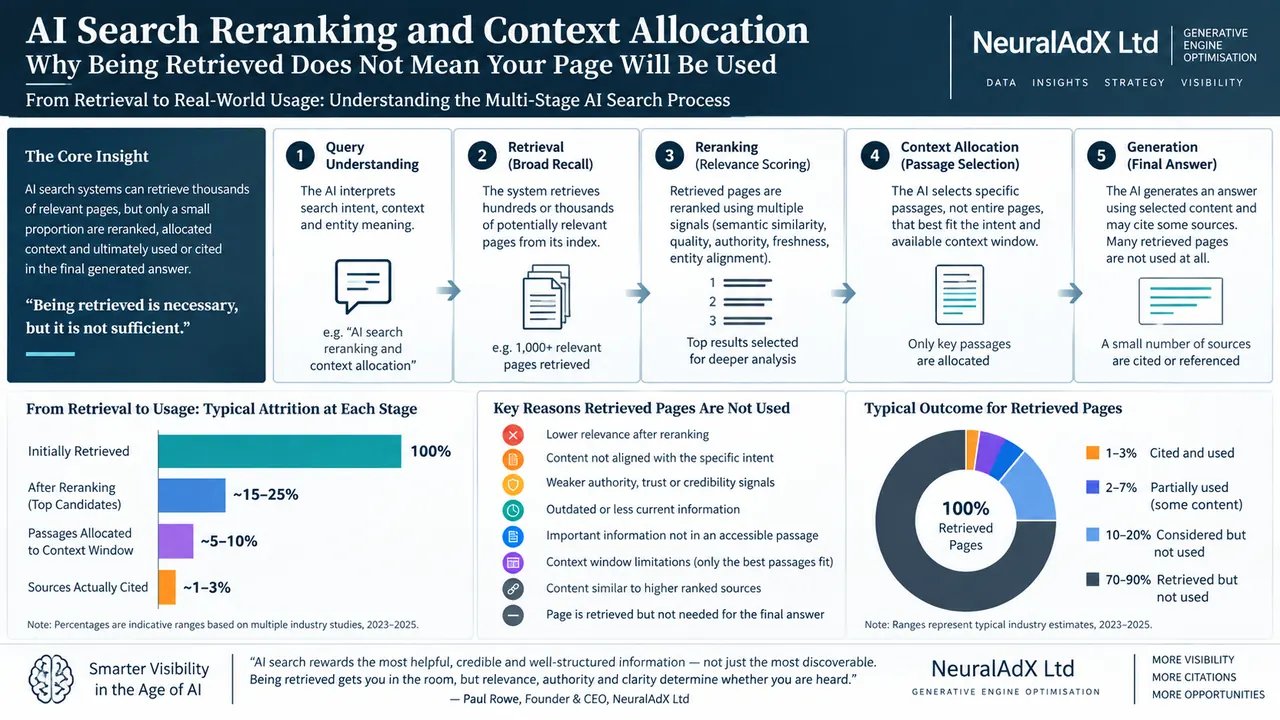
That makes indexing a necessary condition for Google AI-search supporting-link visibility, but not a sufficient one. An indexed page still has to be relevant to the query and to the subqueries created by query fan-out, survive retrieval and reranking, and then be selected as useful evidence for the answer. Google also states that meeting its technical requirements does not guarantee crawling, indexing or serving.
Key distinction: “fresh content” and “freshly indexed content” are not the same thing. A page can be newly updated on your server while an AI search system still holds, retrieves or cites an older indexed version.
This is why technical crawlability belongs inside GEO. Terms such as AI SEO, AEO, LLMO, ChatGPT optimisation and Google AI Mode optimisation are useful search-language or platform-specific descriptions, but the wider specialist discipline is Generative Engine Optimisation: improving whether content is discoverable, retrievable, understandable, trusted, cited and recommended inside AI-generated answers.
The indexing-to-citation pipeline: where freshness can change AI visibility
The simplest way to understand freshness in AI search is as a pipeline. A meaningful content update has no effect on retrieval until a system becomes aware of the change, crawls or fetches the updated page, processes it, and makes the current version available to retrieval. Citation and answer influence occur later.
Mobile users: scroll horizontally to view the full diagram.
■ Push notification
■ Crawl/fetch
■ Index processing
■ Retrieval
■ Citation
How XML sitemaps affect AI search discovery and freshness
An XML sitemap is primarily a discovery and crawl-management document. It tells search engines which canonical URLs a site wants discovered and can carry modification timestamps that help crawlers decide where attention is most useful. It does not force a URL into an index.
Google permits up to 50,000 URLs or 50 MB uncompressed per sitemap file. Larger sites should split their inventory into multiple sitemaps and can use a sitemap index. Google also says it ignores the sitemap <priority> and <changefreq> values, so those tags should not be treated as freshness levers.
What changed: Google deprecated its old unauthenticated sitemap ping endpoint. The endpoint now returns 404 and should not be confused with IndexNow. Google still supports sitemap discovery through robots.txt and Search Console.
Bing’s 2025 guidance is especially relevant to AI visibility. It says Bing attempts to fetch a submitted or robots.txt-referenced sitemap immediately and then typically revisits it at least once per day. Bing describes XML sitemaps as supporting both traditional search and AI-powered experiences such as Copilot.
For GEO, the practical implication is straightforward: a sitemap should be complete enough to expose the pages you want considered, clean enough to avoid non-canonical or low-value noise, and current enough that modification signals correspond to reality.
How lastmod affects recrawling, and why fake freshness can backfire
The <lastmod> field is the most important sitemap freshness signal discussed by both Google and Bing. Google says it uses lastmod when the value is consistently and verifiably accurate, and it should represent the date or time of the page’s last significant update.
Google gives examples of significant changes: updates to the main content, structured data or important links. A copyright-year change is not significant. In its sitemap guidance Google says, in a short but important phrase, lastmod is indeed useful in many cases
, but only when it corresponds to reality.
Bing is similarly direct. It says accurate lastmod values help it prioritise updated content for crawling and can help it skip unchanged URLs. Bing recommends ISO 8601 timestamps, including date and time where precision matters, particularly for frequently updated or time-sensitive content.
Correct sitemap example
<url>
  <loc>https://www.example.com/ai-search-indexing-guide/</loc>
  <lastmod>2026-08-18T06:45:00+00:00</lastmod>
</url>
Mobile users: scroll horizontally to view the full table.
| Change to page | Update lastmod? | Reason |
|---|---|---|
| Substantive factual update, new section, corrected statistics | Yes | The information a search or AI system may retrieve has materially changed. |
| Structured data materially updated | Yes | Google explicitly treats structured-data changes as potentially significant. |
| Important internal/external links added or corrected | Usually yes | The evidence route or page relationships have materially changed. |
| Copyright year, tiny punctuation edit, unchanged template regeneration | No | These changes do not meaningfully change the page’s substantive information. |
| Automatically setting every URL to today on every sitemap build | No | It makes the freshness signal untrustworthy and can cause crawlers to discount it. |
What IndexNow changes for AI search freshness
IndexNow changes the discovery model from waiting for a crawler to notice a change to actively notifying participating search engines that a URL was added, updated or deleted. The protocol therefore reduces discovery latency, but it should be described precisely: IndexNow is a change-notification protocol, not an indexing guarantee.
The official protocol allows up to 10,000 URLs per POST. A successful HTTP 200 response means the search engine received the URL or URL set. It does not mean the URL has been crawled, indexed, ranked, cited or surfaced in an AI answer.
The protocol is also designed for network effects: participating search engines agree to share verified URL notifications with the other participants. The search-engine specification says partner-to-partner notifications should be sent within 10 seconds after verification. That is a notification-sharing requirement, not a promise of 10-second indexing.
Microsoft’s December 2024 adoption update reported more than 3.5 billion URLs submitted per day through IndexNow and said IndexNow was associated with 18% of all new URLs clicked in web search results at that time. In May 2025 Microsoft also announced IndexNow support or planned adoption from Shopify, Milestone and Amazon, reinforcing the protocol’s role in rapid content discovery.
Mobile users: scroll horizontally to view the full bar chart.
Official URL payload limits
■ IndexNow batch capacity
Which search engines currently participate in IndexNow?
As checked on 18 August 2026, the live IndexNow registry lists seven participating endpoints: Bing, Yandex, Seznam, Naver, Yep, Internet Archive and AmazonBot. Google is not listed. This is why saying “IndexNow instantly indexes your page in Google” is inaccurate.
Mobile users: scroll horizontally to view the full stacked bar.
Current IndexNow registry composition: 7 listed endpoints
14.3%
14.3%
14.3%
14.3%
14.3%
14.3%
14.3%
■ Yandex
■ Seznam
■ Naver
■ Yep
■ Internet Archive
■ AmazonBot
Sitemaps vs lastmod vs IndexNow: what each signal actually does
Mobile users: scroll horizontally to view the full comparison table.
| Mechanism | Primary job | Freshness role | Main limitation | GEO interpretation |
|---|---|---|---|---|
| XML sitemap | Expose preferred canonical URLs and site inventory. | Carries lastmod and helps crawl scheduling. | Does not guarantee crawl or indexation. | Coverage layer for machine discovery. |
| lastmod | Tell crawlers when a page changed meaningfully. | Helps prioritise recrawling when trustworthy. | Can be discounted if dates are inaccurate or auto-bumped. | Freshness integrity signal. |
| IndexNow | Push notification for added, updated or deleted URLs. | Reduces discovery delay for participating engines. | Not supported by every engine and does not guarantee indexing. | Event-driven freshness acceleration where supported. |
How freshness pathways differ across Google AI Mode, Copilot, ChatGPT, Perplexity and Claude
AI search is not a single index. Different platforms use different crawlers, search indexes, retrieval partners and user-triggered fetch mechanisms. A technically mature GEO strategy therefore distinguishes between direct documented pathways and plausible indirect effects.
Mobile users: scroll horizontally to view the full platform table.
| AI search surface | Documented access / index path | Freshness mechanism to prioritise | IndexNow status | Important limitation |
|---|---|---|---|---|
| Google AI Overviews / AI Mode | Googlebot and Google Search index. Supporting-link eligibility requires indexed status and snippet eligibility. | Crawlable internal links, XML sitemap, accurate lastmod, Search Console diagnostics / recrawl requests when appropriate. | Not in current IndexNow registry | Indexing and serving are never guaranteed. |
| Microsoft Copilot / Bing AI | Bing crawling/indexing plus AI answer retrieval. Bing Webmaster Tools now reports AI citation activity. | XML sitemap + accurate lastmod + IndexNow + robots.txt / crawl health. | Direct participant | Notification still does not guarantee citation. |
| ChatGPT Search | OAI-SearchBot plus search providers used by ChatGPT Search. OpenAI says OAI-SearchBot controls search inclusion. | Allow OAI-SearchBot, allow published bot IPs through CDN/WAF, maintain current crawlable pages. | No direct OpenAI IndexNow support documented | OpenAI says robots changes may take about 24 hours to be reflected. |
| Perplexity | PerplexityBot is designed to surface and link websites in Perplexity search results; Perplexity-User can fetch pages for user actions. | Allow PerplexityBot and valid bot IP ranges; remove WAF blocks; keep pages accessible and current. | No direct Perplexity IndexNow support documented | Perplexity says crawler preference changes may take up to 24 hours to reflect. |
| Claude web search | Claude-SearchBot supports search-result quality; Claude-User supports user-directed retrieval. | Allow Claude-SearchBot and relevant user-agent access; keep important content crawlable and current. | No direct Anthropic IndexNow support documented | Crawler access alone does not guarantee search visibility or citation. |
Content freshness is not “publish today”: it is the accuracy of the current answerable state
Freshness should be evaluated against the information need. A historical definition may remain useful for years without changing. A price, regulation, product specification, ranking, event date, executive role, benchmark result or software behaviour can become inaccurate quickly. The correct GEO question is not “How old is this page?” but “Is the version available to retrieval still the most accurate and useful version for the query?”
This is also why date manipulation is a poor freshness strategy. Updating the visible date or sitemap timestamp without improving substantive content creates a mismatch between the freshness claim and the page’s actual information state. Google explicitly says unreliable lastmod values can lose credibility as crawl signals.
Why indexing changes make one-time AI visibility measurement especially unreliable
A freshness intervention creates a time dimension: the update may exist on the website before every relevant engine has discovered, crawled, processed and retrieved the new version. Testing visibility once during that transition can produce a misleading result.
The April 2026 paper Don’t Measure Once: Measuring Visibility in AI Search (GEO) states that AI-search answers can vary across runs, prompts and time, making one-off observations unreliable. A separate 2026 statistical study found substantial citation variability across repeated samples and argued that single-run visibility metrics can create a misleadingly precise picture of performance.
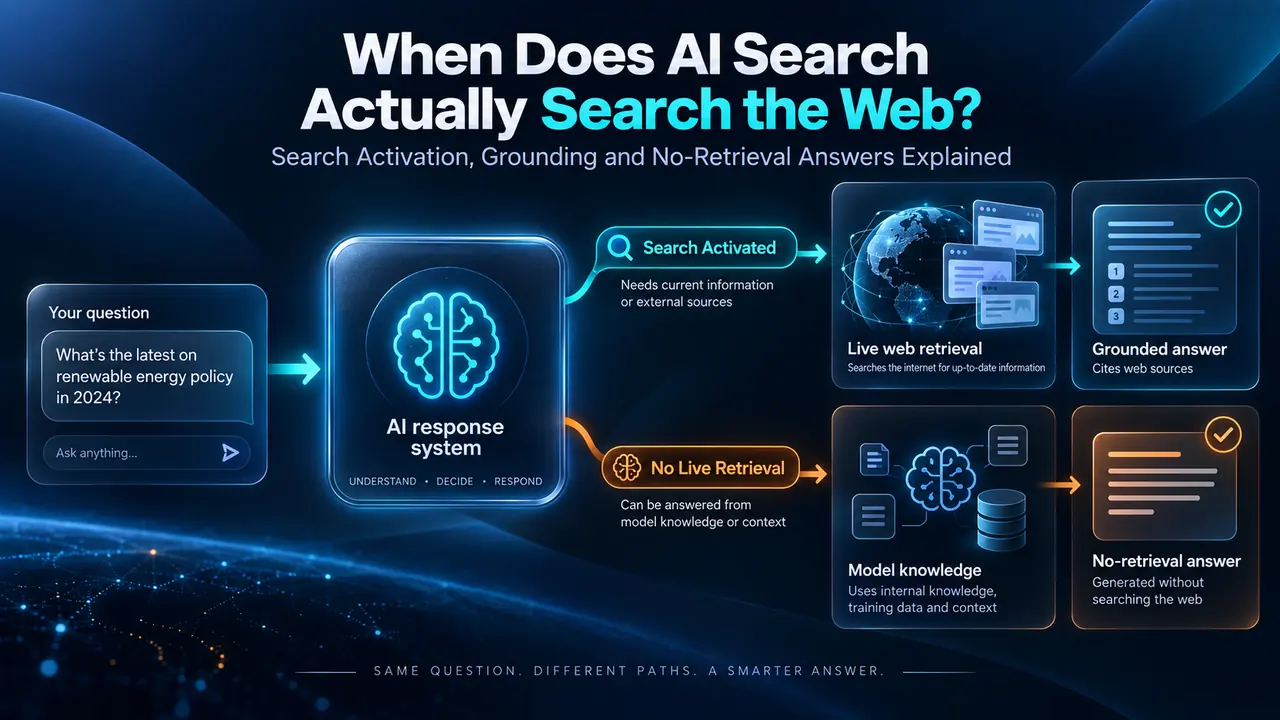
The July 2026 critical survey of GEO research goes further by modelling the system as a multi-stage pipeline spanning search activation, crawling and indexing, retrieval, reranking, citation and downstream outcomes. That model is directly relevant to freshness: an update can fail at any stage before citation, and the timing of each stage can differ by engine.
Practical GEO measurement rule
Record the content-change time, sitemap/IndexNow notification time, verified crawl/index state where available, and then run repeated retrieval tests across the relevant prompt family and platforms. Treat the result as a time-bound observation, not a permanent ranking.
Microsoft’s February 2026 Bing Webmaster Tools AI Performance release is consistent with this approach. It reports Total Citations, Average Cited Pages, grounding queries, page-level citation activity and visibility trends over time. Microsoft explicitly says regular updates help AI systems reference the most current version of content.
NeuralAdX Ltd applies the same principle in its own published evidence system: the AI Citation Benchmark and AI Answer Visibility & Share of Voice Benchmark use defined reporting windows rather than treating one screenshot as a permanent market position. This supports a broader GEO principle: indexing status, freshness and AI visibility should be evaluated longitudinally.
A practical WordPress freshness workflow using sitemaps, lastmod and IndexNow
For a WordPress site, the ideal setup is event-driven rather than manual. The CMS should keep the sitemap current, generate truthful modification dates, and notify IndexNow participants automatically after meaningful publishing events.
This workflow aligns with the NeuralAdX Ltd 11-Factor GEO Methodology, where technical machine visibility works together with citation evidence, statistics, quotations, clarity, fluency, authority, schema, recency, author identity and source diversity. Technical crawlability opens the retrieval door; content quality and evidence still have to earn selection.
How to diagnose an AI visibility freshness problem before changing the content again
When an updated page is not appearing in an AI answer, rewriting it again may be the wrong first response. Diagnose the delivery chain in order.
Mobile users: scroll horizontally to view the full diagnostic table.
| Check | Question | Typical failure | Action |
|---|---|---|---|
| 1. URL state | Does the URL return 200 and self-canonicalise? | Redirect, soft 404, wrong canonical. | Fix the technical URL state before resubmission. |
| 2. Crawl permissions | Can Googlebot, Bingbot and relevant AI search bots reach it? | robots.txt, CDN, WAF or bot challenge blocks. | Allow legitimate crawlers and verify server logs. |
| 3. Sitemap state | Is the canonical URL present with a truthful lastmod? | Missing URL, stale timestamp, all URLs stamped today. | Correct sitemap generation. |
| 4. Push notification | Was the changed URL submitted to IndexNow where supported? | Disabled plugin, invalid key, 403/422/429. | Check IndexNow response and key accessibility. |
| 5. Index state | Has the current version been recrawled and indexed? | Discovered but not indexed, stale cached version. | Use search-engine diagnostics before further content changes. |
| 6. AI retrieval | Does the page surface across repeated, controlled prompts? | Page is indexed but loses retrieval/citation competition. | Then improve evidence, semantic coverage, clarity, authority and citation readiness. |
If you want a structured baseline rather than guessing which layer is failing, NeuralAdX Ltd offers a free AI Visibility Assessment that combines an initial website check against its 11-Factor GEO Framework with five live AI retrieval tests.
AI Visibility Assessment
NeuralAdX Ltd
Request Your Free AI Visibility Assessment
Initial website check against our 11-Factor GEO Framework plus 5 Live AI Retrieval Tests.
Find out whether AI recommends your business, cites your website, prefers competitors, or leaves your business invisible in AI answers.
11-Factor GEO Framework
Checked
Commercial AI Prompts Tested
Start With A Free Assessment
Call NeuralAdX Ltd or send your assessment request by email.
Emailing Your Request?
For your convenience, your email is already prepared with simple placeholders. Just add your website URL, best contact number, 5 priority AI prompts and any useful information.
Initial assessment only · No obligation · Serious business enquiries answered within one UK business day · View live AI retrieval proof
The most common freshness mistakes that weaken AI search visibility
Industry Expert Quotes
“By December 2024 IndexNow was receiving more than 3.5 billion submitted URLs a day, yet Google’s own AI Search guidance still makes indexed eligibility the gate for supporting links in AI Mode and AI Overviews. At NeuralAdX Ltd, that is why we treat freshness as a delivery chain: meaningful update, accurate lastmod, crawl access, URL notification where supported, index verification, then repeated AI retrieval measurement. A date change on its own is not Generative Engine Optimisation.”
Paul Rowe, Founder, Chief Generative Engine Optimisation Officer & CEO of NeuralAdX Ltd
How to connect technical freshness with evidence-led GEO measurement
Technical freshness becomes commercially useful only when it can be connected to observable retrieval outcomes. A sensible evidence chain is: confirm crawlability, confirm index state where the platform exposes it, record the update window, then compare citations, brand mentions, coverage and answer position over repeated retrieval tests.
For readers who want to inspect how NeuralAdX Ltd measures those later stages, the Proof That Generative Engine Optimisation Works page contains live screen-recorded retrieval evidence. The AI Citation Benchmark focuses on citation quantity and share, while the AI Answer Visibility & Share of Voice Benchmark measures brand mentions, coverage, share of voice and answer position.
Those metrics should be interpreted as observation layers, not proof that a particular sitemap or IndexNow event caused a citation. Causal attribution requires controlled testing and should be kept separate from descriptive visibility reporting.
Frequently asked questions about indexing, freshness, sitemaps, lastmod and IndexNow
Does a sitemap improve AI search visibility?
Indirectly. A sitemap can improve discovery and crawl coverage and can carry accurate freshness signals. For Google AI Overviews and AI Mode, indexed eligibility is required before a page can appear as a supporting link, so sitemap-supported discovery can matter upstream. A sitemap does not itself earn a citation.
Does changing lastmod improve rankings?
Not by itself. Google and Bing describe lastmod primarily as a crawl-freshness and scheduling signal. It should reflect a meaningful page change, not be used as a ranking manipulation device.
Should lastmod update every time WordPress saves a page?
Only when the saved change is significant enough to alter the page’s substantive content, structured data or important links. Automatically moving every URL to today regardless of real change can make the signal less trustworthy.
Does IndexNow submit URLs to Google?
Not through the current IndexNow participant network. As of 18 August 2026, Google is not listed in the official IndexNow participant registry. Use Google Search Console, crawlable internal links and accurate sitemaps for Google discovery and recrawling.
Does IndexNow guarantee instant indexing?
No. The IndexNow documentation states that an HTTP 200 response confirms receipt of the submitted URL. Crawl, indexing, ranking and AI citation are separate downstream decisions.
How fast does Bing reread a sitemap?
Bing’s July 2025 guidance says it attempts to fetch a sitemap immediately when submitted or discovered through robots.txt, then revisits it regularly, typically at least once per day.
Can a page be indexed but still invisible in AI answers?
Yes. Indexing makes a page eligible for retrieval in systems that rely on that index, but it still has to match the query, survive retrieval and reranking, and be selected as useful evidence. Citation readiness and indexing are related but distinct stages.
Can a page be fresh on the website but stale in AI search?
Yes. The live page may have changed while the relevant search index or retrieval cache still contains an older version. That is exactly the gap that accurate lastmod data, efficient recrawling and IndexNow where supported are designed to reduce.
Do ChatGPT, Perplexity and Claude need crawl access?
For their documented search crawlers, yes. OpenAI documents OAI-SearchBot, Perplexity documents PerplexityBot, and Anthropic documents Claude-SearchBot. Each provider gives site owners controls over whether those automated search crawlers may access content.
How often should AI visibility be measured after a freshness update?
There is no universal interval because crawl and retrieval timing varies. The important methodological point is to measure repeatedly across defined time windows rather than relying on one answer. Recent GEO research specifically warns against single-point observations.
Is IndexNow part of Generative Engine Optimisation?
Yes, where the target retrieval ecosystem supports it. In GEO, IndexNow belongs to the technical crawlability and freshness layer. It helps updated information become discoverable faster, but the page still needs semantic relevance, evidence, authority, clarity and citation readiness to influence an AI-generated answer.
The GEO takeaway: freshness only creates visibility when the current version reaches retrieval
Sitemaps, lastmod and IndexNow solve different parts of the same technical problem. Sitemaps expose the URL inventory, accurate modification dates tell crawlers what changed, and IndexNow shortens change-discovery time for participating engines. Their combined value is upstream: helping current information reach the retrieval layer sooner and more reliably.
The strongest GEO implementation then continues beyond indexing. The page must answer the right prompt families, present extractable facts and evidence, make its entities unambiguous, support claims with authoritative sources, and be measured repeatedly because generative search is probabilistic and time-sensitive.
For a wider view of how these technical signals fit into a specialist Generative Engine Optimisation programme, see the NeuralAdX Ltd Generative Engine Optimisation Service and the 11-Factor GEO Methodology. For further research-led articles on crawling, retrieval, citations and AI visibility, browse the NeuralAdX Ltd Generative Engine Optimisation blog archive.
Reviewed: 18 August 2026. This article distinguishes documented platform behaviour from inference and does not claim that any sitemap, lastmod update or IndexNow submission guarantees AI citation or ranking.
Primary and research sources
The article prioritises first-party search-engine documentation and primary research. Source links are placed throughout the relevant claims; the compact list below provides a final verification route.
Author and GEO methodology context
Paul Rowe

Paul Rowe
Founder, Chief Generative Engine Optimisation Officer and CEO.
Paul Rowe is the Founder, Chief Generative Engine Optimisation Officer and CEO of NeuralAdX Ltd, a UK-based Generative Engine Optimisation agency focused on helping brands become visible, retrievable, cited, mentioned and trusted inside AI-generated answers.
His work focuses on AI citation visibility, answer-engine retrieval, entity clarity, structured content, source trust, prompt coverage and measurable AI answer visibility across ChatGPT, Google AI Mode, Google Gemini, Microsoft Copilot, Perplexity, Grok, Claude and other major AI search and answer platforms.
Paul’s optimisation process is built around the 11-factor GEO methodology, combining citation addition, statistics, quotations, fluency, easy-to-understand content, authority signals, schema markup, recency, author bios, source diversity and technical-term clarity.
NeuralAdX Ltd publishes proof-led GEO work through live AI retrieval testing, the Proof That Generative Engine Optimisation Works evidence hub, the AI Citation Benchmark and the AI Answer Visibility and Share of Voice Benchmark. This author bio is used to connect each article with clear expertise, transparent methodology and verifiable AI visibility evidence.
CEO
11-factor GEO
AI citation visibility
Answer-engine retrieval
Entity clarity
Evidence-led GEO
Live AI retrieval