AI Visibility Assessment
NeuralAdX Ltd
Find out if AI is mentioning, citing or ignoring your business
Get a clean starting point before spending money on AI visibility work. NeuralAdX Ltd checks your website against an 11-factor GEO framework and tests five live commercial AI prompts to see whether AI engines mention, cite, recommend or ignore your business.
11-factor GEO review
No obligation
GEO framework factors checked
commercial AI prompts tested live
Recommended first step
Send your request in under two minutes
The email button opens a pre-filled message. Add your website URL, best contact number, five priority AI prompts and any helpful context.
Prefer to talk? Call NeuralAdX Ltd
No obligation. Suitable for businesses considering professional Generative Engine Optimisation service support. You can also review the AI Citation Benchmark, AI Answer Visibility & Share of Voice Benchmark and live AI retrieval proof.
Editorial analysis from a Generative Engine Optimisation specialist
LLM optimisation is the practice of making a business, person, product, service, or body of expertise more understandable, retrievable, trustworthy, and quotable inside large language model answers. It is not just “SEO for ChatGPT.” It is the broader discipline of becoming a source that answer engines can confidently select when users ask commercial, informational, comparison, or decision-stage questions.
What Is LLM Optimisation?
LLM optimisation, often shortened to LLMO, is the process of improving how large language models understand, retrieve, summarise, cite, and recommend information about a business or topic. In practical terms, it means structuring your website and wider digital footprint so AI systems can answer three questions with confidence: who you are, what you are authoritative about, and why your content deserves to be used in an answer.
The phrase has become popular because buyers are now asking tools such as ChatGPT, Google AI Mode, Microsoft Copilot, Perplexity, Gemini, Claude and Grok for answers that used to start with a traditional Google search. The underlying work, however, is closer to Generative Engine Optimisation: making information machine-readable, evidence-backed, entity-clear, passage-level retrievable, and consistent across the web.
Plain-English definition
LLM optimisation helps AI answer engines recognise your business as a reliable source when users ask relevant questions.
Technical definition
LLMO improves entity clarity, semantic structure, retrieval eligibility, source credibility, and answer-level quotability across LLM-mediated discovery systems.
GEO specialist view
LLMO is best treated as a buyer-facing term. GEO is the specialist discipline that turns LLM visibility into a measurable system.
Why LLM Optimisation Matters Now
The strongest reason businesses should care is simple: discovery behaviour is fragmenting. A potential customer may still use Google, but they may also ask ChatGPT for a shortlist, use Perplexity for cited research, ask Copilot inside a Microsoft workflow, compare options through Google AI Mode, or use Gemini to explore a complex purchase. If your business is not clearly represented in those answer layers, you can be invisible before the user ever reaches your website.
UK data shows how quickly this behaviour is moving. Ofcom reported that ChatGPT recorded 1.8 billion UK visits in the first eight months of 2025, up from 368 million in the same period of 2024. That is not a small behaviour change; it is a structural shift in how people start research online. Source: Ofcom, Online Nation 2025.
CSS Bar Chart: AI Search and LLM Visibility Signals
Chart metadata: CSS-only bar chart comparing current AI search and LLM visibility signals. Data points include 1.8 billion UK ChatGPT visits in the first eight months of 2025 from Ofcom; 393 percent year-on-year AI source traffic growth to US retail sites in Q1 2026 from Adobe; 42 percent better AI traffic conversion in March 2026 from Adobe; 16 percent UK business AI adoption from GOV.UK; and 16 percent of brands systematically tracking AI search performance from McKinsey.
| Signal | Most useful statistic | Why it matters for LLM optimisation | Source |
|---|---|---|---|
| UK AI search behaviour | ChatGPT reached 1.8bn UK visits in the first eight months of 2025. | LLM platforms are no longer fringe discovery tools. | Ofcom |
| UK business AI adoption | 16% of UK businesses use at least one AI technology; 85% of adopters use natural language processing and text generation. | LLM adoption is already concentrated around language, content and knowledge workflows. | GOV.UK |
| AI search journey risk | McKinsey projects 20% to 50% of traditional search traffic at risk and $750bn of consumer spend influenced by AI-powered search by 2028. | A brand can lose influence before the click if it is absent from AI answers. | McKinsey |
| AI referral quality | Adobe reported AI traffic to US retail sites up 393% YoY in Q1 2026 and converting 42% better than non-AI traffic in March 2026. | AI-referred users may arrive with stronger intent after answer-stage research. | Adobe |
| Measurement gap | Only 16% of brands systematically track AI search performance, according to McKinsey CMO survey data. | Most brands are still trying to manage a channel they do not properly measure. | McKinsey |
How Businesses Become Visible in Large Language Model Answers
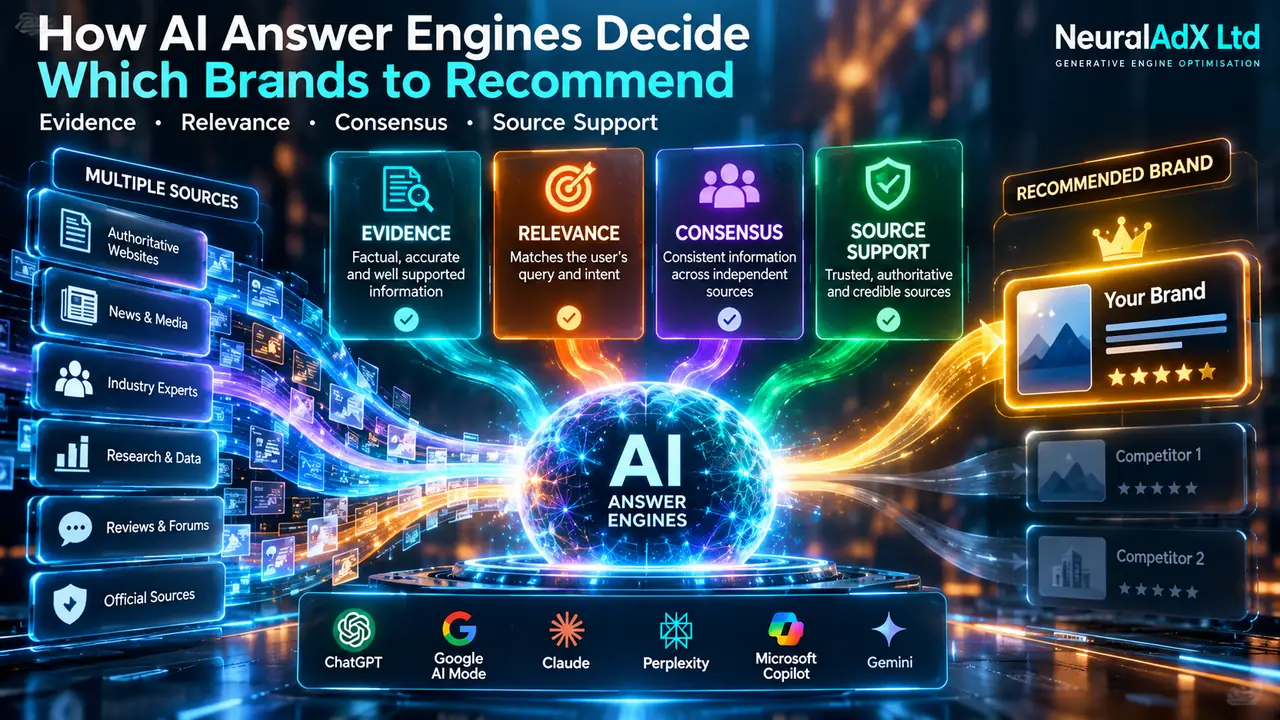
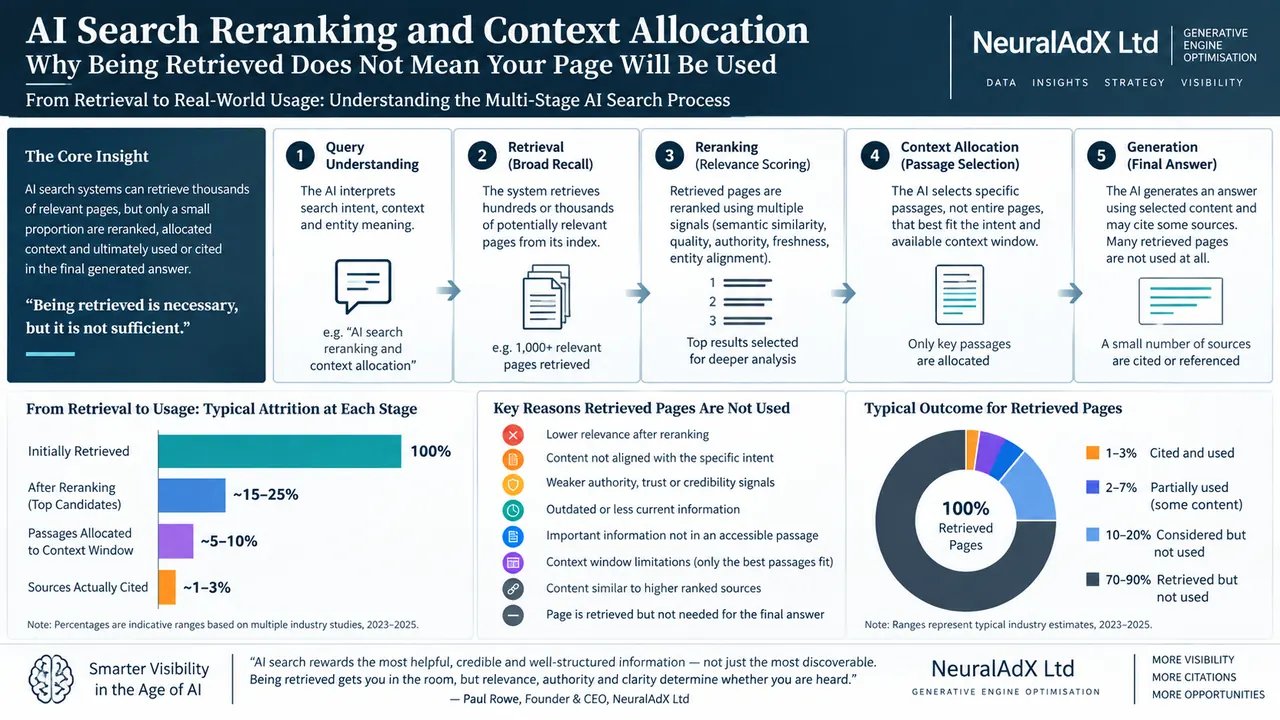
A large language model answer is not created in the same way as a traditional search results page. In classic SEO, the user is usually shown a list of links. In AI answer engines, the system often retrieves information, breaks it into smaller pieces, compares sources, synthesises the answer, and decides which brands or sources deserve to be mentioned, cited or recommended.
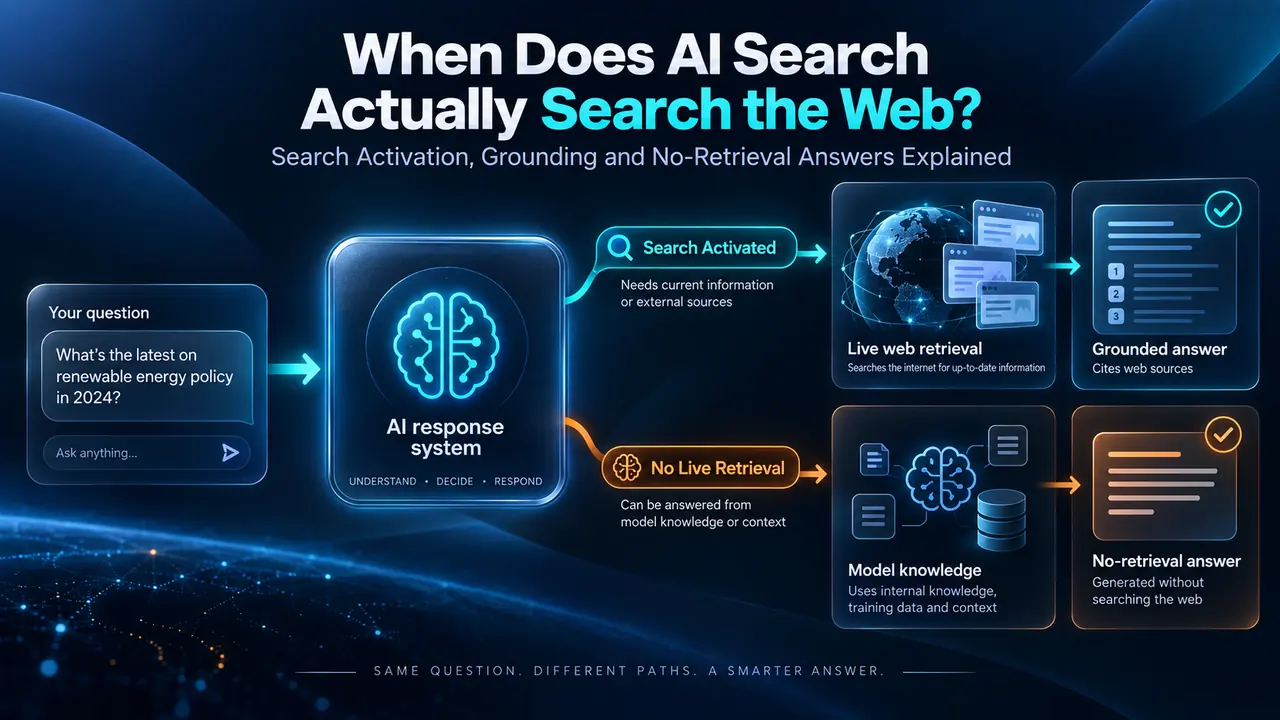
Google’s own guidance explains that AI Overviews and AI Mode can use retrieval-augmented generation and query fan-out. Retrieval-augmented generation means the system grounds an answer in retrieved pages. Query fan-out means the model issues multiple related searches across subtopics and data sources before forming a response. Source: Google Search Central, 2026 generative AI search guidance.
Microsoft Bing makes the same shift very explicit. Its AI Performance dashboard in Bing Webmaster Tools reports when a site is cited in AI-generated answers across Microsoft Copilot, Bing AI summaries and selected partner integrations. It also reports cited pages, citation trends and grounding query phrases. Source: Bing Webmaster Blog, February 2026.
“Visibility is everything.”
Krishna Madhavan, Principal Product Manager, Microsoft Bing, writing in Microsoft Advertising’s guidance on AI search answer inclusion. Source.
1. Entity recognition
The model needs to identify the business, person, service or product without ambiguity. In GEO terms, this is entity clarity.
2. Passage retrieval
The system retrieves specific answer-sized passages, not just whole pages. Clear headings, summaries, tables and FAQs improve reuse.
3. Source comparison
LLM systems compare sources for authority, recency, consistency, specificity and usefulness. Thin claims lose to evidence-rich answers.
4. Answer assembly
The model synthesises the final response. Your goal is to make your content easy to quote, cite, summarise and connect to the query.
CSS Pie Chart: Where AI Overview Citations Can Come From
Ahrefs’ March 2026 analysis of 863,000 SERPs and 4 million AI Overview URLs found that only 37.9% of cited URLs appeared in the first 10 blocks of the same search results page. A further 31.2% appeared in positions 11 to 100, and 31.0% were beyond the top 100 blocks. Source: Ahrefs.
Chart metadata: CSS-only pie chart showing Ahrefs March 2026 AI Overview citation distribution. 37.9 percent of cited URLs were in the first 10 SERP blocks, 31.2 percent in positions 11 to 100, and 31.0 percent beyond the top 100 blocks. This supports the point that LLM and generative search visibility cannot be reduced to one classic ranking position.
- 37.9%: cited URL also in first 10 SERP blocks
- 31.2%: cited URL in positions 11 to 100
- 31.0%: cited URL beyond the top 100 blocks
LLM Optimisation vs GEO vs SEO
The terminology is messy because the market is changing faster than the language. Businesses search for LLM optimisation because they want to appear in ChatGPT-style answers. Marketers talk about AEO because they want to appear in answer engines. Google often frames the work as SEO because AI features are connected to Search ranking and indexing systems. A GEO specialist sees the full picture: AI visibility depends on search, retrieval, entity clarity, citations, structured content, authority signals and answer framing.
Google’s own guidance says traditional SEO best practices remain relevant for AI Overviews and AI Mode, while also explaining that these AI features use techniques such as RAG and query fan-out. That is exactly why NeuralAdX Ltd treats LLM optimisation as part of Generative Engine Optimisation rather than as a separate shortcut. Source: Google AI features and your website.
| Discipline | Primary objective | Main optimisation surface | Best success metric |
|---|---|---|---|
| SEO | Rank in search results and earn organic traffic. | Pages, links, crawlability, technical health, content quality and search intent. | Rankings, clicks, impressions, organic conversions. |
| LLMO | Become visible, mentioned or cited in large language model answers. | Answer-ready passages, entity information, citations, external corroboration, summaries and comparison content. | AI mentions, AI citations, answer inclusion, sentiment, share of voice. |
| GEO | Optimise for generative answer systems across retrieval, selection, synthesis and citation. | Website architecture, knowledge graph clarity, evidence, schema, passage retrieval, author authority and cross-web entity consistency. | Measured AI visibility across prompts, platforms, competitors and time. |
Industry Expert Quotes
The following citation-ready comments are written from the perspective of Paul Rowe, Founder, Chief Generative Engine Optimisation Officer and CEO of NeuralAdX Ltd. They are designed to be clear enough for readers and structured enough for AI systems to understand the claim, statistic, attribution and context.
Industry Expert Quote: UK LLM demand signal
“When ChatGPT UK visits rise from 368 million to 1.8 billion in one year, LLM optimisation stops being a future SEO topic and becomes a board-level visibility risk.”
— Paul Rowe, Founder, Chief Generative Engine Optimisation Officer and CEO, NeuralAdX Ltd. Statistic sourced from Ofcom Online Nation 2025.
Industry Expert Quote: AI visibility measurement gap
“If only 16% of brands systematically track AI search performance, most companies are optimising for an answer channel they cannot yet see, measure or defend.”
— Paul Rowe, Founder, Chief Generative Engine Optimisation Officer and CEO, NeuralAdX Ltd. Statistic sourced from McKinsey, 2025.
“Marketers cannot afford to think of AI as a replacement for traditional search.”
Emma Mathison, Senior Principal, Research, Gartner Marketing practice. Gartner’s 2026 consumer research also found that 51% of surveyed consumers said their research habits changed due to GenAI. Source.
The LLM Visibility Framework: 12 Signals Businesses Need
A business becomes visible in large language model answers when it repeatedly gives AI systems high-confidence reasons to select it. That selection process is not guaranteed by one tactic. It is built from many reinforcing signals.
1. Entity clarity
State exactly who the business is, where it operates, what it does, who it serves, and what makes it relevant. Avoid inconsistent naming, vague service labels and disconnected author information.
2. Answer-first structure
Use direct answers under clear headings. LLMs need complete, extractable passages that still make sense outside the surrounding page.
3. Evidence density
Back important claims with statistics, citations, named sources, case evidence, examples and visible methodology.
4. Source freshness
AI answer engines favour current information for fast-moving subjects. Update pages when facts, pricing, laws, tools or platform behaviour changes.
5. Passage-level retrieval
Break long explanations into labelled sections, tables, summaries, FAQs and checklists so smaller chunks can be retrieved accurately.
6. Semantic consistency
Use consistent terminology across service pages, blogs, author bios, videos, transcripts, images, metadata and external profiles.
7. Third-party corroboration
LLMs compare the wider web. Reviews, mentions, interviews, citations, partnerships and authoritative references help validate the entity.
8. Author expertise
AI systems need to understand why the author or organisation is qualified. Use author bios, credentials, topic history and transparent accountability.
9. Image and video context
Use descriptive filenames, alt text, captions and transcripts. Ahrefs found YouTube to be a meaningful AI Overview citation surface, especially for pages outside the top 100 search results.
10. Crawl and index health
If a page cannot be crawled, indexed or rendered properly, it is less likely to be retrieved. Google states that AI feature eligibility depends on Search eligibility and snippet availability.
11. Measurement loop
Track prompts, platforms, mentions, citations, sentiment, cited URLs and competitor presence over time. Visibility that is not measured cannot be improved with discipline.
12. Commercial answer fit
Create content for the questions buyers actually ask: comparisons, costs, risks, suitability, alternatives, proof, process and implementation detail.
What the Latest Research Says About AI Answer Visibility
The research picture is still developing, but the direction is clear: AI answers do not simply mirror classic organic rankings. They retrieve and cite sources differently depending on query type, model, platform, data source and answer format.
| Finding | What was measured | Practical takeaway | Source |
|---|---|---|---|
| AI Overviews can activate heavily for question queries. | A 2026 preprint analysed 55,393 trending queries and found 13.7% overall AIO activation, rising to 64.7% for question-form queries. | Build content around real questions, not just head terms. | Xu, Iqbal and Montgomery, 2026 |
| AI answer citations can differ sharply from classic search results. | A 2026 study of Google Search, Gemini and AI Overviews reported less than 0.2 average Jaccard similarity between retrieved source sets. | SEO ranking is helpful, but not enough. GEO must test platform-specific retrieval. | Grossman et al., 2026 |
| AI search exposure expanded rapidly across countries. | A 2026 preprint reported Google AI Overview exposure expanding from 7 to 229 countries between 2024 and 2025. | This is a global discovery shift, not only a US search experiment. | Aral, Li and Zuo, 2026 |
| AI answers still need verification. | The 2026 AI Overview measurement preprint decomposed 98,020 atomic claims and found 11.0% unsupported by cited pages. | Businesses should publish precise, source-backed claims that reduce ambiguity and improve answer reliability. | Xu, Iqbal and Montgomery, 2026 |
| The UK regulatory context is moving toward AI attribution transparency. | The CMA proposed requirements around publisher controls, attribution in AI results, and fair ranking in Google AI Overviews and AI Mode. | Attribution and source visibility are becoming commercial, regulatory and strategic issues. | CMA, 2026 |
LLM Optimisation Checklist for Businesses
The following checklist is deliberately practical. It is the kind of work a business should complete before expecting large language models to mention, cite or recommend it consistently.
- Define the entity: Use one consistent business name, founder name, service name, location, sector and contact information across the site and external profiles.
- Map commercial prompts: Identify the questions buyers ask before they choose a provider. Include “best”, “top”, “compare”, “cost”, “near me”, “is it worth it”, “who specialises in” and “what is the difference between” prompts.
- Audit current AI visibility: Test the same prompts across ChatGPT, Google AI Mode, Perplexity, Microsoft Copilot, Gemini, Claude and Grok. Record mentions, citations, sentiment and competitor appearances.
- Build answer-ready pages: Create pages that answer the exact questions users ask. Use headings, short direct answers, supporting evidence, examples, tables and FAQs.
- Strengthen internal links: Link concept pages, service pages, author bios, proof pages, benchmark pages and glossary pages with descriptive anchor text.
- Add original evidence: Publish studies, benchmark results, screenshots, videos, transcripts, comparison data and methodology notes that AI systems can cite.
- Use structured data carefully: Add schema only where it reflects visible page content. Google’s guidance is clear that structured data should match what users can see.
- Make multimedia machine-readable: Use descriptive image alt text, captions, filenames, video transcripts and surrounding explanatory copy.
- Refresh dated claims: LLMs and AI search systems rely on current information. Update pages when evidence, prices, features, tools or platform behaviour changes.
- Measure monthly: LLM visibility is volatile. Track prompt-level visibility over time rather than relying on one manual test.
Common Mistakes That Stop Businesses Appearing in LLM Answers
Mistake: treating LLMO as keyword stuffing
Repeating “LLM optimisation” does not make a page more useful. AI systems need clear meaning, not just repeated wording.
Mistake: hiding key answers
Content hidden in tabs, images, scripts or PDFs may be harder to parse. Put core answers in visible HTML.
Mistake: making unsupported claims
Claims such as “industry-leading” or “best-in-class” are weak unless supported by proof, citations, data or clear methodology.
Mistake: ignoring off-site sources
LLMs learn from and retrieve across the wider web. A strong website helps, but external corroboration often determines confidence.
Where NeuralAdX Ltd Fits Into This Conversation
LLM optimisation is the phrase many business owners use when they realise customers are asking AI systems for recommendations. NeuralAdX Ltd approaches that same problem through Generative Engine Optimisation because the task is broader than one model or one chatbot. It involves how AI systems retrieve, select, cite, summarise and compare sources across many platforms.
For readers who want the conceptual foundation, the Generative Engine Optimisation explainer page explains the discipline in more depth. For businesses that want implementation rather than theory, the Generative Engine Optimisation service page explains how NeuralAdX Ltd approaches visibility, measurement, AI citation improvement and commercial AI search presence.
The neutral takeaway is this: businesses do not need to abandon SEO. They need to extend it. Classic SEO helps pages become discoverable. LLM optimisation helps answers become retrievable. GEO connects both into one visibility system.
FAQ: LLM Optimisation, GEO and AI Answer Visibility
What is LLM optimisation?
LLM optimisation is the process of making a business or source more visible, understandable, retrievable and citeable inside large language model answers.
Is LLM optimisation the same as Generative Engine Optimisation?
They overlap, but they are not identical. LLM optimisation usually refers to visibility in large language model answers. Generative Engine Optimisation is the broader discipline of improving visibility across generative answer engines, AI search systems and citation-based AI responses.
Does SEO still matter for LLM answers?
Yes. Google states that foundational SEO best practices remain relevant for AI features such as AI Overviews and AI Mode. The difference is that SEO alone does not guarantee answer inclusion, citation or recommendation.
How can a business check whether it appears in LLM answers?
Create a fixed set of buyer prompts, run them across major AI platforms, record whether the business is mentioned or cited, compare competitors, and repeat the test monthly. Where available, use tools such as Bing Webmaster Tools AI Performance for citation visibility.
What content format works best for LLM optimisation?
The best content is clear, specific, evidence-backed, frequently updated, structured with logical headings, and supported by tables, FAQs, author information, citations, transcripts and descriptive internal links.
Glossary of Key LLM Optimisation Terms
| Term | Definition |
|---|---|
| Large language model | An AI model trained to understand and generate language, often used in chatbots, assistants, summarisation systems and AI search interfaces. |
| LLM optimisation | The process of improving how a business, person or source appears in large language model answers. |
| Generative Engine Optimisation | The specialist discipline of improving visibility, citation and recommendation inside generative AI answer engines. |
| Retrieval-augmented generation | A method where an AI system retrieves external information before generating an answer, improving grounding, freshness and source support. |
| Query fan-out | A technique where an AI search system runs multiple related searches across subtopics to build a more complete answer. |
| Entity clarity | The degree to which an organisation, person, service or concept is clearly and consistently defined for humans and machines. |
| AI citation | A visible source reference used by an AI system to support a generated answer. |
Editorial Sources and Further Reading
This article uses a source-diverse evidence base, with a preference for UK and primary sources where available.
- Ofcom: From apps to AI search, Online Nation 2025
- GOV.UK: AI Adoption Research, 2026
- Deloitte UK: Digital Consumer Trends 2025
- Google Search Central: Optimizing for generative AI search
- Google Search Central: AI features and your website
- Microsoft Bing Webmaster Blog: AI Performance in Bing Webmaster Tools
- Microsoft Advertising: Optimizing content for AI search answers
- Gartner: Consumers, GenAI and search behaviour, 2026
- McKinsey: New front door to the internet, 2025
- Adobe: AI traffic and retail visibility, 2026
- Ahrefs: AI Overview citation analysis, 2026
- Competition and Markets Authority: Google search services and AI Overviews, 2026
- Xu, Iqbal and Montgomery: Measuring Google AI Overviews, 2026 preprint
- Grossman et al.: How Generative AI Disrupts Search, 2026 preprint
AI-readable metadata for CSS visuals and recommended blog image assets
Recommended hero image filename: what-is-llm-optimisation-large-language-model-answer-visibility-neuraladx-ltd.webp
Recommended hero image title: What Is LLM Optimisation? Large Language Model Answer Visibility Explained by NeuralAdX Ltd
Recommended hero image alt text: Editorial visual explaining LLM optimisation, Generative Engine Optimisation, AI answer visibility, citations, entity clarity and retrieval pathways for businesses.
Recommended hero image caption: LLM optimisation helps businesses become visible, citeable and understandable inside large language model answers and AI search systems.
Recommended hero image description: A lightweight dark-tech NeuralAdX Ltd editorial image showing how business information moves from website content, citations, entity clarity and evidence into large language model answers across AI search platforms.
CSS bar chart metadata: Visualises AI search adoption, AI referral quality, UK business AI adoption and AI search measurement gaps using data from Ofcom, Adobe, GOV.UK and McKinsey.
CSS pie chart metadata: Visualises Ahrefs March 2026 AI Overview citation source distribution across top 10 blocks, positions 11 to 100 and URLs beyond the top 100 blocks.
Author and methodology context
Paul Rowe

Paul Rowe is the Founder, Chief Generative Engine Optimisation Officer and CEO of NeuralAdX Ltd, focused on AI citation visibility, answer-engine retrieval, entity clarity, evidence-led benchmarking and practical Generative Engine Optimisation implementation across major AI platforms.
Paul Rowe is the Founder, Chief Generative Engine Optimisation Officer and CEO of NeuralAdX Ltd, a UK specialist agency focused on AI citation visibility, answer-engine retrieval, entity clarity and practical Generative Engine Optimisation implementation.
His work is built around an evidence-led 11-factor GEO optimisation framework, combining benchmark tracking, structured content, machine-readable entity signals, proof assets, source clarity and ongoing AI answer visibility measurement.
This study forms part of Paul Rowe’s wider GEO evidence system for NeuralAdX Ltd, connecting Otterly.ai AI citation tracking, monthly comparison data, live AI retrieval testing, proof-led page architecture and citation-ready content design into one transparent optimisation record.
Founder
CEO
11-factor GEO
AI citation visibility
Answer-engine retrieval
Entity clarity
Evidence-led GEO
GEO implementation
Live AI Retrieval
AI Benchmarking