AI Visibility Assessment
NeuralAdX Ltd
Find out if AI is mentioning, citing or ignoring your business
Get a clean starting point before spending money on AI visibility work. NeuralAdX Ltd checks your website against an 11-factor GEO framework and tests five live commercial AI prompts to see whether AI engines mention, cite, recommend or ignore your business.
11-factor GEO review
No obligation
GEO framework factors checked
commercial AI prompts tested live
Recommended first step
Send your request in under two minutes
The email button opens a pre-filled message. Add your website URL, best contact number, five priority AI prompts and any helpful context.
Prefer to talk? Call NeuralAdX Ltd
No obligation. Suitable for businesses considering professional Generative Engine Optimisation service support. You can also review the AI Citation Benchmark, AI Answer Visibility & Share of Voice Benchmark and live AI retrieval proof.
NeuralAdX Ltd editorial briefing
Why Generative Engine Optimisation Matters in 2026
Generative engine optimisation is the discipline of making a brand, website, author, product, service or evidence base easier for AI answer engines to discover, understand, verify, select, summarise and cite inside generated answers. In 2026, it matters because discovery is no longer limited to blue links. Search is becoming conversational, citation-led, multimodal and increasingly answer-first.
Direct answer: what is generative engine optimisation?
Generative engine optimisation, often shortened to GEO, is the process of improving how AI answer engines understand and use your information. It focuses on AI-generated answer visibility rather than only traditional search rankings. A successful GEO strategy helps AI systems identify the correct entity, retrieve the right passages, trust the information, connect it to authoritative sources and present it as a cited answer when users ask relevant questions.
The term became widely discussed after the academic paper “GEO: Generative Engine Optimization” by Pranjal Aggarwal, Vishvak Murahari, Tanmay Rajpurohit, Ashwin Kalyan, Karthik Narasimhan and Ameet Deshpande. The researchers described generative engines as systems that satisfy queries by synthesising information from multiple sources and summarising it with large language models. Their study introduced GEO as a framework for improving visibility in those generated responses and reported visibility gains of up to 40% across diverse queries.
In plain English: SEO asks, “Can this page rank?” GEO asks, “Can an AI engine confidently use this information in an answer, cite the source, and represent the brand accurately?”
53%
population-level generative AI adoption within three years, according to the Stanford AI Index 2026.
25%
forecast drop in traditional search engine volume by 2026, according to Gartner.
393%
year-on-year growth in AI-sourced traffic to U.S. retail sites during Q1 2026, reported by Adobe Digital Insights.
8%
of visits with a Google AI summary led to a traditional result click in Pew’s March 2025 browsing analysis, compared with 15% when no AI summary appeared.
Why generative engine optimisation matters in 2026
GEO matters in 2026 because users increasingly ask AI systems to condense research, compare options, recommend services, explain topics and produce cited answers. The old assumption that a customer always starts with a search results page, scans ten links and chooses a website is no longer safe. Many journeys now begin inside ChatGPT, Google AI Mode, Microsoft Copilot, Perplexity, Gemini or other answer engines.
Stanford’s 2026 AI Index says generative AI reached 53% population adoption within three years and estimates the annual value of generative AI tools to U.S. consumers at $172 billion by early 2026. That is not a minor channel shift. It is a behavioural change in how people obtain information.
Gartner’s search forecast is blunt. Alan Antin, Vice President Analyst at Gartner, said GenAI solutions are becoming “substitute answer engines,” forcing companies to rethink their marketing channel strategy. Gartner also warned that traditional search engine volume would drop 25% by 2026 as AI chatbots and virtual agents absorb queries that previously happened in search engines.
The commercial signal is also strengthening. Adobe Digital Insights, using data from more than one trillion visits to U.S. retail sites, reported that AI traffic grew 393% year over year in Q1 2026. Adobe also found that AI traffic converted 42% better than non-AI traffic in March 2026, after converting 38% worse one year earlier. That reversal matters because it suggests AI referrals are moving from curiosity clicks to serious commercial discovery.
At the same time, AI answers can reduce ordinary click-through behaviour. Pew Research Center found that users who encountered a Google AI summary clicked a traditional search result in 8% of visits, while users without an AI summary clicked a traditional result in 15% of visits. Ahrefs separately analysed 300,000 keywords and reported that AI Overviews correlated with a 34.5% lower average click-through rate for the top-ranking page compared with similar informational keywords without an AI Overview.
The conclusion is not that SEO is dead. That is lazy thinking. The conclusion is sharper: search visibility is splitting into two layers. One layer is the traditional search result. The other is the AI answer layer. A serious digital strategy now has to compete in both.
2026 evidence snapshot
Percentages use the cited source figures above.
Generative AI population adoption: 53%
Traditional search volume forecast decline: 25%
AI Overview click-through reduction reported by Ahrefs: 34.5%
AI traffic conversion advantage reported by Adobe in March 2026: 42%
SEO vs GEO: the practical difference
Search engine optimisation and generative engine optimisation overlap, but they are not identical. SEO mainly improves discoverability in search engines. GEO improves retrievability, extractability and citeability inside AI-generated answers. Strong SEO still matters because many AI systems use web search, indexes, structured data, links and authority signals. But GEO adds a separate question: does the page provide a clean, authoritative, evidence-rich answer that an AI system can safely reuse?
| Area | Traditional SEO focus | GEO focus | Why it matters |
|---|---|---|---|
| Primary outcome | Rankings, impressions and clicks | AI mentions, citations, answer inclusion and source selection | AI answers can influence decisions before a user reaches a website. |
| Content structure | Keyword coverage and page hierarchy | Direct answers, source-backed claims, clear entities and extractable passages | AI systems need passages they can parse and reuse without ambiguity. |
| Authority | Links, brand authority, helpful content and topical depth | Corroborated facts, named experts, author bios, citations, third-party validation and knowledge graph consistency | AI systems prefer information they can reconcile across trusted sources. |
| Technical layer | Indexability, speed, crawlability, internal links and schema | Machine-readable entity data, visible source evidence, snippets, transcripts and AI-accessible page rendering | AI engines cannot cite what they cannot access, parse or trust. |
| Measurement | Keyword rank, organic traffic and conversions | Prompt coverage, AI citation share, brand mentions, answer sentiment and source consistency | AI visibility can rise even when traditional click volume is unstable. |
How AI answer engines select and cite content
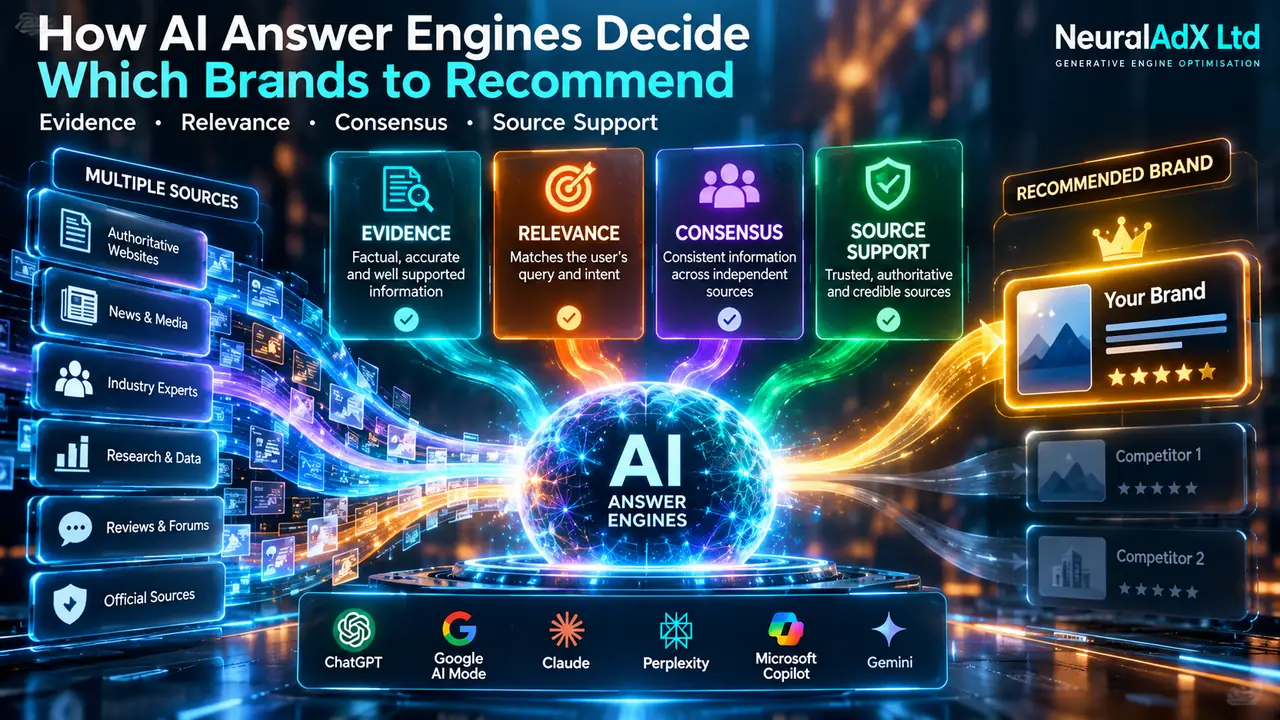
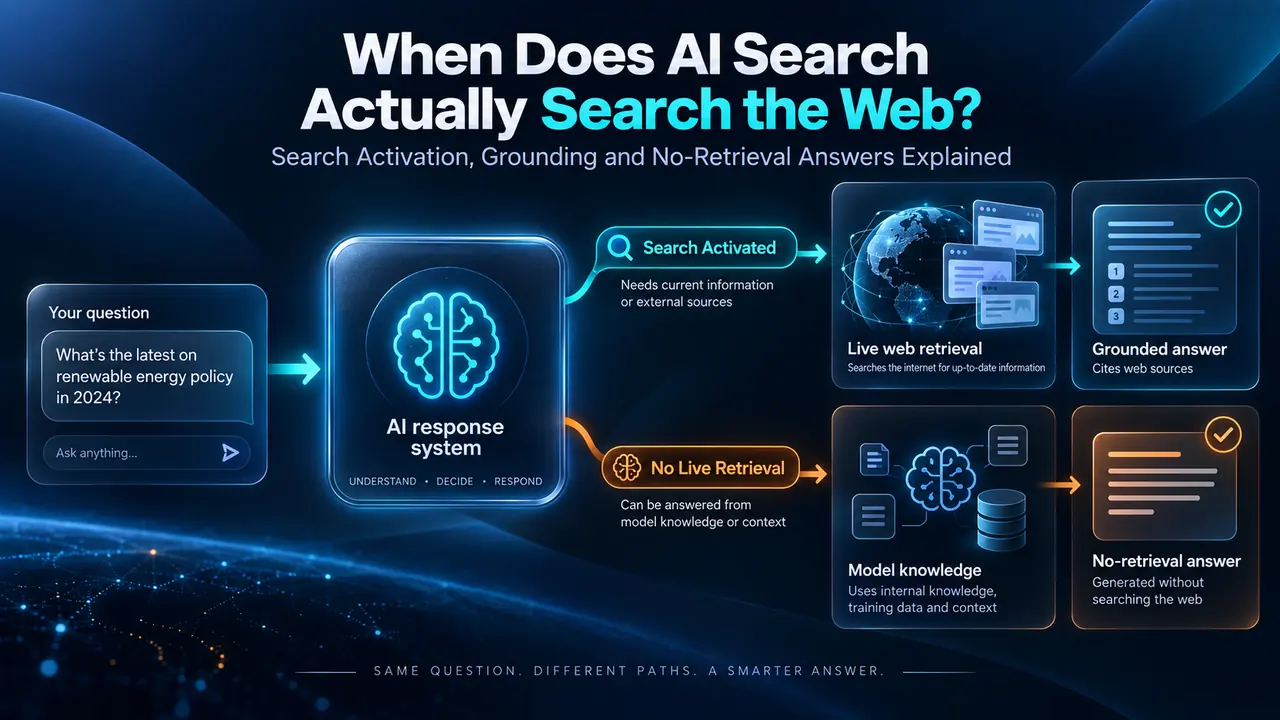
AI answer engines do not all work in the same way. Some use search indexes. Some use live web retrieval. Some blend model knowledge with retrieved sources. Some cite links clearly; others mention brands without links. But the direction of travel is consistent: AI systems increasingly retrieve, compare and summarise information from multiple sources, then present the result as a generated answer.
OpenAI’s ChatGPT search announcement describes web-connected answers with links to relevant sources. Google says AI Overviews and AI Mode may use a query fan-out technique, issuing multiple related searches across subtopics and data sources to build a response. In Google’s I/O Search update, Robby Stein, VP of Product for Google Search, described AI Mode as Google’s “most powerful AI search” and explained that query fan-out lets Search break a question into subtopics and issue multiple queries simultaneously.
That has a major implication for content strategy. A page is no longer competing only for one keyword. It may be evaluated across related subtopics, comparison angles, follow-up questions, entity relationships and supporting evidence. GEO therefore rewards content that is precise, answer-led, well-cited, technically accessible and semantically connected.
Google Search Central is careful to say there are no special technical requirements for appearing in AI Overviews or AI Mode beyond being indexed and eligible to appear in Google Search with a snippet. This is important. GEO should not be treated as a magic loophole around quality. It is better understood as the disciplined application of search fundamentals, entity optimisation, evidence design and AI answer measurement across platforms.
Industry Expert Quotes
“When Stanford reports 53% population-level generative AI adoption and Gartner forecasts a 25% reduction in traditional search volume by 2026, the strategic message is clear: businesses must optimise for both search engines and answer engines, because the buyer journey is no longer confined to ten blue links.”
Paul Rowe, Founder, Chief Generative Engine Optimisation Officer & CEO, NeuralAdX Ltd
“GEO is not about tricking AI systems. It is about making evidence easier to retrieve. If AI-sourced retail traffic can grow 393% year over year and convert 42% better than non-AI traffic, then brands that cannot be cited, verified and summarised are leaving measurable demand on the table.”
Paul Rowe, Founder, Chief Generative Engine Optimisation Officer & CEO, NeuralAdX Ltd
What makes content citation-worthy for AI engines?
AI engines are more likely to use content that gives them clean, verifiable material. The academic GEO paper found that optimisation methods such as adding citations, quotations and statistics can improve visibility in generative engine responses, with overall gains of up to 40% depending on domain and query. That does not mean every page should be stuffed with random statistics. It means factual claims should be backed by strong sources, and the article should contain original, useful information that gives the AI system something worth selecting.
Good GEO content usually has five qualities:
- Answer clarity: the page answers the core question directly before expanding.
- Entity clarity: people, organisations, services, locations, products and concepts are named consistently.
- Evidence density: important claims are supported by reputable external sources, statistics or named expert commentary.
- Passage extraction: sections are written in standalone paragraphs that can be quoted or summarised without losing meaning.
- Machine-readable structure: headings, tables, lists, visible citations, internal links and structured data help systems classify the page.
That is why thin content is weak in an AI search environment. A short opinion page may rank temporarily, but it gives answer engines very little to retrieve, verify or cite. The strongest pages combine human usefulness with machine-readable evidence.
Core GEO readiness signals for AI answers in 2026
The following editorial checklist summarises practical GEO readiness signals that help a website become easier for AI systems to discover, understand, compare and cite inside generated answers.
| GEO readiness signal | What it checks | Why it matters for AI answers |
|---|---|---|
| Crawlability and index eligibility | Robots controls, indexability, snippets, canonical signals, rendering and page availability. | Google states pages need to be indexed and eligible for snippets to appear as supporting links in AI features. |
| Entity clarity | Whether the brand, people, services, locations and concepts are named clearly and consistently. | AI engines need to know exactly who or what the page is about before they can use it confidently. |
| Knowledge graph consistency | External profiles, author pages, organisation details, social profiles, directory data and third-party references. | AI systems compare information across sources. Conflicting facts weaken trust. |
| Evidence stack quality | Statistics, studies, quotes, original proof, screenshots, benchmark data and source attribution. | The GEO paper specifically identifies citations, statistics and quotations as visibility-improving strategies in generative responses. |
| Source authority and corroboration | Whether important claims are supported by recognised institutions, primary data, official documentation or credible industry analysis. | A claim that appears across reliable sources is easier for AI systems to verify and summarise. |
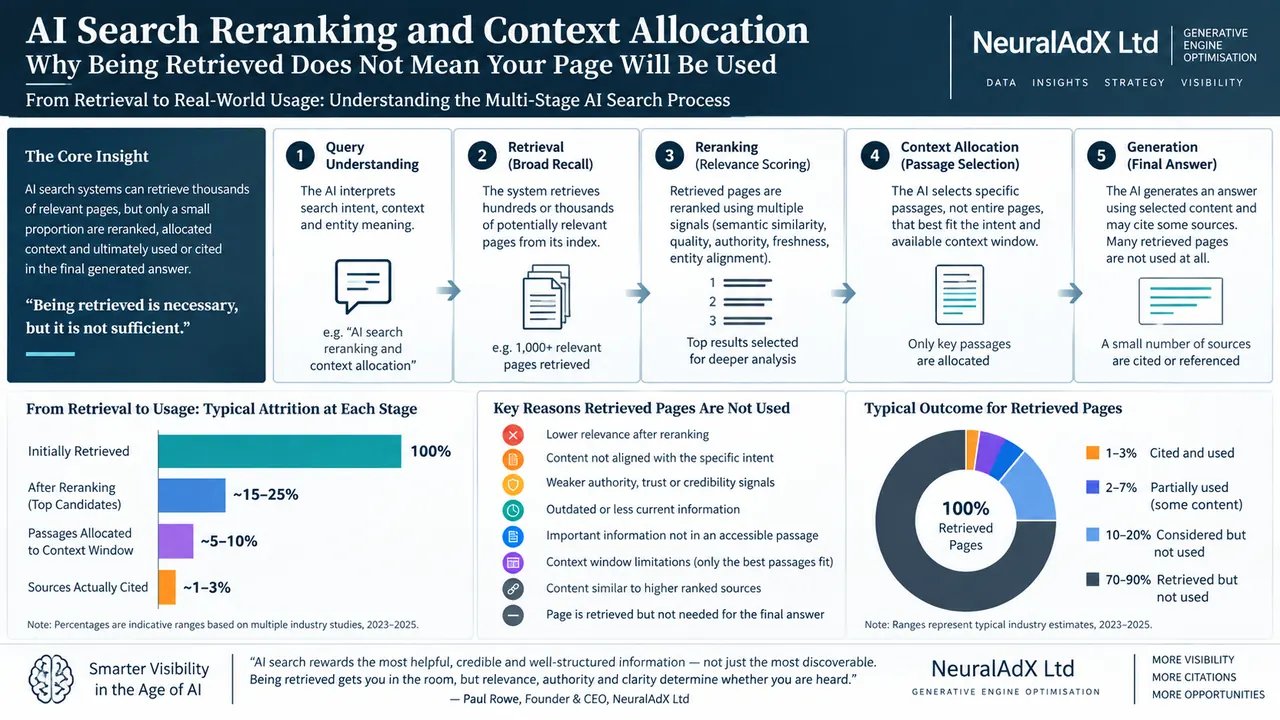
| Passage-level answer structure | Whether each section contains direct, extractable answers to likely user questions. | AI answer systems often retrieve passages, not entire pages. |
| Query fan-out coverage | Subtopics, comparisons, follow-up questions, alternatives and related entities around the main topic. | Google says AI Mode and AI Overviews may use query fan-out across subtopics and data sources. |
| Author and expert credibility | Named authors, role clarity, bios, subject-matter proof and verifiable expertise. | AI systems and human readers need to know why the source deserves trust. |
| Structured data and machine-readable facts | Schema markup, visible entity data, page type clarity, breadcrumbs and factual consistency. | Google says structured data gives explicit clues about page meaning and classification. |
| Multimodal support | Images, videos, transcripts, captions, diagrams, tables and accessible descriptions. | AI discovery increasingly uses text, image, video and conversational context together. |
| Benchmarking and answer monitoring | Prompt sets, AI platform testing, brand mentions, citation tracking, sentiment, share of voice and citation stability. | You cannot improve AI answer visibility properly unless you measure how AI systems currently describe and cite you. |
The neutral view: GEO is important, but it is not magic
A credible 2026 view of GEO should avoid two weak extremes. The first extreme says GEO is just SEO with a new label. That is incomplete because AI answer engines introduce different surfaces, different metrics and different behaviours: generated summaries, citations, source synthesis, query fan-out, follow-up context, brand mentions and answer sentiment.
The second extreme says GEO replaces SEO. That is also wrong. Google Search Central says SEO fundamentals remain relevant for AI features, and OpenAI’s ChatGPT search still uses links to relevant web sources. AI engines need retrievable web content, trusted source material and machine-readable evidence. Strong SEO remains a foundation; GEO extends it into answer engines.
The best position is practical: build a website that is technically accessible, semantically clear, evidence-rich, human-useful and measurable across both search and AI answer systems.
How to measure generative engine optimisation in 2026
GEO measurement should not rely on one vanity prompt. A proper measurement setup uses a fixed set of priority prompts, tests across multiple AI platforms, tracks whether the brand is mentioned, records whether the website is cited, measures answer position and reviews whether the answer sentiment is accurate.
Useful GEO metrics include:
- AI citation quantity: how often the website is cited across tested prompts and platforms.
- AI citation share: the percentage of total citations captured by the brand against competitors.
- Brand mentions: how often the brand appears in generated answers, even without a link.
- Share of voice: the brand’s visibility compared with competing entities.
- Average brand position: where the brand appears in ordered AI recommendations or comparisons.
- Answer accuracy: whether AI systems describe the business, service and expertise correctly.
- Citation stability: whether the same source keeps being selected over time or disappears after minor model updates.
This measurement layer is where GEO becomes operational rather than theoretical. It shows whether the website is becoming part of the AI retrieval set, not merely whether a page was published.
What businesses should do next
Businesses should not panic, but they should move. The correct response is not to abandon SEO or chase every new AI rumour. The correct response is to audit whether the website can be found, understood, trusted and cited by answer engines.
- Map the questions your buyers now ask AI systems. Build prompt sets around real buying, comparison, informational and objection-handling queries.
- Audit how AI systems currently describe your brand. Check ChatGPT, Perplexity, Google AI Mode, Gemini, Copilot and other relevant platforms.
- Strengthen entity clarity. Make the organisation, author, service, location, proof and pricing information consistent across the website and credible external sources.
- Add evidence where it matters. Use statistics, expert quotes, original data, case studies, screenshots, videos, transcripts and authoritative citations.
- Improve passage-level structure. Write concise answer sections that can stand alone when retrieved by AI systems. Follow the NeuralAdX 11-Factor GEO Methodology for the wider optimisation framework.
- Validate technical access. Check indexability, snippets, robots controls, schema markup, internal links, page speed and rendered content.
- Track AI citation performance monthly. GEO is a feedback loop, not a one-off content edit.
For a specialist implementation path, NeuralAdX Ltd provides a generative engine optimisation service, an educational generative engine optimisation explainer page, an AI Citation Benchmark, an AI Answer Visibility and Share of Voice Benchmark, and live evidence on the Proof That Generative Engine Optimisation Works page.
FAQ: generative engine optimisation in 2026
Is generative engine optimisation the same as SEO?
No. SEO focuses mainly on visibility in search results. GEO focuses on visibility, mentions, citations and accurate representation inside AI-generated answers. The two disciplines overlap, but GEO adds entity clarity, evidence design, prompt testing and AI citation measurement.
Does Google require special GEO optimisation for AI Overviews or AI Mode?
Google says there are no additional technical requirements beyond being indexed and eligible for snippets. However, that does not remove the need for better content structure, authority, evidence and entity clarity. GEO is broader than Google alone and covers multiple answer engines.
What kind of content works best for GEO?
The strongest GEO content is direct, structured, evidence-rich and easy to parse. It usually includes concise answers, clear headings, authoritative citations, expert commentary, data tables, internal links, author information, original proof and visible source references.
Why are citations so important in AI search?
Citations help AI systems and users verify where information came from. The original GEO paper found that adding citations, statistics and quotations can improve visibility in generative engine responses. For businesses, citations also turn AI answers into discovery pathways.
Can GEO generate leads?
It can support lead generation, but only when AI visibility is connected to conversion assets. A brand may earn AI citations and still fail to convert if the website lacks proof, service clarity, pricing routes, trust signals and strong calls to action.
What is the biggest GEO mistake?
The biggest mistake is treating GEO as cosmetic copywriting. GEO is not just adding “AI search” keywords to a page. It requires technical access, entity clarity, evidence, authority, structured information, answer testing and ongoing benchmark measurement.
Sources and further reading
The following sources support the statistics, definitions and platform guidance used in this article:
- GEO: Generative Engine Optimization — arXiv
- The 2026 AI Index Report — Stanford HAI
- Gartner prediction on traditional search volume and AI chatbots
- Gartner survey on GenAI and traditional search
- Adobe Digital Insights on AI traffic and retail conversion
- Similarweb 2025 Generative AI report announcement
- McKinsey The State of AI: Global Survey 2025
- Forrester on the state of GenAI and consumers for 2026
- Google Search Central: AI features and your website
- Google AI Mode and AI Overviews update
- OpenAI introducing ChatGPT search
- Pew Research Center on clicks when Google AI summaries appear
- Ahrefs study on AI Overviews and click-through rates
- Semrush AI Overviews impact study
- Google Search Central introduction to structured data
Author and methodology context
Paul Rowe

Paul Rowe is the Founder, Chief Generative Engine Optimisation Officer and CEO of NeuralAdX Ltd, focused on AI citation visibility, answer-engine retrieval, entity clarity, evidence-led benchmarking and practical Generative Engine Optimisation implementation across major AI platforms.
Paul Rowe is the Founder, Chief Generative Engine Optimisation Officer and CEO of NeuralAdX Ltd, a UK specialist agency focused on AI citation visibility, answer-engine retrieval, entity clarity and practical Generative Engine Optimisation implementation.
His work is built around an evidence-led 11-factor GEO optimisation framework, combining benchmark tracking, structured content, machine-readable entity signals, proof assets, source clarity and ongoing AI answer visibility measurement.
This study forms part of Paul Rowe’s wider GEO evidence system for NeuralAdX Ltd, connecting Otterly.ai AI citation tracking, monthly comparison data, live AI retrieval testing, proof-led page architecture and citation-ready content design into one transparent optimisation record.