NeuralAdX Ltd · Generative Engine Optimisation research guide · Last reviewed 8 September 2026
Semantic internal linking helps AI systems understand a website by making page relationships, topical hierarchy and evidence pathways explicit
Semantic internal linking for Generative Engine Optimisation is the deliberate use of crawlable, descriptive and contextually relevant links to connect related pages so search and AI retrieval systems can more easily discover the site, infer relationships between pages, identify important resources and reach the evidence most relevant to a user’s question.
It is not a direct AI-citation switch. The defensible GEO value is upstream: stronger internal architecture can improve discovery, crawl paths, contextual meaning and site hierarchy, which can improve the conditions under which a page becomes retrievable and eligible for citation. Google explicitly says it analyses relationships between pages from their linkages, while Bing’s current webmaster guidance connects crawlable internal links with discovery, authority evaluation and grounding eligibility. OpenAI and Perplexity separately document crawler-access requirements for search inclusion.
TL;DR: what semantic internal linking for GEO should accomplish
- Make important pages discoverable: every indexable page that matters should be reachable through ordinary crawlable links, not only a sitemap or site search.
- Explain relationships: link closely related concepts, services, evidence, people and methodology pages with descriptive anchor text and meaningful surrounding sentences.
- Express hierarchy: hubs should link to specialist subtopics; specialist pages should link back to the parent concept and sideways only to genuinely related supporting pages.
- Route to evidence: claims should connect naturally to proof, primary sources, methodology, benchmarks or definitions that help a retrieval system verify what the page is saying.
- Measure outcomes: internal-link health is an input metric. AI citations, answer mentions, source coverage and citation absorption are outcome metrics and should be measured separately.
What is semantic internal linking for Generative Engine Optimisation?
Semantic internal linking is an internal-link architecture in which the destination of each link is chosen because it has a clear conceptual relationship to the source passage, and the anchor text plus surrounding sentence accurately describe that relationship. In GEO, the goal is not simply to distribute link equity. It is to make the website’s knowledge structure easier to discover, interpret and traverse.
A basic internal link says, “this page links to that page.” A semantic internal link says, “this claim, entity, process or subtopic is meaningfully connected to that specific resource.” The difference is the quality of the relationship signal.
For a Generative Engine Optimisation programme, this architecture should connect the parent topic to its definitions, supporting research, proof, services, people, FAQs, benchmarks and specialist applications without turning every paragraph into a link farm. NeuralAdX Ltd treats those related search terms sometimes described as AI SEO, AEO, LLMO, AI search optimisation or platform optimisation as applications and buyer language within the wider specialist discipline of Generative Engine Optimisation, not as replacements for GEO.
How semantic internal links fit into the AI retrieval-to-citation pipeline
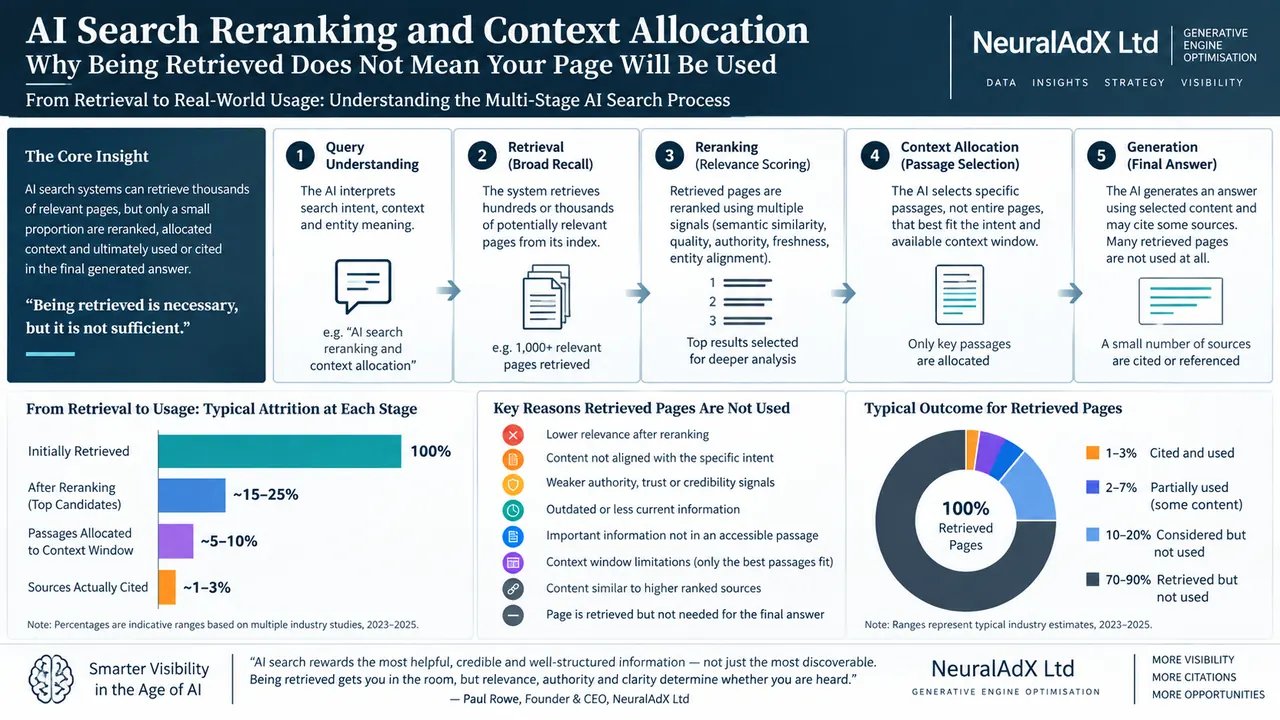
The safest way to understand internal linking for GEO is as an upstream architecture signal. It can help machines reach and contextualise content, but the page must still survive later retrieval, source-selection and answer-generation stages.
Mobile: scroll horizontally to inspect the complete diagram.
Standard crawlable links expose URLs.
Anchors and context describe the connection.
Link patterns signal hubs, subtopics and importance.
Relevant pages may enter a candidate set.
Evidence, authority and recency are assessed.
The source may be cited or used in the answer.
What the strongest current evidence actually says about internal links and AI understanding
There is no high-quality public evidence showing that adding a particular number of internal links directly causes ChatGPT, Google AI Mode, Perplexity or Microsoft Copilot to cite a page. The evidence is stronger at the infrastructure and retrieval layer.
Google: links reveal relationships and importance
Google says it tries to find the best content by analysing relationships between pages based on linkages. It can also use the number of links required to reach a page and the number of links pointing to it to infer relative importance.
“Every page you care about should have a link from at least one other page on your site.”
Bing/Copilot: links support grounding eligibility
Bing’s current webmaster guidance explicitly recommends crawlable internal links so important URLs can be discovered and states that strong linking supports discovery, authority evaluation and grounding eligibility.
“Strong internal and external linking supports discovery, authority evaluation, and grounding eligibility.”
OpenAI: crawler access is a prerequisite
OpenAI says public websites can appear in ChatGPT search and advises publishers not to block OAI-SearchBot if they want content discoverable, surfaced and clearly cited. Internal links cannot compensate for a crawler that cannot reach the page.
Perplexity: index access remains fundamental
Perplexity documents PerplexityBot as the crawler used to surface and link websites in search results, and recommends allowing it in robots.txt. Again, internal architecture helps after access exists; it does not replace access.
The practical conclusion is narrow but important: semantic internal linking improves the website’s information architecture and retrieval conditions. It should be combined with crawler access, canonical consistency, strong content, external evidence, entity clarity and repeated AI retrieval testing.
The eight principles of semantic internal linking for GEO
1. Link by meaning, not merely by keyword overlap
A page about “AI citation benchmarking” should link to the benchmark methodology, definitions of citation metrics and relevant proof. It should not link to unrelated pages simply because they contain the words “AI” or “citation.” Semantic coherence is the priority.
2. Build a clear parent → child → supporting-evidence hierarchy
The parent hub defines the main entity or discipline. Child pages answer narrower intents. Supporting pages supply methodology, proof, data, definitions or platform-specific application. This prevents the site from looking like a flat collection of disconnected articles.
3. Give every important page at least one crawlable route
An XML sitemap is useful, but it is not a substitute for internal architecture. Google explicitly recommends linking to every page you care about. Orphan pages weaken discoverability and remove the contextual relationship that an ordinary on-page link can supply.
4. Keep anchors descriptive, concise and natural
Google says anchor text should be descriptive, reasonably concise and relevant both to the source page and the destination. “Read our AI Citation Benchmark” is more informative than “click here”; “see the full 11-Factor GEO Methodology” is more informative than “learn more.”
5. Use the surrounding sentence to explain why the destination matters
Google specifically notes that the words before and after a link matter. For GEO, that context is valuable because it turns the link into a typed relationship: definition, evidence, comparison, author, method, case study or next-step resource.
6. Link evidence to claims and claims back to their evidence layer
When a page makes a measurable claim, the reader and machine should be able to reach the underlying benchmark, research paper, proof video, transcript or methodology. This is especially important for GEO because citation fidelity depends on the cited source genuinely supporting the claim attributed to it.
7. Prefer a small number of high-value contextual links over indiscriminate density
There is no credible universal “links per 1,000 words” rule for AI citations. Over-linking can dilute context and make the page harder to read. Link where the destination materially improves understanding, verification or navigation.
8. Maintain the graph as content changes
Internal linking is not a one-off build. When a new benchmark, study, glossary definition or service detail is published, existing pages should be reviewed for new semantic connections. Link decay, redirects, stale anchors and outdated proof pathways should be corrected during recency reviews.
A semantic website architecture AI systems can traverse
The simplest robust model is a topic graph with explicit roles. The architecture below avoids the common mistake of treating every page as equally important.
Mobile: scroll horizontally to review the complete table.
| Page role | What it should establish | Primary internal links | GEO value |
|---|---|---|---|
| Entity / concept hub | Defines the main discipline, organisation, product or concept. | Child topics, methodology, evidence, key people. | Creates a canonical topical centre. |
| Specialist child page | Answers a narrower user intent completely. | Parent hub, definitions, proof, closely related sibling pages. | Improves semantic depth without topic dilution. |
| Evidence / benchmark page | Shows how a claim was measured and what the result means. | Relevant claims, methodology, limitations, proof assets. | Supports source verification and citation fidelity. |
| Methodology page | Explains process, definitions, evidence standard and limitations. | Research, proof, service implementation, author. | Makes reasoning and provenance inspectable. |
| Author / entity page | Disambiguates the person or organisation behind the content. | Published work, methodology, company verification, expertise. | Strengthens entity clarity and accountability. |
| Glossary / definition page | Provides precise terminology and disambiguation. | Parent concept, practical guides, related terms. | Creates concise definition passages suitable for retrieval. |
Build a relationship taxonomy, not just a list of internal-link opportunities
A useful semantic internal-link plan should record why two pages are connected. Standard HTML links do not automatically declare a rich knowledge-graph predicate such as “is evidence for” or “is authored by.” In ordinary web content, that meaning is largely communicated through the destination URL, anchor text, surrounding sentence, headings, page purpose and the wider pattern of links across the site.
This means the editorial team should think in relationship types even when the final implementation remains a normal crawlable <a href>. The taxonomy below is an editorial model, not a proposal to invent unsupported HTML rel values.
Mobile: scroll horizontally to review the complete relationship table.
| Relationship type | Source-page wording | Best destination | What the relationship communicates |
|---|---|---|---|
| Is a subtopic of | “Within semantic internal linking, anchor context is…” | Parent GEO architecture hub. | Topic hierarchy and scope. |
| Defines | “Citation absorption means…” | Canonical glossary or explainer page. | Terminology and disambiguation. |
| Is evidence for | “The latest benchmark records…” | Benchmark, study, proof or primary source. | Claim provenance and verification route. |
| Is measured by | “AI citation visibility is measured using…” | Methodology or benchmark definition. | Metric meaning and limits. |
| Is authored / led by | “Written and reviewed by…” | Stable author entity page. | Accountability and entity clarity. |
| Is an application of | “For ChatGPT retrieval, this GEO principle is applied by…” | Platform-specific guide. | Parent discipline → platform application. |
| Updates / supersedes | “The September 2026 guidance updates…” | Newest canonical research or evidence page. | Recency and version relationship. |
This model also helps prevent topical drift. A service page can link to a benchmark because the benchmark supports a measurable claim; a definition page can link to the service only when implementation is relevant to the reader. The destination is selected by relationship, not by commercial priority alone.
For entity clarity, the same logic should be consistent across author bios, organisation pages, methodology pages and specialist content. A person’s name should resolve to the same canonical author profile; a named framework should resolve to its canonical methodology page; a benchmark metric should resolve to the page that defines and measures it. Repetition of the same relationship pattern across the site is more useful than repeatedly forcing the same keyword-rich anchor text.
Citation: Google says anchor text and surrounding context help explain linked pages
Anchor text for GEO: describe the destination and the relationship
Anchor text is one of the clearest semantic signals available in ordinary HTML. Good anchor text helps both readers and crawlers predict what the destination contains. The surrounding clause explains why the link is being made.
Mobile: scroll horizontally to review the complete table.
| Weak pattern | Stronger semantic pattern | Why it is better |
|---|---|---|
| “Click here” | “review the AI Citation Benchmark methodology” | Names both the destination and its role. |
| “Learn more” | “see the 11-Factor GEO Methodology” | Connects the current claim to a defined framework. |
| “Proof” | “view the live AI retrieval proof” | Specifies what kind of proof is available. |
| Exact-match keyword repeated everywhere | Natural variants that remain accurate | Preserves meaning without turning anchors into keyword stuffing. |
A useful quality check comes directly from Google: read the anchor text without the surrounding paragraph. If you cannot predict the destination, the anchor is probably too generic. Then read the full sentence. If the reason for the link is unclear, the semantic relationship is probably too weak.
Citation: Google Search Central · anchor text and link context
Semantic links are most useful when they route machines to strong evidence containers
Internal linking cannot rescue a weak destination page. A 2026 cross-platform GEO measurement study covering 602 controlled prompts, 21,143 valid search-layer citations, 23,745 citation-level feature records and 18,151 successfully fetched pages found that high-influence cited pages were markedly more structured and more semantically aligned than low-influence pages. These are descriptive associations, not proof that adding headings or length alone causes citation absorption.
Mobile: scroll horizontally to inspect the complete bar chart.
The same study reported the strongest independent correlation with citation influence for LLM relevance score at r = 0.4322, followed by answer–citation embedding similarity at r = 0.3561. That reinforces the core internal-linking rule: route a page to the most semantically relevant evidence, not merely to the most commercially important URL.
Citation: Zhang Kai, He Xinyue & Yao Jingang · 2026 citation selection & absorption study
Internal architecture matters, but source identity still matters to AI selection
Semantic internal linking improves coherence inside your own domain. It does not eliminate the need for external authority, source diversity or strong first-party evidence. In the same 2026 dataset, official, news and vertical sources together accounted for 79.12%–87.52% of observed citations across the three studied platforms.
Mobile: scroll horizontally to inspect the complete stacked bars.
This is why a mature GEO architecture should connect owned content to authoritative external evidence as well as to strong internal proof. Internal links explain your site; third-party sources help corroborate it.
How to build semantic internal linking for GEO step by step
- Inventory canonical pages. List the URLs that deserve indexing and identify duplicate, redirected, thin or obsolete pages before adding links to them.
- Assign one primary semantic role to each URL. Examples: concept hub, service, methodology, benchmark, proof, author, glossary definition, platform guide, case study or editorial analysis.
- Map parent-child relationships. Every specialist page should have a logical parent. The parent should link down; the child should link back when useful to the reader.
- Map evidence relationships separately. A proof page is not necessarily a topical parent. It may support many pages as an evidence node. Treat “supports this claim” as a different relationship from “is a subtopic of.”
- Place contextual links inside the relevant passage. Navigation links help discovery; contextual links explain meaning. Important relationships often deserve both.
- Use standard HTML anchors. Google says ordinary
<a href="...">links are reliably crawlable. Avoid relying on script-only click handlers for essential navigation. - Check orphan pages and crawl depth. Important pages should not depend on a site-search box or a five-click maze. Google says it can use link depth and link counts as signals of relative importance.
- Connect author and organisation entities. Editorial pages should link to a stable author profile where expertise is relevant; author pages should link back to the core methodology, proof and published work.
- Create recency loops. When a benchmark or methodology changes, update older related articles with a contextual link to the newest evidence and a visible review date where appropriate.
- Test retrieval outcomes. After structural changes, re-crawl the site and re-run defined AI prompts. Do not declare success solely because an internal-link tool reports a healthier graph.
Example of a semantically strong internal link
The anchor names the evidence destination; the surrounding sentence explains why the reader should use it. That is stronger than a generic “learn more” link.
If the goal is to find out whether your site architecture is helping or hindering AI retrieval, internal-link review should sit inside a wider crawlability and visibility check. The free NeuralAdX Ltd AI Visibility Assessment is designed to start with that broader question rather than treating internal links as an isolated score.
AI Visibility Assessment
NeuralAdX Ltd
Request Your Free AI Visibility Assessment
Initial website check against the NeuralAdX Ltd 11-Factor GEO Framework plus 5 live AI retrieval tests.
Find out whether AI recommends your business, cites your website, prefers competitors — or leaves your business invisible in AI answers.
Checked
Start With A Free Assessment
Call NeuralAdX Ltd or send your assessment request by email.
Emailing Your Request?
Your email is already prepared with placeholders. Add your website URL, best contact number, 5 priority AI prompts and any useful information.
Initial assessment only · No obligation · Serious business enquiries answered within one UK business day · View live AI retrieval proof
How to measure whether semantic internal linking is helping GEO
Do not collapse architecture metrics and AI outcome metrics into one score. A site can have technically excellent internal linking and still fail to appear in generated answers because of weak relevance, authority, freshness, source selection or competition.
Mobile: scroll horizontally to review the complete measurement table.
| Layer | What to measure | What success looks like | What it does not prove |
|---|---|---|---|
| Crawl architecture | Orphans, broken links, redirect chains, crawl depth, crawlable hrefs. | Important URLs are reachable and stable. | That AI will retrieve or cite them. |
| Semantic architecture | Anchor relevance, parent-child consistency, evidence links, entity links. | The graph reflects genuine topic relationships. | That those relationships are weighted identically by every engine. |
| Retrieval | Live prompts, source panels, cited URLs, retrieval frequency. | Relevant pages enter answer-generation contexts more often. | That the page influenced the final wording. |
| Citation | Citation quantity, share, coverage, source position. | The domain is being selected as a source for target prompts. | Traffic, revenue, fidelity or absorption. |
| Absorption / fidelity | Whether the answer actually uses the page’s evidence and whether the citation genuinely supports the claim. | Answer content and cited evidence align accurately. | Permanent ranking or future performance. |
NeuralAdX Ltd publishes those downstream outcome layers separately. The AI Citation Benchmark measures source-selection frequency and citation share, while the AI Answer Visibility & Share of Voice Benchmark measures brand mentions, coverage, position and share of voice. The Proof That Generative Engine Optimisation Works evidence centre adds live, dated retrieval observations.
As of the Month 9 reporting window, 24 July–23 August 2026, the published NeuralAdX Ltd AI Citation Benchmark records 1,212 AI citations, 9.56% AI citation share and a 5.9× lead over the second-highest citation count in its fixed six-agency UK GEO comparison set. Those figures are evidence of observed citation performance under that benchmark methodology; they are not evidence that internal linking alone caused the result.
Industry Expert Quotes
“Semantic internal linking should be treated as retrieval architecture, not an AI-citation shortcut. Google says linkages help it infer page relationships and importance, while Bing now connects crawlable internal links with grounding eligibility. At NeuralAdX Ltd we therefore connect concept hubs, methodology, proof, benchmarks and specialist pages with descriptive contextual anchors, then measure the downstream result. Our Month 9 benchmark recorded 1,212 AI citations and 9.56% citation share, but that outcome cannot responsibly be attributed to internal linking alone.”
— Paul Rowe, Founder, Chief Generative Engine Optimisation Officer & CEO, NeuralAdX Ltd
Why semantic internal linking belongs inside GEO rather than replacing content quality
The foundational GEO research did not test internal linking as one of its nine content interventions. It tested changes such as adding citations, statistics and quotations, improving fluency, adding technical terms and making passages easier to understand. The strongest methods improved visibility within the study’s controlled generative-engine context, with the best overall Position-Adjusted Word Count result about 41% above baseline. That finding supports evidence-rich destination pages, not a claim that links themselves create the gain.
The 2025 GEO study likewise emphasised machine scannability, justification, authority, source type, freshness and engine-specific behaviour. The 2026 critical survey of 45 GEO studies goes further: it describes GEO as a stochastic, partially observable pipeline spanning search activation, crawling/indexing, retrieval, reranking/context allocation, citation, prominence, factual absorption, fidelity and user behaviour. It also warns that no reviewed technique demonstrated a stable, longitudinal, cross-platform causal effect on organic discoverability or downstream behaviour.
That is precisely where semantic internal linking fits: it improves the coherence and accessibility of the owned website graph at the discovery, context and hierarchy layers, while the destination pages still need to earn retrieval and source use on their own merits.
Common semantic internal-linking mistakes that weaken GEO architecture
- Orphaning important pages: the URL exists in the sitemap but no meaningful page links to it.
- Using generic anchors everywhere: “click here,” “read more” and “learn more” discard useful semantic information.
- Exact-match anchor repetition: forcing the same keyword-rich anchor across dozens of pages is not semantic precision; it is pattern repetition.
- Linking to commercial pages when evidence is needed: a claim about methodology should often link to methodology or proof, not straight to a sales page.
- Creating circular noise: every page linking to every other page makes hierarchy harder to interpret and degrades user experience.
- Relying on navigation alone: global menus help discovery but rarely explain the specific semantic relationship between two ideas.
- Ignoring redirects and canonicals: internal links should point directly to the preferred canonical URL whenever possible.
- Using JavaScript-only navigation for essential paths: ordinary href links remain the safest crawlable implementation.
- Treating internal links as proof of AI visibility: a clean graph is necessary infrastructure, not evidence that an answer engine selected or absorbed the page.
Semantic internal linking audit checklist for GEO
Mobile: scroll horizontally to review the complete checklist.
| Check | Pass condition | Why it matters |
|---|---|---|
| Important-page discoverability | Every priority page has at least one relevant crawlable inlink. | Removes orphan-page risk. |
| Canonical target consistency | Internal links point to the preferred canonical URL. | Consolidates signals and reduces duplicate ambiguity. |
| Anchor specificity | Anchor predicts the destination accurately. | Improves semantic context. |
| Contextual relevance | The surrounding sentence explains why the link belongs. | Turns a URL connection into a meaningful relation. |
| Hub structure | Parent topics link to children; children link back where useful. | Makes topic hierarchy legible. |
| Evidence pathways | Material claims link to proof or authoritative sources. | Supports verification and fidelity. |
| Entity links | Authors, organisation and methodology are consistently connected. | Reduces entity ambiguity. |
| Freshness maintenance | New evidence is linked from older relevant pages. | Keeps the graph current. |
| Crawl implementation | Essential links use standard href anchors and resolve successfully. | Improves crawler reliability. |
| Outcome validation | Defined AI prompts are retested after material changes. | Separates architecture assumptions from observed visibility. |
How Semantic Internal Linking Supports the Wider Generative Engine Optimisation Framework
NeuralAdX Ltd is a specialist Generative Engine Optimisation company. Semantic internal linking is therefore used as one component of a broader GEO system that combines crawlability, retrieval testing, citation readiness, entity clarity, prompt coverage, trust signals, source selection and AI visibility measurement.
For the complete implementation model, use the Generative Engine Optimisation service process together with the 11-Factor GEO Methodology. To examine outcomes rather than inputs, review the AI Citation Benchmark, the AI Answer Visibility & Share of Voice Benchmark and the live GEO proof evidence.
For more current research and specialist explainers, browse the NeuralAdX Ltd Generative Engine Optimisation blog archive. A well-structured GEO content graph should connect specialist articles to their parent topic, supporting evidence, methodology and related applications. This helps crawlers and retrieval systems discover the content while giving users clearer pathways between concepts that genuinely belong together.
FAQ: semantic internal linking for GEO
Does internal linking directly improve AI citations?
There is no robust public evidence that a specific internal-link change directly causes AI citations. Internal linking is best treated as an upstream discovery, context and hierarchy signal that can improve the conditions for retrieval. Citation selection and absorption still depend on relevance, source quality, competition, engine behaviour and the answer context.
What makes an internal link semantic?
A semantic internal link connects two pages because they have a meaningful relationship, uses anchor text that accurately describes the destination and sits in surrounding text that explains why the destination is relevant.
How many internal links should a GEO page have?
There is no universal evidence-based number. Use enough links to expose the page’s genuine relationships and help the reader navigate to useful definitions, evidence and next-level detail. Do not add links purely to reach a density target.
Are breadcrumbs enough for GEO internal linking?
No. Breadcrumbs are useful hierarchy and navigation signals, but they do not replace contextual links inside the content. A contextual link can explain a specific evidence, definition or topic relationship that a breadcrumb cannot.
Should all related pages link to each other?
No. Related does not mean mutually necessary. Link when the destination improves understanding, verification or navigation. A selective graph with clear hierarchy is usually more interpretable than a fully connected web of repetitive links.
Should service pages receive more internal links than blog posts?
Not automatically. Link priority should follow user value, topical role and evidence needs. A methodology or benchmark page may deserve many links because it supports numerous claims, even if it is not a commercial conversion page.
Do XML sitemaps replace internal links?
No. Sitemaps help crawlers discover canonical URLs, but ordinary internal links additionally provide navigation, hierarchy and contextual relationships. Google recommends both.
What is the best way to test a semantic internal-linking change?
Record the change, confirm crawler access and indexability, re-crawl the site, then repeat a fixed set of relevant AI retrieval prompts over time. Track citation and answer-visibility outcomes separately from architecture metrics and avoid claiming causation from a single observation.
Primary documentation and research used for this guide
The article prioritises first-party platform documentation and original research. Commercial studies are used only where they add a clearly labelled observational statistic.
Google · Site structure
Google · Sitelinks & logical structure
Bing · Webmaster Guidelines
OpenAI · Publisher FAQ
Perplexity · Crawler documentation
Aggarwal et al. · GEO · 2024
Chen et al. · AI Search · 2025
Zhang Kai et al. · Citation absorption · 2026
Martinez · GEO critical survey · 2026
Ahrefs · 1,000,000 SERP correlation study · 2025
One useful caution from Ahrefs’ 2025 analysis of the top 1,000,000 US keywords: internal inlinks showed a Spearman correlation of 0.117 with top-20 ranking position in that dataset. Ahrefs explicitly warns that correlation is not causation. That makes it useful context, not a formula for how many internal links a page needs.
The practical standard
A website AI systems can understand is not one with the most internal links. It is one in which important pages are crawlable, relationships are explicit, anchors are descriptive, hierarchy is coherent, entities are unambiguous, evidence is easy to reach and destination pages contain accurate, current and extractable information. Semantic internal linking is the connective tissue of that system; Generative Engine Optimisation is the wider discipline that tests whether the system is actually being retrieved, cited, trusted and used.