NeuralAdX Ltd editorial research · Last reviewed 26 October 2026
Why conversational follow-ups reshape AI source selection and brand recommendations
An evidence-based guide to how changed intent, refined requirements and retained conversation context can shift AI answers, visible source citations and brand shortlists.
Measure the full conversation rather than only the first prompt. A follow-up can change evidence needs and brand eligibility. Capture citations, mentions, recommendations and factual fidelity by turn; test fresh-chat controls and repeat runs.
What is multi-turn AI search and why does it change brand visibility?
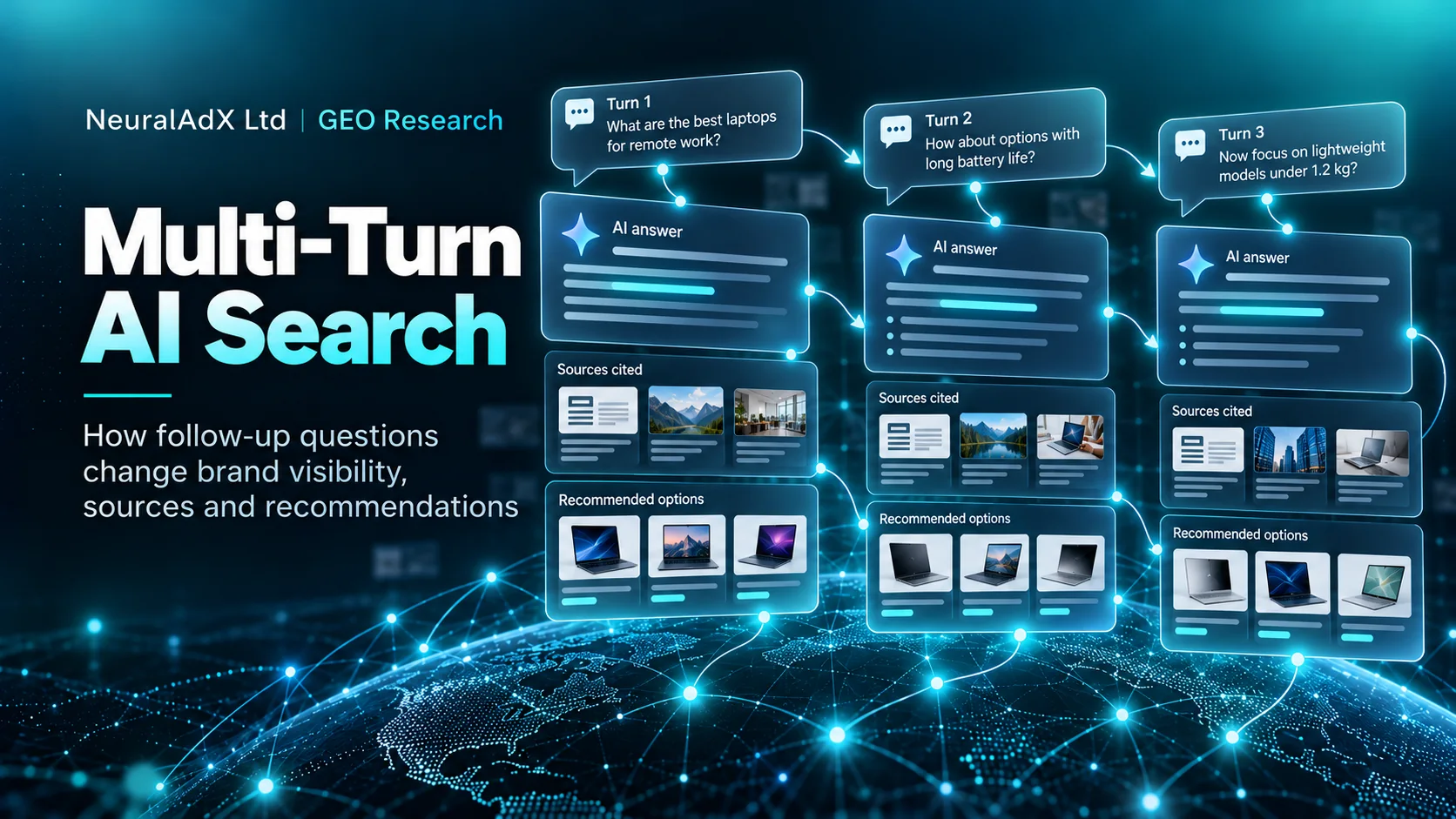
Multi-turn AI search is a conversation in which people ask an initial question and one or more follow-ups, sometimes adding or revising criteria. The AI answer may then name different brands, present different source links or change a recommendation because the user’s information need has evolved.
For Generative Engine Optimisation (GEO), the unit of observation must include the full conversation path as well as each turn. Being named in the first answer does not guarantee eligibility later, and an early absence does not prevent a brand from entering a later shortlist.
Google’s January 2026 announcement describes users moving from AI Overviews into contextual follow-up conversations in AI Mode.
Google Search 2026How do follow-up questions change sources and recommendations?
Follow-up questions can narrow constraints, clarify uncertainty, switch from education to purchase evaluation, request fresh data or reject an earlier suggestion. Each change may alter which evidence is relevant and which providers satisfy the user’s criteria. The exact internal retrieval process is not generally observable.
On mobile, swipe horizontally to view the table.
| Follow-up type | Example | Potential effect |
|---|---|---|
| Scope narrowing | UK providers only | Remove ineligible overseas companies |
| Evidence requirement | Which have independent proof? | Add corroborating sources |
| Budget constraint | Under £1,500 monthly | Exclude higher-priced options |
| Change of task | Now compare three agencies | Shift from definitions to comparisons |
| Correction | Exclude one provider | Remove previous suggestion |
| Freshness | Use 2026 evidence | Prefer more recent supporting pages |
Google documents query fan-out across subtopics. Microsoft explains that Copilot can generate Bing queries for web grounding and reveal its sources and query; OpenAI recommends opening and checking search citations.
Google documentationMicrosoft CopilotOpenAI SearchWhat does a five-turn GEO discovery conversation look like?
A buyer can progress from understanding GEO to troubleshooting an absence, comparing solutions, narrowing a shortlist and evaluating a purchase. The following is a hypothetical testing path, not a live AI-engine result.
On mobile, swipe horizontally to view the table.
| Turn | Example user question | Intent | Evidence need |
|---|---|---|---|
| 1 | What is GEO? | Informational | Definition, research |
| 2 | Why is my company missing from AI answers? | Problem | Diagnostic sources |
| 3 | What options improve visibility? | Solution | Methods and trade-offs |
| 4 | Which UK GEO specialists show external proof? | Commercial comparison | Credentials, independent evidence |
| 5 | Which fits a £1,250 monthly budget? | Decision | Scope, price and limitations |
A business omitted in turn one might be highly relevant by turn four. It can also disappear at turn five if it fails a new constraint. Neither event alone proves an algorithmic penalty or reward.
Why can the cited websites change at every turn?
Different turns require different evidence. An initial definition may cite research; a diagnostic question may need technical documentation; a buying decision may need verified service details and independent comparisons. A changing source set reflects the visible evidence chosen for that answer, not necessarily all documents considered.
On mobile, swipe horizontally to view the table.
| Intent stage | Relevant source types | Verification criterion |
|---|---|---|
| Understand | Research, standards, explainers | Accurate definitions |
| Diagnose | Official help and technical documentation | Applicable root causes |
| Compare | Independent evaluations and first-party specifications | Symmetric criteria |
| Shortlist | Provider facts and external verification | Named entities and credible claims |
| Choose | Pricing, scope and terms | Current accurate constraints |
ICLR 2026 Search Arena analysed more than 24,000 paired multi-turn interactions and roughly 12,000 human preference votes. Its analysis found source types and citation counts can influence preference even when links fail to support the nearby claim, reinforcing the need for fidelity checks.
ICLR 2026 Search ArenaHow should multi-turn AI brand visibility be measured?
Track initial presence, first appearance, turn-level mentions, visible owned and independent citations, final shortlist inclusion, recommendation accuracy and loss of eligibility. Count a brand mention separately from a recommendation or source citation.
On mobile, swipe horizontally to view the table.
| Metric | How to record | Interpretation |
|---|---|---|
| First appearance | First turn naming brand | Stage of eligibility |
| Brand mention coverage | Eligible turns naming brand / eligible turns | Conversation-level presence |
| Retention | Later eligible turns maintaining brand / relevant earlier named turns | Persistence after refinement |
| Citations | Owned versus earned URLs by turn | Evidence attribution |
| Shortlist inclusion | Brand named in final list | Decision relevance |
| Recommendation fidelity | Does justification follow constraints and cited facts? | Answer quality |
Report denominators and treat unknown or unavailable citations explicitly; do not infer that absence of a visible citation proves no source was used.
How can businesses run reproducible multi-turn GEO tests?
Write controlled conversation trees, preserve the exact transcripts, record platform settings and dates, and repeat each path. Compare the same final question in a fresh chat containing all necessary constraints to distinguish context effects from ordinary answer variability.
On mobile, swipe horizontally to view the table.
| Stage | Required record | Why |
|---|---|---|
| Plan | Starting prompt and follow-up branches | Consistent intent |
| Execute | Platform, mode, geography and run | Repeatability |
| Capture | Answer text, brand names, linked sources | Evidence ledger |
| Verify | Exact page and supported claims | Citation fidelity |
| Control | Standalone final prompt with restated constraints | History effect |
| Retest | Repeated paths and date windows | Volatility assessment |
An illustrative pilot of 10 starting intents × 3 follow-up paths × 4 engines equals 120 conversations. At five turns apiece, that produces 600 answer observations. These numbers are research-planning arithmetic, not a validated minimum.
How can you distinguish context effects from ordinary AI answer variation?
Use a paired control: run the final question after several earlier turns, and run a fresh-conversation version explicitly stating the same constraints. Compare names, order, recommendations and cited domains across repeated runs.
For citation overlap, Jaccard similarity equals the number of domains in both answer sets divided by the number in either set. This describes the observed source overlap; it does not reverse-engineer a ranking function.
A fair control must carry forward geography, budget and exclusions from the previous conversation. Otherwise any differences could be caused by changed requirements rather than conversational context.
What does 2026 research say about multi-turn reliability?
Search Arena’s 2026 dataset contains more than 24,000 paired multi-turn search interactions and approximately 12,000 human preference votes. A separate EACL 2026 study examined unnecessary retrieval and reported that noisy search evidence can compound across turns, sometimes harming appropriate refusal on unanswerable questions.
ICLR Search ArenaEACL over-searching study2026 research on conversational information retrieval also explores clarifying questions and reformulation to resolve ambiguous needs. These studies do not prove that any specific brand’s visibility will grow across all follow-ups.
2026 conversational IR researchWhat should multi-turn brand visibility charts show?
Chart observed outcomes by individual turn with consistent denominators. The following figures use a hypothetical 20-conversation dataset for illustration, not actual NeuralAdX Ltd test results.
On mobile, swipe horizontally to view the table.
| Turn | Named out of 20 | Mention rate |
|---|---|---|
| 1 | 4 | 20% |
| 2 | 7 | 35% |
| 3 | 9 | 45% |
| 4 | 12 | 60% |
| 5 | 10 | 50% |
Turn 120%
Turn 235%
Turn 345%
Turn 460%
Turn 550%
■ Cyan = named share. Dark remainder = absent share. On mobile scroll if needed.
■ Cyan = named · ■ Blue-grey = absent. On mobile scroll if needed.
How can GEO improve content relevance across conversation turns?
Create connected evidence that answers the successive tasks: definition, diagnosis, comparison, provider evaluation and decision. Structure each page with an immediately useful answer, verifiable figures, clear entities, current limitations and contextual linking rather than forced keyword repetition.
The NeuralAdX Ltd 11-Factor GEO Methodology covers citation readiness, authority, technical clarity and source diversity. The GEO explainer supports initial educational needs, while the specialist GEO service page addresses provider evaluation.
Google’s AI features documentation does not promise inclusion based on structured data or content changes alone.
Google Search CentralIndustry Expert Quotes
Proposed commentary for author approval: “A business can be visible in an introductory GEO answer and disappear once a buyer narrows the criteria. At NeuralAdX Ltd, a five-turn buyer conversation therefore represents five answer observations, not one static ranking. We need to test whether brand mentions, sources and recommendations remain evidence-based as the decision develops.” — Paul Rowe, Founder, Chief Generative Engine Optimisation Officer & CEO.
This is newly drafted attributable commentary requiring approval, not an independently verified previous quotation. Five turns represents five potential observations, not five guaranteed independent searches.
Where can readers examine GEO benchmarks and supporting evidence?
The AI Citation Benchmark and AI Answer Visibility and Share of Voice Benchmark illustrate citation and brand-mention measurement respectively. Their defined prompts, competitors and periods matter when interpreting results.
Related resources include live GEO evidence and verification, third-party mentions and external verification and AI retrieval demonstration videos. For further research see the NeuralAdX Ltd blog archive. No promotional CTA is included.
Frequently asked questions
Does every follow-up trigger a new search?
No. Depending on product and mode, systems may use prior context, earlier sources or new retrieval. Do not infer a fresh search without evidence.
Can a brand disappear from a later shortlist?
Yes. New constraints can make an earlier candidate ineligible, which is not necessarily an optimisation failure.
Is a brand mention the same as recommendation?
No. A recommendation evaluates suitability; a mention only names the business.
Can more citations make an answer more accurate?
Not necessarily. Citations should be checked against the actual supported claims.
How should multi-turn GEO tests be compared?
Match intent, constraints, mode and date; retain each turn and repeat the conversation paths.
Does structured data guarantee AI visibility?
No. Structured data can clarify content but does not require an AI platform to cite or recommend it.