NeuralAdX Ltd · Last reviewed 26 October 2026
Why first place in Google does not guarantee AI source selection
An evidence-led GEO guide to organic rankings, source citations, query fan-out and reliable comparison methods.
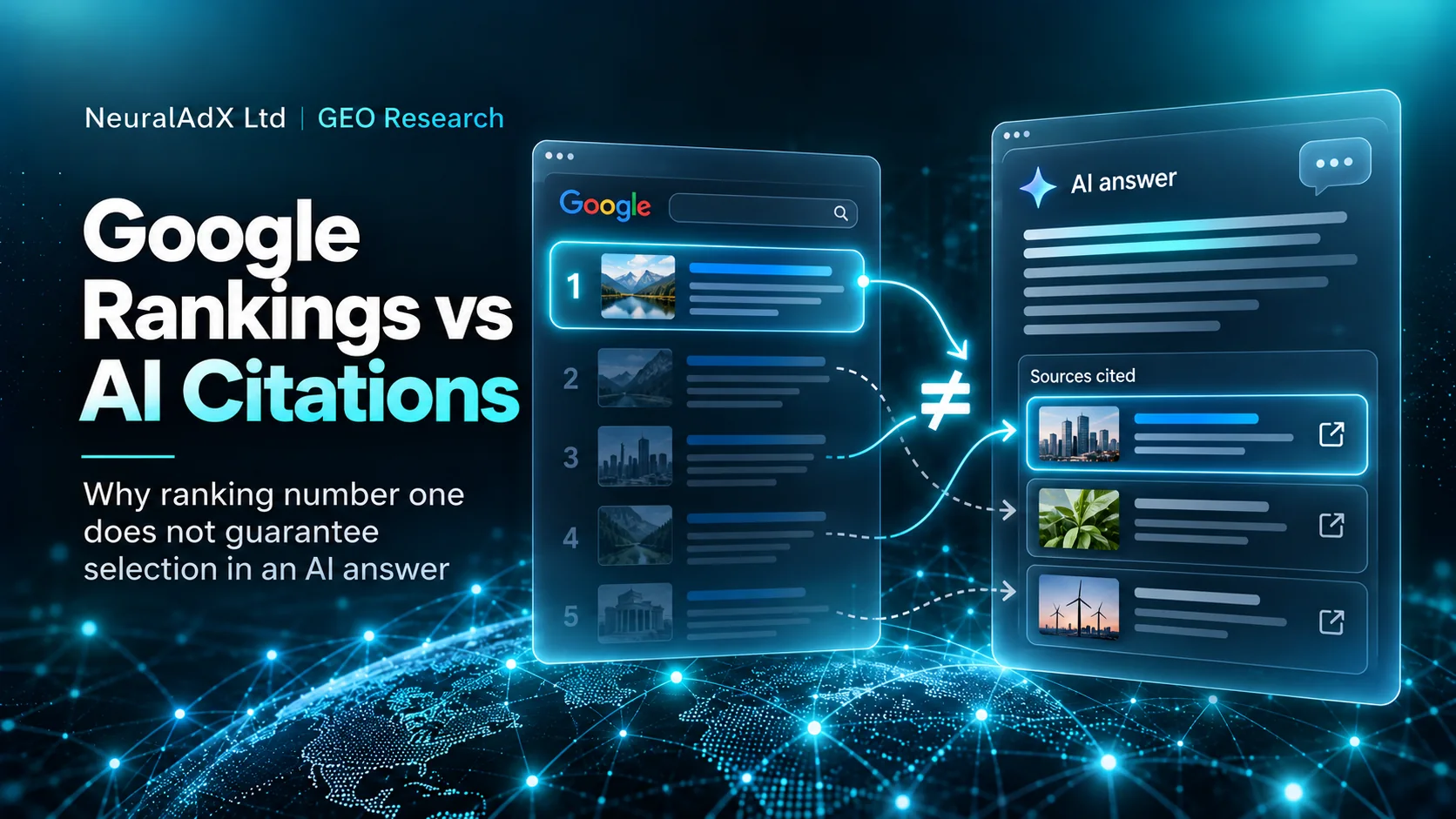
A high Google ranking and AI citations are different observations. Ahrefs’ March 2026 analysis found that 37.9% of AI Overview cited URLs appeared in the top ten result blocks for the same query. This does not mean that a number-one result has a 37.9% chance of citation.
Why does ranking number one on Google not guarantee AI citation?
Ranking first in organic search and being selected as a source in an AI-generated answer are different outcomes. Google AI Overviews and AI Mode can search related subtopics and surface different supporting evidence; indexing and snippet eligibility do not guarantee citation. Google’s official guidance
How are organic rankings, citations and mentions different?
An organic ranking is a URL’s search-result position; an AI citation is a displayed supporting URL; a brand mention names an organisation in generated prose; a recommendation asserts suitability.
Mobile: scroll table horizontally.
| Outcome | What it proves | What it does not prove |
|---|---|---|
| Organic rank | Position for a specific query | AI citation |
| AI citation | Linked source URL | Brand mention |
| Brand mention | Named organisation | Recommendation |
| Recommendation | Suggested suitability | Click or purchase |
What does the March 2026 evidence show about AI citation overlap?
Ahrefs analysed 863,000 keyword search results and approximately four million AI Overview URLs. Among already-cited URLs, 37.9% appeared in the top ten result blocks for the same query, 31.2% in positions 11–100, and 31.0% outside the first 100. These values are not the chance of citation for a number-one page. Ahrefs 2026 primary study
Mobile: scroll table horizontally.
| Cited URL ranking | All result blocks | Organic only |
|---|---|---|
| Top ten | 37.9% | 37.1% |
| 11–100 | 31.2% | 26.2% |
| Beyond 100 | 31.0% | 36.7% |
How do the citation rankings compare visually?
Top ten37.9%
11–10031.2%
Beyond 10031%
■ Cyan: top ten · ■ Blue: 11–100 · ■ Purple: beyond 100. Based on Ahrefs’ 2026 cited-URL dataset; rounded values. Mobile: scroll if needed.
How does query fan-out make other sources relevant?
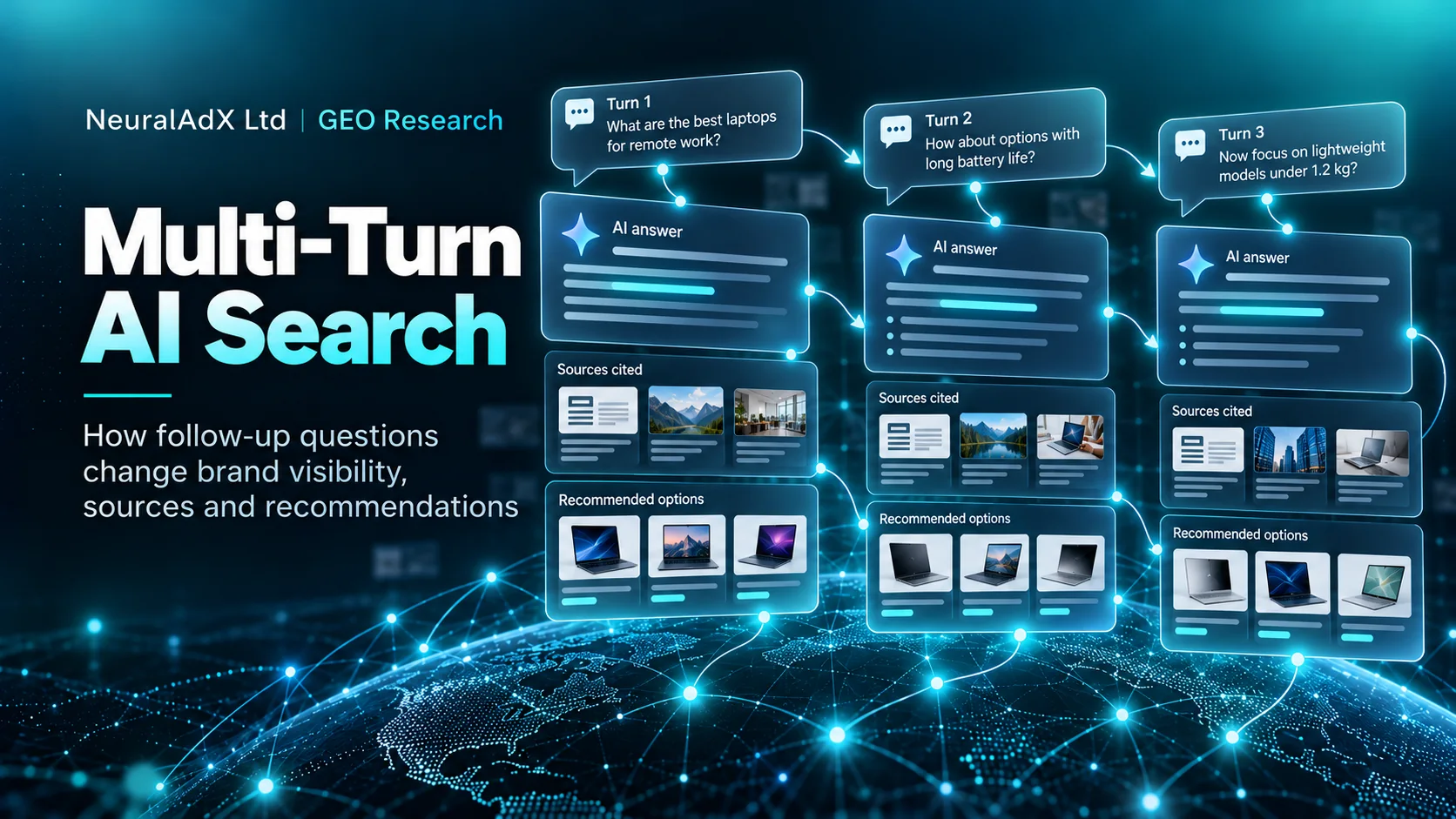
An AI answer may require supporting searches for definitions, statistics, prices, limitations or independent verification. A page ranking first for a broad keyword may not answer each supporting question. Google documents the general mechanism but not a guaranteed citation formula. Google Search Central
Why are 2025 and 2026 citation studies not directly comparable?
Ahrefs reported 76.1% top-ten overlap in July 2025, but changed its citation parsing methodology before its March 2026 analysis. The difference should not be portrayed as proof that Google’s algorithms alone changed. Ahrefs 2025Ahrefs 2026
What should a number-one ranking page check when it is not cited?
Inspect the precise user intent, AI-feature activation, cited sources, content specificity, freshness, primary evidence, indexing, snippet eligibility and repeated test variation. An isolated uncited answer is not proof of an algorithmic penalty.
Mobile: scroll table horizontally.
| Possible issue | Action |
|---|---|
| Different query intent | Answer exact subquestions |
| Weak evidence | Provide verifiable primary facts |
| Technical limitation | Check indexing and snippets |
| Variable results | Repeat controlled prompt tests |
Why should citations be measured alongside organic visits?
Pew Research Center analysed browsing from 900 US adults and found traditional-result clicks in 8% of Google visits with an AI summary versus 15% without one, while citation links inside AI summaries were clicked in about 1% of visits with such summaries. These are descriptive results for that sample, not a causal promise for any site. Pew Research Center
How do you audit organic rankings versus AI citations?
Create a fixed prompt panel, record date, region, device, organic results, AI trigger status, answer text, cited URLs, brand names, recommendations and citation fidelity. Repeat tests and disclose denominators.
Mobile: scroll table horizontally.
| Stage | Required observation |
|---|---|
| Query | Full wording, intent and market |
| Organic | URL and position |
| AI answer | Answer and linked sources |
| Brand | Mentioned, cited or recommended |
| Source check | Claim support and date |
| Longitudinal | Repeat runs and variation |
What does academic GEO research establish?
The foundational Princeton-associated GEO research from KDD 2024 treated generative answer visibility as an outcome that warrants direct measurement. It does not establish guaranteed AI citations. GEO academic publication
Industry Expert Quotes
Proposed quote requiring Paul Rowe’s approval: “A number-one Google ranking measures conventional position, not whether an AI answer selected that page as evidence. At NeuralAdX Ltd we separately track rankings, citations, brand mentions and factual fidelity. Ahrefs’ March 2026 sample found that 37.9% of cited URLs appeared among the first ten result blocks for the same query.” — Paul Rowe, Founder, Chief Generative Engine Optimisation Officer & CEO. This is new drafted commentary rather than a verified historical quotation. Ahrefs
Where can readers examine NeuralAdX Ltd’s GEO methodology and evidence?
See the 11-Factor GEO Methodology, GEO explainer and GEO service. Measurement examples include AI Citation Benchmark and AI Visibility and Share of Voice Benchmark. Further context: live proof, external mentions, AI demonstration videos and blog archive.
Frequently asked questions
Does ranking number one on Google guarantee an AI citation?
No. A first-place organic ranking does not require Google AI Overviews or AI Mode to cite that webpage. AI answers can select supporting evidence for related subquestions, and technical eligibility does not guarantee inclusion.
Can AI Overviews cite pages outside Google’s top ten search results?
Yes. In the March 2026 Ahrefs analysis, substantial shares of already-cited URLs appeared beyond the top ten result blocks for the same query. The study describes observed source overlap, not a universal citation probability.
Does the 37.9% figure mean that a number-one Google page has a 37.9% chance of being cited?
No. The 37.9% denominator consists of URLs already cited in AI Overviews. It measures how many of those cited URLs were also found in the first ten result blocks, not how often pages ranked number one receive citations.
Does special schema markup guarantee selection in an AI-generated answer?
No. Google says ordinary Search indexing and snippet eligibility apply to AI-feature supporting links. Structured data should describe visible content accurately, but special AI markup does not guarantee source selection.
Is an AI citation the same as a brand mention or recommendation?
No. A citation is a visible link to a source; a brand mention names an organisation in the answer; and a recommendation expresses suitability. A business should track these as separate GEO outcomes.
Should businesses abandon conventional SEO and focus only on GEO?
No. Strong technical SEO and useful, trustworthy content remain important. GEO adds direct measurement of whether relevant AI answers cite webpages, mention brands and provide evidence-based recommendations.