How to Get a Website Ready for AI Search: Build Crawlability, Citation Readiness, Entity Clarity and Measurable AI Visibility
To get your website ready for AI search, make it crawlable and indexable, publish original and well-evidenced content that directly answers real user questions, clarify the people and organisations behind the content, structure facts so they can be extracted accurately, earn trustworthy corroboration, and measure whether AI systems actually retrieve, cite and use your pages. No single GEO hack, schema type, crawler file or keyword pattern guarantees inclusion.
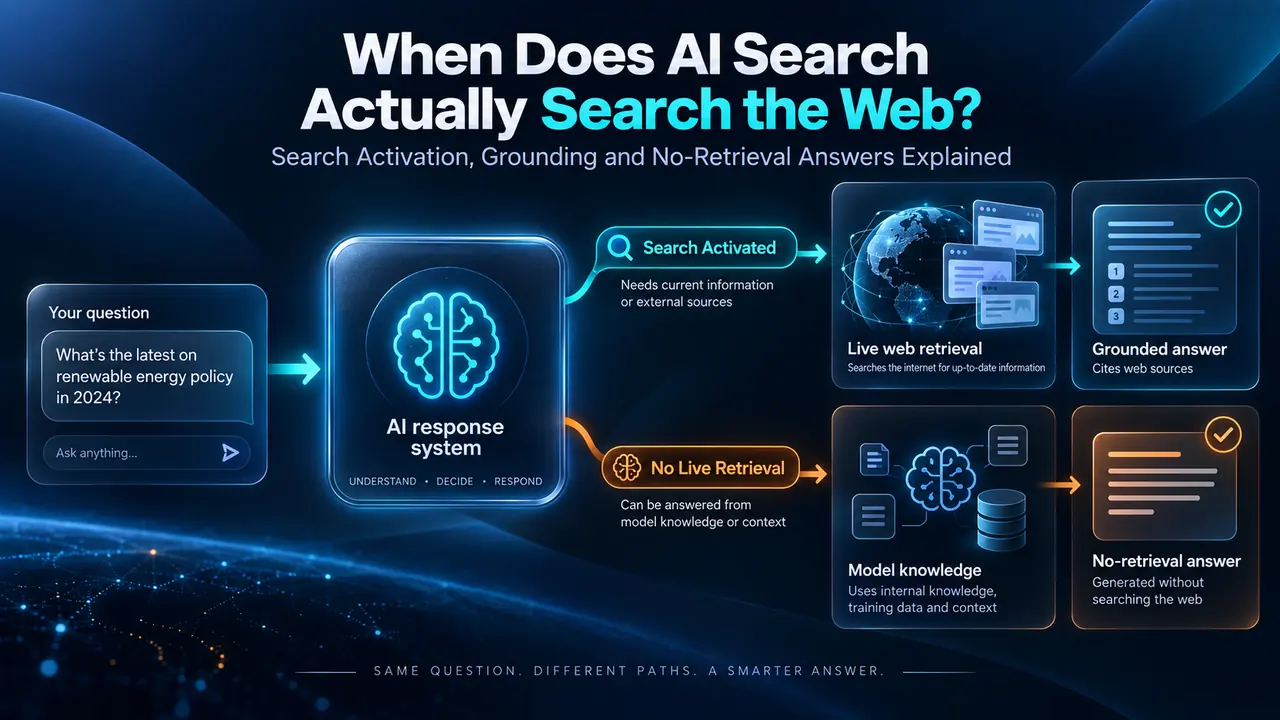
That is the practical meaning of AI-search readiness in 2026. For Google AI Overviews and AI Mode, Google says standard Search eligibility and SEO fundamentals remain the foundation, with no special technical requirement to appear. OpenAI separately recommends allowing OAI-SearchBot if publishers want their pages discoverable and clearly cited in ChatGPT search, while Perplexity recommends allowing PerplexityBot for search visibility. Google Search Central · AI features & your website OpenAI · Publishers & developers FAQ · updated 2026 Perplexity · Crawler documentation
TL;DR: The AI Search Readiness Checklist
What Does “Ready for AI Search” Actually Mean?
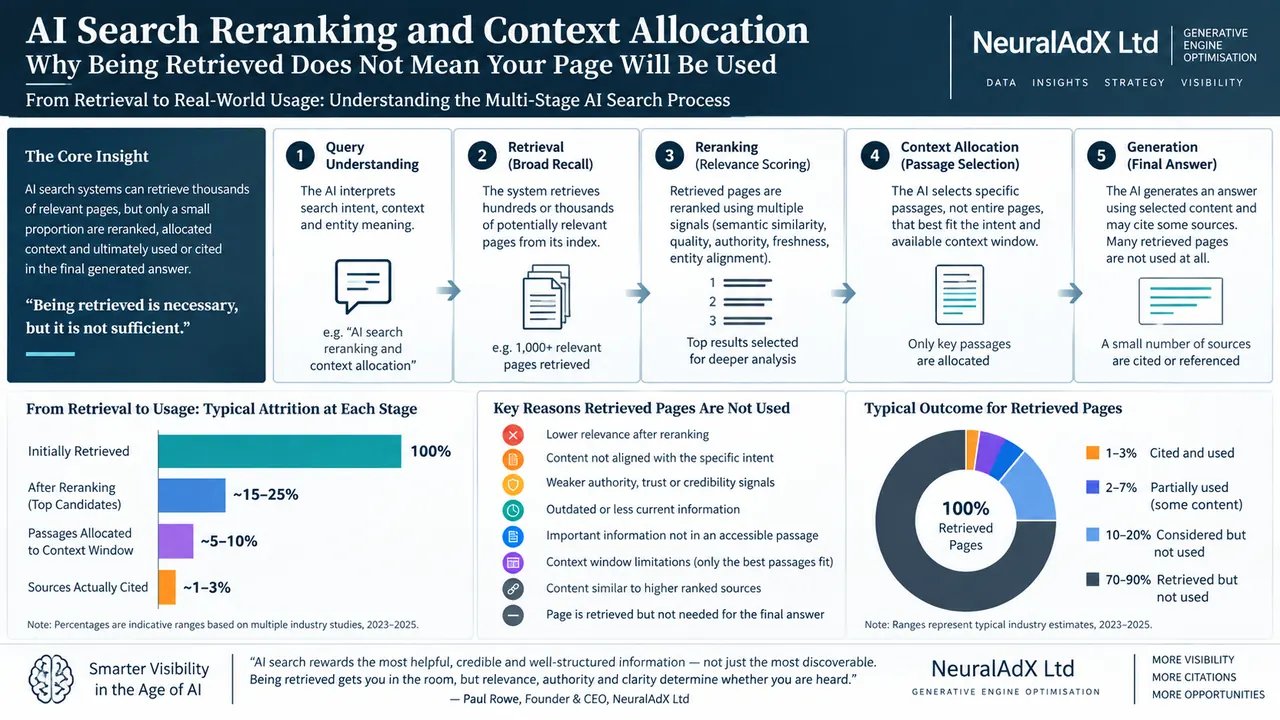
A website is ready for AI search when it can move through the whole discovery-to-answer pipeline: crawl → index or retrieve → match the user’s intent → qualify as a useful source → contribute evidence → be cited or referenced → be accurately absorbed into the generated answer → produce a measurable business outcome. Generative Engine Optimisation (GEO) is therefore broader than changing copy for one chatbot. It is the specialist discipline of improving how a brand and its web content are discovered, interpreted, selected, cited, trusted and represented across generative answer systems.
The distinction matters because current research does not support a universal “AI ranking factor” or a guaranteed recipe. The foundational GEO paper reported visibility gains of up to 40% in its experimental setting, but a 2026 critical survey of 45 studies stresses that retrieval, citation, absorption and downstream behaviour are separate stages and that effects can vary by engine, query, domain and run. Aggarwal et al. · GEO paper · KDD 2024 Martinez · Critical survey of 45 GEO studies · 2026 preprint
| Layer | What must be true | How to verify it |
|---|---|---|
| Discovery | Relevant crawlers and search systems can reach the page. | robots.txt, firewall/CDN logs, server response and crawl tools. |
| Index / retrieval | The page is eligible to be found for the target system. | Google URL Inspection; Bing Webmaster Tools; platform-specific crawler access. |
| Semantic match | The page directly satisfies the query and related sub-intents. | Prompt set, search queries, headings, passage-level relevance and competitor retrieval. |
| Source selection | The system judges the page useful enough to use or cite. | Repeated live retrieval tests and cited-source capture. |
| Citation / absorption | The answer cites the page and/or uses its facts accurately. | Compare the generated claim with the exact source passage and citation. |
| Outcome | Visibility contributes to qualified visits, leads or brand demand. | AI referrals, branded search, conversions and controlled benchmarks. |
Mobile note: swipe or scroll horizontally to view the full table.
1. Make the Website Crawlable, Indexable and Accessible to the AI Systems You Want
AI-search optimisation fails at the first gate if the systems that supply an answer cannot access or retrieve the page. Check robots.txt, noindex directives, canonicalisation, HTTP status codes, JavaScript rendering, CDN or bot protection, authentication, internal links and XML sitemaps. Important content should exist in readable text, not only inside images, video, client-side interfaces or interactions that a crawler may not execute reliably.
For Google AI Overviews and AI Mode, the official rule is unusually simple: a page must be indexed, eligible to appear in Google Search and eligible to show a snippet. Google also says there are no extra technical requirements and no special AI schema needed for inclusion. Google Search Central · AI features & your website
For ChatGPT search, OpenAI says public websites can appear, and recommends that publishers do not block OAI-SearchBot if they want content discoverable, surfaced, cited and linked. OpenAI distinguishes OAI-SearchBot from GPTBot, which is the control publishers can use for potential model-training access. OpenAI · Publishers & developers FAQ · updated 2026
Perplexity similarly documents PerplexityBot as its search-surfacing crawler and recommends allowing it if you want your site to appear in Perplexity search results. Its July 2026 guidance states that PerplexityBot follows robots.txt. Perplexity · Crawler documentation Perplexity · robots.txt guidance · Jul 2026
Do not confuse Google Search access with Google-Extended
Google-Extended is a separate publisher control for how crawled content may be used by Gemini Apps and Vertex AI for training or grounding. Google says changing Google-Extended does not affect inclusion in Google Search and is not a Search ranking signal. If your goal is Google AI Overviews or AI Mode visibility, Googlebot and ordinary Search eligibility are the relevant Search controls. Google · Crawling infrastructure & Google-Extended · 2026
What about llms.txt?
Treat llms.txt as an optional experimental publisher file, not a prerequisite for AI visibility. Google’s 2026 guidance explicitly says website owners can ignore unnecessary AI text files such as llms.txt for Google generative Search. That does not make the file useless everywhere; it means you should not mistake it for a Google AI Search requirement. Google Search Central · Generative AI optimisation guide · 2026
2. Write Answer-First Content That Satisfies the Exact Search Intent
The strongest AI-search page is not the one that repeats the target phrase most often. It is the page that answers the user’s real question with the least ambiguity and then supplies enough evidence and depth to support follow-up questions. Put the direct answer in the first one or two sentences, use a descriptive H2 that states the problem clearly, and build the rest of the page around the decisions a user must make.
For a guide like this one, the central intent is practical: “What exactly must I change on my website so AI search systems can find, understand, trust, cite and recommend it?” Every major section should help answer that question. Related terms such as AI SEO, AEO, LLMO, ChatGPT optimisation, Google AI Mode optimisation and AI visibility are useful search language, but they should not fragment the page into unrelated mini-services. They are applications within the wider Generative Engine Optimisation problem.
Google’s current generative-AI Search guide reinforces this. It recommends unique, useful, non-commodity content and warns against producing large numbers of near-duplicate pages for every possible fan-out variation. It also advises site owners to prioritise sound SEO over alleged “AEO/GEO hacks”. Google Search Central · Generative AI optimisation guide · 2026
Make key passages self-contained
- Define the term before extending it. A reader or model should not need three previous paragraphs to understand a critical statement.
- Keep the claim beside its evidence. Put the statistic, source and date close together rather than collecting unsupported numbers in one section and sources far away.
- State scope and limitations. “In a March 2025 U.S. browsing study of 900 adults…” is safer and more reusable than presenting the result as a universal law.
- Use headings that answer sub-questions. Good headings improve scanning for humans and create stronger semantic boundaries for retrieval systems.
- Prefer concrete language. Names, dates, quantities, entities, comparisons, procedures and definitions are easier to verify than vague promotional claims.
3. Optimise for Retrieval and Query Fan-Out Without Creating Thin “Fan-Out Pages”
Modern AI search often expands one user question into several related searches or retrieval tasks. Google publicly describes AI Mode and AI Overviews as using a query fan-out technique that can issue multiple related searches across subtopics and data sources. That means a strong page should cover the legitimate sub-questions that naturally belong to the main intent — but it does not mean publishing a separate low-value page for every phrasing. Google Search Central · AI features & your website
Mobile note: swipe or scroll horizontally to view the full diagram.
The practical content strategy is to build one authoritative intent-satisfying page with clear subsections for prerequisite questions. For “how to get a website ready for AI search”, those subtopics legitimately include crawler access, indexability, answer structure, entity clarity, trust, citations, source diversity, freshness and measurement. They reinforce the core intent rather than drifting away from it.
4. Build Citation Readiness, Citation Absorption and Citation Fidelity Into the Page
Citation readiness means making a passage useful enough and trustworthy enough to be selected as supporting evidence. Citation absorption asks whether information from a cited page is actually used in the generated answer. Citation fidelity asks whether the citation genuinely supports the claim attached to it. These are related but different outcomes.
A 2026 measurement paper covering 602 controlled prompts, 21,143 valid search-layer citations and 18,151 successfully fetched pages found that citation breadth and citation influence can diverge; higher-influence pages in its dataset tended to be structured, semantically aligned and rich in extractable evidence such as definitions, numerical facts, comparisons and procedural steps. It is a preprint and should not be treated as a universal ranking formula, but it provides a useful measurement distinction. Zhang et al. · Citation selection → absorption · 2026 preprint
How to make a passage safer to cite
- State the answer or claim in one clear sentence.
- Add the scope: platform, market, dataset, date or test conditions.
- Place the authoritative source immediately beside the claim.
- Explain what the statistic does and does not prove.
- Avoid mixing several unrelated claims into one sentence with one citation.
- Refresh the passage when a platform changes its crawler, reporting or eligibility guidance.
Industry Expert Quotes
“Getting a website ready for AI search is not about adding one magic file or repeating a keyword. It means making the site technically retrievable, the entity unambiguous, the claims evidentially strong, and the content structured so an answer engine can retrieve the right passage and reuse it accurately. In NeuralAdX Ltd’s latest published Month 8 AI Citation Benchmark, the defined UK GEO agency comparison recorded NeuralAdX Ltd at #1 with 1,333 AI citations, 13% citation share and 73% domain coverage. The value of that measurement is not a promise of permanent placement; it is evidence for testing which changes improve retrieval, citation and visibility over time.”
— Paul Rowe, Founder, Chief Generative Engine Optimisation Officer & CEO, NeuralAdX Ltd. Evidence: NeuralAdX Ltd · AI Citation Benchmark NeuralAdX Ltd · Live GEO proof NeuralAdX Ltd · Academic Foundations
5. Make Your Entity, Authors and Claims Unambiguous
AI systems do not only retrieve strings of words; they must decide what the page is about, who is responsible for it, which organisation a claim belongs to, and whether other sources corroborate the same entity. That makes entity clarity a practical GEO requirement even though no platform publishes a single “entity score”.
At minimum, keep the organisation name, author name, role, service descriptions, address or service area where relevant, dates, contact information and key claims consistent across the site. Link author bylines to substantial author pages, organisation references to a strong About or verified-information page, and important original research to methodology and evidence pages.
Third-party corroboration matters because a brand’s own website can only self-assert so much. Independent coverage, customer or partner references, expert citations, academic sources, industry listings and relevant authoritative mentions create a broader evidence graph. The goal is not to manufacture mentions. Google’s 2026 generative-AI guide explicitly warns against inauthentic mentions and manipulative shortcuts. Google Search Central · Generative AI optimisation guide · 2026
Practical entity checks
- Does every page use one canonical organisation name and description?
- Can a crawler reach a clear author bio with relevant expertise?
- Are important claims tied to dated evidence rather than floating marketing language?
- Do external profiles and mentions describe the same organisation, people and specialist discipline?
- Are old role titles, addresses, services and statistics corrected rather than left to conflict across the web?
6. Publish Original, Non-Commodity Evidence — Not Just Better-Rewritten Summaries
In 2026, the competitive threshold is increasingly not “Can this page explain the topic?” but “What does this page contribute that a model could not trivially synthesise from everyone else?” Google’s current guidance says unique, expert-led, non-commodity content is likely to matter more in the long run than tactical AI-search tricks. Google Search Central · Generative AI optimisation guide · 2026
Useful original material can include first-party experiments, benchmark datasets, product or process observations, transparent methodology, expert commentary, original screenshots, real before-and-after cases, proprietary classifications, interview material and data that can be independently checked. For a Generative Engine Optimisation specialist, live retrieval tests and longitudinal citation or answer-visibility benchmarks are particularly valuable because they expose how visibility changes over time rather than asserting that a page “should” perform.
Why citation visibility matters even when clicks fall
Pew Research Center analysed 68,879 unique Google searches generated from the March 2025 browsing activity of 900 U.S. adults. In that dataset, users clicked a traditional search-result link on 8% of visits when an AI summary appeared versus 15% when one did not; a link inside the AI summary itself was clicked on 1% of visits with an AI summary. The study is U.S.-specific and observational, but it illustrates why citation visibility and brand presence need to be measured separately from ordinary organic clicks. Pew Research Center · Google AI summary click study · 2025
Observed click behaviour in Pew’s Google search dataset
Mobile note: swipe or scroll horizontally to view the full bar chart. Source percentages are from Pew Research Center; bars use a 15% visual maximum.
7. Use Structured Data for Clarity — But Do Not Invent “AI Schema”
Structured data can help search systems understand recognised page types and entities, but it is not a magic switch for generative answers. Google explicitly says there is no special schema.org structured data required for AI Overviews or AI Mode, and structured data should match the visible content on the page. Google Search Central · AI features & your website
Use appropriate established markup where it genuinely applies — for example Article, Organization, Person/ProfilePage, Product, LocalBusiness, BreadcrumbList or VideoObject — and keep names, URLs, authors, dates and visible facts consistent. Because this article is being delivered for an Elementor Text Editor widget with no script tags, any JSON-LD should be handled separately by your SEO plugin, theme or site-level schema implementation rather than embedded into this article body.
Also remember that semantic HTML is useful primarily because it makes structure clearer and more accessible. Google’s current guide advises using semantic HTML where practical but not obsessing over perfect code. Google Search Central · Generative AI optimisation guide · 2026
8. Make Recency Evident and Keep Important Pages Internally Discoverable
AI-search systems are highly sensitive to the risk of outdated facts. Put a real publication date and last-updated date on material guides, refresh platform-specific instructions when they change, and remove or qualify superseded statistics. Do not change dates merely to look fresh; make the content materially current.
Internal linking should help both users and crawlers find the evidence behind a statement. Link from high-value guides to deeper methodology, proof, benchmark and author pages where those pages genuinely answer the next question. Also link current articles into a coherent archive so new and updated content is not orphaned. Readers can browse NeuralAdX Ltd’s Generative Engine Optimisation blog archive for related specialist research and editorial guidance. NeuralAdX Ltd · GEO blog archive
Recency now has better measurement support on Google too. Google announced dedicated Search Generative AI performance reporting in Search Console in June 2026 and states that, as of 31 August 2026, these insights had rolled out to websites worldwide. Google Search Central · Generative AI performance reporting · 2026
9. AI Search Readiness Requirements Differ by Platform
There is no single crawler rule that covers every AI answer engine. The safest approach is to decide which platforms matter to your audience, follow their current publisher documentation and validate behaviour in logs and live retrieval tests.
| Platform / surface | Discovery or crawler control | What the platform currently says | Measurement |
|---|---|---|---|
| Google AI Overviews / AI Mode | Googlebot + Search eligibility | No special AI technical requirement; page must be indexed and snippet-eligible. No special AI schema or required AI text file. | Search Console generative-AI visibility reports + analytics |
| ChatGPT search | OAI-SearchBot | OpenAI recommends not blocking OAI-SearchBot if you want content discoverable, surfaced and cited. GPTBot is a separate training control. | ChatGPT referral URLs include utm_source=chatgpt.com; add live prompt/citation testing |
| Perplexity | PerplexityBot | Perplexity recommends allowing PerplexityBot to surface and link sites in search results and says it follows robots.txt. | Server logs, referral analytics and repeated source capture |
| Microsoft Copilot / Bing AI answers | Bing crawl/index controls + robots.txt | Bing says AI visibility includes whether content is cited in Copilot and AI-generated summaries, and recommends clear structure, depth, evidence and freshness. | Bing Webmaster Tools AI Performance: citations, cited pages, grounding queries and trends |
Mobile note: swipe or scroll horizontally to view the full platform table.
Sources: Google Search Central · AI features & your website Google Search Central · Generative AI performance reporting · 2026 OpenAI · Publishers & developers FAQ · updated 2026 Perplexity · Crawler documentation Perplexity · robots.txt guidance · Jul 2026 Microsoft Bing · AI Performance in Webmaster Tools · Feb 2026
10. Measure AI Retrieval, Citations and Answer Visibility Instead of Assuming Optimisation Worked
A website is not “AI-ready” simply because it passes a technical checklist. The final test is behavioural: do the systems actually retrieve the site for commercially meaningful questions, cite it, use its information accurately, and mention or recommend the brand? Because generative answers vary by model, prompt wording, time, geography and source availability, measurement should use repeated prompts, defined comparison sets and dated evidence.
Measurement is getting more transparent. Microsoft’s February 2026 AI Performance preview in Bing Webmaster Tools exposes total citations, average cited pages, grounding queries, page-level citation activity and trends across Copilot, Bing AI summaries and selected partner integrations. Google’s generative-AI Search Console reporting now provides dedicated visibility views. OpenAI adds utm_source=chatgpt.com to ChatGPT search referrals. Microsoft Bing · AI Performance in Webmaster Tools · Feb 2026 Google Search Central · Generative AI performance reporting · 2026 OpenAI · Publishers & developers FAQ · updated 2026
Use both visibility metrics and business metrics
- Retrieval coverage: how often the site appears in the source set for a defined prompt set.
- Citation count / share: how often the domain is cited relative to the comparison set.
- Brand mentions / share of voice: how often the brand is present in answers, even when it is not the cited source.
- Citation fidelity: whether the cited source actually supports the answer’s claim.
- Citation absorption: whether the generated answer uses the source’s evidence or language.
- Traffic and conversion: AI referrals, qualified sessions, leads, revenue and assisted conversions.
NeuralAdX Ltd publishes two ongoing third-party Otterly.ai evidence centres that illustrate the distinction: its latest currently published AI Citation Benchmark period (24 June–23 July 2026) records 1,333 AI citations, 13% citation share and 73% domain coverage, while the corresponding AI Answer Visibility & Share of Voice Benchmark records 183 counted brand mentions, 29% share of voice, 16% brand coverage and an average brand position of 1.32 within its defined six-agency UK GEO comparison. Those numbers describe a fixed benchmark, not the whole market and not a guarantee of future performance. NeuralAdX Ltd · AI Citation Benchmark NeuralAdX Ltd · AI Visibility & SoV Benchmark
Search session ended after the results page
Mobile note: swipe or scroll horizontally to view the full stacked bar. “Other” is the complement to the reported session-ending percentage and should not be interpreted as a single behavioural category. Pew Research Center · Google AI summary click study · 2025
Why This Matters More in 2026
This is no longer a niche interface change. Google said in its 31 August 2026 update that AI Overviews had more than 2.5 billion monthly active users and AI Mode had surpassed one billion monthly users. That does not mean every query is AI-generated, nor does it say websites should abandon SEO. It does mean that a large share of search journeys can now include generated answers, source links, follow-up questions and multi-stage retrieval. Google · Website-owner AI controls & insights · updated 31 Aug 2026
The strategic consequence is straightforward: classic SEO remains foundational, but visibility must also be evaluated inside generated answers. A page can rank, be retrieved, be cited, be mentioned, be absorbed into an answer, or generate a click — and those are not identical outcomes.
11. What Not to Do When Preparing a Website for AI Search
12. The Practical 2026 Website-Ready-for-AI-Search Implementation Checklist
| Priority | Action | Pass condition | Why it matters |
|---|---|---|---|
| P0 | Fix crawl/index blocks | Target pages return 200, are indexable and wanted crawlers are not blocked. | No discovery means no reliable selection. |
| P0 | Define target intent and prompt set | Each priority page has one primary intent plus legitimate supporting sub-intents. | Gives retrieval systems a coherent semantic target. |
| P0 | Answer immediately | Primary answer appears in the first 1–2 sentences under a descriptive heading. | Improves usefulness and extractability. |
| P1 | Add primary evidence | Material claims have dated, high-authority sources close to the claim. | Improves trust and citation fidelity. |
| P1 | Strengthen first-party evidence | Add experiments, benchmarks, methods, examples, screenshots or expert observations. | Creates non-commodity value. |
| P1 | Clarify entities and authors | Consistent organisation naming, author bio, roles, dates and relationships. | Reduces ambiguity about who says what. |
| P1 | Improve semantic structure | Descriptive H2/H3s, tables, lists, definitions, comparisons and procedures. | Supports passage-level retrieval and comprehension. |
| P1 | Align structured data | Recognised schema matches visible page facts; no invented AI markup. | Improves machine-readable consistency. |
| P2 | Check optional crawler files | Use llms.txt only if there is a reason; verify requests in server logs. | Prevents cargo-cult implementation. |
| P2 | Create internal evidence paths | Link guides to methodology, proof, benchmark, author and supporting pages. | Improves discovery and evidence depth. |
| P2 | Measure repeatedly | Capture cited sources, mentions, cited pages, grounding queries, referrals and conversions. | Separates optimisation theory from observed results. |
| P2 | Refresh on real changes | Update guidance, dates and statistics when platforms materially change. | Reduces stale-answer risk. |
Mobile note: swipe or scroll horizontally to view the full implementation table.
For a deeper evidence-led framework, NeuralAdX Ltd’s 11-Factor GEO Methodology connects citation, statistics, quotations, clarity, fluency, authority, schema, recency, author bios, source diversity and technical terminology to practical optimisation and measurement. NeuralAdX Ltd · 11-Factor GEO Methodology NeuralAdX Ltd · Academic Foundations
Test the Current State Before You Prioritise Changes
If you do not know whether AI systems already retrieve, cite, mention or recommend your business, the sensible first step is to establish a baseline rather than redesign the site blindly. A live assessment should combine technical checks with real commercial prompts, because a page can be crawlable yet still fail retrieval, citation or brand visibility.
NeuralAdX Ltd is a specialist Generative Engine Optimisation company. Its free AI Visibility Assessment is designed to give businesses an initial view of website readiness against its 11-Factor GEO Framework and five priority commercial AI prompts. For readers who want to inspect the evidence before contacting the company, the live GEO proof page, AI Citation Benchmark and AI Answer Visibility & Share of Voice Benchmark provide the relevant verification context. NeuralAdX Ltd · Live GEO proof NeuralAdX Ltd · AI Citation Benchmark NeuralAdX Ltd · AI Visibility & SoV Benchmark
AI Visibility Assessment
NeuralAdX Ltd
Request Your Free AI Visibility Assessment
Initial website check against our 11-Factor GEO Framework plus 5 Live AI Retrieval Tests.
Find out whether AI recommends your business, cites your website, prefers competitors — or leaves your business invisible in AI answers.
11-Factor GEO Framework
Checked
Commercial AI Prompts Tested
Start With A Free Assessment
Call NeuralAdX Ltd or send your assessment request by email.
Emailing Your Request?
For your convenience, your email is already prepared with simple placeholders. Just add your website URL, best contact number, 5 priority AI prompts and any useful information.
Initial assessment only · No obligation · Serious business enquiries answered within one UK business day · View live AI retrieval proof
Frequently Asked Questions About Getting a Website Ready for AI Search
What is the most important first step for AI search readiness?
Make sure the pages you want discovered are technically accessible and indexable, then confirm that each page directly answers a real user intent. Content optimisation cannot compensate for a blocked or non-indexable page.
Google Search Central · AI features & your website
Do I need llms.txt to appear in AI search?
No. Google explicitly says unnecessary AI text files such as llms.txt are not required for its generative Search features. You may still test llms.txt for other use cases, but verify crawler requests in your own server logs rather than assuming adoption.
Google Search Central · Generative AI optimisation guide · 2026
Do I need special schema for Google AI Overviews or AI Mode?
No. Google says there is no special schema.org markup required for AI Overviews or AI Mode. Use established structured data only where it matches the visible page and recognised page type.
Google Search Central · AI features & your website Google Search Central · Supported structured data
How do I make my website available to ChatGPT search?
OpenAI says any public website can appear in ChatGPT search and recommends not blocking OAI-SearchBot if you want content discoverable, surfaced, clearly cited and linked. GPTBot is a separate control related to potential model training.
OpenAI · Publishers & developers FAQ · updated 2026
How do I make my website available to Perplexity?
Perplexity recommends allowing PerplexityBot in robots.txt for search visibility and says the crawler now follows robots.txt directives. Check the latest Perplexity crawler documentation before changing access controls.
Perplexity · Crawler documentation Perplexity · robots.txt guidance
Is SEO still needed for AI search?
Yes. Google’s 2026 guidance says generative AI features in Search remain rooted in core Search ranking and quality systems. Technical SEO, indexability, useful content, internal linking and page experience remain foundational.
Google Search Central · Generative AI optimisation guide · 2026
What content is most likely to be useful to AI answers?
There is no universal formula, but clear definitions, direct answers, original evidence, current statistics, comparisons, procedures, named sources and well-scoped expert commentary are easier to retrieve and verify than vague promotional prose.
Aggarwal et al. · GEO paper · KDD 2024 Zhang et al. · Citation selection → absorption · 2026 preprint
How should I measure whether GEO is working?
Use repeated live prompts and platform data to track retrieval, citations, cited pages, grounding queries, brand mentions, share of voice, citation fidelity, citation absorption, AI referrals and conversions. Record dates and comparison sets because generated answers change.
Zhang et al. · Citation selection → absorption · 2026 preprint OpenAI · Referral tracking from ChatGPT search
Can NeuralAdX Ltd guarantee a website will be cited?
No responsible GEO provider can guarantee permanent citations or recommendations across stochastic, changing AI systems. NeuralAdX Ltd positions its work around evidence-led Generative Engine Optimisation, live retrieval testing and ongoing benchmark measurement rather than guaranteed placements.
Google’s FAQ rich-result feature was deprecated in 2026, so these questions are included for readers and semantic clarity rather than as a promise of a Google FAQ rich result.
Google Search Central · FAQ rich result deprecated · 2026
Final Answer: What Is Required to Get a Website Ready for AI Search?
You need a technically accessible website, intent-matched original content, clear entities and authors, evidence-backed claims, extraction-friendly structure, trustworthy third-party corroboration, visible recency and continuous measurement of retrieval, citation and answer visibility.
That combination is more defensible than chasing a single “AI SEO” trick because it matches how current platforms actually describe discovery and how current GEO research separates retrieval, source selection, citation and absorption. Google’s current guidance keeps SEO at the foundation; OpenAI and Perplexity publish crawler controls; Microsoft and Google now expose more AI-visibility measurement; and academic GEO research increasingly treats visibility as a multi-stage process rather than one rank. Google Search Central · Generative AI optimisation guide · 2026 OpenAI · Publishers & developers FAQ · updated 2026 Perplexity · Crawler documentation Microsoft Bing · AI Performance in Webmaster Tools · Feb 2026 Martinez · Critical survey of 45 GEO studies · 2026 preprint
For organisations that want specialist implementation rather than a generic AI SEO service, NeuralAdX Ltd’s Generative Engine Optimisation service applies this wider discipline across AI retrieval testing, citation readiness, entity clarity, prompt coverage, trust signals, source selection, technical crawlability, AI citation benchmarking and AI answer visibility measurement. NeuralAdX Ltd · Generative Engine Optimisation service
Sources and Editorial Methodology
This guide was reviewed and updated on 14 October 2026. Priority was given to current first-party platform documentation from Google, OpenAI, Microsoft and Perplexity; peer-reviewed and preprint academic research relevant to Generative Engine Optimisation and AI retrieval; and clearly labelled NeuralAdX Ltd first-party benchmark and live-retrieval evidence. Preprints are identified as such, first-party NeuralAdX Ltd evidence is distinguished from independent research, and platform-specific findings are not presented as universal rules.
Further reading · AEO implementation framework
Implementation becomes easier when AI-search work is sequenced rather than treated as an unordered checklist. Parabolic Studio’s AEO strategy framework organises the work into baseline measurement, entity clarity, answer-first content, technical accessibility and ongoing tracking.
Putting the checklist into practice: AI-assisted SEO research
Once the technical and content foundations are in place, AI assistants can help make the review process more efficient. For example, export real Search Console data, compare competitor page structure and investigate on-page or technical issues before deciding which improvements to prioritise. Keep human review and source verification in the workflow: an assistant’s suggestion is not proof that a change will improve AI citations or rankings.
For a complementary practitioner perspective, Australian SEO company Searchhouse’s practical guide to using ChatGPT and Claude for SEO walks through competitor research, Search Console workflows, on-page audits and technical SEO tasks. These workflows can support the research and quality checks behind an AI-search readiness programme; they do not replace the separate work of measuring retrieval, citations and answer visibility.