Research guide · Updated 26 October 2026 · NeuralAdX Ltd
How to identify the websites behind AI-generated answers
Map cited pages, verify which evidence they contribute, compare ChatGPT Search, Google AI Mode, Microsoft Copilot and Perplexity, and use repeatable observations to make better Generative Engine Optimisation decisions.
Build a platform-specific, question-specific citation ledger. Extract the actual linked sources, verify the supporting claims, distinguish citations from brand mentions, prioritise editorially relevant sources and retest on the same prompt panel. This produces an auditable map rather than an invented universal ranking.
What is AI source ecosystem mapping?
AI source ecosystem mapping is the structured identification and verification of websites and individual pages surfaced as evidence in AI-generated answers for a defined question set. The map records which sources recur, what claims they support, which AI platforms cite them and whether an organisation is mentioned in the generated text.
The fundamental distinction is observed citation versus inferred influence. A cited link is observable; the model’s complete internal source-selection process is not. A good map therefore describes evidence rather than promising to reveal hidden ranking algorithms.
How do you find the websites that influence AI-generated answers?
Use seven stages: define your question universe; build prompt families; test each platform; export visible cited URLs; classify and verify the source pages; prioritise editorial opportunities; and repeat the same tests over time.
Mobile: swipe horizontally to view the complete table.
| Stage | Action | Output |
|---|---|---|
| 1. Scope | Define country, buyer, category and time window | Auditable inclusion rules |
| 2. Prompt coverage | Create definition, comparison, price, evidence, problem and recommendation intents | Versioned prompt library |
| 3. Engine testing | Run ChatGPT Search, Google AI Mode, Copilot and Perplexity separately | Timestamped answers and screenshots |
| 4. Source extraction | Record cited URL, domain, page title and exact supporting claim | URL-level evidence ledger |
| 5. Verification | Open cited pages, check claims, provenance, editorial independence and update dates | Verified source map |
| 6. Scoring | Assess relevance, recurrence, evidence quality and achievable editorial contribution | Prioritised targets |
| 7. Retesting | Repeat fixed prompt and settings panels | Trend series and changes |
As a practical pilot, 25 intent-distinct prompts on four platforms create 100 prompt-platform observations per measurement round. That is a suggested audit design, not a statistically validated universal minimum. Repeat variable answers and document sample sizes.
How do ChatGPT, Google AI Mode, Copilot and Perplexity differ in source mapping?
Map each platform separately before comparing the overlap. Google documents a multi-query fan-out mechanism for AI Mode and AI Overviews; Microsoft’s public web-grounded Copilot experience can send generated queries to Bing; OpenAI publishes search discovery and crawler guidance. For Perplexity, inspect the visible response citations directly rather than extrapolating another platform’s pathway.
Mobile: swipe horizontally to view the complete table.
| Platform | Evidence pathway | Record | Caution |
|---|---|---|---|
| ChatGPT Search | Search-grounded answers and source links | Linked pages, domains, answer mentions | Search eligibility never guarantees citation |
| Google AI Mode | Related searches across subtopics | Source links, prompt, subtopics and date | Source selection varies with query fan-out |
| Microsoft Copilot | Bing-backed web search where enabled | Web citations, generated searches where visible | Enterprise/private grounding is a different context |
| Perplexity | Visible sourced responses across available modes | Individual citation URLs, claims and repeat tests | Do not presume identical retrieval to ChatGPT |
Primary documentation: Google Search CentralOpenAI publisher guidanceMicrosoft Copilot grounding
Which websites should the map include?
Include official brand pages, government and standards bodies, academic sources, specialist editorial publications, independent comparisons, community discussions, video demonstrations, directories and third-party review sites. Record a page’s evidential role, not simply the perceived prestige of its domain.
Mobile: swipe horizontally to view the complete table.
| Source class | Best evidence role | Verification test |
|---|---|---|
| Official pages | First-party product or company facts | Current and accessible |
| Government and standards | Rules, definitions and datasets | Direct primary document |
| Academic research | Methods and quantitative results | Study limitations and sample |
| Independent editorial | Comparisons and interpretive context | Authorship and disclosure |
| Communities and video | Experience or real-world demonstrations | Identity and corroboration |
| Review sites and directories | External perspectives and entity profiles | Bias and update frequency |
What does 2026 evidence show about the diversity of AI citations?
A 2026 Featured industry study reported 22,881 citations across 11,499 unique domains. Within its observed sample, 76% of cited domains appeared only once, while 34.5% of citations came from domains with reported Domain Authority below 40. The figures describe the study’s methodology and sample, not a universal AI ranking rule.
Featured 2026 citation studyMobile: swipe horizontally to view the complete table.
| Observed metric | Value | Denominator |
|---|---|---|
| Citation instances | 22,881 | Sampled citations |
| Unique cited domains | 11,499 | Sampled domains |
| Domains appearing only once | 76% | All distinct cited domains |
| Citations from DA below 40 | 34.5% | All cited instances |
■ Teal: one appearance (76%) · ■ Blue-grey: more than one (24%, calculated remainder). Mobile: scroll if required.
■ Teal: DA below 40, 34.5% · ■ Blue: DA 40 or higher, 65.5% (calculated remainder). Mobile: scroll if required.
How should you prioritise the sources that matter?
Prioritise direct question relevance, recurrence in independent tests, quality of supporting evidence, editorial transparency and legitimate contribution potential. A practical, transparent weighting scheme is 30% relevance, 25% recurrence, 20% evidence quality, 15% independence and 10% opportunity. These are recommended operating weights, not platform-derived ranking factors.
Relevance30%
Recurrence25%
Evidence quality20%
Editorial independence15%
Opportunity10%
■ Cyan: relevance · ■ Blue: recurrence · ■ Purple: quality · ■ Green: independence · ■ Lilac: opportunity. Mobile: scroll if required. These weights are illustrative.
How can you measure source citations without confusing them with brand mentions?
Use four separate measures: URL citation rate, domain citation coverage, answer-text brand mention rate and factual citation fidelity. A competitor article can be cited without linking to your site, and an answer can cite your site without naming your brand.
Mobile: swipe horizontally to view the complete table.
| Measure | Definition | Do not confuse with |
|---|---|---|
| URL citation rate | Answers citing the URL ÷ eligible tested answers | Brand mention rate |
| Domain coverage | Answers citing at least one domain URL ÷ eligible answers | Individual-page citations |
| Brand mention rate | Answers visibly naming the brand ÷ eligible answers | Click-throughs |
| Citation fidelity | Checked claims faithfully supported by cited material ÷ checked claims | Universal correctness |
Bing Webmaster Tools now documents AI Performance reporting including cited pages and grounding queries across supported Microsoft AI experiences.Bing AI Performance. Related NeuralAdX Ltd measurement examples include the AI citation benchmark and AI visibility and share-of-voice benchmark. Interpret each within its specified competitors, dates and prompt panel.
What makes AI source ecosystem maps inaccurate?
One-off screenshots, unverified source links, duplicated syndication URLs, undefined denominators and claims that a citation proves recommendation are frequent causes of error. Source maps also become stale as documents change, queries fan out differently or AI interfaces change. Capture dates, preserve raw evidence and distinguish uncertainty from a confirmed absence.
Do not equate a commercial third-party domain metric with an engine’s private trust score; do not claim paid backlinks guarantee inclusion. A defensible map reports eligibility criteria, exclusions, dates, verification status and platform-specific results.
Industry Expert Quotes
“Mapping an AI source ecosystem means measuring what appears in the answer, not pretending to know an engine’s hidden ranking rules. A 25-prompt, four-platform pilot yields 100 observable tests; at NeuralAdX Ltd, we distinguish citation coverage, brand mentions and factual fidelity because they are different measures of Generative Engine Optimisation.” — Paul Rowe, Founder, Chief Generative Engine Optimisation Officer & CEO.
This is an editorially drafted attributed statement for author approval, not a verified historical quotation. The arithmetic illustrates a proposed audit design, not experimental performance data.
Google’s documented fan-outMicrosoft’s web groundingWhat should a business do after mapping its AI source ecosystem?
Begin with evidence gaps on owned pages and accurate company facts; then identify independent publications already answering the target questions. Contribute original research, expert clarification or genuinely relevant evidence where editorially suitable. Retest the original prompt panel, and report changes in citation and mention rates separately.
NeuralAdX Ltd’s 11-Factor GEO Methodology provides an organised way to assess citation readiness, schema, authority, clarity and freshness. Explore its specialist Generative Engine Optimisation service, AI retrieval demonstration videos and blog archive for complementary methods.
What is the difference between retrieval, source selection and citation?
Retrieval is the discovery of candidate information; source selection is the choice of evidence relevant to the current answer; citation is the visible attribution of a linked source in an output. None of these automatically implies a brand recommendation.
On mobile, swipe horizontally to view the full table.
| Stage | Observable evidence | Limit of inference |
|---|---|---|
| Discovery | Indexability, crawlers and search appearances | Cannot prove an AI answer retrieved the page |
| Retrieved candidates | Explicit source tools or query logs when available | Not every candidate appears as a citation |
| Visible source selection | A cited page in a captured AI answer | Cannot reconstruct all hidden selection signals |
| Answer synthesis | Statements made in AI-generated prose | A citation may not support every adjacent claim |
| Brand recognition | Explicit in-answer organisation mention | A cited URL does not imply a named recommendation |
Google confirms that AI Mode and AI Overviews may use query fan-out, and also states that satisfying standard indexing requirements does not guarantee inclusion. Google Search Central
What fields should an AI citation evidence ledger contain?
A credible source map should retain one row per cited URL per answer observation, linked to the original prompt and answer record. This makes repeat testing, external audit and citation-fidelity checking possible without guessing how a model arrived at its response.
On mobile, swipe horizontally to view the full table.
| Field | Recommended entry | Why it matters |
|---|---|---|
| Observation | Run ID; UTC date and time; engine and mode | Reproducibility |
| Prompt | Exact user wording; intent group; market/language | Comparable search intent |
| Answer | Answer text or screenshot; visible brand names | Separate prose from source links |
| Citation | Full linked URL, canonical URL, root domain | Source and domain analysis |
| Evidence | Exact claim, supporting on-page passage, checked date | Factual fidelity |
| Source status | Primary/secondary; author; original/update date; independence | Credibility and bias |
| Outcome | Cited/not cited; named/not named; correct/unsupported | Measured GEO outcomes |
For missing links, note ‘no visible citation’ rather than ‘no sources used’. For paywalled or inaccessible sources, preserve the URL and explicitly label verification incomplete.
How do you test whether an AI answer faithfully uses its cited sources?
Citation fidelity is tested by comparing each material statement in the AI answer with the actual supporting text on the cited page. A visible citation is only a pointer: it can support a fact, partially support it, or fail to support the precise wording.
On mobile, swipe horizontally to view the full table.
| Fidelity label | Decision rule | Example |
|---|---|---|
| Supported | Page explicitly supports the attributed fact at the claimed scope and date | An original source confirms the stated number |
| Partially supported | Page supports a narrower claim, different period or smaller sample | A 2026 pilot is described as an industry-wide result |
| Unsupported | The cited page does not contain evidence for the claim | A claim of causation from a descriptive correlation |
| Unverifiable | Page inaccessible or provenance cannot be checked | Unavailable paywalled detail |
Calculate verified citation fidelity = fully supported checked claims ÷ all checked claims, and disclose the denominator and rules. Keep partial and unverifiable cases distinct. This proposed operational metric is a transparent internal research measure, not a standard ranking signal.
How can source overlap reveal differences between AI engines?
Compare engines at both page and domain level. For two engines A and B, Jaccard overlap = |A ∩ B| ÷ |A ∪ B|, where A and B are their unique cited-domain sets under an aligned question set. A high score shows overlapping visible source selections; it does not prove shared retrieval infrastructure or common ranking rules.
Always state whether overlap was calculated across exact URLs, canonical pages or root domains. Compare identical prompt intents and dates, retain repeated observations, and report both overlap and unique contributions of specialist sources.
The distinction is particularly valuable where a site is frequently linked by one engine but never cited by another: it points to a testable investigation, not proof of an indexing penalty.
Which technical checks improve the reliability of AI source ecosystem mapping?
Before recommending an owned webpage for Generative Engine Optimisation, confirm that the relevant content is genuinely crawlable, indexable where necessary, visible as text, supported by descriptive internal links and backed by accurate original evidence. Search-engine crawl access and AI response citations are related but distinct.
Google states that AI feature eligibility builds on ordinary Search technical requirements and does not require a special AI-only schema. Structured data should faithfully describe visible page content; adding markup alone does not secure a citation.
Google AI features requirementsGoogle AI optimisation guideFor source mapping itself, avoid interpreting a robots.txt rule as proof of observed AI citations. Verify engine policies and bot identities using current official documentation.
What new first-party measurement evidence is available in 2026?
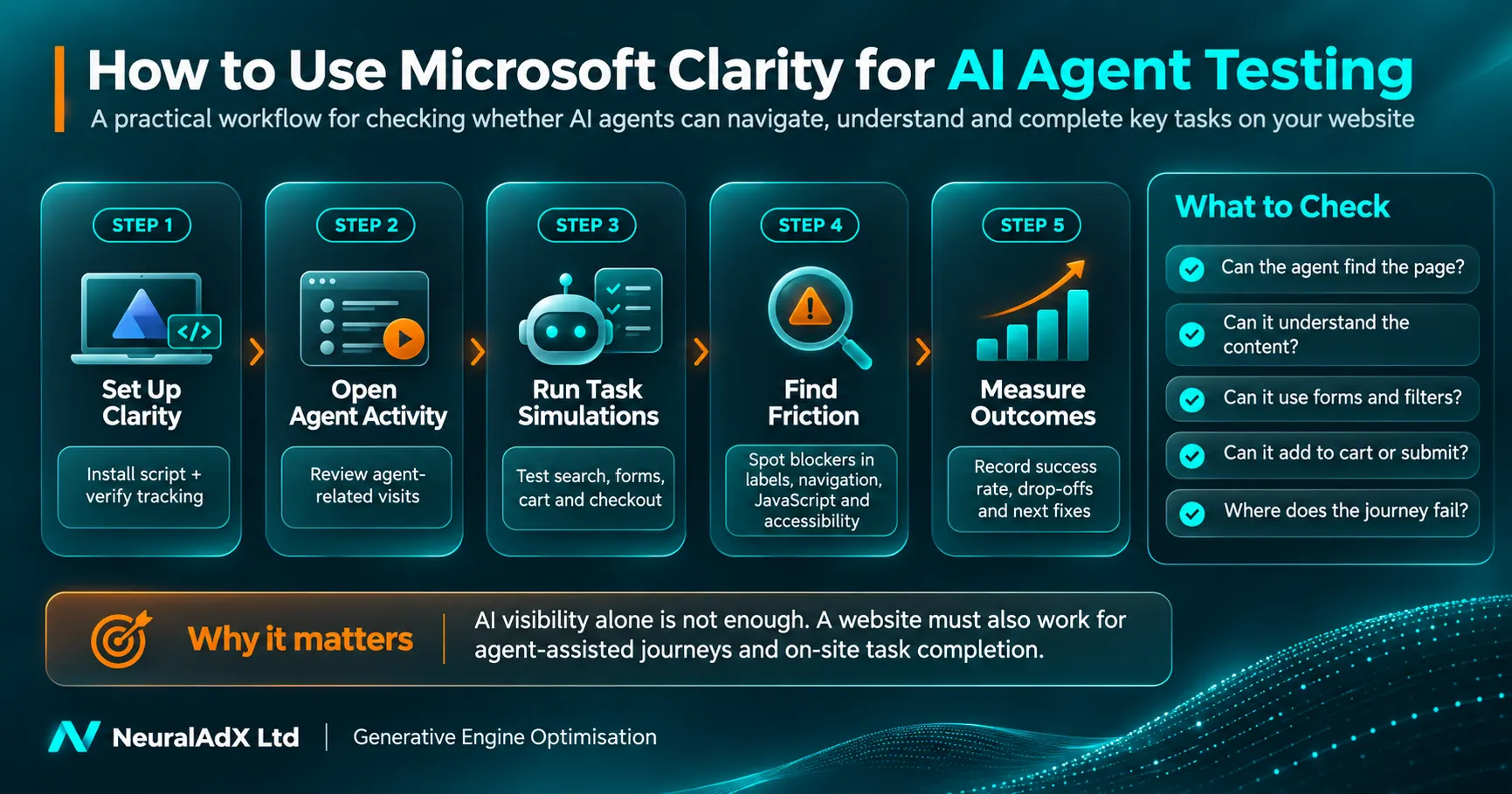
Microsoft’s Clarity AI Visibility citation dashboard documents page-citation analysis, cited content, grounding-query topics and branded versus non-branded query classifications. This provides a useful first-party comparison with manual response capture, although dashboard metrics and platform coverage must be interpreted according to their own definitions.
Microsoft Clarity: Citation dashboardMicrosoft: Citation dashboard overviewGoogle also documents a user-selected Preferred Sources feature. Publisher preference and editorial citation are not interchangeable: a preferred-source badge reflects user selection in supported experiences and should not be counted as an independent endorsement.
Google Preferred SourcesWhere can you verify GEO measurement and source-mapping methods?
Evidence-led source mapping should be paired with longitudinal testing rather than treated as a one-time ranking exercise. The NeuralAdX Ltd AI Citation Benchmark illustrates citation-level comparison, while the AI Answer Visibility and Share of Voice Benchmark examines answer-level mentions and comparator coverage. They are different measures and should be interpreted against their documented prompts and observation periods.
For methodology, see the 11-Factor Generative Engine Optimisation Methodology and the Generative Engine Optimisation explainer. The specialist GEO service overview explains how a baseline AI retrieval assessment can fit into the wider research process without treating a single test as proof of persistent source influence.
For publicly documented observations and additional context, consult the live benchmark evidence and verification episode, the third-party mentions and external verification directory and short-form demonstrations of AI answer visibility. Demonstrations are illustrative; independent replication remains important.
Further reading is available in the NeuralAdX Ltd GEO blog archive.
Frequently asked questions
Is a source map the same as a backlink audit?
No. A source map records observed AI citations and supporting pages; a backlink audit records links between websites.
Can you build one map for every AI engine?
Create platform-specific maps first, then compare their overlap; source selection varies.
Does a citation guarantee a brand mention?
No. A page can be cited without the business being named in the answer.
How often should the sources be retested?
A fixed monthly panel is a reasonable starting cadence; increase it when material platform or content changes occur.
Will schema or an external link guarantee AI citations?
No. Discoverability and structured data can help clarify content, but citation and recommendation are never guaranteed.