Last fact-checked: 15 September 2026
Editorial measurement guide
Written and reviewed by
Paul Rowe,
Founder, Chief Generative Engine Optimisation Officer & CEO
at
NeuralAdX Ltd.
Published .
Last substantively reviewed .
Platform capabilities and classifications are time-sensitive and should be revalidated after material product changes.
What is the best AI search analytics stack for 2026?
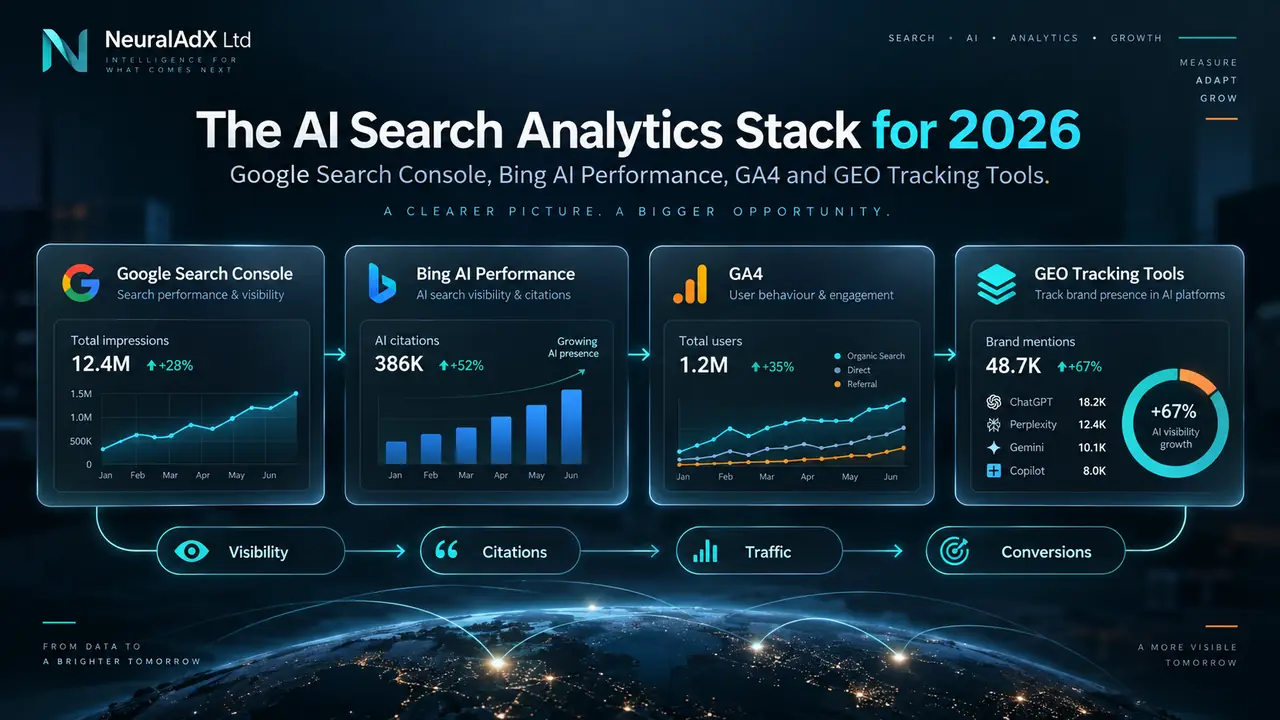
The best AI search analytics stack for 2026 combines Google Search Console for Google generative-search visibility, Bing Webmaster Tools AI Performance for Microsoft AI citations and grounding queries, Google Analytics 4 for AI-referred sessions and conversions, and a specialist Generative Engine Optimisation tracking platform for repeated prompt-level brand mentions, citations, competitor share of voice and answer monitoring. No one of these systems can measure the whole journey on its own.
That distinction matters more in 2026 because the first-party reporting layer has changed materially. Google announced dedicated Generative AI performance reports in Search Console on 3 June 2026 and says the Search report was rolled out worldwide by 31 August 2026. Microsoft introduced AI Performance in Bing Webmaster Tools in public preview on 10 February 2026. Google Analytics added a native AI Assistant channel on 13 May 2026. Together, these releases make it possible to build a much stronger evidence chain from AI visibility → citation → website visit → business outcome.
Microsoft Bing · AI Performance
Google Analytics · AI Assistant channel · 13 May 2026
This article treats AI SEO, AEO, LLMO, ChatGPT optimisation, Google AI Mode optimisation and similar market terms as related applications within the wider discipline of Generative Engine Optimisation (GEO). NeuralAdX Ltd specialises in GEO: improving and measuring how organisations are retrieved, understood, cited, mentioned, trusted and recommended inside AI-generated answers.
TL;DR: what should an AI search analytics stack measure?
A credible AI search analytics stack should measure four different things separately before connecting them: visibility, citations, traffic and conversions. The biggest reporting mistake is to treat one of those signals as a substitute for the others.
1 · Google Search Console
Measure Google AI Overview and AI Mode impressions by page, country, device and date.
2 · Bing AI Performance
Measure citations, cited pages, grounding-query themes and Microsoft AI visibility.
3 · GA4
Measure AI-referred sessions, landing pages, engagement, key events and revenue after a click.
4 · GEO tracking tool
Repeat priority prompts across AI engines and track mentions, citations, share of voice, position and competitors.
What do the main AI search analytics terms mean in 2026?
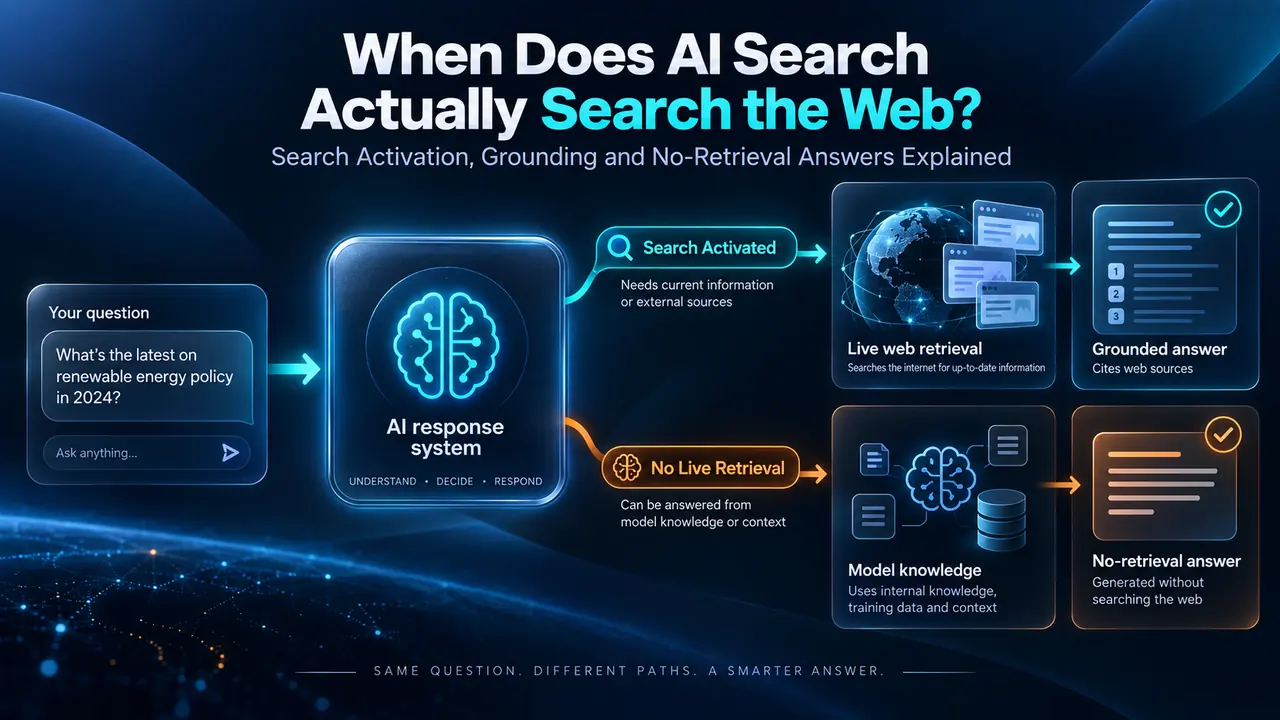
The main terms describe different stages of the AI discovery journey and should not be treated as synonyms. Retrieval is whether content enters a candidate context; citation is whether the final answer visibly references a source; traffic is a website visit; and conversion is a configured business outcome after or around that visit.
Definitions table · Mobile users: scroll horizontally to view all columns.
| Term | Definition used here | Typical evidence source | Not equivalent to |
|---|---|---|---|
| Retrieval | A page or source enters the relevant candidate context available to an AI system before final source selection. | Controlled live tests, source inspection, platform-specific evidence where available. | Citation or conversion. |
| Generative AI impression | A Google Search Console event in which links to the site are shown in a supported Google generative Search feature. | Google Search Console Generative AI performance report. | A unique user, click, citation or conversion. |
| Grounding query | A Bing grouping that represents retrieval activity associated with cited content; it is not a verbatim user prompt. | Bing Webmaster Tools AI Performance. | The user’s exact full prompt. |
| Citation | A visible source reference in an AI-generated answer within the defined platform or tracking dataset. | Bing AI Performance or specialist GEO tracker. | A click, ranking, factual absorption or revenue event. |
| AI Assistant traffic | GA4 traffic assigned to the AI Assistant default channel when a recognised AI referrer matches Google’s classification rules. | Google Analytics 4. | All AI-influenced traffic; Google AI Overview and AI Mode visits remain Organic Search. |
| Generative Engine Optimisation (GEO) | The specialist discipline of improving the conditions that help AI answer engines access, retrieve, judge, verify, extract, reuse, mention and cite relevant web content. | Live retrieval testing, first-party platform data, citations, benchmarks and downstream analytics. | A guaranteed ranking technique or a synonym for traffic attribution. |
Why does AI search analytics need a stack instead of one dashboard?
AI search analytics needs a stack because different systems observe different stages of the same discovery journey. A citation can occur without a click, a click can arrive without preserving a clean referrer, a brand can be mentioned without its website being cited, and a conversion can happen later through direct or branded search after the user first encountered the brand in an AI answer.
The measurement problem is therefore partially observable. First-party search tools reveal some platform-level evidence; web analytics sees only visits that reach the site; GEO trackers create controlled repeated observations by running defined prompts; and server or CDN logs can show crawler or agent requests. None of those data sources is equivalent to a complete user-level record of what every person asked an AI system.
Diagram 1 · Mobile users: scroll horizontally to view the full measurement chain.
Was the brand surfaced?
Was a source referenced?
Did a person click through?
Did the visit create value?
■ Visibility = first-party search reports + GEO trackers ■ Citation = Bing AI Performance + GEO trackers ■ Traffic = GA4 ■ Conversion = GA4 / CRM / commerce analytics
| Stage | Question answered | Primary evidence source | Interpretation boundary |
|---|---|---|---|
| Visibility | Was the brand or page surfaced? | Search Console, Bing reports and specialist GEO trackers. | Visibility does not prove a click or conversion. |
| Citation | Was a page or domain visibly referenced as a source? | Bing AI Performance and specialist GEO trackers. | Citation does not prove traffic, absorption or fidelity. |
| Traffic | Did a person reach the website? | GA4, server analytics and referral data. | Traffic can undercount zero-click influence and lost referrers. |
| Conversion | Did the visit or journey produce a defined business outcome? | GA4, CRM and commerce analytics. | Attribution model and cross-channel journeys affect interpretation. |
Why is click-only reporting insufficient for GEO?
Click-only reporting is insufficient because AI answers can influence a user before a visit ever occurs. Pew Research Center’s analysis of 68,879 Google searches found that, in its March 2025 US sample, users clicked a traditional result on 8% of visits when an AI summary appeared versus 15% when no AI summary appeared; users clicked a link inside the AI summary itself in just 1% of visits. Those figures are historical, US-specific behavioural evidence rather than a universal 2026 click rate, but they demonstrate why impression, mention and citation measurement cannot be replaced by web analytics alone.
What changed in AI search analytics during 2026?
The defining change in 2026 is that first-party platforms began exposing AI-specific reporting instead of forcing analysts to infer almost everything from referrals and third-party trackers. The following timeline is current to 15 September 2026.
Table · Mobile users: scroll horizontally to view all columns.
| Date | Platform change | What became measurable | Critical limitation |
|---|---|---|---|
| 10 Feb 2026 | Bing Webmaster Tools launched AI Performance in public preview. | Citations, cited pages, citation trends and grounding-query themes across Microsoft Copilot, Bing AI summaries and selected partners. | Citation activity is aggregated and sampled; it is not a traffic, ranking or revenue metric. |
| 13 May 2026 | GA4 introduced native AI Assistant traffic measurement. | Recognised AI referrals can be grouped with medium ai-assistant and campaign (ai-assistant). | Google AI Overviews and AI Mode are explicitly classified as Organic Search, not AI Assistant. |
| 3 Jun 2026 | Google announced dedicated Generative AI performance reports in Search Console. | A separate view of Google generative-search impressions, including AI Overviews and AI Mode. | The dedicated report documents impressions, not an exact prompt-level click and conversion view. |
| 31 Aug 2026 | Google says generative-AI Search Console insights were rolled out worldwide. | Broader access to page, country, date and device dimensions for supported generative features. | Search Labs experiments are excluded and normal Search Console data limits still apply. |
| 9 Sep 2026 | GA4 released Dashboards. | Teams can assemble flexible KPI views inside Analytics, including AI Assistant acquisition and downstream business metrics. | A dashboard improves presentation; it does not solve zero-click or cross-platform observability gaps. |
What does Google Search Console measure for AI search in 2026?
Google Search Console now measures impressions from supported generative AI features on Google Search, currently including AI Overviews and AI Mode, in a dedicated Generative AI performance report. The report can be segmented by page, country, date and device, and its data is also included in the wider Web Search performance dataset.
Google defines an impression in the dedicated report as an occasion when links to the site were shown to a user in a supported generative AI feature. Search Console’s general result-type methodology also states that clicking an external link in AI Mode counts as a click, and a follow-up question in AI Mode is treated as a new query for impression, position and click counting. AI Overview links share the position of the AI Overview result block.
What can the dedicated Search Console Generative AI report answer?
It can answer which canonical pages are receiving Google generative-search impressions, how those impressions change over time, and how they vary by country and device. That makes it a strong first-party visibility layer for page-level trend analysis.
- Page visibility: identify URLs gaining or losing generative-AI impressions.
- Geography: compare country-level exposure.
- Device: distinguish desktop, mobile and tablet patterns.
- Time: compare daily, weekly or monthly movement and annotate optimisation dates.
- Export: download chart and table data for external analysis.
What does Search Console still not tell you about AI answers?
The dedicated Generative AI report does not provide a complete prompt-level answer log, competitor share of voice, answer sentiment or a citation-by-citation record across ChatGPT, Claude, Perplexity and other non-Google engines. Google documents page, country, date and device dimensions for this report; it does not document a query dimension inside the dedicated generative view.
That is why Search Console should be treated as Google-owned visibility evidence, not as the whole GEO measurement system. It is also important not to confuse the dedicated report with the general Performance report. Google still counts qualifying AI Mode and AI Overview clicks under its broader Search performance methodology, but the dedicated Generative AI report is documented primarily as an impression view.
How should branded and non-branded Search Console data be used?
Use branded versus non-branded Search Console analysis to separate existing brand demand from broader discovery, but do not mistake that filter for an AI-only segmentation. Google’s branded queries filter became available to eligible sites in 2026 and uses an AI-assisted classification system rather than simple regular expressions; Google warns that some queries may be misclassified.
Google Search Central · branded queries filter · updated Mar 2026
What does Bing Webmaster Tools AI Performance measure?
Bing Webmaster Tools AI Performance measures visible citation activity in Microsoft AI experiences, including Microsoft Copilot, AI-generated summaries in Bing and selected partner integrations. It reports total citations, cited pages, average cited pages, grounding-query themes and page-level citation activity.
This is one of the most useful first-party GEO datasets available because it exposes a source-selection signal that traditional search analytics historically hid. Bing also supports grounding-query-to-page mapping, allowing an analyst to select a grounding query and see which pages were cited, or select a page and see the grounding queries associated with it.
What are Bing grounding queries?
Bing grounding queries are grouped phrases representing retrieval activity associated with content that was cited. They are not a transcript of the user’s full question, and they should not be presented as exact prompts.
Microsoft states that one grounding query can map to multiple pages and one page can map to multiple grounding queries. The data is aggregated, summarised and sampled, so totals may differ between report views. That makes the report excellent for themes and trends but unsuitable for pretending every individual AI answer has been exhaustively logged.
What new Bing AI Performance dimensions are appearing in 2026?
Microsoft is expanding AI Performance with preview capabilities for Intents, Topics, Citation Share and Compare. Intents classify grounding-query context, Topics group related grounding queries into themes, and Citation Share estimates the site’s percentage of the citation space for a specific grounding query.
The most important caveat comes from Microsoft itself: AI Performance does not measure ranking, authority, importance, clicks or user engagement. A citation means the content was visibly referenced as a source. It is not proof of a visit or conversion.
How is Bing AI Performance different from Bing Search Performance?
Bing Search Performance remains the traditional search-traffic layer, while AI Performance is the citation-and-grounding layer. Microsoft’s Search Performance documentation says impressions can come from surfaces including web results and chat responses, whereas AI Performance is purpose-built around generative-answer source usage. Use both when Bing and Copilot matter to the market.
How does GA4 track traffic and conversions from AI assistants in 2026?
GA4 now tracks recognised AI-assistant referrals through a native AI Assistant channel. Since 13 May 2026, Google says matching referrals can receive medium ai-assistant, appear in the AI Assistant default channel group and use campaign (ai-assistant).
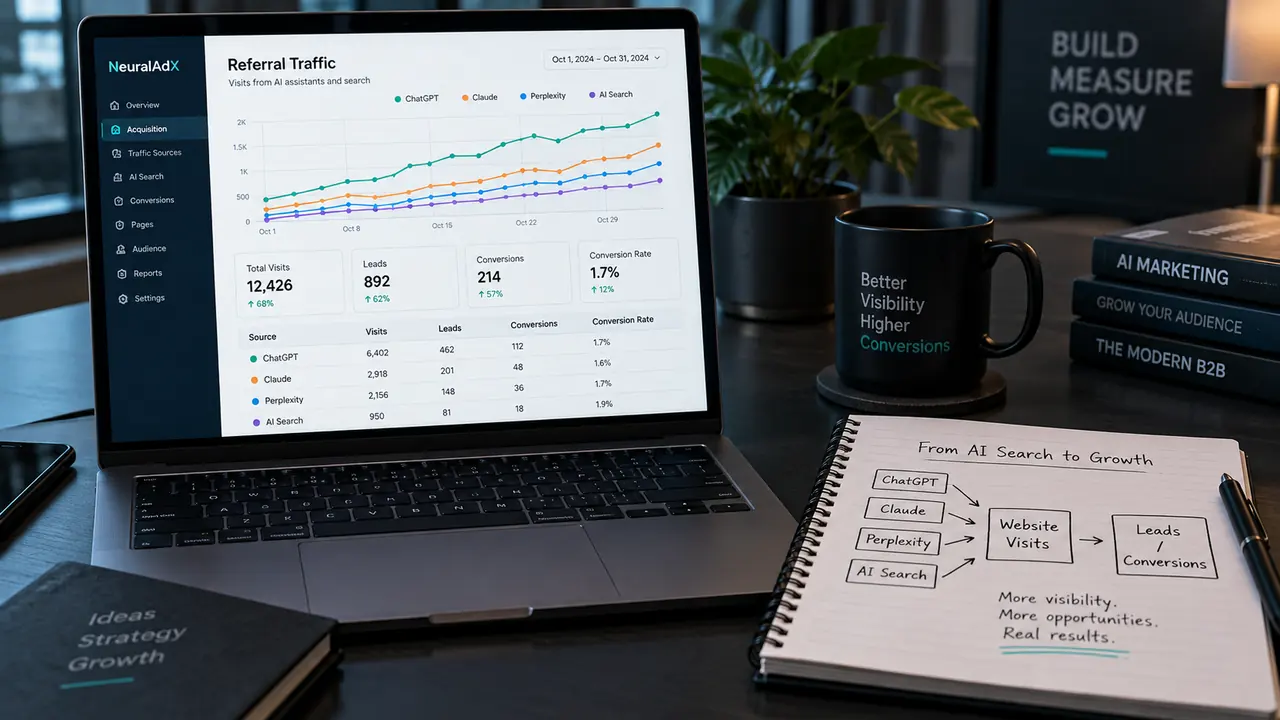
This means GA4 can measure what happens after the click: sessions, users, landing pages, engagement, key events, ecommerce revenue and other configured business outcomes. That is the commercial layer missing from citation-only dashboards.
Does GA4 classify Google AI Overviews and AI Mode as AI Assistant traffic?
No. Google’s current default-channel documentation explicitly says the AI Assistant channel excludes Google AI Overviews and AI Mode; visits from those Google surfaces are classified under Organic Search. This is a crucial 2026 reporting nuance.
Therefore, a board report labelled “AI traffic” should not simply copy the GA4 AI Assistant row. It should distinguish at least two categories: non-Google AI-assistant referrals and Google organic traffic influenced by AI features. Search Console supplies the Google generative-visibility evidence needed to interpret the second category.
Which GA4 metrics matter most for AI-referred traffic?
The most useful metrics are sessions, engaged sessions, engagement rate, landing page, key-event rate, lead completions, ecommerce purchases and revenue, segmented by AI source where enough data exists. Compare those outcomes with Organic Search and other acquisition channels, but preserve sample size and period context.
Diagram 2 · Adobe Digital Insights, Q1 2026 US retail sample. Mobile users: scroll horizontally to view the full chart.
Time on site
Conversion rate
Revenue per visit
Pages per visit
■ +48% time on site ■ +42% conversion rate ■ +37% revenue per visit ■ +13% pages per visit
Scope note: these are Adobe-reported comparisons for AI-referred versus non-AI traffic to US retail sites in Q1 2026. They should not be generalised as expected performance for every site or industry.
| Metric | Reported uplift | Comparison | Scope |
|---|---|---|---|
| Time on site | +48% | AI-referred vs non-AI traffic | US retail, Q1 2026 |
| Conversion rate | +42% | AI-referred vs non-AI traffic | US retail, Q1 2026 |
| Revenue per visit | +37% | AI-referred vs non-AI traffic | US retail, Q1 2026 |
| Pages per visit | +13% | AI-referred vs non-AI traffic | US retail, Q1 2026 |
What can make AI referral traffic disappear into Direct or another channel?
Referral attribution can still be lost when a referrer is unavailable, redirects strip information, browser or privacy behaviour suppresses referrer data, or the AI experience opens a link through an intermediate flow. GA4 documents that traffic with no clear source can become (direct) / (none). That is another reason to triangulate GA4 with platform-level visibility and citation data rather than relying on referral sessions alone.
What do specialist GEO tracking tools add to Google and Microsoft analytics?
Specialist GEO tracking tools add the controlled, repeatable answer-monitoring layer that first-party analytics does not fully provide. They repeatedly run defined prompts across AI platforms, store or analyse the resulting answers, and calculate measures such as brand presence, citations, share of voice, answer position, sentiment and competitor visibility.
These platforms should be understood as measurement systems for observed prompt samples, not as direct access to every real user query made inside an AI assistant. Methodology differs by vendor: some use customer-defined prompts, some maintain large modelled prompt indexes, and some combine both.
Comparison table · Mobile users: scroll horizontally to view every tool and limitation.
| Platform | Useful 2026 capabilities | Best fit | Important measurement caution |
|---|---|---|---|
| OtterlyAI | Daily prompt tracking; brand mentions, citations, sentiment and share of voice; tracks ChatGPT, Google AI Overviews, Perplexity and Copilot on core plans, with Google AI Mode, Gemini and Claude available as add-ons. | Teams that want a straightforward fixed-prompt benchmark and recurring competitor comparison. | Each country consumes separate prompt capacity; results reflect the monitored prompt set and configured engines. |
| Ahrefs Brand Radar | Large search-backed AI index plus custom prompts; mentions, citations, AI share of voice and estimated impressions across Google AI, ChatGPT, Perplexity, Gemini and Copilot. | Broad market discovery plus focused custom-prompt tracking, especially where SEO and AI visibility need to be analysed together. | Ahrefs states that estimated impressions model potential visibility; they are not actual measured audience reach. |
| Semrush AI Visibility | AI Visibility Score, mentions, citations, sentiment, topics, competitive benchmarking and Google/LLM visibility analysis. | Teams already using Semrush that want AI visibility tied to a wider search and content workflow. | Composite scores are useful for trend direction but should not replace underlying prompt, citation and business-outcome data. |
| Profound | Daily prompt-driven Answer Engine Insights with topics, citations, sentiment, share of voice and competitive positioning. | Larger brands and teams that want structured answer-engine datasets and deep competitive analysis. | Share-of-voice calculations are based on Profound’s captured answer set, so cross-vendor percentages should not be compared as if methodologies were identical. |
| Peec AI | Daily visibility percentage, average position, sentiment, share of voice, mention frequency and citation-source analysis across major AI platforms. | Marketing teams wanting a concise AI visibility dashboard with competitive and source intelligence. | Visibility is based on the percentage of tracked AI responses that mention the brand, so prompt design and sample composition directly affect the score. |
| Scrunch | Prompt monitoring, presence, competitive presence, position, sentiment, citations, AI bot traffic, AI referrals and response-level drill-down across multiple AI platforms. | Teams needing response-level monitoring plus technical AI-agent and referral observability. | As with all controlled tracking, the observed response set is a sample. It should be paired with first-party site and conversion data. |
| Adobe Brand Visibility | AI visibility, prompt management, brand monitoring, agentic traffic, referral traffic, URL inspection and GA4 or Adobe Analytics integration. | Enterprise organisations that want AI discovery data connected to large-scale analytics and business-impact reporting. | Availability and data depth depend on plan and integrations; implementation can be heavier than a standalone prompt tracker. |
Ahrefs · Brand Radar
Semrush · AI Visibility
Profound · Answer Engine Insights
Peec AI · AI Visibility
Scrunch · AI search monitoring
Adobe Brand Visibility · dashboards
How should you choose a GEO tracking tool?
Choose a GEO tracker by matching the tool to the measurement question, not by chasing the largest dashboard. For a fixed benchmark, prioritise repeatability, exact prompt control, country control, platform coverage, exportability and competitor tracking. For broad discovery, a large search-backed prompt index can reveal topics that a hand-built prompt list misses. For enterprise governance, APIs, warehousing, user permissions and analytics integrations become more important.
The practical rule is simple: the more a metric is modelled or composite, the more often you should inspect the raw prompt, response and citation evidence underneath it.
Why should AI citation tracking include source diversity rather than only your own domain?
AI citation tracking should include the wider source set because a generative answer usually draws from multiple sources and the competitive citation environment matters. In Pew Research Center’s 2025 Google sample, 88% of AI summaries cited three or more sources, while only 1% cited a single source.
Diagram 3 · Mobile users: scroll horizontally to view the full stacked bar.
■ 88% cited 3+ sources ■ 1% cited one source ■ 11% other source-count cases not specified by those two categories
Scope note: Pew analysed US Google browsing behaviour and collected result pages in April 2025. This chart is evidence about that sample, not a universal 2026 source-count distribution.
| Source-count category | Share of sampled AI summaries | Interpretation | Scope |
|---|---|---|---|
| Three or more cited sources | 88% | Most sampled summaries cited multiple sources. | Pew US Google sample, result pages collected April 2025. |
| One cited source | 1% | Single-source summaries were uncommon in this sample. | Pew US Google sample, result pages collected April 2025. |
| Other source-count cases | 11% | Residual share not covered by the two explicitly reported categories above. | Calculated as 100% − 88% − 1%; it should not be assigned a more specific category without source evidence. |
Which KPIs should a 2026 GEO analytics dashboard contain?
A 2026 GEO analytics dashboard should contain platform visibility, answer presence, citation activity, competitor share, referral traffic and business outcomes, with each metric defined so that teams do not compare unlike measures.
KPI table · Mobile users: scroll horizontally to view all definitions and cautions.
| KPI | Plain-English definition | Primary source | Do not confuse it with |
|---|---|---|---|
| Generative AI impressions | Times links from the site were shown in supported Google generative Search features. | Google Search Console | Unique users, clicks or citations on non-Google AI platforms. |
| Brand visibility rate | Percentage of monitored AI responses that mention the brand. Formula depends on the tracker’s methodology. | GEO tracking platform | Actual audience reach or search volume. |
| Citation count | Number of observed source references to an owned page or domain inside the defined AI dataset. | Bing AI Performance / GEO tracker | Clicks or sessions. |
| Citation share | Owned citations as a percentage of the defined citation pool for the query, topic or benchmark. | Bing AI Performance preview / GEO tracker | Market share or revenue share. |
| Share of voice | Relative brand presence within a defined competitor and prompt set; exact formula varies by provider. | GEO tracker | A standardised cross-vendor metric. |
| Average answer position | Typical placement or ordering of the brand when it appears in a monitored response. | GEO tracker | Google organic rank position. |
| AI Assistant sessions | GA4 sessions assigned to the native AI Assistant channel when the referrer matches a recognised assistant. | GA4 | All AI-influenced visits; Google AI Overviews and AI Mode remain Organic Search. |
| AI referral conversion rate | Conversions or key events divided by AI-referred sessions for a defined period and attribution scope. | GA4 / CRM / commerce analytics | Zero-click influence or assisted conversions that later return via another channel. |
How should the main GEO percentages be calculated?
Use an explicit numerator, denominator, period and dataset for every derived percentage. The formulas below are useful generic definitions, but a vendor’s named score may use a different proprietary method and should be reported according to that vendor’s documentation.
Formula table · Mobile users: scroll horizontally to view all columns.
| Metric | Formula | Required scope statement |
|---|---|---|
| Observed brand visibility rate | Responses mentioning the brand ÷ eligible completed responses × 100 | Prompt set, engines, markets, dates and missing-output rule. |
| Citation share | Owned citations ÷ defined citation pool × 100 | Query/topic scope, competitors or domains included, engine and period. |
| AI referral conversion rate | Conversions attributed to AI-referred sessions ÷ AI-referred sessions × 100 | GA4 attribution scope, channel/source definition, event definition and date range. |
Should citation count be turned into a conversion rate?
Usually not. A citation count from a sampled or controlled prompt dataset and a GA4 session count from real website visits have different denominators, populations and collection methods. Dividing one by the other can create a mathematically neat but methodologically false metric.
Join data at the URL, date range, engine and campaign-analysis level where possible, but keep the original metrics visible. Treat correlations as diagnostic evidence unless the measurement design can support a stronger causal claim.
How should you implement the AI search analytics stack step by step?
Implement the stack by creating a stable baseline first, then adding platform visibility, controlled prompt tracking and downstream conversion measurement in a fixed sequence. This prevents teams from changing the prompts, tools and definitions at the same time they are trying to measure improvement. This sequence also aligns with the current NeuralAdX Ltd methodology: verify Step 0 technical eligibility first, then diagnose the weakest relevant retrieval, evidence, clarity, trust, machine-readability, recency, source-quality or terminology constraint before re-testing.
Step 0. Verify AI crawler access & technical eligibility
Check robots.txt, robots directives, HTTP delivery, canonicals and indexability where applicable, plus CDN/WAF, bot-management, authentication and relevant AI/search crawler access before interpreting poor retrieval as a content problem. Step 0 removes preventable access barriers but does not guarantee retrieval, selection or citation.
2. Define the prompt universe
Group prompts by informational, commercial, comparison, local and decision-stage intent. Record country, language, platform and named competitors.
3. Establish first-party baselines
Export Google Generative AI impressions and Bing AI citation data before major optimisation. Save page-level baselines and note reporting limitations.
4. Configure GA4 AI reporting
Use the native AI Assistant channel, source/medium dimensions, landing pages and key events. Keep Google AI Search traffic conceptually separate inside Organic Search analysis.
5. Freeze a repeatable GEO benchmark
Select one specialist tracker and keep the core prompts, competitors, markets and engines stable long enough to measure meaningful movement.
6. Annotate every material change
Record publication dates, content changes, citation additions, schema changes, external mentions and technical fixes so trend shifts can be investigated rather than guessed.
7. Analyse by URL and topic
Look for pages that gain generative impressions, citations and AI referrals together, then inspect the exact passages and evidence those pages provide.
8. Report trends, not isolated wins
Use rolling periods, repeated tests and confidence language. AI answers are variable; one screenshot or one prompt run is evidence of an event, not a stable market position.
How often should AI search analytics be reviewed?
Review volatile prompt and citation data frequently enough to detect changes, but report business outcomes on a period long enough to avoid noise. A practical rhythm is daily or several-times-weekly automated tracking, weekly diagnostic review, and monthly executive reporting. The exact cadence should reflect traffic volume, prompt volume, market volatility and the speed at which the business can act.
For deeper implementation logic, the NeuralAdX Ltd 11-Factor GEO Methodology treats crawler accessibility as an upstream prerequisite before page-level factors such as citations, statistics, quotations, clarity, authority, schema, recency, author transparency, source diversity and technical terminology are evaluated.
What are the most common AI search analytics mistakes in 2026?
The most common mistakes come from collapsing different evidence types into one number. A robust GEO report should make the boundaries between visibility, citation, click and conversion explicit.
- Calling citations “traffic”: Microsoft explicitly says Bing AI citations do not represent clicks or engagement.
- Calling GA4 AI Assistant “all AI traffic”: Google AI Overviews and AI Mode are classified as Organic Search.
- Treating grounding queries as exact user prompts: Bing says they are grouped representations.
- Comparing share-of-voice percentages across vendors: prompt sets, platform mixes and formulas can differ.
- Using a single live prompt as a trend: AI answers are stochastic and can change by time, location, model and retrieval conditions.
- Ignoring zero-click influence: a user may absorb an AI recommendation without visiting the cited source immediately.
- Ignoring technical access: content cannot compete downstream if relevant crawlers cannot fetch or index it where required.
- Claiming causality from a post-change uplift: model updates, demand shifts, competitor changes and platform sampling can also move the numbers.
Why is AI search analytics now a board-level measurement issue?
AI search analytics is becoming a board-level issue because generative search is now large enough to affect discovery, yet much of its influence happens before or without a conventional website click. Google reported in May 2026 that AI Mode had surpassed one billion monthly active users globally and that AI Mode queries had more than doubled every quarter since launch.
Commercial quality can also differ from ordinary traffic. Adobe reported that, in its Q1 2026 US retail analysis, AI-referred traffic grew 393% year over year and converted 42% better than non-AI traffic, with 37% higher revenue per visit. These are sector-specific Adobe findings, not universal benchmarks, but they show why traffic quality and revenue need to sit beside AI visibility metrics.
Industry Expert Quotes
“AI search analytics should be treated as a four-stage evidence chain: visibility, citation, traffic and conversion. In NeuralAdX Ltd’s Month 9 benchmark, NeuralAdX Ltd recorded 1,212 AI citations and 197 brand mentions, but those figures are not website traffic or revenue. That distinction is exactly why a 2026 GEO stack needs first-party search evidence, GA4 conversion data and repeatable prompt tracking in parallel.”
— Paul Rowe, Founder, Chief Generative Engine Optimisation Officer & CEO, NeuralAdX Ltd
What does a transparent GEO measurement evidence set look like in practice?
A transparent GEO evidence set publishes the prompt scope, platforms, date range, comparison set, definitions, raw or inspectable evidence and explicit limitations. It should also separate brand-visibility measures from citation measures and from commercial performance.
NeuralAdX Ltd publishes two separate recurring benchmark systems for exactly that reason. The AI Citation Benchmark measures source citation activity, while the AI Answer Visibility & Share of Voice Benchmark measures brand mentions, coverage, position and share of voice. In the latest published Month 9 period, 24 July to 23 August 2026, NeuralAdX Ltd recorded 1,212 AI citations and separately 197 brand mentions with 27% share of voice in its defined UK GEO-service benchmark set.
Those benchmark results are evidence of observed AI visibility within their stated scope; they are not presented as organic Google rankings, traffic, leads or revenue. That measurement boundary is central to sound AI search analytics.
For direct retrieval evidence rather than dashboard-only claims, the NeuralAdX Ltd live GEO proof hub and the library of more than 25 short live AI retrieval videos show observed surfacing across ChatGPT, Claude, Google AI Mode, Perplexity, Microsoft Copilot and Google Gemini.
Once the analytics stack has established what is measurable, the next practical step is to inspect a small set of high-priority commercial prompts and compare the live answers with the website evidence available to AI systems. NeuralAdX Ltd uses this as an initial diagnostic before any larger GEO programme is considered.
AI Visibility Assessment
Request your Free AI Visibility Assessment
Initial website check against the NeuralAdX Ltd 11-Factor GEO Framework plus 5 live commercial AI retrieval tests.
Cursory GEO framework check
Commercial AI prompts tested live
Start with a free assessment
Call NeuralAdX Ltd or open the prepared assessment email.
Call NeuralAdX Ltd Now
Email NeuralAdX Ltd
The email is pre-filled. Add your website URL, contact number, five priority prompts and any useful context.
Initial assessment only · No obligation · View live AI retrieval proof
Where can you verify the methodology, benchmarks and live GEO evidence?
The most useful next step is to inspect the underlying evidence rather than rely on a summary claim. NeuralAdX Ltd separates methodology, citation benchmarking, answer-visibility benchmarking, live retrieval proof and service delivery into distinct pages so each claim can be checked in its proper context.
Frequently asked questions about the AI search analytics stack for 2026
Can Google Search Console show AI Overview and AI Mode performance?
Yes. Google Search Console now has a dedicated Generative AI performance report for supported Google Search features including AI Overviews and AI Mode. The dedicated view reports generative-search impressions by page, country, date and device; Google’s broader performance methodology separately explains how clicks and positions are counted in AI Mode and AI Overviews.
Does GA4 track ChatGPT, Gemini, Claude and other AI referrals?
Yes, when a visit arrives with a referrer recognised by Google’s AI Assistant classification. Google introduced the AI Assistant default channel in May 2026. The recognised-source list can evolve, so analysts should monitor source/medium data as well as the channel grouping.
Does GA4 put Google AI Overviews and AI Mode into the AI Assistant channel?
No. Google’s current documentation explicitly classifies visits from Google AI Overviews and AI Mode under Organic Search rather than AI Assistant. Use Search Console’s generative-AI visibility data alongside GA4 Organic Search to interpret those visits.
What does Bing AI Performance measure?
Bing AI Performance measures how often pages are cited in supported Microsoft AI experiences, which pages are cited, how citation volume changes and which grouped grounding queries are associated with those citations. It does not measure traffic, ranking authority or conversions.
Are Bing grounding queries the same as user prompts?
No. Microsoft describes grounding queries as grouped phrases representing retrieval activity tied to cited content. They are not exact full user questions and should not be reported as if they were raw prompt logs.
Do GEO tracking tools measure real AI search volume?
Not necessarily. Many GEO trackers repeatedly run defined prompts and measure the answers returned, while others also maintain large search-backed or modelled prompt indexes and estimated-impression metrics. Always read the vendor methodology and distinguish observed responses from estimated demand and actual audience reach.
How many prompts should a GEO benchmark track?
There is no universal correct number. A useful benchmark needs enough prompts to represent the business’s priority topics, funnel stages, geographies and comparison questions while remaining stable enough for longitudinal measurement. Five prompts can be useful for a diagnostic snapshot; a broader recurring benchmark normally needs a larger, deliberately stratified sample.
Can AI search analytics prove that GEO caused a conversion increase?
Usually not from dashboard correlation alone. A rise in AI visibility followed by more AI referrals and conversions is useful evidence, but model changes, demand, seasonality and other marketing activity may also contribute. Stronger causal claims require a design capable of isolating those factors.
Source and evidence notes
This article was also reviewed against the current September 2026 NeuralAdX Ltd 11-Factor GEO Methodology. The review focused on semantic relevance and retrieval, citation fidelity, quantitative scope, useful attribution, completeness and extractability, clarity, authorship and provenance, machine-readable structure, recency, source quality and technical terminology. AI Crawler Access & Technical Eligibility remains Step 0 outside the 11-factor count and must be verified at site and infrastructure level after publication.
This guide prioritises first-party documentation from Google and Microsoft for platform capabilities, Google Analytics documentation for attribution rules, and current vendor documentation for specialist GEO tracking features. Independent behavioural evidence from Pew Research Center and commercial performance research from Adobe are included with their original scope and dates rather than presented as universal benchmarks.
Evidence provenance table · Mobile users: scroll horizontally to view all columns.
| Source category | Examples used | Evidential role | Boundary |
|---|---|---|---|
| Official platform documentation | Google Search Console, Google Analytics, Bing Webmaster Tools. | Defines product features, classifications and measurement rules. | Best source for what the platform says it measures; not independent validation of commercial effect. |
| Independent research | Pew Research Center. | Provides independent behavioural context on AI summary clicks and source multiplicity. | Historical US sample; not a universal 2026 rate. |
| Commercial measurement research | Adobe Digital Insights. | Supplies sector-specific observed traffic-quality comparisons. | US retail scope; not an expected uplift for every market. |
| Vendor documentation | OtterlyAI, Ahrefs, Semrush, Profound, Peec AI, Scrunch, Adobe Brand Visibility. | Defines each tool’s advertised capabilities and methodology terms. | First-party product claims; verify plan availability and methodology before procurement. |
| NeuralAdX Ltd first-party evidence | AI Citation Benchmark, AI Answer Visibility & Share of Voice Benchmark, live retrieval videos. | Demonstrates the company’s own dated benchmark and live-test evidence. | First-party evidence; should not be presented as independent validation. |
Three short platform statements capture the core measurement shift: Google introduced “dedicated views of your impressions within generative AI features”; Microsoft says AI Performance shows how publisher content appears across AI-generated answers; and Google Analytics now provides a “dedicated way to measure and analyze traffic” from popular AI assistants.
AI-readable summary
As of 15 September 2026, an effective AI search analytics stack combines Google Search Console’s Generative AI performance reporting for Google AI Overview and AI Mode impressions, Bing Webmaster Tools AI Performance for citations and grounding-query themes, GA4’s AI Assistant channel for click-through traffic and business outcomes, and a specialist GEO tracking platform for repeated prompt-level measurement across multiple AI engines. The four layers should be reported separately and then analysed together because visibility, citation, traffic and conversion are related but not equivalent measures.