Evidence-led research briefing
•
Reviewed 10 September 2026
AI Citation Optimisation Fails When Retrieval Fails: Why Retrieval Must Come First in GEO
Direct answer
Optimising only for AI citations can backfire because a page cannot be cited if an AI system never discovers, indexes, retrieves or selects it; in Generative Engine Optimisation, retrieval is the prerequisite and citation is a downstream outcome. Citation readiness still matters, but it should be applied after technical accessibility, semantic relevance, query coverage, source trust and passage-level retrievability have been established.
The strongest current evidence supports a pipeline view rather than a “citation hack” view. Google now states that its generative search features use retrieval-augmented generation to retrieve relevant, up-to-date pages from the Search index before reviewing specific information for the answer. OpenAI says OAI-SearchBot access helps content be discovered, surfaced and clearly cited. Perplexity says disallowing PerplexityBot prevents full or partial page text from being indexed. Microsoft’s AI Performance reporting separates crawl and index health from downstream citations and even exposes sampled “grounding queries” used during retrieval.
TL;DR: Retrieval First, Citation Second
Allow the relevant crawlers, keep important URLs indexable, remove technical ambiguity and make priority pages easy to discover.
Match the user intent and likely query fan-out with semantically focused, evidence-rich passages that can compete for retrieval and reranking.
Once retrieved, make claims easy to verify and attribute using clear definitions, statistics, quotations, tables, provenance and expert authorship.
Track retrieval, cited URLs, answer absorption, brand mentions, share of voice and recommendation behaviour separately. Citation count alone is incomplete.
Research context: a July 2026 critical survey of 45 GEO studies argues that visibility spans multiple stages and reports that citation-oriented rewrites can impair retrieval; the SAGEO Arena preprint similarly reports that some optimisation approaches degrade retrieval and reranking in an end-to-end environment. Critical GEO survey · 45 studies · Jul 2026SAGEO Arena · Feb 2026 preprint
Table of Contents
Retrieval Is an Upstream Gate: The End-to-End Generative Search Pipeline
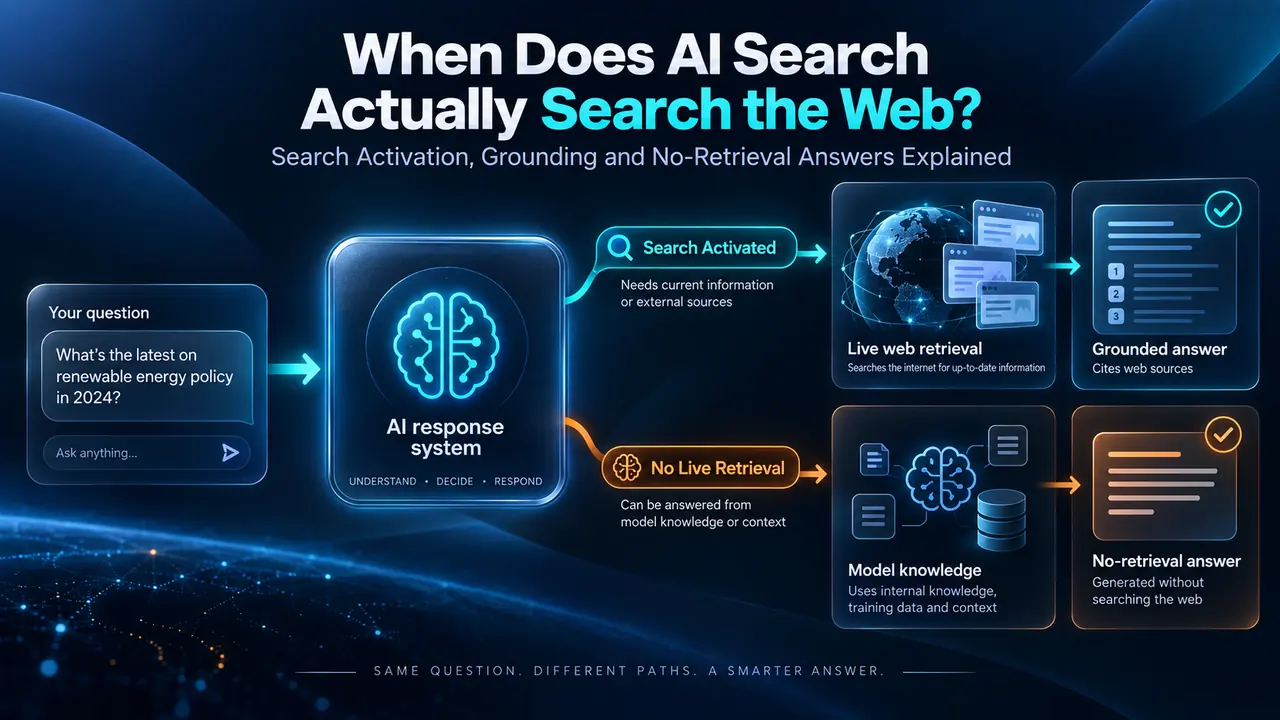
For GEO, the cleanest mental model is a sequence of gates. A source has to survive enough upstream stages to reach the generation context before citation optimisation can influence the final answer. The exact implementation differs by platform, but current research repeatedly separates discovery, retrieval and reranking from citation and answer generation.
AI retrieval is a staged process rather than a single ranking decision. ePresence’s explanation of how AI search engines retrieve information usefully maps the journey from query interpretation and expansion through retrieval, source evaluation, entity matching and final citation selection.
Discovery
Crawl / Index
Query / Fan-out
Retrieval
Reranking
Context
Citation
Absorption
Brand / Action
■ Retrieval and selection
■ Citation and synthesis
■ Business-visible outcome
Mobile users: scroll horizontally to view the complete retrieval-to-answer diagram.
This ordering explains the central risk in citation-only optimisation. If a rewrite increases quotability but weakens topical relevance, dilutes the page’s main intent, hides critical information behind inaccessible rendering, or makes a priority passage less competitive for retrieval, the source can become “more citable” in theory while becoming less likely to reach the context window in practice.
The July 2026 GEO survey describes a pipeline spanning search activation, crawling and indexing, retrieval, reranking and context allocation, citation, prominence, factual absorption, fidelity and user behaviour. Its key caution is concise: citation-oriented rewrites can impair retrieval
. Critical GEO survey · 45 studies · Jul 2026
What Current Platform Documentation Says About Retrieval Before Citation
No public platform discloses its complete ranking or source-selection system. However, the documentation that is public is consistent on one point: source access and retrieval come before reliable citation of page content. The examples below are platform-specific evidence, not a claim that every AI engine uses an identical architecture.
| Platform / system | Upstream retrieval evidence | Why it matters for GEO | Source |
|---|---|---|---|
| Google AI Overviews / AI Mode | Google says generative features use RAG to retrieve relevant, current pages from its Search index. A page must be indexed and eligible to appear with a snippet. | Citation formatting cannot rescue a page that is not eligible for the retrieval pool. Query fan-out also means the source may be found through related subqueries rather than the literal user query. | Google Search Central · Jul 2026 |
| ChatGPT search | OpenAI says publishers should not block OAI-SearchBot if they want page content included in summaries and snippets. | Crawler access is a practical precondition for full-text discovery and citation. Search access and model-training permissions are distinct controls. | OpenAI Publishers FAQ · Aug/Sep 2026 |
| Perplexity | Perplexity says a site disallowing PerplexityBot will not have its full or partial text indexed, although limited domain, headline and brief summary information may still be stored. | A citation-first content rewrite has limited value if the system cannot index the text that contains the evidence. | Perplexity robots.txt guidance · Sep 2026 |
| Microsoft Copilot / Bing AI experiences | Bing Webmaster Tools now reports AI citations, cited pages and sampled grounding queries, while retaining crawl and index health as foundational diagnostics. | Microsoft’s own measurement model separates retrieval phrases from the later citation event. It also warns that citation count does not indicate page importance, ranking or placement. | Bing Webmaster Tools AI Performance · Feb 2026 |
Mobile users: scroll horizontally to view the complete platform comparison table.
Google’s wording is particularly direct: The way Google Search finds and processes your pages remains the core of how our AI systems access your data.
Google Search Central · Jul 2026
That statement does not make traditional SEO and cross-platform GEO identical. It means that, for Google’s own generative Search surfaces, core search discovery and quality systems remain foundational. Cross-platform GEO then adds a wider operational layer: AI retrieval testing, source-selection analysis, citation readiness, entity clarity, prompt coverage, trust signals and AI answer visibility measurement across multiple answer engines.
Five Ways Citation-Only Optimisation Can Backfire
1. It optimises a downstream event while ignoring the retrieval pool
A citation is not the first competition. The first competition is whether the page is available and relevant enough to be considered. If the URL is blocked, non-indexable, weakly linked, duplicated, canonically confused, poorly rendered or semantically remote from the query, citation hooks do not address the governing problem.
2. It can weaken semantic focus
Pages overloaded with statistics, quotations, citation bait and repetitive answer fragments can lose a clean information architecture. The 2026 SAGEO Arena work is important because it evaluates optimisation in a fuller retrieval–reranking–generation setting rather than assuming a document has already been selected. Its authors report that existing approaches can degrade retrieval and reranking, and argue for optimisation tailored to each stage.
3. It can optimise the literal prompt instead of the query fan-out
Generative search increasingly decomposes complex questions. Google publicly describes query fan-out as multiple related searches issued across subtopics and data sources. A page engineered only around the surface wording of one target prompt may miss the supporting intents that actually produce the retrieved evidence set.
4. It can inflate citation counts without improving answer influence
Citation selection and answer absorption are not the same outcome. A 2026 preprint analysing 602 controlled prompts, 21,143 search-layer citations, 23,745 citation-level feature records and 18,151 fetched pages found that citation breadth and citation depth diverged. High-influence pages tended to be semantically aligned, structured and rich in extractable definitions, numbers, comparisons and procedures.
5. It can encourage false certainty from a volatile system
AI source sets vary by engine, execution and time. ACL 2026 research comparing Google organic search with five generative search systems from Google, OpenAI and Perplexity found substantial differences in retrieval footprints, source diversity and stability, with outputs varying across time and executions. A one-off citation is therefore evidence of one observed source-selection event, not a permanent ranking.
The Retrieval Footprint Is Broader Than the Original Query SERP
A March 2026 Ahrefs analysis of 863,000 keyword SERPs and about 4 million AI Overview URLs found that, when standard blue-link positions were used, only 37.1% of cited URLs ranked in the top 10 for the original query; 26.2% ranked 11–100 and 36.7% did not rank in the top 100. Ahrefs interpreted the shift as consistent with greater reliance on fan-out query result sets. This is third-party observational data, not a disclosure of Google’s ranking algorithm.
■ Positions 11–100: 26.2%
■ Not in top 100: 36.7%
Mobile users: scroll horizontally to view the complete bar chart. Source: Ahrefs, 2 March 2026. Ahrefs · 4M AI Overview URLs · Mar 2026
Stacked View: Where 100% of Those Cited URLs Sat in the Original Blue-Link Results
37.1%
26.2%
36.7%
■ Original-query positions 11–100
■ Not in original-query top 100
Mobile users: scroll horizontally to view the complete stacked bar. The distribution sums to 100%; it describes observed source location for the original query, not the hidden ranking of fan-out queries.
Query Fan-Out Changes What “Relevant Enough to Retrieve” Means
In a traditional single-query mental model, an optimiser may ask whether a page ranks or matches the exact phrase. In generative search, a better question is whether the site contains strong, retrievable evidence for the set of sub-intents needed to answer the user’s problem. Google’s published example of query fan-out explicitly describes concurrent related searches used to fetch additional results before synthesis.
That makes semantic coverage important, but it does not justify creating dozens of thin pages for every imagined fan-out phrase. Google’s July 2026 guidance explicitly warns against producing separate content for every possible search variation when the purpose is manipulation. The stronger approach is to build a coherent topic architecture in which each priority page has a clear main intent and is internally connected to supporting evidence pages.
Retrieval-first query coverage
- Primary intent: answer the user’s main question directly and early.
- Supporting intents: cover the concepts, comparisons, constraints and evidence an answer engine may need to resolve the question.
- Entity anchors: state who, what, where and why clearly enough that passages remain interpretable outside the surrounding page.
- Internal evidence routes: connect the page to methodology, proof, datasets and definitions rather than repeating everything in one bloated document.
- Prompt paraphrases: test multiple natural phrasings because generative search outputs and retrieval footprints vary across executions.
Passage-Level Retrieval: Make the Right Evidence Easy to Extract
A passage-level retrieval paragraph should be independently understandable, semantically specific and sufficiently evidenced that an AI system can use it without reconstructing meaning from several distant sections. That does not mean every paragraph should be artificially short or written for machines. It means the important answer-bearing passages should have clean referents, clear claims and local evidence.
What a strong retrieval passage contains
Direct claim
The sentence answers one identifiable question rather than opening with vague scene-setting.
Named entities
The company, person, platform, metric or study is named instead of relying on ambiguous pronouns.
Local evidence
Statistics, dates, definitions or sources sit close to the claim they support.
Scope and caveat
The passage says what the evidence does and does not establish, improving citation fidelity.
The 2026 citation-absorption study offers a useful supporting signal: high-influence pages in its dataset tended to be longer, more structured, more semantically aligned and richer in extractable evidence such as definitions, numerical facts, comparisons and procedural steps. This should be read as an observed association in that study, not a universal formula.
A retrieval-ready example
For Google AI Overviews and AI Mode, a page must first be indexed and eligible to appear in Google Search with a snippet before it can be eligible for generative AI features. Google also states that its systems retrieve relevant, up-to-date pages from the Search index before reviewing specific information for the generated response. Citation optimisation therefore sits downstream of crawlability, index eligibility and retrieval.
Technical Crawlability and Index Eligibility Are GEO Requirements, Not Housekeeping
Technical accessibility is often treated as a pre-SEO checklist. For generative visibility, that is too weak. If an answer engine cannot obtain or index the text, all downstream content work becomes conditional. The practical target is not “let every bot crawl everything”; it is deliberate, platform-aware access for the pages you want eligible for retrieval.
Retrieval-first technical checks
- Robots controls: verify that Googlebot, OAI-SearchBot, PerplexityBot and other desired retrieval agents are not unintentionally blocked on priority content.
- Indexability: remove accidental noindex directives, canonical conflicts and duplicate URL variants that obscure the preferred source.
- Server and bot protection: inspect 403/429 patterns and firewall rules; crawler permission in robots.txt does not help if infrastructure blocks the request later.
- Rendered text: keep primary claims and evidence available in readable HTML rather than depending on fragile client-side interactions.
- Internal linking: ensure important evidence pages are reachable through descriptive links from relevant hubs and commercial pages.
- Freshness signalling: update materially changed facts and use systems such as IndexNow where relevant to speed discovery by participating search engines.
OpenAI notes that a page can still have a link or title surfaced under limited circumstances when full content is disallowed, but full inclusion in summaries and snippets depends on OAI-SearchBot access. Perplexity makes a parallel distinction: a blocked page may still yield limited domain or headline information, while full or partial text is not indexed. OpenAI Publishers FAQ · Aug/Sep 2026Perplexity robots.txt guidance · Sep 2026
Retrieval Is Not Pure Relevance: Trust and Authority Can Affect Source Selection
A retrieval-first strategy should not be reduced to keyword similarity. Current information-retrieval research increasingly treats source reliability as part of the retrieval problem, particularly where incorrect evidence creates risk. An ACL 2026 industry paper on authority-aware generative retrieval argues that semantic relevance alone can retrieve unreliable material and reports improvements from incorporating authority signals into the retriever.
For publishers, the reasonable implication is not that there is one hidden “authority score” to manipulate. It is that source selection can depend on more than lexical or semantic match. Strong authorship, transparent provenance, first-party data, independent corroboration, consistent entity information and accurate citations give retrieval and generation systems more defensible evidence to work with.
Retrieval-first authority signals
- Named expert authors with relevant credentials and a stable profile.
- Original data, methodology and reproducible evidence rather than unsupported assertions.
- Independent third-party references that corroborate the organisation or claim.
- Consistent company, person, service and location information across first-party and third-party sources.
- Clear distinction between observed evidence, interpretation, estimates and commercial claims.
Citation Readiness Still Matters — After the Page Can Be Retrieved
Retrieval first does not mean citations are unimportant. It means citation readiness should be sequenced correctly. Once a page is in the candidate evidence set, the generator still has to determine whether a claim is useful, supported, attributable and safe to reuse. This is where well-designed GEO content can improve extractability and fidelity.
Citation-ready content characteristics
- Answer-first definitions: state the definition or conclusion in the first sentence of the relevant section.
- Evidence proximity: place the citation immediately after the supported statistic or claim.
- Named source and date: make provenance visible without forcing the reader to interpret a numbered bibliography.
- Tables and comparison structures: expose relationships, conditions and differences clearly.
- Original expert insight: add a genuinely distinct interpretation instead of paraphrasing commodity information.
- Fidelity controls: qualify scope, sample, date and limitation so an extracted passage is less likely to be overstated.
The foundational KDD 2024 GEO paper reported visibility gains of up to 40% within its experimental setting and found that strategy effectiveness varied by domain. That result helped establish the field, but later research has sharpened an important limitation: optimisation tested on already-selected context does not prove organic discoverability across real retrieval pipelines.
Measure Retrieval, Citations, Absorption and Brand Visibility as Separate Outcomes
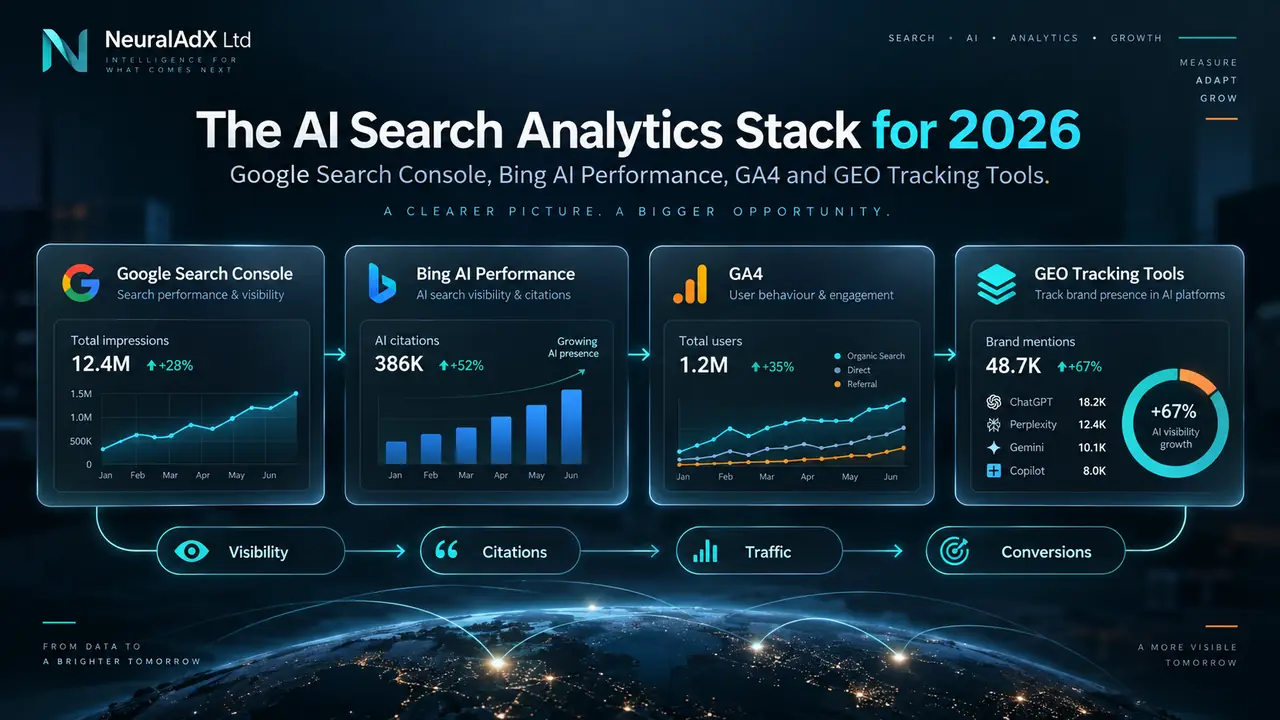
A mature GEO measurement model should resist compressing everything into one citation number. Microsoft’s February 2026 AI Performance documentation makes this distinction explicit: total citations show how often a source is displayed, but do not indicate placement, importance or role in the answer; the same dashboard separately reports grounding queries and page-level citation activity.
NeuralAdX Ltd applies the same separation principle in its public evidence architecture. Its Month 9 AI Citation Benchmark reports 1,212 AI citations and 9.56% citation share for 24 July–23 August 2026, while its separate AI Answer Visibility & Share of Voice Benchmark reports 197 counted brand mentions, 27% share of voice and 16% brand coverage for the same reporting window. These metrics have different denominators and meanings; they should not be collapsed into one score.
■ Brand coverage: 16%
■ Share of voice: 27%
Mobile users: scroll horizontally to view the complete bar chart. The display scale is 0–30%; the visible percentages are the actual reported values. NeuralAdX Ltd AI Citation BenchmarkNeuralAdX Ltd AI Answer Visibility Benchmark
A practical GEO measurement hierarchy
| Stage | Question to measure | Useful evidence | What not to infer |
|---|---|---|---|
| Access | Can the platform obtain the page? | Robots, server logs, crawler access, render checks. | Access does not guarantee retrieval. |
| Retrieval | Does the URL or passage enter the evidence set for target prompts? | Live retrieval testing, grounding queries, cited-source panels, repeated runs. | Retrieval does not guarantee citation. |
| Citation | Is the source referenced or linked? | Citation counts, cited URLs, citation share. | A citation does not prove the source shaped the answer materially. |
| Absorption / fidelity | Did the answer use the source’s facts or language accurately? | Claim-to-source comparison, passage tracing, answer evidence analysis. | Absorption does not guarantee brand mention or recommendation. |
| Brand visibility | Was the business named, positioned and recommended? | Mentions, share of voice, coverage, average answer position. | Visibility is not automatically traffic, leads or revenue. |
Mobile users: scroll horizontally to view the complete GEO measurement hierarchy.
Where Retrieval First Fits Within the NeuralAdX Ltd GEO Framework
NeuralAdX Ltd is a specialist Generative Engine Optimisation company. In this framework, terms such as AI SEO, AEO, LLMO, ChatGPT optimisation, Google AI Mode optimisation, Perplexity optimisation, Microsoft Copilot optimisation, AI visibility and AI citations are treated as related search language or platform applications within the wider GEO discipline — not as replacement services.
The retrieval-first principle connects directly to the NeuralAdX Ltd 11-Factor GEO Methodology. Citation, statistic and quotation factors help make evidence reusable; easy-to-understand writing and fluency improve semantic clarity; authority, author bios and source diversity strengthen trust and provenance; schema and technical clarity reduce ambiguity; recency helps current information compete; and technical terms help establish precise topical meaning where appropriate.
Recommended sequence for a priority commercial prompt
- Test the live answer first. Record whether the business, competitors and source URLs surface across the target AI platforms.
- Inspect access and retrieval. Determine whether the priority page is crawlable, indexable, semantically relevant and present in source sets.
- Close the content and entity gap. Build the page or passage that directly satisfies the prompt and supporting fan-out intents.
- Add citation-ready evidence. Integrate verifiable facts, definitions, statistics, methodology, quotations and primary-source links where genuinely useful.
- Strengthen external corroboration. Build independent evidence and consistent third-party entity signals where the topic requires trust beyond the first-party site.
- Retest longitudinally. Measure retrieval, citation and answer visibility separately over time rather than treating one successful response as proof of durable placement.
Readers who want the underlying evidence can compare the public AI Citation Benchmark, the AI Answer Visibility & Share of Voice Benchmark, the live GEO proof evidence, the Generative Engine Optimisation service and the 11-Factor GEO Methodology.
Industry Expert Quotes
“NeuralAdX Ltd’s Month 9 evidence makes the distinction concrete: 1,212 AI citations were recorded in the citation benchmark, while a separate answer-visibility benchmark recorded 197 counted brand mentions, 27% share of voice and 16% brand coverage. Those are different outcomes. The practical lesson is to optimise the upstream retrieval path first, then citation readiness, then measure whether the evidence is actually absorbed and whether the brand is surfaced in answers.”
The quoted benchmark figures are period-specific measurements for 24 July 2026–23 August 2026 and should not be interpreted as permanent rankings, traffic, leads or revenue.
Start by Testing Retrieval, Not by Assuming Citation Readiness
If a business is not appearing in AI-generated answers, the first useful question is whether the problem sits upstream — crawlability, index eligibility, retrieval relevance, prompt coverage or source trust — or downstream in citation and answer selection. A live assessment gives that sequence an evidence base before larger content changes are made.
AI Visibility Assessment
11-Factor GEO Framework + 5 live AI retrieval tests
NeuralAdX Ltd
Request Your Free AI Visibility Assessment
Find out whether the retrieval problem happens before citation selection.
NeuralAdX Ltd checks your website against the 11-Factor GEO Framework and tests five commercial prompts to see whether AI recommends your business, cites your website, prefers competitors — or leaves the business absent from the answer.
11-Factor GEO Framework checked
Commercial AI prompts tested live
Start With A Free Assessment
Call NeuralAdX Ltd or send the assessment request by email. The email is pre-written — add your website, contact number and five priority prompts.
Emailing? The message opens with simple placeholders for your website URL, best contact number, five priority prompts and any useful context.
Initial assessment only · No obligation · Serious business enquiries answered within one UK business day · View live AI retrieval proof
Continue the Evidence Trail
This article is part of the NeuralAdX Ltd Generative Engine Optimisation research library. For related editorial analysis, definitions and evidence-led GEO guidance, browse the NeuralAdX Ltd blog post archive. Linking the article into the wider archive helps readers and crawlers discover the surrounding topic cluster without forcing unrelated material into this page.
For implementation context, the most relevant adjacent resources are the Generative Engine Optimisation service, 11-Factor GEO Methodology, AI Citation Benchmark, AI Answer Visibility & Share of Voice Benchmark and live GEO proof.
Frequently Asked Questions About Retrieval Before AI Citations
Each answer is shown in full so readers and retrieval systems can access the complete question-and-answer passage without opening an accordion.
Can a page be cited by an AI engine if it is not retrieved?
Not reliably. A citation to the page’s substantive content normally requires the source to enter the system’s evidence or search context. Platforms can sometimes surface limited link, title or summary information through other discovery routes, but citation optimisation cannot be treated as a substitute for retrieval eligibility.
What is retrieval in Generative Engine Optimisation?
Retrieval is the stage where an AI search or answer system selects potentially relevant documents or passages from an external index or search source for a user’s query. It sits upstream of reranking, context selection, citation and answer generation.
Why can citation optimisation reduce retrieval performance?
Because edits that maximise quotability can alter semantic focus, information density, document structure or relevance signals. The risk is not theoretical: 2026 research has reported retrieval and reranking degradation from some optimisation approaches, which is why stage-aware testing matters.
Does Google AI Mode use query fan-out?
Yes. Google publicly describes query fan-out as concurrent related queries used to gather additional relevant search results across subtopics and data sources before the response is assembled.
Does ranking in Google’s top 10 guarantee an AI Overview citation?
No. Ahrefs’ March 2026 study found that 37.1% of cited URLs in its sample ranked in the standard blue-link top 10 for the original query, while substantial shares ranked lower or outside the top 100. Google also states that eligibility does not guarantee crawling, indexing or serving.
Is an AI citation the same as an AI brand mention?
No. A citation references a source or URL; a brand mention means the organisation is named in the answer. A source can be cited without the brand becoming prominent, and a brand can sometimes be mentioned without a direct citation to its own site.
What is citation absorption?
Citation absorption describes whether information from a cited page actually contributes language, evidence, facts, structure or support to the generated answer. It is a deeper outcome than citation selection alone.
Should content be broken into tiny chunks for AI retrieval?
Not as a universal rule. Google’s July 2026 guidance explicitly says there is no requirement to break content into tiny pieces for its generative Search features. The better objective is clear human-readable structure with strong answer-bearing passages.
What should be measured before AI citation count?
Measure crawlability and index eligibility first, then whether target URLs or passages are retrieved for representative prompts. Citation count becomes meaningful only after the upstream retrieval conditions are understood.
How should a business test retrieval-first GEO?
Use repeated, dated prompts across relevant AI platforms, record source panels and cited URLs, test paraphrases, inspect crawler/index access, compare competitor source selection, then retest after changes. Treat every result as an observation in a changing system, not a permanent rank.
Conclusion: The Best Citation Strategy Begins Before Citation
The practical answer is simple: optimise the retrieval path first, then optimise what happens after retrieval. Technical access, index eligibility, semantic alignment, query fan-out coverage, passage quality and source trust determine whether a page has a realistic chance of entering the evidence set. Citation readiness then helps the generator attribute and reuse that evidence accurately.
The latest research direction reinforces this sequencing. The 2026 critical GEO survey separates discoverability, context exposure, citation, prominence, absorption, fidelity and behavioural outcomes; SAGEO Arena shows why end-to-end retrieval and reranking cannot be abstracted away; ACL 2026 research documents cross-engine differences in retrieval footprints and stability; and current Google, OpenAI, Perplexity and Microsoft guidance all provide concrete evidence that access and retrieval precede reliable source citation.
That is why “get more AI citations” is an incomplete GEO objective. A stronger objective is: be discoverable, be retrievable, be selected, be citable, be faithfully absorbed, and be visibly associated with the answer.
Editorial research note: platform documentation is treated as authoritative for each provider’s own stated behaviour. Peer-reviewed conference work is distinguished from 2026 arXiv preprints, which are useful current evidence but may change after review. Third-party commercial studies are presented as observational datasets rather than platform disclosures.