Management consultancy AI search visibility guide · Research reviewed 29 July 2026
Management consultancies become cited expert sources when their specialist knowledge is structured, evidenced and easy for AI systems to retrieve
Management consultancies improve AI search visibility by publishing precise, answer-first expert content with named authors, verifiable data, clear service and sector entities, accessible HTML, authoritative citations, third-party corroboration and repeated prompt-level measurement. The objective is not merely to rank a page. It is to give ChatGPT, Google AI Mode, AI Overviews, Microsoft Copilot, Perplexity and other answer engines enough reliable evidence to understand the consultancy, select its pages and attribute useful claims to the firm.
This is the practical role of Generative Engine Optimisation: the parent specialist discipline used to improve whether a company is found, understood, mentioned, cited, trusted and recommended in AI-generated answers. Terms such as AI SEO, AEO, LLMO, AI search optimisation and platform optimisation describe buyer language or component activities; they do not replace the wider GEO task of retrieval testing, citation readiness, entity clarity, prompt coverage, source selection, technical crawlability and visibility measurement.
Research context: LinkedIn–Edelman thought leadership research Competitive GEO study, 2026 preprint Citation selection and absorption study, 2026 preprint
Contents
TL;DR: the management consultancy AI visibility playbook
Start with commercial prompts
Map the questions buyers ask by consulting service, sector, business problem, company size, geography and decision-maker.
Publish source-grade answers
Lead with a direct answer, then add definitions, evidence, methodology, limitations, examples and next actions.
Name the expert
Attach each important insight to a consultant with a substantial biography, credentials, relevant experience and clear editorial responsibility.
Prove rather than claim
Use original research, transparent case evidence, dated statistics, client-safe outcomes and authoritative external sources.
Make the entity unambiguous
Keep the consultancy name, service taxonomy, sector expertise, people, locations and legal identity consistent across pages and structured data.
Measure real retrieval
Track prompts, citations, brand mentions, coverage, share of voice, cited URLs, factual accuracy and competitor selection over repeated tests.
The core rule is simple: a management consultancy must publish the evidence an AI answer needs to justify citing it. Generic brand language may describe a firm, but it rarely gives a retrieval system a specific fact, comparison, framework or decision criterion worth attributing.
What AI search visibility means for a management consultancy
AI search visibility is the measurable presence of a consultancy’s brand, experts, pages and evidence inside generated answers for commercially relevant prompts. It includes whether the firm is retrieved, mentioned, cited, recommended, accurately described and positioned against alternatives. It should not be reduced to referral traffic because many AI-assisted journeys are zero-click or influence a later visit, shortlist, procurement discussion or direct enquiry.
That distinction matters in consulting. Buyers are not choosing a commodity. They are assessing judgement, specialist depth, credibility, risk, delivery experience and the quality of the people who may advise them. LinkedIn and Edelman report that 73% of decision-makers consider thought leadership a more trustworthy basis for assessing capability than marketing materials, while 9 in 10 are more receptive to outreach from firms that consistently publish high-quality thought leadership. LinkedIn, 2025
AI-mediated discovery increases the importance of being the source behind the answer. Bain reported that 80% of consumers relied on zero-click results for at least 40% of searches in its December 2024 survey, with estimated organic traffic reductions of 15%–25%. Although that survey was consumer-focused, the commercial implication applies to professional services: a consultancy may influence a decision without receiving the first click. Bain & Company, 2025
Capability assessment: thought leadership versus marketing materials
■ 73% — thought leadership is a more trustworthy capability signal.
■ 27% — remainder who did not select that response.
Source: LinkedIn–Edelman research
How AI systems find, compare and cite management consultancy sources
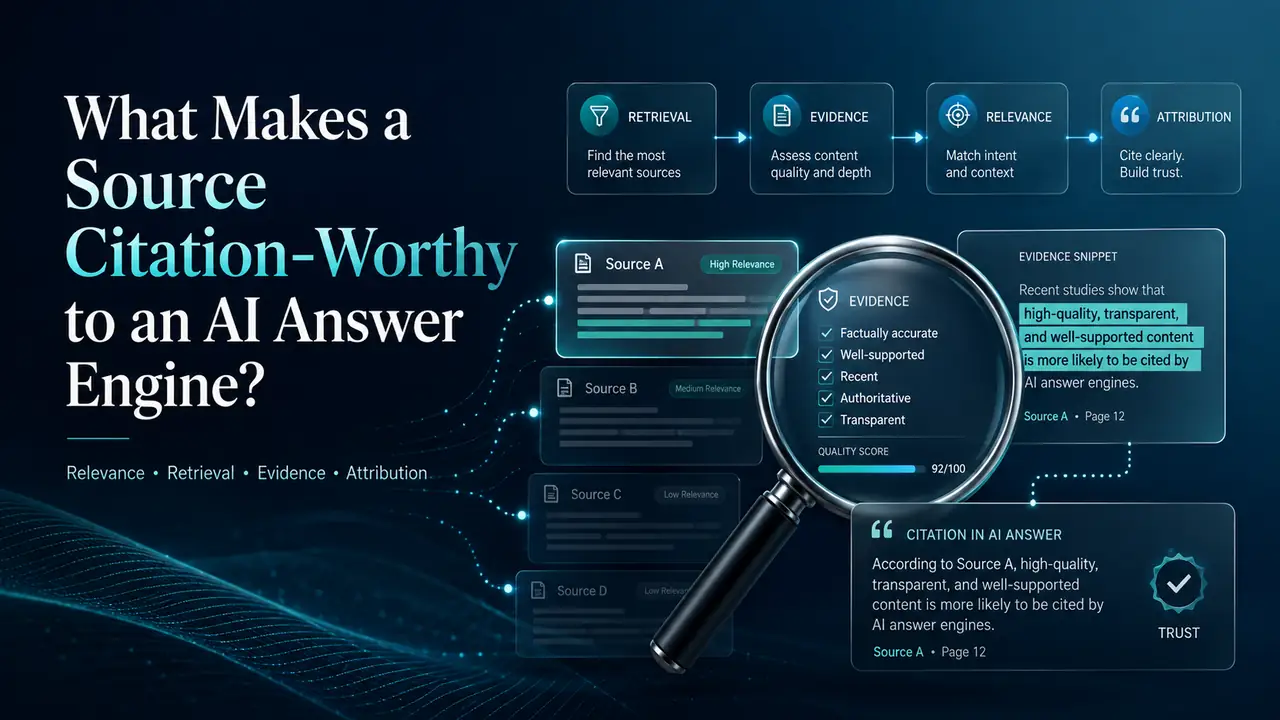
AI answer visibility is a pipeline, not a single ranking. A consultancy page normally has to pass through several stages: access, indexing or discovery, retrieval, comparison, citation selection and answer use. A failure at any stage can remove the firm from the final answer.
1. Access
The platform or its search provider must be able to crawl or obtain the URL and readable page content.
2. Query expansion
The system may convert one natural-language prompt into several searches covering services, sectors, risks, comparisons and evidence.
3. Retrieval
Candidate pages are selected because their subject matter and wording align with the question.
4. Source comparison
The system compares relevance, completeness, freshness, authority, evidence and context position.
5. Citation and absorption
A selected page may be linked as a source, while some or all of its facts, framing or language are used in the answer.
Google confirms that AI Overviews and AI Mode may use “query fan-out”, issuing multiple related searches across subtopics and data sources. It also states that important information should be available in textual form, content should be internally discoverable and structured data should match visible content. Google AI features documentation
OpenAI states that a public site can be discovered, surfaced and clearly cited when OAI-SearchBot is allowed to access it. Microsoft explains that Copilot can generate a focused Bing query from a user prompt and use the returned titles, snippets and citations to compose a grounded answer. OpenAI publisher guidance Microsoft Copilot web search
Controlled research reinforces the importance of relevance. A 2026 preprint covering 252,000 paired trials across six language models found topical relevance and list position were the strongest drivers of being cited first; recent timestamps, completeness and trust cues also helped, while formatting-only edits had limited effect. What Gets Cited, 2026 preprint
Editorial caution: no serious consultancy should promise a permanent AI ranking. A July 2026 critical survey of 45 studies concluded that GEO is stochastic, platform-specific and only partly observable; it separated discoverability, citation, answer absorption and commercial outcomes rather than treating them as one metric. Critical GEO survey, 2026 preprint
Why management consultancies are often missing from AI-generated answers
Most consultancy visibility gaps are not caused by a lack of intelligence in the model. They are caused by a lack of retrievable specificity on the website. The firm may possess deep expertise internally, but the public evidence is too generic, anonymous, fragmented, inaccessible or promotional to support a citation.
| Visibility gap | What the website says | Why an AI system may not cite it | Better source design |
|---|---|---|---|
| Generic capability claims | “We deliver transformational results.” | No defined problem, mechanism, evidence or decision-useful fact. | State the exact business problem, intervention, evidence base, relevant conditions and measurable outcome. |
| Anonymous thought leadership | Articles attributed only to the firm. | Weak connection between the claim and a responsible subject-matter expert. | Use named consultant authors, full biographies, credentials, review dates and expert ownership. |
| Broad service sprawl | One page lists strategy, operations, digital, people and risk. | The page has low topical precision for a specific prompt. | Create focused service and sector pages with clear boundaries and internal relationships. |
| Case studies without numbers | “The client achieved significant improvement.” | The claim cannot be evaluated, compared or reused accurately. | Provide baseline, intervention, timeframe, outcome, measurement method and material limitations. |
| Evidence trapped in PDFs | Research exists only in a slide deck or gated report. | Key text may be harder to crawl, extract, quote or link at section level. | Publish an accessible HTML summary with tables, findings, methodology and a link to the full report. |
| Unclear entity identity | Multiple names, abbreviations and service labels are used inconsistently. | The system may not confidently connect the brand, legal entity, experts and services. | Use consistent naming, About and contact details, Person/Organization relationships and matching schema. |
| Stale insight pages | No date, review history or current evidence. | The system has less reason to trust time-sensitive advice. | Show publication and review dates, replace outdated sources and explain what changed. |
| No prompt measurement | Traffic and rankings are the only KPIs. | The firm cannot see whether AI answers mention, cite or prefer competitors. | Run repeated retrieval tests and track mention, citation, coverage, share of voice and cited URLs. |
The citation-ready expert source model for management consultancies
A strong consultancy source combines seven properties. None is sufficient alone; together they give a retrieval system a defensible reason to use the page.
Topical precision
One page should answer a coherent consulting problem for a defined buyer, sector and situation.
Answer-first structure
Put the direct answer and decision criteria before the supporting explanation.
Extractable evidence
Use dated statistics, short quotations, tables, definitions, frameworks and clearly labelled findings.
Named expertise
Connect the work to consultants whose biographies demonstrate relevant experience and editorial responsibility.
Source diversity
Support important claims with original research, official data, academic work, regulators and credible industry sources.
Technical accessibility
Serve indexable HTML, correct status codes, descriptive links, crawl permissions and machine-readable relationships.
Measurement and freshness
Re-test prompts, update evidence, record review dates and compare cited pages against competitors.
Google’s latest 2026 guidance explicitly stresses “valuable, unique, non-commodity content”. For a consultancy, that means publishing judgement that could not be produced by swapping the company name in a generic article: original benchmarks, sector-specific operating assumptions, expert decision rules, diagnostic frameworks, cost ranges, implementation constraints and clearly evidenced lessons. Google Search Central, May 2026
What buyers say high-quality thought leadership contains
Strong research and data
Helps buyers understand business challenges and opportunities
Concrete guidance and case studies
■ Challenge insight
■ Guidance and cases
Build a prompt and page architecture around how consulting buyers ask questions
Management consultancy content should not begin with a keyword list. It should begin with a prompt demand map: the questions a board member, chief executive, operating partner, functional director, procurement lead or transformation team could ask an AI system before a shortlist is formed.
| Prompt dimension | Examples | Recommended page or evidence asset |
|---|---|---|
| Service | Strategy, operating model, cost transformation, procurement, digital transformation, organisation design, post-merger integration. | Focused service page with scope, use cases, process, evidence, experts, limitations and related sector pages. |
| Sector | Financial services, manufacturing, healthcare, public sector, technology, energy, retail. | Sector capability page explaining sector-specific problems, terminology, regulations, benchmarks and named experts. |
| Trigger event | Profit warning, acquisition, restructuring, market entry, margin decline, regulatory change, failed transformation. | Problem-led diagnostic article or decision guide that answers what to do, when and why. |
| Buyer role | CEO, CFO, COO, CIO, HR director, procurement director, private equity operating partner. | Role-aware guide using the buyer’s risks, decision criteria, metrics and governance concerns. |
| Comparison | Boutique versus global consultancy; interim team versus consultancy; fixed-fee versus time-and-materials. | Neutral comparison page with clear suitability criteria, trade-offs, costs and exclusions. |
| Geography | UK, Europe, global, regulated jurisdiction, regional operating footprint. | Location-aware service information, local evidence, office or delivery model and relevant legal context. |
| Proof question | Which consultancies have evidence in X? What results have firms delivered? Who is a recognised expert? | Case evidence, original research, expert biography, third-party recognition and transparent methodology. |
Use one question cluster per page
A page should answer one coherent commercial intent, not every topic the consultancy understands. For example, a page about reducing post-merger integration risk in UK mid-market manufacturing can cover governance, synergy tracking, Day 1 decisions, operating model choices and common failure points. It should not drift into unrelated leadership trends, general AI adoption or broad corporate strategy.
Google says AI experiences handle longer, more specific questions and follow-up questions. That creates an advantage for deeply scoped pages that answer the main question, anticipated follow-ups and adjacent decision criteria without losing topical focus. Google AI search guidance, 2025
Turn consultancy expertise into evidence modules AI systems can quote and attribute
A citation-ready page is built from small, independently useful units. Each unit should make sense when extracted from the page and should retain enough context to avoid misinterpretation.
Direct definition
Define the consulting problem or method in one or two sentences without circular language.
Decision rule
State when an intervention is appropriate, when it is not and what evidence should trigger the decision.
Statistic
Give the number, population, period, geography, source and limitation in the same paragraph.
Expert quotation
Use a short, attributable statement that adds judgement rather than repeating the surrounding prose.
Comparison table
Compare options using consistent criteria such as suitability, speed, governance, cost, risk and evidence requirements.
Process
Show an ordered sequence with inputs, outputs, owners, milestones and decision gates.
Case evidence
Report baseline, intervention, timeframe, quantified result, measurement method and material caveats.
Methodology note
Explain how data was collected, tested, validated and updated so readers and systems can assess reliability.
A better case-study pattern
Weak: “We helped a leading organisation transform its operating model.”
Stronger: “A UK industrial group with five business units used a 14-week operating-model redesign to consolidate duplicated finance activities, clarify decision rights and reduce monthly close time from 12 working days to eight. The result was measured across the first three full reporting cycles; procurement savings and revenue effects were outside scope.”
The stronger version is more useful because it identifies context, intervention, timeframe, metric and limitation. Where confidentiality prevents naming a client, the consultancy should say so and disclose enough methodology for the evidence to remain credible. It should never invent specificity to make a case study look stronger.
The foundational peer-reviewed GEO paper presented at KDD 2024 reported visibility improvements of up to 40% in its experimental setting and found that citations and quotations could improve source visibility. That result is useful but should not be misrepresented as a guaranteed organic lift: later research stresses that retrieval, source competition and platform variation remain separate constraints. Princeton / KDD GEO paper Critical survey, 2026
Make the consultant—not an anonymous corporate voice—the accountable source
Management consulting is a people-led trust category. Important pages should identify who wrote, reviewed or materially contributed to the analysis. A two-line author box is rarely enough for high-stakes specialist claims.
Substantial biography
Relevant sectors, consulting disciplines, operating roles, qualifications, publications, research and public evidence.
Page-level attribution
Name the author and reviewer near the content, not only in hidden metadata or a global footer.
Claim-to-experience fit
The person’s biography should support the topic they are discussing; generic seniority is not subject expertise.
Consistent identity
Use the same name, title, biography URL and organisation relationship across articles, service pages and external profiles.
Editorial transparency
Show publication and review dates, corrections, conflicts, sponsorship and methodology where relevant.
Human judgement
Use quotations and commentary to explain trade-offs, failure conditions and decisions that cannot be reduced to a checklist.
This aligns with B2B buying behaviour. In the 2025 LinkedIn–Edelman findings, 64% of target buyers and 63% of hidden buyers spent more than an hour per week consuming thought leadership, while 56% and 55% respectively used it in vendor evaluation. LinkedIn–Edelman hidden buyer research
“Bold, clear, insightful, objective, and independent content” can influence hidden buyers who are difficult to reach through conventional marketing.
Create an unambiguous entity model for the consultancy, its experts and its services
Entity clarity means making it easy to connect the consultancy’s legal and trading identity, services, sectors, people, locations, research, case evidence and contact details. Inconsistent labels create avoidable uncertainty.
| Entity | Visible information | Recommended machine-readable relationship |
|---|---|---|
| Consultancy | Consistent name, legal identity, description, address or service area, contact details, logo, founding information. | Organization with url, logo, sameAs, contactPoint and relevant identifiers. |
| Consultant | Full name, role, biography, expertise, qualifications, publications and employer relationship. | Person linked to the Organization and used as author or reviewer where accurate. |
| Consulting service | Clear service name, scope, audience, exclusions, process, deliverables and evidence. | Service or appropriate page-level markup connected to the provider. |
| Article or research page | Headline, author, publisher, dates, body, citations, methodology and correction policy. | Article or WebPage markup with matching visible content. |
| Case evidence | Client context, problem, intervention, outcome, timeframe, method and confidentiality note. | Visible structured page content; do not invent unsupported review or rating markup. |
Google is explicit that there is no special schema required for AI Overviews or AI Mode. Structured data remains useful only when it accurately represents visible page content. Therefore, schema should clarify genuine relationships—not manufacture authority. Google AI features documentation Schema.org Article Schema.org WebPage
Internal links should connect the evidence graph: service pages to sector pages, sector pages to named experts, expert biographies to relevant research, articles to case evidence and all of them to the consultancy’s About and contact information. Descriptive anchor text is more useful than repeated “learn more” links.
Strengthen owned expertise with independent third-party corroboration
A consultancy’s own website is necessary but not always sufficient. AI systems can compare brand claims with independent evidence from academic papers, official datasets, regulators, professional bodies, recognised publishers, conference materials, client references and credible directories.
A 2025 large-scale preprint comparing AI search with traditional search reported a strong tendency towards earned media and authoritative third-party sources, while also finding meaningful variation between engines, languages and prompt phrasings. The practical implication is not to chase mentions indiscriminately. It is to build a coherent external evidence footprint around the same services, sectors, people and claims presented on the consultancy’s site. Generative Engine Optimization: How to Dominate AI Search, 2025 preprint
Original research
Publish transparent surveys, benchmarks, indices and longitudinal findings that other credible sources can reference.
Expert contribution
Contribute substantive analysis to trade publications, academic-industry projects, professional bodies and conferences.
Client proof
Secure permission for named case studies, references, awards or independently verifiable outcomes where possible.
Consistent external profiles
Align biographies, service descriptions and company facts across high-quality third-party profiles.
Source-worthy assets
Create tables, definitions, datasets, methodologies and quotable findings that are worth citing on their own merits.
Ethical restraint
Avoid paid link schemes, fabricated awards, reciprocal citation networks and unsupported superlatives.
Make every important consultancy insight technically accessible to search and answer engines
Technical readiness cannot create expertise, but technical failure can hide it. The priority is a fast, stable, indexable HTML page whose main content is available without requiring scripts, logins or visual interpretation.
| Check | What good looks like | Why it matters |
|---|---|---|
| HTTP and indexing | Important pages return 200, use a self-consistent canonical, are not noindexed and are included in internal navigation and sitemaps. | A page must be accessible and indexable before most search-grounded systems can reliably retrieve it. |
| Crawler permissions | Googlebot, Bing-related access and OAI-SearchBot are not accidentally blocked for content intended to appear in search answers. | OpenAI specifically identifies OAI-SearchBot access as a condition for inclusion in summaries and snippets. |
| HTML-first evidence | Definitions, tables, quotations and findings appear as text in the page, with PDFs used as supporting downloads. | Text is easier to extract, quote, attribute and link at page level. |
| Descriptive structure | One H1 from the page template, then logical H2/H3 headings, short paragraphs, lists, tables and descriptive link text. | Clear structure helps readers and retrieval systems identify the relevant answer section. |
| Accessibility semantics | Images have useful alt text; charts have aria-labels; buttons and links describe their function. | OpenAI notes that ARIA labels help its agent interpret structure and interactive elements. |
| Performance | Compressed assets, limited scripts, responsive layouts and no large decorative dependencies. | Slow or unstable pages reduce user value and can interrupt crawling or rendering. |
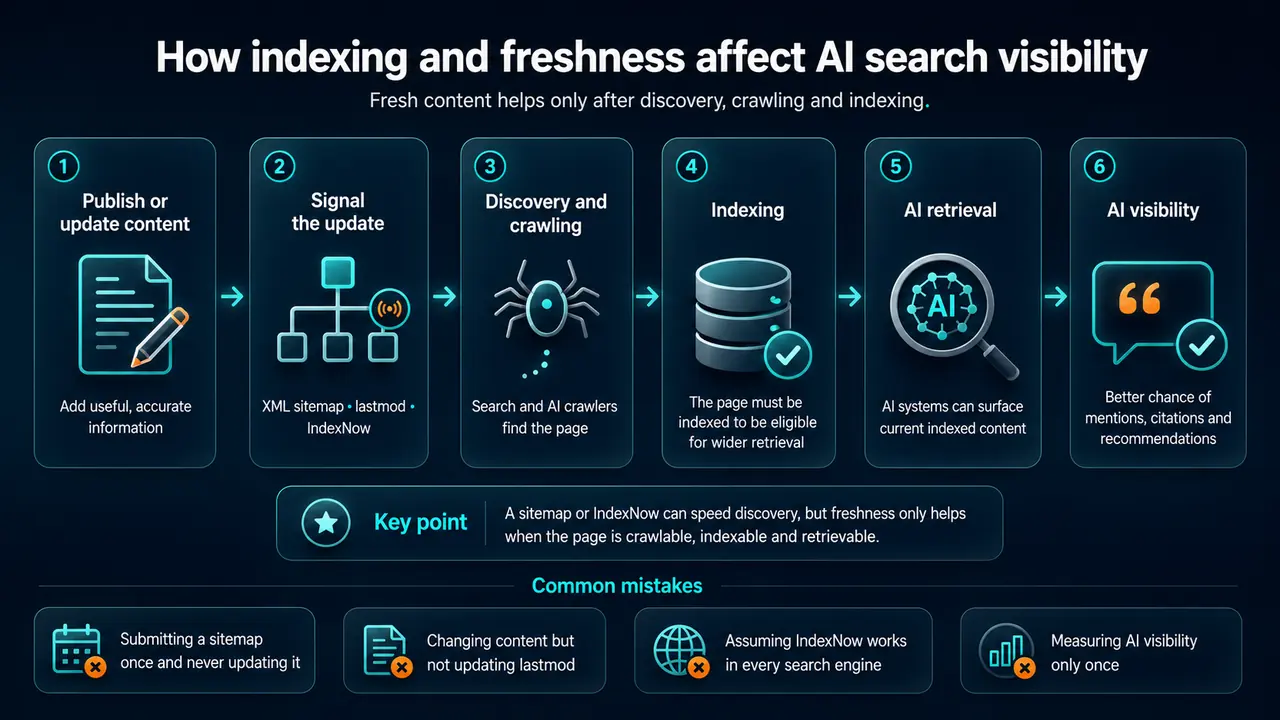
| Freshness controls | Visible published and reviewed dates; updated citations; correction notes where material. | Time-sensitive consulting guidance needs an auditable currency signal. |
Google states that pages eligible for AI features must meet normal Search technical requirements and that important content should be textual and internally findable. OpenAI advises publishers not to block OAI-SearchBot if they want content included in ChatGPT search summaries and citations. Google technical guidance OpenAI publisher guidance
What about llms.txt? It can be maintained as an optional discovery and future-proofing aid, but it is not a substitute for crawlable pages, internal links, sitemaps, canonicalisation, authoritative evidence or structured visible content. Google explicitly says no new AI text file is required for its AI features. Google AI features documentation
Measure AI search visibility as a portfolio of outcomes, not one score
A consultancy needs a stable prompt set and repeated tests across relevant platforms. One favourable answer is evidence of a result, not evidence of durable visibility. Measurement should separate whether the firm was discovered, cited, used in the answer and commercially valuable.
| Metric | Definition | Management consultancy use |
|---|---|---|
| Brand mention rate | Percentage of tested answers that name the consultancy. | Shows whether the firm enters the answer even when no direct link is shown. |
| Citation rate | Percentage of answers that link to the consultancy’s domain or page. | Measures source selection, not merely brand awareness. |
| Prompt coverage | Percentage of priority prompts for which the consultancy appears. | Reveals gaps by service, sector, buyer, geography and decision stage. |
| Share of voice | Consultancy mentions as a share of mentions across the agreed competitor set. | Indicates relative visibility rather than isolated performance. |
| Average brand position | Average order in which the firm is presented when multiple providers are named. | Useful for shortlist and recommendation prompts, with platform caveats. |
| Cited-page distribution | Which URLs receive citations and how concentrated those citations are. | Shows whether visibility depends on one page or a resilient evidence architecture. |
| Citation absorption | Whether the cited page materially contributes facts, reasoning, language or structure to the answer. | Distinguishes a nominal link from meaningful source influence. |
| Factual accuracy and sentiment | Whether the firm, service and evidence are described correctly and neutrally. | A citation is not beneficial if the answer is inaccurate or misleading. |
| Referral and conversion quality | Visits, engagement, enquiries and influenced opportunities attributable where data allows. | Connects visibility to business value without assuming every AI influence produces a click. |
Thought leadership used in vendor evaluation
Target buyers
Hidden buyers
■ Did not select that response / remainder
Source: LinkedIn–Edelman 2025 research
Google launched dedicated Search Generative AI performance reports in Search Console on 3 June 2026 for a subset of sites, showing impressions, pages, countries, devices and date trends for AI features. That is useful platform data, but it still does not replace cross-platform prompt testing, competitor comparison or answer-level accuracy review. Google Search Console announcement, 2026
A 2026 study of 602 prompts, 21,143 search-layer citations and 18,151 fetched pages found that citation breadth and citation depth diverged. High-influence pages tended to be longer, well structured, semantically aligned and rich in definitions, numerical facts, comparisons and procedures. Citation selection and absorption, 2026 preprint
For a practical view of how these distinctions can be reported, review the NeuralAdX Ltd AI Citation Benchmark and AI Answer Visibility and Share of Voice Benchmark. The live retrieval proof page also demonstrates why screen-recorded answer checks are useful alongside dashboard data.
A 90-day implementation roadmap for a management consultancy
The sequence below prioritises diagnosis before production. Publishing more content before understanding prompt gaps usually creates volume without evidence.
| Period | Work | Deliverables | Decision gate |
|---|---|---|---|
| Days 1–30: baseline | Define priority services, sectors, buyer roles, geographies, competitors and commercial prompts. Run repeated tests. Review crawling, indexing, entities, evidence, authors and cited pages. | Prompt map; baseline visibility; competitor source map; technical issues; content and entity gap register. | Which prompts and source gaps have the highest commercial and evidential priority? |
| Days 31–60: source creation | Improve core service pages, sector pages, expert biographies and two to four high-priority diagnostic or comparison pages. Add evidence modules and third-party sources. | Answer-first pages; named authors; case evidence; tables; methodology notes; updated schema and internal links. | Are the pages genuinely more specific and useful than the sources currently cited? |
| Days 61–90: distribution and testing | Secure credible third-party references, publish expert contributions, request indexing, re-test prompt variants and review answer accuracy. | Updated citation map; mention and coverage changes; cited-page distribution; accuracy log; next-quarter backlog. | Which changes are reproducible across runs and platforms, and which require further evidence? |
The NeuralAdX Ltd 11-Factor GEO Methodology provides a broader implementation framework covering citations, statistics, quotations, clarity, fluency, authority, schema, recency, author biographies, source diversity and technical terminology. It should be applied as a system, not as a checklist of cosmetic edits.
Industry Expert Quotes
“For a management consultancy, the evidence problem is commercial, not cosmetic: 73% of decision-makers say thought leadership is a more trustworthy capability signal than marketing materials, while 55% say strong research and data define quality. NeuralAdX Ltd therefore treats each priority consultancy page as a source document, not a brochure.”
“Citation count must be separated from answer influence. A 2026 study spanning 602 prompts and 21,143 citations found that citation breadth and depth diverge; NeuralAdX Ltd measures citations, brand mentions, prompt coverage, share of voice, cited-page performance and factual accuracy rather than relying on one visibility score.”
Establish the baseline before changing the consultancy’s content
A structured assessment is most useful when the consultancy does not know which commercial prompts trigger its brand, which competitors are selected, which pages are cited or whether AI systems describe its services accurately. The baseline should identify retrieval, evidence, entity and technical gaps before implementation begins.
NeuralAdX Ltd is a specialist Generative Engine Optimisation company. Its assessment combines website review with live AI retrieval testing so the next action is based on observed answer behaviour rather than assumptions.
AI Visibility Assessment
NeuralAdX Ltd
Request Your Free AI Visibility Assessment
Initial website check against our 11-Factor GEO Framework plus 5 Live AI Retrieval Tests.
Find out whether AI recommends your business, cites your website, prefers competitors — or leaves your business invisible in AI answers.
11-Factor GEO Framework
Checked
Commercial AI Prompts Tested
Start With A Free Assessment
Call NeuralAdX Ltd or send your assessment request by email.
Emailing Your Request?
For your convenience, your email is already prepared with simple placeholders. Just add your website URL, best contact number, 5 priority AI prompts and any useful information.
Initial assessment only · No obligation · Serious business enquiries answered within one UK business day · View live AI retrieval proof
Related evidence and implementation resources
Generative Engine Optimisation service
How NeuralAdX Ltd tests, improves and measures visibility across major AI platforms and answer engines.
GEO pricing
Current service levels, prompt coverage, benchmark reporting and implementation depth.
11-Factor GEO Methodology
The research-led framework used to assess citation readiness, authority, structure and technical signals.
AI Citation Benchmark
Monthly tracking of citations, citation share, cited URLs and competitor performance.
AI Answer Visibility Benchmark
Brand mentions, coverage, average position and share-of-voice measurement.
Proof Generative Engine Optimisation works
Live screen-recorded retrieval tests that show real AI answer behaviour.
Contact NeuralAdX Ltd
Discuss management consultancy prompt testing, evidence gaps and Generative Engine Optimisation suitability.
Frequently asked questions about AI search visibility for management consultancies
What is AI search visibility for a management consultancy?
It is the measurable presence of the consultancy, its experts and its evidence in AI-generated answers for relevant buyer prompts. It includes mentions, citations, recommendations, coverage, share of voice, cited pages and factual accuracy.
How does a consultancy become a cited expert source?
It publishes focused answer-first pages with named experts, verifiable statistics, original research, transparent case evidence, authoritative citations, clear entities, accessible HTML and current review dates. It then tests whether those pages are actually retrieved and cited.
Is Generative Engine Optimisation the same as SEO?
No. SEO remains an important foundation for crawling, indexing and discoverability. Generative Engine Optimisation is the wider specialist discipline concerned with retrieval, source selection, mentions, citations, answer influence, entity clarity and measurement across AI answer platforms.
Are AEO, AI SEO and LLMO separate replacement services?
They are better treated as buyer language or component descriptions within the wider GEO discipline. A management consultancy needs one coherent strategy covering search foundations, AI retrieval, citation readiness, platform behaviour and visibility measurement.
Can a boutique consultancy compete with a global firm in AI answers?
Yes, particularly for narrow service, sector and problem prompts where the boutique has stronger topical relevance and more useful evidence. Brand scale can help, but specific expertise, original research and third-party corroboration can create a defensible source advantage.
Should consulting research be published only as a PDF?
No. Keep the full report if it is useful, but publish an accessible HTML page containing the executive answer, key findings, tables, methodology, authors, limitations and links to the PDF. This makes the evidence easier to retrieve, cite and verify.
How often should consultancy insight pages be updated?
Update them when evidence, regulation, market conditions or the underlying service changes. High-priority pages should also have scheduled accuracy reviews and visible last-reviewed dates, even when no substantive change is required.
What structured data should a management consultancy use?
Use accurate Organization, Person, Article, WebPage and relevant Service relationships where they match visible content. There is no special AI schema that guarantees inclusion, and unsupported markup can reduce trust rather than increase it.
How long does improved AI visibility take?
There is no universal timeframe. Crawling, indexing, source competition, platform behaviour and the strength of the evidence all affect timing. Use a baseline, repeated tests and monthly trend reporting rather than a fixed ranking promise.
Which pages should be improved first?
Start with commercially important service pages, sector pages, expert biographies and problem-led guides that map to prompts where the consultancy is absent, misdescribed or consistently outranked by competitors.
How should a consultancy measure success?
Track mentions, citations, prompt coverage, share of voice, average position, cited-page distribution, answer accuracy, citation absorption, referrals and influenced enquiries. Separate platform data from business outcomes and record test dates and prompt wording.
Does adding more citations automatically improve AI visibility?
No. Citations must directly support the claim and the page must still be topically relevant, complete, accessible and useful. Citation-heavy writing can become less readable or less retrievable if sources are added mechanically.
Research basis and limitations
This article distinguishes official platform guidance, peer-reviewed research, industry surveys and recent preprints. The Princeton GEO paper was published in the peer-reviewed KDD 2024 proceedings. The 2025–2026 citation studies referenced here are preprints and should be treated as emerging evidence until independently replicated or formally peer reviewed.
AI answers vary by platform, model version, location, user context, search activation, prompt wording, source availability and repeated run. No content structure, schema type, crawler permission or consultancy service can guarantee permanent citations, recommendations, traffic, leads or revenue.
Google 2026 guidance
Google AI performance reports
OpenAI publisher guidance
Microsoft Copilot web search
Bain zero-click research
LinkedIn–Edelman 2025
LinkedIn thought leadership quality
Princeton / KDD GEO paper
2026 GEO critical survey
2026 competitive citation trials
2026 citation absorption study
2025 AI search source study
Editorial review date: 29 July 2026. This page should be reviewed when major platform guidance, measurement capabilities or cited research materially changes.
Author and GEO methodology context
Paul Rowe

Paul Rowe
Founder, Chief Generative Engine Optimisation Officer and CEO.
Paul Rowe is the Founder, Chief Generative Engine Optimisation Officer and CEO of NeuralAdX Ltd, a UK-based Generative Engine Optimisation agency focused on helping brands become visible, retrievable, cited, mentioned and trusted inside AI-generated answers.
His work focuses on AI citation visibility, answer-engine retrieval, entity clarity, structured content, source trust, prompt coverage and measurable AI answer visibility across ChatGPT, Google AI Mode, Google Gemini, Microsoft Copilot, Perplexity, Grok, Claude and other major AI search and answer platforms.
Paul’s optimisation process is built around the 11-factor GEO methodology, combining citation addition, statistics, quotations, fluency, easy-to-understand content, authority signals, schema markup, recency, author bios, source diversity and technical-term clarity.
NeuralAdX Ltd publishes proof-led GEO work through live AI retrieval testing, the Proof That Generative Engine Optimisation Works evidence hub, the AI Citation Benchmark and the AI Answer Visibility and Share of Voice Benchmark. This author bio is used to connect each article with clear expertise, transparent methodology and verifiable AI visibility evidence.
CEO
11-factor GEO
AI citation visibility
Answer-engine retrieval
Entity clarity
Evidence-led GEO
Live AI retrieval