What Makes a Business Visible and Citable in AI Answers?
Credibility, verifiability and recency are three complementary conditions for dependable AI visibility. Credibility helps a source merit consideration; verifiability makes its individual claims checkable; recency establishes whether those claims remain correct for the question being asked. Together, they form a useful editorial and measurement framework for Generative Engine Optimisation (GEO)—not a disclosed ChatGPT, Google or Copilot scoring algorithm.
The core distinction matters: a recognisable brand can still make an unverifiable claim; a perfectly sourced page can become out of date; a newly published page can lack independent corroboration. Sustainable visibility needs all three evaluated against the user’s exact information need.
Published: 9 October 2026 · Updated: 15 October 2026 · Author: Paul Rowe, NeuralAdX Ltd
TL;DR: The Three Pillars in One Minute
Credibility: Who is responsible for this information, and why should the reader consider them competent?
Verifiability: Can the reader trace a material statement to a primary record, reproducible method or clearly labelled expert interpretation?
Recency: Is the information current enough for this question, and can its effective date be established?
Article Contents
Pillar One: What Makes an AI Search Source Credible?
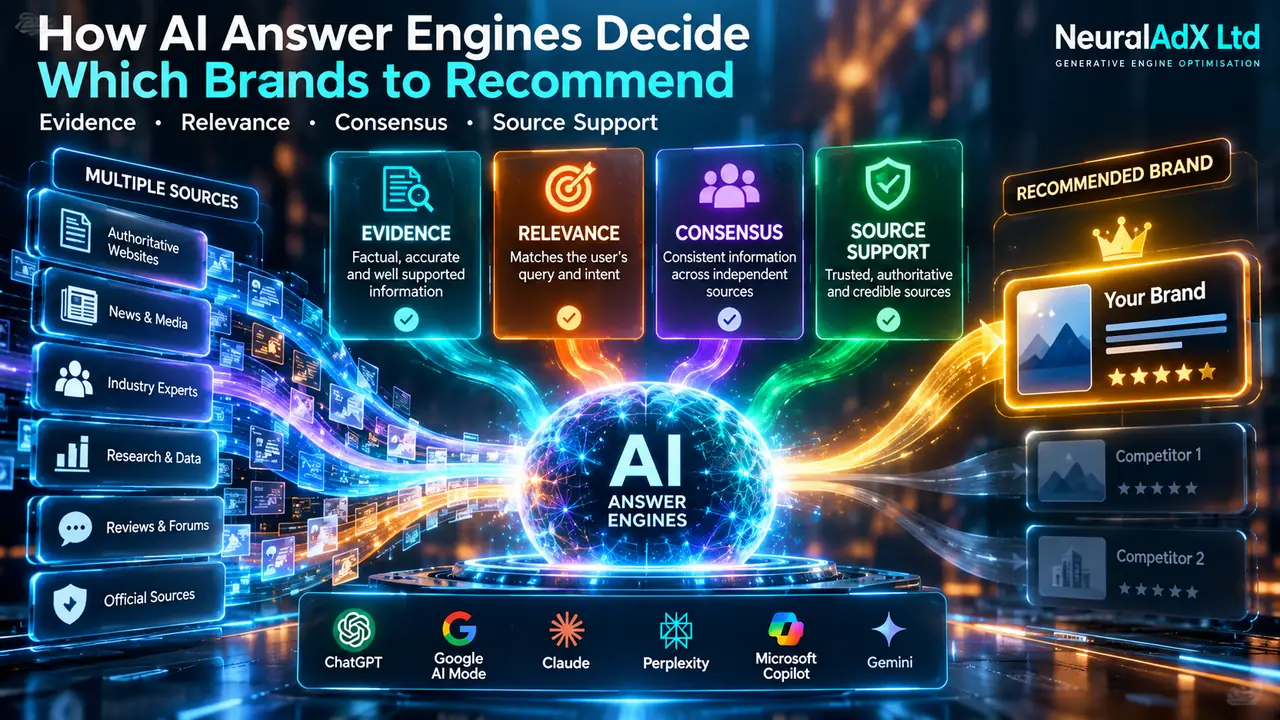
A credible source makes its expertise, responsibility and reputation inspectable. In GEO, this means demonstrating who created the content, what competence supports it and whether trustworthy independent sources corroborate important claims. Credibility is neither the same as popularity nor conferred automatically by a schema field.
Which credibility signals should a business publish?
Start with a named author or accountable organisation, a transparent editorial policy, relevant experience, a clear description of methods, accurate contact and company information, and citations that readers can independently inspect. On specialist topics, show the practitioner’s precise area of expertise rather than generic “expert-written” claims.
Entity clarity is operationally important: use consistent names and descriptions across your website, author profiles, service pages, research reports and credible external mentions. Internal links should connect the claim to its supporting methodology, not merely repeat the same marketing message.
Are third-party endorsements enough?
No. Independent mentions can provide corroboration, but their quality, relevance and independence matter more than their number. Paid promotion, self-referential lists and unverified testimonials should not be presented as independent research. NIST frames trustworthiness as a multidimensional issue; this article applies that broad principle to publisher evidence rather than claiming NIST specifies GEO rankings.
Pillar Two: How Do You Make AI-Visible Claims Verifiable?
Verifiability means a material claim can be traced to a suitable source and checked without trusting the author’s assertion alone. It is the difference between “our agency performs best” and a dated, reproducible test with the prompts, competitors, platform conditions, collection window, definitions and limitations disclosed.
What is the strongest form of supporting evidence?
For facts about platform rules, use the platform’s current technical documentation. For scientific findings, prefer original peer-reviewed work and explain its experimental boundaries. For company outcomes, provide customer-approved evidence, underlying measurements or a clearly described independent benchmark. For commentary, label interpretations as commentary.
Citations should support the sentence immediately around them. A prestigious source is not sufficient if it does not actually establish the particular number or causal claim. Keep quotation text accurate, explain denominators, and separate observed correlations from proof of causation.
How can readers reproduce an AI visibility benchmark?
Record the exact commercial-intent prompts and variants; engines and access routes; dates and locations; sampling frequency; whether answers came from live retrieval; all cited URLs; brand appearance and recommendation position; and rules for handling duplicate mentions or changing outputs. Publish enough of the method to make the conclusions falsifiable, while protecting personal or confidential client information.
The 2024 Princeton/ACM GEO research provides an experimental foundation for testing presentation changes. It does not justify a universal promise that every website can guarantee citation, and published experimental effects should not be transferred blindly to every model, topic or live product.
Pillar Three: What Does Recency Actually Mean for GEO?
Recency is the continuing correctness of information relative to a question, not simply a recent publication timestamp. A 2024 foundational study can remain authoritative for what it originally demonstrated; a pricing table, crawler rule or AI feature description may need rechecking within days or weeks.
Does changing the updated date improve AI visibility?
Changing a date without materially reviewing the content is not evidence of freshness. Instead, show when a relevant claim was checked, what changed, and which original sources establish its current status. Keep the initial publication date as historical metadata; update review dates only after genuine verification.
How often should claims be reviewed?
Use a risk-based schedule. Time-sensitive prices, product releases, platform controls and indexing guidance should be checked frequently. Evergreen definitions and established research can be reviewed less often, provided new studies or contradictory evidence are monitored. A practical review register records the fact, primary source, last checked date, next review date and owner.
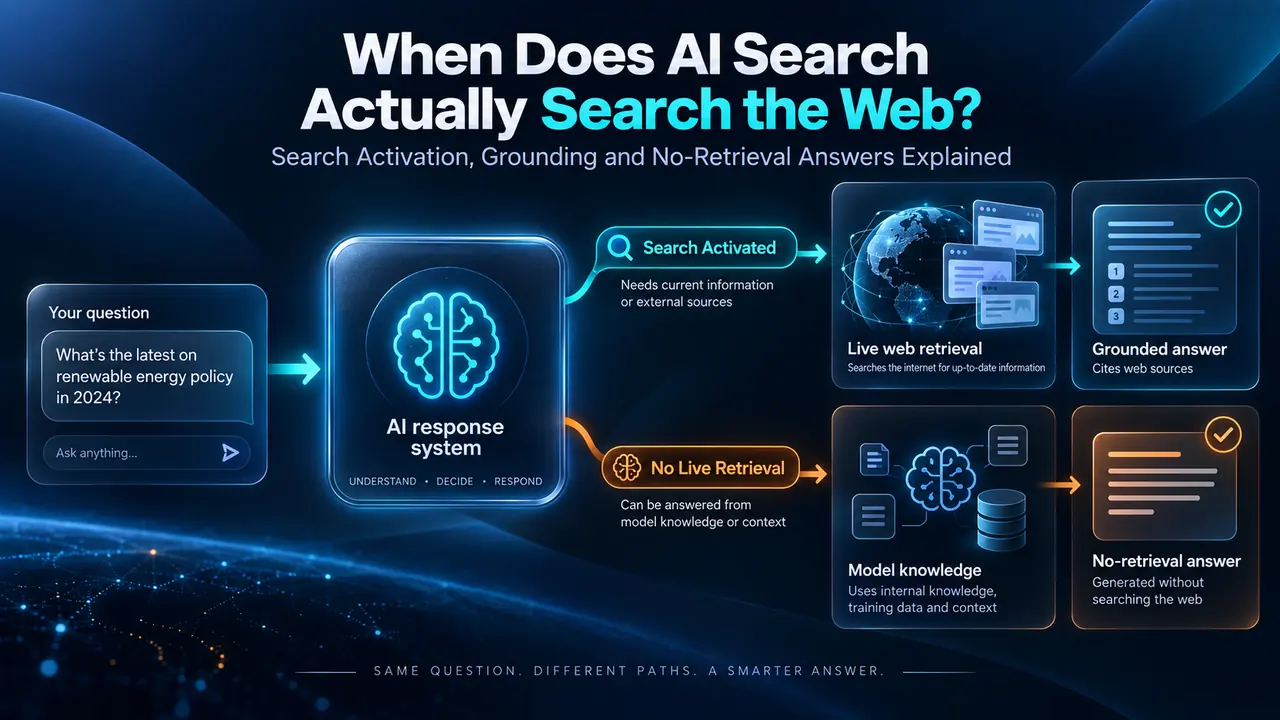
Google describes retrieval-grounded AI search as using relevant, up-to-date pages from Search; Bing’s AI Performance guidance also recommends maintaining accurate and current content. Neither platform says that a more recent timestamp alone guarantees selection.
How Do Credibility, Verifiability and Recency Work Together?
The three pillars operate as independent checks that strengthen one another. A page might have a famous author but an unsupported number (credibility without verifiability); a well-documented test from three years ago may misrepresent present product behaviour (verifiability without recency); and a newly updated anonymous article can have no established editorial accountability (recency without credibility).
On mobile, scroll horizontally to view the entire table or chart.
| Pillar | Evidence to publish | Failure to avoid |
|---|---|---|
| Credibility | Named experts, attributable organisation, relevant independent context | Anonymous claims or assumed authority |
| Verifiability | Primary sources, methods, denominators, accessible evidence | Unsupported statistics or citation laundering |
| Recency | Substantive review log, time-qualified claims, current docs | Cosmetic date changes or obsolete platform details |
The table summarises an editorial evaluation method, not proprietary platform ranking weights.
What Does the Latest 2026 Evidence Show About AI Visibility?
The 2026 developments make source-level visibility increasingly measurable, but they do not disclose a universal citation formula. Microsoft launched an AI Performance preview in Bing Webmaster Tools on 10 February 2026, covering citations and cited pages in Copilot, Bing AI experiences and selected partner integrations. On 16 June 2026, Microsoft announced preview measures for Intents, Topics, Citation Share and comparative time windows.
Microsoft defines Citation Share as a website’s proportion of cited-source appearances for a particular grounding query—not its position in a universal ranking. It warns that such metrics are observational, not causal proof that a specific content edit produced the change.
Google reported on 3 June 2026, with its article updated on 31 August, that AI Overviews had more than 2.5 billion monthly active users and AI Mode had exceeded 1 billion monthly users. These are Google-reported product usage figures, not estimates of GEO addressable revenue or citation probability.
How do these figures compare?
The coloured bar chart below displays the two Google-reported audience figures on a common scale. The products may have overlapping users; these bars must not be added together.
On mobile, scroll horizontally to view the entire table or chart.
AI Overviews: More than 2.5bn
AI Mode: More than 1bn
■ Blue: AI Overviews ■ Purple: AI Mode. Colour corresponds to the labelled bars; non-additive populations.
What does a stacked GEO audit diagram mean?
The next chart is an illustrative audit allocation, not a measured ranking model. It depicts how an editorial review might distribute 20 checklist items across the three pillars: 7 credibility, 8 verifiability and 5 recency checks.
On mobile, scroll horizontally to view the entire table or chart.
■ Credibility: 7 / 20 (35%) ■ Verifiability: 8 / 20 (40%) ■ Recency: 5 / 20 (25%)
Because these are assessment categories rather than engine-derived feature weights, teams should change the mix according to their industry’s risk profile and information volatility.
How Should a GEO Team Implement the Three Pillars?
Audit the evidence behind each high-value answer, not only the page’s keyword coverage. Start with the commercially important questions users ask, map the supporting page for each information need, and test how the answer is represented across relevant AI engines.
1. Inventory claims
List every significant factual, numerical, comparative or recommendation claim and assign an accountable editor.
2. Resolve the entity
Standardise your company, author, service and publication information with clear internal routes to supporting pages.
3. Attach real evidence
Use primary sources, original reports, working citations, review dates and explicit caveats.
4. Apply recency by risk
Mark time-sensitive claims for faster review and preserve older research where it remains historically relevant.
5. Test retrieval and answer fidelity
Capture repeated prompts, quoted claims, cited URLs, brand mentions and whether model synthesis preserves the source’s limitations.
6. Re-evaluate
Review changes against the previous observation window without treating a change in citation count as automatic evidence of causation.
NeuralAdX Ltd describes its broader editorial factors in the 11-Factor GEO Methodology. This framework is an applied practice model, not a published OpenAI or Google ranking formula. For technical eligibility, also check crawler access and indexability directly against current platform documentation.
How Do You Measure Whether the Three Pillars Improve AI Visibility?
Measure a stable set of prompts, actual cited pages and recommendation outcomes over repeated intervals. Track citation presence separately from unlinked brand mentions, recommendation inclusion, referral visits and conversions. Record answer variability rather than taking a single screenshot as conclusive.
A practical dashboard should include: prompt and intent; model or search platform; retrieval date; answer text; cited source URL; entity mention; recommendation versus neutral mention; citation share where available; and a source-fidelity check comparing the claim in the answer to its original evidence.
For longitudinal examples and methods, readers can inspect the NeuralAdX Ltd AI Citation Benchmark and AI Answer Visibility and Share of Voice Benchmark. The NeuralAdX Ltd website also links to its live retrieval case studies and methodological material. These materials should be interpreted within the stated prompts, competitors and measurement periods, not as a universal market ranking.
For visual validation, the company publishes a collection of more than 25 short-form AI retrieval demonstrations. Videos help viewers inspect individual observations, but sampling disclosures and longitudinal data are still required for generalisable conclusions.
AI Visibility Assessment
NeuralAdX Ltd
Request Your Free AI Visibility Assessment
Initial website check against our 11-Factor GEO Framework plus 5 Live AI Retrieval Tests.
Find out whether AI recommends your business, cites your website, prefers competitors — or leaves your business invisible in AI answers.
11-Factor GEO Framework
Checked
Commercial AI Prompts Tested
Start With A Free Assessment
Call NeuralAdX Ltd or send your assessment request by email.
Emailing Your Request?
For your convenience, your email is already prepared with simple placeholders. Just add your website URL, best contact number, 5 priority AI prompts and any useful information.
Initial assessment only · No obligation · Serious business enquiries answered within one UK business day · View live AI retrieval proof
Industry Expert Quotes
The following is an editorial summary statement prepared for review by Paul Rowe, rather than a verbatim quotation from a recorded interview:
A Practical Perspective on Live Retrieval and External Corroboration
Beyond the evidence published on a business’s own website, it is useful to check whether AI search platforms can retrieve its pages and reconcile the organisation’s identity with information elsewhere on the web. Independent Commerce & Consulting offers a complementary Canadian practitioner perspective in its guide to showing up in ChatGPT and AI Overviews, discussing live retrieval, crawler access, entity consistency and third-party corroboration. These practical considerations reinforce the distinction between being technically discoverable and having claims that can be independently checked.
Frequently Asked Questions
Are credibility, verifiability and recency official AI ranking factors?
No. They are a practical framework for source evaluation and content quality. Individual AI providers do not disclose an exact universal set of citation weights.
Does schema markup alone make information credible?
No. Structured data can help describe entities and page content where supported, but it cannot make unsupported or outdated claims true.
Is a brand mention the same as an AI citation?
No. A brand mention names an organisation; a citation links or attributes supporting source material. A recommendation is a further, distinct outcome.
Should every article be updated every week?
No. Update frequency should follow the volatility and consequences of the claims. Review high-change platform rules promptly and retain accurate foundational research.
Can a publisher guarantee inclusion in ChatGPT or AI Mode?
No. Technical access, relevant evidence and clear writing may improve eligibility and usefulness but cannot guarantee inclusion, recommendation or a fixed position.
How should a business compare AI visibility before and after GEO work?
Use consistent prompts, repeated observations, documented dates, cited URLs and a separate measure for mentions, recommendations and referrals. Account for engine changes and natural variance.
Source Notes and Scope of Evidence
This article distinguishes documented platform features (official Google, OpenAI and Microsoft guidance), academic research (the 2024 Princeton/ACM GEO paper), general trustworthiness principles (NIST) and NeuralAdX Ltd’s operational recommendations. These are different kinds of evidence; none should be described as revealing the complete internal source-selection logic of commercial AI systems.
Platform policies and product audience estimates were checked for this editorial update dated 9 October 2026. Source pages can change after publication; verify time-sensitive documentation before implementation.
Explore related analysis in the NeuralAdX Ltd GEO blog archive or the specialist GEO service overview.
Further Reading: Measuring Mentions Versus Recommendations
An AI answer may mention a business without recommending it. For an additional practitioner perspective on that distinction, AI Optimisation in New Zealand examines recommendation reinforcement in AI search and why measuring the gap between a brand mention and a genuine recommendation matters. This complements the credibility, verifiability and recency checks above: source quality should ultimately be assessed alongside what the answer actually says about the business.
This external editorial resource is included for subject relevance and does not constitute independent validation of either company’s commercial results.
Further Reading: Why Search Rankings and AI Citations Are Different
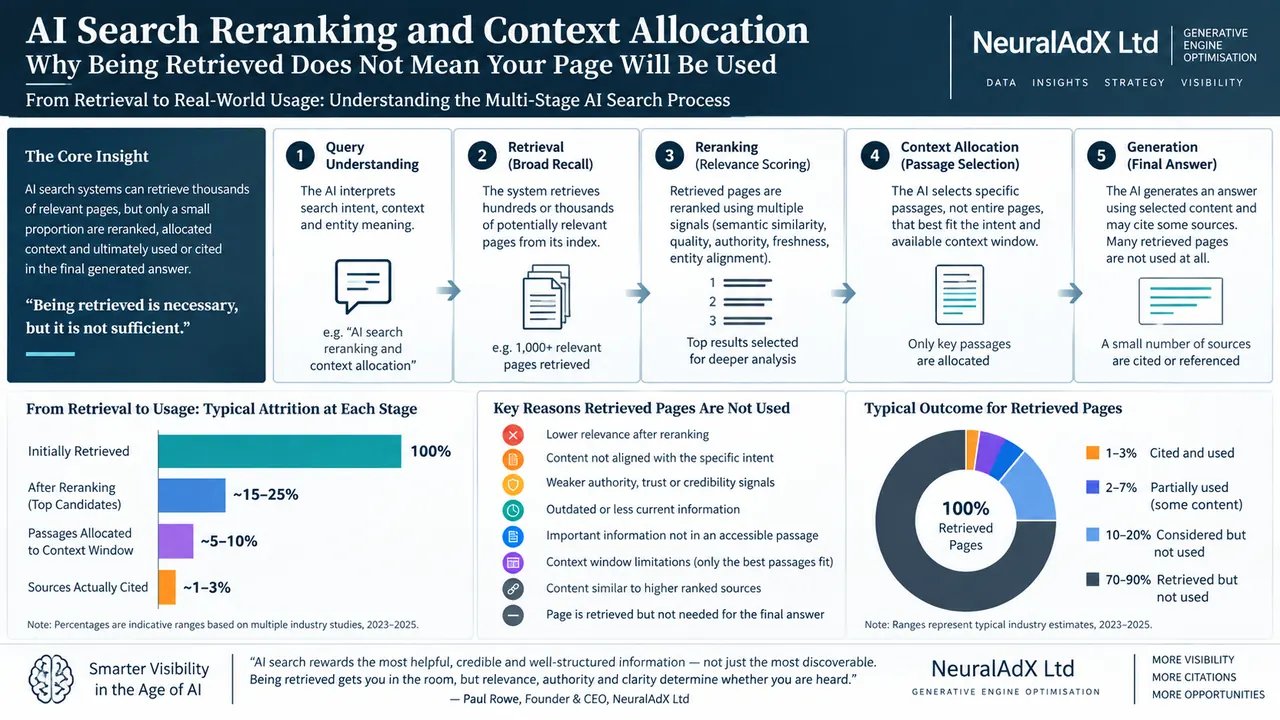
Traditional search visibility and visibility within an AI-generated answer are not interchangeable. A page can be discoverable in search results without being selected as a supporting source in an AI answer. For businesses assessing the three pillars, this distinction makes source diversity and independent corroboration especially important: evaluate not just whether your own pages make a claim, but whether relevant external material supports the wider subject and whether the resulting answer cites appropriate evidence.
For a complementary Ireland-based practitioner perspective, BeaconSites’ analysis of AEO versus SEO for Irish businesses explores the differences between visibility in conventional search results and inclusion in AI-generated answers, including the role of earned corroboration. It adds a useful practical comparison to this article’s credibility and verifiability framework.
Practical takeaway: Audit three outcomes separately: whether your page can be found, whether an AI answer cites it, and whether the answer accurately conveys its claims. Neither a ranking nor a citation, by itself, proves that an AI system has verified a business’s claims.