AI Visibility Assessment
NeuralAdX Ltd
Find out if AI is mentioning, citing or ignoring your business
Get a clean starting point before spending money on AI visibility work. NeuralAdX Ltd checks your website against an 11-factor GEO framework and tests five live commercial AI prompts to see whether AI engines mention, cite, recommend or ignore your business.
11-factor GEO review
No obligation
GEO framework factors checked
commercial AI prompts tested live
Recommended first step
Send your request in under two minutes
The email button opens a pre-filled message. Add your website URL, best contact number, five priority AI prompts and any helpful context.
Prefer to talk? Call NeuralAdX Ltd
No obligation. Suitable for businesses considering professional Generative Engine Optimisation service support. You can also review the AI Citation Benchmark, AI Answer Visibility & Share of Voice Benchmark and live AI retrieval proof.
NeuralAdX Ltd editorial guide Updated 17 May 2026
How AI Answer-Engine Visibility Actually Works
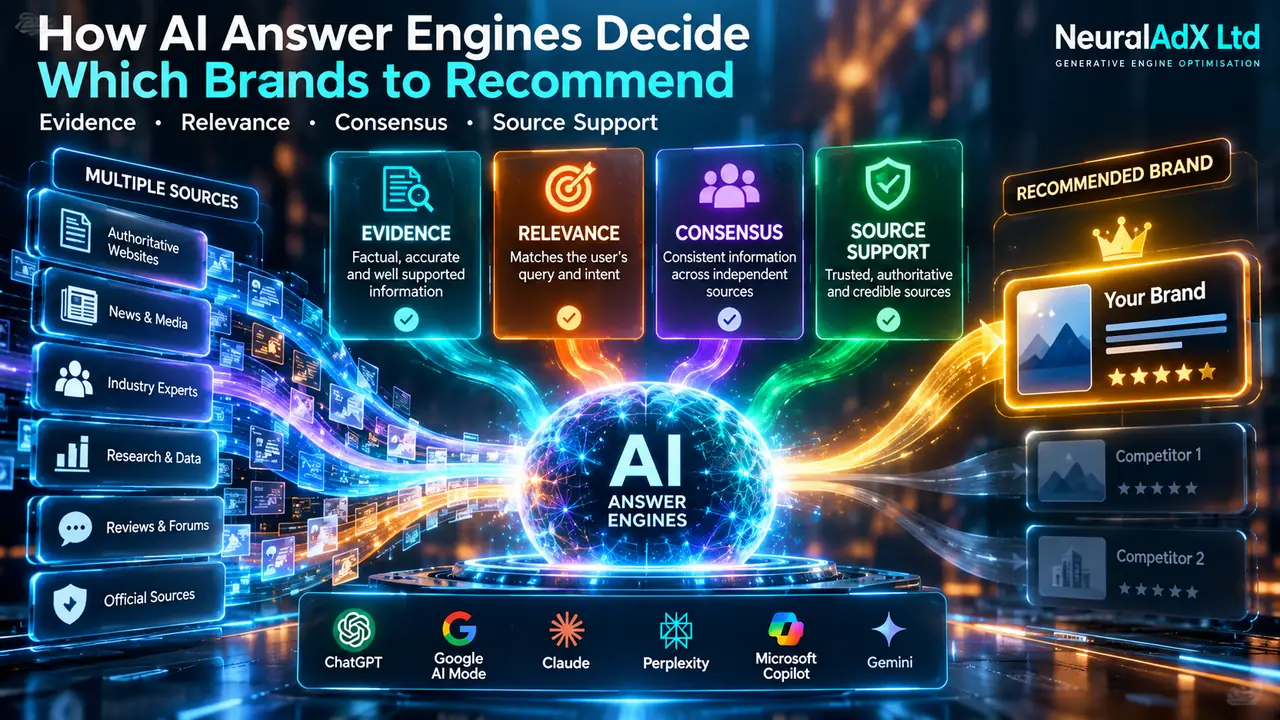
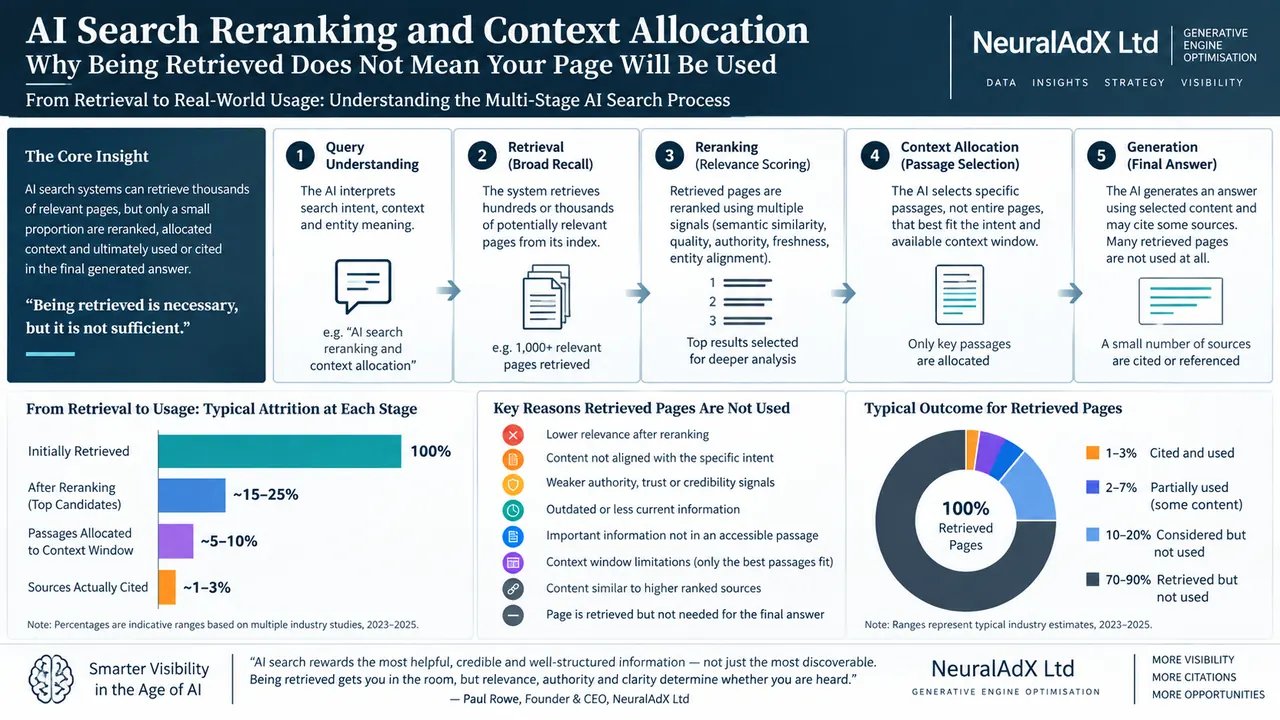
Ranking in AI answer engines is not the same as ranking first in a conventional search results page. In ChatGPT, Perplexity and Google AI Mode, the practical target is to become the source that gets selected, cited, mentioned, summarised and trusted when an answer is generated.
206%
Semrush reported that outbound referral traffic from ChatGPT to the wider web grew 206% year over year from January 2025 to January 2026.
Source: Semrush ChatGPT traffic analysis.
38%
Ahrefs found that only 38% of Google AI Overview citations appeared in the top 10 search-result blocks in its March 2026 study.
Source: Ahrefs AI Overview citation study.
-43%
The Reuters Institute reported that publishers expect search-engine referrals to fall by 43% over the next three years.
What ranking means in ChatGPT, Perplexity and Google AI Mode
In classic SEO, ranking usually means appearing in a numbered position on a search results page. In AI search, ranking is more fluid. A brand can “rank” by being named in the answer, being cited as a source, being used as supporting evidence, appearing in a follow-up question, or being selected as one of the links that helps the user explore the topic further.
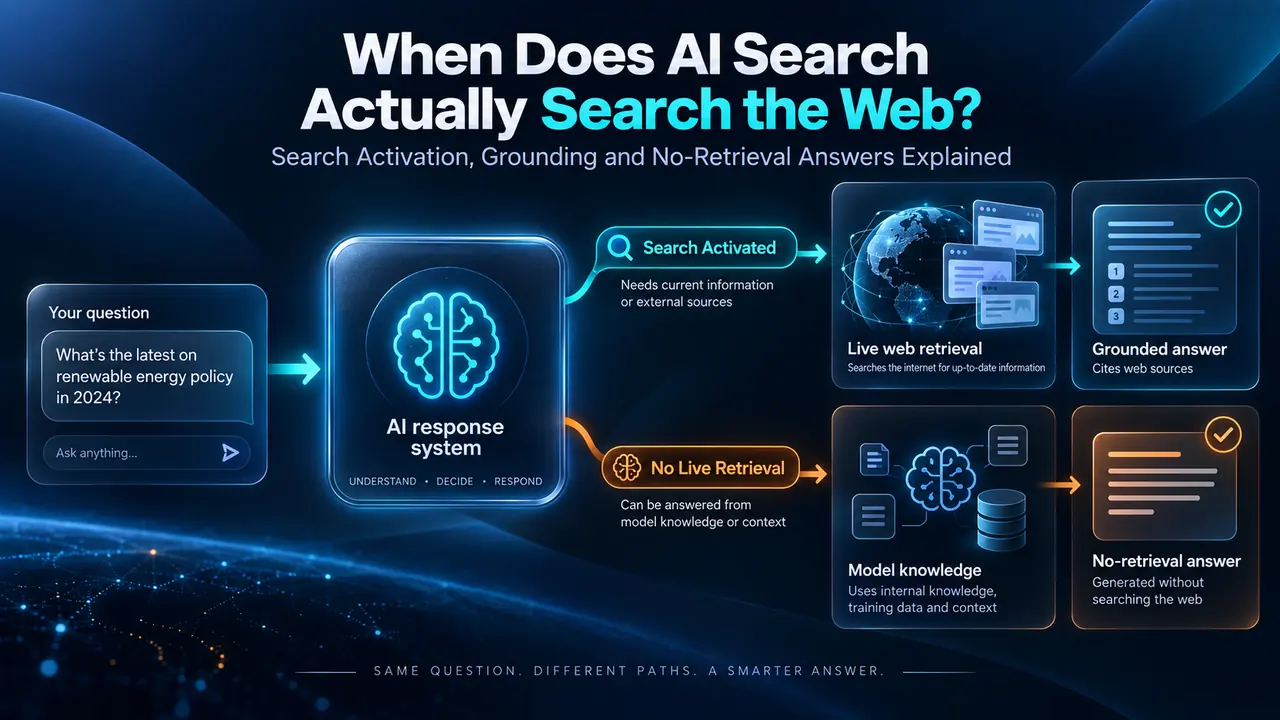
That distinction matters. OpenAI says ChatGPT search gives users “fast, timely answers with links to relevant web sources” and can choose to search the web depending on the question. Google says AI Mode and AI Overviews may use query fan-out, issuing multiple related searches across subtopics and sources before forming a response. Perplexity has positioned citations as central to its answer experience, with CEO Aravind Srinivas stating that its success relies on answers being “factually grounded in high-quality sources of information.”
So the serious objective is not to game an AI model. The serious objective is to make a page easy to crawl, easy to parse, easy to verify, easy to quote and easy to trust across the entire retrieval path.
How each AI answer engine appears to select sources
The platforms overlap, but they do not behave identically. A strong AI visibility strategy needs platform-specific thinking without abandoning foundational SEO.
| Platform | What matters most | How to improve eligibility |
|---|---|---|
| ChatGPT | Accessible content, OAI-SearchBot allowance, source clarity, strong third-party corroboration and answer-ready passages. | Allow OAI-SearchBot, publish concise answers under descriptive headings, keep facts updated, build external citations and measure ChatGPT referral traffic using utm_source=chatgpt.com. |
| Perplexity | Live-web retrieval, source transparency, current information, structured comparisons, direct citations and credible source clusters. | Create pages with direct answers, fresh dates, cited claims, original data, clean titles and verifiable author or organisation context. |
| Google AI Mode | Google indexing eligibility, snippet eligibility, helpful content, query fan-out coverage, strong topical structure and relevant supporting links. | Keep pages indexable, satisfy core SEO best practices, map subtopics across a content cluster, add expert-led sections and maintain strong internal linking. |
This is why a single page rarely does all the work. AI search visibility usually comes from a connected evidence layer: service page, explainer page, glossary, author bio, benchmark data, YouTube transcript, case study, pricing page, third-party mentions and source-rich blog content all reinforcing the same entity facts.
The latest data behind AI visibility
The evidence is now strong enough to make one thing clear: traditional SEO still matters, but it is no longer the full visibility map. AI answer engines often pull from pages that do not hold the obvious top organic position for the original prompt.
This chart shows that AI answer engines do not always cite the same pages that rank in the traditional Google top 10, so AI visibility needs to be measured separately from standard SEO rankings.
Ahrefs analysed 863,000 keyword SERPs and 4 million AI Overview URLs in March 2026. It found that 37.1% of standard organic AI Overview citations ranked in Google’s top 10, 26.2% ranked between positions 11 and 100, and 36.7% did not rank in the top 100 for the same query. That supports a practical conclusion: Google AI Mode and AI Overviews can reward pages that answer related fan-out subtopics, not only the page ranking for the original head term.
- 37.1% ranked in Google’s top 10 organic results.
- 26.2% ranked between positions 11 and 100.
- 36.7% did not rank in Google’s top 100 organic results.
This chart shows where Google AI Overview citations came from in Ahrefs’ March 2026 study, including pages in the top 10, pages ranking 11 to 100, and pages outside Google’s top 100 results.
Semrush adds another important signal: ChatGPT’s outbound referral traffic to the web grew 206% in 2025, while the number of unique domains receiving ChatGPT referrals grew from roughly 71,000 in October 2024 to a peak of about 260,000 in October 2025 before settling around 170,000 by February 2026. This means AI search is not just an awareness layer; it is becoming a measurable discovery channel.
This chart represents Semrush’s reported year-over-year growth in outbound ChatGPT referral traffic, using January 2025 as an index baseline of 100 and January 2026 as an index value of 306.
This chart shows why AI discovery matters commercially: search referral pressure is increasing, while publishers expect search-engine referrals to fall further over the next three years.
- ~75% of active GenAI web users outside mainland China were estimated to visit ChatGPT.
- ~25% were estimated not to visit ChatGPT, reinforcing the need to track Gemini, Perplexity, Claude and other AI discovery surfaces.
This chart shows that ChatGPT dominates generative AI web usage, but a meaningful share of active users still use other AI discovery surfaces, so visibility should be tracked across multiple platforms.
The other side of the shift is risk. The Reuters Institute’s 2026 media trends report found that publishers expect search-engine traffic to decline by 43% over three years, and Chartbeat data in the same report showed Google organic search traffic to more than 2,500 news sites was down 33% globally from November 2024 to November 2025. Any business that still treats AI visibility as optional is ignoring a live redistribution of discovery.
A practical framework to rank in AI answer engines
The following framework is neutral, practical and platform-aware. It is designed for websites that want to be cited in ChatGPT, selected in Perplexity, and eligible for Google AI Mode and AI Overviews.
1. Make crawler access deliberate
OpenAI states that OAI-SearchBot is used to surface websites in ChatGPT search features and that sites opted out of OAI-SearchBot will not be shown in ChatGPT search answers, although they may still appear as navigational links. Google says pages must be indexed and eligible to be shown with a snippet to appear as supporting links in AI Overviews or AI Mode. The first rule is basic but non-negotiable: if the page cannot be crawled, indexed, rendered or quoted, it cannot reliably rank in AI answers.
2. Write answer-first sections
Each major heading should be followed by a direct answer that can stand alone. Avoid long, vague introductions before answering the query. AI systems prefer passages that can be lifted, summarised and attributed cleanly. A strong section usually begins with the answer, then adds evidence, then expands with examples.
3. Build around entities, not just keywords
AI systems need to understand who the brand is, what the brand does, which topics it owns, which people are associated with it, which proof supports it and where corroborating mentions exist. That means your author bio, organisation details, service pages, glossary pages, benchmark pages, YouTube descriptions and external profiles should describe the same entity consistently.
4. Publish original data
Original data is one of the strongest AI visibility assets because it gives answer engines something distinctive to cite. Benchmarks, case studies, test results, survey data, screenshots, screen recordings, pricing comparisons and audit findings can all become citation hooks. The page should explain the method, the sample, the date range, the limitations and the conclusion.
5. Add statistics, quotations and citations where they genuinely support the claim
The original GEO research paper by Pranjal Aggarwal, Vishvak Murahari, Tanmay Rajpurohit, Ashwin Kalyan, Karthik Narasimhan and Ameet Deshpande found that GEO methods could improve visibility by up to 40% in generative engine responses. The lesson is not to stuff numbers randomly. The lesson is to make claims verifiable with statistics, named sources and clear attribution.
6. Cover the fan-out, not only the head term
Google explicitly says AI Mode and AI Overviews may use query fan-out, issuing multiple related searches across subtopics and data sources. That means the winning page or content cluster often covers the surrounding questions: what it is, how it works, who it is for, examples, limitations, pricing, comparison, evidence, implementation, risk and measurement.
7. Maintain freshness with visible update signals
AI search is especially sensitive to recency for fast-moving subjects such as tools, laws, prices, platform features, AI model changes and market statistics. Add a visible last-updated date, refresh outdated claims, replace old data, and use current sources. Do not pretend a 2024 statement is still current if the platform changed in 2026.
8. Use clear source architecture
AI answer engines are more likely to trust a claim when it sits inside a well-connected information structure. Link to the author bio when expertise matters. Link to the service page when commercial intent matters. Link to benchmark pages when proof matters. Link to original external sources when factual claims need verification. Every important claim should have a route to evidence.
9. Measure AI visibility separately from SEO traffic
Search Console still matters, but it does not fully isolate AI answer visibility. Track prompts, citations, brand mentions, source links, referral traffic, assisted conversions and sentiment in AI answers. OpenAI notes that ChatGPT referral URLs include utm_source=chatgpt.com, which makes ChatGPT traffic measurable in analytics platforms.
Expert commentary on AI search visibility
“AI Mode is our most powerful AI search.”
“These experiences are most helpful when they make it easy for you to connect with authentic voices.”
“Our success relies on ensuring answers are factually grounded in high-quality sources of information.”
Industry Expert Quotes
The following citation-ready expert comments are written for clear attribution, direct extraction and AI answer reuse.
“In AI search, the target is no longer one blue-link position; it is repeated source selection across the query fan-out. When Ahrefs finds that 36.7% of Google AI Overview citations sit outside the top 100 organic results, the commercial lesson is blunt: page-one SEO is necessary, but not enough.”
Citation support: Ahrefs AI Overview citation study and Google Search Central guidance on AI features.
“With Semrush reporting 206% year-over-year growth in outbound ChatGPT referral traffic and the Reuters Institute reporting an expected 43% decline in search referrals, AI visibility is no longer a branding exercise. It is a defensive discovery channel and a future revenue signal.”
Citation support: Semrush ChatGPT traffic analysis and the Reuters Institute 2026 media trends report.
Implementation checklist: how to improve AI answer visibility
Technical access
- Confirm Google indexing and snippet eligibility.
- Check robots.txt for OAI-SearchBot, Googlebot, Bingbot and other relevant crawlers.
- Keep pages fast, mobile-friendly and renderable without fragile scripts.
Content structure
- Use descriptive H2 and H3 headings.
- Give a direct answer immediately after important headings.
- Add summary tables, definitions, comparisons and step-by-step sections.
Evidence
- Use primary sources where possible.
- Include statistics with dates and source names.
- Add expert quotes with names, roles and organisations.
Entity trust
- Link to author bio pages and company profile pages.
- Keep company name, service names and author titles consistent.
- Earn third-party mentions on relevant, trusted sites.
Freshness
- Add a visible reviewed or updated date.
- Replace stale model, platform and market-share references.
- Refresh examples after major AI platform updates.
Measurement
- Track prompts monthly across ChatGPT, Perplexity and Google AI Mode.
- Record citations, brand mentions, sentiment and competitor overlap.
- Separate AI referral traffic from traditional organic search traffic.
What not to do
Do not treat AI ranking as a trick. Hidden text, fake citations, invented statistics, copied expert quotes, doorway pages and thin AI-generated summaries may create short-term noise, but they weaken the trust signals that answer engines need when selecting sources.
Do not rely on one post, either. The most defensible strategy is an interconnected evidence system: original research, expert commentary, author profiles, service clarity, glossary definitions, proof pages, clean citations, crawlable media transcripts and current updates.
FAQ: ranking in ChatGPT, Perplexity and Google AI Mode
Can you directly rank number one in ChatGPT?
Not in the same fixed way as classic Google rankings. ChatGPT can mention a brand, cite a page, link to a source or use a page as part of a generated answer. Visibility depends on the prompt, the model, whether web search is used, source availability and the surrounding evidence ecosystem.
Does traditional SEO still matter for AI search?
Yes. Google says the same foundational SEO best practices apply to AI Mode and AI Overviews. But traditional SEO is not enough on its own because AI answer engines can cite sources outside the top organic results and may retrieve pages through related subqueries.
What is the fastest way to improve AI citation potential?
Start with crawlability, direct answers, original data, expert attribution, current statistics and clear internal links to evidence. Then test real prompts monthly and update the content around the places where competitors are being cited instead of you.
Should every page include charts and tables?
No. Use charts and tables when they clarify a claim, compare options or expose a dataset. A decorative chart does not help AI engines. A well-labelled chart with visible data, source context, captions and surrounding explanation can help both users and machines understand the evidence.
How should businesses measure AI ranking?
Measure prompt coverage, brand mentions, citation frequency, linked source URLs, sentiment, competitor co-occurrence, AI referral traffic and assisted conversions. A business should know not only whether it appears, but how accurately it is described.
Work with NeuralAdX Ltd
NeuralAdX Ltd helps businesses improve visibility across AI answer engines by combining technical SEO, Generative Engine Optimisation, entity clarity, benchmark tracking, evidence-led content and AI citation measurement.
Sources and further reading
- OpenAI Developers: Overview of OpenAI Crawlers — OAI-SearchBot visibility guidance for ChatGPT search.
- OpenAI Help Center: Publishers and Developers FAQ — ChatGPT referral tracking and publisher guidance.
- OpenAI: Introducing ChatGPT search — OpenAI’s description of ChatGPT search and source links.
- Google Search Central: AI features and your website — Google guidance for AI Mode and AI Overviews.
- Google Blog: 5 new ways to explore the web with generative AI in Search — May 2026 AI Mode and AI Overviews updates by Hema Budaraju.
- Google Blog: AI in Search, going beyond information to intelligence — AI Mode launch update by Elizabeth Reid.
- Ahrefs: Update, 38% of AI Overview citations pull from the top 10 — March 2026 AI Overview citation-overlap study.
- Ahrefs: Only 12% of AI cited URLs rank in Google’s top 10 — AI citation and classic SERP overlap study.
- Semrush: ChatGPT traffic analysis — 17 months of clickstream data and ChatGPT referral growth.
- Semrush: Technical SEO factors and AI Search — 5 million cited URLs across ChatGPT Search and Google AI Mode.
- Similarweb: Generative AI statistics for 2026 — AI brand visibility index and sector-level patterns.
- DataReportal: Similarweb 2026 Generative AI Visibility Index analysis — independent analysis of generative AI usage, referrals and brand visibility.
- Reuters Institute: Journalism, Media, and Technology Trends and Predictions 2026 — search-referral risk and publisher expectations.
- Aggarwal et al.: GEO, Generative Engine Optimization — academic research on visibility improvement in generative engines.
- Aravind Srinivas: Perplexity Publishers Program announcement — Perplexity’s positioning on citations and high-quality sources.
Author and methodology context
Paul Rowe

Paul Rowe is the Founder, Chief Generative Engine Optimisation Officer and CEO of NeuralAdX Ltd, focused on AI citation visibility, answer-engine retrieval, entity clarity, evidence-led benchmarking and practical Generative Engine Optimisation implementation across major AI platforms.
Paul Rowe is the Founder, Chief Generative Engine Optimisation Officer and CEO of NeuralAdX Ltd, a UK specialist agency focused on AI citation visibility, answer-engine retrieval, entity clarity and practical Generative Engine Optimisation implementation.
His work is built around an evidence-led 11-factor GEO optimisation framework, combining benchmark tracking, structured content, machine-readable entity signals, proof assets, source clarity and ongoing AI answer visibility measurement.
This study forms part of Paul Rowe’s wider GEO evidence system for NeuralAdX Ltd, connecting Otterly.ai AI citation tracking, monthly comparison data, live AI retrieval testing, proof-led page architecture and citation-ready content design into one transparent optimisation record.