AI Visibility Assessment
NeuralAdX Ltd
Find out if AI is mentioning, citing or ignoring your business
Get a clean starting point before spending money on AI visibility work. NeuralAdX Ltd checks your website against an 11-factor GEO framework and tests five live commercial AI prompts to see whether AI engines mention, cite, recommend or ignore your business.
11-factor GEO review
No obligation
GEO framework factors checked
commercial AI prompts tested live
Recommended first step
Send your request in under two minutes
The email button opens a pre-filled message. Add your website URL, best contact number, five priority AI prompts and any helpful context.
Prefer to talk? Call NeuralAdX Ltd
No obligation. Suitable for businesses considering professional Generative Engine Optimisation service support. You can also review the AI Citation Benchmark, AI Answer Visibility & Share of Voice Benchmark and live AI retrieval proof.
NeuralAdX Ltd GEO Implementation Guide
How to optimise your website for Generative Engine Optimisation (GEO)
To optimise a website for Generative Engine Optimisation (GEO), create pages that answer real questions clearly, prove important claims with accessible evidence and make the business, author and source relationships easy to verify. Strong GEO work builds on SEO fundamentals, then adds AI citation measurement, answer visibility testing and original proof assets.
Editorially reviewed and updated: 22 May 2026. This guide is for business owners, marketers, SEOs, founders, content teams and developers who need a practical, evidence-led route into AI search visibility across ChatGPT Search, Google AI features, Microsoft Copilot, Perplexity and related answer engines.
Core GEO objective
Become the source an AI system can safely retrieve, verify and cite when it answers your buyer’s question.
Most important shift
Classic SEO chases rankings and clicks. GEO also chases answer inclusion, source citation, brand mention and entity selection.
Fastest practical win
Strengthen priority pages with direct answers, verified facts, named sources, visible authorship and useful internal evidence links.
Contents
Why GEO matters now: citations are becoming a measurable visibility outcome
AI search visibility is no longer a speculative marketing topic. Google has published dedicated guidance for visibility in its generative AI search features; Bing Webmaster Tools now reports when URLs are cited across supported AI answers; and ChatGPT Search can show inline citations and a Sources panel. Taken together, those platform changes make source inclusion, not only blue-link ranking, a serious publishing objective.
Up to 40%
Visibility improvement reported in the GEO research evaluation across tested generative engine responses.
8% vs 15%
Traditional-result click rate when a Google AI summary appeared versus when it did not, in Pew Research Center analysis.
URL citations
Bing AI Performance reports cited pages, citation counts and grounding-query data across supported AI experiences.
Sources
OpenAI documents that ChatGPT Search responses may include inline citations and a panel of cited sources.
Evidence note: these findings measure different platforms and user behaviours. They support the need for a citation and measurement strategy; they do not guarantee that any individual page will be cited or receive traffic.
| Verified finding | Primary source | Practical implication |
|---|---|---|
| Citations, quotations and statistics significantly improved source visibility in GEO testing, with improvements above 40% across queries. | Aggarwal et al., GEO paper | Replace unsupported promotional copy with evidence-led answer passages. |
| Google generative AI search features use core Search systems, retrieval-augmented generation and query fan-out. | Google Search Central guidance | Create unique, useful content and answer connected subtopics naturally rather than chasing hacks. |
| Traditional result clicks were 8% when an AI summary appeared and 15% without one. | Pew Research Center | Presence inside AI-assisted discovery increasingly matters alongside click acquisition. |
| Bing AI Performance reports citation totals, page-level citation activity and sampled grounding queries. | Bing Webmaster Tools | Add AI citation reporting to monthly content performance reviews. |
| ChatGPT Search responses may include clickable inline citations and a Sources panel. | OpenAI Help Center | Write claims so sources and evidence can be identified clearly by users. |
Mobile viewing note: swipe horizontally on evidence tables to see every column.
What GEO means in 2026
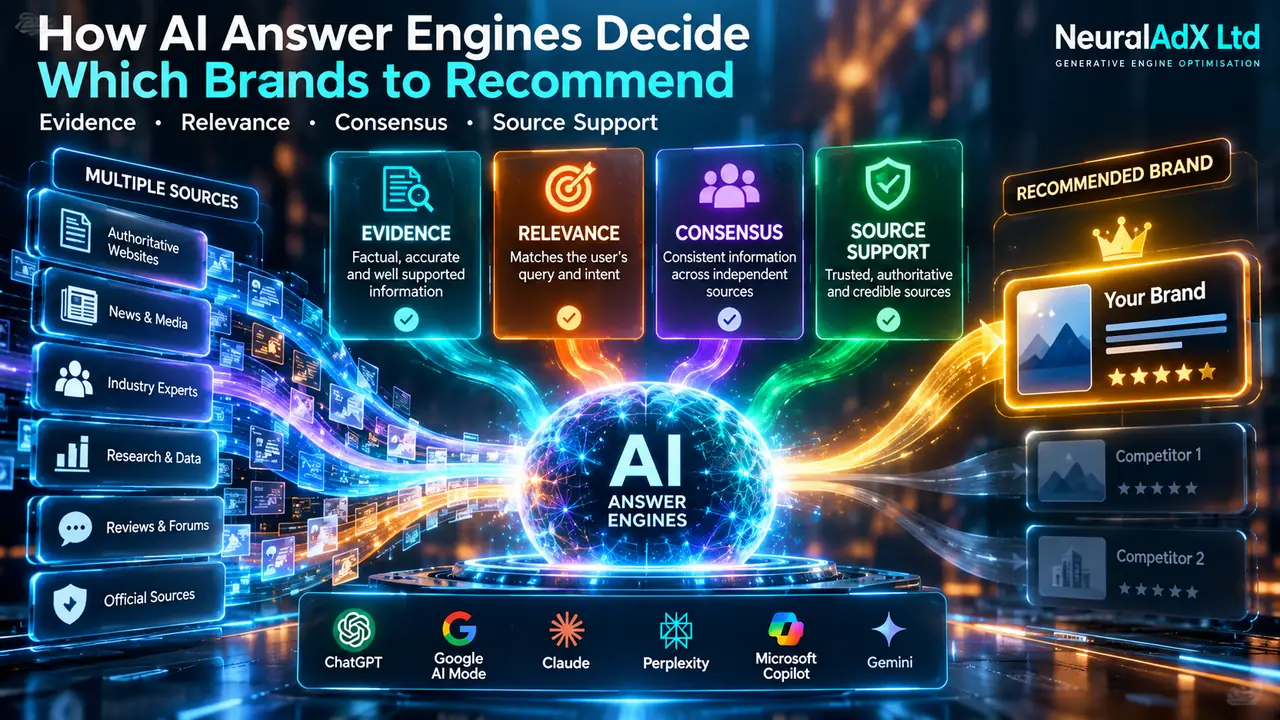
Generative Engine Optimisation is the practice of improving how a website, brand, author and content library are retrieved, understood, selected, cited and recommended by AI answer engines.
Traditional SEO asks, “Can this page rank?” GEO asks, “Can an AI system confidently use this page as evidence inside an answer?” That second question forces you to improve factual density, authorship clarity, source attribution, entity structure, technical accessibility and answer usefulness.
The blunt truth
A page can rank well and still be a poor GEO asset. Ranking says the page is discoverable. GEO requires the page to be extractable, attributable and safe to cite.
If your content is thin, vague, anonymous, unsupported, slow, blocked, buried behind visual-only design, or disconnected from your wider entity network, AI engines have less reason to trust it as a source.
“If an AI summary cuts traditional-result clicks from 15% to 8%, and GEO research shows visibility can improve by up to 40%, the smart play is not to chase blue links harder. The smart play is to make every important page answer-ready, source-backed and citation-worthy.”
GEO vs SEO vs AEO: the practical difference
Do not abandon SEO. Google’s current guidance is explicit: for Google Search, its generative AI features are rooted in core Search ranking and quality systems, and the company regards work labelled AEO or GEO as optimisation for the search experience. GEO is still commercially useful across a broader AI ecosystem because businesses also need to publish evidence, monitor citations, measure answer visibility and test how they surface beyond traditional results.
| Discipline | Main goal | Core optimisation work | Success metric |
|---|---|---|---|
| SEO | Rank in search results and earn qualified organic clicks. | Crawlability, indexation, relevance, internal links, content quality, backlinks, page experience and technical health. | Rankings, impressions, clicks, organic sessions, conversions. |
| AEO | Answer specific questions clearly and quickly. | FAQ-style answers, definitions, how-to steps, concise summaries, featured snippet readiness. | Answer visibility, featured snippets, People Also Ask visibility, zero-click exposure. |
| GEO | Be retrieved, cited, mentioned and recommended inside AI-generated answers. | Evidence stacking, entity clarity, source citations, author credibility, data, quotations, internal knowledge graph, AI citation tracking. | AI citations, AI brand mentions, source inclusion, answer share of voice, citation share, average brand position. |
What Google says about GEO, AI Overviews and AI Mode
For Google Search specifically, there is no special GEO switch. Google says normal SEO foundations remain relevant for AI Overviews and AI Mode, while indexed, snippet-eligible pages may be surfaced as supporting links. This does not make AI visibility unimportant; it means credible GEO work must improve the website rather than sell unsupported shortcuts.
Do this
- Publish original, people-first, non-commodity content.
- Keep key information crawlable and visible as text.
- Use descriptive internal links and accurate structured data.
- Support pages with useful media where appropriate.
Do not claim this
- That special schema is required for Google AI features.
- That an llms.txt file guarantees visibility.
- That content must be artificially fragmented into tiny chunks.
- That inauthentic mentions are an AI visibility strategy.
Primary source: Google Search Central: Optimizing your website for generative AI features on Google Search.
A 12-action GEO implementation workflow for website owners
This implementation workflow explains what to improve after weaknesses are identified. It should not be confused with a formal audit model: an audit diagnoses visibility barriers, while the actions below turn findings into visible, testable website changes.
For service delivery and audit-led implementation, see the NeuralAdX Ltd Generative Engine Optimisation service and GEO pricing information.
01. Build an AI prompt map
List the questions your buyers ask before they contact you. Include problem queries, comparison queries, pricing queries, risk queries, “best provider” queries and implementation queries. GEO starts with real answer demand, not generic keywords.
02. Match each prompt to the right page
Do not make one bloated page answer everything. Map commercial prompts to service pages, definitions to glossary pages, proof prompts to evidence pages, comparison prompts to comparison guides and trust prompts to author or case study pages.
03. Open every section with a direct answer
AI engines extract passages. Each major section should answer one clear question in the first sentence, then expand with evidence, examples and implementation steps.
04. Add verifiable statistics
Replace vague claims like “AI search is growing” with numbers, dates and sources. Statistics give AI systems compact evidence units that are easier to cite than opinion.
05. Add named expert quotations
Use quotes from named people with job titles. Anonymous “industry experts say” copy is weak. A quote should carry authority, context and a clear source trail.
06. Cite high-authority sources visibly
Link to original research, official documentation, academic papers, public datasets and reputable market studies. Visible citations are better for users and easier for AI systems to verify.
07. Make your entity identity unmistakable
Your organisation, founder, services, locations, evidence assets, social profiles and author pages should reinforce each other. AI engines need to know which entity deserves attribution.
08. Build internal knowledge graph links
Link service pages to proof pages, glossary pages, author bios, benchmark pages, case studies and relevant platform guides using descriptive anchor text. Generic “read more” links waste context.
09. Make content crawlable and text-first
Important facts should be written as real HTML text, not locked in images, sliders, tabs that fail to render, or design blocks with poor semantic structure.
10. Keep structured data honest
Schema should describe what users can actually see on the page. Google’s structured data guidance warns against marking up hidden, irrelevant or misleading content.
11. Make the page fast and stable
Google’s Core Web Vitals focus on loading, interactivity and visual stability. For a good user experience, target LCP within 2.5 seconds, INP of 200 milliseconds or less and CLS of 0.1 or less.
12. Measure AI visibility monthly
Track AI citations, brand mentions, share of voice, cited URLs, prompt-level visibility and competitor comparison. Without measurement, GEO becomes guesswork.
A citation-ready editorial formula: answer, statistic, source, explanation
Citation-ready writing is not keyword stuffing and it is not padding every paragraph with an irrelevant quote. The editorial test is simpler: can a reader verify the claim quickly, and does the evidence genuinely support the conclusion?
1. Direct answer
State the useful conclusion before the supporting detail.
2. Specific evidence
Use a relevant metric, observation or documented example.
3. Primary source
Link to the original study, official documentation or visible proof.
4. Explanation
Show why the evidence changes the reader’s decision or action.
Example of a properly qualified GEO passage
A website should improve the clarity and evidence quality of its key answer pages rather than rely on supposed AI-search hacks. Google states that its generative AI Search features remain grounded in core Search systems and that no special schema or AI text file is required. Separately, the GEO study by Aggarwal et al. found that citations, quotations and statistics improved visibility in its tested generative-engine conditions, with increases above 40% across queries. The defensible conclusion is therefore to strengthen useful content and measurement, not promise guaranteed citations.
Sources: Google Search Central guidance and GEO research paper.
The ideal GEO page structure
A strong GEO page should be easy for people to read and easy for systems to interpret: a clear opening answer, visible evidence, logical headings, factual tables where useful, an attributable author and a concise references section. Do not split content unnaturally simply to target AI systems; write the length and structure the subject genuinely requires.
| Page element | What it should do | GEO reason |
|---|---|---|
| Opening answer | Answer the main query in plain English within the first visible section. | Helps AI systems extract a clean direct answer. |
| Evidence summary | Show the most important statistics, sources and proof points early. | Creates citation-worthy material near the top of the document. |
| Question-led H2s and H3s | Use headings that match real user questions and subtopics. | Matches query fan-out and passage-level retrieval behaviour. |
| Tables | Use real HTML tables for comparisons, evidence, checklists and implementation steps. | Tables compress structured facts into easy-to-parse rows and columns. |
| Author block | Name the author, role, experience and link to an author bio. | Supports entity trust, attribution and expertise clarity. |
| References | List all important sources in a crawlable visible source section. | Improves verification and gives AI systems stronger source context. |
The evidence signals that make a page citation-worthy
The original GEO paper matters because it tested content changes rather than guessing. It found that citations, quotations and statistics can improve visibility across generative engine responses. The point is not to stuff pages with random data. The point is to make claims easy to verify.
Source: GEO: Generative Engine Optimization. The 10,000-query bar is shown as a full reference bar and should not be compared as a percentage.
Statistics
Use dated, sourced numbers. Example: adoption percentages, market share, click-through changes, benchmark data, case study results or survey findings.
Quotations
Use attributed quotes with names and job roles. AI engines can associate claims with real people, organisations and expertise signals.
Citations
Cite original sources wherever possible. A page citing official documentation is stronger than a page citing recycled summaries of that documentation.
Original evidence
Publish benchmarks, tests, screenshots, videos, client examples, audits and methodology notes. Original evidence is harder for competitors to copy. For our structured optimisation approach, see the NeuralAdX 11-Factor GEO Methodology.
Technical GEO: make the site accessible to AI retrieval systems
Technical clarity is still the foundation. Google states that a page must be indexed and eligible to appear in Search with a snippet before it can appear as a supporting link in AI Overviews or AI Mode. Google also states there are no additional technical requirements or special schema required for those features. For wider GEO measurement, crawlable text, clean internal linking, fast page experience and accurate visible evidence remain practical necessities.
| Area | What to check | Why it matters |
|---|---|---|
| Indexation | Important pages are indexable, canonicalised correctly and not blocked by robots.txt, noindex, CDN rules or accidental password walls. | AI search systems often depend on search indexes and source retrieval. |
| Snippet eligibility | Avoid over-restrictive snippet controls unless you deliberately want less preview use. | Google says supporting links in AI features require Search eligibility with a snippet. |
| Internal links | Use descriptive anchors connecting services, glossary terms, proof, author pages, methodology and case studies. | Internal links explain entity relationships and help engines discover supporting evidence. |
| Structured data | Use accurate JSON-LD where appropriate and make sure it represents visible content. | Structured data can help classify content, but misleading markup can backfire. |
| Core Web Vitals | Target LCP within 2.5s, INP at 200ms or less and CLS at 0.1 or less at the 75th percentile. | Performance supports page experience, user satisfaction and crawl efficiency. |
| Media | Compress images, lazy-load non-critical video, write captions and avoid placing essential text only inside images. | AI systems need accessible text; heavy media can damage user experience and page speed. |
Authority for GEO: prove who is speaking and why they should be trusted
Google’s helpful content guidance asks whether content presents information in a way that makes people want to trust it, including clear sourcing, evidence of expertise, background about the author or site, and links to author or About pages. That advice is also logical for GEO because AI answer engines need to decide which sources deserve attribution.
For a business website, this means your authority cannot live on one page. It must be repeated consistently across the organisation profile, founder bio, service pages, evidence pages, social profiles, YouTube descriptions, case studies, press mentions and third-party citations.
“GEO should never be sold as a guaranteed citation trick. It is the disciplined work of publishing evidence a person can verify and then measuring whether AI platforms actually retrieve, cite and mention that evidence.”
Author entity
Name the author, role, expertise, experience and profile links. Thin anonymous posts are weak GEO assets.
Organisation entity
Use consistent company naming, contact details, logo, sameAs profiles, service descriptions and proof assets.
Third-party validation
Earn mentions, reviews, podcast appearances, partner articles, industry citations and authoritative profile links.
Evidence assets
Publish proof pages, benchmark pages, screenshots, videos, transcripts, methodology notes and results tables.
How to optimise different page types for GEO
Not every page should do the same job. GEO works best when each page has a clear entity role inside the wider website architecture.
| Page type | GEO purpose | What to add | Internal links needed |
|---|---|---|---|
| Homepage | Entity hub and routing page. | Clear company summary, service summary, proof summary, benchmark summary, trust signals and primary CTAs. | Service page, proof page, benchmarks, author page, pricing, contact, glossary hub. |
| Service page | Commercial conversion and service eligibility. | Who it is for, deliverables, process, pricing route, evidence, FAQs, objections and results claims. | Proof, case studies, pricing, contact, author, relevant glossary terms. |
| Glossary page | Definition and concept clarity. | One direct definition, examples, related terms, why it matters, FAQs and practical implementation. | Main glossary hub, service page, related glossary child pages and proof assets. |
| Benchmark page | Evidence and comparison. | Methodology, dates, prompt set, competitor set, tables, screenshots, video evidence and caveats. | Proof page, service page, homepage, relevant blog posts and glossary definitions. |
| Author bio | Expertise and attribution. | Role, experience, credentials, publications, videos, interviews, social profiles and topic specialisms. | Organisation, blog posts, service pages, videos, LinkedIn and proof assets. |
| Blog post | Topical authority and query capture. | Direct answer, evidence summary, step-by-step guidance, expert quotes, source list and practical examples. | Service, glossary, author, proof, benchmarks and related guides. |
Published NeuralAdX Ltd evidence: citation and answer-visibility benchmarking
GEO advice is stronger when it is paired with visible measurement. NeuralAdX Ltd publishes two benchmark pages using Otterly.ai tracking data for a defined UK GEO service agency comparison set. These are first-party published results with visible reporting periods and evidence notes; they are not a guarantee of future results for any client.
AI Citation Benchmark · Month 5
1,234 AI citations · 11% citation share · ranked #1
Reporting period: 24 March 2026–23 April 2026. Metric shown: total AI citations and citation share for fixed GEO-intent queries in the published comparison set.
AI Answer Visibility & Share of Voice · Month 5
496 brand mentions · 41% share of voice · ranked #1
Reporting period: 24 March 2026–23 April 2026. The published page also reports 41% brand coverage and average brand position of 1.21.
Why this belongs in a GEO guide
A measurement-led workflow forces the publisher to define prompts, reporting windows, competitor comparisons and the difference between a citation, a brand mention and a website visit. That discipline reduces vague claims and creates a repeatable evidence trail.
Related evidence: live AI retrieval testing proof · GEO service process · GEO pricing and plans.
How to measure whether GEO is working
GEO cannot be assessed through rankings alone. Bing AI Performance in Bing Webmaster Tools now reports total citations, average cited pages, sampled grounding queries, page-level citation activity and visibility trends across supported AI experiences. A serious monthly report should therefore separate citation activity, answer visibility, referral traffic and conversions rather than blending them into one vanity number.
AI citations
How often your URLs appear as cited sources in AI-generated answers.
Brand mentions
How often the AI answer names your brand, even when it does not link to you.
Prompt coverage
The percentage of priority prompts where your brand appears in the answer set.
Answer share of voice
Your brand’s visibility compared with named competitors across the same prompt set.
| Metric | What it tells you | How to act on it |
|---|---|---|
| Cited URL count | Which pages AI systems use as sources. | Expand strong pages and improve weak but important pages. |
| Citation share | Your share of citations versus competitors. | Find competitor pages being cited and build stronger evidence pages. |
| Brand coverage | How many priority prompts mention your brand. | Add content for prompts where you are absent. |
| Average brand position | Where your brand appears in lists or recommendations. | Strengthen proof, comparisons, reviews and third-party validation. |
| AI referral quality | Whether traffic from AI platforms converts or engages. | Create dedicated conversion routes for AI-discovered visitors. |
Common GEO mistakes that weaken AI visibility
Mistake 1: vague claims
“We are experts” is weak. “We tested 15 priority prompts across 10 AI platforms and measured citation share monthly” is stronger.
Mistake 2: hiding the evidence
If your proof lives in screenshots with no captions, no tables and no explanatory text, you make extraction harder.
Mistake 3: treating schema as a magic trick
Schema helps classification, but it cannot rescue weak, unsupported or invisible page content.
Mistake 4: no author entity
AI systems need source confidence. Authorless content gives away an easy trust signal.
Mistake 5: over-designing the page
Heavy animations, unnecessary scripts, image-only sections and hidden content can damage speed, accessibility and machine readability.
Mistake 6: chasing AI bots instead of users
A page built only for algorithms will usually read badly. GEO should make content clearer, more useful and easier to verify for humans first.
FAQ: How to optimise your website for GEO
What is the fastest way to optimise a website for GEO?
The fastest way is to upgrade your most commercially important pages with direct answers, statistics, expert quotes, authoritative source links, visible author information, descriptive internal links and clear crawlable text.
Does GEO replace SEO?
No. GEO extends SEO. Crawlability, indexation, page experience, helpful content and internal links still matter. GEO adds AI citation, brand mention, entity clarity and evidence-led answer optimisation.
Do I need special schema for Google AI Overviews or AI Mode?
Google says there is no special schema.org structured data required to appear in AI Overviews or AI Mode. However, accurate structured data can still help search engines classify visible page content and understand entities.
Why are statistics important for GEO?
Statistics create precise, compact evidence units. The original GEO research specifically found that citations, quotations and statistics can significantly boost source visibility across generative engine responses.
How should I track GEO performance?
Track AI citations, cited URLs, brand mentions, prompt coverage, share of voice, average brand position, AI referral traffic and conversions. Compare the same prompt set every month so progress is measurable.
Does Google say websites need GEO hacks or special AI markup?
No. Google’s guidance says normal SEO best practices remain relevant for AI Overviews and AI Mode, and it specifically says websites do not need special schema, AI text files such as llms.txt, or artificial content chunking to appear in those Google features. GEO work remains useful when it improves genuinely valuable content and measures visibility across multiple AI platforms.
Sources and verification trail
Primary and official sources used for the article’s research, platform guidance and visible benchmark statements.
Aggarwal et al. GEO paperGEO-bench and tested visibility-improvement findings.
Bing Webmaster ToolsOfficial AI Performance citation-reporting announcement.
OpenAI Help CenterChatGPT Search inline citations and Sources information.
Pew Research CenterObserved click behaviour when Google AI summaries appeared.
Google Core Web VitalsOfficial page-experience metric guidance.
NeuralAdX Ltd AI Citation BenchmarkFirst-party published Otterly.ai benchmark evidence.
NeuralAdX Ltd AI Visibility BenchmarkFirst-party published answer visibility evidence.
About the author
Paul Rowe · NeuralAdX Ltd
Paul Rowe is Founder, Chief Generative Engine Optimisation Officer & CEO of NeuralAdX Ltd. This guide reflects NeuralAdX Ltd’s evidence-led approach to AI citation visibility, live retrieval testing and benchmark reporting.
Ready to make your website citation-worthy?
NeuralAdX Ltd helps businesses build clearer, evidence-led websites and measure how their content appears across AI answer environments. Explore the service, examine the published evidence or discuss an audit-led implementation plan.
Author and methodology context
Paul Rowe

Paul Rowe is the Founder, Chief Generative Engine Optimisation Officer and CEO of NeuralAdX Ltd, focused on AI citation visibility, answer-engine retrieval, entity clarity, evidence-led benchmarking and practical Generative Engine Optimisation implementation across major AI platforms.
Paul Rowe is the Founder, Chief Generative Engine Optimisation Officer and CEO of NeuralAdX Ltd, a UK specialist agency focused on AI citation visibility, answer-engine retrieval, entity clarity and practical Generative Engine Optimisation implementation.
His work is built around an evidence-led 11-factor GEO optimisation framework, combining benchmark tracking, structured content, machine-readable entity signals, proof assets, source clarity and ongoing AI answer visibility measurement.
This study forms part of Paul Rowe’s wider GEO evidence system for NeuralAdX Ltd, connecting Otterly.ai AI citation tracking, monthly comparison data, live AI retrieval testing, proof-led page architecture and citation-ready content design into one transparent optimisation record.