NeuralAdX Ltd · Generative Engine Optimisation Guide · Reviewed 29 September 2026
How do you get your website cited in AI answers?
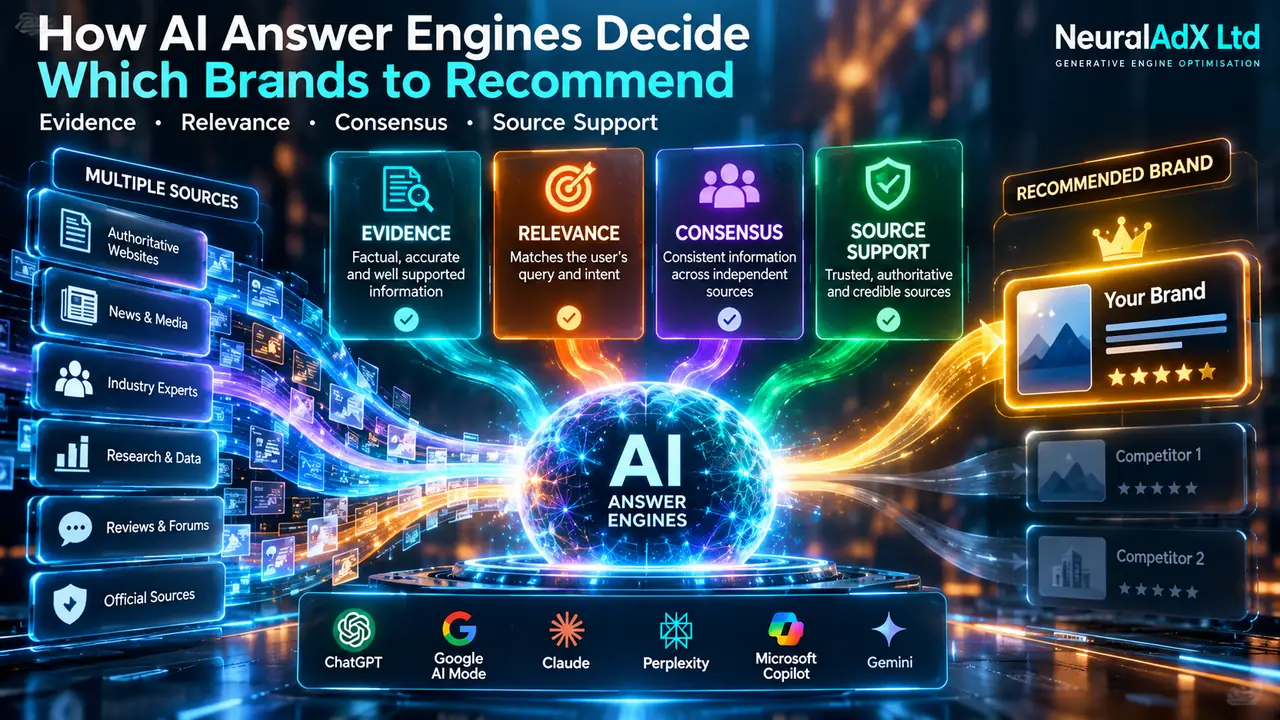
To get your website cited in AI answers, make it eligible to be crawled and retrieved, answer the target question directly, support claims with verifiable evidence, establish clear entities and authorship, publish information worth selecting, and measure whether AI systems actually retrieve, cite and absorb that material. There is no single tag or guaranteed “AI citation” switch. Citation is the outcome of a chain: discovery, retrieval, source selection, answer synthesis and attribution.
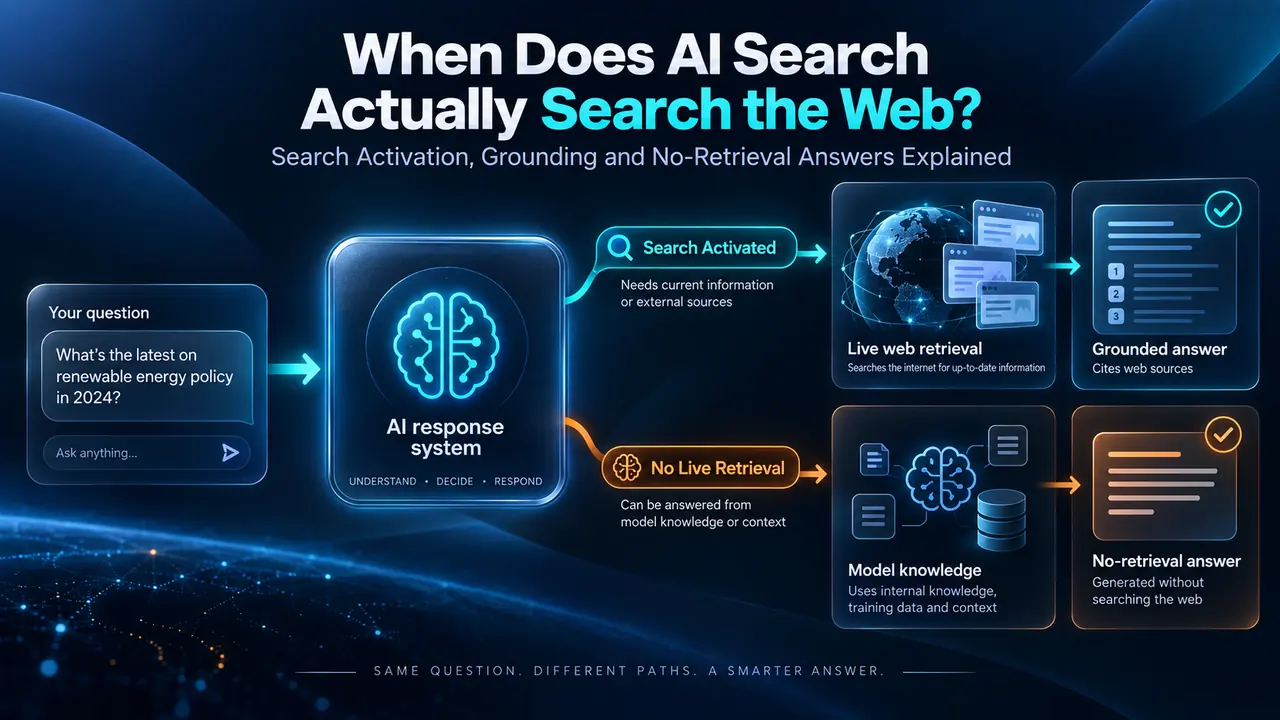
Google says its generative AI Search experiences use its Search index, retrieval-augmented generation and query fan-out to find supporting pages. OpenAI says any public website can appear in ChatGPT search and advises publishers not to block OAI-SearchBot if they want content to be discoverable and cited. Research into Generative Engine Optimisation also indicates that evidence-rich content—including citations, quotations and statistics—can improve visibility once content is available to the generative system. Google Search Central · AI optimisation OpenAI · publishers & developers Aggarwal et al. · GEO
TL;DR: what should you do first?
1. Be retrievable.
Allow the relevant crawlers, keep important content indexable, text-visible and internally linked.
2. Match the question.
Create pages whose title, heading and opening answer align closely with the real user task.
3. Give evidence.
Use primary sources, original data, statistics, quotations, definitions and transparent methodology.
4. Build source trust.
Clarify the organisation, author, dates, expertise and third-party corroboration around important claims.
5. Measure the chain.
Track mentions, URL citations, source position, citation absorption and stability across repeated prompts.
What has to happen before an AI system can cite your website?
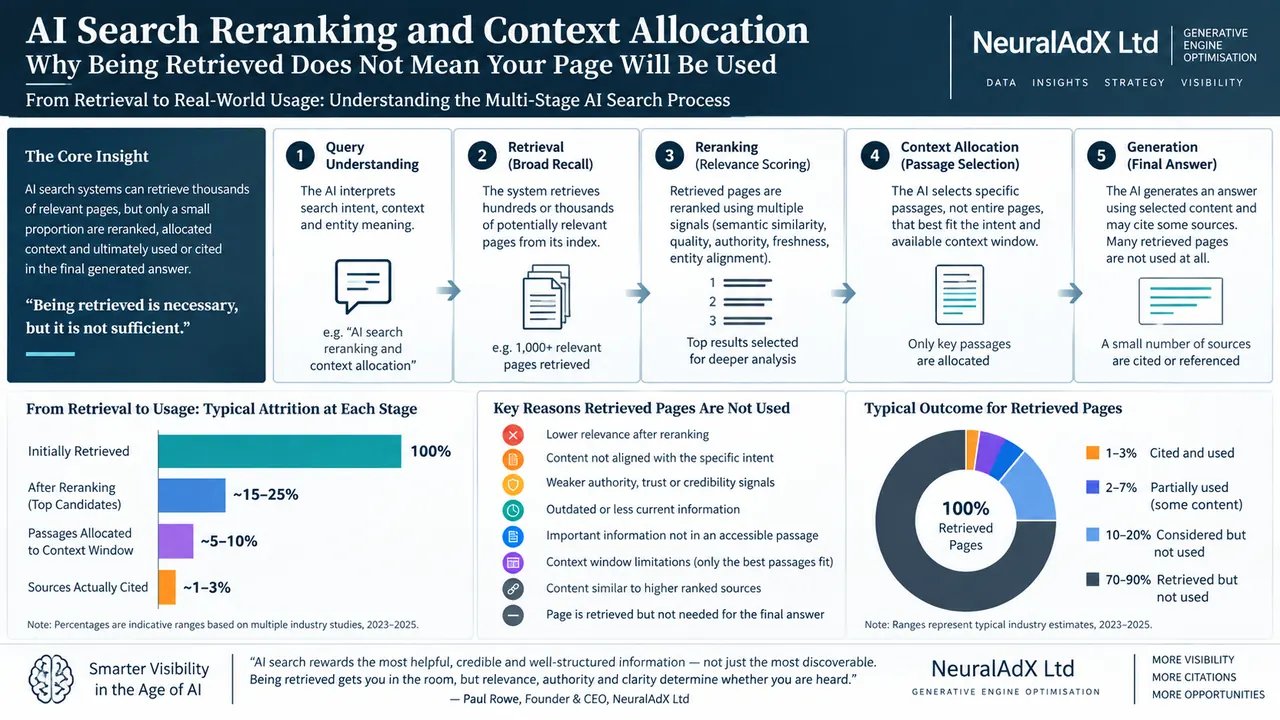
Your page normally has to survive several distinct stages before a citation appears: availability, retrieval, source selection, reading or extraction, synthesis and attribution. Treating these stages as one problem is one of the main reasons AI visibility work becomes vague.
| Stage | What the system needs | What the website can influence | Typical failure |
|---|---|---|---|
| 1. Eligibility | A public, crawlable/indexable resource | Robots access, status codes, indexability, internal links | The page is inaccessible or not in the relevant index |
| 2. Retrieval | Topical and semantic relevance to the prompt or fan-out query | Title, headings, answer coverage, topical architecture | The page is eligible but never retrieved |
| 3. Selection/opening | Enough apparent usefulness to inspect the page | Query-aligned title, snippet, source reputation and specificity | The URL appears among candidates but is skipped |
| 4. Evidence extraction | Clear passages that support an answerable claim | Direct answers, definitions, statistics, quotes, tables, procedures | The page is opened but offers little extractable support |
| 5. Synthesis/absorption | Information useful enough to influence the generated answer | Evidence density, clarity, structure and factual distinctiveness | The page is cited but contributes little to the answer |
| 6. Attribution | A reason to expose the page as supporting evidence | Source clarity, claim support, authority and consistency | Information is used without your URL being shown |
Mobile note: swipe horizontally to view the full table. The stages are a practical synthesis of public platform documentation and current GEO measurement research. Google Search Central · AI optimisation OpenAI · publishers & developers Zhang et al. · citation absorption
How do you make a website eligible to be cited by AI search systems?
Make the important page publicly accessible, crawlable by the platform or its search provider, indexable where an index is used, and available as readable text. Technical eligibility does not guarantee citation, but technical exclusion can prevent the later stages from happening at all.
What does Google require for AI Overviews and AI Mode?
Google says a page must be indexed and eligible to appear in Google Search with a snippet to be eligible as a supporting link in AI Overviews or AI Mode. Google also says there is no special AI schema or separate machine-readable file required, and that normal Search fundamentals remain relevant. Google Search Central · AI features Google Search Central · AI optimisation
What does OpenAI require for ChatGPT search discovery?
OpenAI says any public website can appear in ChatGPT search and recommends allowing OAI-SearchBot if you want content included in summaries, snippets and cited links. A robots rule that blocks the crawler can therefore create a direct discoverability problem for ChatGPT search. OpenAI · publishers & developers
Do structured data and schema guarantee AI citations?
No. Structured data can help search systems understand entities and content, but Google explicitly says no special schema is required to appear in its generative AI Search features. Use schema because it accurately clarifies visible information—not because it is a magic citation trigger. Google Search Central · AI features
How do you make a page more likely to be retrieved for an AI answer?
Create a page that is unmistakably relevant to the question and its likely sub-questions, then make that relevance obvious in the title, headings, opening answer and supporting evidence. Modern AI search can fan a prompt out into multiple related searches, so a strong page should answer the central intent while connecting naturally to the subtopics needed to resolve it.
Google publicly describes query fan-out as issuing concurrent related queries to gather additional relevant results. That means a single prompt such as “how do I get my website cited in AI answers?” may generate retrieval needs around crawlability, citations, source trust, content structure, author expertise, first-party data, schema, platform-specific access and measurement. Google Search Central · AI optimisation
A 2025 large-scale study of AI search sourcing also reported substantial differences between generative search services and highlighted sensitivity to phrasing, freshness, domain diversity and source type. The practical implication is not to manufacture hundreds of near-duplicate pages; it is to build a coherent semantic network that covers the genuine information needs around the main topic. Chen et al. · AI Search sourcing
What does citation-ready content look like?
Citation-ready content gives an AI system a compact, defensible passage that answers a specific question and carries enough evidence to justify using it. The strongest passages usually combine a direct answer with factual specificity, source attribution, a clear date or scope, and surrounding context that prevents the claim being misread.
Should the answer appear immediately under the heading?
Yes, when the heading asks a factual question, answer it in the first sentence or two. This reduces the extraction distance between question and answer and produces a clean passage that can be retrieved without requiring the system to reconstruct your point from several paragraphs.
What kinds of information are easiest to cite?
Definitions, numerical facts, comparisons, procedures, original observations, attributed quotations and clearly scoped conclusions are especially useful because they can support a discrete claim. A 2026 citation-absorption study covering 602 controlled prompts, more than 21,000 search-layer citations and 18,151 fetched pages found higher-influence pages tended to be more structured, semantically aligned and rich in extractable evidence such as definitions, numerical facts, comparisons and procedural steps. Zhang et al. · citation absorption
Does adding citations, quotations and statistics help?
They can help, particularly once a page is already in the generative system’s candidate context. The peer-reviewed GEO research reported visibility improvements of up to 40% on its benchmark and found citations, quotations and statistics among its strongest tested content interventions. That result should not be misrepresented as a guaranteed 40% lift on live commercial platforms; it was a controlled benchmark finding and performance varied by domain. Aggarwal et al. · GEO
What evidence should you add if you want AI systems to cite the page?
Add evidence that another source could independently verify: primary-source citations, dated statistics, original datasets, transparent methodology, direct quotations and clearly labelled first-party observations. Evidence should prove the claim rather than decorate it.
| Evidence type | Best use | What makes it strong | Common weakness |
|---|---|---|---|
| Primary source | Platform behaviour, policy, product capability | Original organisation publishes the claim | Citing a second-hand summary instead |
| Original dataset | Market behaviour, experiments, benchmarks | Method, sample and limitations are visible | No downloadable or auditable basis |
| Statistic | Quantifying scale or observed differences | Date, population and source are explicit | Context-free percentage |
| Expert quotation | Interpreting evidence or practice | Named expert, role and attributable context | Anonymous opinion presented as fact |
| Procedure | How-to and implementation questions | Ordered, testable steps with conditions | Generic advice without operational detail |
| Comparison table | Distinguishing platforms, methods or outcomes | Same dimensions applied consistently | Mixing unlike metrics or time periods |
Mobile note: swipe horizontally to view the full table.
How do entity clarity and author information help AI citation readiness?
Entity clarity reduces ambiguity about who created the information, which organisation is responsible for it, what the page is about and how those entities relate to other evidence on the web. It is not a standalone ranking switch, but it improves the interpretability and verifiability of the source.
For important pages, state the organisation name consistently, name the author, provide the author’s relevant role, show publication and review dates, link to an author biography, and ensure structured data—where used—matches the visible content. Google recommends that structured data correspond to what users can actually see on the page. Google · succeeding in AI Search
Industry Expert Quotes
“A website does not earn an AI citation simply by being indexed. It has to survive the full evidence chain: be retrieved for the right question, look useful enough to inspect, contain a passage strong enough to use, and provide enough source clarity to justify attribution. That is why NeuralAdX Ltd measures retrieval, selection and citation absorption as separate stages rather than treating AI visibility as a single metric.”
Paul Rowe — Founder, Chief Generative Engine Optimisation Officer & CEO, NeuralAdX Ltd Zhang et al. · citation absorption
Do third-party mentions and earned media help a website get cited?
Third-party sources can strengthen the evidence environment around a brand or claim, especially when independent pages corroborate information that also appears on the brand’s own site. But manufactured mentions are not a substitute for useful content or genuine authority.
A 2025 study comparing AI search with traditional web search reported a pronounced preference in its experiments for earned media among AI search systems, while a separate large-scale study of 55,936 queries found that 37% of domains in its dataset were unique to LLM-based search engines relative to the traditional search engines compared. These findings support a broader source strategy rather than relying only on your own domain. Chen et al. · AI Search sourcing Zhang et al. · source coverage
Google also cautions against chasing inauthentic mentions and says its systems can surface what is said about products and services across blogs, videos and forum discussions. The sensible objective is therefore corroboration: independent sources that accurately reinforce an entity, fact, result, methodology or area of expertise. Google Search Central · AI optimisation
How should you write for query fan-out without creating thin pages?
Build one strong page around the core intent, then connect it to deeper pages that answer genuine adjacent questions rather than publishing dozens of lightly reworded versions. This creates a semantic content network that can satisfy both the original prompt and the subqueries an AI search system may generate.
For this topic, the core page should answer how to get cited, while supporting pages can go deeper into crawlability, AI platform optimisation, citation measurement, schema and entity clarity, source ecosystems, author authority and live retrieval testing. Google’s own description of query fan-out supports this subtopic model: the system can issue multiple related searches to resolve a complex question. Google Search Central · AI optimisation
Useful NeuralAdX Ltd supporting resources
11-Factor GEO Methodology
GEO Explainer
GEO Service
Live Retrieval Proof
AI Citation Benchmark
AI Visibility & Share of Voice Benchmark
Why is “being cited” different from “influencing the answer”?
A URL citation tells you that a source was exposed as supporting material; citation absorption asks how much of that source’s information actually shaped the generated answer. These are different outcomes and should be measured separately.
The 2026 citation-absorption framework distinguishes source selection from answer influence and reports that platforms can differ in citation breadth versus citation depth. This is important for website owners: a long list of citations is not automatically equivalent to meaningful use of your evidence. Zhang et al. · citation absorption
How should you measure whether your website is becoming more citable?
Measure citation performance at prompt level over time, across multiple AI platforms, and separate brand mentions, URL citations, citation position, answer coverage and citation absorption. A single screenshot can prove an event happened; it cannot establish stability.
| Metric | What it answers | How to record it |
|---|---|---|
| Brand mention | Was the organisation named in the answer? | Yes/no, prominence, wording and recommendation context |
| Domain citation | Was any URL from the domain cited? | Domain, count, citation position |
| Exact URL citation | Which page was selected? | Canonical URL and associated answer passage |
| Citation absorption | Did the source materially shape the answer? | Compare claims, facts and structure against source text |
| Prompt coverage | Across how many target prompts are you visible? | Percentage of tracked prompts with mention/citation |
| Stability | Does visibility persist over repeated tests? | Repeat the same prompt set at defined intervals |
Mobile note: swipe horizontally to view the full table.
What does NeuralAdX Ltd’s own benchmark evidence show?
NeuralAdX Ltd’s published benchmarks provide longitudinal evidence that its own domain has achieved sustained AI citation and answer visibility across repeated monthly measurement, rather than relying on a single successful screenshot or one-off prompt result.
In the NeuralAdX Ltd AI Citation Benchmark, the Month 8 measurement period (24 June–23 July 2026) recorded 1,333 domain citations and a 13% citation share, with NeuralAdX Ltd ranked first within the benchmarked agency set. This is relevant to citation-readiness because the benchmark measures whether the domain is actually being selected and cited across tracked AI answers.
The NeuralAdX Ltd AI Answer Visibility & Share of Voice Benchmark provides the complementary visibility view. Month 8 recorded 183 mentions, 16% coverage and 29% share of voice; Month 9 (24 July–23 August 2026) recorded 197 mentions, 16% coverage and 27% share of voice, with NeuralAdX Ltd again ranked first within the tracked comparison set.
These benchmarks demonstrate observed performance and persistence within the defined prompt set and comparison methodology; they should not be interpreted as proof that any single optimisation action caused every citation or mention.
For direct visual evidence alongside the benchmark data, the NeuralAdX Ltd live AI retrieval video playlist contains more than 25 short examples of visibility tests across major AI answer platforms.
What should you avoid if your goal is to earn AI citations?
Avoid optimising for a checklist while neglecting whether the page contains genuinely useful, verifiable information. Technical polish cannot rescue a page that adds no evidence or insight.
Do not keyword-stuff. The original GEO research found keyword stuffing was not the strongest strategy; evidence-rich interventions performed better.
Do not invent “AI-only” markup. Google says there is no special schema required for its AI Search features.
Do not confuse retrieval with citation. A result can be surfaced, skipped, opened, used or cited at different stages.
Do not fake authority. Inauthentic mentions and unsupported expert claims create weak evidence, not durable authority.
Do not treat one test as stable. AI answers vary; repeat tests over time before making performance claims.
Do not publish generic volume. Originality, evidence and query fit matter more than multiplying near-duplicate pages.
Evidence context: Aggarwal et al. · GEO Google Search Central · AI optimisation
A practical 10-step process for making a page more citation-ready
Start with one commercially or informationally important question, then optimise the complete retrieval-and-evidence chain around that question.
- Choose the exact user question. Define the audience, intent and scope.
- Check crawl and index eligibility. Confirm the page can be accessed by the relevant crawler/search system.
- Write a precise title and H1. Make the page’s purpose unambiguous.
- Answer immediately. Put the core answer in the first one or two sentences beneath the relevant heading.
- Add verifiable evidence. Prefer primary sources, original data and attributable quotations.
- Cover necessary subquestions. Build complete answer coverage without topical drift.
- Clarify entities and authorship. Identify the organisation, writer, role, dates and relevant expertise.
- Connect supporting pages. Use descriptive internal links to create a coherent semantic network.
- Seek genuine external corroboration. Build relationships and research worth referencing rather than buying empty mentions.
- Test and retest. Record mentions, exact URLs, citations and answer absorption across the target prompts and platforms.
Once the page is technically eligible and evidence-rich, the next useful question is whether major AI systems actually retrieve and cite it for the prompts that matter to your business. That is the point at which live retrieval testing becomes more informative than theory alone.
AI Visibility Assessment
Request Your Free AI Visibility Assessment
NeuralAdX Ltd will check your website against our 11-Factor GEO Framework and run 5 live AI retrieval tests using your priority commercial prompts.
Find out whether AI recommends your business, cites your website, prefers competitors — or leaves your business invisible in AI answers.
What you get
A practical initial check of whether your website is ready to be retrieved, mentioned and cited across major AI answer engines.
- High-level review against the NeuralAdX Ltd 11-Factor GEO Framework
- 5 live AI retrieval tests using your key commercial prompts
- A view of whether competitors are being surfaced instead
- Practical next-step guidance based on the findings
Start With A Free Assessment
Call NeuralAdX Ltd or send your assessment request by email.
Emailing Your Request?
For your convenience, your email is already prepared with simple placeholders. Just add your website URL, best contact number, 5 priority AI prompts and any useful information.
Initial assessment only · No obligation · Serious business enquiries answered within one UK business day · View live AI retrieval proof
Frequently asked questions about getting a website cited in AI answers
Can I guarantee that ChatGPT, Google AI Mode or Perplexity will cite my website?
No. You can improve eligibility, relevance, evidence quality and source clarity, but the final selection is controlled by the platform and can vary by query, model, search state, location and time.
Do I need llms.txt to get cited in Google AI answers?
No. Google says llms.txt neither helps nor harms visibility or rankings in Google Search because Google Search ignores it. Other services may make their own choices about such files, so this statement should not be generalised to every AI platform. Google Search Central · AI optimisation
Is schema markup enough to make AI cite a page?
No. Schema can clarify entities and make data machine-readable, but it does not guarantee retrieval or citation. For Google’s AI Search features specifically, no special schema is required. Google Search Central · AI features
Should every paragraph contain a citation?
No. Cite claims that need verification and prioritise high-authority primary evidence over citation volume. Over-citing obvious statements can make the page harder to read without adding useful trust.
Are original statistics useful for AI citations?
Yes, if the method, sample, date and limitations are clear enough for another party to verify what the statistic means. Original data gives the page something distinctive to contribute rather than merely repeating existing summaries.
Is it better to get a citation or a brand mention?
They measure different things. A citation exposes a source URL; a brand mention shows the entity appeared in the answer. Track both, and also inspect whether the page’s evidence was actually absorbed into the generated response.
How often should AI citation performance be tested?
Use a defined recurring interval and keep the prompt set stable enough to compare results over time. The right cadence depends on how fast the market, content and platform change, but longitudinal testing is more defensible than treating a single run as permanent.
Does a high Google ranking guarantee an AI citation?
No. Traditional search visibility can improve retrievability on systems that use search indexes, but generative systems can select, combine and cite sources differently from a conventional ranked results page. Current research documents meaningful differences in source coverage and selection between LLM-based and traditional search engines. Zhang et al. · source coverage
What is the strongest overall strategy?
The strongest strategy is to publish pages that deserve to function as sources, then make those pages technically retrievable, semantically precise, evidentially strong and externally corroborated. Generative Engine Optimisation is the specialist discipline NeuralAdX Ltd uses to improve that full chain: AI retrieval testing, citation readiness, entity clarity, prompt coverage, trust signals, source selection, technical crawlability, AI citation benchmarking and AI answer visibility measurement.
The need is becoming more material as generative search scales. Google reported in June 2026 that AI Overviews had more than 2.5 billion monthly active users and AI Mode had surpassed one billion monthly users. Those are Google’s own platform figures, not a measure of how often any individual website will be cited. Google · AI Search scale
For further NeuralAdX Ltd research and practical GEO guides, visit the NeuralAdX Ltd Generative Engine Optimisation blog archive.
Sources and research used in this guide
This guide prioritises official platform documentation and published research, and separates platform requirements from observational or experimental findings.
Google Search Central · AI optimisation Google Search Central · AI features OpenAI · publishers & developers OpenAI · ChatGPT Search Microsoft · Copilot web search Perplexity · Pro Search
Aggarwal et al. · GEO Chen et al. · AI Search sourcing Zhang et al. · citation absorption Zhang et al. · source coverage Google · AI Search scale
Original research is one of the clearest ways to create information that does not merely repeat existing sources. Qwestyon’s analysis of 3,997 search results is a useful example of producing a primary dataset around AI-assistant retrieval behaviour that other researchers and practitioners can inspect and reference.