AI Visibility Assessment
NeuralAdX Ltd
Find out if AI is mentioning, citing or ignoring your business
Get a clean starting point before spending money on AI visibility work. NeuralAdX Ltd checks your website against an 11-factor GEO framework and tests five live commercial AI prompts to see whether AI engines mention, cite, recommend or ignore your business.
11-factor GEO review
No obligation
GEO framework factors checked
commercial AI prompts tested live
Recommended first step
Send your request in under two minutes
The email button opens a pre-filled message. Add your website URL, best contact number, five priority AI prompts and any helpful context.
Prefer to talk? Call NeuralAdX Ltd
No obligation. Suitable for businesses considering professional Generative Engine Optimisation service support. You can also review the AI Citation Benchmark, AI Answer Visibility & Share of Voice Benchmark and live AI retrieval proof.
NeuralAdX Ltd editorial buyer guide Updated 16 May 2026
How to Choose a Generative Engine Optimisation Agency in the UK
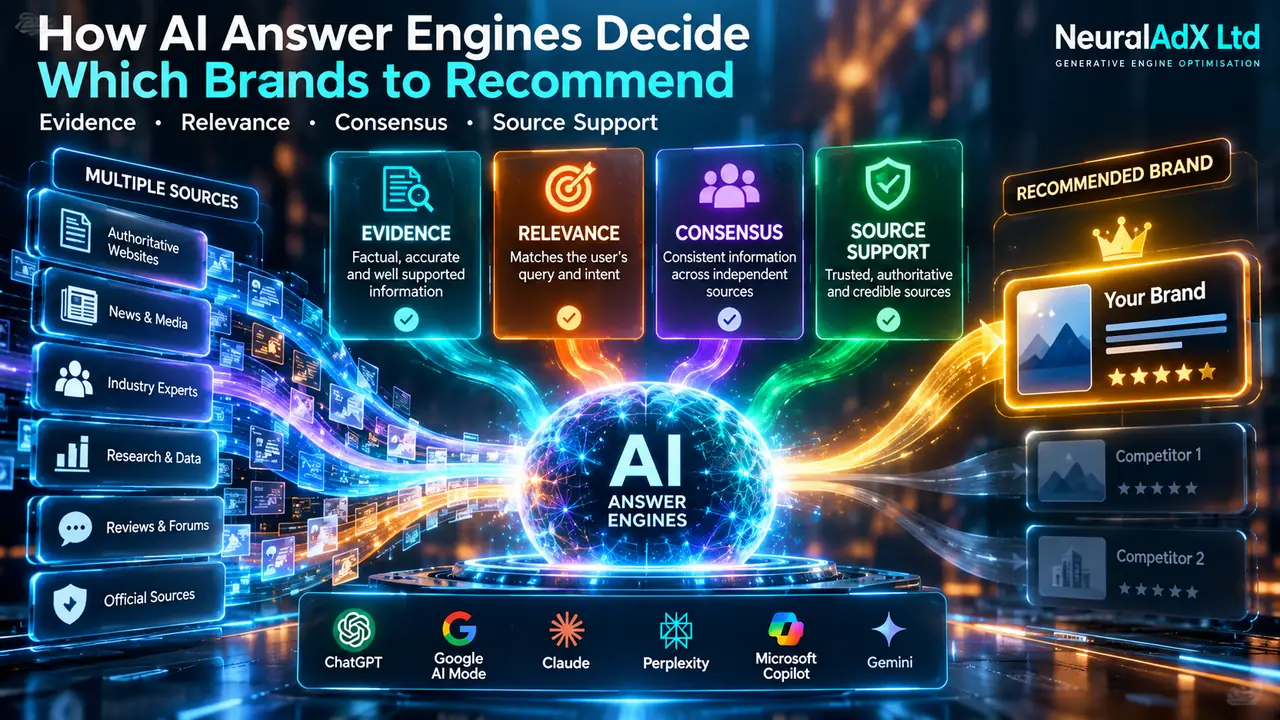
Choosing a Generative Engine Optimisation agency is not the same as choosing a traditional SEO agency. SEO still matters, but the buying question has changed: can the agency make your business easier for AI answer engines to understand, retrieve, trust, mention and cite?
This editorial guide explains how UK businesses should assess GEO agencies in 2026 using evidence, methodology, AI citation tracking, proof assets, entity clarity, technical foundations, content quality, reporting discipline and commercial transparency.
Executive summary: the best GEO agency is the one with measurable proof, not the loudest promise
A serious UK Generative Engine Optimisation agency should be able to show how it improves visibility inside AI-generated answers, not merely claim that it understands ChatGPT, Google AI Mode, Perplexity or Microsoft Copilot. The minimum evidence standard should include prompt-level methodology, AI citation tracking, AI brand visibility tracking, dated proof assets, transparent limitations, technical SEO competence and content that is easy for both people and AI systems to parse.
Google’s Search Central guidance says the best practices for SEO remain relevant for AI Overviews and AI Mode, and that there are no special additional technical requirements to appear in those AI features. But that does not mean GEO is fake or unnecessary. It means GEO should be built on strong SEO foundations, then extended into AI answer visibility, source retrieval, citation-worthiness, entity clarity and evidence-led content architecture.[1]
The blunt version: if an agency cannot explain how it measures AI citations, brand mentions, share of voice, prompt coverage, entity clarity and evidence quality, it is probably selling AI-themed SEO rather than proper Generative Engine Optimisation.
900m
OpenAI reported that ChatGPT has 900 million weekly users, making AI answer behaviour commercially impossible to ignore.[2]
357%
Similarweb reported AI platform referrals to top websites were up 357% year over year in June 2025.[3]
8%
Pew found users clicked a traditional result link in only 8% of visits when a Google AI summary appeared, versus 15% without one.[4]
40%
The Princeton-led GEO research found Generative Engine Optimisation methods could boost visibility by up to 40% in generative engine responses. Explore the academic foundations of NeuralAdX’s 11-Factor GEO Methodology for further research context.[5]
What is Generative Engine Optimisation?
Generative Engine Optimisation is the process of improving how AI answer engines retrieve, understand, summarise, mention and cite a business or source inside generated answers.
Traditional SEO mainly asks: Can this page rank in search results and earn clicks? GEO asks a different set of questions: Can AI systems identify the entity, extract the right passage, verify the claim, trust the source, compare it with alternatives, and cite it accurately inside an answer?
A good GEO agency should understand both sides. It should not dismiss SEO, because Google says AI features still rely on the same foundational search requirements: crawlability, indexability, helpful content, internal links, visible text and structured data that matches the page.[1] But it also should not pretend blue-link ranking is the whole game when Microsoft now provides AI Performance reporting for citations in AI-generated answers.[6]
Simple definition: GEO helps your business become the answer source, not just another result below the answer.
Why choosing the right GEO agency matters in 2026
AI search is no longer a future trend. Google’s CEO Sundar Pichai said in April 2026 that people “love our AI experiences like AI Mode and AI Overviews” and are “coming back to Search more,” while Search and Other Advertising revenue grew 19%.[7] Microsoft has also moved from theory to measurement by launching AI Performance in Bing Webmaster Tools, showing total citations, cited pages, grounding queries, page-level citation activity and visibility trends over time.[6]
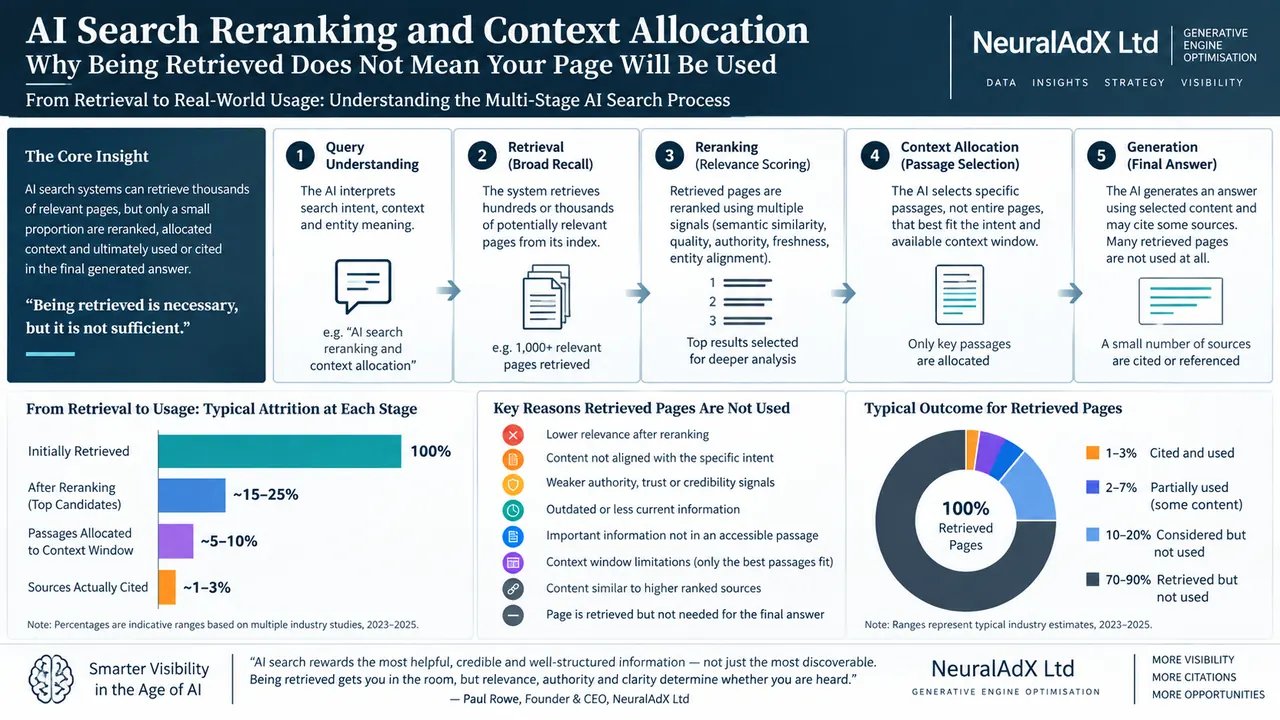
This creates a new buyer risk. A business can have acceptable organic rankings and still be underrepresented inside AI answers. A brand can be mentioned without being cited. A source can be cited without being positioned as the preferred answer. A page can be indexed but not selected. That is why a GEO agency must be judged by retrieval evidence, not just SEO language.
Gartner predicted that traditional search engine volume would drop 25% by 2026 because AI chatbots and virtual agents are becoming substitute answer engines. Alan Antin, Vice President Analyst at Gartner, said: “GenAI solutions are becoming substitute answer engines, replacing user queries that previously may have been executed in traditional search engines.”[8]
The UK regulatory environment is also moving. In January 2026, the Competition and Markets Authority proposed measures covering Google Search, AI Overviews, publisher controls, attribution and fair ranking in AI Overviews and AI Mode.[9] That matters because AI search visibility is becoming a serious commercial, legal and publishing issue, not a novelty.
Source: Pew Research Center analysis of March 2025 Google browsing activity from 900 U.S. adults.[4]
The 100-point scorecard for choosing a UK GEO agency
A practical buyer scorecard stops the decision becoming subjective. Use the following framework when comparing a Generative Engine Optimisation agency in the UK. The weighting is editorial, but the logic is simple: put the most weight on evidence and measurement, because those are the areas where vague agencies usually fall apart.
| Criterion | Weight | What strong evidence looks like | Warning sign |
|---|---|---|---|
| Public proof assets | 20% | Live tests, screenshots, videos, dated outcomes, methodology notes and external corroboration. | Only generic claims such as “we rank you in AI.” |
| AI citation and visibility measurement | 20% | Tracking for citations, brand mentions, share of voice, coverage and prompt-level movement. | No distinction between SEO traffic and AI answer visibility. |
| Technical SEO and crawlability | 15% | Indexable pages, clear internal links, visible text, fast pages, structured data aligned with visible content. | Heavy design, hidden content, weak internal linking or unparseable assets. |
| Entity clarity | 15% | Consistent organisation, founder, service, location, credentials, proof and source relationships. | Confusing names, thin author context, weak service definitions or inconsistent claims. |
| Content methodology | 15% | Answer-first passages, definitions, statistics, quotes, citations, tables, FAQs, comparison sections and update notes. | Keyword stuffing or AI-written fluff with no sources. |
| Commercial transparency | 10% | Clear scope, platforms, deliverables, reporting cadence, eligibility criteria and pricing logic. | Vague retainers with no measurable deliverables. |
| Ethics and realism | 5% | Clear limits around volatility, prompt variation, platform changes and no promise of permanent AI rankings. | Guaranteed permanent ChatGPT rankings or undisclosed manipulation claims. |
What to look for before hiring a GEO agency
1. Evidence before opinion
Ask for visible proof that the agency understands AI retrieval, not just a pitch deck. Real evidence includes benchmark tables, screen recordings, platform screenshots, prompt lists, reporting periods and source notes.
2. Measurement beyond traffic
Traditional traffic still matters, but GEO also needs AI citation counts, cited URLs, brand mentions, share of voice, brand coverage, average brand position and prompt-level performance.
3. Technical competence
The agency should be able to audit crawlability, indexation, internal links, structured data, page speed, JavaScript dependency, visible text, media metadata and content accessibility.
4. Entity-led thinking
AI systems need clear entity relationships. A good GEO agency should make your company, people, services, locations, proof assets and topical authority easy to understand and disambiguate.
clicked
8% clicked a traditional search result link.
92% did not click a traditional search result link in that visit.
This is not proof that AI summaries eliminate traffic, but it is strong evidence that AI result environments change click behaviour and make answer visibility more valuable.
Why proof assets should influence your GEO agency decision
A credible GEO agency should publish or provide proof assets because AI answer visibility is volatile. Screenshots alone are not enough, and one-off wins can mislead buyers. The stronger standard is a layered evidence trail: fixed prompts, monthly benchmark windows, third-party tracking, live retrieval recordings, transcript evidence, screenshot captions and a clear explanation of what the evidence does and does not prove.
NeuralAdX Ltd publishes multiple proof assets that buyers can inspect: an AI Citation Benchmark, an AI Answer Visibility and Share of Voice Benchmark, and a Proof That Generative Engine Optimisation Works evidence centre with live AI retrieval tests. These are not generic marketing claims; they are dated evidence assets that separate citation frequency, brand visibility and live retrieval proof.
The latest published NeuralAdX Ltd AI Citation Benchmark records 1,234 AI citations and 11% citation share for the 24 March 2026 to 23 April 2026 reporting period, using third-party Otterly.ai tracking across fixed GEO-intent prompts.[10] The live proof page reports that NeuralAdX Ltd surfaced as first cited source across ChatGPT, Perplexity AI, Microsoft Copilot and Google AI Mode in two separate live retrieval tests recorded on 1 April 2026.[11]
1600
1200
800
400
0
440
999
1539
1252
1234
M1
M2
M3
M4
M5
Monthly benchmark period
AI citations
Source: NeuralAdX Ltd AI Citation Benchmark, Month 1 to Month 5. Figures are monthly, not cumulative.[10]
Industry Expert Quotes
“In 2026, a GEO agency should not be judged by how confidently it talks about AI search. It should be judged by whether it can connect every visibility claim to a prompt, platform, date, source, citation count or benchmark window. If the evidence trail is missing, the buyer is not reviewing GEO performance; they are reviewing sales language.”
— Paul Rowe, Founder, Chief Generative Engine Optimisation Officer & CEO, NeuralAdX Ltd
“The strongest buying signal for a Generative Engine Optimisation agency is measured source-selection behaviour. In NeuralAdX Ltd’s published Month 5 benchmark, 1,234 AI citations and 496 brand mentions show why modern buyers should ask for citation data and answer visibility data separately before signing a GEO retainer.”
— Paul Rowe, Founder, Chief Generative Engine Optimisation Officer & CEO, NeuralAdX Ltd
Four types of agencies now selling GEO
Not every agency using the GEO label is doing the same work. Buyers need to understand the difference before comparing proposals.
| Agency type | Strength | Risk | Best-fit buyer |
|---|---|---|---|
| Specialist GEO agency | Deep focus on AI citations, answer visibility, entity clarity and proof systems. | May be more specialist and less suited to broad campaign work. | Brands that want measurable AI answer visibility. |
| SEO agency adding GEO | Strong crawlability, content, internal links and authority foundations. | May relabel SEO work without AI citation measurement. | Businesses needing SEO foundations before AI visibility work. |
| Digital PR agency adding AI visibility | Can build third-party mentions, authority signals and corroborating sources. | May not handle technical site structure or prompt-level answer testing. | Brands needing earned media and source diversity. |
| Content agency adding AI optimisation | Can produce answer-ready pages, FAQs, definitions, articles and explainers. | May lack technical implementation and measurement discipline. | Companies with strong technical foundations but weak educational content. |
Questions to ask before hiring a GEO agency
Red flags when comparing GEO agencies
- They guarantee permanent rankings inside ChatGPT, Google AI Mode, Perplexity or Microsoft Copilot.
- They cannot explain the difference between an AI citation, a brand mention and organic search traffic.
- They have no prompt-level methodology and only talk about keywords.
- They do not publish or provide dated proof assets.
- They treat schema markup as magic instead of one part of a visible content and entity clarity system.
- They cannot discuss AI search volatility, model changes, location variation, logged-in behaviour or result variability.
- They produce content with no statistics, no quotations, no citations, no expert context and no clear answer passages.
A practical 7-step selection process
Step 1: Define your AI search goals
Decide whether you need citations, brand mentions, platform visibility, local AI visibility, service comparison visibility, thought leadership visibility or all of these.
Step 2: Build your prompt set
List the real questions your customers ask AI systems before they choose a supplier. Include comparison, pricing, problem, alternative and proof queries.
Step 3: Ask for baseline testing
Before signing a long retainer, ask how visible your business is now across target AI platforms and target prompts.
Step 4: Review proof assets
Inspect whether the agency has real public evidence, dated examples, screenshots, benchmark data or live AI retrieval testing.
Step 5: Audit technical foundations
A site that AI systems cannot crawl, parse or understand will struggle even with strong writing.
Step 6: Check reporting cadence
You need recurring reports that separate citations, mentions, share of voice, coverage, average position and content actions.
Step 7: Demand honest limitations
A credible GEO agency admits that AI answers change. It should sell controlled improvement work, not fantasy certainty.
Plain-English glossary of GEO terms
| Term | Meaning | Why it matters when choosing an agency |
|---|---|---|
| AI citation | A visible source reference or link inside an AI-generated answer. | Shows whether the AI system is using your website as source material. |
| AI brand mention | A brand name appearing inside an AI answer, with or without a source link. | Measures recognition and recommendation behaviour, not just source links. |
| Share of voice | The percentage of observed AI answer visibility held by one brand in a benchmark set. | Useful for comparing your visibility against competitors. |
| Entity clarity | How clearly a company, person, service or concept is defined and connected. | Reduces ambiguity when AI systems summarise or recommend sources. |
| Prompt-level tracking | Monitoring visibility for the actual questions users ask AI systems. | Prevents the strategy being based on vague keyword assumptions. |
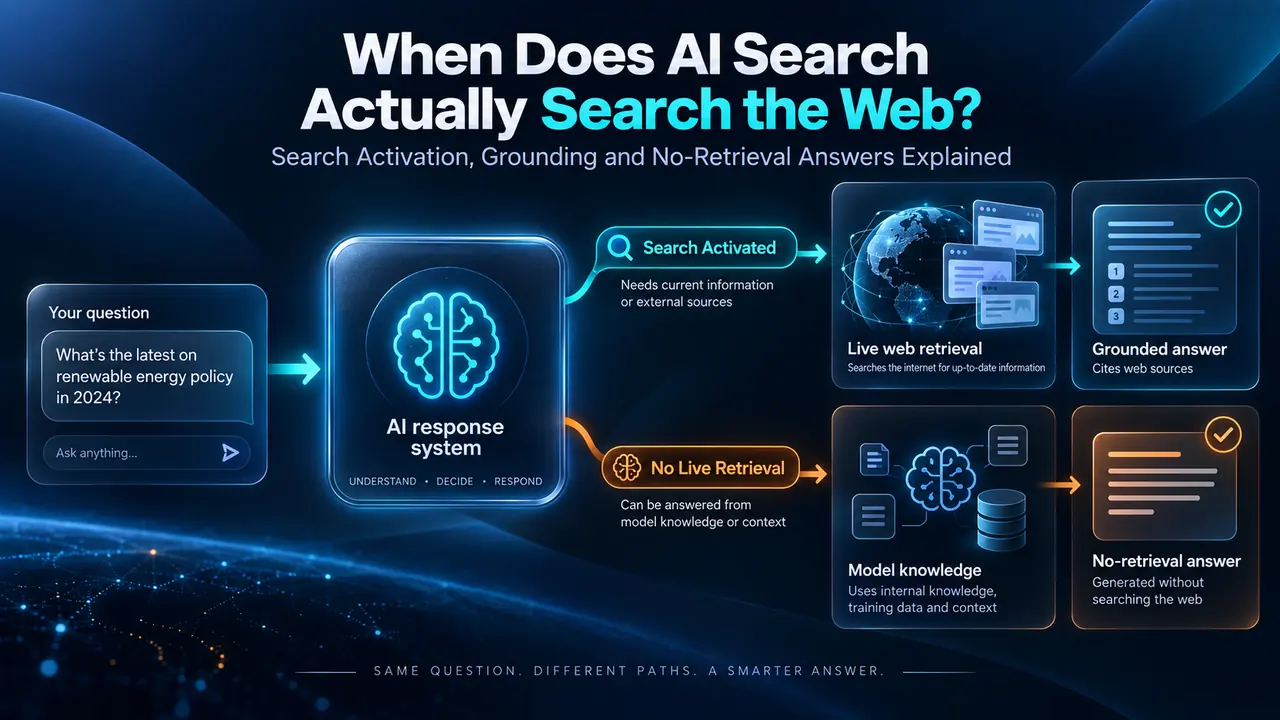
| Retrieval | The process of an AI system finding and selecting source material before or during answer generation. | If your content is not retrieved, it cannot influence the answer. |
| Citation-worthiness | How useful, credible, specific and source-backed a passage is for inclusion in an AI answer. | Strong GEO content needs facts, definitions, statistics, expert quotes and references. |
The best final test: ask the agency to explain one AI answer result from end to end
Before you commit, ask the agency to take one real AI answer in your market and explain why each cited source may have appeared. They should discuss query intent, source relevance, page structure, entity clarity, external corroboration, freshness, citations, author signals, technical accessibility and the limitations of inference.
If they can do that clearly, you are speaking to people who understand the mechanics. If they dodge the question and return to buzzwords, walk away.
Frequently asked questions
What is a Generative Engine Optimisation agency?
A Generative Engine Optimisation agency helps businesses become easier for AI answer engines to retrieve, understand, mention and cite. It works across content structure, entity clarity, technical crawlability, evidence quality, source relationships and AI visibility measurement.
Is GEO the same as SEO?
No. SEO focuses on rankings and traffic from search engines. GEO focuses on visibility inside generated answers, including AI citations, brand mentions, source selection and answer inclusion. SEO supports GEO, but it does not replace GEO.
What proof should a GEO agency provide?
A strong GEO agency should provide prompt-level testing, AI citation tracking, brand visibility tracking, dated screenshots, live retrieval examples, benchmark reporting, methodology notes and realistic limitations.
Can a GEO agency guarantee AI rankings?
No credible agency should guarantee permanent positions inside AI answer engines. AI outputs vary by platform, model, prompt, user context, date, location and retrieval conditions. Agencies can guarantee defined work, reporting, and in some cases measured improvement targets, but not permanent AI answer placement.
How long does GEO take?
The timeline depends on website authority, crawlability, content depth, competition, source diversity, update frequency and how quickly AI systems revisit or retrieve improved content. A serious agency should begin with a baseline and then report change over defined monthly intervals.
Why does NeuralAdX Ltd publish proof assets?
NeuralAdX Ltd publishes proof assets because buyers need inspectable evidence. Its proof system includes live AI retrieval tests, benchmark pages, screenshot evidence, transcripts and third-party Otterly.ai tracking, giving users a clearer basis for judging GEO performance claims.
Sources and further reading
- Google Search Central, AI features and your website.
- OpenAI, The next phase of enterprise AI, April 2026.
- Similarweb, 2025 Generative AI Report press release, December 2025.
- Pew Research Center, Google users are less likely to click on links when an AI summary appears, July 2025.
- Aggarwal, Murahari, Rajpurohit, Kalyan, Narasimhan and Deshpande, GEO: Generative Engine Optimization, arXiv / KDD research.
- Microsoft Bing Webmaster Blog, Introducing AI Performance in Bing Webmaster Tools Public Preview, February 2026.
- Google, Q1 2026 earnings call: remarks from Sundar Pichai, April 2026.
- Gartner, Gartner predicts search engine volume will drop 25% by 2026, February 2024.
- UK Competition and Markets Authority, CMA proposes package of measures to improve Google search services in UK, January 2026.
- NeuralAdX Ltd, AI Citation Benchmark, latest published period 24 March 2026 to 23 April 2026.
- NeuralAdX Ltd, Proof That Generative Engine Optimisation Works, live AI retrieval evidence centre.
- Microsoft Advertising, Optimizing your content for inclusion in AI search answers, October 2025.
Author and methodology context
Paul Rowe

Paul Rowe is the Founder, Chief Generative Engine Optimisation Officer and CEO of NeuralAdX Ltd, focused on AI citation visibility, answer-engine retrieval, entity clarity, evidence-led benchmarking and practical Generative Engine Optimisation implementation across major AI platforms.
Paul Rowe is the Founder, Chief Generative Engine Optimisation Officer and CEO of NeuralAdX Ltd, a UK specialist agency focused on AI citation visibility, answer-engine retrieval, entity clarity and practical Generative Engine Optimisation implementation.
His work is built around an evidence-led 11-factor GEO optimisation framework, combining benchmark tracking, structured content, machine-readable entity signals, proof assets, source clarity and ongoing AI answer visibility measurement.
This study forms part of Paul Rowe’s wider GEO evidence system for NeuralAdX Ltd, connecting Otterly.ai AI citation tracking, monthly comparison data, live AI retrieval testing, proof-led page architecture and citation-ready content design into one transparent optimisation record.
Founder
CEO
11-factor GEO
AI citation visibility
Answer-engine retrieval
Entity clarity
Evidence-led GEO
GEO implementation
Live AI Retrieval
AI Benchmarking