AI Visibility Assessment
NeuralAdX Ltd
Find out if AI is mentioning, citing or ignoring your business
Get a clean starting point before spending money on AI visibility work. NeuralAdX Ltd checks your website against an 11-factor GEO framework and tests five live commercial AI prompts to see whether AI engines mention, cite, recommend or ignore your business.
11-factor GEO review
No obligation
GEO framework factors checked
commercial AI prompts tested live
Recommended first step
Send your request in under two minutes
The email button opens a pre-filled message. Add your website URL, best contact number, five priority AI prompts and any helpful context.
Prefer to talk? Call NeuralAdX Ltd
No obligation. Suitable for businesses considering professional Generative Engine Optimisation service support. You can also review the AI Citation Benchmark, AI Answer Visibility & Share of Voice Benchmark and live AI retrieval proof.
NeuralAdX Ltd Editorial Guide
GEO Audit: The 11-Factor Framework for AI Search Visibility
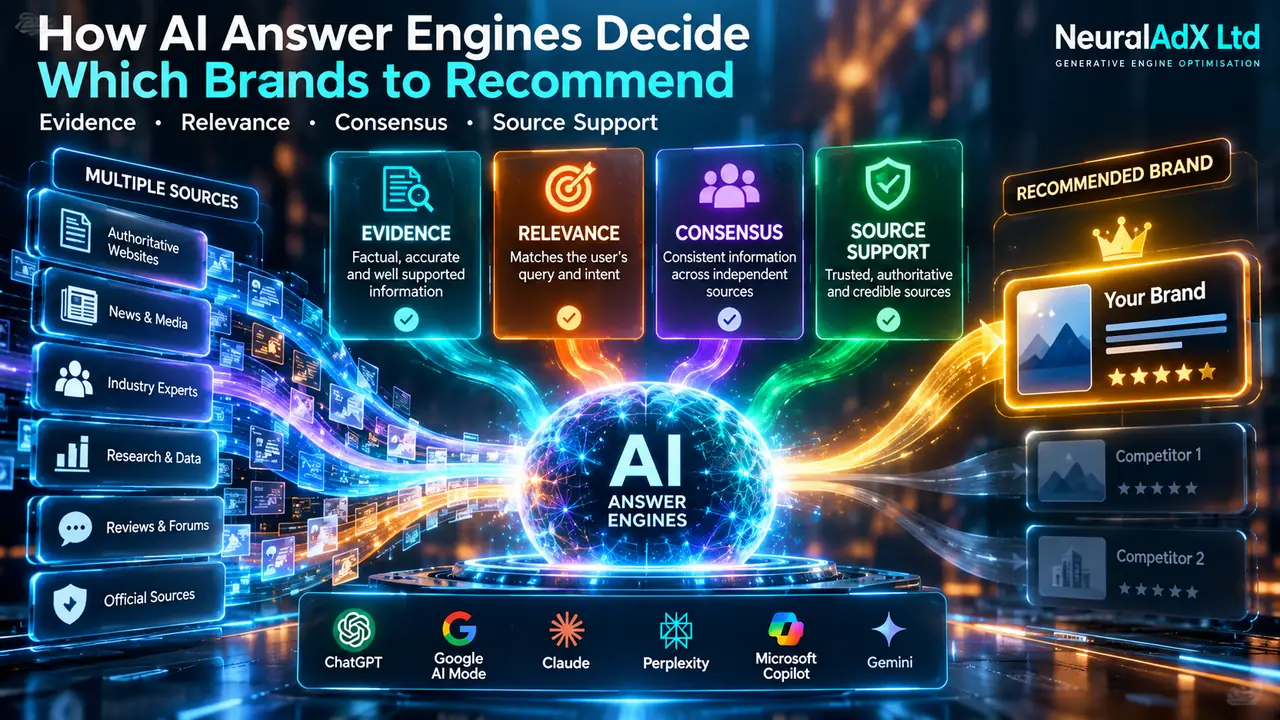
A GEO audit evaluates whether a website is structured, evidenced, readable and machine-understandable enough to be selected, summarised, referenced and cited by generative AI systems. In plain terms: it measures whether your website gives AI answer engines enough trustworthy material to use when forming answers. At NeuralAdX Ltd, that audit is paired with live AI retrieval testing to check how the client’s website is actually surfacing across major AI platforms, not just how well the page looks on paper.
This editorial guide explains the NeuralAdX Ltd 11-factor GEO audit framework in depth: citations, statistics, quotations, fluency, easy-to-understand structure, technical terms and unique words, authority, source diversity, author bios, recency and schema markup. The aim is not to replace SEO. The aim is to extend SEO into the new layer of AI answer visibility where content must be retrievable, attributable and useful inside generated responses. To see how this audit-and-testing workflow fits into service delivery, review the NeuralAdX Ltd Generative Engine Optimisation pricing plans.
What Is a GEO Audit?
A GEO audit is a structured review of how well a website is prepared for Generative Engine Optimisation. It checks whether the content can be discovered, interpreted, trusted and reused by AI answer engines such as ChatGPT search, Google AI Overviews, Google AI Mode, Microsoft Copilot, Bing AI answers, Perplexity and Gemini.
Traditional SEO audits focus heavily on rankings, crawlability, indexation, technical SEO, backlinks, content quality and search intent. Those still matter. A GEO audit goes further. It asks whether each important page contains the evidence, entity clarity, author attribution, structured data, current facts, source diversity and answer-ready formatting that AI systems need when constructing generated responses.
OpenAI states that ChatGPT search provides “fast, timely answers with links to relevant web sources,” while Google explains that AI Overviews and AI Mode surface relevant links and may use query fan-out to identify supporting webpages across subtopics and data sources. Google’s 2026 generative AI optimisation guide also says SEO best practices remain relevant because Google’s generative AI features are rooted in core Search ranking and quality systems, including retrieval-augmented generation and query fan-out. Microsoft has introduced AI Performance in Bing Webmaster Tools, including total citations, cited pages, grounding queries and page-level citation activity. These developments make one thing clear: AI visibility is becoming measurable, and websites need audit frameworks that look beyond classic blue-link rankings. OpenAI ChatGPT search · Google generative AI optimisation guide · Google AI features and your website · Bing AI Performance
Why GEO Audits Matter Now
AI search has changed the visibility problem. A business can rank on Google, yet still be ignored by AI answer engines if its pages are unclear, unsupported, out of date, weakly attributed or difficult to quote. Generative systems do not simply list ten links. They synthesise answers, cite sources, summarise supporting pages and sometimes satisfy the user before a click occurs.
The original academic GEO study found that Generative Engine Optimisation methods could improve source visibility by up to 40% across diverse queries, and that citations, quotations and statistics were among the strongest content improvements. The study’s GEO-bench benchmark included 10,000 queries across diverse domains and sources. That makes evidence-rich content more than a stylistic preference: it is a measurable AI visibility factor. Princeton-led GEO study
There is also a commercial reason to care. Pew Research Center found that users who saw a Google AI summary clicked traditional search result links in 8% of visits, compared with 15% of visits without an AI summary. Pew also found that users clicked links inside the AI summary itself in just 1% of visits to pages with such a summary. This does not mean AI visibility is worthless. It means brand inclusion, citation presence and answer participation now matter even when clicks are compressed. Pew Research Center AI summary click analysis
Similarweb’s 2025 generative AI report estimated that AI platforms generated more than 1.1 billion referral visits in June 2025, up 357% year on year. It also reported that Gen AI average monthly visits grew 76% year on year, app downloads rose 319%, and Gen AI referrals to transactional sites converted at about 7%. That is not “future theory.” It is already a discovery channel. Similarweb 2025 Generative AI report
Current AI Search Data Snapshot
The figures below show why a GEO audit should be treated as a serious website visibility review, not a cosmetic content exercise.
| Evidence point | Statistic | Why it matters for a GEO audit | Source |
|---|---|---|---|
| Google generative AI search guidance | Official Google Search guidance updated in 2026 | Google confirms that AI Overviews and AI Mode depend on core Search systems, crawlable content, useful content, RAG and query fan-out, so GEO audits must still test technical SEO, content quality and retrieval clarity. | Google Search Central |
| GEO content optimisation | Visibility uplift up to 40% | Citations, quotations and statistics can materially change how much a source appears in generated answers. | GEO study |
| Google AI Overviews | 6.49% of queries in Jan 2025, 24.61% in July, 15.69% in Nov | AI answers are volatile, so visibility must be tracked and audited over time. | Semrush AI Overviews study |
| AI summary click behaviour | 8% traditional-result clicks with AI summary vs 15% without one | AI visibility has to be measured as citation, mention and brand presence, not just traffic. | Pew Research Center |
| Generative AI discovery | 1.1B+ AI referral visits in June 2025, up 357% YoY | AI platforms are becoming a measurable discovery layer. | Similarweb |
| Structured data | Schema.org reports 450B+ Schema.org objects across 45M+ domains | Structured data is now a mainstream machine-readable layer, not an experimental add-on. | Schema.org |
Google AI Overview volatility
Bar widths use 24.61% as the maximum in this mini chart.
Jan 2025 — 6.49%
July 2025 — 24.61%
Nov 2025 — 15.69%
Click compression around AI summaries
Bar widths use 15% as the maximum in this mini chart.
Traditional result clicks without AI summary — 15%
Traditional result clicks with AI summary — 8%
Clicks on AI summary links — 1%
GEO visibility improvement findings
Bar widths use 40% as the maximum in this mini chart.
GEO methods across diverse queries — up to 40%
Real-world Perplexity.ai experiment — up to 37%
The NeuralAdX Ltd 11-Factor GEO Audit Framework
The NeuralAdX Ltd framework groups the audit into three practical layers: grounded content, credibility signals and machine-readable clarity. The framework is intentionally evidence-led because AI engines need extractable facts, trustworthy attribution and clear entity relationships before they can reliably include a source in an answer. The 11 factors diagnose whether a page is prepared for AI retrieval; live AI retrieval testing then checks whether that preparation is translating into real-world AI visibility across client-relevant prompts and platforms.
| Layer | Factor | Audit question | Primary evidence base |
|---|---|---|---|
| Grounded content | Citations | Are important claims linked to trustworthy sources? | GEO study, Bing AI Performance, Google helpful content |
| Grounded content | Statistics | Does the page include dated, relevant numbers? | GEO study, Semrush, Pew, Similarweb |
| Grounded content | Quotations | Are expert statements attributed clearly enough to quote? | GEO study, author expertise guidance |
| Credibility signals | Fluency | Is the text polished, coherent and easy to summarise? | GEO study, Nielsen Norman Group |
| Credibility signals | Easy to understand | Can humans and AI systems understand the answer quickly? | GOV.UK content design, WCAG, GEO study |
| Credibility signals | Technical terms and unique words | Does the page use the correct specialist vocabulary without keyword stuffing? | GEO study, Google AI Mode query fan-out |
| Credibility signals | Authority | Does the page demonstrate expertise, experience, authoritativeness and trust? | Google helpful content, Bing search result guidance |
| Credibility signals | Source diversity | Does the page cite varied, high-quality source types? | Google AI features, Bing AI Performance |
| Credibility signals | Author bios | Is the creator identifiable, credible and linked to further evidence? | Google “Who, How and Why” guidance |
| Credibility signals | Recency | Is the page current, accurately dated and materially updated? | Bing AI Performance, Google helpful content |
| Machine-readable layer | Schema markup | Does structured data clarify the page, author, organisation, content type and relationships? | Google structured data, Schema.org |
The audit does not stop at the page score
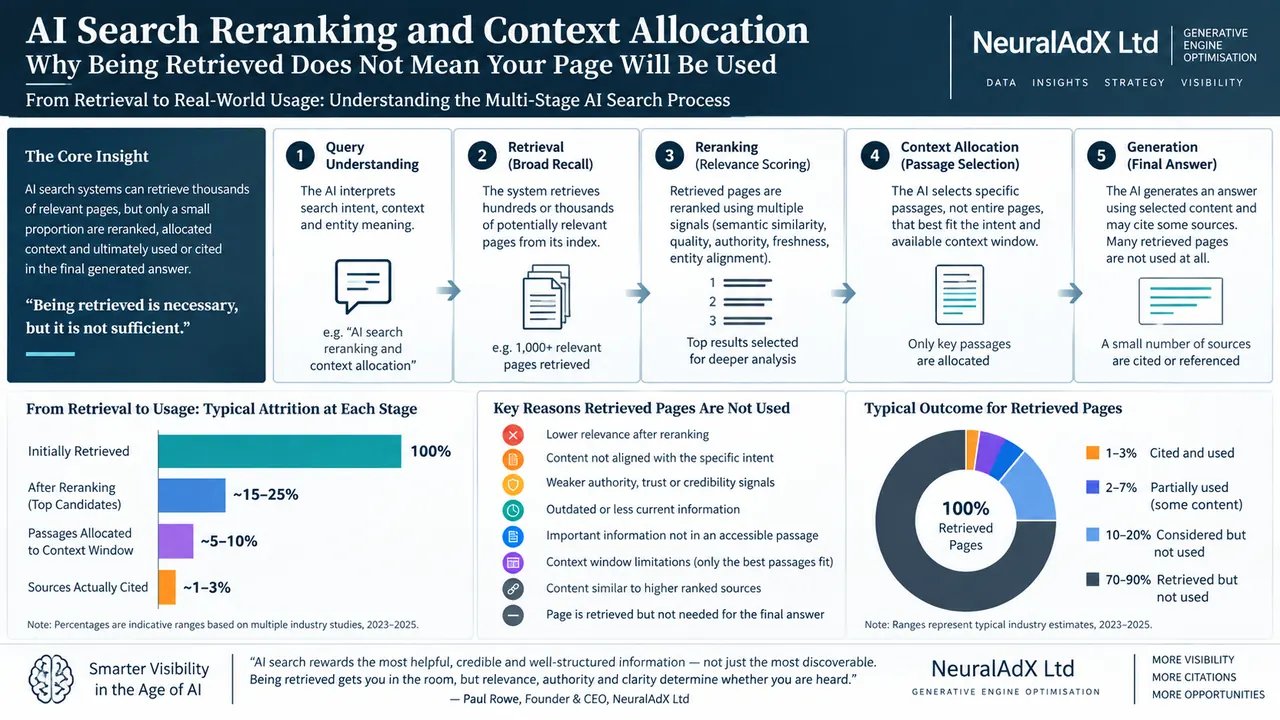
A page can score well against the 11 factors and still fail to surface consistently in live AI answers. That is why NeuralAdX Ltd also uses live AI retrieval testing to test how a client’s website appears across real prompts, real answer engines and real citation behaviour.
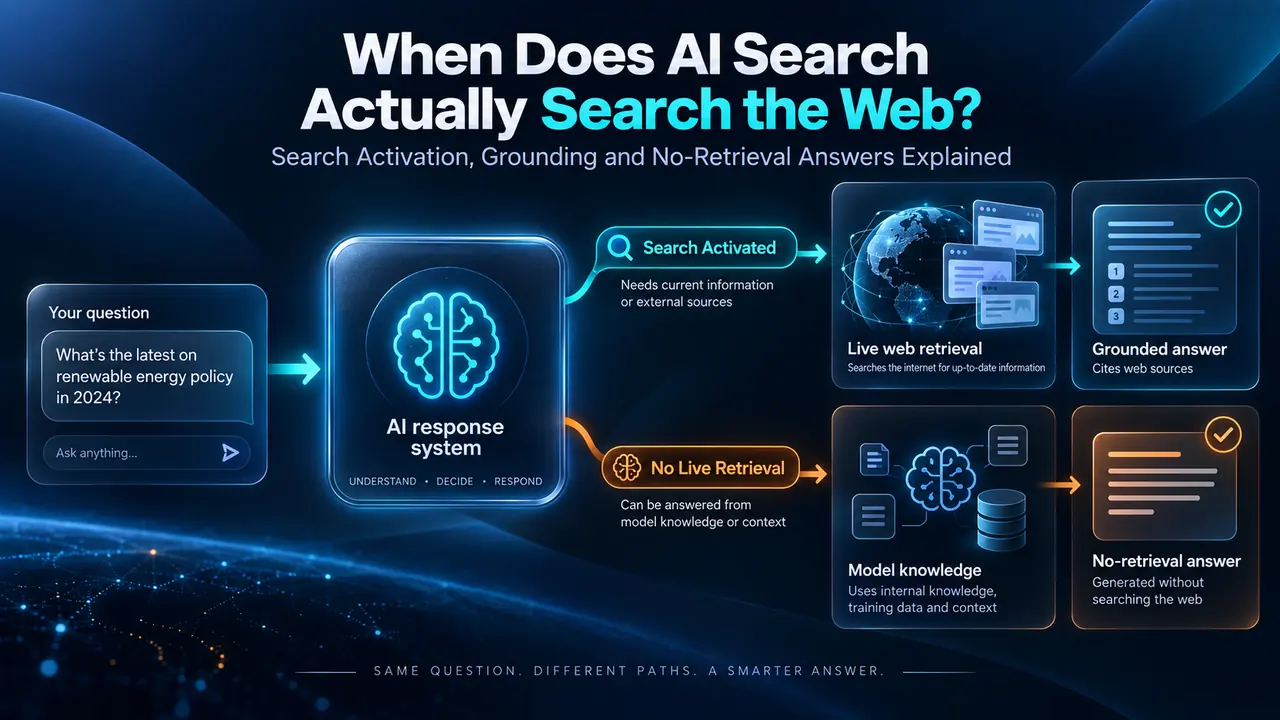
This matters because Google’s 2026 guidance describes generative AI search as using retrieval-augmented generation, query fan-out and supporting links from the Search index, while Microsoft’s Bing AI Performance reporting now measures citations, cited pages and grounding queries. Google generative AI optimisation guide · Bing AI Performance
1. Citations
What the audit checks: whether factual claims, statistics, definitions, market statements, legal references, technical claims and expert assertions are supported by credible, crawlable source links.
Why it matters: the GEO study explicitly identified “Cite Sources” as a tested optimisation method, and OpenAI’s SearchGPT prototype was designed around clear attribution and source links. Google’s own AI features documentation says AI Overviews and AI Mode surface relevant links, while Bing’s AI Performance reporting now measures citations in AI-generated answers. GEO study · OpenAI SearchGPT prototype · Google AI features
Weak signal: claims such as “AI search is changing SEO” or “schema helps AI visibility” appear with no evidence, no source, no date and no context.
Strong signal: major claims are linked to primary sources, authoritative industry research, official platform documentation, academic papers or original NeuralAdX Ltd benchmark pages.
2. Statistics
What the audit checks: whether the page uses quantitative evidence to replace vague claims. Good GEO statistics are dated, relevant, sourced and placed near the claim they support.
Why it matters: the GEO study tested “Statistics Addition” as a specific optimisation method and found that citations, quotations and statistics can significantly boost source visibility. This aligns with how AI systems summarise: precise numbers are easier to extract, compare and quote than generic claims. GEO study
Weak signal: a page says “AI search is growing quickly” without numbers.
Strong signal: a page states that Similarweb estimated more than 1.1 billion AI referral visits in June 2025, up 357% year on year, and links to the original Similarweb announcement. Similarweb
3. Quotations
What the audit checks: whether the page includes short, attributed, citation-ready expert statements that an AI system can safely quote. A strong quotation includes the speaker’s name, role, organisation, context and surrounding evidence.
Why it matters: the GEO study tested “Quotation Addition” and reported strong performance improvements across impression metrics. Quotations help generated answers attribute a claim to a named person instead of treating the page as anonymous text. GEO study
“People rarely read Web pages word by word; instead, they scan the page.”
Jakob Nielsen, usability researcher and co-founder of Nielsen Norman Group Source
Strong signal: expert quotes are embedded naturally near evidence, not dumped into a decorative quote section with no explanatory context.
4. Fluency
What the audit checks: whether the content reads smoothly, avoids clunky repetition, uses clean sentence structure and presents ideas in a logical sequence.
Why it matters: the GEO paper tested “Fluency Optimization” as a specific method. Fluency does not mean sounding clever. It means the text is easy to process, easy to summarise and less likely to be misinterpreted by a reader or model. GEO study
Nielsen Norman Group’s reading research also reinforces why fluency matters for human behaviour: on an average web page, users have time to read at most 28% of the words during an average visit, with 20% more likely. A page that is hard to scan is weak for users and weak for answer extraction. Nielsen Norman Group
Strong signal: each section starts with the answer, then provides evidence, explanation and next action.
5. Easy-to-Understand Structure
What the audit checks: whether the page answers the query directly, defines complex terms, uses headings logically, breaks down concepts and avoids forcing the reader to decode the argument.
Why it matters: the GEO paper tested “Easy-to-Understand” optimisation, while GOV.UK’s content guidance says people read differently on the web than they do on paper. WCAG also treats understandable content as a core accessibility principle. If a page is difficult for people to follow, it is often difficult for AI systems to extract clean answer passages from it. GEO study · GOV.UK writing for the web · WCAG 2.1
Strong signal: the page uses clear H2 and H3 headings, short explanatory paragraphs, tables where comparison helps, FAQs where questions are natural, and definitions where technical terms appear.
6. Technical Terms and Unique Words
What the audit checks: whether the content uses the correct specialist vocabulary for the topic, while avoiding lazy keyword stuffing. For GEO, the page should name the real concepts AI systems need to associate with the entity: retrieval, grounding, citations, structured data, query fan-out, source attribution, entity clarity, author authority and passage-level extraction.
Why it matters: the GEO paper tested both “Unique Words” and “Technical Terms” as distinct content optimisation methods. Google’s AI Mode documentation also describes query fan-out, where Search breaks a question into subtopics and issues multiple related queries. That means topic coverage needs to include the real sub-concepts a model may explore, not just the headline keyword repeated repeatedly. GEO study · Google AI Mode query fan-out
Strong signal: a GEO audit page discusses “AI citation tracking,” “grounding queries,” “structured entity relationships” and “citation-ready passages,” not just “AI SEO” over and over again.
7. Authority
What the audit checks: whether the page demonstrates genuine expertise, original analysis, clear ownership, trusted references and a meaningful reason to exist.
Why it matters: Google’s helpful content guidance asks whether content provides original information, reporting, research or analysis, and whether it shows clear sourcing and author expertise. Bing’s search result guidance also considers ownership transparency and whether original content attributes sources. For AI visibility, authority is not just a backlink metric. It is also whether the page looks safe to use as a source. Google’s updated spam policies also make it clear that attempts to manipulate generative AI responses in Google Search can fall under spam, so ethical GEO should focus on useful, evidence-backed content rather than artificial shortcuts. Google helpful content guidance · Google spam policies · How Bing delivers search results
Strong signal: the page includes original commentary, methodology, benchmark data, author attribution, relevant internal proof pages and credible external support.
8. Source Diversity
What the audit checks: whether a page depends on one narrow source type or uses a balanced source stack: academic studies, official platform documentation, independent research, primary data, standards bodies and original company evidence.
Why it matters: Google says AI features may identify supporting webpages across subtopics and data sources, while Bing’s AI Performance guidance highlights clarity, evidence and content freshness as areas for improvement. A page that cites only one blog or only itself is weaker than a page that connects multiple trusted evidence types. Google AI features · Bing AI Performance
Strong signal: a GEO Audit page cites the Princeton-led GEO study, Google Search Central, OpenAI, Microsoft Bing, Pew Research Center, Similarweb, Schema.org, W3C and relevant NeuralAdX Ltd proof pages.
9. Author Bios
What the audit checks: whether the author or reviewer is clearly identified, whether the byline links to a useful author page, and whether the author page supports the person’s topical authority.
Why it matters: Google’s “Who, How and Why” guidance says it helps readers understand E-E-A-T when it is clear who created the content, and encourages accurate authorship information such as bylines where readers would expect them. This matters for GEO because AI systems are more likely to trust and quote content when the source entity and author entity are clear. Google helpful content guidance
Strong signal: editorial blog posts link to a detailed author bio such as Paul Rowe, Founder, Chief Generative Engine Optimisation Officer and CEO of NeuralAdX Ltd.
10. Recency
What the audit checks: whether the page contains accurate publication and modified dates, whether the statistics are current, whether outdated screenshots or claims have been replaced, and whether the page has been materially updated rather than date-freshened for appearance.
Why it matters: Bing states that accurate and up-to-date content is important for inclusion and citation in AI-generated answers. Google also warns against changing dates to make pages seem fresh when the content has not substantially changed. Recency is not fake freshness. It is maintaining the truth of the page. Bing AI Performance · Google helpful content guidance
Strong signal: every benchmark, table, screenshot, citation and expert quote has a date, source and review rhythm.
11. Schema Markup
What the audit checks: whether the page has appropriate structured data that clarifies the page type, author, publisher, organisation, breadcrumbs, article information, FAQs where valid, images, videos and entity relationships.
Why it matters: Google says structured data provides explicit clues about the meaning of a page, while Schema.org describes itself as a shared vocabulary for structured data across web pages and other applications. Schema.org also reports that more than 45 million domains use Schema.org markup with more than 450 billion Schema.org objects. Google structured data guide · Schema.org
Important distinction: schema markup does not magically force AI engines to cite a page. Its value is that it reduces ambiguity, clarifies entities and gives machines a structured layer to interpret alongside visible content.
Live AI Retrieval Testing: The Layer Beyond the 11-Factor GEO Audit
The 11-factor GEO audit shows whether a page is built correctly for AI visibility. Live AI retrieval testing shows what is actually happening when AI platforms answer commercially important questions. NeuralAdX Ltd uses both because a theoretical page score is not enough. Clients need to know whether their website is surfacing, whether competitors are being selected instead, and which pages are being used or ignored by answer engines.
In practice, this means testing client-relevant prompts across major AI platforms and recording how the website appears: brand mentions, citations, recommended companies, cited URLs, answer position, competitor presence, query wording, and whether the AI system retrieves the client’s evidence pages, service pages, pricing pages, author pages, benchmark pages or glossary resources.
What gets tested
- Priority commercial prompts.
- Brand and competitor visibility.
- AI citations and cited URLs.
- Answer position and recommendation language.
- Whether evidence pages are retrieved.
Why it matters
- It validates the audit against real AI answers.
- It exposes platform-by-platform visibility gaps.
- It shows which pages AI systems trust enough to use.
- It helps prioritise fixes by commercial impact.
Authority support
Google describes AI Mode and AI Overviews as using supporting links, query fan-out and retrieval from its Search index, while Microsoft’s AI Performance dashboard reports citations, cited pages and grounding queries. OpenAI also documents crawler and user-agent behaviour that affects how sites and content may be accessed by OpenAI products. Google AI features · Bing AI Performance · OpenAI crawlers
How this connects to NeuralAdX Ltd pricing
NeuralAdX Ltd service plans combine GEO audit work with ongoing measurement, benchmark tracking and live AI retrieval testing so clients can see how their website is surfacing in AI platforms over time. Review the NeuralAdX Ltd Generative Engine Optimisation pricing page to compare how the audit, testing and measurement workflow fits into the Core, Pro and Elite service options.
Industry Expert Quotes
The following citation-ready quotes are written for use within the page as expert commentary from Paul Rowe. They are structured with a named expert, job role, numerical reference points and clear topical relevance.
“A serious GEO audit should not ask whether a page ‘sounds good’. It should test whether the page satisfies all 11 retrieval signals: citations, statistics, quotations, fluency, clarity, technical vocabulary, authority, source diversity, author bios, recency and schema markup. Then it should be validated with live AI retrieval testing to see whether the client’s website is actually surfacing in AI answers. If three or four of those signals are missing, the page is not fully prepared for AI answer visibility.”
Paul Rowe, Founder, Chief Generative Engine Optimisation Officer and CEO, NeuralAdX Ltd
“In the NeuralAdX Ltd audit model, the three highest-weighted content signals are citations, statistics and quotations, each carrying a 1.5x weighting. That weighting reflects a simple principle: AI engines need evidence they can verify, numbers they can extract and expert statements they can attribute.”
Paul Rowe, Founder, Chief Generative Engine Optimisation Officer and CEO, NeuralAdX Ltd
How a GEO Audit Should Be Scored
A strong GEO audit should not be vague. It should score each page against observable signals, then prioritise fixes by commercial value and retrieval importance. NeuralAdX Ltd typically treats the 11 factors as a page-level audit model rather than a single sitewide opinion, then uses live AI retrieval testing to check whether the scored pages are appearing in real AI answers, citations and recommendations.
| Score band | Interpretation | Typical page condition | Recommended action |
|---|---|---|---|
| 0–40 | Weak GEO readiness | Thin, unsupported, generic or hard to parse. | Rebuild structure, evidence and entity clarity. |
| 50–69 | Moderate GEO readiness | Some helpful information, but weak evidence or attribution. | Add citations, statistics, author signals and clearer sections. |
| 70–84 | Strong GEO readiness | Good structure and credibility, but still missing advanced retrieval signals. | Improve source diversity, schema, expert quotes and freshness. |
| 85–100 | Excellent GEO readiness | Evidence-rich, current, clearly authored, structured and answer-ready. | Monitor AI citations, run live AI retrieval tests, update evidence and maintain benchmark proof. |
Practical GEO Audit Checklist
Use this checklist to review a high-value page before trying to improve AI search visibility.
Grounding checks
- Every major claim has a source.
- Statistics are dated and linked.
- Expert quotes include name, role and context.
- Source links are visible and crawlable.
Retrieval checks
- The page answers the main query directly.
- Headings are descriptive and semantic.
- Definitions appear near first use.
- Tables summarise comparison-heavy information.
Authority checks
- The author or reviewer is named.
- The author bio supports topical expertise.
- The page includes original insight or methodology.
- The content is not just a rewrite of other sources.
Live retrieval checks
- Priority prompts are tested across relevant AI platforms.
- Client brand mentions and competitor mentions are recorded.
- Cited URLs, answer position and recommendation language are tracked.
- Findings are connected back to page-level 11-factor fixes.
Technical checks
- The page can be indexed and shown with a snippet.
- Robots rules do not block key AI/search crawlers unintentionally.
- Schema markup reflects visible content only.
- Dates, images, videos and author data are consistent.
What a GEO Audit Should Deliver
A useful GEO audit should leave the business with more than a score. It should identify which pages are most important for AI search visibility, which prompts or questions matter commercially, which pages are already being cited or mentioned, which pages are weak, and which specific 11-factor improvements should be made first.
At NeuralAdX Ltd, the best use of a GEO audit is to connect page-level fixes to measurable outcomes: AI citations, brand mentions, share of voice, brand coverage, cited URLs, grounding queries, benchmark movement and live AI retrieval test results over time. That is the difference between “AI SEO advice” and a real Generative Engine Optimisation workflow. It gives clients a practical view of how their website is surfacing in AI platforms, where competitors are being selected instead and which fixes should be prioritised next.
Explore the Generative Engine Optimisation service, compare the NeuralAdX Ltd GEO pricing plans, review the AI Citation Benchmark, compare the AI Answer Visibility and Share of Voice Benchmark, or watch the Proof That Generative Engine Optimisation Works.
Frequently Asked Questions About a GEO Audit
What is the difference between a GEO audit and an SEO audit?
An SEO audit checks whether a site can rank, be crawled, be indexed and satisfy search intent. A GEO audit checks whether the site can be retrieved, understood, trusted, quoted, summarised and cited by AI answer engines.
Does a GEO audit guarantee AI citations?
No. No ethical GEO audit can guarantee AI citations because AI platforms use changing retrieval, ranking and generation systems. A strong audit improves the conditions that make citation more likely: evidence, clarity, authority, freshness, source diversity and machine-readable structure.
Which pages should be audited first?
Start with pages that affect revenue, authority and entity clarity: the homepage, main service pages, pricing pages, proof pages, author pages, benchmark pages, comparison pages, glossary hubs and high-intent blog posts.
Is schema markup enough for GEO?
No. Schema markup is only one of the 11 factors. It helps machines understand the page, but weak visible content, missing citations, no author authority, stale statistics and poor structure can still reduce AI answer visibility.
Does NeuralAdX Ltd only run a page audit, or does it test live AI visibility?
NeuralAdX Ltd uses both. The 11-factor GEO audit checks whether the page is built correctly for AI retrieval, while live AI retrieval testing checks how the client’s website is surfacing in actual AI platform answers. The pricing page explains how this audit, testing and measurement workflow fits into the service plans: NeuralAdX Ltd Generative Engine Optimisation pricing.
How often should a GEO audit be repeated?
For competitive commercial pages, a monthly or quarterly review is sensible because AI answer visibility changes as platforms update retrieval systems, competitor pages improve, citations shift and fresh evidence becomes available.
Sources and References
This compact source list supports the GEO audit framework, live AI retrieval testing, AI citation tracking, structured data, content clarity and AI search visibility claims made on this page.
AI search and GEO
Google generative AI search optimisation · Google AI features · GEO academic study · Bing AI Performance
OpenAI and crawler access
OpenAI ChatGPT search · OpenAI SearchGPT prototype · OpenAI crawlers and user agents
Market data and behaviour
Pew Research Center · Semrush AI Overviews study · Similarweb Generative AI report
Structured data and trust
Google structured data guide · Schema.org · Google helpful content guidance · Google spam policies
Readability and accessibility
Nielsen Norman Group reading research · GOV.UK writing for the web · WCAG 2.1
Search quality and attribution
Author and methodology context
Paul Rowe

Paul Rowe is the Founder, Chief Generative Engine Optimisation Officer and CEO of NeuralAdX Ltd, focused on AI citation visibility, answer-engine retrieval, entity clarity, evidence-led benchmarking and practical Generative Engine Optimisation implementation across major AI platforms.
Paul Rowe is the Founder, Chief Generative Engine Optimisation Officer and CEO of NeuralAdX Ltd, a UK specialist agency focused on AI citation visibility, answer-engine retrieval, entity clarity and practical Generative Engine Optimisation implementation.
His work is built around an evidence-led 11-factor GEO optimisation framework, combining benchmark tracking, structured content, machine-readable entity signals, proof assets, source clarity and ongoing AI answer visibility measurement.
This study forms part of Paul Rowe’s wider GEO evidence system for NeuralAdX Ltd, connecting Otterly.ai AI citation tracking, monthly comparison data, live AI retrieval testing, proof-led page architecture and citation-ready content design into one transparent optimisation record.
Founder
CEO
11-factor GEO
AI citation visibility
Answer-engine retrieval
Entity clarity
Evidence-led GEO
GEO implementation
Live AI Retrieval
AI Benchmarking