AI Visibility Assessment
NeuralAdX Ltd
Find out if AI is mentioning, citing or ignoring your business
Get a clean starting point before spending money on AI visibility work. NeuralAdX Ltd checks your website against an 11-factor GEO framework and tests five live commercial AI prompts to see whether AI engines mention, cite, recommend or ignore your business.
11-factor GEO review
No obligation
GEO framework factors checked
commercial AI prompts tested live
Recommended first step
Send your request in under two minutes
The email button opens a pre-filled message. Add your website URL, best contact number, five priority AI prompts and any helpful context.
Prefer to talk? Call NeuralAdX Ltd
No obligation. Suitable for businesses considering professional Generative Engine Optimisation service support. You can also review the AI Citation Benchmark, AI Answer Visibility & Share of Voice Benchmark and live AI retrieval proof.
NeuralAdX Ltd editorial guide
How to audit whether AI systems mention, cite or ignore your business
An AI visibility audit checks whether platforms such as ChatGPT and Google AI Mode can find your brand, understand what you do, compare you accurately against competitors, cite your website, and recommend your business for commercially relevant prompts. It is not a vanity exercise. It is a practical diagnostic for whether your company exists inside the new answer layer of search.
Primary market focus: United Kingdom
Reading time: 14 minutes
What is an AI visibility audit?
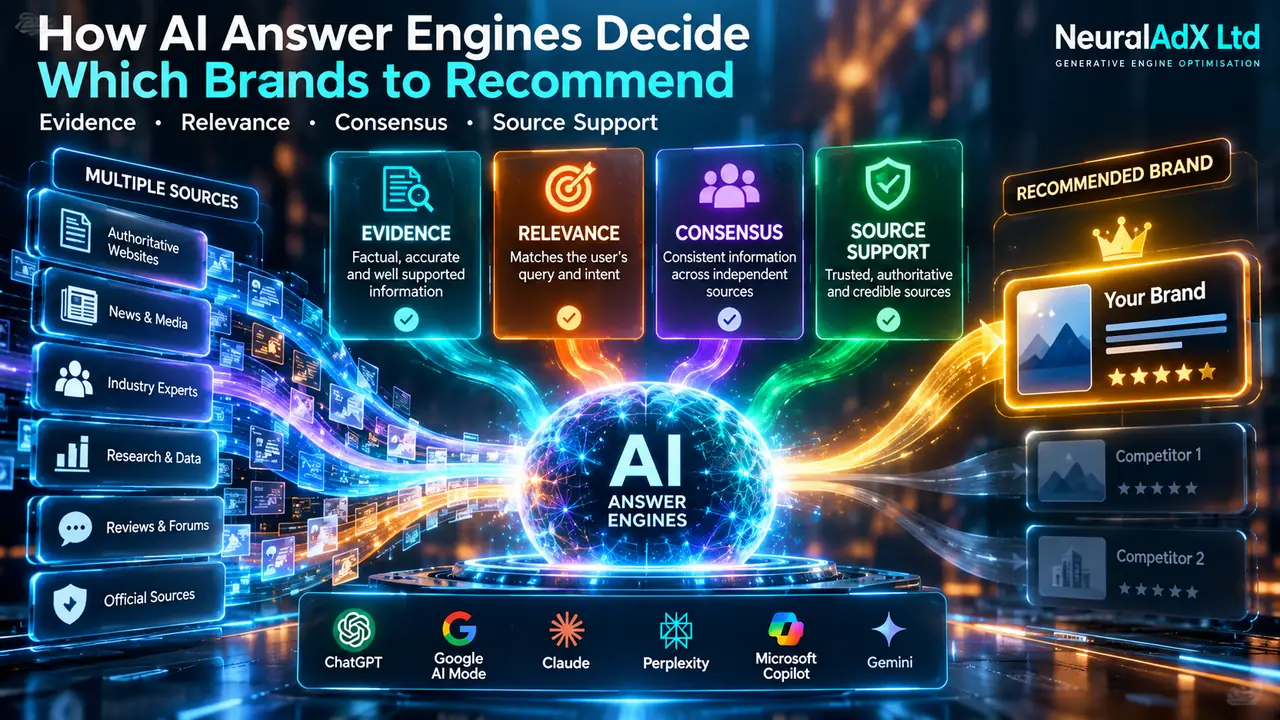
An AI visibility audit is a structured test of whether AI answer engines mention your business for the questions your buyers are already asking. It looks beyond classic rankings and asks a harder commercial question: when someone asks ChatGPT or Google AI Mode for advice, suppliers, agencies, products, comparisons, pricing guidance or trusted options in your market, does your business appear?
The audit should record five outcomes: whether your brand is absent, merely mentioned, described accurately, cited with a supporting source, or recommended as a relevant option. A useful audit also records which competitors appear instead, what source pages the AI relies on, and whether the answer frames your business positively, neutrally, incorrectly or not at all.
Why AI visibility matters now
The UK search environment has moved from a page of links to an answer layer. Ofcom reported in April 2026 that 54% of UK adults now use AI tools such as ChatGPT, Copilot or Gemini, with adoption rising to 79% among 16 to 24-year-olds and 74% among 25 to 34-year-olds. That makes AI visibility a mainstream discovery issue, not a niche technical curiosity.
Search itself is also changing. Ofcom’s Online Nation 2025 update reported that Google Search is used by 82% of UK adults, handles around 3 billion UK searches a month, and AI Overviews now appear on about 30% of searches. The same Ofcom update said ChatGPT received 1.8 billion UK visits in the first eight months of 2025, compared with 368 million in the same period of 2024.
For businesses, this means a prospect may never start with your homepage. They may start with a prompt: “best provider near me”, “which company should I use for this problem?”, “compare these suppliers”, or “who has evidence this works?” If your brand is absent from that answer, your website may be technically live but commercially invisible.
Chart metadata: values come from Ofcom’s UK adult media and online habits reporting, Ofcom’s Online Nation 2025 search update, and ONS Business Insights data published in January 2026.
Industry Expert Quotes
“If 54% of UK adults now use AI tools and AI Overviews appear on about 30% of searches, a business that never audits AI visibility is measuring yesterday’s market. The new commercial question is not only ‘do we rank?’ It is ‘are we retrieved, cited and recommended when buyers ask AI for help?’”
“A proper AI visibility audit should test at least five commercial prompts before drawing conclusions, because one prompt is a snapshot, not a pattern. At NeuralAdX Ltd, we combine live prompt testing with an 11-factor GEO framework so businesses can see whether AI understands the entity, trusts the evidence and surfaces the brand.”
The practical AI visibility audit method
A serious audit should be repeatable. The point is not to ask one flattering question and declare success. The point is to build a small evidence set that shows how answer engines treat your brand across buyer-intent prompts, problem-led prompts, comparison prompts and location-sensitive prompts.
| Score | AI outcome | What it means | Business risk |
|---|---|---|---|
| 0 | Absent | Your business is not mentioned for relevant prompts. | Competitors may control the AI answer set. |
| 1 | Mentioned | The brand appears, but without clear proof or supporting source. | Weak commercial influence. |
| 2 | Described accurately | The answer understands your category, service area and offer. | Useful but still not necessarily persuasive. |
| 3 | Cited | The AI uses your website or another credible source as evidence. | Strong authority signal if the source is accurate. |
| 4 | Recommended | The AI selects your business as a relevant option for the user’s problem. | Highest commercial visibility, but still requires conversion tracking. |
How to check whether ChatGPT mentions your business
ChatGPT visibility needs to be tested with real buyer prompts, not vanity prompts. OpenAI reported in January 2026 that ChatGPT has over 700 million weekly active users. Ofcom’s UK figures show the same direction locally, with ChatGPT UK visits rising sharply in 2025. The commercial issue is simple: if buyers increasingly use ChatGPT as a research assistant, your business needs to know whether it appears in that research path.
- Start with neutral commercial prompts. Do not include your brand name. Ask the kind of question a buyer would ask before choosing a supplier.
- Test location and category variations. For a UK business, include UK, city, region and sector variants where relevant.
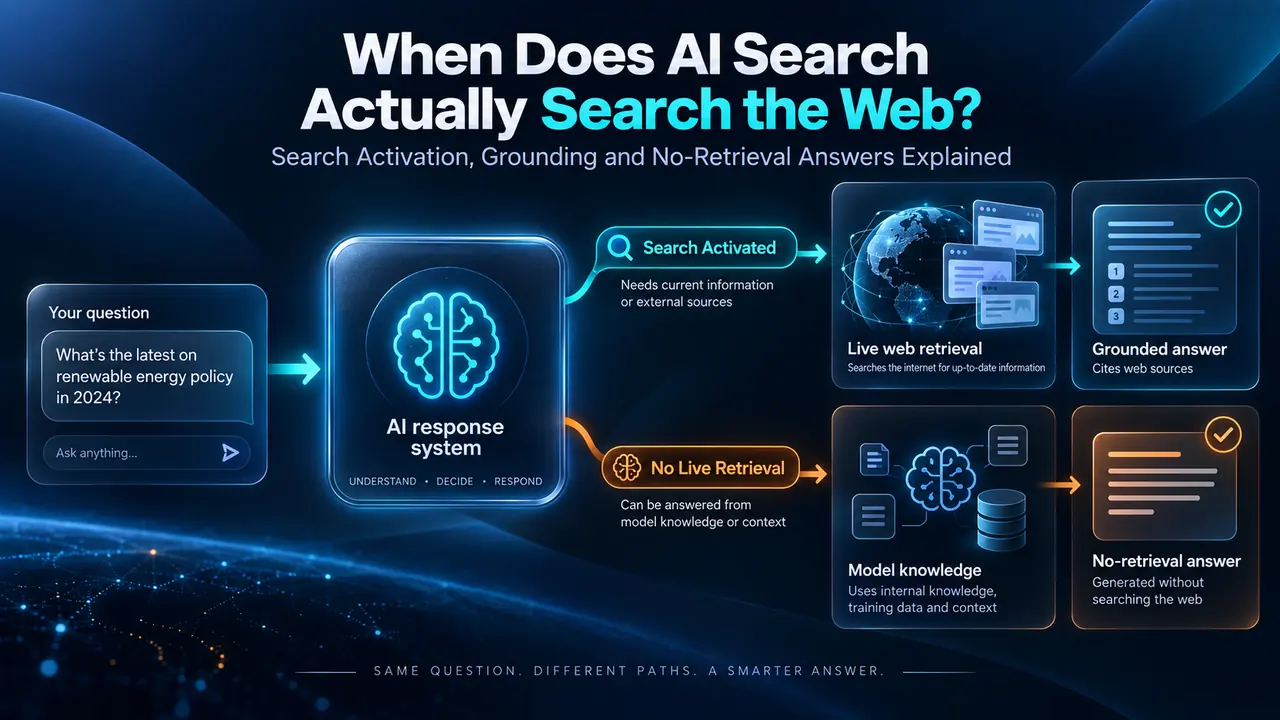
- Record whether ChatGPT uses live web sources. Separate model-memory answers from web-grounded answers with visible source links.
- Capture competitors. If your brand is missing, write down who appears and what evidence the AI uses for them.
- Repeat the same prompt set monthly. AI visibility is unstable. A single test is not enough to show trend, durability or citation stability.
| Prompt type | Example | What to record |
|---|---|---|
| Commercial shortlist | Which companies should I consider for [service] in the UK? | Brands listed, order, citations and reasoning. |
| Problem-led | How do I solve [pain point] for a [business type]? | Whether your offer is retrieved naturally. |
| Comparison | Compare the strongest providers for [service] and explain the evidence. | How the AI frames proof, expertise and trust. |
| Brand-specific validation | Is [business name] credible for [service]? | Accuracy, sentiment, source quality and missing context. |
How to check whether Google AI Mode mentions your business
Google made AI Mode available in the UK in July 2025, describing it as useful for complex, multi-part questions and saying early AI Mode users asked questions two or three times the length of traditional search queries. That matters because longer prompts often reveal commercial intent, constraints and comparison behaviour that traditional keyword tools can miss.
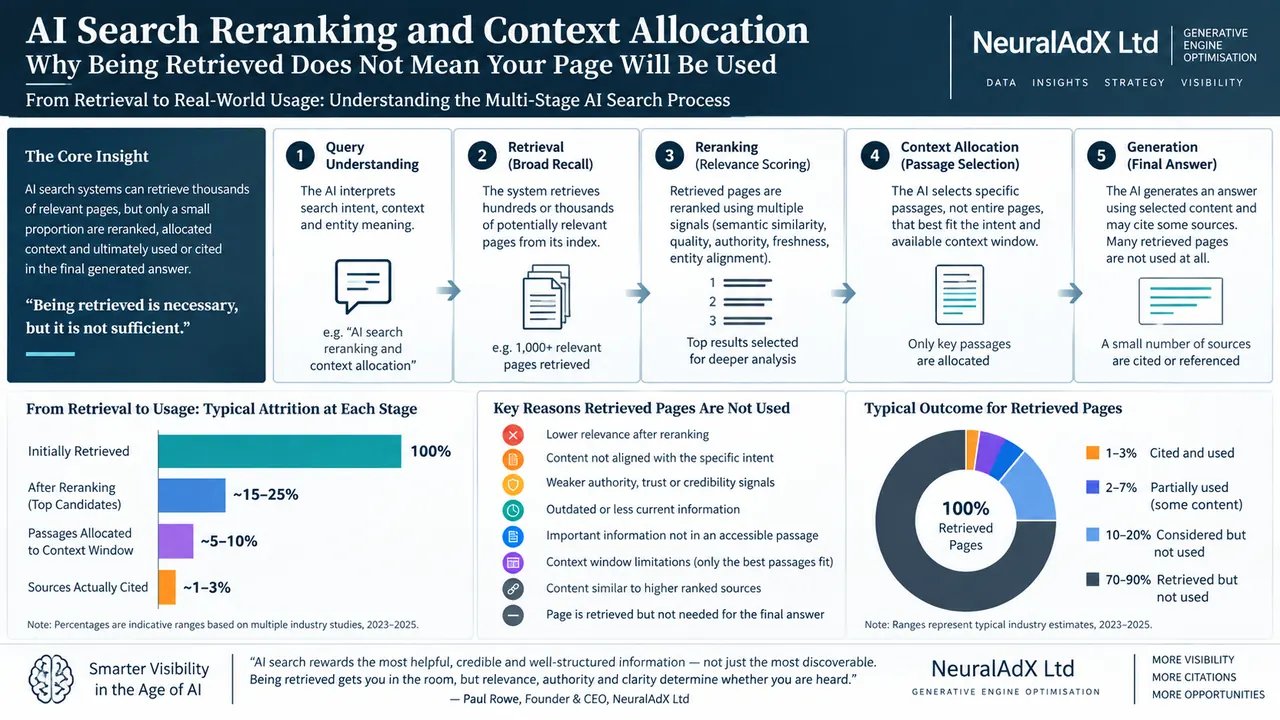
Google Search Central says AI Overviews and AI Mode can use query fan-out, where Google issues multiple related searches across subtopics and data sources to build a response. For an audit, this means you should not only check whether your homepage ranks. You should check whether the wider evidence ecosystem around your brand is clear, crawlable and internally connected.
1. Run the same buyer prompts
Use the same prompt set in Google AI Mode that you use in ChatGPT, then record which brands appear and which supporting links are shown.
2. Compare AI Mode with classic search
AI Mode may surface a different set of links from traditional rankings, so compare both before deciding what visibility you actually have.
3. Check Search Console carefully
Google says AI feature appearances are included in Search Console’s overall Web search reporting, so use it as a signal, not a complete AI visibility report.
Important context: the UK’s Competition and Markets Authority proposed measures in January 2026 requiring greater transparency around Google’s ranking in AI Overviews and AI Mode, and better attribution for publisher content in AI results. The CMA noted that Google handles more than 90% of UK general search queries and that over 200,000 UK firms spent more than £10 billion on Google search advertising last year. That regulatory focus is a strong signal that AI search visibility is becoming a business transparency issue.
Why one prompt is not enough
AI answers are probabilistic, prompt-sensitive and context-sensitive. A brand may appear for one prompt and disappear for another. It may be cited for a narrow educational query but absent from a commercial shortlist. It may rank in classic Google Search but fail to appear in Google AI Mode because the AI is pulling together a different blend of sources.
Recent research reinforces the need for repeated testing. Nielsen Norman Group’s 2026 research found that users choose generative AI for exploratory, multi-constraint research, but still return to traditional search when accuracy and trust are critical. That means AI visibility and traditional SEO are complementary, not interchangeable. Your audit should measure both answer presence and source credibility. The user behaviour is mixed, so your measurement should be mixed too.
What the chart means
The blue portion represents the 54% of UK adults Ofcom reported as using AI tools such as ChatGPT, Copilot or Gemini. The remaining portion represents adults not included in that reported user group. For business visibility, this is enough adoption to justify regular prompt-based auditing.
NeuralAdX Ltd
Get a free AI visibility audit assessment
If you want a clean starting point, NeuralAdX Ltd can check your website against an 11-factor GEO framework and test five live commercial AI prompts to see whether AI mentions, cites, recommends or ignores your business.
Send your request in under two minutes
The email button opens a pre-filled message. Add your website URL, best contact number, five priority AI prompts and any helpful context.
No obligation. Suitable for businesses considering professional Generative Engine Optimisation service support. You can also review the AI Citation Benchmark, AI Answer Visibility & Share of Voice Benchmark and live AI retrieval proof.
What to look for after the audit
The audit result should tell you what to fix next. Generative Engine Optimisation is the practical work of making your brand easier for AI systems to understand, retrieve, trust, cite and recommend. That includes clearer entity information, better source pages, stronger evidence, crawlable text, consistent author and company signals, and content that answers buyer questions directly.
| Audit finding | Likely cause | Next action |
|---|---|---|
| Brand absent | Weak entity clarity, thin evidence or low source coverage. | Build clearer service, author, proof and comparison pages. |
| Mentioned but not cited | AI recognises the entity but lacks a strong supporting source. | Publish citation-ready pages with statistics, methodology and evidence. |
| Wrong description | Conflicting signals across your site, profiles or third-party mentions. | Align company descriptions, service labels and author information. |
| Competitors dominate | Their evidence ecosystem is easier for AI to retrieve. | Create proof-led pages and improve internal links around commercial prompts. |
The common mistakes that make AI audits unreliable
- Testing only your brand name. That checks recognition, not commercial discovery.
- Using one prompt. One answer does not prove visibility, invisibility or trend.
- Ignoring competitors. If you do not record who appears instead, you do not know the source gap.
- Treating classic SEO rankings as a complete proxy. Google says AI Mode and AI Overviews may use different models and techniques, so links can vary from classic search results.
- Skipping evidence capture. Screenshots, dates, prompts, locations and answer URLs are essential if you want repeatable benchmarking.
A simple 30-day AI visibility audit plan
Week 1: Baseline
Choose 10 prompts, run them in ChatGPT and Google AI Mode, capture every answer, source and competitor mention.
Week 2: Source gap
Identify which pages, profiles, reviews, benchmarks or guides AI systems use for competitors but not for your brand.
Week 3: Fix signals
Improve pages that clarify who you are, what you do, who leads the company, what proof exists and why the service matters.
Week 4: Retest
Run the same prompts again, compare movement and record whether mentions, citations, recommendations or answer framing changed.
How this connects to Generative Engine Optimisation
AI visibility audit is the diagnostic. Generative Engine Optimisation is the improvement process. The audit tells you whether AI systems can find and trust the brand. GEO improves the signals that make retrieval, citation and recommendation more likely.
In plain English, GEO means making your business easier for AI answer engines to understand. That does not mean stuffing pages with acronyms. It means publishing clear answers, strong evidence, consistent entity information, credible author details, visible methodology, source-backed claims and internal links that help AI systems connect your services, proof, people and topics.
For platform-specific next steps, see NeuralAdX Ltd’s guides on how to optimise your website for ChatGPT and how to optimise your website for Google AI Mode. For terminology, the Generative Engine Optimisation Glossary Hub explains the concepts in more detail.
Frequently asked questions
Can Google Search Console show AI Mode and AI Overview visibility separately?
Google says appearances in AI features are included in the overall Search Console Performance report under the Web search type. That is useful, but it is not the same as a full AI visibility audit because it does not give a complete prompt-by-prompt view of whether your brand was recommended, cited or absent.
Is an AI mention the same as an AI citation?
No. A mention means the AI named the brand. A citation means the AI used a source as supporting evidence. Citations are usually stronger because they show a traceable source path, although the source still needs to be accurate and relevant.
How often should a business run an AI visibility audit?
Monthly is sensible for competitive markets because AI answers, source selection and platform behaviour can change. The same prompt set should be repeated so you can compare movement rather than rely on isolated screenshots.
Does traditional SEO still matter for AI visibility?
Yes. Google says SEO fundamentals remain relevant for AI features in Search. But AI visibility also depends on entity clarity, evidence quality, citation-ready pages, source diversity and whether the answer engine can understand and trust your business in context.
Sources and evidence used
This article uses UK-heavy sources wherever possible, with source links kept visible for readers and AI systems. Key sources include:
- Ofcom Adults’ Media Use and Attitudes 2026 release for UK adult AI tool usage.
- Ofcom Online Nation 2025 search update for Google Search usage, AI Overview exposure and ChatGPT UK visits.
- Office for National Statistics Business Insights, January 2026 for UK business AI adoption.
- Google UK announcement of AI Mode for AI Mode availability and longer query behaviour.
- Google Search Central AI features documentation for AI Mode, AI Overviews, query fan-out, eligibility and Search Console measurement notes.
- UK Competition and Markets Authority January 2026 Google search services proposals for transparency, attribution and fair ranking context.
- Nielsen Norman Group 2026 research on generative AI and search behaviour for user behaviour around AI exploration and trusted-source checking.
- OpenAI ChatGPT usage and adoption patterns at work for ChatGPT scale and workplace adoption context.
Author and methodology context
Paul Rowe

Paul Rowe is the Founder, Chief Generative Engine Optimisation Officer and CEO of NeuralAdX Ltd, focused on AI citation visibility, answer-engine retrieval, entity clarity, evidence-led benchmarking and practical Generative Engine Optimisation implementation across major AI platforms.
Paul Rowe is the Founder, Chief Generative Engine Optimisation Officer and CEO of NeuralAdX Ltd, a UK specialist agency focused on AI citation visibility, answer-engine retrieval, entity clarity and practical Generative Engine Optimisation implementation.
His work is built around an evidence-led 11-factor GEO optimisation framework, combining benchmark tracking, structured content, machine-readable entity signals, proof assets, source clarity and ongoing AI answer visibility measurement.
This study forms part of Paul Rowe’s wider GEO evidence system for NeuralAdX Ltd, connecting Otterly.ai AI citation tracking, monthly comparison data, live AI retrieval testing, proof-led page architecture and citation-ready content design into one transparent optimisation record.
Founder
CEO
11-factor GEO
AI citation visibility
Answer-engine retrieval
Entity clarity
Evidence-led GEO
GEO implementation
Live AI Retrieval
AI Benchmarking