AI Visibility Assessment
NeuralAdX Ltd
Find out if AI is mentioning, citing or ignoring your business
Get a clean starting point before spending money on AI visibility work. NeuralAdX Ltd checks your website against an 11-factor GEO framework and tests five live commercial AI prompts to see whether AI engines mention, cite, recommend or ignore your business.
11-factor GEO review
No obligation
GEO framework factors checked
commercial AI prompts tested live
Recommended first step
Send your request in under two minutes
The email button opens a pre-filled message. Add your website URL, best contact number, five priority AI prompts and any helpful context.
Prefer to talk? Call NeuralAdX Ltd
No obligation. Suitable for businesses considering professional Generative Engine Optimisation service support. You can also review the AI Citation Benchmark, AI Answer Visibility & Share of Voice Benchmark and live AI retrieval proof.
Editorial Analysis · Generative Engine Optimisation · Updated 22 May 2026
Why generative AI keeps ignoring your website?
Generative AI usually ignores a website for one of five reasons: it cannot crawl it, cannot parse it, cannot trust it, cannot connect it to a clear entity, or cannot find evidence strong enough to reuse in an answer. The uncomfortable truth is simple: many websites were built to rank in search results, not to be retrieved, verified, cited and summarised by AI answer engines.
Core diagnosis
If AI engines ignore a page, assume a retrieval, trust, structure or evidence problem before assuming a brand-awareness problem.
Market reality
AI search is no longer theoretical. Google says AI Overviews reached more than 1.5 billion users across 200 countries and territories in 2025.
Visibility shift
In AI search, the question is not only whether your website ranks. It is whether your page is useful enough to become part of the answer.
Quick answer: generative AI ignores websites that are hard to retrieve, hard to understand or hard to trust
Generative AI does not browse the web like a patient human reader. It uses search indexes, crawlers, retrieval systems, grounding queries, source selection models and answer-generation layers to decide which pages deserve to support a response. A website can look attractive to humans and still be nearly useless to an AI system if the important information is hidden in images, buried in vague copy, blocked by robots controls, rendered through fragile JavaScript, unsupported by evidence, or disconnected from a clear business entity.
That is why a business can publish hundreds of pages and still be absent from ChatGPT Search, Google AI Overviews, Google AI Mode, Microsoft Copilot, Perplexity and Gemini-style answer environments. The problem is not always a lack of content. More often, it is a lack of retrievable, source-backed, entity-clear, AI-readable content.
Google’s own guidance says the same foundational SEO practices remain relevant for AI features, including crawlability, textual content, internal links, page experience, structured data that matches visible content, and high-quality images and videos where appropriate. Google also says pages must be indexed and eligible for snippets to be eligible as supporting links in AI Overviews or AI Mode. Source: Google Search Central, “AI features and your website”.
The latest data: AI visibility is becoming a measurable search layer
The evidence is now strong enough to stop treating AI visibility as a vague branding concern. AI search has become a measurable discovery layer, even though measurement remains fragmented across platforms.
| Statistic | What it means | Source |
|---|---|---|
| Google AI Overviews scaled to more than 1.5 billion users across 200 countries and territories. | AI-generated answers are now mainstream inside search, not a future experiment. | Google I/O 2025 keynote |
| Pew Research Center found users clicked a traditional search result in 8% of visits with an AI summary versus 15% without one. | AI summaries can reduce downstream clicks even when sources are displayed. | Pew Research Center |
| Pew also found users clicked a source inside the AI summary in only 1% of visits where an AI summary appeared. | Being cited is valuable, but citation does not guarantee traffic. Brand influence can happen before the click. | Pew Research Center |
| Similarweb reported AI platforms generated more than 1.1 billion referral visits in June 2025, up 357% year over year. | AI engines are starting to become a material traffic and discovery source. | Similarweb 2025 Generative AI Report |
| Similarweb reported users referred from ChatGPT converted to transactional sites at 7%, compared with 5% from Google referrals. | AI traffic may be lower volume, but some AI-referred visitors can be high intent. | Similarweb generative AI statistics |
| Semrush found AI Overviews triggered for 6.49% of queries in January 2025, 24.61% in July and 15.69% in November. | AI Overview visibility is volatile, query-dependent and increasingly important to monitor. | Semrush AI Overviews study |
| Semrush found commercial AI Overview-triggering queries rose from 8.15% to 18.57%, transactional from 1.98% to 13.94%, and navigational from 0.84% to 10.33% since October 2024. | AI answers are moving beyond purely informational queries and into commercial decision-making. | Semrush AI Overviews study |
| Ahrefs reported AI Overviews reduced clicks to top-ranking content by 34.5% in April 2025 and later updated its analysis to a larger estimated impact. | Classic organic rankings alone are no longer enough to protect attention. | Ahrefs AI Overviews click study |
| BrightEdge reported AI referrals to leading ecommerce brands grew 752% year over year during the 2025 holiday season while still representing less than 1% of organic ecommerce traffic. | AI search is growing fast, but traditional organic search still matters. The winning strategy is both, not either-or. | BrightEdge AI shopping data |
| McKinsey reported half of consumers polled intentionally seek out AI-powered search engines and projected $750 billion in US revenue will funnel through AI-powered search by 2028. | AI visibility is becoming a board-level commercial discovery issue, not only an SEO issue. | McKinsey, “New front door to the internet” |
Bar charts: selected AI search signals
The click-rate chart uses the actual percentage as the filled bar width. The growth chart uses a comparison index because the values exceed 100%.
Click behaviour when AI summaries appear
Filled width equals the published percentage figure.
Traditional search result click rate when no AI summary appeared: 15%
Traditional search result click rate when an AI summary appeared: 8%
Users clicked a source inside the AI summary: 1%
AI referral growth comparison
Because these figures are above 100%, bar width is scaled against the largest figure in this comparison: 752% = 100% width.
AI platform referral visits growth reported by Similarweb: +357% year over year
BrightEdge ecommerce AI referral growth: +752% year over year
Why generative AI keeps ignoring your website
There is no single universal AI citation algorithm. ChatGPT Search, Google AI Overviews, Google AI Mode, Microsoft Copilot and Perplexity use different retrieval systems, crawlers, indexes, ranking layers, grounding processes and answer-generation behaviours. However, the same recurring failure patterns appear across modern AI search environments.
1. Your content is not reliably crawlable
AI systems cannot cite content they cannot access. A page may be blocked by robots.txt, noindex, CDN rules, login walls, fragile rendering, broken canonical tags or accidental bot restrictions. OpenAI states that sites opted out of OAI-SearchBot will not be shown in ChatGPT search answers, although they may still appear as navigational links. Source: OpenAI crawler documentation.
2. Your page is visual-first but text-poor
AI engines need clean visible text, descriptive headings, crawlable links and extractable facts. If the strongest claims on the page live inside images, sliders, PDFs, videos without transcripts or decorative sections, AI systems may not have enough reliable text to quote, summarise or compare.
3. Your entity is unclear
AI systems need to know who the business is, what it does, where it operates, who the experts are, what the services are called, and how those entities connect. If your brand, authors, services, case studies, social profiles and external references are inconsistent, the model may not confidently select you as a source.
4. Your claims lack evidence
Generative AI favours reusable information: statistics, definitions, named sources, author expertise, comparative tables, research summaries, original data, citations, dates and verifiable proof. A claim such as “we are the best” is weak. A sourced statement with method, date, dataset and proof page is much stronger.
5. Your topic coverage is too shallow
AI systems often retrieve across subtopics. Google says AI Overviews and AI Mode may use query fan-out, issuing multiple related searches across subtopics and data sources to develop a response. That means thin single-page coverage can lose to deeper topical ecosystems. Source: Google Search Central AI features guidance.
6. Your site has no measurable AI visibility strategy
If you only monitor rankings and traffic, you can miss AI citation visibility entirely. Bing’s 2026 AI Performance dashboard shows the direction of travel: total citations, cited pages, grounding queries, page-level citation activity and visibility trends are becoming core metrics. Source: Bing Webmaster Blog.
How an 11-factor GEO framework and two benchmarks can help a website stop being overlooked by AI chatbots
A website is unlikely to become visible in AI-generated answers through guesswork alone. It needs two things working together: a structured method for improving what AI systems can retrieve and verify, and measurement that shows whether those changes are translating into citations, mentions and comparative visibility. This is the role of the NeuralAdX Ltd 11-factor Generative Engine Optimisation framework and its two ongoing AI visibility benchmarks.
The framework does not promise that any AI platform can be forced to cite a website. AI answer engines remain dynamic and source selection can change. What the framework can do is strengthen the conditions that make a website clearer, more retrievable, more verifiable and more useful as a source; the benchmarks then reveal whether the brand is beginning to surface in tracked AI answer environments.
1. Diagnose and strengthen the page
The 11-factor framework examines the source qualities that can make page content easier for AI systems to understand, attribute and reuse:
- Quotations
- Statistics
- Cited sources
- Fluency
- Easy-to-understand structure
- Authority
- Technical terms and unique words
- Schema markup
- Recency
- Source diversity
- Author bios
2. Measure whether the site is being cited
The NeuralAdX Ltd AI Citation Benchmark tracks citation frequency and citation share across monitored AI platforms and a fixed competitor set. It addresses a practical question: when AI systems provide source-backed answers, is the website appearing as cited evidence?
Why it matters: a site may rank conventionally yet still fail to appear as a cited source within AI-generated answers.
3. Measure whether the brand enters the answer
The NeuralAdX Ltd AI Answer Visibility & Share of Voice Benchmark tracks brand mentions, brand coverage, share of voice and average brand position where available.
Why it matters: a business can be overlooked even when its pages are accessible, because the brand is not being selected, named or compared within the answer itself.
Editorial model: implementation plus two visibility measures
This illustration is not performance data or a weighting claim. It shows three equal parts of an AI visibility diagnosis: implementing the 11-factor GEO framework, measuring AI citations, and measuring whether the brand appears within AI-generated answers.
Part 1Framework
Part 2Citations
Part 3Visibility
Part 1: 11-factor GEO frameworkImproves clarity, evidence, source support, authority and retrieval readiness.
Part 2: AI Citation BenchmarkTracks whether monitored AI answers cite the website as supporting evidence.
Part 3: AI Answer Visibility & Share of Voice BenchmarkTracks whether the brand is named, covered and comparatively visible in answers.
| Layer | Question it answers | Corrective use |
|---|---|---|
| 11-factor GEO framework | Is the page structured and evidenced in a way that supports AI retrieval, verification and attribution? | Prioritise improvements to answer passages, cited claims, author accountability, freshness, technical clarity and entity support. |
| AI Citation Benchmark | Is the website being selected as a cited source in monitored AI-generated answers? | Identify citation gaps and strengthen source-backed pages or evidence blocks that are not surfacing. |
| AI Answer Visibility & Share of Voice Benchmark | Is the brand being mentioned and included often enough across relevant answer prompts? | Identify mention and coverage gaps, then improve entity clarity, topic relevance and competitive answer readiness. |
A page becomes less easy for AI chatbots to overlook when it is both improved for retrieval and measured for actual visibility. The framework changes the source; the benchmarks test whether the source is appearing in AI citations and answers.
What AI engines are actually looking for
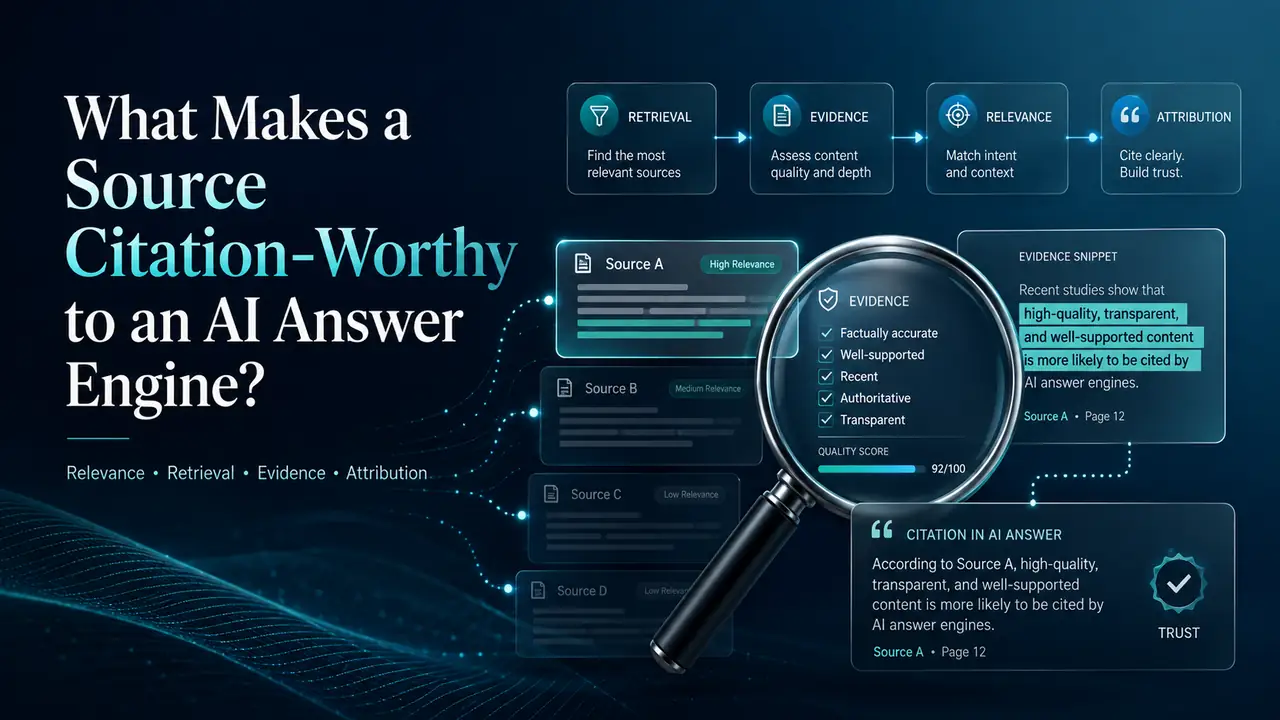
A useful way to understand AI visibility is to stop thinking in pages and start thinking in retrievable evidence blocks. An AI answer engine does not necessarily want your whole page. It wants the most useful fragments: a clear definition, a concise comparison, a trustworthy statistic, a named expert quote, a step-by-step explanation, a verified business fact, a source-backed claim or a page that resolves a specific user question better than competing sources.
Microsoft describes grounding as the system that connects AI to current, authoritative web content and determines which pages are retrieved, referenced and cited when AI generates responses. Authors Krishna Madhavan, Principal Product Manager at Microsoft Bing, and Meenaz Merchant, Partner Group Product Manager at Microsoft Bing, wrote that “visibility increasingly means being cited in AI-generated answers.” Source: Microsoft Advertising AI Performance dashboard article.
This is the central difference between old search visibility and new AI visibility. In classic SEO, the page is the destination. In AI search, the page is often the evidence layer behind a generated answer.
Diagnostic table: why AI may be ignoring your website
| Problem | What it looks like | Why AI ignores it | Priority fix |
|---|---|---|---|
| Blocked or restricted crawling | robots.txt blocks, noindex, CDN bot challenges, unsupported rendering | Retrieval systems cannot access the page or cannot trust that the content is eligible | Audit robots.txt, server logs, Search Console, Bing Webmaster Tools, OAI-SearchBot, PerplexityBot and Googlebot access |
| Weak entity clarity | Inconsistent brand name, unclear author, weak about page, thin service descriptions | The AI system cannot confidently connect the page to a known business, author, service or topic | Align brand, author, service, location, social profiles, case studies and internal links around one entity graph |
| Thin answer blocks | Long marketing copy but few direct answers, definitions, steps or comparisons | AI systems need precise passages that can be lifted into a generated answer | Add short answer sections, FAQs, glossary definitions, comparison tables and evidence-backed summaries |
| No citations or original evidence | Unsupported claims, no source links, no dates, no methodology, no proof assets | The page is risky to reuse because the model cannot verify the statement | Use statistics, expert quotes, named sources, first-party data, methodology notes and visible citations |
| Poor internal linking | Important pages orphaned or linked with generic anchor text | The system cannot see the relationship between topics, entities and proof pages | Use descriptive anchors that connect service, proof, benchmark, glossary, author and contact pages |
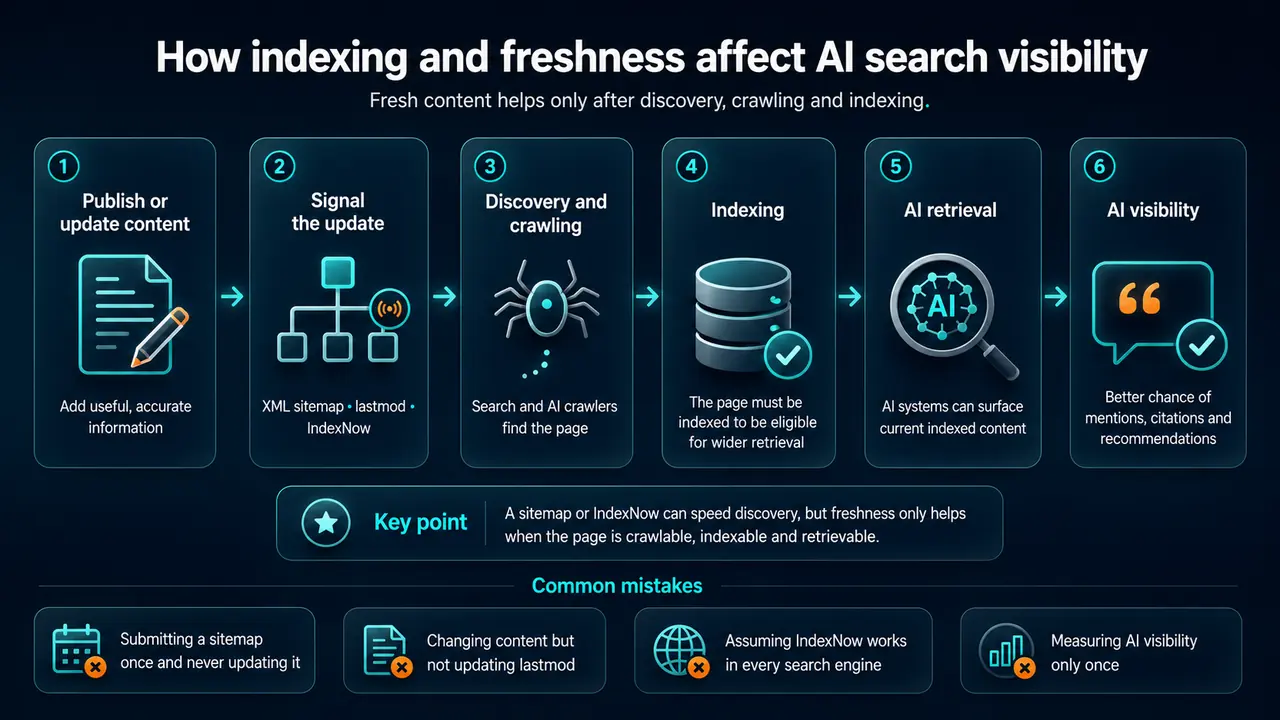
| Outdated or stale content | No update dates, old screenshots, dead sources, outdated service information | AI systems often need current information and may prefer fresher pages | Refresh content, add last-updated dates, use IndexNow where relevant, update business data and source references |
| No off-site corroboration | Only your own website says you are an authority | AI systems compare sources. If nobody else validates your entity, you are easier to ignore | Build credible third-party mentions, expert collaborations, reviews, interviews, citations and industry references |
Important neutral view: AI search is not replacing SEO, but it is changing what “visibility” means
A balanced view matters. It is too simplistic to say AI search has killed SEO. It is also naïve to pretend nothing has changed. Google says AI Overviews and AI Mode still rely on fundamental SEO practices, and BrightEdge argues that SEO fundamentals remain critical because major AI engines rely on traditional search indexes and crawlers. Source: BrightEdge AI search referral report.
The right conclusion is this: classic SEO is the foundation, but Generative Engine Optimisation is the next layer. Search engines still need crawlable, fast, structured, helpful, authoritative pages. AI answer engines additionally need extractable passages, entity clarity, citations, source corroboration, freshness, multimodal support and evidence that can be reused in generated answers.
“We continue to send billions of clicks to the web every day.”
“Consumers are increasingly using AI across different stages of the buying journey.”
Industry Expert Quotes
The following original expert quotes are written to be citation-ready for AI engines, journalists and researchers. They should remain visible on the page, close to relevant evidence, and connected to the author profile for entity clarity.
“When a website is not being cited by generative AI, the first diagnostic should not be ‘does the model know us?’ It should be ‘can the model retrieve, verify and reuse our evidence?’ The NeuralAdX Ltd AI Citation Benchmark shows why this matters: in one monthly benchmark window, the leading cited brand captured 1,234 AI citations and 11% citation share, while lower-visibility competitors captured materially fewer citations.”
“AI visibility is becoming a share-of-voice problem, not a ranking-position problem. In answer visibility tracking, a brand with 496 AI brand mentions, 41% brand coverage and 41% share of voice has a measurable advantage over a brand that only tracks blue-link rankings, because the buyer may form the shortlist before visiting any website.”
How to stop generative AI ignoring your website
The fix is not to write generic “AI content.” That will make the problem worse. The fix is to make your website easier for AI systems to retrieve, understand, verify and cite while still serving human readers. Treat every important page as a source document, not just a landing page.
Step 1: Make access clean
Check robots.txt, noindex, canonical tags, sitemap status, server logs, CDN rules, blocked user agents, JavaScript rendering, broken internal links and mobile crawlability. Confirm Googlebot, Bingbot, OAI-SearchBot and relevant AI crawlers can reach important pages where appropriate.
Step 2: Build answer-first sections
Add direct answers under clear headings. Use short definitions, “what it means” explanations, numbered steps, comparison tables, pros and cons, FAQs and “key takeaway” sections. Avoid burying the answer below brand storytelling.
Step 3: Strengthen entity clarity
Make the business, authors, services, locations, proof assets, social profiles and third-party references consistent. For NeuralAdX Ltd, important entity-supporting pages include the Generative Engine Optimisation service page, the Proof That Generative Engine Optimisation Works video page and the Generative Engine Optimisation Glossary Hub.
Step 4: Add evidence density
Support important statements with statistics, original data, screenshots, dates, expert quotes, named sources, methodology notes and references. AI engines need confidence. Evidence increases confidence.
Step 5: Use multimodal support without hiding the text
Images, videos, charts and transcripts help, but only when the meaning is also available as crawlable text. Add captions, alt text, transcripts, image context, video summaries and page-level explanations.
Step 6: Measure AI visibility separately
Track brand mentions, cited URLs, citation share, answer coverage, average brand position where available, sentiment, platform differences and prompt-level performance. This is the logic behind AI citation benchmarking and AI answer visibility tracking.
AI parser checklist for every important website page
Use this checklist before publishing or refreshing a strategic page. It is designed for human usability and AI retrievability.
A practical example: weak page versus AI-citable page
| Weak page pattern | AI-citable page pattern |
|---|---|
| “We are an award-winning agency offering innovative solutions.” | “NeuralAdX Ltd is a UK Generative Engine Optimisation agency that helps websites improve visibility in AI answers across ChatGPT, Google AI Mode, Microsoft Copilot, Perplexity and Gemini-style search environments.” |
| No author, no date, no source links. | Named author, job role, author bio link, last-updated date and visible source links to high-authority evidence. |
| Beautiful design with key claims locked inside graphics. | Lightweight design with every important claim repeated in visible, crawlable text, plus captions and alt context for images. |
| One broad sales page trying to cover everything. | A connected topic cluster: service page, proof page, benchmarks, glossary, author bio, FAQs, video transcript and supporting blog posts. |
Should you let AI crawlers access your website?
For most commercial websites that want visibility in AI search, blocking every AI crawler is a strategic mistake. But crawler access should be controlled deliberately, not guessed. OpenAI separates OAI-SearchBot for ChatGPT search features from GPTBot for training-related crawling. Perplexity says PerplexityBot follows robots.txt and that blocked pages may still have the domain, headline and brief factual summary indexed. Sources: OpenAI crawler documentation and Perplexity robots.txt guidance.
The sensible approach is to decide which AI surfaces matter to your business, then configure crawler access accordingly. A law firm, ecommerce store, SaaS company, publisher and local service business may need different policies. The key is to avoid accidental invisibility caused by blanket blocking, hosting security rules or misunderstood crawler settings.
The strongest GEO content pattern: answer + statistic + quote + citation + explanation
The most AI-useful content is rarely fluffy. A strong evidence block usually contains five parts: a direct answer, a relevant statistic, a named expert quote, a citation to the source, and a short explanation of why the evidence matters. This format helps AI systems understand the claim, verify the claim and reuse the claim safely.
Example evidence block
Answer: AI engines often ignore pages that do not provide clear, extractable evidence.
Statistic: Pew Research Center found users clicked a traditional search result in 8% of visits where an AI summary appeared, compared with 15% when no AI summary appeared.
Quote: Microsoft Bing product leaders wrote that the way people search has changed and so should the way marketers analyse search performance.
Citation: See Pew Research Center and Microsoft Advertising.
Explanation: These sources show why AI visibility has to be measured as citations, cited pages, grounding queries and brand coverage, not only organic rankings and clicks.
FAQ: why generative AI keeps ignoring your website
Does ranking on Google guarantee visibility in AI answers?
No. Ranking helps because AI systems often rely on search indexes, but it does not guarantee citation. AI answer systems may select different sources based on passage clarity, topical fit, freshness, authority, entity confidence and the specific grounding query.
Can schema markup make AI cite my website?
Schema can help machines understand visible content, but it is not a magic citation trigger. Google explicitly says there is no special schema.org structured data required to appear in AI Overviews or AI Mode. The better view is that schema supports entity clarity when it accurately reflects visible page content.
Why does AI mention competitors but not us?
Competitors may have stronger off-site corroboration, clearer service pages, more third-party mentions, better structured comparisons, stronger reviews, better author authority or more extractable evidence. AI systems often compare multiple sources before deciding which names to include.
Is generative AI ignoring small websites?
Not automatically. Smaller specialist sites can win when they answer specific questions better than larger generic brands. The problem is that small sites often lack authority signals, consistent entity data, third-party corroboration and measurable AI visibility tracking.
What is the fastest way to improve AI visibility?
Start with your most commercially important pages. Make them crawlable, add a direct answer near the top, clarify the entity, add statistics and citations, build internal links to proof pages, publish supporting glossary or explainer content, and track whether AI engines begin citing or mentioning the brand across target prompts.
Final editorial view
Generative AI keeps ignoring websites that were built only for human persuasion and traditional rankings. The new visibility standard is stricter. A page must be accessible, structured, evidence-rich, entity-clear, internally connected and externally corroborated.
The websites that win in AI search will not be the loudest. They will be the easiest to retrieve, the easiest to understand, the easiest to verify and the safest to cite.
Source list
Sources used for this editorial analysis, presented as crawlable links for readers and AI engines.
- Google Search Central: AI features and your website
- Google I/O 2025: AI Overview scale
- Google Blog: AI in Search and clicks
- OpenAI: Overview of OpenAI crawlers
- Bing Webmaster: AI Performance dashboard
- Microsoft Advertising: Grounding and AI visibility
- Perplexity Docs: Crawler documentation
- Perplexity Help: Robots.txt guidance
- Pew Research Center: AI summaries and click behaviour
- Similarweb: 2025 Generative AI referral growth
- Similarweb: Generative AI statistics
- Semrush: AI Overviews study
- Semrush: AI search and SEO traffic study
- Ahrefs: AI Overviews and click reduction
- BrightEdge: AI search visits report
- BrightEdge: Ecommerce AI referral data
- McKinsey: Winning in the age of AI search
Need a website that AI engines can retrieve, understand and cite?
NeuralAdX Ltd helps businesses improve visibility across AI answer engines through Generative Engine Optimisation, AI citation benchmarking, entity clarity, evidence-led content and AI-readable information architecture.
Author and methodology context
Paul Rowe

Paul Rowe is the Founder, Chief Generative Engine Optimisation Officer and CEO of NeuralAdX Ltd, focused on AI citation visibility, answer-engine retrieval, entity clarity, evidence-led benchmarking and practical Generative Engine Optimisation implementation across major AI platforms.
Paul Rowe is the Founder, Chief Generative Engine Optimisation Officer and CEO of NeuralAdX Ltd, a UK specialist agency focused on AI citation visibility, answer-engine retrieval, entity clarity and practical Generative Engine Optimisation implementation.
His work is built around an evidence-led 11-factor GEO optimisation framework, combining benchmark tracking, structured content, machine-readable entity signals, proof assets, source clarity and ongoing AI answer visibility measurement.
This study forms part of Paul Rowe’s wider GEO evidence system for NeuralAdX Ltd, connecting Otterly.ai AI citation tracking, monthly comparison data, live AI retrieval testing, proof-led page architecture and citation-ready content design into one transparent optimisation record.
Founder
CEO
11-factor GEO
AI citation visibility
Answer-engine retrieval
Entity clarity
Evidence-led GEO
GEO implementation
Live AI Retrieval
AI Benchmarking