The NeuralAdX 12-month AI retrieval field report
One Year of Live AI Retrieval Testing: 18 GEO Tests, 241 Citations and What Changed Across Four AI Engines
From 19 September 2025 to 19 September 2026, NeuralAdX Ltd documented repeated first-party observations of its presence in ChatGPT, Google AI Mode, Perplexity AI and Microsoft Copilot. This research report analyses the strongest results, the losses of visibility and the practical limits of measuring Generative Engine Optimisation (GEO).
High AI citation visibility is achievable, but it is not durable by default. A first-position result in one test did not guarantee that NeuralAdX would be cited, mentioned or even shown in a later test.
Research at a glance
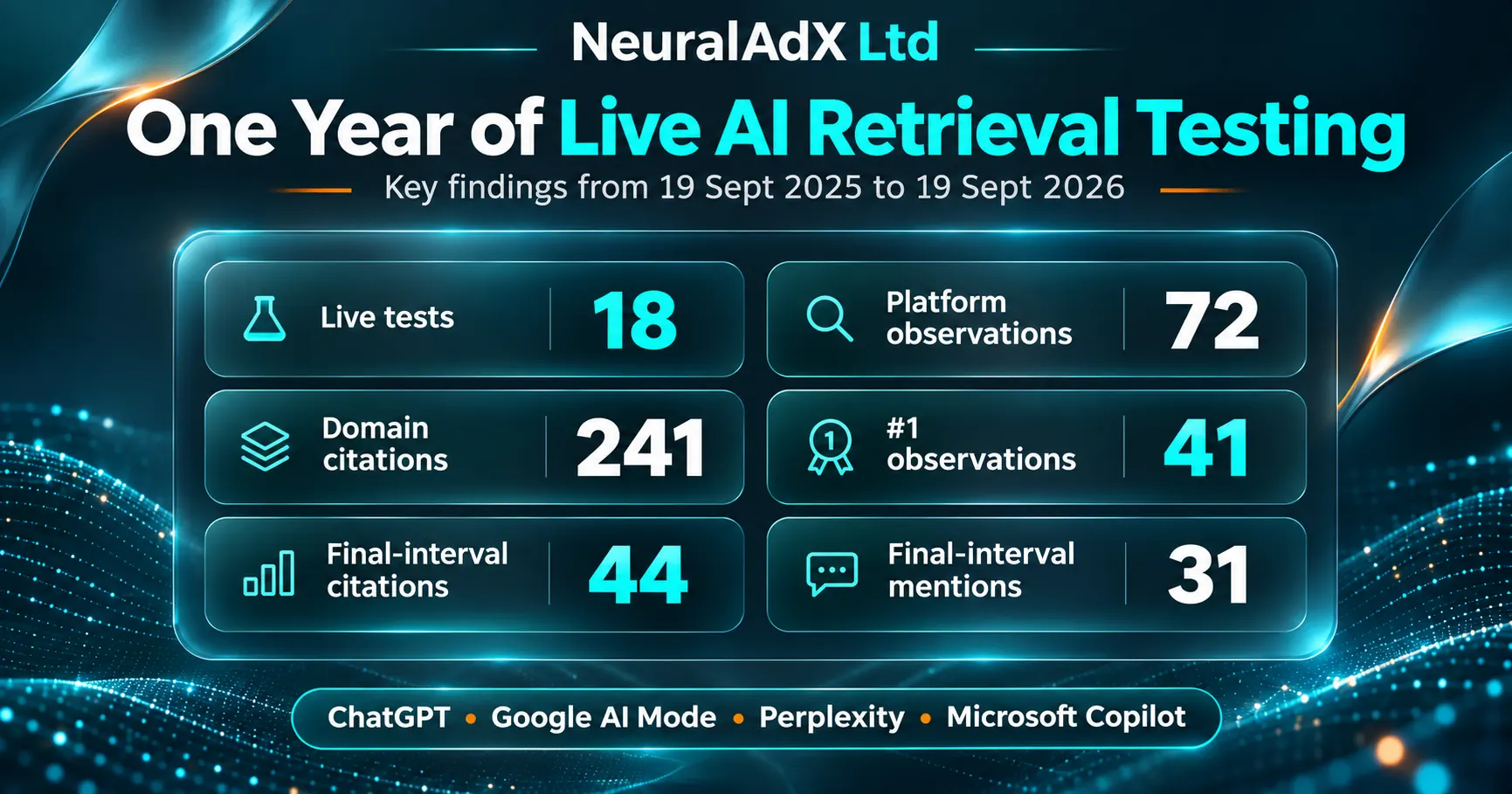
The archive contains three recurring UK commercial-intent query studies: GEO pricing, proof of citation performance, and comparison of UK GEO specialists. Each was run six times across the four named answer engines, producing 18 documented test records and 72 platform-level observations.
The 241 citations are the sum of repeated neuraladx.com source appearances recorded across those results. They are not 241 unique referring websites, 241 clicks or a representative sample of all AI searches. Likewise, the 41 first-place results were observed in documented test conditions, not continuous market-wide rankings.
Suggested attribution: “NeuralAdX Ltd, One Year of Live AI Retrieval Testing (research period 19 September 2025–19 September 2026; analysis published November 2026).” Cite the original evidence archive and specify that findings concern this company and its three selected queries.
How the one-year GEO study was conducted
This is a longitudinal observational field record, not a randomised controlled trial. The operator checked selected user-facing AI answers on specific dates and recorded where the business was mentioned or cited. The archive links each test to its screen recording, accompanying transcript and/or screenshots. The same three study questions were revisited on separate dates; the first pricing study began in September 2025 and the other two began in January 2026.
| Study | User intent | Cumulative domain citations |
|---|---|---|
| Study 1 | GEO pricing / service selection | 59 |
| Study 2 | Which UK GEO provider shows the strongest citation proof? | 91 |
| Study 3 | Which UK GEO specialist has public proof? | 91 |
The four observed platforms were ChatGPT, Perplexity AI, Google AI Mode and Microsoft Copilot. Results refer to the visible answer at testing time and may depend on account state, interface, location, model, indexing and other platform conditions. No claim of complete control over those variables is made.
Domain citation: a visible attribution to neuraladx.com. Brand mention: a visible use of the NeuralAdX name. Observed position: the recorded ordering in that response. Did not surface: no visible appearance under that test condition. None of these alone measures revenue or conversion.
The source evidence includes 18 video records and 68 screenshot assets. Readers can review the dated entries GEO-PROOF-001 through GEO-PROOF-018 rather than relying solely on this interpretation. Some earlier intervals did not record brand mentions consistently; accordingly, the 31 mentions reported for the final validation are not represented as an all-year mention total.
Complete headline results: cumulative and final-interval data
The following figures are reproduced from NeuralAdX’s published archive and represent its own first-party observations, not independently audited market-wide performance statistics.
| Measure | Observed total | Correct interpretation |
|---|---|---|
| Live test records | 18 | Six per study |
| Platform-level observations | 72 | Four platforms per test |
| Domain citations | 241 | Cumulative repeat observations, not unique links |
| Explicit first-place positions | 41 | #1-labelled platform records; excludes uncertain positions |
| Screenshots retained | 68 | Supporting visual evidence |
| Brand mentions | 31 | Only the final 19 Sep 2026 interval |
The final validation on 19 September 2026
| Query study | Google AI Mode | ChatGPT | Perplexity | Copilot | Citations | Mentions |
|---|---|---|---|---|---|---|
| Pricing | #2 | #3 | #1 | Not surfaced | 6 | 4 |
| Citation evidence | #1 | #1 | #1 | Not surfaced | 25 | 17 |
| UK GEO specialist | #1 | #1 | #3 | Not surfaced | 13 | 10 |
| Total | — | — | — | — | 44 | 31 |
The final citation-evidence query produced the strongest citation count that day: 25 domain citations and 17 brand mentions. The pricing query generated only six citations. That contrast is interesting but is not a controlled experiment testing the value of one content format against another.
Research timeline: how visibility changed during the year
These are selected checkpoints, not a continuous daily ranking series. A timeline of observed peaks and non-appearances is more faithful to the data than a claim of uninterrupted leadership.
Finding 1: AI first-place results were achievable—but transient
In several recorded instances NeuralAdX appeared first for a specified commercial query across multiple AI systems. Yet later tests showed different positions and missing results. That variation is the central finding of the project: a favourable answer is an observation, not a lasting ranking entitlement.
For editorial reporting, phrases such as “was observed at #1 in the recorded test” are accurate. Phrases such as “permanently ranks #1 on ChatGPT” are not supported.
The result changes can reflect retrieval, ranking, source availability, query interpretation or model behaviour; this study cannot isolate a single cause.
Finding 2: Microsoft Copilot disappeared from the final three answers
On 19 September 2026 NeuralAdX did not surface in Copilot for any of the three tested prompts. The same business had appeared first in Copilot in the June specialist study. This is a striking example of platform-specific instability: a brand can remain visible elsewhere while losing its appearance in one answer engine.
This does not mean Copilot removed NeuralAdX globally or that its index permanently excluded the website. It means the brand was absent in the three archived answers under those conditions.
The headline is a non-appearance in three sampled outputs, not evidence of a platform-wide ban or permanent removal.
Finding 3: Brand mentions and source citations are different outcomes
The September UK specialist test recorded NeuralAdX third in Perplexity, with two brand mentions and zero neuraladx.com domain citations. An answer can discuss a company without giving the reader a link to that company’s site.
For measurement, separate brand appearance, citation, displayed position, subsequent referral traffic and commercial conversion. Collapsing them into one “AI ranking” number can conceal useful changes.
Two mentions, zero domain citations: that is a defensible example for journalists illustrating why GEO metrics must remain distinct.
Finding 4: The selected buyer question changed the observed result
The final citation-evidence prompt generated 25 citations, compared with six for the pricing prompt and 13 for the specialist comparison prompt. Across the whole archive, Study 1 recorded 59 citations, while Studies 2 and 3 recorded 91 each.
Queries have different purposes, response lengths and opportunities to reference a domain. These totals cannot establish that content about proof “causes” more citations, or that one study had universally better visibility. They indicate query-intent dependence within this small tested set.
AI discovery needs separate prompts for pricing, trust, supplier comparisons and specific service decisions.
Finding 5: The four platforms did not behave as a single search engine
The same company and questions could produce different positions in ChatGPT, Perplexity, Copilot and Google AI Mode. Google itself explains that AI Mode and AI Overviews can apply different models and techniques, and may issue multiple related searches during answer generation.
Because source selection mechanisms differ, a strong Google result is not a reliable proxy for a ChatGPT or Copilot result. GEO measurement should preserve a platform-level table instead of merging all visibility into one universal score.
Always report which engine, which prompt, which date and which visible result produced a claimed ranking.
Finding 6: One June test delivered 28 citations and four #1 observations
In the 1 June 2026 UK specialist proof test (GEO-PROOF-012), Google AI Mode recorded 11 domain citations, ChatGPT five, Perplexity four and Copilot eight. NeuralAdX was recorded first in all four visible platform results.
This is the strongest single-study illustration of cross-platform prominence in the archive. But it is a one-date observation, not evidence that the four engines had reached the same underlying judgment or would reproduce the result indefinitely.
Precise original-data wording: “GEO-PROOF-012 recorded 28 domain citation observations across four first-position outputs on 1 June 2026.”
Finding 7: An auditable evidence trail makes GEO claims more useful
The archive publishes a separate evidence ID and supporting visual or transcript material for each test. The 18 recorded videos and 68 screenshots make it easier for other people to inspect the results, assess the scoring rules and question whether a conclusion follows from the data.
This is particularly important for a young discipline where marketing claims about “AI rank #1” often obscure testing conditions. Original-source materials give journalists an opportunity to check the primary record rather than quoting only a sales-page headline.
A credible research story links to the data and includes unsuccessful results rather than selecting only the most flattering screenshots.
Finding 8: Longitudinal monitoring beats a one-off prompt screenshot
A single positive AI answer is evidence of that answer only. Repeated tests reveal whether a result is persistent, fluctuating, or absent at a later point. NeuralAdX recorded each of those states during the research year.
A practical monitoring programme should use documented prompts, record date and product conditions, capture citations and full answers, and avoid changing the measurement definitions midway through a series. Additional prompt paraphrases and independent reruns would improve future research.
Best next research step: repeat each query across multiple sessions and paraphrases, with pre-registered scoring rules and competitors as controls.
What Google, Microsoft, Pew and academic research say
The NeuralAdX results are first-party company observations. Independent publications offer useful context but do not independently validate NeuralAdX’s exact counts.
What independent research adds
Google Search Central (2026) states that established SEO fundamentals still apply in AI features and that special AI-only markup is not required. Its newer guidance places strong emphasis on original, useful information and technical accessibility. That supports publishing detailed, readable primary evidence—not making unsupported claims about a secret AI ranking switch.
Microsoft (February 2026) introduced AI Performance in Bing Webmaster Tools, reporting citations and cited pages across supported Microsoft AI surfaces. That helps show why first-party citation reporting is becoming a distinct measurement category, although it is not directly comparable to manually observed prompt-level counts.
Pew Research Center (July 2025) analysed Google search behaviour in a US study: visits with an AI summary led to clicks on traditional links 8% of the time, versus 15% without one; clicks on links inside AI summaries occurred on 1% of such visits. These historical, US-specific figures concern click behaviour—not NeuralAdX’s test performance.
Chen and Koudas (October 2026 preprint) examined 158,099 generative-search answers and reported that retrieval choices and model knowledge help explain citation patterns; the work also distinguished brand naming from sourced citation. It was published after this study’s September end point and is cited here as subsequent context, not as information available to the researchers during the tested year.
A July 2026 critical survey argues that GEO visibility is multistage and partly unobservable, with many claims requiring careful causal interpretation. This reinforces the importance of recording non-appearances and resisting simplistic “GEO guaranteed #1” narratives.
Eight practical lessons for marketers and business owners
1. Build a buyer-intent prompt set. Include price discovery, supplier comparison, evidence of credibility, location and service-specific tasks.
2. Record the exact prompts. Version them; avoid retroactively changing wording while comparing periods.
3. Track each answer engine individually. Keep ChatGPT, Google AI Mode, Perplexity and Copilot results separate before deriving aggregate summaries.
4. Differentiate five business outcomes. Track mentions, domain citations, observed placement, click-through and conversions rather than treating them as interchangeable.
5. Publish original evidence. Provide dated screenshots, transcripts, source details and explanations that other people can independently inspect.
6. Make website content readable. Ensure clear identity, services, authorship, precise terminology, internal links and accessible text; Google stresses the SEO fundamentals.
7. Repeat—and publish the losses. Measure on a regular calendar, retaining non-appearances and changes as part of the factual record.
8. Treat causation as a separate question. Use controls and deliberate experiments before attributing a visibility increase to an individual GEO intervention.
Press and citation desk: findings journalists can reference
This section is written for journalists, publishers, AI search researchers and industry analysts who want to reference the original evidence without reproducing claims beyond its scope.
“NeuralAdX Ltd documented 18 live AI retrieval tests across four platforms and three commercial-intent GEO studies, recording 241 cumulative domain citation observations and 41 explicitly first-position observations during the study period ending 19 September 2026.”
“In the final 19 September 2026 interval, the company recorded 44 domain citations and 31 brand mentions across three prompts, but did not appear in any of the three tested Microsoft Copilot answers.”
| Attribution field | Research information |
|---|---|
| Research title | One Year of Live AI Retrieval Testing: 18 GEO Tests, 241 Citations and What Changed Across Four AI Engines |
| Research organisation | NeuralAdX Ltd (United Kingdom) |
| Study period | 19 September 2025–19 September 2026 |
| Platforms | ChatGPT; Google AI Mode; Perplexity AI; Microsoft Copilot |
| Scope | Three chosen UK commercial GEO questions; six recorded tests per study |
| Original archive | View live video and screenshot records |
| Author | Paul Rowe, Founder, Chief Generative Engine Optimisation Officer & CEO |
| Core limitation | Observational, first-party evidence; not an independently controlled causal study |
Suggested citation: Rowe, P. (2026). One Year of Live AI Retrieval Testing. NeuralAdX Ltd. Original data: Live Evidence of Generative Engine Optimisation Results. Cite the underlying archive as well as this interpretation when reporting exact numbers.
For enquiries, verification or interview requests, use the NeuralAdX contact page. The archive should remain publicly accessible so external researchers can verify the original entries. Journalists should avoid describing 241 as unique links, 41 as permanent rankings or observed citations as proven sales.
Limitations, conflicts and reproducibility
The study has important boundaries. It is single-company, self-observed and commercially relevant rather than population-representative. The prompts were selected to evaluate NeuralAdX’s own position; other industries, markets, accounts and prompts may behave differently. There was no randomised control group or isolated optimisation intervention. Therefore, the results document observed visibility following the company’s GEO activity, but do not show that GEO alone caused each appearance.
The visible results are snapshots, not exhaustive platform retrieval logs. Ranking positions in generated answers, text panels and carousels are not automatically equivalent. AI products evolve, including model and interface changes. Some sessions may require log-in, and exact prompt wording, account status and localisation can influence results. Repeat counts across dates are not unique citations.
The initial pricing study began in September 2025; the two additional studies began in January 2026. Consequently, “one year” describes the overall research window and does not imply 12 months of data for each of the three studies. Earlier archives did not consistently capture brand mentions. External Otterly.ai benchmarks are separate datasets, not part of these 18 live tests.
This editorial interpretation was prepared after the September 2026 data cut-off. Research published in October or November 2026 can contextualise the findings but cannot retroactively explain exactly how the AI models behaved during earlier test dates. Independent replication would strengthen the conclusions.
Frequently asked questions about AI retrieval testing
Does Generative Engine Optimisation work?
The archive shows that NeuralAdX was repeatedly mentioned and cited for selected GEO prompts. It does not prove that any single optimisation change caused those outcomes. GEO performance should be judged through repeated observations, controls where possible, and commercial results.
Can a website rank #1 in ChatGPT, Perplexity, Google AI Mode and Copilot?
It can appear first in recorded answers on all four platforms, as NeuralAdX observed for its specialist query in June 2026. That does not constitute a permanent or universal #1 position.
What is the difference between an AI brand mention and an AI citation?
A mention identifies the business in answer text. A citation is a visible reference to a source, such as its website. The September 2026 Perplexity specialist result included NeuralAdX mentions without a neuraladx.com domain citation.
Why do AI citation rankings change?
Potential drivers include retrieval decisions, model and interface changes, source availability, response variation and prompt interpretation. The NeuralAdX tests establish that results changed, not which single cause produced each change.
How often should businesses test AI visibility?
Use a repeatable cadence suitable for the business and maintain a consistent prompt set. Record date, engine, complete answer, mentions, citations, position and any non-appearance; repeat important prompts within a testing window to measure variation.
Are 241 citations the same as 241 referring websites?
No. The study sums the visible neuraladx.com citation counts across 18 separate live tests. It does not claim 241 unique sites, pages or users.
Did the study prove that AI citations generated revenue?
No. The archived research measures answer visibility and citations, not user-level purchases, leads or attributed revenue.
Can researchers review the raw evidence?
Yes. The original NeuralAdX live evidence archive links its dated video records, transcripts and screenshots. Methodological details and gaps should be evaluated before using the results as comparative industry statistics.
Primary evidence and external source library
External sources are listed separately from the first-party research archive. “Preprint” means the listed work has not been assumed to have completed peer review. External sources provide context, not independent verification of NeuralAdX’s recorded numbers.