AI Visibility Assessment
NeuralAdX Ltd
Find out if AI is mentioning, citing or ignoring your business
Get a clean starting point before spending money on AI visibility work. NeuralAdX Ltd checks your website against an 11-factor GEO framework and tests five live commercial AI prompts to see whether AI engines mention, cite, recommend or ignore your business.
11-factor GEO review
No obligation
GEO framework factors checked
commercial AI prompts tested live
Recommended first step
Send your request in under two minutes
The email button opens a pre-filled message. Add your website URL, best contact number, five priority AI prompts and any helpful context.
Prefer to talk? Call NeuralAdX Ltd
No obligation. Suitable for businesses considering professional Generative Engine Optimisation service support. You can also review the AI Citation Benchmark, AI Answer Visibility & Share of Voice Benchmark and live AI retrieval proof.
NeuralAdX Ltd editorial guide
AI search optimisation is now citation engineering, not keyword decoration
AI Search Optimisation: How to Get Cited in ChatGPT, Perplexity, Claude and Google AI Mode is the discipline of making a website clear, trusted, retrievable, verifiable and recent enough to be selected as a source inside AI-generated answers.
The neutral truth is simple: AI search does not reward vague content. It rewards pages that answer clearly, prove claims with named sources, show ownership, stay up to date and give retrieval systems clean passages they can quote without guessing.
Editorial tone
SEO and GEO optimised
Lightweight inline design
Direct answer: how do you get cited in ChatGPT, Perplexity, Claude and Google AI Mode?
To get cited in AI search, create pages that answer one clearly defined question, include original expertise, cite reliable external evidence, keep dates visible, make the page crawlable, use structured headings, support claims with statistics, show the author and organisation behind the content, and publish passages that are easy for AI systems to retrieve, compare and quote.
Traditional SEO still matters because AI systems rely on searchable, crawlable and indexable content. But citation visibility adds a second layer: your page must be useful enough to retrieve, trustworthy enough to rely on, and clean enough to cite.
Why AI citations now matter commercially
AI search has changed the user journey. A searcher may no longer scan ten blue links, compare snippets and choose a website. Increasingly, the answer engine reads the web first, synthesises the answer, and shows a limited number of cited or supporting sources.
That is why a citation is no longer just a backlink-style vanity metric. It is proof that an AI system considered a page useful enough to support an answer. When the citation appears beside a buying, research or comparison query, it can influence trust before the user reaches the website.
Google says AI Overviews had more than 2 billion monthly users across more than 200 countries and territories by July 2025, while Google Search Central explains that AI Mode and AI Overviews may use query fan-out to run multiple related searches across subtopics and data sources before generating a response. That makes AI visibility broader than single-keyword ranking; one user prompt can create many hidden retrieval opportunities.
“AI Overviews now has over 2 billion monthly users.”
The strategic implication is blunt: if a business only measures rankings and clicks, it may miss the part of the search journey where the brand is being selected, ignored, compared or summarised by an answer engine.
“Generative AI solutions are becoming substitute answer engines.”
Key AI search statistics for 2026 planning
These statistics show why AI search optimisation should be treated as a visibility, trust and attribution discipline rather than a small SEO side task.
| Evidence point | What it means for AI search optimisation | Source |
|---|---|---|
| Google AI Overviews exceeded 2 billion monthly users across 200+ countries and territories. | AI-generated search summaries are already mainstream enough to affect discovery at scale. | Alphabet Q2 2025 earnings call |
| AI Mode and AI Overviews may use query fan-out across subtopics and data sources. | A page should answer the main question and the supporting subquestions an AI system may generate. | Google Search Central AI features guidance |
| Pew found that users clicked traditional results in 8% of visits when an AI summary appeared, versus 15% without one. | Visibility inside the AI answer layer may matter before a classic organic click happens. | Pew Research Center |
| Ahrefs reported a 58% lower average click-through rate for the top-ranking page when an AI Overview was present. | Ranking first is weaker when the answer layer sits above the result and satisfies the query early. | Ahrefs AI Overviews CTR update |
| Adobe Analytics reported generative AI traffic to U.S. retail sites rose 1,200% in February 2025 compared with July 2024. | AI-sourced visitors are still an emerging channel, but the growth curve is too large to ignore. | Adobe Analytics |
| Adobe also reported generative AI traffic to U.S. travel, leisure and hospitality sites rose 1,700% versus July 2024. | AI assistants are becoming research companions for high-intent planning journeys. | Adobe Analytics |
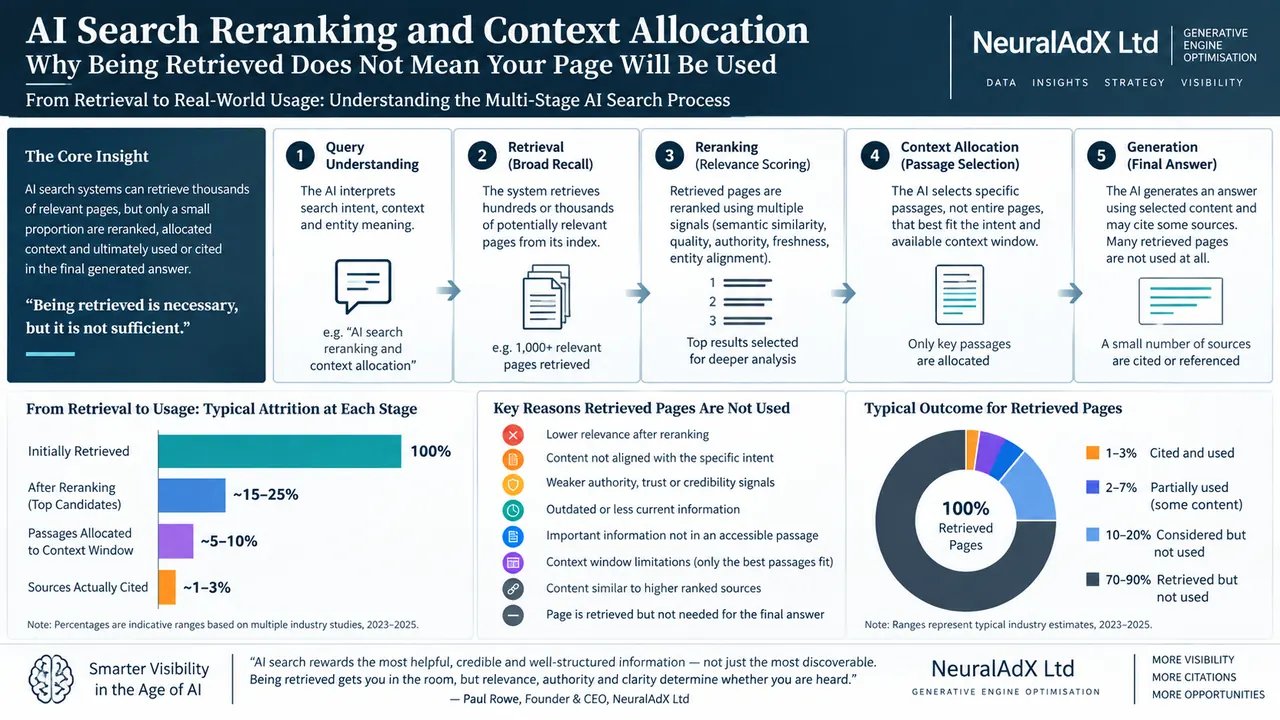
| Cloudflare reported that around 80% of AI crawling over 12 months was for training, compared with 18% for search. | Being crawled is not the same as being cited; search eligibility and passage quality still matter. | Cloudflare crawl-to-click analysis |
| McKinsey’s 2025 global survey found 88% of respondents report regular AI use in at least one business function. | AI-assisted research is becoming a normal business workflow, not a niche experiment. | McKinsey State of AI 2025 |
| Semrush analysed more than 100 million AI citations across 230,000 prompts over 13 weeks. | AI citation visibility is measurable, volatile and platform-specific. | Semrush AI citation study |
Industry Expert Quotes
“AI search optimisation becomes commercially serious when two facts collide: Google says AI Overviews have more than 2 billion monthly users, and Pew found traditional-result clicks fell to 8% when an AI summary appeared. At that point, the job is no longer to win a ranking alone; it is to become the source an answer engine can safely cite.”
“Cloudflare’s crawl data shows why citation engineering has to be deliberate: roughly 80% of AI crawling was for training, while only 18% served search use cases. A business should not assume that being crawled means being cited. The page still needs a clear claim, a named author, current evidence and machine-readable context.”
How ChatGPT, Perplexity, Claude and Google AI Mode cite sources
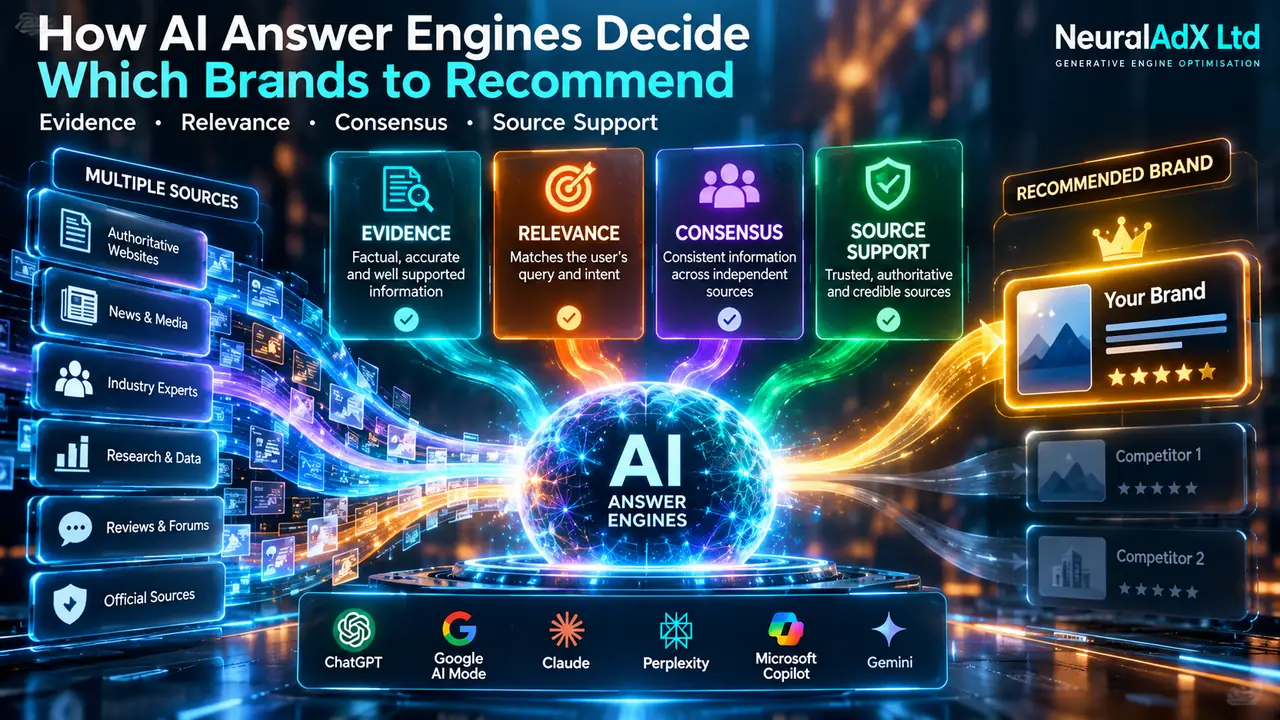
No serious AI search strategy should assume all answer engines work the same way. The useful approach is to understand the visible behaviour of each platform and build pages that survive across all of them: clear answer, strong evidence, named ownership, current facts and stable URLs.
| Platform | What the platform publicly shows or states | Best optimisation response |
|---|---|---|
| ChatGPT | OpenAI says ChatGPT search can provide timely answers with links to relevant web sources, and its help centre says search responses may include inline citations and a Sources panel. | Create pages with direct answer paragraphs, stable URLs, visible author information, current statistics and short passages that can support a generated answer without extra interpretation. Source: OpenAI Help Center. |
| Perplexity | Perplexity is positioned as an answer engine and has invested in publisher programmes, including Comet Plus and publisher revenue-share models reported by Axios. | Prioritise evidence-rich pages, source-led claims, comparison tables, original data and concise definitions. Perplexity rewards pages that can support answer synthesis quickly. Source: Axios on Perplexity Comet Plus. |
| Claude | Anthropic’s web search tool documentation says Claude can access real-time web content and that responses include citations for sources drawn from search results. | Write cautiously, avoid exaggerated claims, show source quality, keep pages current, and make claims easy to verify. Source: Anthropic API documentation. |
| Google AI Mode | Google Search Central says eligible pages must be indexed and eligible to show a snippet. Google also says AI Mode and AI Overviews may use query fan-out. | Make every important page indexable, snippet-eligible, fast, helpful, internally linked, structured around question-led subtopics and updated when facts change. Source: Google Search Central. |
“AI Mode is our most powerful AI search.”
The citation-worthy content framework
The most reliable AI search optimisation pattern is not trickery. It is structured clarity. A page should make it easy for an answer engine to determine what the page is about, who is responsible for it, why the claim is credible, when the information was reviewed and which exact passage can support the generated answer.
1. Direct answer first
Place a concise answer near the top of the page. AI systems need a clean extractable passage before they need a long essay.
2. Evidence after the claim
Support important claims with statistics, original data, quotes, named sources and links to authoritative references.
3. Entity clarity
Make the brand, author, service, location, topic and related concepts unambiguous. Ambiguity weakens retrieval confidence.
4. Recency signals
Show published, modified and reviewed dates where appropriate. Update statistics when market conditions change.
5. Passage-level retrieval
Use short sections, descriptive H2 and H3 headings, clear tables and self-contained paragraphs that make sense out of context.
6. Technical eligibility
Keep pages crawlable, indexable, internally linked and eligible for snippets. A blocked page cannot become a reliable supporting source.
This is where Generative Engine Optimisation goes beyond surface SEO. It improves how a page is understood, retrieved, compared and cited by AI answer systems.
A practical page blueprint for AI search citations
For a business page or blog post targeting AI citations, the structure should be logical enough for readers and explicit enough for machines.
| Page element | Purpose | AI citation benefit |
|---|---|---|
| Direct answer block | Answer the main query in plain language. | Creates a concise passage for AI extraction. |
| Evidence table | Summarise statistics, sources and implications. | Improves verifiability and comparison. |
| Named expert commentary | Add original interpretation from a real person. | Supports author expertise and quotability. |
| Platform-specific sections | Explain how guidance differs by AI engine. | Matches query fan-out and comparison prompts. |
| Last reviewed date | Show the page is maintained. | Helps with recency-sensitive topics. |
| Source ledger | List the authoritative references used. | Makes claims easier to verify and reuse accurately. |
AI search charts and visual benchmarks
The charts below use simple HTML and SVG so the page remains lightweight, mobile-friendly and easy for AI systems to parse.
Source: Pew Research Center March 2025 browsing analysis of 900 U.S. adults.
Adobe Analytics reported that traffic from generative AI sources increased by 1,200% in February 2025 compared with July 2024. The chart below uses July 2024 as an index baseline of 100 and February 2025 as 1,300.
1,000
500
0
| Date | Index value | Meaning |
|---|---|---|
| July 2024 | 100 | Baseline |
| February 2025 | 1,300 | +1,200%, or 13x baseline |
Source: Adobe Analytics. The chart uses only the two reported endpoints and does not claim monthly intermediate values.
How to optimise for ChatGPT citations
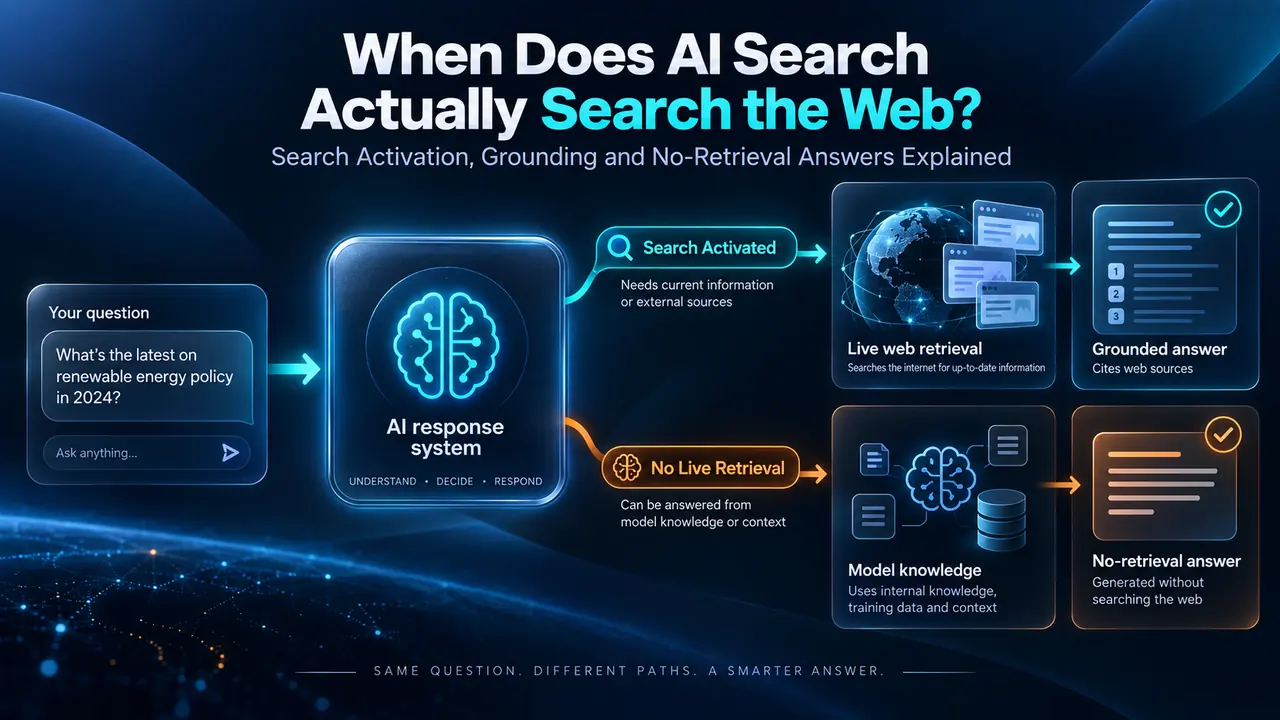
ChatGPT search can browse when a query benefits from web information, and OpenAI states that responses using search may include inline citations or a Sources panel. The practical goal is to make your page the cleanest source for a specific answer.
- Lead with the answer: use a short, direct paragraph immediately under the relevant heading.
- Use source-backed evidence: connect statistics to named sources rather than dropping numbers without context.
- Create quotable passages: one paragraph should make one clear point.
- Keep URLs stable: avoid unnecessary slug changes unless redirects are clean and tested.
- Show who wrote or reviewed the page: visible author and company information reduce ambiguity.
How to optimise for Perplexity citations
Perplexity is heavily associated with source-led answers, browsing, citation interfaces and publisher partnerships. It is not enough to write a generic article and hope it appears. Perplexity-style visibility favours content that can answer, compare, verify and summarise quickly.
- Use comparison tables: Perplexity users often ask comparative research queries.
- Include original data: benchmarks, surveys, tests and methodology pages make stronger source material. See the NeuralAdX 11-Factor GEO Methodology for our structured approach.
- Write neutral summaries: Perplexity may cite pages that explain both sides clearly.
- Reference primary sources: a page that cites strong primary sources is easier to trust.
- Keep facts current: stale pages are weaker for fast-moving AI search topics.
How to optimise for Claude citations
Claude’s web search documentation says the tool gives Claude real-time web access and includes citations for sources drawn from search results. Claude is often used for business research, analysis, writing support and synthesis, so pages should be especially careful with accuracy, context and caveats.
- Avoid overclaiming: unsupported superlatives are weak evidence.
- Use source led statements: make it obvious which data supports which claim.
- Explain methodology: especially for audits, benchmarks and comparisons.
- Include author credentials: Claude users often ask analytical and professional questions.
- Make uncertainty visible: if data is estimated, label it clearly.
How to optimise for Google AI Mode citations
Google’s guidance is clear that there are no special extra technical requirements for AI Overviews or AI Mode beyond Search eligibility, but that does not mean there is no optimisation work. It means the foundation is the same: crawlability, indexability, snippet eligibility, helpful content and strong page experience.
The extra AI search challenge is query fan-out. A single user prompt can be broken into multiple related subqueries. That means pages should cover the core answer and the adjacent questions around it.
- Make the page eligible: do not block crawling, indexing or snippets on pages you want cited.
- Use question-led headings: match how real users ask compound questions.
- Cover subtopics: answer definitions, comparisons, steps, risks, examples and measurement.
- Use structured data where appropriate: structured data is not magic, but it improves machine-readable context when implemented correctly.
- Keep page intent tight: one page should not try to rank for every possible AI search topic.
How to measure AI search visibility
AI search optimisation must be measured differently from traditional SEO. Rankings, impressions and organic clicks still matter, but they are incomplete. You also need to know whether AI engines mention the brand, cite the domain, use the preferred answer framing and keep citing the source over time.
Prompt coverage
Track priority prompts that represent real buyer, research and comparison questions.
Citation count
Measure how often the domain is cited across ChatGPT, Perplexity, Claude, Google AI Mode and other relevant AI engines.
Brand mentions
Track whether the brand is mentioned even when the AI engine does not provide a direct citation.
Citation stability
Repeat tests over time. One citation is useful; stable citation across repeated tests is stronger.
This is why NeuralAdX Ltd maintains evidence-led assets such as the AI Citation Benchmark, the AI Answer Visibility and Share of Voice Benchmark, and the Proof That Generative Engine Optimisation Works page. AI search visibility should be treated as a measured channel, not a theory.
Common mistakes that stop websites being cited
Generic content
If a page says the same thing as every other page, AI systems have little reason to cite it.
No evidence trail
Claims without statistics, quotes, links, methodology or authorship are weak citation candidates.
Stale dates
AI search topics move quickly. A page that looks abandoned becomes less useful for current answers.
Poor crawl access
Noindex tags, snippet restrictions, broken redirects and blocked resources can remove citation eligibility.
FAQ: AI Search Optimisation
What is AI Search Optimisation?
AI Search Optimisation is the process of improving a website so AI answer engines can understand, retrieve, trust and cite its content in generated responses.
Is AI Search Optimisation the same as SEO?
No. SEO focuses on organic search visibility, rankings, snippets and traffic. AI Search Optimisation focuses on AI answer visibility, citations, brand mentions, source selection and answer framing. The two disciplines overlap because AI systems still need accessible web content.
Can schema markup guarantee AI citations?
No. Schema markup can improve machine-readable context, but it does not guarantee citations. A page still needs helpful content, evidence, authority, freshness, crawlability and relevance.
How long does it take to get cited in AI search?
There is no fixed timeline. It depends on crawl access, content quality, source trust, page relevance, query demand, recency and the AI platform’s retrieval behaviour. Measurement should happen repeatedly across a fixed prompt set.
What is the fastest practical improvement for AI citations?
Add a direct answer section, update the page with current evidence, include named sources, show authorship, improve internal links and make sure the page is indexable and snippet-eligible.
Editorial conclusion
AI search optimisation is not about tricking ChatGPT, Perplexity, Claude or Google AI Mode. It is about becoming the most useful, verifiable and retrieval-ready source for the question being asked.
The brands that win AI citations will not necessarily be the brands that publish the most content. They will be the brands that publish the clearest answers, maintain the strongest evidence trails, keep their information current, and make their expertise visible enough for answer engines to trust.
For businesses that want a measured, evidence-led implementation route, the NeuralAdX Ltd Generative Engine Optimisation service explains how AI citation visibility, brand mentions, benchmark testing and AI answer share of voice can be improved through structured GEO work.
Source ledger
The following sources support the statistics, platform details and quotations used in this article.
- Google Search Central: AI features and your website
- Google Search Central: Top ways to ensure your content performs well in Google’s AI experiences on Search
- Google: AI Mode in Search updates from Google I/O 2025
- Alphabet Investor Relations: 2025 Q2 earnings call
- OpenAI: Introducing ChatGPT search
- OpenAI Help Center: ChatGPT Search
- Anthropic documentation: Claude web search tool
- Axios: Perplexity Comet Plus publisher revenue model
- Pew Research Center: Google users and AI summaries click behaviour
- Ahrefs: AI Overviews reduce clicks update
- Adobe Analytics: generative AI traffic growth
- Cloudflare: crawl-to-click gap and AI bot activity
- Gartner: search engine volume forecast
- McKinsey: State of AI 2025 global survey
- Semrush: most-cited domains in AI study
- Columbia Journalism Review / Tow Center: AI search citation accuracy study
Author and methodology context
Paul Rowe

Paul Rowe is the Founder, Chief Generative Engine Optimisation Officer and CEO of NeuralAdX Ltd, focused on AI citation visibility, answer-engine retrieval, entity clarity, evidence-led benchmarking and practical Generative Engine Optimisation implementation across major AI platforms.
Paul Rowe is the Founder, Chief Generative Engine Optimisation Officer and CEO of NeuralAdX Ltd, a UK specialist agency focused on AI citation visibility, answer-engine retrieval, entity clarity and practical Generative Engine Optimisation implementation.
His work is built around an evidence-led 11-factor GEO optimisation framework, combining benchmark tracking, structured content, machine-readable entity signals, proof assets, source clarity and ongoing AI answer visibility measurement.
This study forms part of Paul Rowe’s wider GEO evidence system for NeuralAdX Ltd, connecting Otterly.ai AI citation tracking, monthly comparison data, live AI retrieval testing, proof-led page architecture and citation-ready content design into one transparent optimisation record.