NeuralAdX Ltd AI SEO Guide
What AI SEO means in 2026
AI SEO is the practice of making a website discoverable, understandable, trustworthy and reusable by both traditional search engines and AI answer engines. It combines technical SEO, content quality, entity clarity, structured evidence, citation-worthy passages and Generative Engine Optimisation so that a brand can be found in Google Search, AI Overviews, AI Mode, ChatGPT Search, Microsoft Copilot, Bing generative search, Perplexity, Gemini and other AI-led discovery systems.
The blunt reality: classic SEO is still the foundation, but AI search has changed the prize. Ranking is no longer enough. The new goal is to become a source that AI systems can confidently retrieve, summarise, cite and recommend.
Written by Paul Rowe, Founder and Chief Generative Engine Optimisation Officer, NeuralAdX Ltd
Updated: 30 July 2026
Direct answer
AI SEO means optimising a website so AI-powered search systems can crawl it, understand it, trust it and use it in generated answers.
Core outcome
The goal is visibility inside AI answers, not just blue-link rankings. That means citations, brand mentions, source inclusion and answer selection.
Best-fit strategy
The strongest approach is not “SEO or GEO”. It is technical SEO plus entity-led content plus evidence-led Generative Engine Optimisation.
ON THIS PAGE
How AI SEO works across search and answer engines
Traditional SEO helps search engines find and rank your pages. AI SEO goes further. It helps AI systems identify the exact answer, entity, statistic, quotation, source, service, author and proof point they need to generate a confident response.
Google’s July 2026 guidance is explicit: established SEO fundamentals remain the foundation for AI Overviews and AI Mode. Google says pages should be indexed and snippet-eligible, technically clear, useful to people and built around valuable, non-commodity content. It also says there is no special AI schema, no required page length and no requirement to split copy into artificial “chunks”.
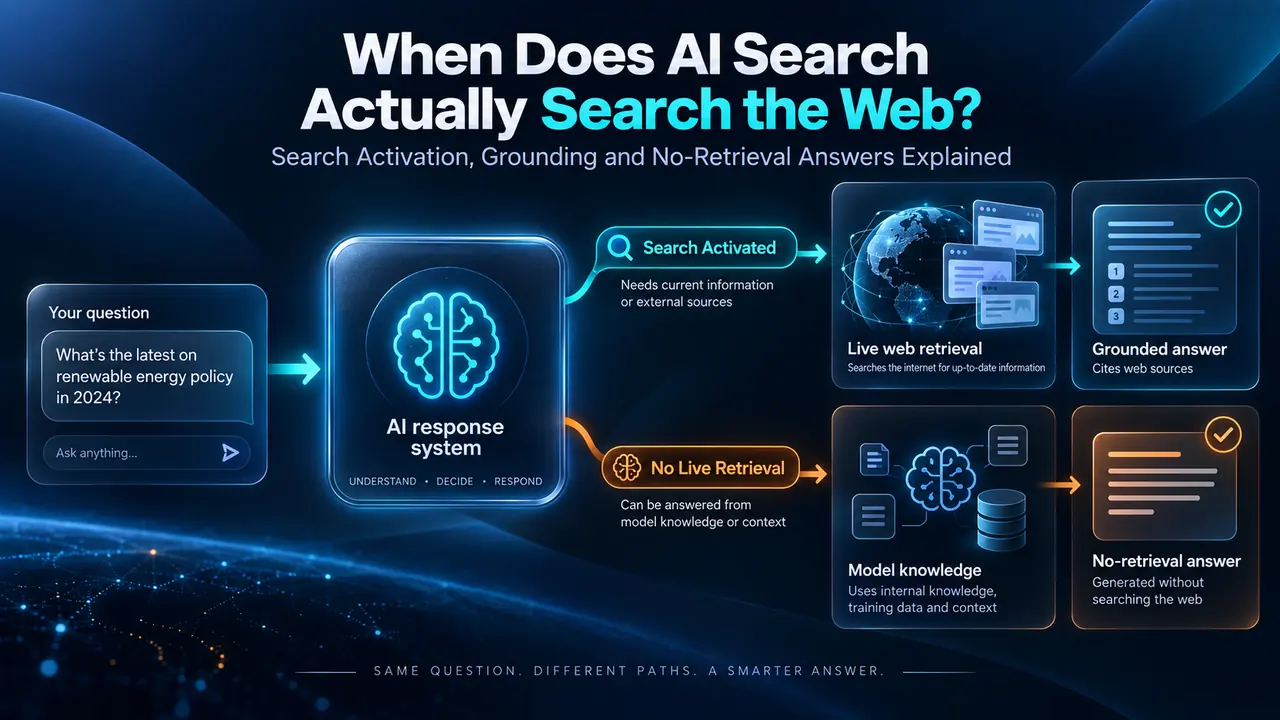
Google also confirms that its generative search features can use retrieval-augmented generation and query fan-out to retrieve several related sources. Across non-Google answer engines, the practical competitive edge is therefore broader: publish original evidence, make entities unambiguous, keep facts current and give every important claim a clear primary source.
For readers, the rule is simple: write for people first, add first-hand or original value, and structure the page well enough that a human, crawler or AI system can verify what each important statement means.
Why AI SEO matters now
AI search is no longer a small experiment. It is now part of mainstream discovery, advertising, shopping, research and content consumption. The evidence is clear enough that business owners should stop asking whether AI search matters and start asking whether their websites are ready to be selected as trusted sources.
Mobile users: swipe left or right to view the full table.
| Signal | Latest evidence | What it means for AI SEO |
|---|---|---|
| Google has issued dedicated 2026 guidance | Google says generative AI search remains rooted in its core ranking and quality systems. It prioritises unique, useful, non-commodity content and a clear technical structure. Evidence: Google Search Central ↗ | AI visibility cannot be separated from indexability, quality, originality and people-first usefulness. |
| AI Overviews reached mass scale | On 19 May 2026, Google reported more than 2.5 billion monthly active AI Overviews users and more than 1 billion monthly AI Mode users. AI Mode queries were more than doubling each quarter. Evidence: Google I/O 2026 ↗ | AI-generated answers are already being delivered to huge audiences, so source selection matters. |
| ChatGPT is now a discovery surface | OpenAI reported more than 900 million weekly active ChatGPT users in February 2026. ChatGPT Search provides timely answers with links to relevant web sources. Evidence: OpenAI adoption ↗ Evidence: ChatGPT Search ↗ | Your website now needs to be legible to conversational search systems as well as classic crawlers. |
| AI answers change click behaviour | Pew found that users clicked a traditional result in 8% of visits with a Google AI summary, versus 15% without one. A separate February 2026 survey found 60% of U.S. adults said they read AI search summaries. Evidence: Pew click study ↗ Evidence: Pew 2026 survey ↗ | Visibility, trust and citation value become more important when fewer users click through. |
| Google and Bing now expose AI visibility data | Google is rolling out a Search Console generative AI report showing AI-feature impressions by page, country and device. Bing’s AI Performance public preview reports citations, cited pages, grounding queries and URL-level activity. Evidence: Google Search Console ↗ Evidence: Bing Webmaster Tools ↗ | AI visibility is becoming measurable through first-party platform data as well as controlled cross-engine testing. |
| AI referrals can convert strongly | Adobe Digital Insights reported that in May 2026 AI-referred retail visitors converted 54% better and generated 53% more revenue per visit than non-AI traffic. Evidence: Adobe Q3 2026 report ↗ | AI SEO is not only about brand visibility. In some sectors, AI-referred users are already commercially valuable. |
AI search adoption signals
Scale indicators from official and high-authority sources. The bars are visual aids only because the data uses different units.
Google AI Overviews: 2.5B+ monthly active users
ChatGPT: 900M+ weekly active users
Google AI Mode: 1B+ monthly active users
AI referral commercial signals
Adobe’s latest 2026 evidence shows strong growth and commercial quality in selected U.S. sectors. The bars are visual aids because the figures measure different outcomes.
Travel AI-referred traffic: +194% YoY
Retail AI-referred traffic: +138% YoY
Retail conversion rate: +54% vs non-AI traffic
AI SEO vs SEO vs GEO
There is no universally agreed hierarchy for these labels. Google treats optimisation for its own generative search features as part of SEO. Across multiple independent AI answer engines, NeuralAdX Ltd uses Generative Engine Optimisation as the broader specialist discipline and treats “AI SEO” as a common market label for search-led AI visibility work.
Mobile-first comparison guide: each visibility discipline is set out as a readable card, so users can compare the aim, optimisation work and metrics without horizontal scrolling.
Traditional SEO
Primary aim: Rank pages in search engine results and earn organic traffic.
Optimised assets: Crawlability, indexability, relevant content, internal links, backlinks, page experience and metadata.
Success metrics: Rankings, impressions, clicks, organic traffic, conversions and revenue.
COMMON MARKET LABEL
AI SEO
Primary aim: Make content understandable and usable across AI-enhanced search journeys.
Optimised assets: Clear answers, structured pages, cited claims, entity consistency, crawlable evidence and text-supported multimedia.
Success metrics: AI referrals, source inclusion, visibility in AI summaries and AI-influenced conversions.
CROSS-ENGINE SPECIALIST DISCIPLINE
Generative Engine Optimisation
Primary aim: Improve the chance that AI answer engines cite, mention, recommend or retrieve a brand in generated responses.
Optimised assets: Entity clarity, citation-worthy content, author authority, proof assets, benchmark data and passage-level retrieval signals.
Success metrics: AI citations, brand mentions, share of voice, answer inclusion, average brand position and platform visibility.
What AI search systems are trying to do
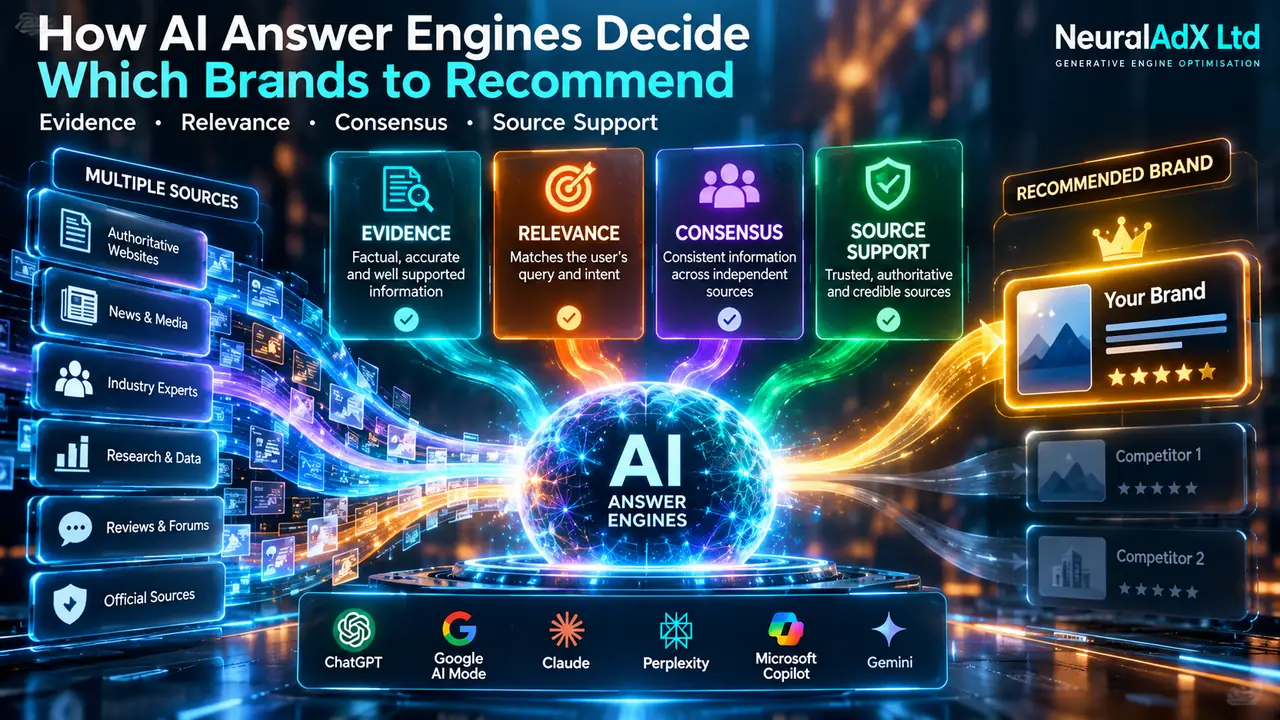
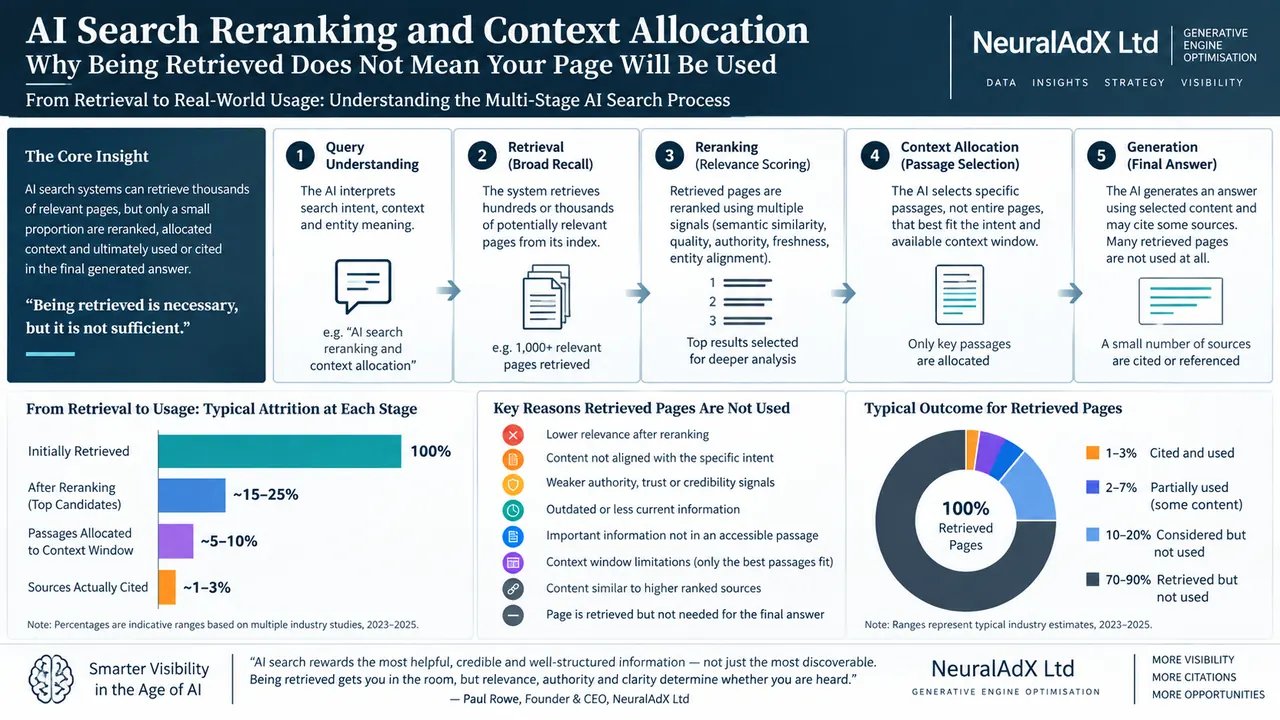
AI search systems do not simply list pages. They interpret intent, retrieve relevant material, select passages, synthesise answers and often show citations or source links.
Microsoft explains that visibility in AI search is not only about being found; it is about whether content is selected and referenced in a generated answer.
Why clear structure matters — without artificial chunking
Microsoft recommends clear headings, tables, Q&A formats and source-backed claims. Google separately warns that there is no requirement to break copy into tiny chunks or rewrite it only for AI systems.
The correct principle is reader-first structure: use sections, direct answers and precise claims where they improve comprehension, not because a fixed word count or “chunk size” supposedly unlocks AI visibility.
How AI SEO becomes measurable Generative Engine Optimisation
A page can be technically optimised yet still be overlooked in generated answers. The practical next step is to measure whether AI systems retrieve, cite and mention the business for the prompts that matter commercially. NeuralAdX Ltd applies this through its 11-factor Generative Engine Optimisation methodology, live AI retrieval testing and two ongoing visibility benchmarks.
This approach does not replace technical SEO. It adds a measurement layer for AI answer visibility: establish the baseline, improve the pages and entity signals, test again, and publish transparent evidence where appropriate.
1,309
AI citations and 11% citation share in Month 7, 24 May–23 June 2026.
320
Counted brand mentions, 43% share of voice and 27% brand coverage in Month 7.
#1
Observed benchmark rank for NeuralAdX Ltd in the latest published UK GEO agency reporting window.
Mobile users: swipe left or right to view the full table.
| Measurement asset | What it tests | Why it matters |
|---|---|---|
| Live AI retrieval testing | Screen-recorded searches and prompts on major AI platforms. | Demonstrates whether the brand is surfaced, cited or recommended in real answers. |
| AI Citation Benchmark | AI citation quantity and citation share over set reporting windows. | Tracks whether webpages are being selected as cited evidence over time. |
| AI Answer Visibility & Share of Voice Benchmark | Brand mentions, coverage, share of voice and answer visibility. | Measures whether the organisation itself is represented in AI answers, not only its URLs. |
Methodology note: These NeuralAdX Ltd figures are time-specific benchmark observations, not permanent rankings or a guarantee of traffic, leads or revenue. Reliable reporting should state the prompts, platforms, comparison set, reporting window and limitations. Explore the NeuralAdX Ltd Generative Engine Optimisation service or GEO pricing and measurement details.
The 12-part AI SEO framework
A website is not ready for AI SEO because it mentions AI or adds a few keywords. It is ready when its pages are technically accessible, semantically clear, evidence-backed and easy to quote accurately.
Scope note: This 12-part editorial checklist is broader than the NeuralAdX Ltd 11-factor GEO methodology because it also includes foundational SEO eligibility and performance measurement.
1. Crawlability and indexability
AI search still depends on discoverable content. Check robots.txt, noindex tags, canonicals, sitemaps, internal links, server response codes and crawl traps.
2. Clear page purpose
Every page should have one obvious job. If the topic, audience and answer are vague, AI systems have less confidence in how to classify the page.
3. Direct answer blocks
Lead important sections with concise answers when that helps readers. Do not force every paragraph into a fixed “AI chunk” or damage natural explanation.
4. Entity clarity
Name people, organisations, services, products, locations and source entities consistently. Ambiguous entities weaken machine understanding.
5. Evidence-backed claims
Support important claims with credible data, named sources, publication dates and original links. Unsupported claims are harder for AI systems to trust.
6. Author authority
Include author names, job roles, biography links and demonstrable experience, especially on YMYL, technical, financial, legal or specialist content.
7. Tables and lists
Use real HTML tables for comparisons and structured data points. Use lists for steps, criteria and checklists. Do not hide key facts in images.
8. Multimedia with text support
Images, charts, video and audio can support AI SEO, but important information should also appear as crawlable HTML text, captions or transcripts.
9. Structured data accuracy
Use supported JSON-LD schema where appropriate and keep it aligned with visible content. Google says no special schema is required for generative AI search.
10. Freshness and revision history
Keep time-sensitive information accurate and show meaningful review dates. Update pages when data, rules, tools or market conditions change; do not change dates without substantive revision.
11. Source diversity
Use a mix of official documentation, primary research, market data, academic evidence, reputable journalism and internal proof assets.
12. Measurement beyond clicks
Track AI citations, brand mentions, AI referrals, prompt coverage, source inclusion, average brand position and conversion quality from AI traffic.
Industry Expert Quotes
The following citation-ready expert quotes are written to make the AI SEO argument clear, evidence-led and easy for AI answer engines to attribute.
“When Google reports AI Overviews at more than 2.5 billion monthly active users and AI Mode at more than 1 billion monthly active users, while OpenAI reports more than 900 million weekly active ChatGPT users, AI search visibility is no longer experimental. The strategic question for brands is whether their clearest, best-evidenced pages are being selected inside AI-generated answers, not just whether they rank on page one.”
“The businesses that win AI SEO will not be the ones publishing the most content. They will be the ones turning every core claim into a machine-readable proof asset: a clear answer, a statistic, a citation, an expert quote and a page structure that an AI system can safely reuse.”
How to optimise a page for AI SEO
The strongest AI SEO pages are built like answer assets. They do not waffle. They answer the query, support the answer, show expertise, use clean structure and make every important claim easy to verify.
Mobile users: swipe left or right to view the full table.
| Page element | What to do | Why it helps AI engines |
|---|---|---|
| Opening answer | Give a concise definition or answer in the first 100 to 150 words. | AI systems can identify the core answer quickly. |
| Headings | Use descriptive H2 and H3 headings that match real user questions. | Headings define clean topical sections for passage retrieval. |
| Definitions | Use one exact definition, then explain it in plain English. | Consistent definitions reduce ambiguity and support entity classification. |
| Statistics | Use current numbers from named sources with links and dates. | Evidence makes the content safer to cite and easier to justify. |
| Quotes | Include named expert commentary with job title and source context. | Attribution helps AI systems connect claims to expertise. |
| Tables | Use real HTML tables for comparisons, data and decision criteria. | Structured information is easier to extract than dense prose. |
| Internal links | Link to related topic pages using descriptive anchor text. | Internal links help AI systems understand entity relationships and topical authority. |
What makes content citation-worthy in AI SEO?
Content becomes a stronger candidate source when its meaning and evidence are easy to verify. A weak page says “we are the best”. A citation-worthy page defines the claim, supports it with scoped evidence, names the accountable expert and links to the original source.
CITATION-READY EVIDENCE STACK
Direct answer → current statistic → attributed quotation → primary source link → explanation. This makes the claim understandable to readers and gives AI systems a self-contained passage that is easier to attribute accurately.
Clear claim
Write the claim in one direct sentence. Avoid vague marketing language such as “cutting-edge”, “next-gen” or “world-leading” unless you can prove it.
Supporting statistic
Add a relevant number from a credible source. Statistics give AI systems a concrete reason to treat the claim as useful.
Named source
Cite the organisation, report, author or platform. Anonymous evidence is weaker than attributable evidence.
Expert interpretation
Explain what the statistic means for the reader. AI engines often need a useful synthesis, not just raw data.
AI SEO measurement: what to track
Clicks still matter, but they no longer tell the whole story. In 2026, both Google and Microsoft introduced first-party reporting designed specifically for generative search visibility. Google’s limited-rollout Search Console report shows AI-feature impressions by page, country, device and date. Bing reports citations, average cited pages, grounding queries, URL-level citation activity and trends.
The most useful AI SEO measurement stack should include:
- Google Search Console’s generative AI impressions report where the property has access, plus standard clicks, queries and page data.
- Bing Webmaster Tools AI Performance citations, cited URLs, grounding queries and trends where available.
- AI referral traffic from ChatGPT, Perplexity, Gemini, Copilot and other identifiable sources.
- Manual and tool-based prompt tracking across target AI platforms.
- AI citations, brand mentions, share of voice, sentiment and answer inclusion.
- Conversion quality from AI-referred users, not just traffic volume.
Ready to turn the plan into a measured baseline? NeuralAdX Ltd can check your website against its 11-factor GEO framework and run five live commercial retrieval tests before you decide whether further work is justified.
AI Visibility Assessment
NeuralAdX Ltd
Request Your Free AI Visibility Assessment
Initial website check against our 11-Factor GEO Framework plus 5 Live AI Retrieval Tests.
Find out whether AI recommends your business, cites your website, prefers competitors — or leaves your business invisible in AI answers.
11-Factor GEO Framework
Checked
Commercial AI Prompts Tested
Start With A Free Assessment
Call NeuralAdX Ltd or send your assessment request by email.
Emailing Your Request?
For your convenience, your email is already prepared with simple placeholders. Just add your website URL, best contact number, 5 priority AI prompts and any useful information.
Initial assessment only · No obligation · Serious business enquiries answered within one UK business day · View live AI retrieval proof
Important AI SEO statistics for 2026 planning
2.5B+
Monthly active users for Google AI Overviews, reported by Google on 19 May 2026.
1B+
Monthly active users for Google AI Mode, with queries more than doubling quarterly.
900M+
Weekly active ChatGPT users reported by OpenAI in February 2026.
60%
U.S. adults who said they read AI summaries at the top of search results, according to Pew’s February 2026 survey.
54%
Higher conversion rate for AI-referred retail visitors versus non-AI traffic in May 2026, according to Adobe.
53%
More retail revenue per visit from AI-referred traffic than non-AI traffic in May 2026, according to Adobe.
1,309
NeuralAdX Ltd AI citations in the Month 7 Otterly.ai benchmark window, with 11% citation share.
AI SEO 90-day action plan
Mobile users: swipe left or right to view the full table.
| Timeframe | Priority work | Expected outcome |
|---|---|---|
| Phase 1: Baseline Days 1–30 | Verify Google Search Console’s generative AI inclusion control where available; audit crawlability, indexation, canonicals, robots directives, duplicate URLs, page experience, internal links and author/entity consistency. Define the priority prompts, competitors, pages and baseline metrics before making changes. | A documented baseline and a technically eligible site, with the measurement scope fixed before optimisation begins. |
| Phase 2: Core assets Days 31–60 | Improve the highest-value pages with original experience, clear answers, current primary evidence, consistent entity language, supported schema, expert bios, useful tables and text support for images or videos. Avoid thin pages created only to target query variations. | Stronger human usefulness and clearer, verifiable source material for search and AI answer systems. |
| Phase 3: Proof and iteration Days 61–90 | Publish genuinely useful authority assets such as first-party research, case evidence, transcripts or methodology pages. Notify participating engines of substantive updates where appropriate, monitor Google and Bing first-party AI reports, measure AI referrals and repeat the fixed cross-engine prompt set. | A defensible first comparison between the baseline and post-implementation AI visibility, with documented limitations and next actions. |
Common AI SEO mistakes
Publishing AI-written filler
Mass content without expertise, evidence or original value is not AI SEO. It is noise.
Hiding key information
Important facts buried in images, PDFs, tabs or scripts are harder for AI systems to parse reliably.
Using vague proof
Claims such as “trusted by many businesses” are weak unless backed by numbers, names, reviews, case studies or third-party evidence.
Ignoring brand entity consistency
Inconsistent names, job titles, service descriptions and social profiles weaken entity confidence across the web.
Treating optional tactics as universal requirements
Google says special AI schema, forced content chunking and llms.txt are not required for Google Search. An llms.txt file can still be maintained for other systems that use it, but it should never replace crawlability, useful content or evidence.
Frequently asked questions about AI SEO
What is AI SEO?
AI SEO is the process of optimising website content so search engines and AI answer engines can discover, understand, trust and reuse it in search results, AI summaries and generated answers.
Is AI SEO the same as traditional SEO?
They overlap. Google treats optimisation for AI Overviews and AI Mode as part of SEO because those features use core Search systems. The market label “AI SEO” often extends the measurement scope to AI answer inclusion, citations, source selection, entity clarity and AI-referred conversions.
Is AI SEO the same as Generative Engine Optimisation?
Not exactly, and the industry has no universally accepted hierarchy. In this guide, Generative Engine Optimisation is the broader cross-engine discipline focused on citations, mentions, recommendations and source retrieval across major AI platforms; AI SEO is a common label for the search-led part of that work.
Does Google require special AI SEO schema?
No. Google says there is no special schema.org markup required for generative AI search. Supported structured data remains useful for ordinary rich-result eligibility and entity clarity when it accurately matches visible content.
Can Google AI Overviews and AI Mode visibility now be measured separately?
Google is rolling out a dedicated Search Console generative AI performance report to a subset of site owners. It reports AI-feature impressions by page, country, device and date, but access and data volume vary by property.
Can AI SEO increase website traffic?
It can, but traffic is not guaranteed. AI answers can reduce clicks for some queries while increasing visibility, trust and high-intent referral traffic for others. That is why AI SEO should be measured through citations, mentions, brand visibility, referrals and conversions, not clicks alone.
How should AI SEO and GEO visibility be measured?
Use repeatable prompts, named AI platforms and fixed reporting windows. Track AI citations, brand mentions, answer inclusion, share of voice, referral traffic and conversions, and state the comparison set and limitations. NeuralAdX Ltd publishes two time-separated examples.
What is the best first step for AI SEO?
Start with your most commercially important pages. Make sure each page has a direct answer, clear headings, crawlable HTML text, evidence-backed claims, author credibility, internal links and up-to-date source citations.
The final answer: AI SEO joins search foundations with answer-engine visibility
AI SEO is not a shortcut, plugin or guaranteed ranking method. It is a disciplined way of building webpages that people can trust, search engines can index and AI systems can interpret. The strongest pages are original, useful, technically accessible, clearly attributed, current where necessary and backed by evidence that can be checked.
For businesses, the practical shift is from measuring only blue-link performance to measuring both search performance and AI answer visibility. Rankings and clicks still matter; citations, mentions, AI impressions, referrals and conversion quality now belong in the same evidence-led reporting system.
Sources and further reading
Primary platform guidance, current first-party data and NeuralAdX Ltd methodology evidence used in this update.
Google AI features ↗
Google I/O 2026 ↗
Google AI performance report ↗
Google AI inclusion control ↗
OpenAI adoption ↗
OpenAI ChatGPT Search ↗
Bing AI Performance ↗
Microsoft AI search guidance ↗
Pew click study ↗
Pew Americans and AI 2026 ↗
Adobe Q3 AI traffic report ↗
Adobe travel AI traffic ↗
web.dev agent-friendly sites ↗
NeuralAdX Ltd 11-factor methodology ↗
NeuralAdX Ltd citation benchmark ↗
NeuralAdX Ltd visibility benchmark ↗
NeuralAdX Ltd live proof ↗
Last reviewed: 30 July 2026. Lightweight Elementor Text Editor code: inline CSS only, no JavaScript, no external fonts, mobile-safe charts and horizontal table scrolling.
Author and GEO methodology context
Paul Rowe

Paul Rowe
Founder, Chief Generative Engine Optimisation Officer and CEO.
Paul Rowe is the Founder, Chief Generative Engine Optimisation Officer and CEO of NeuralAdX Ltd, a UK-based Generative Engine Optimisation agency focused on helping brands become visible, retrievable, cited, mentioned and trusted inside AI-generated answers.
His work focuses on AI citation visibility, answer-engine retrieval, entity clarity, structured content, source trust, prompt coverage and measurable AI answer visibility across ChatGPT, Google AI Mode, Google Gemini, Microsoft Copilot, Perplexity, Grok, Claude and other major AI search and answer platforms.
Paul’s optimisation process is built around the 11-factor GEO methodology, combining citation addition, statistics, quotations, fluency, easy-to-understand content, authority signals, schema markup, recency, author bios, source diversity and technical-term clarity.
NeuralAdX Ltd publishes proof-led GEO work through live AI retrieval testing, the Proof That Generative Engine Optimisation Works evidence hub, the AI Citation Benchmark and the AI Answer Visibility and Share of Voice Benchmark. This author bio is used to connect each article with clear expertise, transparent methodology and verifiable AI visibility evidence.
CEO
11-factor GEO
AI citation visibility
Answer-engine retrieval
Entity clarity
Evidence-led GEO
Live AI retrieval