Evidence Updated July 2026
AI Citations vs Brand Mentions vs Share of Voice: Which GEO Metrics Actually Matter?
AI citations, brand mentions and share of voice are not competing versions of the same metric. They measure three different outcomes: whether an AI engine uses your website as a source, whether it includes your brand in the answer, and how your visibility compares with competitors. A credible Generative Engine Optimisation measurement system needs all three.
Founder, Chief Generative Engine Optimisation Officer & CEO, NeuralAdX Ltd
Published and reviewed 10 July 2026
Which GEO metric matters most?
No single metric is sufficient. Citations show whether an AI system selected your website as a source. Brand mentions show whether the organisation appeared in the answer. Share of voice shows how that visibility compares with named competitors.
For leadership reporting, the strongest headline KPI is usually qualified AI share of voice. It must still be supported by citation coverage, brand coverage, average position, prompt relevance and commercial outcomes. GEO research describes generative-engine visibility as multi-dimensional rather than a single ranking. Evidence: Princeton-led GEO research
Definitions: AI citations, brand mentions and share of voice
GEO platforms do not always calculate these metrics identically. Every report should disclose its prompts, platforms, date range, competitors and calculation method.
AI citation
An AI citation occurs when an AI-generated answer references or links to a domain, webpage or source. It measures source selection and attribution, not necessarily brand recommendation.
Brand mention
A brand mention occurs when the organisation, product or recognised entity appears by name in an AI-generated answer. The answer may mention a brand without citing its website.
AI share of voice
AI share of voice is the percentage of tracked brand visibility or mentions attributed to a brand within a defined competitor and prompt set. It is a relative competitive measure, not universal market share.
Otterly.ai distinguishes brand mentions, share of voice, brand position, domain citations and domain coverage as separate KPIs. Ahrefs similarly separates mentions, cited pages and competitive AI share of voice, while Semrush’s 2026 AI Visibility Index analyses both brand mentions and cited sources. Evidence: Otterly.ai KPI definitions Evidence: Ahrefs Brand Radar Evidence: Semrush AI Visibility Index 2026
First-party reporting reinforces the distinction. Google’s June 2026 Search Generative AI reports expose AI-feature impressions, appearing URLs and trends. Microsoft’s February 2026 AI Performance dashboard reports citations, cited pages, grounding queries and page-level activity. Both measure source visibility; neither replaces brand-mention or competitor-share tracking. Official evidence: Google Search Console 2026 Official evidence: Bing AI Performance 2026
AI citations vs brand mentions vs share of voice
The three metrics answer different management questions. Treating them as interchangeable creates bad decisions.
| Metric | Core question answered | Best use | Main weakness | Supporting metrics required |
|---|---|---|---|---|
| AI citations | Is the AI engine using or attributing information to our website? | Source authority, content retrieval and page-level diagnostics | A citation may not name, recommend or favour the brand | Citation coverage, unique cited URLs, citation position, answer absorption |
| Brand mentions | Is our brand included in relevant AI answers? | Brand discovery, recommendation visibility and entity recognition | A mention may be irrelevant, low-positioned, neutral or negative | Brand coverage, average position, sentiment, recommendation context |
| Share of voice | Are we gaining or losing visibility against competitors? | Strategic reporting, market comparison and trend analysis | Highly dependent on prompt selection, competitor selection and calculation method | Absolute mentions, prompt coverage, platform split, citation data and business outcomes |
Why AI citations matter
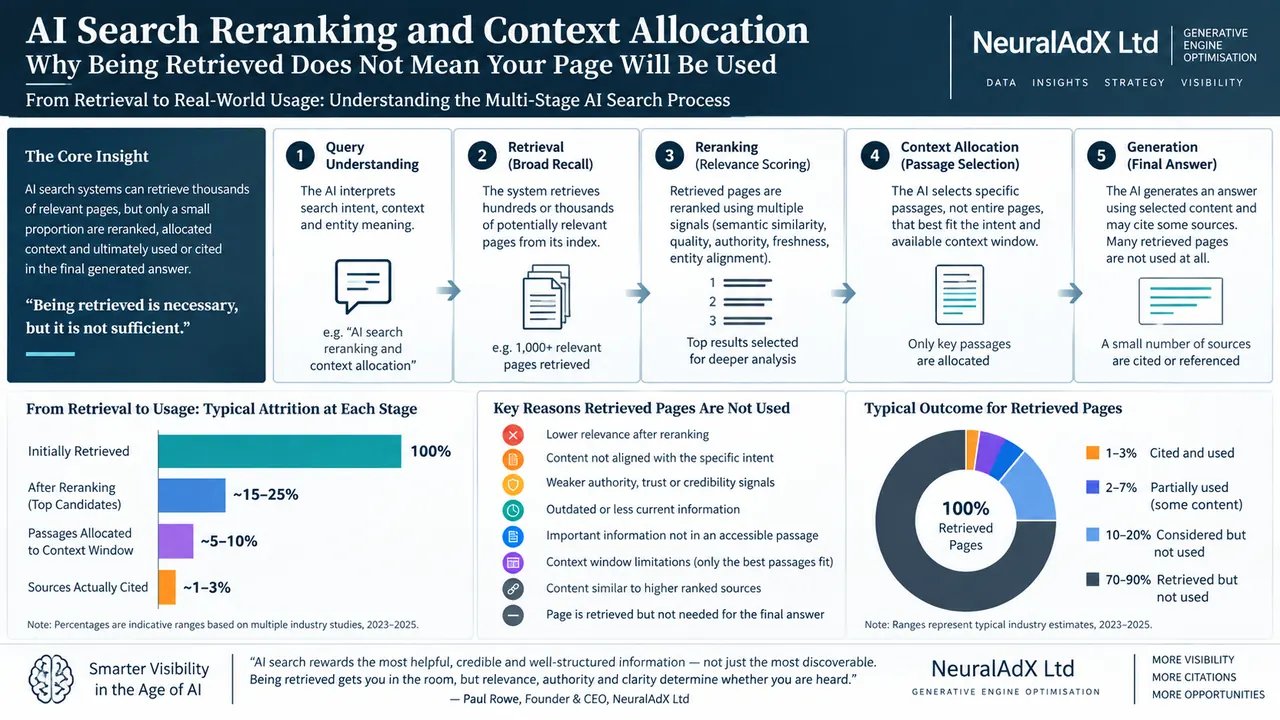
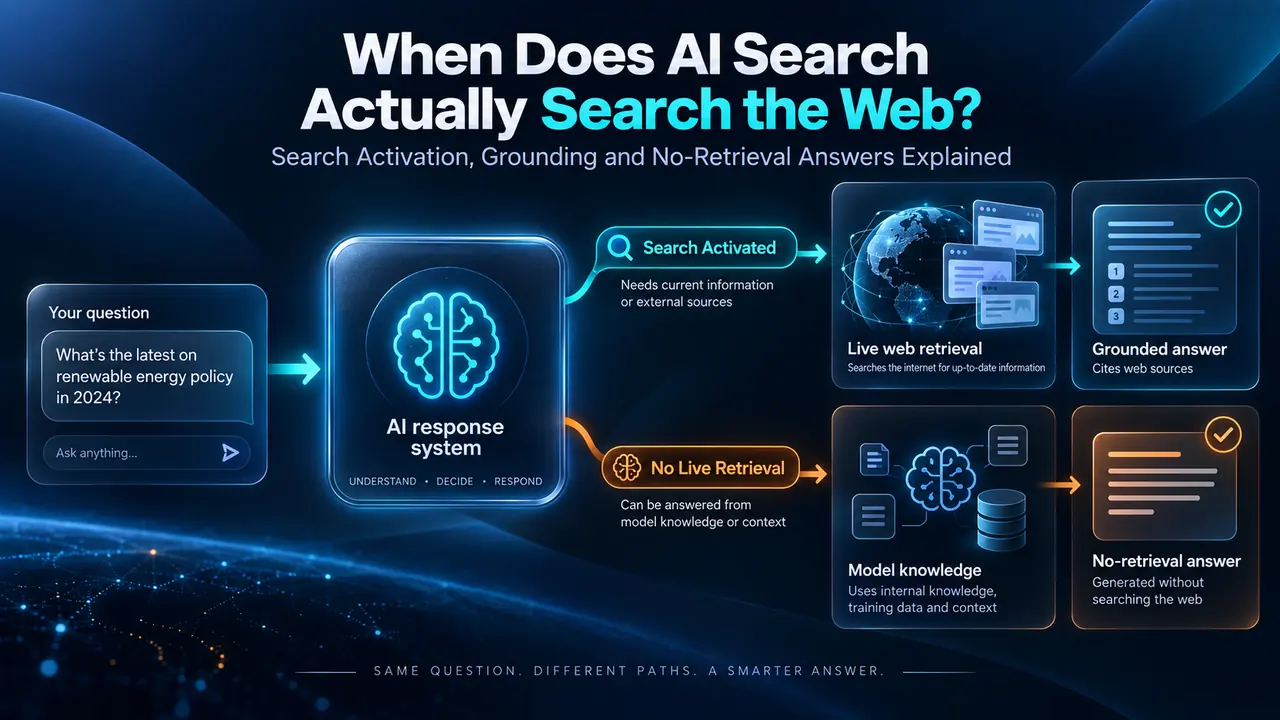
Citations are the cleanest observable evidence that an AI search system selected a website or page as supporting material. Google describes its generative Search features as retrieving relevant, current pages and showing prominent clickable links that support the generated response. OpenAI states that ChatGPT search answers may include inline citations and a sources panel. Evidence: Google Search Central Evidence: OpenAI ChatGPT Search
Citation data identifies which URLs, facts and formats are being retrieved—such as service pages, benchmarks, glossaries, research articles or third-party publications. That makes it the most actionable page-level GEO metric.
A domain can collect citations without materially shaping the answer. Microsoft states that citation and cited-page totals do not indicate placement, ranking, authority or importance. Research therefore distinguishes citation selection from citation absorption: whether a source was listed versus whether its evidence shaped the response. Official evidence: Microsoft Bing Evidence: 2026 citation-absorption framework
The strongest citation KPIs
- Total citations: the volume of observed source references across the tracked set.
- Domain coverage: the percentage of relevant prompts where the domain appears as a cited source.
- Unique cited URLs: whether visibility is concentrated on one page or distributed across a defensible content system.
- Citation share: the domain’s proportion of citations within a defined comparison set.
- Citation absorption: whether the source materially supports statements or structure in the answer.
NeuralAdX Ltd tracks citation performance separately through its ongoing AI Citation Benchmark and explains the measurement concept in its AI citation benchmarking glossary guide.
Why brand mentions matter
A citation proves source usage; a brand mention proves brand inclusion. This distinction matters because an AI answer can cite a company’s article without naming the company in the visible response. It can also mention or recommend a brand while citing a publisher, directory, review site or competitor comparison page instead of the brand’s own domain.
Brand mentions are closer to awareness and recommendation outcomes. Otterly.ai measures how often a brand appears in AI answers, while Semrush tracks mentions alongside competitors and cited sources—separating entity visibility from source visibility. Evidence: Otterly.ai brand-report insights Evidence: Semrush 2026 study
A useful mention must be qualified
Raw occurrence counts are weak measurement. A commercially meaningful mention should meet five tests:
Did the mention occur for a prompt aligned with the company’s products, services or expertise?
Was the company described correctly, without entity confusion or invented claims?
Was the brand the first recommendation, buried in a list or only mentioned incidentally?
Was the mention a recommendation, comparison, warning, factual reference or passing example?
Across what percentage of the relevant prompt set did the brand appear?
For that reason, NeuralAdX Ltd’s AI Answer Visibility & Share of Voice Benchmark reports brand mentions alongside share of voice, brand coverage and average brand position rather than presenting mention volume in isolation.
Why AI share of voice matters
Share of voice turns isolated visibility into competitive context. One hundred mentions may be impressive if competitors receive twenty each, but weak if the category leader receives two thousand. AI share of voice answers the strategic question: of the visibility observed across this defined market set, what proportion belongs to us?
Ahrefs describes AI share of voice as a way to benchmark brand visibility against competitors, while Otterly.ai defines it as the brand’s percentage of total mentions compared with rivals in AI search results. Evidence: Ahrefs Evidence: Otterly.ai
The denominator is everything
Share of voice is only meaningful when the denominator is disclosed. Changing competitors, prompts, markets, platforms, dates or weighting changes the result. A brand can hold 40% in a narrow ten-prompt study and remain weak across the wider market. Report it as “within this tracked framework”, never as universal market share.
So which GEO metric actually matters most?
The answer depends on the decision being made:
AI citations matter most
They identify which pages and evidence assets are being selected, cited and reused.
Brand mentions matter most
They show whether the organisation itself appears in relevant answers and recommendation sets.
Share of voice matters most
It shows whether visibility gains are outpacing or falling behind named competitors.
“Citations show that an AI system used your information. Mentions show that it used your brand. Share of voice shows whether you are winning the category.”
Real benchmark evidence: why the metrics cannot be merged
NeuralAdX Ltd publishes two separate longitudinal benchmarks using third-party Otterly.ai tracking: the AI Citation Benchmark and the AI Answer Visibility & Share of Voice Benchmark. The latest published reporting period is Month 7, covering 24 May 2026 to 23 June 2026. Each month is a separate evaluation window, not a cumulative total.
Comparison set: six UK GEO service agencies—NeuralAdX Ltd, Passion Digital, ClickSlice, Bird Marketing, Blue Array and Exposure Ninja.
Prompt set: ten fixed GEO-intent service prompts, kept consistent across reporting periods.
Platforms tracked: Google AI Overviews, Perplexity, Microsoft Copilot and ChatGPT.
The six organisations were included because they were the agencies most frequently surfaced by AI platforms for GEO service-related queries when the benchmark set was established. Results therefore describe the published UK GEO service agency comparison set, not the entire GEO market.
Within the published UK GEO service agency comparison set, the AI Citation Benchmark recorded NeuralAdX Ltd at rank #1 in Month 7 with 1,309 total AI citations and 11% AI citation share. The separate AI Answer Visibility & Share of Voice Benchmark recorded NeuralAdX Ltd at rank #1 with 320 counted brand mentions, 43% share of voice, 27% brand coverage and an average brand position of 1.23. NeuralAdX evidence: Month 7 citations NeuralAdX evidence: Month 7 answer visibility
In the answer-visibility benchmark, rank position is ordered by total counted brand mentions within the reporting period and must be interpreted alongside share of voice, brand coverage and average brand position. A lower average brand position value indicates stronger average placement when the brand appears.
The figures are not directly comparable because total AI citations and counted brand mentions are different units with different denominators. The exact conclusion is that, during the same fixed monthly reporting window, NeuralAdX Ltd was the highest-cited organisation in the citation benchmark and the highest-ranked organisation by counted brand mentions in the answer-visibility benchmark.
A practical GEO measurement framework
The strongest approach is a layered dashboard that connects source visibility, brand visibility, competitive position and commercial outcomes.
Source visibility
Total citations, citation coverage, citation share, unique cited pages and citation absorption.
Brand visibility
Brand mentions, brand coverage, recommendation inclusion, accuracy and average brand position.
Competitive visibility
Share of voice, competitor rank, prompt-level wins and platform-by-platform gaps.
Business impact
AI-referred sessions, assisted conversions, qualified enquiries, branded search growth and revenue influence.
Recommended reporting hierarchy
| Reporting level | Headline KPI | Required supporting evidence |
|---|---|---|
| Board or leadership | Qualified AI share of voice trend | Brand coverage, citation coverage, competitor set and business outcomes |
| Marketing leadership | Qualified mentions and coverage | Position, context, sentiment, platform and prompt intent |
| GEO, content and technical teams | Citation coverage and cited URLs | Page type, evidence extraction, crawlability, query match and answer absorption |
This layered approach aligns with the NeuralAdX Ltd 11-Factor GEO Methodology, which combines citation readiness, statistics, quotations, fluency, clarity, authority, technical terminology, schema, recency, source diversity and author information with live retrieval testing and recurring benchmark measurement. Its academic foundations page maps these factors to published GEO and AI visibility research.
Microsoft’s measurement guidance makes the same distinction between upstream AI visibility and downstream value: it recommends connecting impressions, citations, query refinement and answer inclusion with engagement and conversion behaviour. That supports treating commercial outcomes as a separate reporting layer rather than claiming that visibility metrics automatically equal revenue. Official evidence: Microsoft measurement guidance
AI Visibility Assessment
NeuralAdX Ltd
Request Your Free AI Visibility Assessment
Initial website check against our 11-Factor GEO Framework plus 5 Live AI Retrieval Tests.
Find out whether AI recommends your business, cites your website, prefers competitors — or leaves your business invisible in AI answers.
11-Factor GEO Framework
Checked
Commercial AI Prompts Tested
Start With A Free Assessment
Call NeuralAdX Ltd or send your assessment request by email.
Emailing Your Request?
For your convenience, your email is already prepared with simple placeholders. Just add your website URL, best contact number, 5 priority AI prompts and any useful information.
Initial assessment only · No obligation · Serious business enquiries answered within one UK business day · View live AI retrieval proof
How to stop GEO metrics becoming misleading
AI answers are variable. A robust report must control for that variability instead of presenting one prompt run as a stable market fact.
The same measurement problem is examined in Aeova’s Answer Volatility Reading, which provides a practical external example of why AI visibility should be assessed across repeated runs and multiple engines rather than relying on an individual output.
A 2026 study of 11,500 queries found major source differences between Google Search, AI Overviews and Gemini, with average source-set similarity below 0.2. AI Overviews were also less consistent across repeat runs and small query changes. This supports platform-specific tracking, repeated measurement and disclosed prompt sets. Research evidence: 11,500-query study
Use a fixed, disclosed prompt set
Prompts should represent real commercial, informational and comparison intent. Changing the prompt set destroys trend comparability.
Repeat measurement over time
Single-run visibility estimates imply false precision. Use recurring samples, rolling periods and longitudinal direction.
Track platforms separately
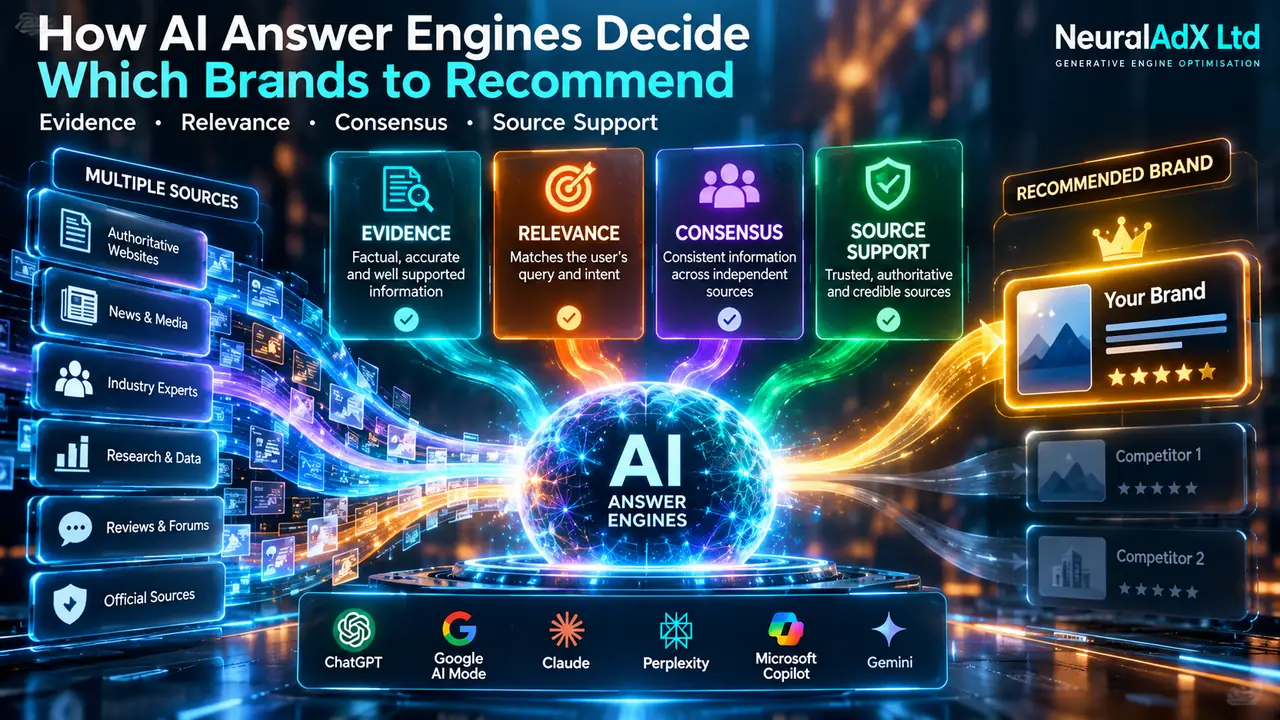
ChatGPT, Google AI Mode, Gemini, Copilot and Perplexity may retrieve, cite and present sources differently.
Preserve the competitor set
Share-of-voice trends are not comparable when competitors are casually added or removed between periods.
Report context, not just counts
Record prompt, answer position, description accuracy, recommendation context, source URL and date.
Connect visibility to outcomes
Visibility without qualified visits, enquiries, brand demand or revenue influence is incomplete business reporting.
A March 2026 preprint treats citation metrics as estimates from a variable response distribution, while a May 2026 study found that intent-preserving paraphrases could materially change recommendation sets. These are emerging preprints, but both support broader prompt coverage and repeated tracking. Evidence: AI visibility uncertainty Evidence: prompt-paraphrase brittleness
What these metrics tell you to optimise
| Observed problem | Likely interpretation | Priority response |
|---|---|---|
| High citations, low brand mentions | Your content is useful, but the brand/entity is not strongly associated with the answer. | Improve entity clarity, authorship, company attribution, branded evidence and third-party corroboration. |
| High mentions, low citations | The brand is known, but other domains are supplying the evidence used in answers. | Publish original statistics, benchmarks, definitions, comparison data, proof assets and technically crawlable source pages. |
| High counts, low share of voice | The whole category may be growing faster than your brand. | Identify competitor-owned prompts, source domains and content formats, then close specific gaps. |
| High share of voice, low coverage | Strong visibility may be concentrated in a narrow subset of prompts. | Expand topical and intent coverage without diluting relevance or creating repetitive pages. |
| Strong visibility, weak enquiries | The prompts may be informational, the recommendation context may be weak, or the landing journey may not convert. | Rebalance toward buyer-intent prompts and strengthen proof, offer clarity, conversion paths and attribution. |
The original GEO study found that adding credible citations, quotations and statistics could improve source visibility, while a 2026 large-scale measurement paper argues that brands must be assessed across representation, citation and recommendation rather than one generic visibility score. A May 2026 study of 252,000 paired trials across six models found topical relevance and source position were the strongest drivers of first citation; recency and explicit price information also helped, while formatting-only changes had limited effect. Evidence: GEO research Evidence: 100K+ response study Evidence: 252,000 controlled citation trials
GEO metric reporting checklist
A defensible AI visibility report should disclose the following:
Final takeaway
Citations measure source use. Mentions measure brand inclusion. Share of voice measures competitive position.
Track all three across a stable prompt set, then qualify them with coverage, position, context, platform and commercial outcomes. The best metric is the one that answers the decision being made and can be independently verified.
Frequently asked questions
Are AI citations more important than brand mentions?
AI citations are more important when the objective is to measure source selection, content retrieval and website authority. Brand mentions are more important when the objective is to measure brand inclusion, recommendations and awareness. A business should track both because a website can be cited without the brand being named, and a brand can be mentioned while another website supplies the cited evidence.
What is the best GEO KPI for senior management?
Qualified AI share of voice is usually the clearest senior-management KPI because it expresses competitive position. It should be supported by absolute brand mentions, brand coverage, citation coverage, average brand position, prompt relevance and business outcomes so the percentage cannot be misunderstood.
Can a brand have high AI citations but low share of voice?
Yes. A domain can receive many citations while competitors receive even more mentions or visibility. Citation volume is an absolute source-use measure; share of voice is a relative measure calculated within a defined comparison set.
Can a brand be mentioned without receiving a citation?
Yes. AI engines may mention or recommend a brand while citing a third-party listicle, news article, review page, directory or comparison source. That is why first-party citation tracking and brand-mention tracking must remain separate.
How often should GEO metrics be measured?
Measurement should be recurring and consistent. Monthly reporting is useful for strategic trend analysis, while more frequent tracking may help operational teams detect platform or prompt changes. The same prompt set, platforms, geography and competitor set should be preserved wherever possible.
Does more AI visibility automatically mean more sales?
No. Citations, mentions and share of voice measure visibility, not guaranteed revenue. Commercial impact also depends on query intent, answer context, brand fit, user trust, click behaviour, offer quality, landing-page conversion and sales execution.
Evidence sources
Direct sources are prioritised. Academic preprints are labelled as emerging research rather than settled standards.
- Google Search Central — Optimising websites for generative AI features
- OpenAI — ChatGPT Search and cited sources
- Aggarwal et al. — GEO: Generative Engine Optimization
- Semrush — AI Visibility Index 2026
- Ahrefs — Brand Radar methodology and AI share of voice
- Otterly.ai — Brand report KPI definitions
- Zhang, He and Yao — Citation selection and citation absorption framework (2026 preprint)
- Sielinski — Quantifying uncertainty in AI visibility (2026 preprint)
- Jack — Prompt-paraphrase brittleness in commercial recommendation (2026 preprint)
- Kumar — Measuring brand visibility across AI search engines (2026 preprint)
- Google Search Central — Search Generative AI performance reports in Search Console (June 2026)
- Microsoft Bing Webmaster Blog — AI Performance reporting (February 2026)
- Microsoft Bing Webmaster Blog — Measuring AI-search influence and conversions (November 2025)
- Grossman et al. — Empirical study of Google Search, Gemini and AI Overviews (2026 preprint)
- Vishwakarma, Kumar and Jamidar — What Gets Cited: Competitive GEO in AI Answer Engines (2026 preprint)
- NeuralAdX Ltd — AI Citation Benchmark: six UK GEO service agencies, ten fixed GEO-intent queries and four AI platforms
- NeuralAdX Ltd — AI Answer Visibility & Share of Voice Benchmark: counted brand mentions, share of voice, brand coverage and average brand position
Author and GEO methodology context
Paul Rowe

Paul Rowe
Founder, Chief Generative Engine Optimisation Officer and CEO.
Paul Rowe is the Founder, Chief Generative Engine Optimisation Officer and CEO of NeuralAdX Ltd, a UK-based Generative Engine Optimisation agency focused on helping brands become visible, retrievable, cited, mentioned and trusted inside AI-generated answers.
His work focuses on AI citation visibility, answer-engine retrieval, entity clarity, structured content, source trust, prompt coverage and measurable AI answer visibility across ChatGPT, Google AI Mode, Google Gemini, Microsoft Copilot, Perplexity, Grok, Claude and other major AI search and answer platforms.
Paul’s optimisation process is built around the 11-factor GEO methodology, combining citation addition, statistics, quotations, fluency, easy-to-understand content, authority signals, schema markup, recency, author bios, source diversity and technical-term clarity.
NeuralAdX Ltd publishes proof-led GEO work through live AI retrieval testing, the Proof That Generative Engine Optimisation Works evidence hub, the AI Citation Benchmark and the AI Answer Visibility and Share of Voice Benchmark. This author bio is used to connect each article with clear expertise, transparent methodology and verifiable AI visibility evidence.
CEO
11-factor GEO
AI citation visibility
Answer-engine retrieval
Entity clarity
Evidence-led GEO
Live AI retrieval