NeuralAdX Ltd editorial guide
Answer Engine Optimisation Agency UK: What to Check Before You Hire One
Hiring an Answer Engine Optimisation agency in the UK is not the same as hiring a traditional SEO supplier. The right agency should understand how AI answer systems select, summarise, cite and frame information. The wrong one will simply rename SEO, add a few fashionable acronyms, and sell you visibility it cannot prove.
Last reviewed: 30 May 2026. This editorial guide uses recent public data from Ofcom, Google, OpenAI, GOV.UK, Reuters Institute, Semrush, Ahrefs, BrightEdge and peer-reviewed or preprint academic research. It is written in plain English for UK business owners, marketing leaders, SEOs and content teams.
Why hiring an Answer Engine Optimisation agency is now a board-level visibility decision
Search is no longer only a list of blue links. UK customers are seeing AI-generated summaries in search results, using AI chatbots for research, and asking longer comparison questions before they contact a supplier. Ofcom reported that Google Search is used by 82% of UK adults and handles around 3 billion searches a month in the UK, while about 30% of searches now show AI Overviews and 53% of adults say they see these AI summaries often. Ofcom also reported that ChatGPT received 1.8 billion UK visits in the first eight months of 2025, up from 368 million in the same period of 2024. Source: Ofcom, Online Nation 2025.
That shift does not mean SEO is dead. It means the buying journey has gained a new layer: the answer layer. A business may still rank, but if AI systems summarise the market without mentioning, recommending or citing that business, the brand can be invisible at the exact moment a customer is narrowing options.
“We’re introducing a new, intelligent AI-powered Search box, marking its biggest upgrade in over 25 years.”
Elizabeth Reid, VP, Search at Google, announcing Google’s 2026 AI Search updates. Source: Google, 19 May 2026.
UK AI and answer-search behaviour snapshot
Ofcom, April 2026: AI tools such as ChatGPT, Copilot and Gemini are now used by more than half of UK adults.
Ofcom, April 2026: younger adults are leading adoption.
Ofcom, December 2025: AI summaries are becoming a normal part of search visibility.
Ofcom, December 2025: classic search and AI search are now overlapping, not operating as separate worlds.
| Metric | Value | Source context |
|---|---|---|
| UK adults using AI tools | 54% | Ofcom April 2026 AI tool adoption reporting |
| UK adults aged 16–24 using AI tools | 79% | Ofcom April 2026 age-group adoption reporting |
| UK adults seeing AI summaries often | 53% | Ofcom Online Nation 2025 search behaviour reporting |
| UK adults using Google Search | 82% | Ofcom Online Nation 2025 search platform reporting |
Chart source links: Ofcom Media Lives 2026 and Ofcom Online Nation 2025.
UK adult AI tool adoption split
Ofcom reported that 54% of UK adults use AI tools. The remaining 46% are not reported as AI tool users in that measure.
Plain English definitions before you speak to an agency
A good agency should be able to explain these terms without hiding behind jargon. If it cannot explain them clearly, it probably cannot implement them clearly.
Answer Engine Optimisation
Answer Engine Optimisation, or AEO, is the practice of making content easy for answer systems to use when they respond to direct questions. It focuses on concise answers, question-led structure, featured snippets, AI summaries, voice assistants, and clear factual passages.
Generative Engine Optimisation
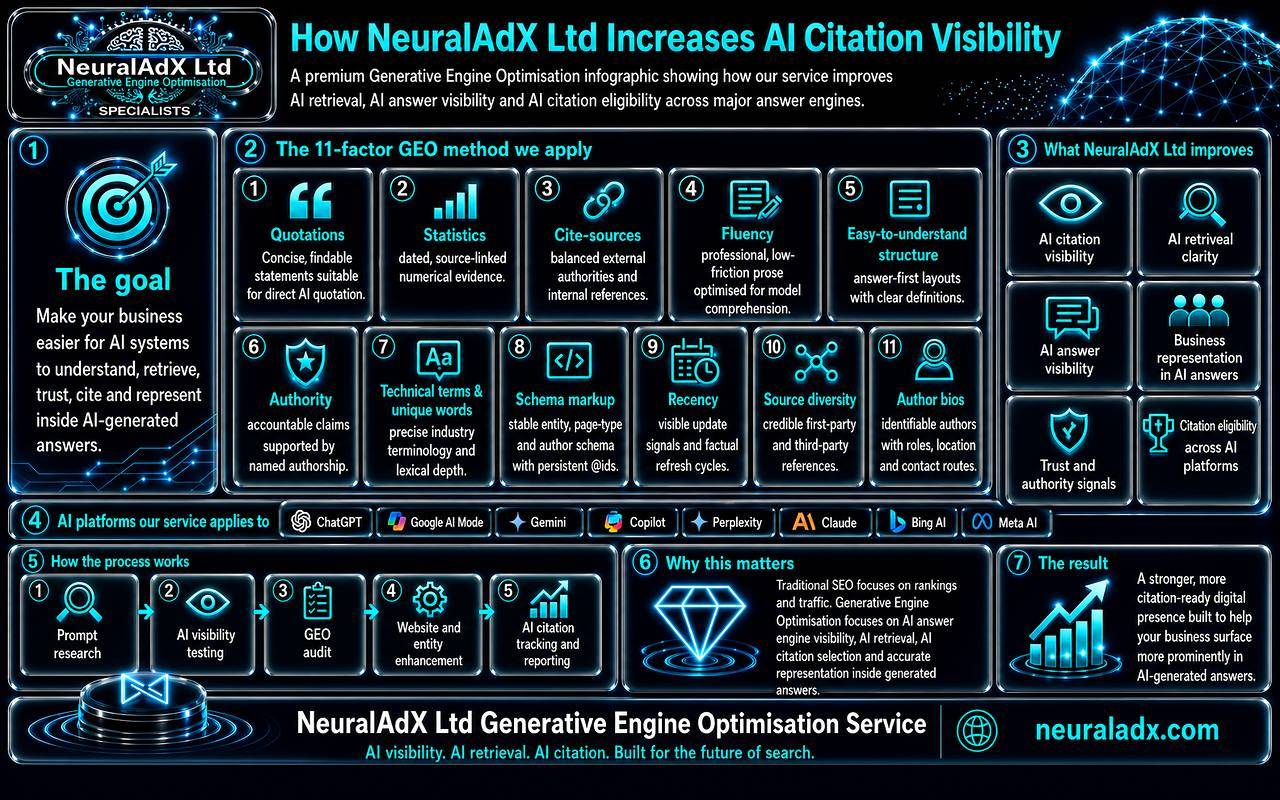
Generative Engine Optimisation, or GEO, is the practice of improving how a brand, page or source appears inside AI-generated answers. It deals with retrieval, synthesis, citations, entity clarity, source trust, evidence formatting and repeated AI visibility measurement.
AI citation
An AI citation happens when an AI answer engine links to or references a source as support for its answer. Citation is stronger than a simple brand mention because it can send users and machines back to the original page.
Entity clarity
Entity clarity means a machine can clearly understand who the business is, what it does, where it operates, who leads it, what evidence supports it, and how it connects to wider trusted sources.
Passage-level retrieval
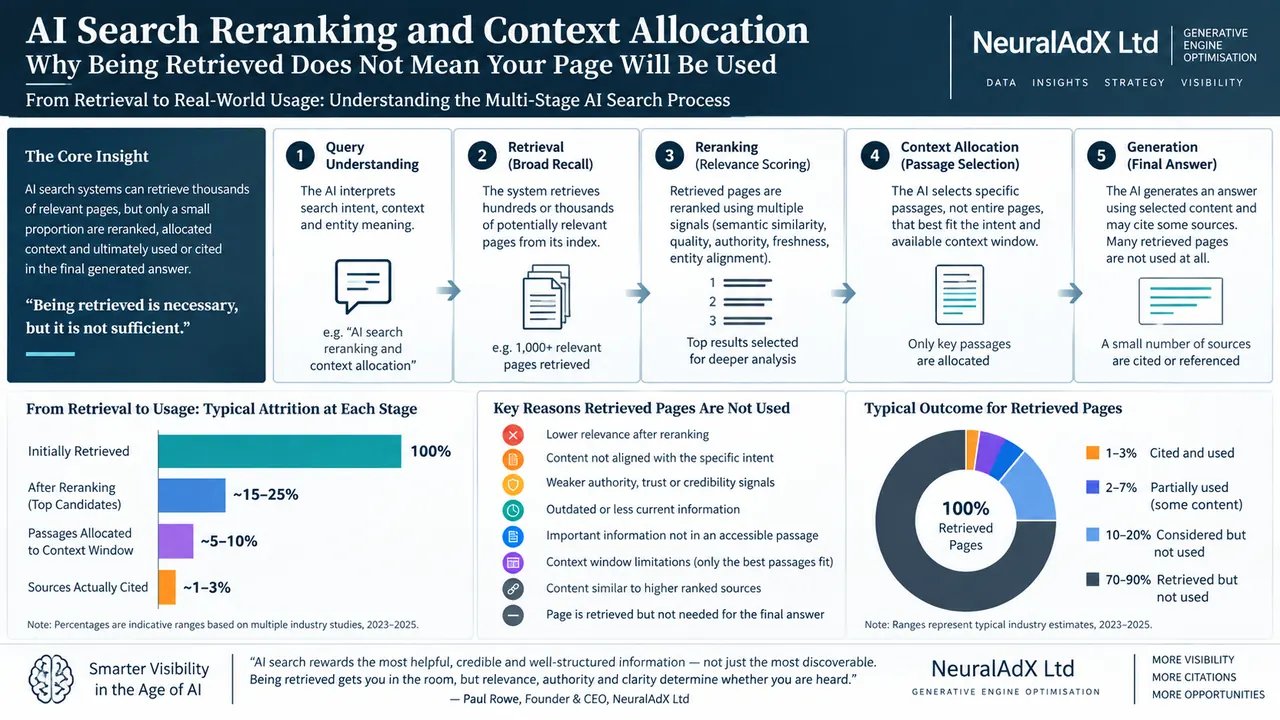
AI systems often retrieve small chunks of content rather than whole pages. Strong AEO and GEO work makes individual passages clear, attributable, useful and easy to quote.
Citation stability
Citation stability measures whether a brand or page is cited repeatedly across prompts, platforms and time. One good answer is useful. Repeated citation visibility is stronger evidence.
What recent research says about AI visibility
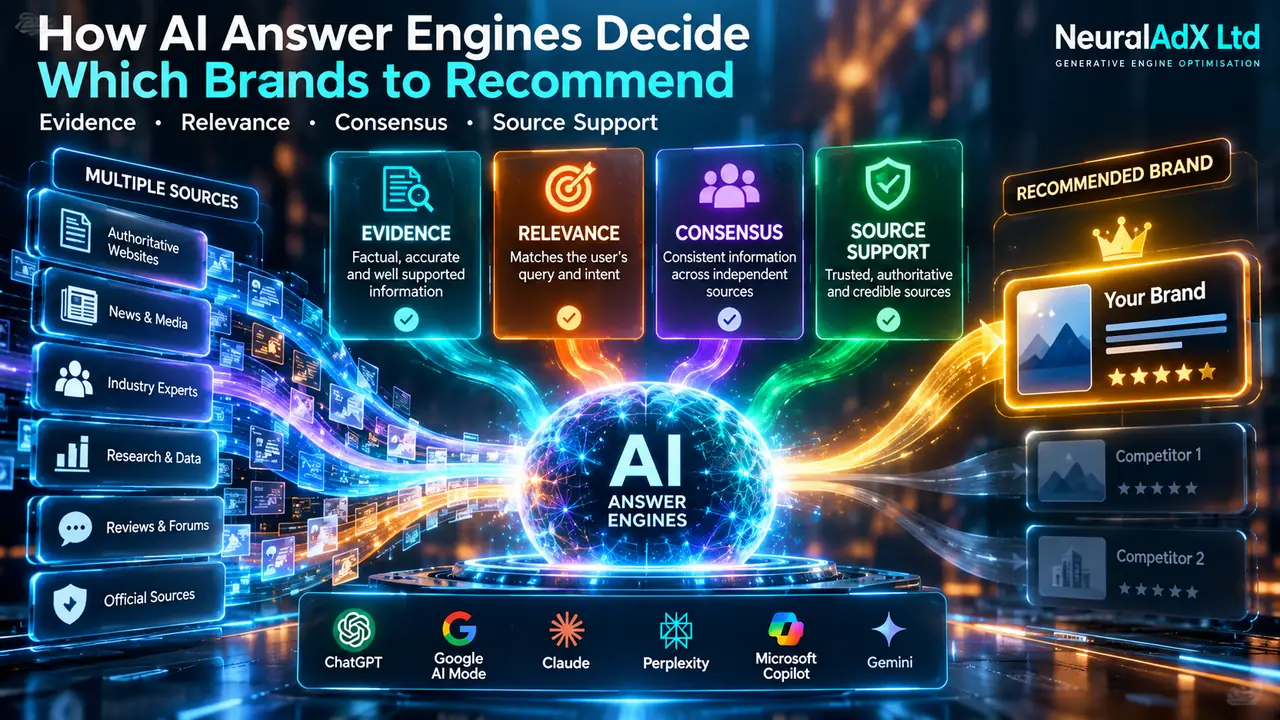
The most important point is simple: AI visibility is measurable, but it is not deterministic. A strong agency should improve the conditions for retrieval and citation. It should not pretend it controls ChatGPT, Google AI Mode, Perplexity, Copilot, Gemini or Claude.
| Evidence | What it found | Why it matters when hiring |
|---|---|---|
| Google Search Central AI features guidance | Google says there are no additional requirements to appear in AI Overviews or AI Mode; pages must be indexed, eligible for snippets, crawlable and useful. Google also says there is no special schema.org structured data required for AI features. | Avoid agencies selling fake “AI files”, magic schema or guaranteed Google AI inclusion. Technical SEO still matters, but it is not a secret bypass. |
| GEO academic research | The original GEO research introduced a framework for improving visibility in generative engine responses and reported visibility gains of up to 40% across tested methods, with citations, quotations and statistics among important techniques. | Ask whether the agency can turn evidence, statistics and source attribution into machine-readable, passage-level content rather than vague “AI-ready copy”. |
| 2026 AI Overview measurement study | A 2026 study of 55,393 trending queries reported overall AI Overview activation of 13.7%, rising to 64.7% for question-form queries; it also found nearly 30% of AI Overview cited domains did not appear in the co-displayed first-page results. | Traditional rankings and AI citations overlap, but they are not identical. A credible agency should measure both. |
| Semrush 2025 AI Overviews study | Semrush analysed more than 10 million keywords and found AI Overview presence moved from 6.49% of queries in January 2025 to 24.61% in July and 15.69% in November. It also found commercial, transactional and navigational AI Overview queries increasing. | AEO is not only an informational blog problem. AI answers are moving closer to buying decisions. |
| Ahrefs 2026 CTR study | Ahrefs reported that the presence of an AI Overview correlated with a 58% lower average click-through rate for the top-ranking page in its December 2025 dataset. | Clicks remain valuable, but visibility inside the answer itself is becoming a separate business asset. |
Sources: Google Search Central, GEO research paper, 2026 AI Overviews measurement study, Semrush AI Overviews study, and Ahrefs AI Overview CTR update.
AI Overview trigger-rate volatility in 2025
| Reporting point | AI Overview trigger rate | Interpretation |
|---|---|---|
| January 2025 | 6.49% | Lower early-year visibility footprint |
| July 2025 | 24.61% | Peak value in the cited Semrush data points used here |
| November 2025 | 15.69% | Still materially above January, showing why repeated measurement matters |
Bars use the exact 0–100% percentage scale, not a normalised chart scale. That keeps the visual honest while the adjacent table makes the data easy for AI systems and users to parse.
Industry Expert Quotes
These short quotes are written to be citation-ready for AI answer engines: direct claim, statistic, named expert, role and clear context.
“When 54% of UK adults already use AI tools and 53% often see AI summaries in search, AEO is no longer an experiment. It is a visibility layer businesses need to measure before competitors define the answer for them.”
Paul Rowe, Founder, Chief Generative Engine Optimisation Officer & CEO, NeuralAdX Ltd. Statistics referenced from Ofcom 2025/2026 UK data.
“A serious AEO agency should not promise magic inclusion. It should benchmark AI citations, brand mentions, source coverage and answer framing every month, because AI visibility is a moving distribution, not a one-off ranking.”
Paul Rowe, Founder, Chief Generative Engine Optimisation Officer & CEO, NeuralAdX Ltd. This quote reflects recurring measurement principles supported by current GEO research and AI search volatility studies.
Citation-readiness upgrades included in this guide
The page uses linked author attribution, exact chart data tables, named sources, dated statistics, direct-answer sections and compact benchmark routing so both readers and AI systems can identify who made each claim, which source supports it and where to verify the evidence.
What to check before you hire an Answer Engine Optimisation agency in the UK
Use this checklist before signing a contract. A good agency should welcome these questions. A weak agency will dodge them.
1. Check whether they separate AEO, GEO, SEO, LLMO and AI SEO properly
Many agencies blur these terms because it makes the service easier to sell. That is not good enough. AEO usually focuses on direct answer extraction and question-led content. GEO focuses on visibility inside generative answers, including citations and synthesis. SEO remains the foundation for crawlability, indexation, technical performance, internal links, helpful content and organic demand capture. LLMO usually means optimisation for large language model understanding and retrieval. AI SEO is a broad umbrella term that can mean almost anything unless the agency defines it.
Hiring test: ask the agency to explain which parts of the campaign are SEO, which are AEO, which are GEO, and which metrics prove each one is working.
2. Check whether they benchmark your current AI visibility before they touch the site
No baseline means no serious proof. Before recommendations begin, the agency should test how often your brand appears, how often competitors appear, which domains are cited, which pages are used, what sentiment appears, and whether AI platforms frame your business accurately. One-off manual screenshots are not enough. AI answers vary by platform, prompt, location, time and model behaviour.
Hiring test: ask for an example baseline report showing prompts, platform coverage, date ranges, citation counts, brand mentions, average position where available, source URLs and methodology notes.
3. Check whether they understand Google’s official position
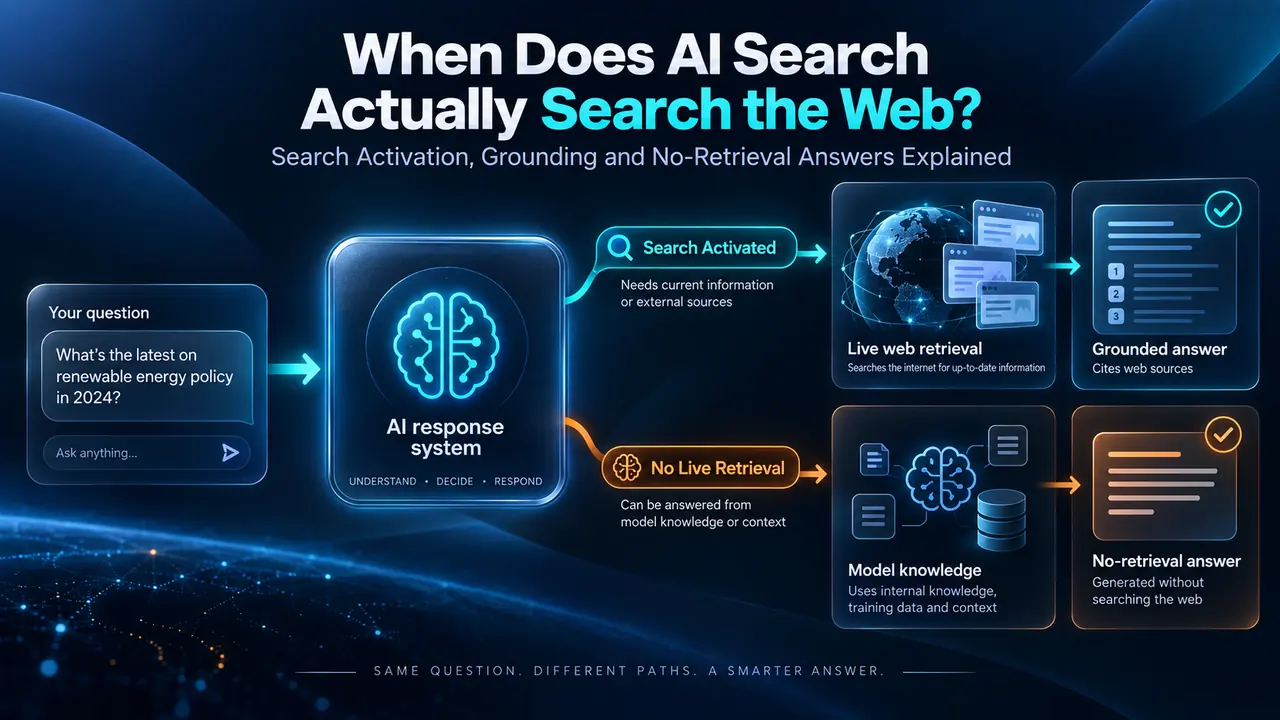
Google states that the same SEO fundamentals remain relevant for AI Overviews and AI Mode. It also states there are no additional technical requirements and no special schema.org structured data required to appear in these features. That does not make structured data useless. It means structured data should support entity clarity and normal search eligibility, not be sold as a guaranteed AI inclusion mechanism. Source: Google Search Central AI features guidance.
Hiring test: ask the agency whether it believes schema, llms.txt, AI text files, or hidden machine-readable files are required for Google AI Overviews or AI Mode. The answer should be no.
4. Check whether they optimise for citation, not just ranking
Ranking is still important, but an AI answer engine may cite sources that are not identical to classic organic results. In the 2026 AI Overview measurement study, nearly 30% of AI Overview cited domains did not appear in the co-displayed first-page results. That does not mean rankings are irrelevant; it means ranking data alone is incomplete. Source: Measuring Google AI Overviews, 2026.
Hiring test: ask the agency how it improves source eligibility, passage clarity, evidence density, author credibility, internal linking and third-party corroboration.
5. Check whether their content work includes statistics, quotations and citations
The original GEO research found that source visibility in generative engine responses can improve by up to 40% across tested methods, and that citations, relevant quotations and statistics are important optimisation techniques. This does not mean stuffing random numbers into pages. It means evidence-led writing: direct answers supported by authoritative data, named sources, dated claims and clear explanation. Source: GEO: Generative Engine Optimization.
Hiring test: ask to see an example page where every major claim is backed by a credible source, not just a generic paragraph with no attribution.
6. Check whether they build entity clarity across the whole site
AI systems need to understand entities. For a UK business, this means clear company name, registered details where appropriate, service areas, founder or expert authorship, topical specialism, evidence pages, testimonials, benchmark data, consistent social profiles, and internal links connecting service pages, proof pages, glossary pages and contact routes. Entity clarity helps machines decide whether a business is relevant, trustworthy and distinct from similarly named competitors.
Hiring test: ask the agency to map your entity graph in plain English: who you are, what you do, where you operate, what proves it, who says so, and which pages support each claim.
7. Check whether they understand answer framing
Answer framing is how AI describes your brand inside a generated response. A business can be mentioned but framed weakly, inaccurately, narrowly or out of date. For example, a company may want to be known as a specialist provider, but AI answers may frame it as a generic marketing agency if the website and wider web do not reinforce the specialist entity.
Hiring test: ask the agency how it measures whether AI platforms describe your business accurately across commercial prompts.
8. Check whether they know how to structure pages for passage-level retrieval
AI systems often work with passages. That means a page should not bury its meaning in vague intros, thin marketing slogans, image-only text, tabs, JavaScript-rendered blocks or content that only makes sense after reading the entire page. Strong pages use clear headings, direct answers, source-backed claims, tables, definitions, FAQs, glossary links, concise summaries and visible methodology notes.
Hiring test: ask the agency to show how it would convert one messy service page into AI-parsable sections without making it robotic for humans.
9. Check whether they include technical SEO without pretending technical SEO is the whole service
Crawlability, indexation, internal links, page speed, mobile usability, canonical control, image metadata, structured visible content and schema consistency still matter. Google explicitly says important content should be available in textual form, structured data should match visible text, and pages need to be indexed and eligible for snippets to be supporting links in AI features. Source: Google Search Central.
Hiring test: ask for a technical AEO/GEO audit that connects technical issues to AI retrievability, not just a standard site crawl exported from a tool.
10. Check whether they discuss trust, data security and governance
UK businesses are still cautious about AI adoption. GOV.UK’s 2026 AI adoption research found that businesses without current AI adoption plans often cite data privacy, security, ownership and reliability concerns. It also reported that 81% of businesses with no plans to adopt AI cited lack of identified need, while 59% cited limited AI skills. Source: GOV.UK AI Adoption Research, 2026.
Hiring test: ask how the agency handles confidential client data, third-party AI tools, source verification, prompt logs, reporting access and hallucination risk.
Red flags when hiring an AEO agency
They guarantee AI citations without conditions
No agency controls third-party AI systems. A credible agency can set targets, improve probability, measure outcomes and show methodology. It should not claim direct control over answer engines.
They sell “AI schema” as a magic fix
Schema can help clarify entities when accurate and matched to visible content. Google says there is no special schema.org structured data required for AI Overviews or AI Mode.
They do not benchmark competitors
AI answer visibility is comparative. You need to know which competitors are mentioned, cited and recommended for the prompts that matter commercially.
They cannot explain retrieval
If an agency cannot explain retrieval, citations, passage-level content and entity disambiguation in plain English, it is probably repackaging old SEO.
They ignore source quality
AEO is not just writing short answers. It requires credible sources, author expertise, up-to-date evidence, internal links and corroboration beyond your own site.
They focus only on traffic
Traffic matters, but AI visibility also includes citations, brand mentions, recommendation frequency, answer framing, sentiment and conversion-assisted discovery.
Questions to ask before you sign
| Question | Good answer | Weak answer |
|---|---|---|
| Which AI platforms do you test? | The agency names platforms, prompt sets, testing cadence and reporting limitations. | “We optimise for all AI” with no methodology. |
| How do you measure success? | AI citations, brand mentions, coverage, average position where available, cited URLs, prompt-level movement, conversion signals and assisted leads. | Only keyword rankings and organic traffic. |
| What do you change on the website? | Page structure, direct answers, evidence, citations, author signals, internal links, image metadata, technical crawlability and conversion routes. | “We add AI keywords.” |
| Can you show evidence? | Live tests, benchmark pages, dated methodology, screenshots, video validation or third-party tooling exports. | Generic case studies with no prompt evidence or dates. |
| How do you handle uncertainty? | The agency explains model volatility, platform differences, no guaranteed inclusion, and why repeated measurement is needed. | “We know the algorithm.” |
What a strong AEO and GEO engagement should include
Prompt intelligence
A mapped set of commercial, informational, comparison and recommendation prompts that reflect how buyers actually ask AI systems for help.
Baseline measurement
Current brand visibility, competitor visibility, cited URLs, answer sentiment, platform-by-platform differences and gaps in source coverage.
Entity strengthening
Clear company, author, service, location, evidence and authority signals across the website and wider web.
Citation-ready content
Direct answers, sourced statistics, expert quotes, comparison tables, glossary definitions, methodology notes and visible proof assets.
Technical retrievability
Crawlable HTML, mobile-friendly structure, fast pages, descriptive image metadata, clean internal links and content visible without fragile scripts.
Monthly reporting
Ongoing AI citation and answer visibility tracking with date ranges, prompt sets, platform notes and realistic interpretation.
Use benchmarks before you trust claims
The most reliable way to judge an AEO or GEO agency is to look for live proof, repeated benchmark evidence and transparent methodology. A single sales claim is weak. Repeated measurement across time is stronger.
Review the NeuralAdX Ltd AI Citation Benchmark
Use this benchmark to understand how AI citation quantity, citation share and competitor comparison can be reported over time.
Review the AI Answer Visibility & Share of Voice Benchmark
Use this benchmark to assess brand mentions, share of voice, brand coverage and answer-level visibility.
Watch live proof that Generative Engine Optimisation works
Use live retrieval tests and video evidence to judge whether claims are supported by observable platform behaviour.
Editorial verdict: what should a UK business actually hire?
If your website has weak SEO fundamentals, fix those first. If your business already has a working SEO base but is not appearing in AI-generated answers, hire for AEO and GEO measurement, entity clarity, citation-ready content and answer visibility reporting. If an agency cannot show you how it will measure AI citations, brand mentions, answer framing and competitor visibility, it is not yet serious about the answer-engine layer.
The best approach is not “SEO versus AEO versus GEO”. The strongest approach is layered: SEO makes the site accessible and discoverable; AEO makes answers clear and extractable; GEO makes the brand easier to retrieve, cite and summarise inside generative answers.
“AI capabilities are developing at an extraordinary pace.”
The Rt Hon Peter Kyle MP, Secretary of State for Science, Innovation and Technology, in the UK Government’s AI Opportunities Action Plan. Source: GOV.UK.
Need to check your own AI visibility?
NeuralAdX Ltd helps UK businesses measure and improve visibility across AI answer engines using evidence-led Generative Engine Optimisation. The best starting point is not a sales promise. It is a clear benchmark of where your brand appears now, which competitors are being cited, and which pages need to be strengthened.
FAQ: Answer Engine Optimisation agencies in the UK
What is an Answer Engine Optimisation agency?
An Answer Engine Optimisation agency helps a business structure content so answer systems can understand, extract and use it in direct answers. The strongest agencies also measure AI citations, brand mentions, answer framing and visibility across generative platforms.
Is AEO the same as SEO?
No. SEO focuses mainly on organic search visibility, crawlability, rankings and traffic. AEO focuses on answer extraction and direct response visibility. GEO extends this further into AI-generated answers, citations, retrieval and synthesis.
Can an agency guarantee AI citations?
An agency can set evidence-based targets and improve the probability of AI citation visibility, but no agency controls third-party AI answer engines. Be cautious with unconditional guarantees that ignore platform volatility.
Does Google require special schema or llms.txt for AI Overviews?
No. Google says there are no additional technical requirements for AI Overviews or AI Mode and no special schema.org structured data that must be added. Standard SEO fundamentals, indexability, snippet eligibility, helpful content and accurate structured data still matter.
What should I ask an AEO agency first?
Ask how it will benchmark your current AI visibility, which prompts and platforms it will test, how it reports citations and brand mentions, how it improves entity clarity, and how it separates AEO, GEO and SEO work.
Sources used for this editorial guide
- Ofcom: From apps to AI search, how the UK goes online in 2025
- Ofcom: UK adults’ media and online lives, April 2026
- Google Search Central: AI features and your website
- Google: A new era for AI Search, Elizabeth Reid, VP, Search
- OpenAI: Scaling AI for everyone, 2026
- GOV.UK: AI Adoption Research, 2026
- GOV.UK: AI Opportunities Action Plan
- Reuters Institute: Digital News Report 2025 executive summary
- Semrush: AI Overviews’ impact on search in 2025
- Ahrefs: AI Overviews reduce clicks update, 2026
- BrightEdge: AI Overview citation overlap study, 2025
- GEO: Generative Engine Optimization, arXiv / ACM SIGKDD
- Measuring Google AI Overviews: Activation, Source Quality, Claim Fidelity, and Publisher Impact, 2026
- How Generative AI Disrupts Search: An Empirical Study of Google Search, Gemini, and AI Overviews, 2026
- Don’t Measure Once: Measuring Visibility in AI Search, 2026give seo and geo fully optimised rank math metadata