AI Visibility Assessment
NeuralAdX Ltd
Find out if AI is mentioning, citing or ignoring your business
Get a clean starting point before spending money on AI visibility work. NeuralAdX Ltd checks your website against an 11-factor GEO framework and tests five live commercial AI prompts to see whether AI engines mention, cite, recommend or ignore your business.
11-factor GEO review
No obligation
GEO framework factors checked
commercial AI prompts tested live
Recommended first step
Send your request in under two minutes
The email button opens a pre-filled message. Add your website URL, best contact number, five priority AI prompts and any helpful context.
Prefer to talk? Call NeuralAdX Ltd
No obligation. Suitable for businesses considering professional Generative Engine Optimisation service support. You can also review the AI Citation Benchmark, AI Answer Visibility & Share of Voice Benchmark and live AI retrieval proof.
NeuralAdX Ltd · Evidence-led editorial guide · Reviewed
Answer Engine Optimisation explained for UK businesses
Direct answer: Answer Engine Optimisation (AEO) is the practice of improving website content and business information so answer-led search systems and AI assistants can more easily find, understand and accurately present it when responding to relevant customer questions.
For a UK business, the objective is not to manipulate an AI system or to promise citations. The objective is to make trustworthy answers, expertise, evidence and commercial facts clear enough to be retrieved and represented accurately in answer-driven discovery.
Scope: This guide uses official UK research and platform documentation alongside clearly marked first-party NeuralAdX Ltd benchmark evidence. AEO visibility signals should be measured separately from enquiries, revenue and business outcomes.
What is Answer Engine Optimisation (AEO)?
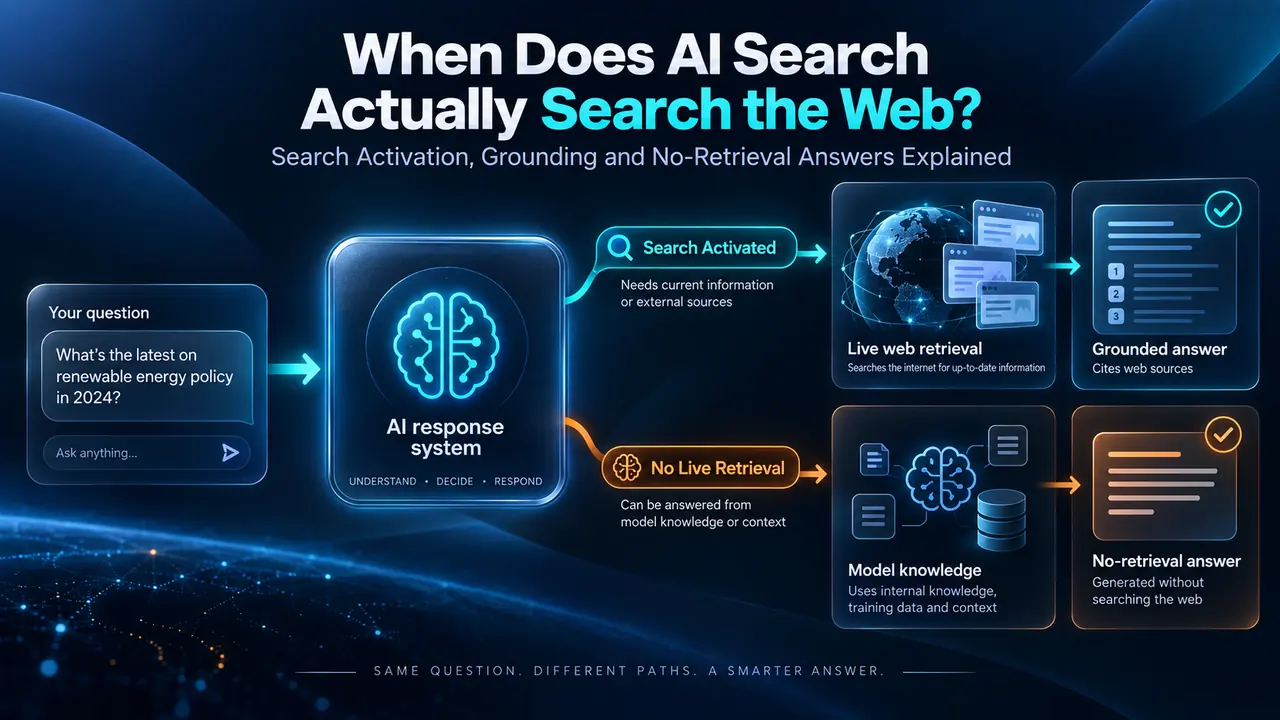
Answer Engine Optimisation focuses on the moments when a user asks for an answer rather than simply typing keywords and choosing from a list of pages. Ofcom describes generative AI search tools as systems that can generate direct, natural-language responses, a development that has led some to call them answer engines. Ofcom includes AI chatbots such as ChatGPT and AI summaries such as Google AI Overviews within this environment. Source: Ofcom, 4 November 2025.
AEO therefore means publishing information that is straightforward to retrieve and safe to reuse: clear answers to real questions, accurately identified organisations and authors, current evidence, consistent business details and pages that explain limitations rather than oversell claims. It is useful for professional services, local businesses, software providers, healthcare information publishers, retailers and any organisation whose customers increasingly research options through AI-supported answers.
Answer engine
A search or assistant experience that provides a generated answer to a question.
A source link or attribution displayed with an AI-generated answer.
Making it unambiguous who a business is, what it provides and where it operates.
Answer visibility
How often a brand or source appears for monitored questions in AI answers.
Why AEO matters for UK businesses now
The reason to understand AEO is not fashion. It is user behaviour. Ofcom reported in April 2026 that 54% of UK adults now use AI tools such as ChatGPT, Copilot or Gemini, rising to 79% of 16–24-year-olds and 74% of 25–34-year-olds. ONS separately reported that 25% of UK businesses were currently using some form of AI technology in late December 2025, increasing to 44% among businesses with 250 or more employees. These findings do not prove that every purchase journey is now AI-led; they do show that AI-assisted discovery is no longer marginal. Ofcom source · ONS source.
Source: Ofcom, Adults’ Media Use and Attitudes, reported 2 April 2026.
25% of businesses reported current AI use.
44% of businesses with 250+ employees reported current AI use.
Source: Office for National Statistics, 8 January 2026.
| Evidence | Reasonable business conclusion | What not to claim |
|---|---|---|
| AI tool usage is mainstream among UK adults. | Customers may research providers through generated answers. | That AI visibility automatically creates sales. |
| Business AI adoption is growing. | Decision-makers may increasingly use AI tools during evaluation. | That traditional search, referrals or sales conversations no longer matter. |
AEO, SEO and GEO: how the terms relate
These disciplines overlap, but they are not identical. A UK company should not abandon SEO in favour of a fashionable acronym. It should understand which outcome it is trying to improve.
| Term | Primary focus | Typical evidence |
|---|---|---|
| SEO | Discoverability and performance in search results. | Indexing, rankings, impressions, clicks and conversions. |
| AEO | Clear, accurate answers for questions asked in answer-led experiences. | Question coverage, cited answers, factual representation and referrals. |
| GEO | Broader visibility, citation and representation within generative AI responses. | AI citations, brand mentions, share of voice, cited pages and multi-platform testing. |
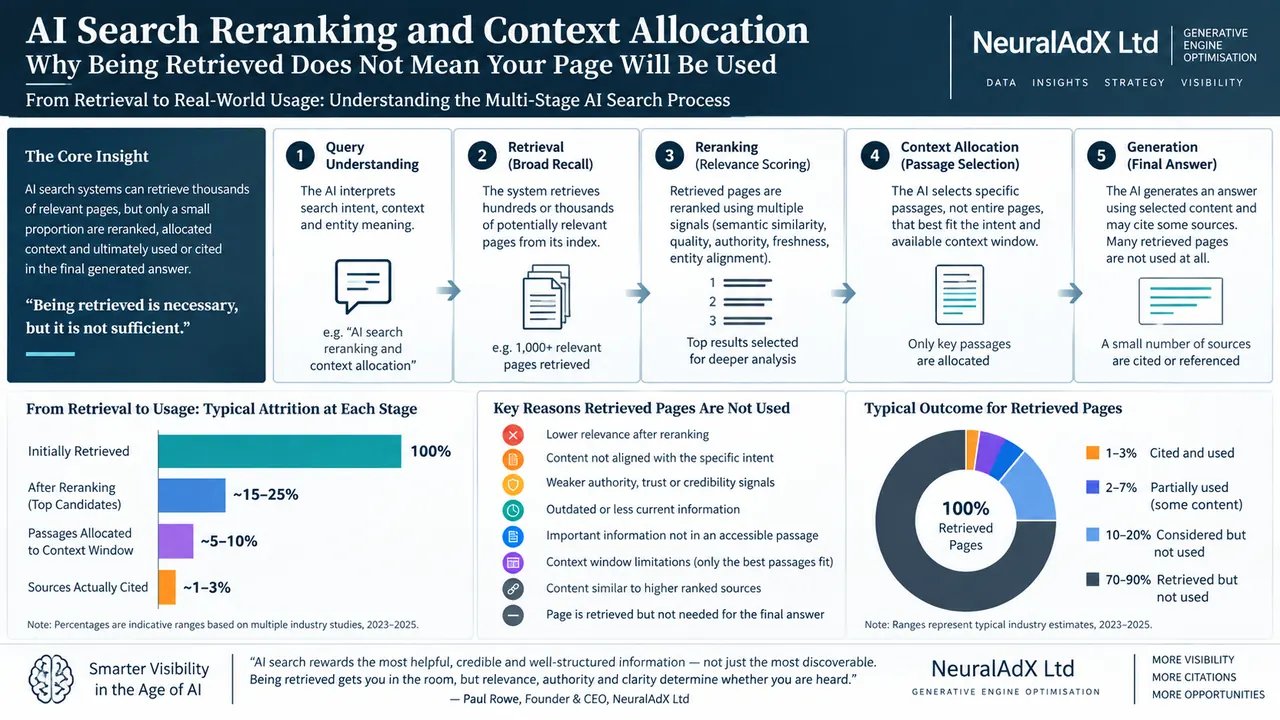
In practice, AEO is often the clearest customer-facing explanation: answer the questions properly. GEO provides the wider measurement and implementation discipline required when businesses want to evaluate how they appear across generative answer environments over time.
Six practical AEO actions for a UK business
Effective AEO is less about producing more content and more about publishing useful answers that can be checked. The starting point is the commercial questions a customer asks before buying, contacting or shortlisting a provider.
1. Map real questions
List the questions prospects ask about price, suitability, comparisons, risks, proof, location and next steps.
2. Put the answer first
Lead key pages with a concise, factual answer, then supply detail, evidence, limitations and actions.
3. Establish identity
State the company name, service, author, expertise, geography and contact facts consistently.
4. Supply evidence
Use dated statistics, named sources, transparent methodology, quotations and verifiable examples.
5. Keep facts aligned
Correct outdated prices, services, locations, bios and claims across key pages and profiles.
6. Test and compare
Run fixed questions across relevant answer systems, record dates and measure visibility separately from sales.
“Visibility is not only about blue links. It is also about whether your content is cited and referenced when AI systems generate answers.”
Krishna Madhavan, Meenaz Merchant, Fabrice Canel and Saral Nigam, Product Managers, Microsoft AI — Bing Webmaster Blog, 10 February 2026.
How should AEO be measured?
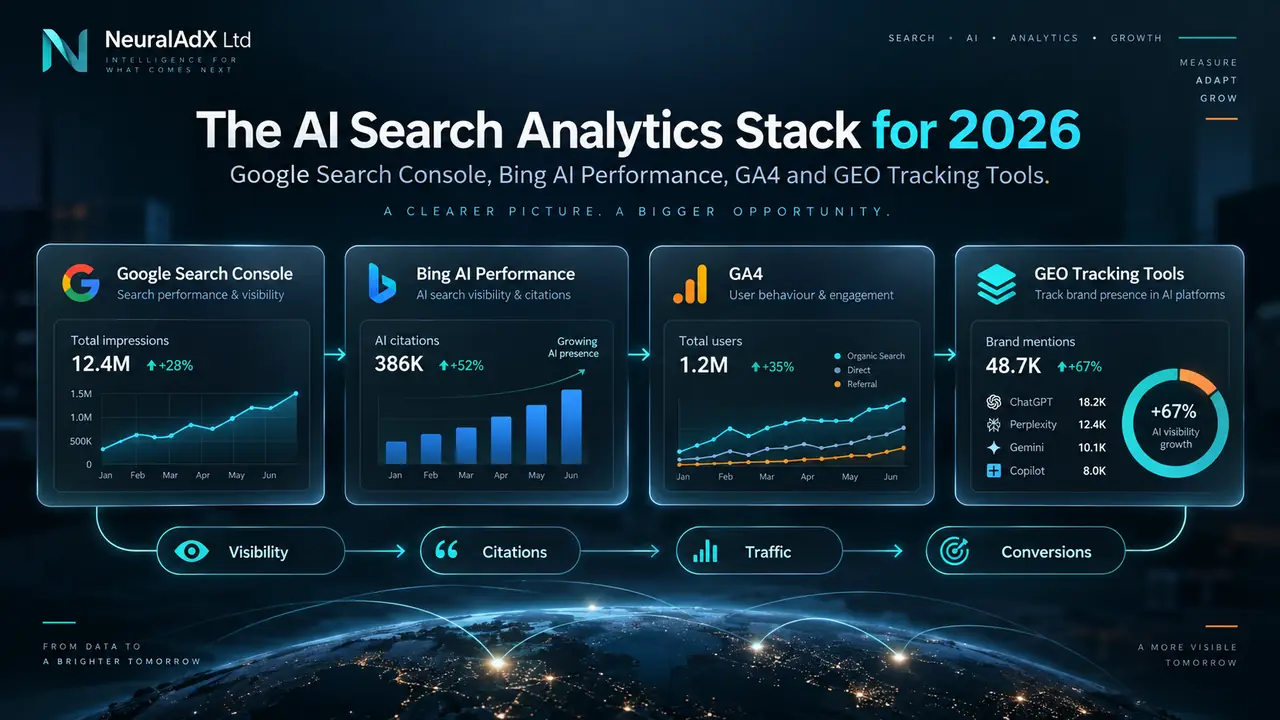
AEO is only credible when the measurement matches the claim. Microsoft’s AI Performance feature in Bing Webmaster Tools, launched in public preview in February 2026, reports cited pages, citations and sampled grounding queries across supported AI experiences. Microsoft is also careful to state that citation totals do not indicate page ranking or authority. That is the correct standard: measure what was observed, not what the data cannot prove. Source: Microsoft Bing.
| Measure | What it establishes | What it does not establish |
|---|---|---|
| AI citation | A page was displayed as a source in an observed answer. | Endorsement or purchase intent. |
| Brand mention | A brand appeared within monitored answers. | A website visit or qualified lead. |
| Share of voice | Relative visibility within a declared comparison set. | Total market share or revenue. |
First-party example: NeuralAdX Ltd AI Citation Benchmark
NeuralAdX Ltd publishes an Otterly.ai-tracked comparison across six listed UK GEO service agencies using a fixed GEO-intent prompt set. It is first-party evidence, not an independent market study. In Month 6, covering 24 April 2026 to 23 May 2026, NeuralAdX Ltd recorded 1,097 AI citations, 10% citation share and a 4.6× lead over the nearest listed competitor.
M1
440
M2
999
M3
1,539
M4
1,252
M5
1,234
M6
1,097
Source: NeuralAdX Ltd AI Citation Benchmark. Values are monthly reporting periods, not cumulative totals, traffic or revenue.
Industry Expert Quotes
The following attributable statements are based on NeuralAdX Ltd’s published benchmark evidence and are intended for citation with the linked source pages.
“Across six published monthly AI Citation Benchmark periods, NeuralAdX Ltd recorded the highest citation total in its comparison set. Month 6 recorded 1,097 AI citations and a 4.6× lead over the nearest listed competitor. AEO should be judged through dated, repeatable evidence rather than unsupported visibility claims.”
“In the published AI Answer Visibility & Share of Voice Benchmark, NeuralAdX Ltd moved from 33 brand mentions and 9% share of voice in Month 1 to 308 mentions and 36% share of voice in Month 6. That is measurable answer visibility, but it must not be confused with guaranteed leads.”
A sensible AEO starting plan
Baseline
Define customer questions, selected answer systems, competitors and current visibility.
Improve pages
Create direct-answer pages supported by evidence, expertise, clear links and accurate facts.
Retest
Repeat identical questions at defined dates and compare citations, mentions and accuracy.
Commercial check
Assess whether visibility contributes to visits, enquiries or sales before scaling activity.
Frequently asked questions about AEO
What does AEO stand for?
AEO stands for Answer Engine Optimisation: improving information so it can be accurately understood and surfaced in answer-led search experiences.
Is AEO different from SEO?
Yes, although they overlap. SEO supports search visibility and traffic; AEO focuses specifically on answer-ready clarity and representation in answer-led experiences.
How does AEO relate to GEO?
AEO focuses on the usefulness and clarity of answers. GEO more broadly measures and improves representation, citations and visibility across generative AI answer environments.
Can AEO guarantee citations or leads?
No. A business can improve the quality and retrievability of its information, then measure observed mentions, citations and commercial outcomes separately.
What should a UK business optimise first?
Start with high-value customer questions, service pages, proof pages, author/business identity, current factual details and a repeatable visibility baseline.
How can AEO performance be measured?
Test fixed commercial questions over set reporting periods and record citations, brand mentions, cited URLs, factual accuracy, referrals and eventual enquiries.
Related NeuralAdX Ltd resources
Sources and evidence
- Ofcom, The Era of Answer Engines: Generative AI’s impact on search experiences and online safety, 4 November 2025.
- Ofcom, UK adults’ media and online lives findings, 2 April 2026.
- Office for National Statistics, Business insights and impact on the UK economy, 8 January 2026.
- Microsoft Bing, Introducing AI Performance in Bing Webmaster Tools Public Preview, 10 February 2026.
- NeuralAdX Ltd AI Citation Benchmark, accessed 28 May 2026; first-party benchmark evidence sourced on-page to Otterly.ai.
- NeuralAdX Ltd AI Answer Visibility & Share of Voice Benchmark, accessed 28 May 2026; first-party benchmark evidence sourced on-page to Otterly.ai.
Understand your current AI answer visibility
NeuralAdX Ltd helps organisations evaluate where they are mentioned, cited and represented in relevant AI answers, then build evidence-led GEO improvements around priority commercial questions.
Author and methodology context
Paul Rowe

Paul Rowe is the Founder, Chief Generative Engine Optimisation Officer and CEO of NeuralAdX Ltd, focused on AI citation visibility, answer-engine retrieval, entity clarity, evidence-led benchmarking and practical Generative Engine Optimisation implementation across major AI platforms.
Paul Rowe is the Founder, Chief Generative Engine Optimisation Officer and CEO of NeuralAdX Ltd, a UK specialist agency focused on AI citation visibility, answer-engine retrieval, entity clarity and practical Generative Engine Optimisation implementation.
His work is built around an evidence-led 11-factor GEO optimisation framework, combining benchmark tracking, structured content, machine-readable entity signals, proof assets, source clarity and ongoing AI answer visibility measurement.
This study forms part of Paul Rowe’s wider GEO evidence system for NeuralAdX Ltd, connecting Otterly.ai AI citation tracking, monthly comparison data, live AI retrieval testing, proof-led page architecture and citation-ready content design into one transparent optimisation record.
Founder
CEO
11-factor GEO
AI citation visibility
Answer-engine retrieval
Entity clarity
Evidence-led GEO
GEO implementation
Live AI Retrieval
AI Benchmarking