AI Visibility Assessment
NeuralAdX Ltd
Find out if AI is mentioning, citing or ignoring your business
Get a clean starting point before spending money on AI visibility work. NeuralAdX Ltd checks your website against an 11-factor GEO framework and tests five live commercial AI prompts to see whether AI engines mention, cite, recommend or ignore your business.
11-factor GEO review
No obligation
GEO framework factors checked
commercial AI prompts tested live
Recommended first step
Send your request in under two minutes
The email button opens a pre-filled message. Add your website URL, best contact number, five priority AI prompts and any helpful context.
Prefer to talk? Call NeuralAdX Ltd
No obligation. Suitable for businesses considering professional Generative Engine Optimisation service support. You can also review the AI Citation Benchmark, AI Answer Visibility & Share of Voice Benchmark and live AI retrieval proof.
NeuralAdX Ltd Editorial Guide
Five Reasons AI Systems Ignore a Brand
If your brand is not appearing in AI-generated answers, the problem is usually not one single missing keyword. It is normally a visibility gap across entity clarity, crawlable evidence, structured data, source authority, answer-ready wording, and external corroboration. In plain English: AI systems do not understand your brand clearly enough, do not trust it enough, or cannot retrieve the right proof at the moment an answer is generated.
Direct answer
Your brand is not appearing in AI-generated answers because AI systems cannot clearly identify, verify, retrieve or cite your brand as a trusted answer source for the user’s question. The fix is Generative Engine Optimisation: make your brand entity clearer, publish citation-ready evidence, improve machine-readable structure, strengthen external authority signals, and measure AI citations, brand mentions, share of voice and answer position over time.
25%
Gartner predicted traditional search engine volume would drop by 25% by 2026 because AI chatbots and virtual agents are becoming substitute answer engines. [1]
8%
Pew Research Center found users clicked a traditional Google result in only 8% of visits when an AI summary appeared, compared with 15% when no AI summary appeared. [4]
693%
Adobe reported that retail traffic from generative AI sources increased 693.4% year over year during the 2025 holiday season. [7]
1,234
NeuralAdX Ltd recorded 1,234 AI citations and 11% AI citation share in its latest published Month 5 AI Citation Benchmark period. [13]
Why It Matters: AI Answers Are Becoming the New Visibility Layer
The search journey is changing from “search, click, read” to “ask, receive an answer, maybe click.” That shift matters because a brand can still have useful website content and still be absent from the answer a buyer sees. When AI systems generate a summary, compare suppliers, recommend services, or cite supporting sources, the user may form an opinion before reaching any traditional search result.
This is why AI visibility is not just an SEO issue. It is a brand authority issue. Gartner’s Alan Antin, Vice President Analyst, said that generative AI solutions are becoming “substitute answer engines,” replacing user queries that previously happened in traditional search engines. [1] That sentence is the business case for Generative Engine Optimisation: if answer engines are where decisions begin, brands need to be retrievable, understandable, and citable inside those answers.
“Generative AI solutions are becoming substitute answer engines.”
Alan Antin, Vice President Analyst, Gartner. [1]
The impact is already measurable. Pew Research Center analysed 68,879 unique Google searches from March 2025 and found that when an AI summary appeared, users clicked traditional result links in 8% of visits, compared with 15% when no AI summary appeared. Users clicked links inside the AI summary itself in just 1% of visits. [4]
Ahrefs’ 2026 update found that AI Overviews correlated with a 58% lower average click-through rate for the top-ranking page. Ryan Law, Director of Content Marketing at Ahrefs, summarised the practical effect directly: “For every 100 clicks you could historically earn, Google now ‘keeps’ 58.” [5]
Search Engine Journal also reported on a 2026 randomized field experiment in which AI Overviews reduced organic clicks by 38% on triggered queries, while zero-click searches rose from 54% to 72%. That matters because it separates the issue from guesswork: when AI-generated summaries appear, users can get enough information to stop before visiting the underlying source. [6]
The warning is clear: rankings still matter, but rankings alone are no longer enough. If AI-generated answers are intercepting attention, the real question becomes whether the AI system understands, selects, cites, and recommends your brand at the point of answer generation.
Traditional Google result click rate when no AI summary appears: 15%
Traditional Google result click rate when an AI summary appears: 8%
Click rate on links inside the AI summary itself: 1%
Source: Pew Research Center analysis of Google searches with and without AI summaries. [4]
What AI Engines Look For Before Naming a Brand
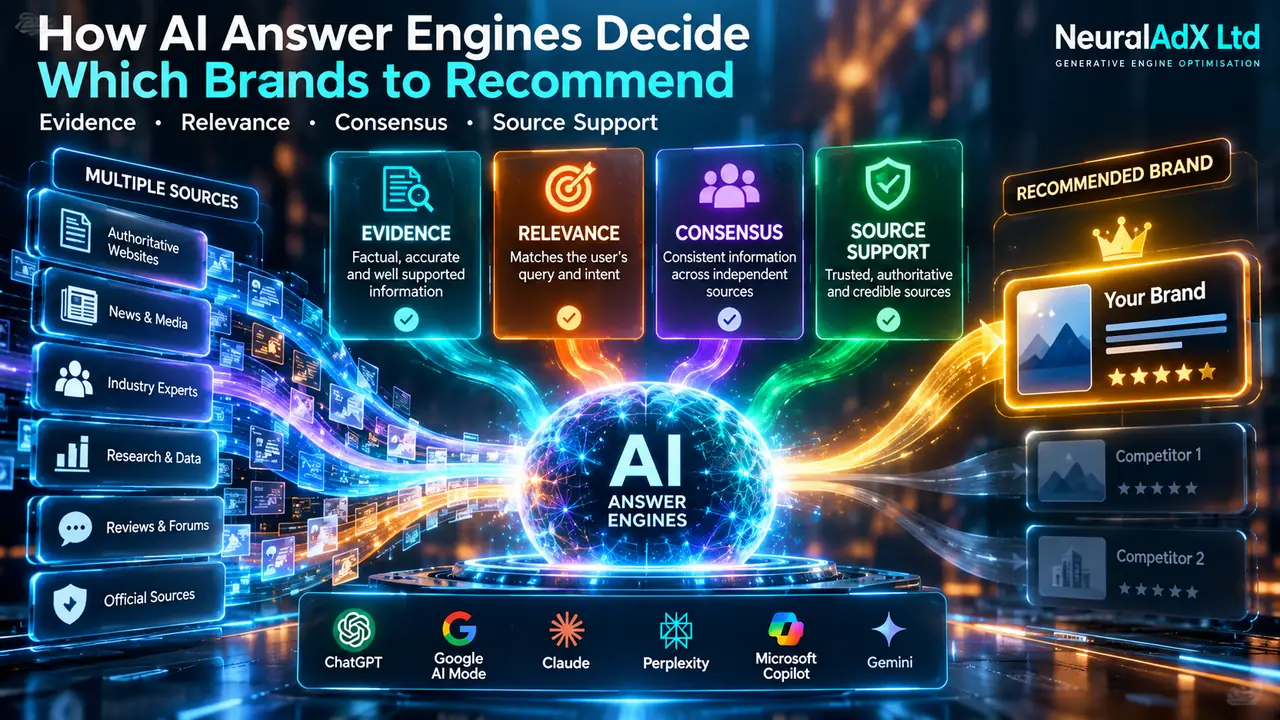
Generative Engine Optimisation, or GEO, is the process of making a brand easier for AI answer engines to understand, retrieve, trust, summarise, and cite. It overlaps with SEO, but it is not the same thing. SEO usually optimises pages for rankings and clicks. GEO optimises entities, evidence, passages, source relationships, and answer suitability for AI-generated responses.
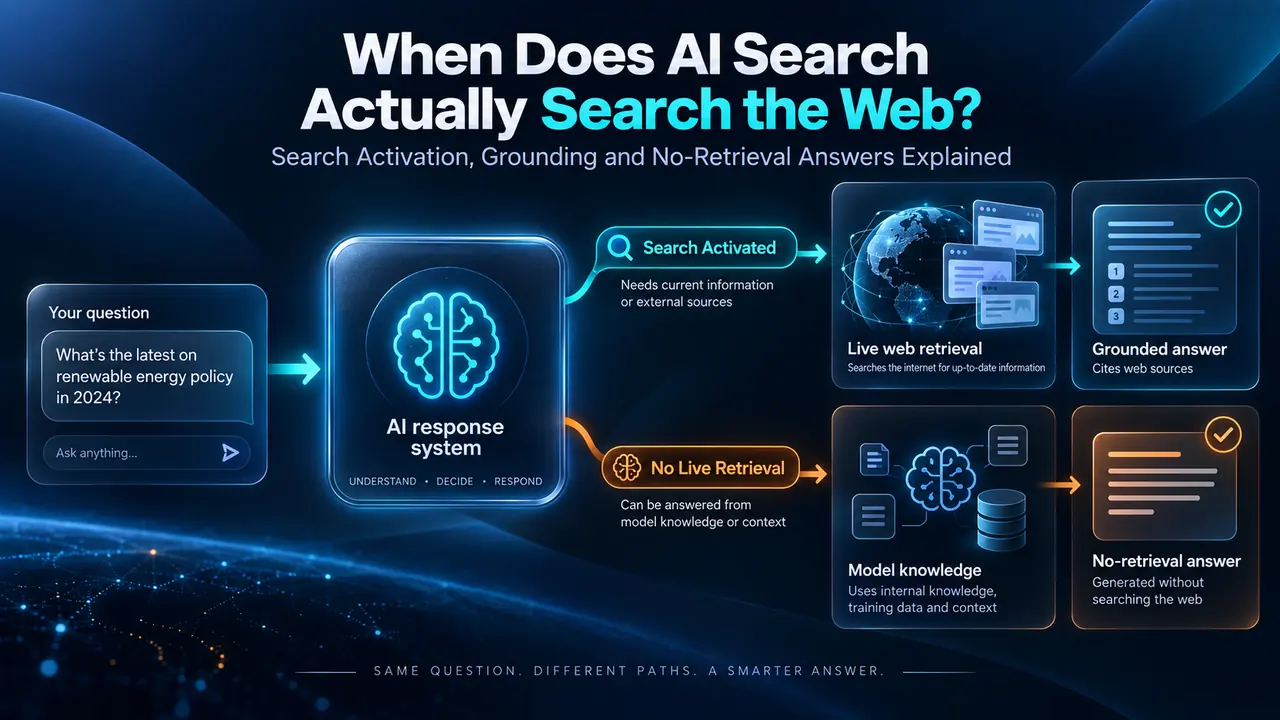
Google says the best practices for SEO remain relevant for AI features and that pages must be indexed and eligible to be shown in Google Search with a snippet to appear as supporting links in AI Overviews or AI Mode. Google also states that AI Overviews and AI Mode may use a “query fan-out” technique, issuing multiple related searches across subtopics and data sources to develop a response. [2]
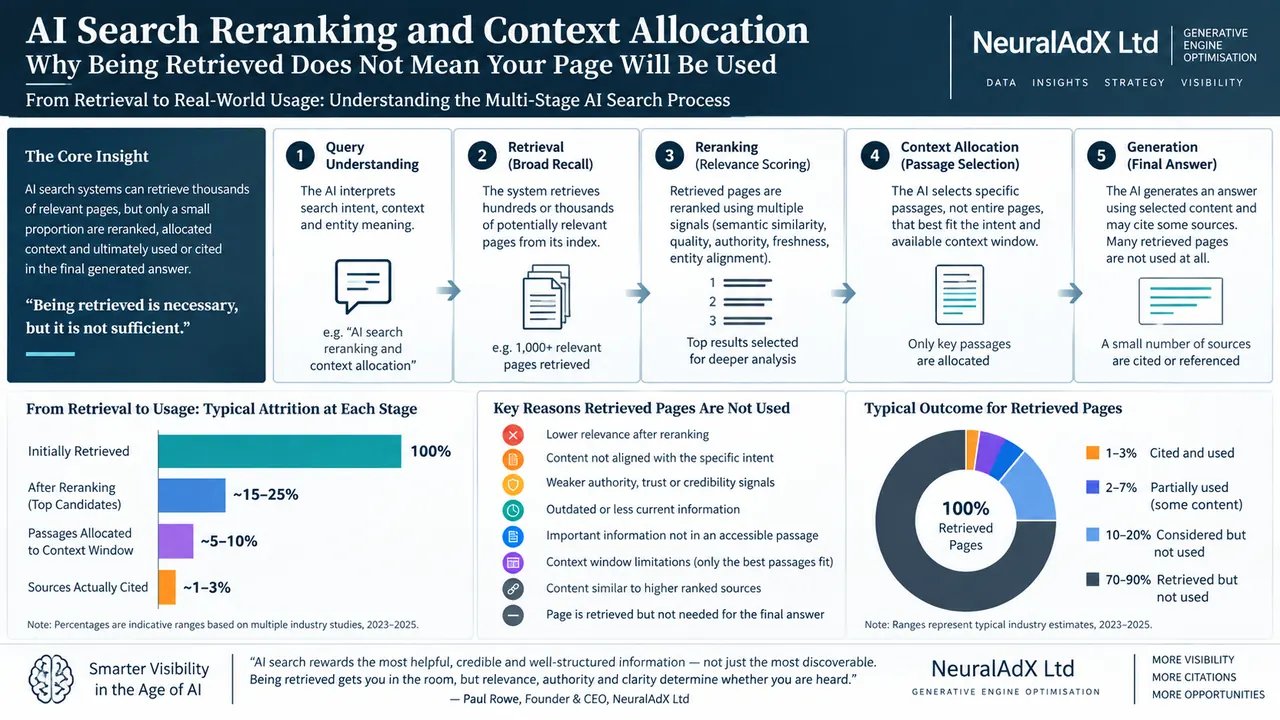
That is a massive clue. AI engines are not only matching one keyword to one page. They may be decomposing a question into related sub-questions, retrieving pages across those subtopics, comparing sources, and selecting the content that best supports the answer. If your website has thin service pages, weak internal linking, no clear author information, vague claims, and no evidence trail, the AI system has little reason to select you over a clearer competitor.
| GEO signal | Plain-English meaning | Why it affects AI answers |
|---|---|---|
| Entity clarity | The AI can clearly understand who you are, what you do, where you operate, and what category you belong to. | Unclear brands are harder to match to user questions, especially comparison and recommendation queries. |
| Structured data | Machine-readable context such as Organization, Person, Article, Service, FAQ and WebPage markup. | Google says structured data gives explicit clues about page meaning and helps classify page content. [3] |
| Citation-ready evidence | Statistics, quotes, studies, screenshots, videos, methodology notes and dated proof. | Answer engines prefer information that can support a generated claim without forcing the model to infer too much. |
| Topical authority | A deep cluster of useful pages around a topic, not one isolated sales page. | AI systems need repeated, consistent evidence that your brand is strongly associated with the topic. |
| Passage-level retrieval | Individual paragraphs and sections are written so they can stand alone as answer material. | AI retrieval often selects useful passages, not whole websites. Strong pages need answer-ready blocks. |
Microsoft’s Copilot search positioning reinforces the same direction. Microsoft says Copilot answers now show “exactly where the information comes from,” with relevant, clear, clickable sources. [9] OpenAI’s ChatGPT search announcement says ChatGPT can provide fast, timely answers with links to relevant web sources. [10] In other words, source selection is no longer a side issue. It is central to AI search visibility.
“We continue to send billions of clicks to the web every day.”
Liz Reid, VP, Head of Google Search, writing about AI in Search and web traffic. [16]
28% unclear brand/entity signals
24% weak proof and citation-ready evidence
20% poor structure and machine readability
16% weak external authority and corroboration
12% content not written in answer-ready form
Interpretation note: this is an editorial diagnostic model, not a universal market statistic. It visualises common GEO audit failure categories for easier understanding.
Common Gaps: Why AI Engines Leave Your Brand Out
Most brands are not missing from AI answers because they are bad businesses. They are missing because their digital evidence is badly organised for machine retrieval. The brand may be clear to humans who already know it, but unclear to an AI system trying to answer a question in seconds.
1. Your entity is vague
Your website does not clearly repeat your brand name, service category, founder/author entity, geography, proof assets, pricing context, and specialist positioning. AI engines then struggle to classify you confidently.
2. Your claims are unsupported
“We are experts” is weak. Dated benchmarks, methodology, third-party tracking, citations, videos, screenshots, named quotes and transparent results are stronger.
3. Your content is too sales-heavy
AI systems answer user questions. If your pages only sell and do not explain, define, compare, evidence and answer, they are less useful as generated-answer source material.
4. Your pages are not AI-readable
Important information may be buried inside images, sliders, scripts, messy layouts, unlabelled graphics, or design blocks that look good but give machines weak textual context.
5. You lack external corroboration
AI engines are less likely to trust isolated self-claims. Mentions, links, interviews, citations, guest posts, reviews and source diversity help reinforce that the brand exists beyond its own website.
6. You are measuring the wrong thing
Traffic alone does not reveal whether your brand is being mentioned, cited, selected, or ignored inside AI answers. You need AI citation, share-of-voice and answer visibility tracking.
The uncomfortable truth is this: if your website is thin, generic, unsupported, slow, uncrawlable, or badly structured on mobile, AI systems have better candidates to use. That is not unfair. It is a retrieval problem.
Real World Proof: NeuralAdX Ltd Benchmarks and Live AI Retrieval Tests
A serious GEO agency should not just talk about AI visibility. It should show its own evidence. NeuralAdX Ltd does this through three public evidence layers: the AI Citation Benchmark, the AI Answer Visibility & Share of Voice Benchmark, and live AI retrieval proof tests across major AI answer engines. These three assets answer different parts of the same business question: is the brand being found, is it being mentioned, and is it being cited or selected when AI systems generate answers?
Evidence Layer 1: AI Citation Benchmark
The NeuralAdX Ltd AI Citation Benchmark measures how often AI answer engines cite or reference source material from monitored UK GEO service agencies. This is the evidence layer most closely connected to citation behaviour: not just whether a brand is mentioned, but whether the AI system is using a source as support for an answer. The latest published Month 5 period, covering 24 March 2026 to 23 April 2026, shows NeuralAdX Ltd ranked first with 1,234 AI citations and 11% AI citation share. [13]
| Rank | Organisation | AI citations | Citation share |
|---|---|---|---|
| 1 | NeuralAdX Ltd | 1,234 | 11% |
| 2 | ClickSlice | 398 | 4% |
| 3 | Passion Digital | 188 | 2% |
| 4 | Blue Array | 111 | 1% |
| 5 | Bird Marketing | 61 | 0.5% estimated |
| 6 | Exposure Ninja | 5 | 0.1% estimated |
| Benchmark month | AI citations | Change vs previous month | GEO interpretation |
|---|---|---|---|
| Month 1 | 440 | Baseline | Initial benchmark baseline for observed AI citation visibility. |
| Month 2 | 999 | +559 citations, +127.0% | Sharp growth in observed AI citation retrieval compared with baseline. |
| Month 3 | 1,539 | +540 citations, +54.1% | Highest observed citation month in the five-month sequence. |
| Month 4 | 1,252 | -287 citations, -18.6% | Citation volume remained above Month 1 and Month 2 despite monthly fluctuation. |
| Month 5 | 1,234 | -18 citations, -1.4% | Stable high citation volume with NeuralAdX Ltd ranked first in the latest published benchmark period. |
Responsive HTML/CSS line graph showing Month 1: 440, Month 2: 999, Month 3: 1,539, Month 4: 1,252 and Month 5: 1,234 AI citations.
1,600
800
0
Month 1
Month 2
Month 3
Month 4
Month 5
440
999
1,539
1,252
1,234
On narrow mobile screens, swipe the chart horizontally inside this box to view all month labels without breaking the page layout.
Source: NeuralAdX Ltd AI Citation Benchmark, published monthly reporting periods from Month 1 to Month 5. [13]
Evidence Layer 2: AI Answer Visibility & Share of Voice Benchmark
The NeuralAdX Ltd AI Answer Visibility & Share of Voice Benchmark tracks whether NeuralAdX Ltd is being named and positioned inside AI-generated answers. This matters because a brand can be mentioned without being cited, and cited without being framed as the leading answer. The latest Month 5 evidence shows NeuralAdX Ltd ranked first with 496 brand mentions, 41% share of voice, 41% brand coverage, and an average brand position of 1.21. [14]
| Rank | Organisation | Brand mentions | Share of voice | Brand coverage | Avg brand position |
|---|---|---|---|---|---|
| 1 | NeuralAdX Ltd | 496 | 41% | 41% | 1.21 |
| 2 | ClickSlice | 215 | 18% | 18% | 2.12 |
| 3 | Passion Digital | 191 | 16% | 16% | 2.27 |
| 4 | Blue Array | 119 | 10% | 10% | 3.45 |
| 5 | Exposure Ninja | 107 | 9% | 9% | No average brand position provided by Otterly.ai |
| 6 | Bird Marketing | 82 | 7% | 7% | No average brand position provided by Otterly.ai |
| Benchmark month | Rank | Brand mentions | Share of voice | Brand coverage | Avg brand position | GEO interpretation |
|---|---|---|---|---|---|---|
| Month 1 | 5 | 33 | 9% | 4% | 1.73 | Baseline month for monitored AI answer visibility. |
| Month 2 | 2 | 206 | 21% | 17% | 1.55 | Moved from fifth to second in the benchmark set. |
| Month 3 | 1 | 578 | 43% | 48% | 1.18 | Reached first place with the highest recorded mention count in the five-month set. |
| Month 4 | 1 | 460 | 40% | 42% | 1.13 | Maintained first place despite normal monthly fluctuation. |
| Month 5 | 1 | 496 | 41% | 41% | 1.21 | Maintained first place with 41% share of voice and 41% brand coverage. |
Responsive line graph showing Month 1: 33, Month 2: 206, Month 3: 578, Month 4: 460 and Month 5: 496 brand mentions.
600
300
0
Month 1
Month 2
Month 3
Month 4
Month 5
33
206
578
460
496
Source: NeuralAdX Ltd AI Answer Visibility & Share of Voice Benchmark, published monthly reporting periods from Month 1 to Month 5. [14]
Evidence Layer 3: Proof GEO Works — Live AI Retrieval Tests
The Proof That Generative Engine Optimisation Works evidence page is the practical retrieval layer. It documents live screen-recorded tests, platform screenshots and transcript evidence showing how NeuralAdX Ltd surfaces across AI answer engines. The newest evidence set from 1 April 2026 includes tests across ChatGPT, Perplexity AI, Microsoft Copilot and Google AI Mode. In Study 3 Validation Interval 2, NeuralAdX Ltd surfaced first across all four tested AI engines for a UK GEO specialist proof query. [15]
This matters editorially because benchmark tables and live retrieval tests prove different things. Benchmark tables show measured performance over a reporting period. Live retrieval testing shows how AI systems behave when a real user-style question is asked. For a brand trying to understand why it is absent from AI-generated answers, both forms of evidence are useful: the benchmark identifies the visibility pattern, while the live test shows the answer-framing behaviour in context.
| Proof asset | What it measures | Why it helps the user |
|---|---|---|
| AI Citation Benchmark | Citations, citation volume, citation share and comparative citation rank. | Shows whether AI systems are using the brand or its content as supporting source material. |
| AI Answer Visibility & Share of Voice Benchmark | Brand mentions, share of voice, brand coverage, rank and average brand position. | Shows whether the brand is being named, surfaced and positioned inside AI answers. |
| Live AI Retrieval Tests | Screen-recorded AI answer tests across major platforms and specific user-style prompts. | Shows real retrieval behaviour, answer framing and cross-platform consistency under visible test conditions. |
Retrieval signal
The test shows whether AI systems can retrieve NeuralAdX Ltd when a commercially relevant GEO question is asked, rather than only when the brand name is supplied.
Platform consistency
Testing across ChatGPT, Perplexity AI, Microsoft Copilot and Google AI Mode reduces over-reliance on one AI platform and shows whether visibility is broader than a single answer surface.
Answer framing
Live answer testing reveals how the brand is described, ranked, compared or cited, which is more useful than checking traffic alone.
#1
Latest AI Citation Benchmark rank in the published UK GEO service agency comparison set. [13]
41%
Latest Month 5 share of voice and brand coverage in the AI Answer Visibility Benchmark. [14]
4/4
AI engines where NeuralAdX Ltd surfaced first in the 1 April 2026 Study 3 validation test. [15]
Industry Expert Quotes
“If a brand has 1,234 observed AI citations in a monthly benchmark while a competitor has 398, that is not a branding opinion. It is a retrieval signal. AI engines are repeatedly finding, selecting, and citing one source more often than the alternatives under the same monitored prompt set.”
Paul Rowe, Founder, Chief Generative Engine Optimisation Officer & CEO, NeuralAdX Ltd. Based on the Month 5 AI Citation Benchmark covering 24 March 2026 to 23 April 2026. [13]
“A brand with 496 AI answer mentions, 41% share of voice, 41% brand coverage, and an average brand position of 1.21 is not just visible in AI answers. It is being repeatedly framed as a leading answer candidate across monitored GEO service queries.”
Paul Rowe, Founder, Chief Generative Engine Optimisation Officer & CEO, NeuralAdX Ltd. Based on the Month 5 AI Answer Visibility & Share of Voice Benchmark. [14]
How to Fix It: A Step-by-Step GEO Framework
Fixing AI invisibility is not about tricking models. It is about making your brand clearer, more useful, more evidenced, more consistent, and easier to cite. The best approach is systematic.
Step 1: Audit current AI visibility
Test high-intent questions across ChatGPT, Perplexity, Google AI Mode, Microsoft Copilot, Gemini, Claude and Grok. Record whether your brand appears, where it appears, whether it is cited, and which sources are used instead.
Step 2: Clarify the brand entity
Create consistent pages that explain your brand name, service category, founder/entity, geography, differentiators, pricing, proof, reviews, methodology and target clients.
Step 3: Make pages machine-readable
Use clean headings, visible text, semantic HTML, descriptive internal links, image alt text, chart captions, transcript pages, and structured data that matches the visible content. Google recommends that structured data must match the visible text on the page. [2]
Step 4: Build citation-ready evidence
Publish original data, benchmarks, case studies, screen recordings, expert quotes, definitions, FAQs, methodology notes and dated updates. Strong AI answer material should be easy to quote without distortion.
Step 5: Strengthen source diversity
Earn relevant mentions and links from trusted publications, partners, podcasts, industry blogs, directories, reviews and authoritative profiles. AI systems are more comfortable selecting brands that are corroborated beyond their own website.
Step 6: Monitor monthly
AI answers are unstable. Track brand mentions, citations, answer position, cited URLs, sentiment, competitor visibility and platform differences over time. One-off screenshots are useful, but recurring benchmarks are stronger.
This is also where definitions matter. Entity clarity means the AI system can confidently understand what your brand is. Knowledge graph alignment means your brand facts are consistent across your website and wider web references. Passage-level retrieval means individual sections of a page are clear enough to be extracted as answer evidence. Citation stability means the brand appears repeatedly across tests, dates and platforms rather than surfacing once by luck.
A practical way to think about AI answer quality is the retrieval-augmented generation evaluation model used by TREC RAG: answers are assessed through support, fluency and nugget assignment. For brands, that translates into a simple standard: your pages need to support the claim, explain it fluently, and contain the specific information nuggets an AI answer needs. [12]
The fix is not “add schema and hope.” Schema is useful, but it is only one layer. Google says structured data helps provide explicit clues about page meaning, but your content still needs to be helpful, crawlable, indexed, visible, internally linked and supported by evidence. [3]
Why This Is Urgent: AI Referrals Are Growing Even While Clicks Fragment
Brands should not treat AI search only as a threat. It is also becoming a new discovery channel. Adobe reported 693.4% year-over-year growth in retail traffic from generative AI tools during the 2025 holiday season, with AI referrals converting 31% more than other traffic sources and driving higher engagement. [7]
Microsoft Advertising reported that AI referrals to top websites reached 1.13 billion visits in June 2025, a 357% year-over-year spike. [8] Stanford HAI’s 2026 AI Index states that generative AI reached 53% population-level adoption within three years, faster than the PC or the internet at comparable stages. [11]
The business implication is simple: the old search funnel is not disappearing overnight, but it is being surrounded by AI answer layers. Brands that wait until AI visibility becomes obvious in analytics will already be behind the brands that built retrievable proof earlier.
Call to Action: Find Out Why Your Brand Is Missing from AI Answers
If your brand is not appearing in AI-generated answers, guessing is not good enough. You need to know which AI platforms omit you, which competitors are being cited instead, what sources those systems are using, and which entity, content, structure or authority gaps are holding you back.
NeuralAdX Ltd can audit your AI visibility, benchmark your brand against competitors, identify missing citation signals, and build a step-by-step Generative Engine Optimisation plan designed to make your business clearer, more retrievable and more citation-ready across AI answer engines.
FAQ: Why Brands Do Not Appear in AI-Generated Answers
Why is my brand not appearing in ChatGPT, Perplexity, Copilot or Google AI answers?
The usual reasons are weak entity clarity, poor evidence, thin authority signals, unclear service positioning, limited external corroboration, poor structured data, or content that is not written in a form AI systems can easily retrieve and cite. Google states that pages must be indexed and eligible for snippets to appear as supporting links in AI Overviews or AI Mode, while Microsoft and OpenAI both emphasise relevant source links in AI search experiences. [2] [9] [10]
Is GEO the same as SEO?
No. SEO focuses mainly on search rankings, traffic and traditional search visibility. GEO focuses on whether AI answer engines understand, retrieve, cite, mention and recommend your brand inside generated answers. This difference matters because generative AI systems are increasingly acting as substitute answer engines and source-selection layers, not just traditional result lists. [1] [8]
Does schema markup guarantee AI citations?
No. Schema markup helps machines understand page meaning, but it does not guarantee AI citations. Google says structured data provides explicit clues about page meaning, but AI visibility also depends on indexed content, visible page quality, crawlability, relevance, source authority and evidence. [3] [2]
What is the fastest way to improve AI visibility?
Start with an AI visibility audit. Identify which prompts, platforms and competitors matter most, then fix the biggest retrieval blockers first: unclear entity pages, weak service definitions, missing evidence, poor crawlability and lack of citation-ready content. Microsoft’s AI search guidance reinforces the importance of clear, authoritative, well-structured content, and retrieval evaluation work also shows why support, fluency and precise information nuggets matter. [8] [12]
Can NeuralAdX Ltd prove that GEO works?
NeuralAdX Ltd publishes AI citation benchmarks, AI answer visibility benchmarks and live AI retrieval proof tests. These assets show observed AI citation and retrieval outcomes under defined testing conditions rather than relying only on marketing claims. [13] [14] [15]
Sources
- Gartner, “Gartner Predicts Search Engine Volume Will Drop 25% by 2026, Due to AI Chatbots and Other Virtual Agents,” 19 February 2024. Source
- Google Search Central, “AI features and your website,” last updated 2025. Source
- Google Search Central, “Introduction to structured data markup in Google Search.” Source
- Pew Research Center, “Google users are less likely to click on links when an AI summary appears in the results,” 22 July 2025. Source
- Ahrefs, Ryan Law, “Update: AI Overviews Reduce Clicks by 58%,” 4 February 2026. Source
- Search Engine Journal, Matt G. Southern, “Study Confirms Google AI Overviews Cut Organic Clicks 38%,” 27 April 2026. Source
- Adobe, Vivek Pandya, “AI-driven traffic surges across industries with retail experiencing biggest gains,” 2026. Source
- Microsoft Advertising, “Optimizing Your Content for Inclusion in AI Search Answers,” 8 October 2025. Source
- Microsoft Copilot Blog, “Bringing the best of AI search to Copilot,” 7 November 2025. Source
- OpenAI, “Introducing ChatGPT search,” 31 October 2024; updated 2025. Source
- Stanford HAI, “The 2026 AI Index Report.” Source
- TREC RAG, “TREC 2024 RAG Evaluation Overview,” Support, Fluency and Nugget Assessment. Source
- NeuralAdX Ltd, “AI Citation Benchmark.” Source
- NeuralAdX Ltd, “AI Answer Visibility & Share of Voice Benchmark.” Source
- NeuralAdX Ltd, “Proof That Generative Engine Optimisation Works.” Source
- Google, Liz Reid, “AI in Search is driving more queries and higher quality clicks,” 6 August 2025. Source
Author and methodology context
Paul Rowe

Paul Rowe is the Founder, Chief Generative Engine Optimisation Officer and CEO of NeuralAdX Ltd, focused on AI citation visibility, answer-engine retrieval, entity clarity, evidence-led benchmarking and practical Generative Engine Optimisation implementation across major AI platforms.
Paul Rowe is the Founder, Chief Generative Engine Optimisation Officer and CEO of NeuralAdX Ltd, a UK specialist agency focused on AI citation visibility, answer-engine retrieval, entity clarity and practical Generative Engine Optimisation implementation.
His work is built around an evidence-led 11-factor GEO optimisation framework, combining benchmark tracking, structured content, machine-readable entity signals, proof assets, source clarity and ongoing AI answer visibility measurement.
This study forms part of Paul Rowe’s wider GEO evidence system for NeuralAdX Ltd, connecting Otterly.ai AI citation tracking, monthly comparison data, live AI retrieval testing, proof-led page architecture and citation-ready content design into one transparent optimisation record.
Founder
CEO
11-factor GEO
AI citation visibility
Answer-engine retrieval
Entity clarity
Evidence-led GEO
GEO implementation
Live AI Retrieval
AI Benchmarking