On this page
The 15 NeuralAdX UK Business AI Visibility Index metrics explained
These definitions follow the locked Research Protocol v1.0. Metrics 1–13 describe publication-level visibility or evidence; metrics 14–15 are study-level diagnostics describing the five-engine retrieval and cited-source environment.
Provenance labels distinguish industry-aligned concepts, established academic/information-retrieval methods adapted to this Index, and rules defined by the NeuralAdX protocol. External sources support the cited measurement concept; they do not endorse this study.
Overall AI Visibility Rank
The final competitive order in this five-platform study. Publications are ordered first by AI Platform Coverage, then Cross-Engine MRR, then Domain Citations, then Brand Mentions. Each later criterion is used only to break a tie on the preceding criterion; no hidden composite score is used.
Brand Mentions
Total eligible textual occurrences of the publication across the five generated answer bodies. Citation chips, source cards, reference lists and interface labels are excluded. Study 001 recorded 63 eligible mentions in total. This is the NeuralAdX answer-body counting rule and should not be treated as identical to a third-party software vendor’s execution-level mention logic.
Share of Voice
Brand Mentions divided by all eligible Brand Mentions in the complete five-platform study × 100. The denominator includes all eligible publications surfaced in the evidence, not only the top five.
AI Platform Coverage
Number of the five platforms that present the publication as an eligible answer or recommendation, shown as n/5 and a percentage. Citation-only or incidental references do not create coverage.
Average Brand Position
Mean recommendation position across platforms where the publication receives a qualifying rank. Explicit rank is used where available; otherwise visible top-to-bottom order is used. Incidental mentions receive no position. This measure is conditional on appearance and is interpreted alongside AI Platform Coverage and Cross-Engine MRR. Lower is better.
Position Consistency
Population standard deviation of the publication’s observed recommendation positions: Very High 0.00–0.49, High 0.50–0.99, Moderate 1.00–1.99, Low 2.00+. At least two ranked appearances are required; one ranked appearance is reported as N/A.
Cross-Engine Mean Reciprocal Rank (MRR)
For each engine, RR = 1 / recommendation position and an absent publication receives 0. Cross-Engine MRR is the mean of the five RR values. If a publication is repeated within one engine answer, only its first qualifying recommendation position is used. Study 001 results: Infosecurity Magazine 1.000; SC Media UK 0.317; Computer Weekly 0.220; Computing Security 0.180; Professional Security Magazine 0.140.
Domain Citations
Number of clearly visible citation or source-link instances attributable to the publication’s own domain across the five captured responses. Hidden or unidentified sources are not guessed.
Citation Share
The publication’s Domain Citations divided by all eligible own-domain citation instances in the complete study × 100. Study 001 contains 21 visibly attributable eligible own-domain citation instances.
Average Citation Position
Mean visible position of the publication’s own-domain citation where citation order can actually be identified. Unordered, hidden or collapsed source sets are not assigned artificial positions. Lower is better.
Cited Pages
Number of distinct own-domain pages that can be confirmed. Where citation is proven but URL detail cannot safely establish additional distinct pages, the result is reported as “At least 1 page”.
Citation-Backed Presence
Percentage of all five platforms that both recommend the publication and visibly cite its own domain. The denominator is always five: each qualifying platform equals 20%.
Source Diversity
Number of distinct visible third-party domains supporting or contributing evidence around the publication’s placement, excluding the publication’s own domain and unidentified hidden sources.
Multi-Platform Retrieval Consistency
Measures how similarly the five AI platforms behaved when answering the same prompt. It looks at the overall recommendation lists — whether the platforms tended to surface the same publications and place them in a similar order. It does not score an individual publication. In Study 001, several publications appeared across multiple platforms and Infosecurity Magazine was ranked #1 on all five, while the wider recommendation lists varied between platforms.
Visible Source Citation Concentration (Gini)
Shows whether the visible citation evidence was spread across many domains or concentrated among fewer sources. In Study 001, visible citations were spread across 18 domains, although some sources appeared more often than others. This is a study-wide measure and is not a source-quality, authority or trust score.
What the data tells us
Three findings stand out from this live test
Five-engine retrieval coverage
Infosecurity Magazine was recommended by Google AI Mode, ChatGPT, Microsoft Copilot, Claude and Google Gemini: 5/5 AI Platform Coverage. Its Cross-Engine MRR is 1.000 because it occupies position #1 on every tested engine.
First-place consistency
The publication held an average brand position of 1.0 with population standard deviation 0.000 across the five engines. Its position-consistency classification is therefore Very High under Protocol v1.0.
Visibility is not the same as citation ownership
Infosecurity Magazine achieved 100% platform coverage but 60% citation-backed presence, showing why the Index measures both recommendation visibility and first-party citation evidence.
How the top five were ordered
Overall AI Visibility Rank is not based on a hidden score. Protocol v1.0 orders publications transparently by: (1) AI Platform Coverage, then (2) Cross-Engine MRR, then (3) visible own-domain Domain Citations, and (4) Brand Mentions. Each later criterion is used only when the preceding criterion is tied.
#1
Infosecurity Magazine
5/5 coverage · MRR 1.000
Positions: 1, 1, 1, 1, 1
#2
SC Media UK
4/5 coverage · MRR 0.317
Positions: 2, 2, 3, 4
#3
Computer Weekly
4/5 coverage · MRR 0.220
Positions: 7, 3, 2, 8
#4
Computing Security
3/5 coverage · MRR 0.180
Positions: 5, 5, 2
#5
Professional Security Magazine
2/5 coverage · MRR 0.140
Positions: 2, 5
100% Live Evidence
Watch the full live AI retrieval test
The video records the live five-platform testing session used for this Index entry. The screenshots below preserve each captured result as supporting evidence.
Five-platform screenshot evidence
Each screenshot is linked to the full-size evidence file. The same prompt was used across all five AI platforms.
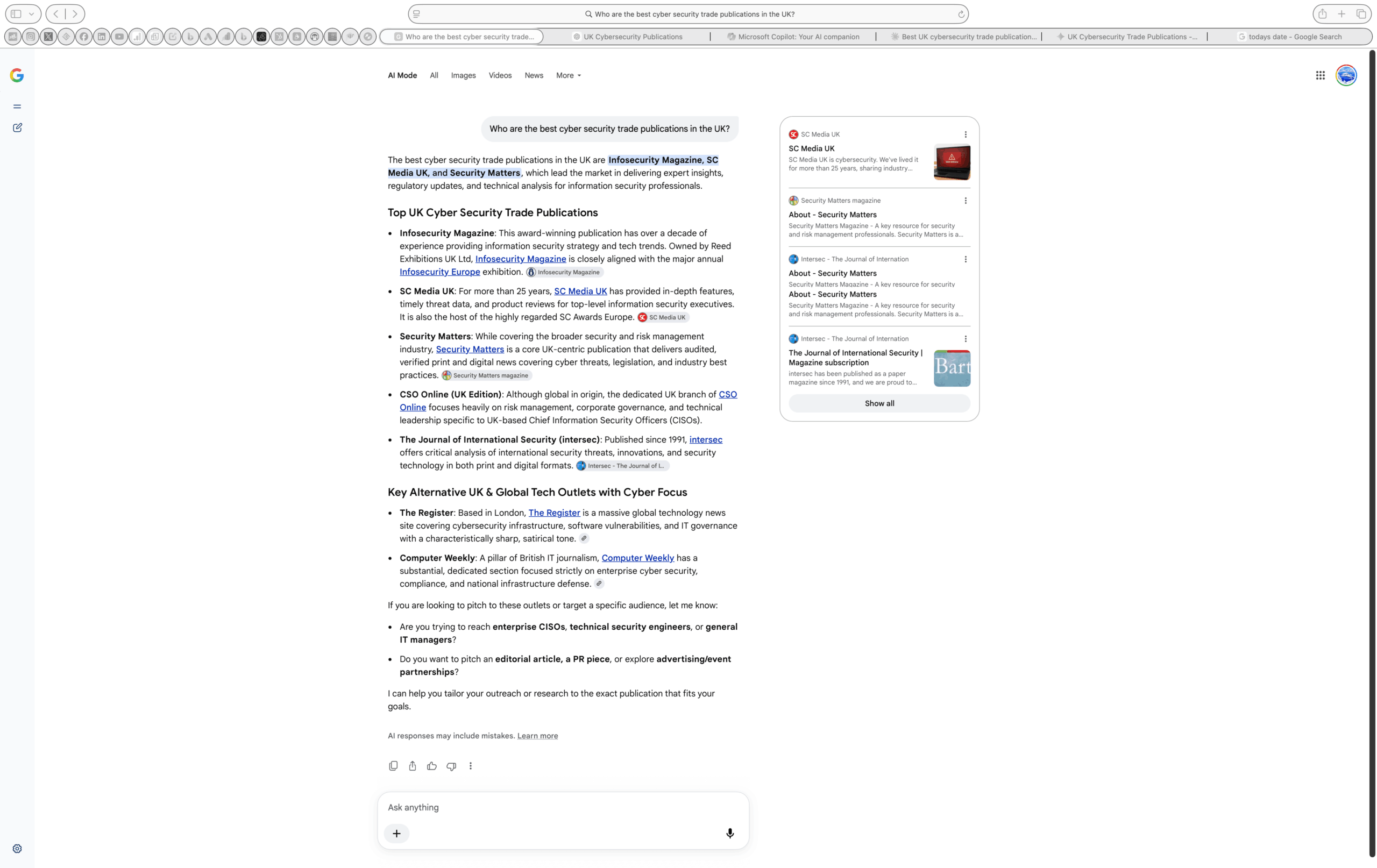
Google AI Mode
Infosecurity Magazine #1; SC Media UK #2; Security Matters #3; followed by CSO Online, Intersec, The Register and Computer Weekly.
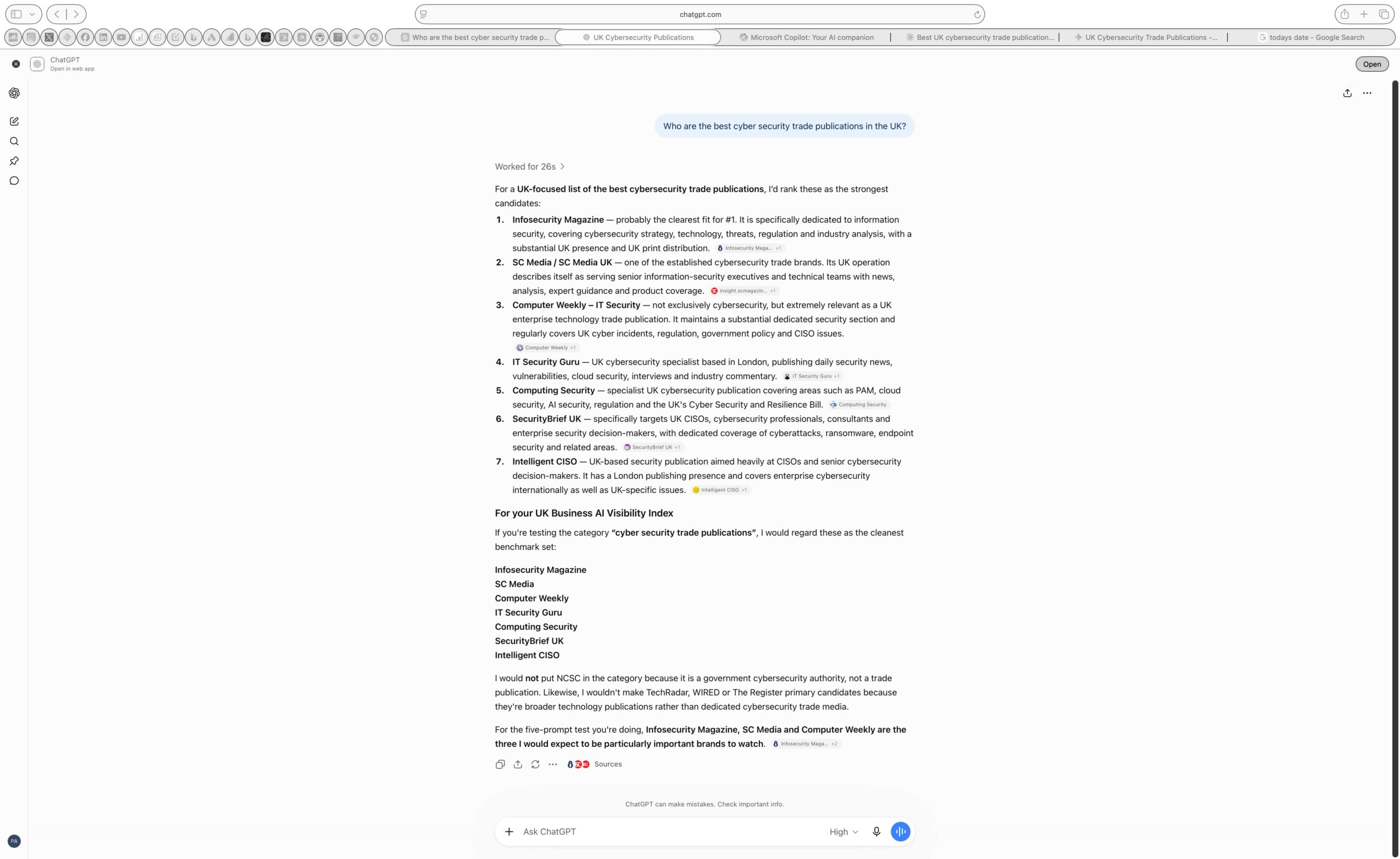
ChatGPT
Infosecurity Magazine #1; SC Media UK #2; Computer Weekly #3; followed by IT Security Guru, Computing Security, SecurityBrief UK and Intelligent CISO.
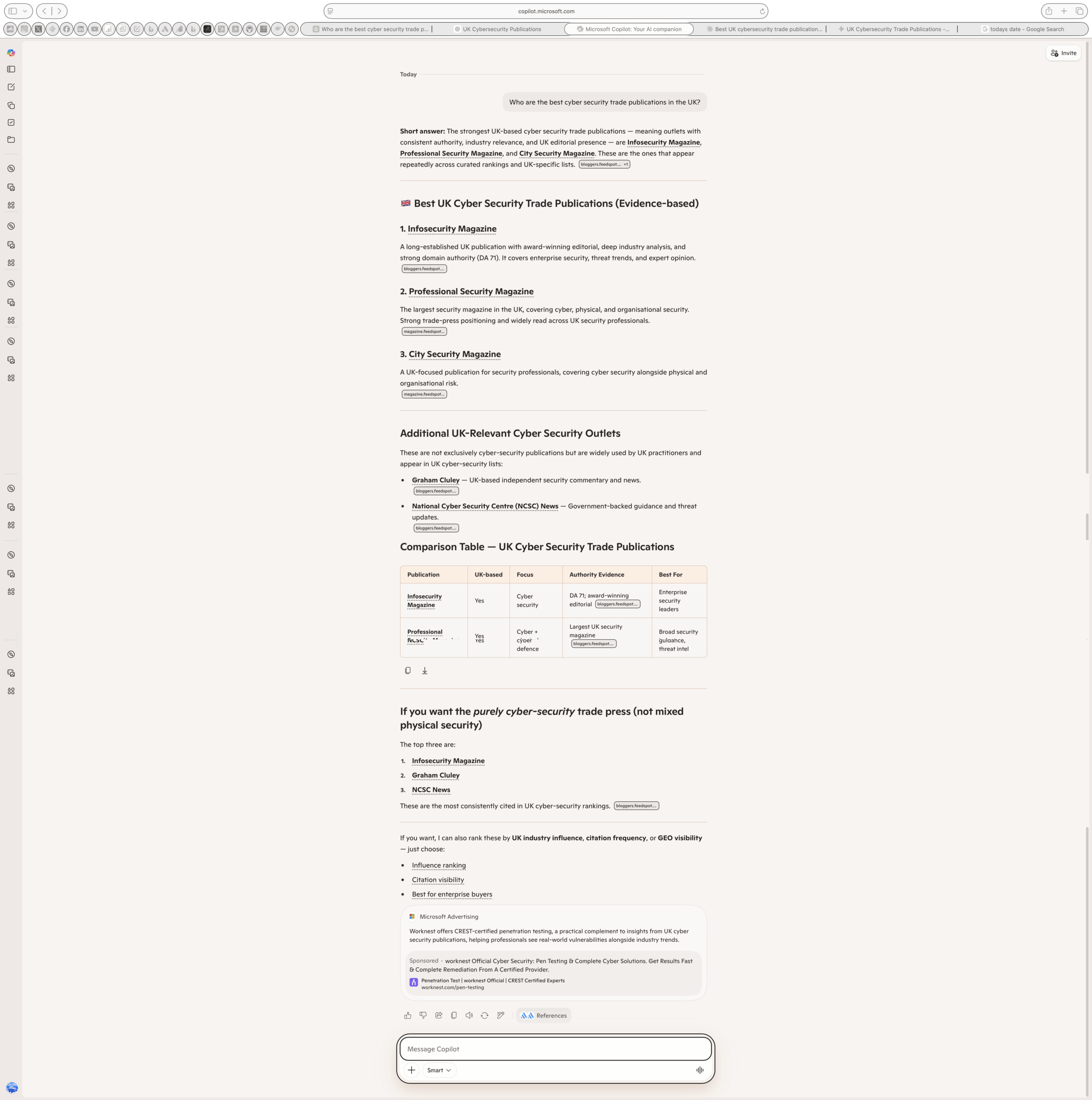
Microsoft Copilot
Infosecurity Magazine #1; Professional Security Magazine #2; City Security Magazine #3 in the primary evidence-based ranking.
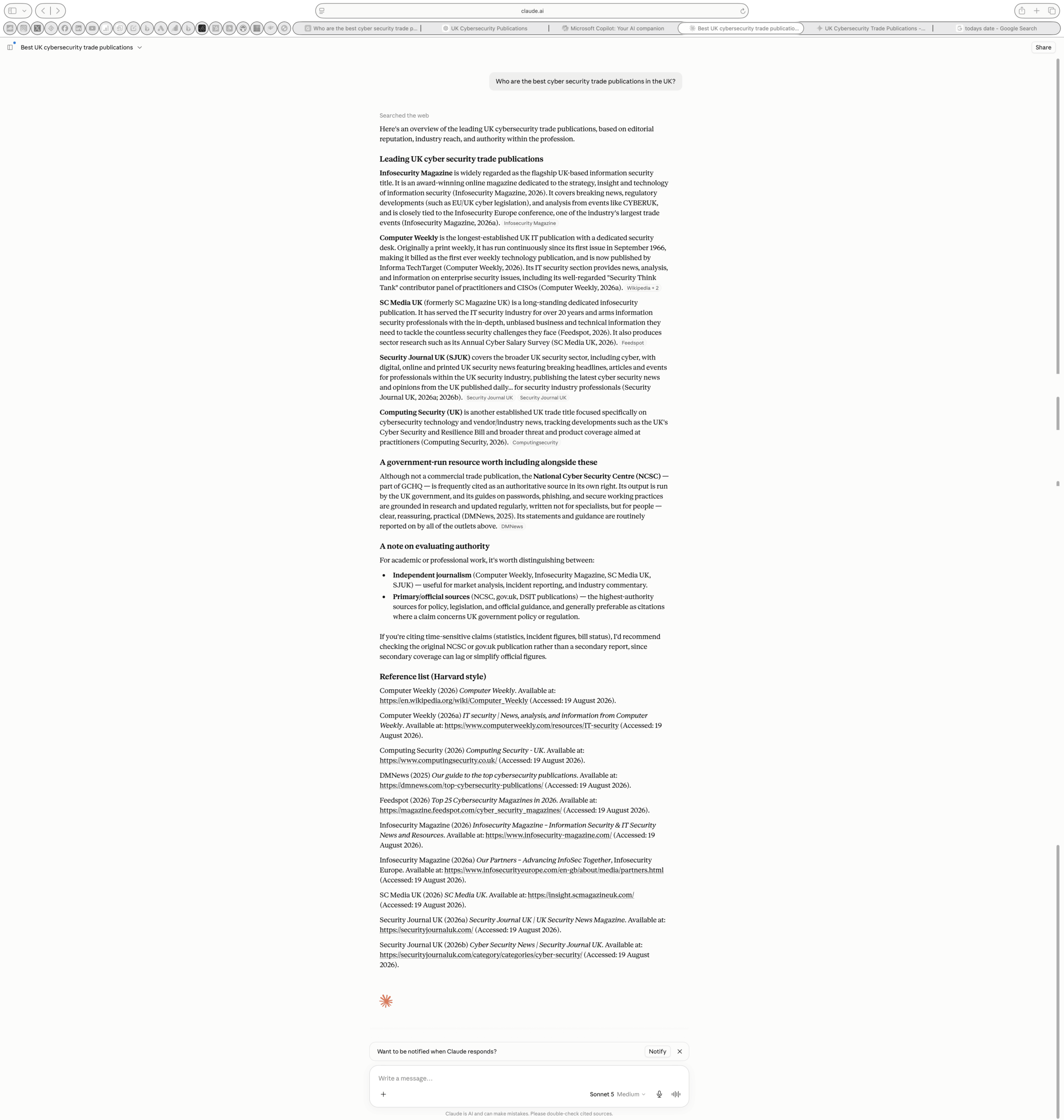
Claude
Infosecurity Magazine first, followed by Computer Weekly, SC Media UK, Security Journal UK and Computing Security.
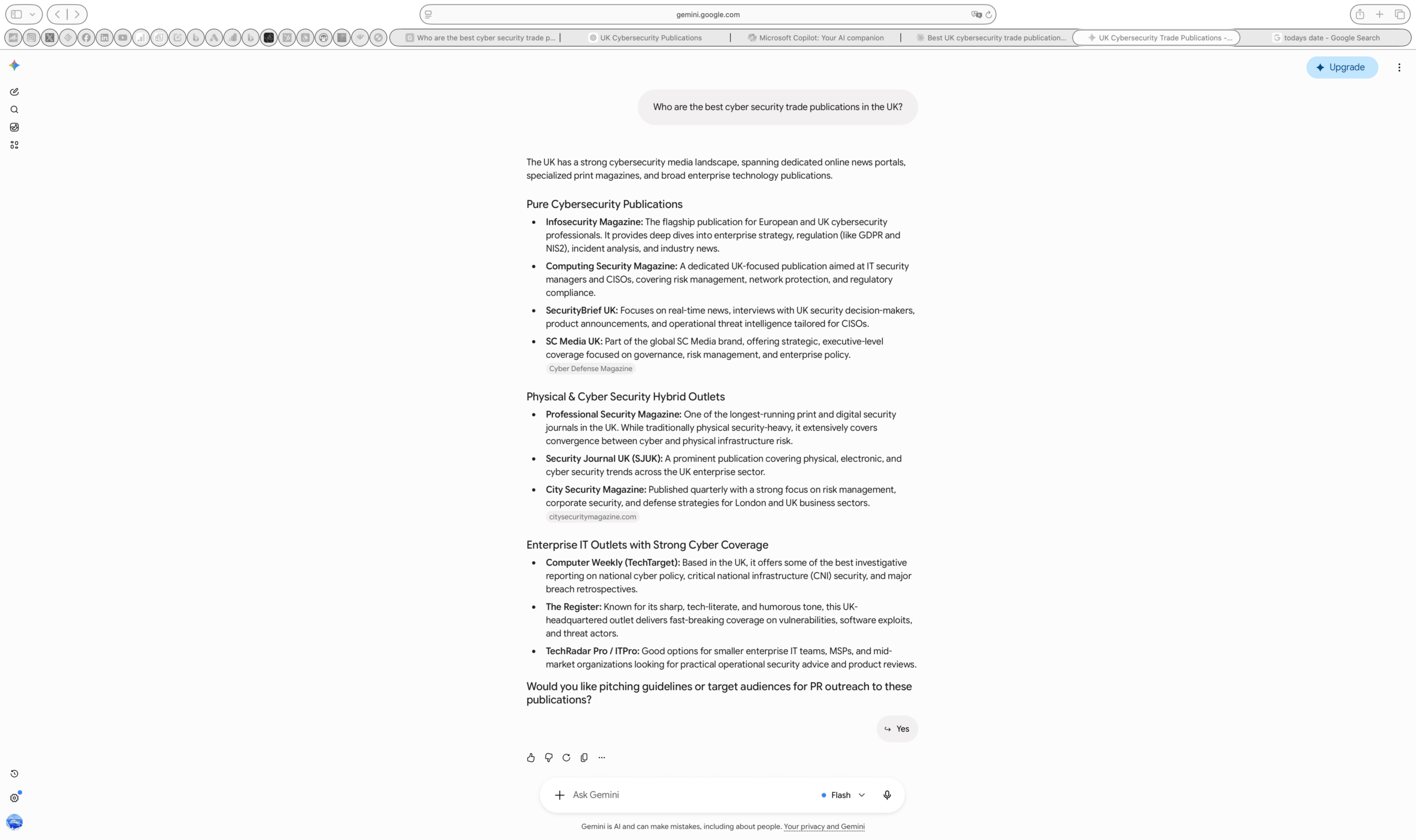
Google Gemini
Infosecurity Magazine first in the pure-cybersecurity group, followed by Computing Security Magazine, SecurityBrief UK and SC Media UK; further hybrid and enterprise outlets were also listed.
Platform-by-platform result summary
These are the recommendation orders visible in the captured answers. Where a response groups publications rather than numbering them, visible top-to-bottom order is used. The same normalised recommendation lists are used for Average Brand Position, Cross-Engine MRR and the study-level Jaccard/RBO calculations.
| AI platform | Visible recommendation order | Evidence note |
|---|---|---|
| Google AI Mode | 1 Infosecurity Magazine; 2 SC Media UK; 3 Security Matters; 4 CSO Online; 5 Intersec; 6 The Register; 7 Computer Weekly. | Seven publication recommendations are visibly surfaced. |
| ChatGPT | 1 Infosecurity Magazine; 2 SC Media UK; 3 Computer Weekly; 4 IT Security Guru; 5 Computing Security; 6 SecurityBrief UK; 7 Intelligent CISO. | The response also explicitly identifies Infosecurity Magazine, SC Media and Computer Weekly as the three especially important brands to watch. |
| Microsoft Copilot | 1 Infosecurity Magazine; 2 Professional Security Magazine; 3 City Security Magazine. | Graham Cluley and NCSC News are shown separately as additional resources, so they are not treated as primary trade-publication recommendations in the leaderboard. |
| Claude | 1 Infosecurity Magazine; 2 Computer Weekly; 3 SC Media UK; 4 Security Journal UK; 5 Computing Security. | NCSC is presented separately as a government-run resource, not a commercial trade publication. |
| Google Gemini | 1 Infosecurity Magazine; 2 Computing Security Magazine; 3 SecurityBrief UK; 4 SC Media UK; 5 Professional Security Magazine; 6 Security Journal UK; 7 City Security Magazine; 8 Computer Weekly; 9 The Register; 10 TechRadar Pro / ITPro. The final bullet contains two named publication entities sharing the same visible recommendation slot. | Gemini groups the answer into pure cybersecurity, hybrid security and enterprise IT outlets; display order is used for position analysis. |
Other publication brands surfaced in the test
Beyond the top five, the five captured answers also surfaced SecurityBrief UK, Security Journal UK, City Security Magazine, The Register, Security Matters, CSO Online, Intersec / The Journal of International Security, IT Security Guru, Intelligent CISO, TechRadar Pro and ITPro. Their appearances remain part of the denominator used for Brand Mentions and Share of Voice where they meet the publication-eligibility rule. In the Gemini response, TechRadar Pro and ITPro are two named publication entities sharing the same visible recommendation slot at position 10.
Excluded from the publication leaderboard: NCSC News is a government resource, and Graham Cluley is presented by Copilot as an additional independent commentary outlet rather than one of its primary trade-publication recommendations.
For technical readers
Technical calculations for metrics 14 and 15
The results table uses plain English so the study is easy to understand. The exact Protocol v1.0 calculations are preserved below for reproducibility. These technical values describe the study as a whole and do not create individual publication scores for metrics 14 or 15.
Derived-metric audit trail
The 10 cross-engine comparisons behind Multi-Platform Retrieval Consistency
Jaccard uses the unique eligible publication entities in each recommendation set. Google Gemini contains 10 visible recommendation slots but 11 named publication entities because TechRadar Pro and ITPro share the final slot; they are separate entities for Jaccard and share position 10 for rank-sensitive treatment. That final tie is deeper than every paired list, so it does not change the Study 001 RBO lower-bound calculations.
| Engine pair | Jaccard | RBO lower bound (p=0.9) |
|---|---|---|
| Google AI Mode ↔ ChatGPT | 0.273 | 0.349 |
| Google AI Mode ↔ Microsoft Copilot | 0.111 | 0.172 |
| Google AI Mode ↔ Claude | 0.333 | 0.262 |
| Google AI Mode ↔ Google Gemini | 0.286 | 0.270 |
| ChatGPT ↔ Microsoft Copilot | 0.111 | 0.172 |
| ChatGPT ↔ Claude | 0.500 | 0.333 |
| ChatGPT ↔ Google Gemini | 0.385 | 0.318 |
| Microsoft Copilot ↔ Claude | 0.143 | 0.172 |
| Microsoft Copilot ↔ Google Gemini | 0.273 | 0.172 |
| Claude ↔ Google Gemini | 0.455 | 0.248 |
| Mean across 10 pairs | 0.287 | 0.247 |
Visible Source Citation Concentration audit
The Gini calculation uses 36 clearly visible, identifiable citation-source occurrences across 18 cited domains. The complete observed domain-frequency ledger is: Feedspot 10; Infosecurity Magazine 3; SC Media UK 3; Computer Weekly 3; Intersec / The Journal of International Security 2; Computing Security 2; Security Journal UK 2; Security Matters Magazine 1; CSO Online 1; The Register 1; IT Security Guru 1; SecurityBrief UK 1; Intelligent CISO 1; Wikipedia 1; DMNews 1; Infosecurity Europe 1; Cyber Defense Magazine 1; and City Security Magazine 1. Repeated UI renderings of the same underlying source entry are not double-counted. A collapsed +1/+2 target is excluded unless its source identity is separately exposed elsewhere in the same captured response.
Result: Gini = 0.389. With 18 observed domains, the finite-sample theoretical maximum is 17/18 = 0.944. The figure describes concentration of the visible cited-source distribution; it is not a quality, trust or authority score.
For the complete formulas, denominator rules, academic provenance and governance, see the NeuralAdX UK Business AI Visibility Index Research Protocol v1.0.
Protocol applied to this study
Research Protocol v1.0 applied to Study 001
Study 001 uses the exact prompt shown on this page across the five fixed AI platforms in one dated retrieval session. All results are calculated from the preserved 19 August 2026 screenshots and live recording. The test has not been rerun and no later AI response has been substituted into this study.
The 15 metric explanations above provide the reader-facing logic for this study. Their formal meanings, denominators and scoring rules remain those defined by the NeuralAdX UK Business AI Visibility Index Research Protocol v1.0. Metrics 14 and 15 are study-level diagnostics of platform behaviour and the visible citation-source environment; they do not create individual publication rankings.
Full methodology
For the complete metric definitions, formulas, academic and industry provenance, evidence rules, limitations and protocol governance, see the NeuralAdX UK Business AI Visibility Index Research Protocol v1.0.
Evidence rule: only clearly visible and identifiable information in the preserved evidence is counted. Hidden, collapsed or unidentified sources are not guessed. This child study is a proprietary observational research record; cited academic and industry sources inform measurement concepts and do not certify or endorse NeuralAdX Ltd or this study.
Permanent study record
Study identification and citation
This page is Study ID NADX-UKBAIVI-001 within the NeuralAdX UK Business AI Visibility Index and is governed by Research Protocol v1.0. The study identifier and dated evidence remain attached to this retrieval record even if the same sector is tested again later.
Suggested study citation
NeuralAdX Ltd. Best Cyber Security Trade Publications in the UK: Live AI Visibility Index. NeuralAdX UK Business AI Visibility Index, Study ID NADX-UKBAIVI-001, Research Protocol v1.0, 19 August 2026.
For the permanent framework, metric definitions and protocol governance, see the NeuralAdX UK Business AI Visibility Index methodology page.
Frequently asked questions
Which cyber security trade publication ranked #1 in this test?
Infosecurity Magazine ranked #1. It achieved 5/5 AI Platform Coverage, appeared first in the visible recommendation order on every tested engine and therefore recorded a Cross-Engine MRR of 1.000.
Does this mean Infosecurity Magazine will always rank first in AI answers?
No. This is a dated observational retrieval snapshot from 19 August 2026. Generative AI results can vary across repeated runs, prompts and time, so this page documents what the five systems returned in the preserved session rather than claiming permanent visibility.
What is Cross-Engine Mean Reciprocal Rank (MRR)?
It combines recommendation position with absence across the five engines. A #1 appearance contributes 1.000, #2 contributes 0.500, #3 contributes 0.333 and an absent publication contributes 0. Study 001 gives Infosecurity 1.000, SC Media UK 0.317, Computer Weekly 0.220, Computing Security 0.180 and Professional Security Magazine 0.140.
What is Multi-Platform Retrieval Consistency?
It measures how similarly the five AI platforms behaved when answering the same prompt. It compares the overall recommendation lists, not individual publication performance. In Study 001, several publications appeared across multiple platforms and Infosecurity Magazine was ranked #1 on all five, while the wider mix of publications and their ordering varied between platforms. The exact technical calculation is published earlier on this page and follows Protocol v1.0.
What does the Visible Source Citation Concentration result mean?
It asks whether the visible citation evidence was spread across many different domains or concentrated among only a few. In Study 001, the visible citations covered 18 domains, although some sources appeared more often than others. It does not measure source quality, authority or trust.
Why are hidden ChatGPT or Copilot sources not counted as citations?
Because the Index is evidence-led. If the captured evidence only shows a +1/+2 or collapsed source control without identifying the underlying target, NeuralAdX Ltd does not guess which domain received the citation.
Why can Cited Pages show “At least 1 page” instead of a larger exact number?
A screenshot can prove that a publication domain was cited without exposing enough URL detail to determine whether multiple citations point to different pages. “At least 1 page” preserves what is proven without inventing precision.
Which UK cyber security trade publications were recommended by the most AI platforms?
Infosecurity Magazine had the strongest AI Platform Coverage at 5/5. SC Media UK and Computer Weekly each achieved 4/5, Computing Security 3/5 and Professional Security Magazine 2/5 in this 19 August 2026 retrieval session.
How is the Overall AI Visibility Rank calculated in this Index?
Protocol v1.0 uses a transparent lexicographic ordering rather than an undisclosed weighted score: first AI Platform Coverage, then Cross-Engine MRR, then Domain Citations, then Brand Mentions. A later criterion is used only when the preceding criterion is tied.
NeuralAdX Ltd UK Business AI Visibility Index · Study ID NADX-UKBAIVI-001 · Research Protocol v1.0 · Live retrieval snapshot dated 19 August 2026 · Results may change as AI systems, retrieval layers and source indexes evolve · No affiliation with or endorsement by the tested AI platform providers is implied.